
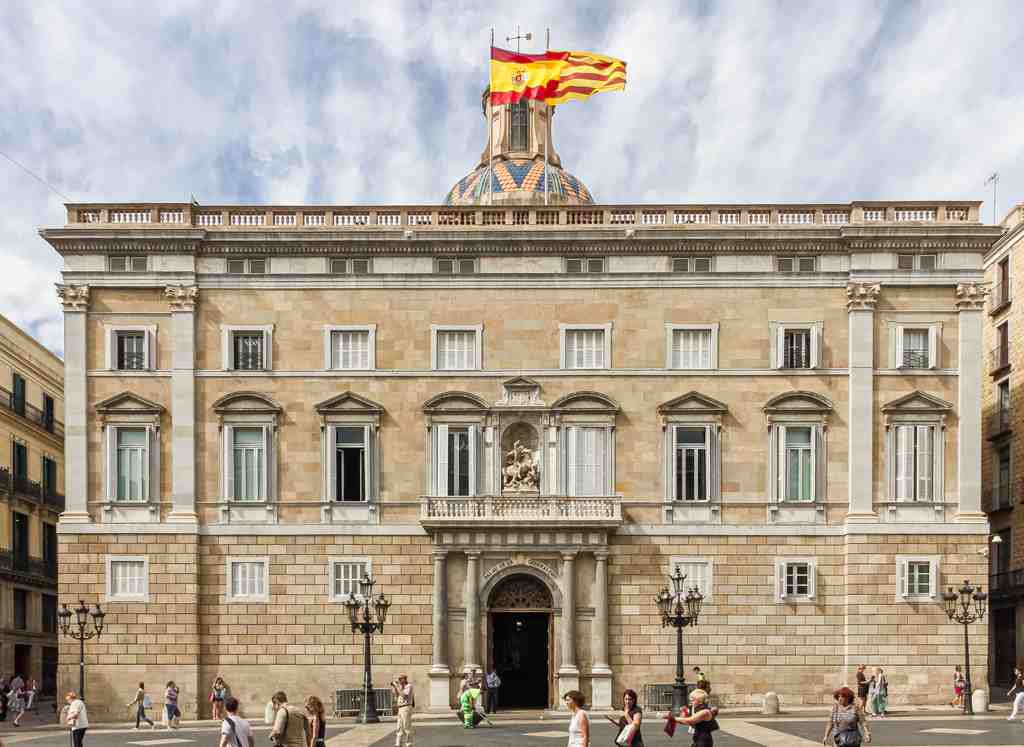
Turn your attention left to the imposing rectangular facade built from smooth, tan stone blocks, anchored by a large central arched doorway and a prominent balcony right above it. Notice the sculpted statue of a knight on horseback nestled into the niche above that balcony.
That knight is Saint George, the patron saint of Catalonia, watching over the Palace of the Generalitat. This is the historic seat of the Catalan government. It is actually one of the very few medieval buildings in Europe that still serves as the headquarters for the exact same institution that built it.
The roots of this government stretch deep into the Middle Ages. Back in 1282, the Catalan courts formed, and by 1359, they created a permanent commission to collect taxes. That humble tax board eventually evolved into the Generalitat, essentially taking on the role of an executive branch of government.
But this palace did not spring up from empty land. It was built directly over a tragic piece of the buried ancient city we explored earlier. These properties originally belonged to the prosperous Jewish Quarter. In 1391, a brutal pogrom... a targeted, violent riot... wiped out the neighborhood. Nine years later, the government purchased the vacant houses, paving over the lost community to build a new center of power.
Take a close look at the four plain stone columns flanking the main entrance door. When the architect designed this Renaissance facade in 1596, he did not carve those columns. He imported them. They are actually almost two thousand years old, carved from granite near the legendary city of Troy. The Romans originally brought them to Spain to build a massive temple. Centuries later, they were salvaged and shipped here to frame this doorway. It is a perfect metaphor for this place. Ancient foundations propping up new political ambitions.
Now, direct your attention to the balcony right above the door. Over the last century, that small ledge has been the stage for profound triumph and devastating tragedy. In 1931, Francesc Macià stepped onto it to boldly declare a Catalan Republic. Three years later, his successor, Lluís Companys, proclaimed a Catalan State from that exact spot. That second declaration provoked a furious response from the central government in Madrid. Artillery shells bombarded this very palace. Following a night of heavy fighting, the Catalan government surrendered, waving a white flag from the balcony. Companys was arrested, and later became the only democratically elected president in European history to be executed in office by the Franco dictatorship.
Yet, the institution survived its ghosts. In 1977, after thirty eight years in exile and the fall of the dictatorship, President Josep Tarradellas returned to Barcelona. He stepped out onto that same balcony, looked down at a massive, euphoric crowd, and shouted... Citizens of Catalonia, I am here.
The Generalitat remains a powerful symbol of endurance. Now, turn your back to the palace and look directly across the plaza. We are heading to its royal counterpart, the Royal Palace, which is just a three minute walk away.




