AudaTours logoAudaTours

Roskilde Audio Tour: Echoes of Cathedrals, Springs, and Spirits

Audio guide13 stops

Forty kings and queens sleep beneath the cold stones of Roskilde, but the true ghosts of this city haunt the streets outside the cathedral walls. You are about to walk through a thousand years of rebellion, royal scandal, and liquid history. This self-guided audio tour unlocks the secrets hidden in plain sight. Explore beyond the guidebooks to uncover the dramatic tales that most visitors completely miss. Why did a desperate monarch try to burn the city to the ground? What forbidden whispers echoed through the halls of the spirits factories during the height of the black market? How did a single forgotten tavern brawl change the course of a national political battle? Trace the path of ancient power and modern intrigue. Transform your walk into a cinematic journey through shadow and stone. Feel the pulse of a city that refuses to stay silent. Uncover the truth of Roskilde today.

Tour preview

map

About this tour

  • schedule
    Duration 40–60 minsGo at your own pace
  • straighten
    4.0 km walking routeFollow the guided path
  • location_on
    LocationRoskilde, Denmark
  • wifi_off
    Works offlineDownload once, use anywhere
  • all_inclusive
    Lifetime accessReplay anytime, forever
  • location_on
    Starts at Hestetorvet

Stops on this tour

  1. Look across this sweeping cobblestone plaza toward the grand yellow brick building, anchored by two square towers and elegant arched windows. Welcome to Hestetorvet, or Horse…Read moreShow less
    Hestetorvet
    HestetorvetPhoto: Smiley.toerist, Wikimedia Commons, CC BY-SA 4.0. Cropped & resized.

    Look across this sweeping cobblestone plaza toward the grand yellow brick building, anchored by two square towers and elegant arched windows. Welcome to Hestetorvet, or Horse Square! If we stood here in the Middle Ages, the smell of pigs, steers, and horses would instantly hit you. This bustling animal market thrived for centuries just inside the old eastern city gate. In nineteen fifty-eight, developers dug up the square to build an underground parking garage. But that excavation revealed something completely unexpected. People had actually lived on this exact spot since the Bronze Age! Fast forward to nineteen ninety-nine, and the city celebrated its one thousandth anniversary by installing massive clay jars designed by artist Peter Brandes. They are five meters tall and weigh twenty-four tons! Amazingly, Elsebeth Stryhn, director of a famous Danish liver pâté company, donated them to the city. Toward the street, you will also spot a beautiful granite horse well, carved by local artist Karl Hansen Glem in nineteen forty-five. It is incredible how much vibrant history is layered beneath these very stones. Take a moment to soak this all in. Whenever you are ready, we can head to the next stop.

    Open dedicated page →
  2. It first opened its doors way back in eighteen fifty-five under the name Roskilde Sygehus. Imagine the scene back then. We are talking about the mid-nineteenth century, a time…Read moreShow less

    Welcome to Zealand University Hospital, Roskilde! Just look at the sheer scale of this campus in front of you. You might not expect a hospital on a walking tour, but this place is an absolute powerhouse of history, science, and human resilience.

    It first opened its doors way back in eighteen fifty-five under the name Roskilde Sygehus. Imagine the scene back then. We are talking about the mid-nineteenth century, a time before modern antibiotics, when medical science was just beginning to truly understand infections. Fast forward to today, and the transformation is absolutely mind-blowing. On the fourth of March, two thousand and sixteen, it officially became Zealand University Hospital, recognizing its incredible leap into cutting-edge research and education.

    Today, this is the most highly specialized hospital in the entire Zealand region. Behind those windows, incredible things happen every single day. Surgeons here use state-of-the-art robotics to perform operations. That means doctors control highly advanced robotic arms to make ultra-precise, incredibly gentle movements that human hands simply cannot do. They treat everything from complex heart conditions and advanced cancers to neurological diseases. They even have a special unit where a patient can get every single diagnostic test done on the exact same day, all under one roof.

    But this building is not just about treating patients today. It is about inventing the medicine of tomorrow. The hospital partners with Roskilde University and the Risø Research Center to push the boundaries of biomedical science. It is also a massive, buzzing training ground. If you stand here long enough, you will likely see a steady stream of medical students, nurses, physiotherapists, and rescue workers, all learning their craft in these very halls.

    The hospital is also constantly evolving. With a massive new facility taking over certain treatments in the nearby town of Køge, this Roskilde campus is taking on an exciting new identity. It is transitioning into a specialized hub for outpatient care, rehabilitation, and a real-world testing ground for totally new ways to organize healthcare. They run patient schools here, helping folks manage chronic conditions like diabetes and C-O-P-D, which stands for chronic obstructive pulmonary disease.

    It is deeply comforting to know that places like this exist, always ready to help, and as you might expect, the hospital and its emergency room remain open twenty-four hours a day, seven days a week.

    Take a moment to appreciate the incredible dedication happening just inside these walls. When you are ready, we can head to the next stop.

    Open dedicated page →
  3. Look to your right, where you will see a sprawling, multi-wing building made of striking red brick, featuring distinctive stepped gables and a small, green copper-roofed turret…Read moreShow less
    Roskilde Monastery
    Roskilde MonasteryPhoto: Mogens Engelund, Wikimedia Commons, CC BY-SA 3.0. Cropped & resized.

    Look to your right, where you will see a sprawling, multi-wing building made of striking red brick, featuring distinctive stepped gables and a small, green copper-roofed turret near the entrance.

    This is Roskilde Monastery, the absolute oldest inhabited building in the entire city! Long before it looked like this, a medieval Dominican monastery stood on this very spot. But the story I really want to share with you starts later, in sixteen ninety-nine, with two fiercely independent women named Margrethe Ulfeldt and Berte Skeel.

    Both were extremely wealthy widows of prominent Danish military heroes. Instead of just quietly managing their estates, they bought this massive property for nine thousand two hundred rigsdaler, a fortune equivalent to several million dollars today. They used that wealth to establish Denmark's very first maiden monastery.

    Now, a maiden monastery was not a convent for Catholic nuns. It was a unique Protestant foundation designed exclusively to support unmarried noblewomen. Back then, if a woman of high birth did not marry by a certain age, society offered her very few paths. Margrethe and Berte changed the game. They created an elegant sanctuary where a prioress and eighteen noble maidens received free housing, daily meals, and a very handsome allowance. Talk about the ultimate early safety net!

    The estate they left behind is a total architectural treasure. It is built from deep red monk bricks, those oversized, heavy clay blocks traditionally baked by medieval monks. If you could walk through the main doors right now, you would find a spectacular Knights Hall. Its walls are lined with authentic golden leather tapestries, and it boasts a unique cassette ceiling, which is an elaborate wooden grid showcasing sixty different hand-painted biblical scenes. The side wing even houses a private church holding a breathtaking ivory crucifix carved by Chancellor Johan Friis way back in fifteen forty-six.

    Over time, the strict rules of the monastery evolved. In nineteen seventy-four, the charter was modernized entirely. Today, any Danish citizen can apply for an apartment here, regardless of gender or noble blood, and ten residents currently get to call this magnificent estate home.

    It is amazing to see how a grand vision from two widows over three centuries ago still thrives today as a living community. Take all the time you need to admire those beautiful stepped gables. When you are ready, we can head over to our next stop.

    Open dedicated page →
Show 10 more stopsShow fewer stopsexpand_moreexpand_less
  1. Look right in front of you at that long, red brick building with its orderly rows of white-framed windows and the distinct blue double doors set into an elegant archway. Welcome…Read moreShow less
    Roskilde Museum
    Roskilde MuseumPhoto: Thomas Maarup, Wikimedia Commons, CC BY-SA 3.0. Cropped & resized.

    Look right in front of you at that long, red brick building with its orderly rows of white-framed windows and the distinct blue double doors set into an elegant archway. Welcome to the main branch of Roskilde Museum. I am absolutely thrilled to share the history of this place with you! You are actually looking at two incredible heritage buildings fused together. Right here is the Liebe House, and just attached is the older Sugar House, built in yellow brick. You can check your app to see a great view of that iconic yellow brick facade as it looks further down the street.

    Imagine the rich, sweet smells filling the air here back in the seventeen sixties. A savvy local man named Johan Jørgen Holst brought together a group of investors to build a massive refinery right on this spot. They processed raw sugar shipped across the ocean from the Danish West Indies. The company even commanded its own dedicated ship, the Roskilde Ark, which locals lovingly nicknamed the Sugar Ship. Before this operation began, large vessels had to unload miles up the fjord. But Holst and his partners convinced the city to build an entirely new pier so their massive ship could sail its cargo of raw sugar and coal all the way into Roskilde.

    Inside the walls, a sugar master managed a bustling, sticky operation. A busy crew processed up to four hundred heavy barrels of raw sugar every single year. Today, the yellow brick Sugar House, with the memorial plaque resting above its gate, holds a very special title. It is the only surviving building of its exact kind in all of Denmark!

    Now, let us look back at the red brick building in front of you. In eighteen oh four, a wealthy merchant named Jacob Borch tore down a modest seventeenth-century timber home to build this grand structure with its distinctive half-hip roof. It later became known as the Liebe House, named after the prominent family who lived here for two generations. When the last owner passed away in nineteen hundred, he generously gifted the entire estate to the city. Spanning over a century, this historic comparison reveals how the historic estate has been beautifully preserved and integrated into the modern Roskilde Museum complex.

    By nineteen twenty-nine, the museum officially opened right here on the ground floor, eventually expanding to take over the whole complex. If you want to step inside and explore the incredible artifacts, the museum is open Tuesday through Sunday from ten AM to four PM, though they do close on Mondays.

    Enjoy the museum's historic exterior. When you are ready, we can head to the next stop.

    A view of the courtyard at Roskilde Museum, which is housed in two listed buildings, the Sugar House and the Liebe House.
    A view of the courtyard at Roskilde Museum, which is housed in two listed buildings, the Sugar House and the Liebe House.Photo: Ramblersen, Wikimedia Commons, CC BY-SA 4.0. Cropped & resized.
    Open dedicated page →
  2. Look to your left and you will spot a pale yellow, two-story building with a red half-hipped tile roof and the year eighteen thirty-two inscribed right above the dark front door.…Read moreShow less
    Meyercrones Stiftelse
    Meyercrones StiftelsePhoto: Ramblersen, Wikimedia Commons, CC BY-SA 4.0. Cropped & resized.

    Look to your left and you will spot a pale yellow, two-story building with a red half-hipped tile roof and the year eighteen thirty-two inscribed right above the dark front door. This is Meyercrones Stiftelse, a lovely example of Late Neoclassical architecture.

    The story here is deeply touching. When the Danish envoy to France, Henning de Meyercrone, passed away in seventeen oh six, his widow Christiane needed a new chapter. If you glance at your app, you can see a painted portrait of Henning. Following his death, Christiane bought this exact plot from her mother. Back then, locals called it the Cantor's Garden, because the cathedral's lead singer used to live here.

    Christiane converted the small house on the property into safe, comfortable residences specifically for needy, middle-class widows. She boldly managed this haven herself until she died in seventeen thirty-eight, ensuring the foundation lived on in her will. Eventually, builders replaced that original house with the larger building you see today.

    It remains a beautiful monument to women helping women. Linger as long as you like, and whenever you are ready, we can wander to our next stop.

    Open dedicated page →
  3. Right in front of you sits a bright yellow brick building with a classic red tile roof and a prominent white band across the middle proudly displaying its name. We just saw…Read moreShow less
    Wilhelm Topps Minde
    Wilhelm Topps MindePhoto: Ramblersen, Wikimedia Commons, CC BY-SA 4.0. Cropped & resized.

    Right in front of you sits a bright yellow brick building with a classic red tile roof and a prominent white band across the middle proudly displaying its name.

    We just saw another Stiftelse, or charitable housing foundation, just a minute ago, but this one has a very different origin story. Built back in seventeen eighteen, this house started out as a family sanctuary. A wealthy local merchant named Hans Rasmussen Lange and his wife built it specifically to house their indigent, or extremely poor, relatives. Imagine being totally broke in the eighteenth century and your rich uncle hands you the keys to an apartment right next to the grand cathedral.

    Take a look at the photo on your screen to see its classic market town architecture. Notice how the middle section steps outward. Architects call that an avant-corps, a French term for a projecting central block, designed to make even a small, five-bay house look grand and perfectly balanced.

    So, who is Wilhelm Topp? Fast forward to eighteen seventy-four. A Copenhagen merchant named Wilhelm Christian Topp buys the property. He generously lets his wife's sister, Marie, live here. When Wilhelm passed away, Marie was so grateful that in eighteen eighty-three, she installed the very sign you see today to honor his memory.

    Later, in nineteen forty, the mighty Roskilde Cathedral actually bought this tiny house. Why? Simply to stop anyone from tearing it down and building something tall that would block their majestic view.

    It is amazing how a simple desire to protect family, and later a nice view, preserved this beautiful slice of history for us. Take all the time you need here, and whenever you are ready, we will stroll over to our next stop.

    Open dedicated page →
  4. Back in the eleventh and twelfth centuries, builders mined travertine... a type of light, porous limestone formed by the spring's mineral deposits... to construct several local…Read moreShow less
    Maglekilde
    MaglekildePhoto: Thomas Maarup, Wikimedia Commons, CC BY-SA 3.0. Cropped & resized.

    Welcome to Maglekilde, where you can spot a small, octagonal timber wellhouse topped with a steeply pitched red tile roof and supported by beautifully carved wooden pillars. This spot marks the most powerful natural spring in all of Roskilde! It used to pump out a staggering ninety thousand liters of water every single hour. Today it is closer to fifteen thousand, but its historical impact on the city is immeasurable.

    Back in the eleventh and twelfth centuries, builders mined travertine... a type of light, porous limestone formed by the spring's mineral deposits... to construct several local churches before bricks became readily available. The spring naturally formed a large pool, which soon powered the Maglekilde Watermill, first officially recorded in twelve fifty-eight.

    As the centuries rolled by, the energy of this rushing water became irresistible to industry. After a devastating fire swept through Roskilde in seventeen thirty-one, a paper mill and later a textile mill took over the site. In eighteen ten, five Jewish industrialists from Copenhagen bought the complex, bringing in skilled weavers from Magdeburg and building new housing for their workers. By eighteen twenty, this forward-thinking paper mill even installed the fourth steam engine in the entire country! Check out the historical image on your screen...... to see what the bustling mill looked like back then.

    But despite the cutting edge technology, the factory could not compete with larger operations and eventually went bankrupt. Then, a group of ambitious citizens had a completely different vision. In eighteen forty-six, they demolished the factories, filled the mill pond, and built a luxurious spa and mineral water factory designed by architect Hans Conrad Stilling. Take a look at your app again...... to see this incredible eighteen forty-six woodcut of the spa's grotto, where the spring water flowed directly from the mouth of a sculpted Neptune figure! It was highly dramatic, but sadly, the spa flopped and closed after just two years.

    Eventually, this quaint little wellhouse was built over the spring in nineteen twenty-seven to protect what remains of Roskilde's once mighty water source. Pause to enjoy the sound of the spring. When you are ready, we can head to the next stop.

    This image shows the wellhouse built over the spring in 1927, which was listed in the Danish registry of protected buildings and places in 1979.
    This image shows the wellhouse built over the spring in 1927, which was listed in the Danish registry of protected buildings and places in 1979.Photo: Thomas Maarup, Wikimedia Commons, CC BY-SA 3.0. Cropped & resized.
    Open dedicated page →
  5. On your left, look for the monumental red brick cathedral, defined by its massive twin towers reaching toward the sky with needle-like copper spires. Welcome to Roskilde…Read moreShow less
    Roskilde Cathedral
    Roskilde CathedralPhoto: CucombreLibre, Wikimedia Commons, CC BY-SA 4.0. Cropped & resized.

    On your left, look for the monumental red brick cathedral, defined by its massive twin towers reaching toward the sky with needle-like copper spires. Welcome to Roskilde Cathedral! This is not just a church, it is the official royal burial ground of the Danish monarchy and an absolute masterpiece that literally rewrote the architectural history of Northern Europe.

    It is a UNESCO, the United Nations Educational, Scientific and Cultural Organization, World Heritage Site. Why? Because it spans eight hundred years of architectural styles. If you look at your screen, you can see an aerial view showing how these vastly different chapels were added onto the building over the centuries.

    The story of this site goes way back to around the year nine sixty. King Harald Bluetooth made Roskilde his new capital and built a small wooden church right about here. When he died, his army brought his body back and buried him inside.

    Later, the local bishops decided they needed a holy relic to elevate the status of the church. Two clerics traveled to Rome and secured the shining skull of Saint Lucius. As they sailed back to Denmark, a powerful demon attacked their ship! The terrified crew drew straws, and the man holding the skull had to act. He washed the skull three times, threw the water into the ocean, and jumped in. Amazingly, the cleric walked on water, and the demon vanished screaming into the depths. You have to love a dramatic origin story!

    In the eleven sixties, Italian monks brought the art of firing bricks to Denmark, and the massive Gothic cathedral you see today began to rise. It soon became the ultimate resting place for generations of Danish royalty. Take Queen Margrethe the First. When she died in fourteen twelve, she was buried in a completely different town. But a year later, the bishop of Roskilde brought her body here. The monks at her original resting place were absolutely furious! They lost the massive income from saying paid prayers, known as requiem masses, for her soul. Take a peek at your app to see the intricate details of her magnificent sarcophagus.

    There is also a fascinating spot inside called the King's Pillar. It is a central granite column marked with the heights of visiting royals. The absolute tallest mark belongs to Tsar Peter the Great of Russia, measured in seventeen sixteen at a towering two hundred and eight centimeters.

    From a simple wooden church to a sprawling brick marvel holding centuries of Danish kings and queens, this cathedral truly captures the soul of the nation. Let the cathedral's sheer magnitude sink in. When you're ready, we can head to the next stop.

    Christian IV's chapel, built in Dutch Renaissance style from 1614-1641, features a corbie stepped gable and sandstone figures representing Christian virtues.
    Christian IV's chapel, built in Dutch Renaissance style from 1614-1641, features a corbie stepped gable and sandstone figures representing Christian virtues.Photo: Sintakso, Wikimedia Commons, CC0. Cropped & resized.
    This royal box, gifted by Christian IV around 1600, provided a privileged viewing area for monarchs during services.
    This royal box, gifted by Christian IV around 1600, provided a privileged viewing area for monarchs during services.Photo: Jakub Hałun, Wikimedia Commons, CC BY-SA 4.0. Cropped & resized.
    This 1862 illustration from a travel article depicts Roskilde Cathedral, a major tourist attraction bringing in over 165,000 visitors annually.
    This 1862 illustration from a travel article depicts Roskilde Cathedral, a major tourist attraction bringing in over 165,000 visitors annually.Photo: After John Skinner Prout / Joseph Swain and workshop, Wikimedia Commons, Public domain. Cropped & resized.
    This detailed 1865 artwork captures the grand interior of Roskilde Cathedral, a UNESCO World Heritage Site due to its unique architectural evolution over 800 years.
    This detailed 1865 artwork captures the grand interior of Roskilde Cathedral, a UNESCO World Heritage Site due to its unique architectural evolution over 800 years.Photo: Johann Rudolf Rahn, Wikimedia Commons, Public domain. Cropped & resized.
    Open dedicated page →
  6. On your left is a long, two-story pale brown brick building with rhythmic arched windows and a neat central roof pediment. Take a peek at your screen to see how this beautiful…Read moreShow less

    On your left is a long, two-story pale brown brick building with rhythmic arched windows and a neat central roof pediment. Take a peek at your screen to see how this beautiful eighteen forty-two neo-classical facade blends the site's rich history with modern student life.

    This is Roskilde Gymnasium, affectionately known by locals as Amtet, or A-i-R. The buildings wrap right around the historic Roskilde Cathedral. Before nineteen sixty-nine, these very walls housed the old cathedral school, but today, they are home to nearly one thousand bright teenagers.

    The school champions three big values: community, academics, and diversity. And they absolutely live up to them! A twenty twelve study found that their graduating seniors had the highest grade point average in the entire Zealand region. On top of that, it boasts the highest well-being score of any large high school in all of Denmark. Locals playfully call it the school where all the diverse, artistic, and hippie-spirited kids go, proving that a wonderfully inclusive community really does breed success.

    The campus itself acts as a living timeline. The oldest section is the north wing of an old rector's house from the seventeen hundreds. But jump forward a few centuries, and you will find a stunning science building finished in September twenty twelve. That modern addition is a massive, copper-clad, elliptical structure filled with state-of-the-art labs. Students actually love that the campus buildings are spread out, because a simple walk to class lets them experience both the deep weight of history and a vibrant, cutting-edge modern atmosphere.

    The students and teachers even team up to produce a cleverly named school magazine called A-i-R-condition about six times a year, mixing academics with all the latest campus buzz.

    As a working school, the buildings are open from seven forty-five AM to five PM Monday through Friday, and closed on the weekends. The brilliant energy here almost makes me want to repeat high school all over again. Whenever you feel ready, we can take a pleasant walk over to our next stop.

    Open dedicated page →
  7. You are standing at Stændertorvet, a wide, open plaza paved in distinct grey stone blocks, bordered by brightly painted, multi-story brick buildings and anchored by a classic…Read moreShow less
    Stændertorvet
    StændertorvetPhoto: Ramblersen, Wikimedia Commons, CC BY-SA 4.0. Cropped & resized.

    You are standing at Stændertorvet, a wide, open plaza paved in distinct grey stone blocks, bordered by brightly painted, multi-story brick buildings and anchored by a classic stone fountain. This space actually owes its existence to the Reformation, the massive sixteenth-century religious shift when Denmark officially broke away from the Catholic Church. Before that, a huge church and graveyard sat right where you are standing. But when the city demolished the church, suddenly, Roskilde had room for a proper central square!

    Over the centuries, mayors expanded the area by tearing down old buildings to open it up. In nineteen twenty-one, Mayor I-C Sørensen officially named it Stændertorvet, honoring the provincial estates, which were early regional advisory councils that used to meet right next door in the Yellow Palace.

    You can tell the locals really cared about this space. In nineteen thirty-three, a local businessman named Carl Andersen passed away and left twenty thousand kroner in his will, which is roughly one hundred and fifteen thousand dollars today. He left those funds specifically to build a respectable bronze monument of Roskilde's legendary founders, the brothers Roar and Helge. The sculptor Johan Galster won the design contest, and his proud monument still stands in the northern end of the square today. Down at the southern end, you will find Schmeltz's fountain, which the architect V-J Mørk-Hansen designed in eighteen ninety-five.

    It is amazing how centuries of local pride beautifully layer together in one central gathering spot. Appreciate the square's vibrant atmosphere, and when you are ready, we can head to the next stop.

    Open dedicated page →
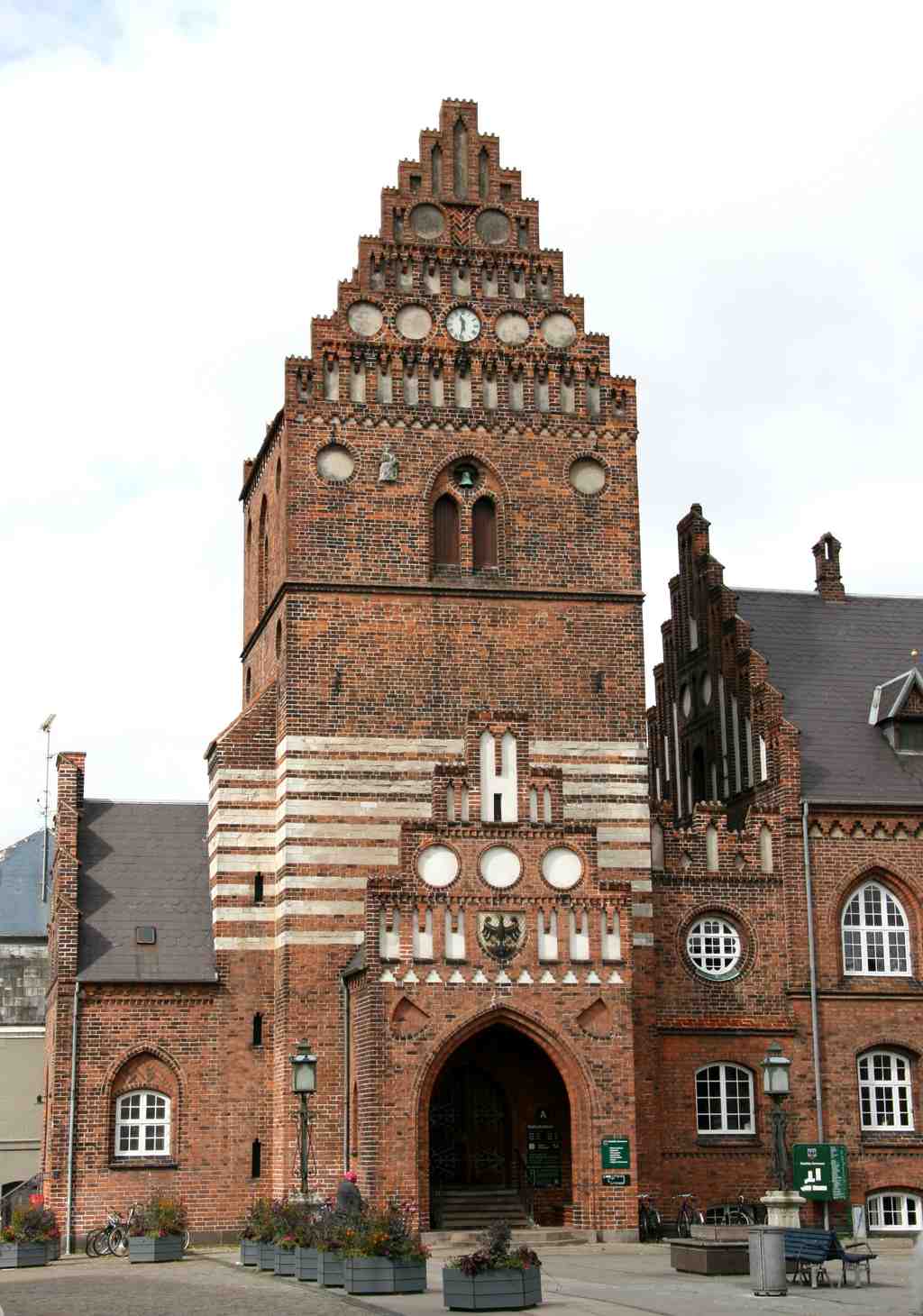
  8. Look for the towering red brick structure with its distinct stepped gable roof and striking white horizontal stripes near the large arched entrance. It is magnificent. This…Read moreShow less
    Sankt Laurentius Church ruins
    Sankt Laurentius Church ruinsPhoto: Ib Rasmussen, Wikimedia Commons, Public domain. Cropped & resized.

    Look for the towering red brick structure with its distinct stepped gable roof and striking white horizontal stripes near the large arched entrance. It is magnificent. This originally belonged to Sankt Laurentius Church, built around the year eleven hundred. But where is the rest of the church? In fifteen thirty-one, city leaders desperately needed a central market square, so they simply tore the main building down. They spared this beautiful tower for one practical reason. They needed its massive bell to keep ringing to organize the town's daily schedule. Today, it serves as the town hall tower. Look at the paving tiles right here on the square. They mark the exact outline of the old walls. The actual ruins sit directly beneath your feet. Down in the basement, a little museum displays medieval artifacts discovered during an excavation in nineteen ninety-eight. You can pop down there any day from ten A-M to four P-M. It is wild to imagine an entire medieval church hiding under the pavement. Take all the time you need here, and whenever you are ready, we can head over to our next stop.

    Open dedicated page →
  9. Look to your left for the striking two-story pale brick building featuring a long row of tall windows and three distinct, decorative stepped gables along the roofline. Welcome…Read moreShow less
    Farvergården, Roskilde
    Farvergården, RoskildePhoto: Ramblersen, Wikimedia Commons, CC BY-SA 4.0. Cropped & resized.

    Look to your left for the striking two-story pale brick building featuring a long row of tall windows and three distinct, decorative stepped gables along the roofline.

    Welcome to Farvergården, the Dyer's Court! Let us check out your screen to see the older, single-story wing on Skomagergade, started back in seventeen sixty-six by Johan Jørgen Holst. He passed away before it was finished, leaving his widow Maren to complete the work.

    But the real color of this place comes from Hans Poul Hammer. He bought the complex in eighteen thirty-nine to set up a massive fabric dyeing operation. Take a look at your phone again to see the impressive Ringstedgade facade. Hammer brought in master mason Matthias Vrock in the eighteen fifties to build this magnificent two-story addition just for his booming business.

    Running a dye plant was a total family affair. After Hammer and his son passed away, the women took charge. Cathrine Hammer and her daughter Caroline kept the vibrant dyes flowing, with Caroline even quitting her teaching job in nineteen hundred to run their storefront in the older wing.

    Can you imagine the close calls this beautiful complex has survived? In nineteen sixty-four, the city actually bought the property and planned to tear it all down just to widen the street! Thankfully, they abandoned that plan, fully restoring it in nineteen seventy-five instead.

    If you want to check it out, the building is open Monday through Friday from eight AM to six PM, and Saturdays from nine AM to three PM.

    It is wonderful to see such an incredible piece of local family history preserved so beautifully. Take your time enjoying the architecture, and when you are ready, we can wander over to our next destination.

    Open dedicated page →
  10. Look to your left for a striking red brick building defined by its prominent, flat-topped square tower and rows of elegant arched windows. Welcome to The Danish Spirits Factories,…Read moreShow less
    The Danish Spirits Factories
    The Danish Spirits FactoriesPhoto: Ramblersen, Wikimedia Commons, CC BY-SA 4.0. Cropped & resized.

    Look to your left for a striking red brick building defined by its prominent, flat-topped square tower and rows of elegant arched windows. Welcome to The Danish Spirits Factories, a place that practically bottled the soul of Denmark!

    I just love the history of this place. Back in eighteen eighty-one, three ambitious men named C-F Tietgen, Isidor Henius, and C-A Olesen decided to unite the country's scattered, small-scale distilleries into one powerhouse. Isidor Henius is an absolute legend here. He is widely considered the father of modern Danish spirit production. You see, before him, local homemade booze could be incredibly rough. Henius introduced advanced equipment, like a rectification tower, which was a tall column that used extra distillation to boil off the harsh, bad-tasting impurities. The result was a spectacularly clean, smooth spirit.

    Their new company was fiercely successful. In fact, they grew so powerful that by nineteen twenty-three, they literally owned every single distillery in the country! They held an absolute monopoly on producing all spirits, yeast, and the beloved national drink, aquavit. If you have never tried aquavit, it is a potent, aromatic spirit usually flavored with caraway or dill, traditionally snapped back during massive festive meals. The company maintained this total control of the market all the way until nineteen seventy-three, when the monopoly finally ended after Denmark joined the European Economic Community.

    Let me tell you my favorite story from their empire. Before the massive merger, there was a young man named Harald Jensen who dreamed of becoming a famous painter. His family owned a distillery, and it was supposed to go to his older brother. But his brother refused to leave Copenhagen! Suddenly, Harald had to put down his paintbrushes and take over the family business. He poured all his unfulfilled creative energy into the copper stills instead, and he ended up creating the Harald Jensen Akvavit, a recipe so brilliantly crafted that you can still buy it in stores today!

    Here in Roskilde, co-founder C-A Olesen actually managed the local spirits factory before taking on the national stage. Over the decades, the company produced everything from gin to a popular caraway liqueur known simply as C-L-O-C.

    Today, the days of heavy industrial distillation in this exact spot are gone, but the building is full of life. This beautiful historic complex has been transformed into youth housing, and if you head down into the basement, you will find the Roskilde Climbing Club. It is incredible how this historic brick fortress now echoes with the energy of young people scaling walls instead of factory workers bottling schnapps! If you want to check out the climbing club or the bustling area around it, keep in mind they are open Thursday and Friday from three PM to ten PM, and Saturday from one PM to ten PM.

    Open dedicated page →

Frequently asked questions

How do I start the tour?

After purchase, download the AudaTours app and enter your redemption code. The tour will be ready to start immediately - just tap play and follow the GPS-guided route.

Do I need internet during the tour?

No! Download the tour before you start and enjoy it fully offline. Only the chat feature requires internet. We recommend downloading on WiFi to save mobile data.

Is this a guided group tour?

No - this is a self-guided audio tour. You explore independently at your own pace, with audio narration playing through your phone. No tour guide, no group, no schedule.

How long does the tour take?

Most tours take 60–90 minutes to complete, but you control the pace entirely. Pause, skip stops, or take breaks whenever you want.

What if I can't finish the tour today?

No problem! Tours have lifetime access. Pause and resume whenever you like - tomorrow, next week, or next year. Your progress is saved.

What languages are available?

All tours are available in 50+ languages. Select your preferred language when redeeming your code. Note: language cannot be changed after tour generation.

Where do I access the tour after purchase?

Download the free AudaTours app from the App Store or Google Play. Enter your redemption code (sent via email) and the tour will appear in your library, ready to download and start.

verified_user
Satisfaction guaranteed

If you don't enjoy the tour, we'll refund your purchase. Contact us at [email protected]

Checkout securely with

Apple PayGoogle PayVisaMastercardPayPal

AudaTours: Audio Tours

Entertaining, budget-friendly, self-guided walking tours

Try the app arrow_forward

Loved by travelers worldwide

format_quote This tour was such a great way to see the city. The stories were interesting without feeling too scripted, and I loved being able to explore at my own pace.
Jess
Jess
starstarstarstarstar
Tbilisi Tour arrow_forward
format_quote This was a solid way to get to know Brighton without feeling like a tourist. The narration had depth and context, but didn't overdo it.
Christoph
Christoph
starstarstarstarstar
Brighton Tour arrow_forward
format_quote Started this tour with a croissant in one hand and zero expectations. The app just vibes with you, no pressure, just you, your headphones, and some cool stories.
John
John
starstarstarstarstar
Marseille Tour arrow_forward

Unlimited Audio Tours

Unlock access to EVERY tour worldwide

0 tours·0 cities·0 countries
all_inclusive Explore Unlimited

