
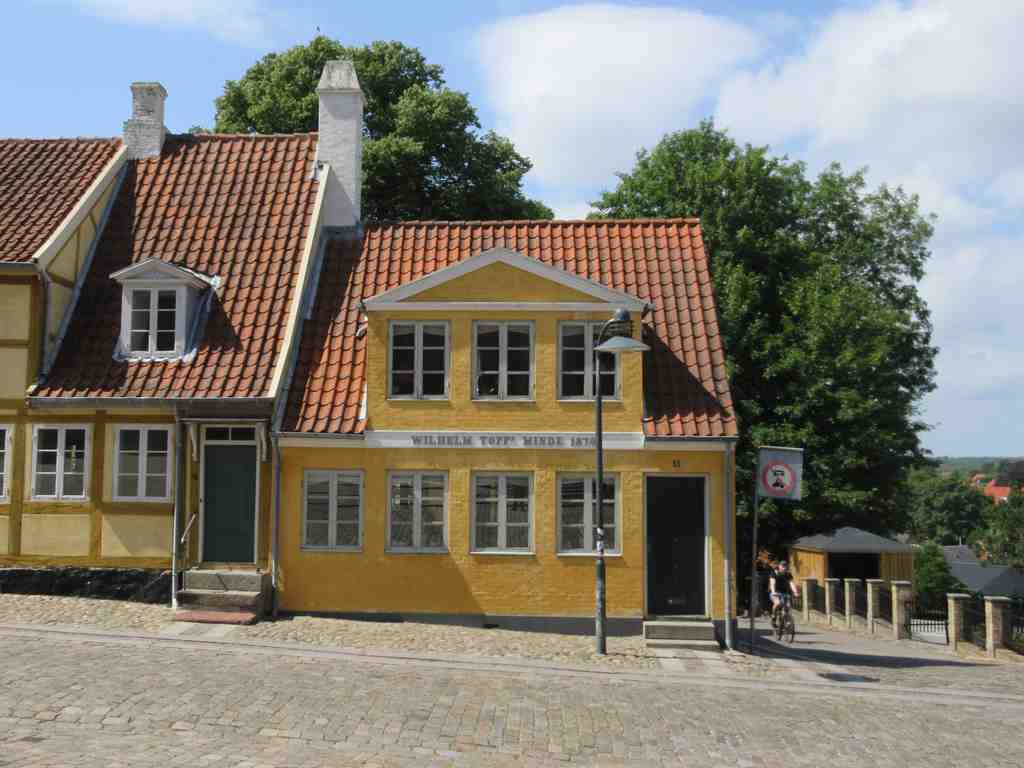
Right in front of you sits a bright yellow brick building with a classic red tile roof and a prominent white band across the middle proudly displaying its name.
We just saw another Stiftelse, or charitable housing foundation, just a minute ago, but this one has a very different origin story. Built back in seventeen eighteen, this house started out as a family sanctuary. A wealthy local merchant named Hans Rasmussen Lange and his wife built it specifically to house their indigent, or extremely poor, relatives. Imagine being totally broke in the eighteenth century and your rich uncle hands you the keys to an apartment right next to the grand cathedral.
Take a look at the photo on your screen to see its classic market town architecture. Notice how the middle section steps outward. Architects call that an avant-corps, a French term for a projecting central block, designed to make even a small, five-bay house look grand and perfectly balanced.
So, who is Wilhelm Topp? Fast forward to eighteen seventy-four. A Copenhagen merchant named Wilhelm Christian Topp buys the property. He generously lets his wife's sister, Marie, live here. When Wilhelm passed away, Marie was so grateful that in eighteen eighty-three, she installed the very sign you see today to honor his memory.
Later, in nineteen forty, the mighty Roskilde Cathedral actually bought this tiny house. Why? Simply to stop anyone from tearing it down and building something tall that would block their majestic view.
It is amazing how a simple desire to protect family, and later a nice view, preserved this beautiful slice of history for us. Take all the time you need here, and whenever you are ready, we will stroll over to our next stop.




