
Audiotour por Barcelona: Puntos Destacados Históricos
Bajo las brillantes avenidas de Barcelona, un barrio judío medieval aún susurra entre piedras, y un teatro de ópera guarda el calor de los disturbios en sus muros. Este es un audiotour autoguiado que recorre desde la Sinagoga Antigua hasta el Liceu y el Palau Güell de Gaudí, revelando rebeliones, escándalos, batallas políticas y rincones olvidados que la mayoría de los visitantes atraviesan sin darse cuenta. ¿Qué sucedió cuando la furia se desbordó en La Rambla y la ciudad exigió un cambio justo frente al Liceu? ¿Qué señales ocultas cerca de la Sinagoga Antigua apuntan a vidas borradas, aunque no del todo desaparecidas? ¿Por qué el Palau Güell esconde un detalle extrañamente específico que solo aparece bajo un cierto ángulo y hora? Muévete a través de callejones sombríos hacia salas doradas, más allá de los secretos en el hierro y los ecos en las plazas. Espera tensión, descubrimiento y la sensación de que Barcelona encaja en su lugar. Pulsa play y deja que la ciudad hable desde debajo de la superficie.
Vista previa del tour
Sobre este tour
- scheduleDuración 120–140 minsVe a tu propio ritmo
- straighten4.9 km de ruta a pieSigue el camino guiado
- location_on
- wifi_offFunciona sin conexiónDescarga una vez, úsalo en cualquier lugar
- all_inclusiveAcceso de por vidaReprodúcelo en cualquier momento, para siempre
- location_onComienza en Plaça de Catalunya
Paradas en este tour
lock_open 3 previews gratuitas · 15 se desbloquean con la compra
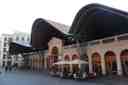
Levanta la vista hacia la gran arcada de hierro forjado, con ese remate en pico. Fíjate en los medallones circulares de vidrio tintado, amarillos y azules, y en el escudo…Leer másMostrar menos
Abrir página dedicada →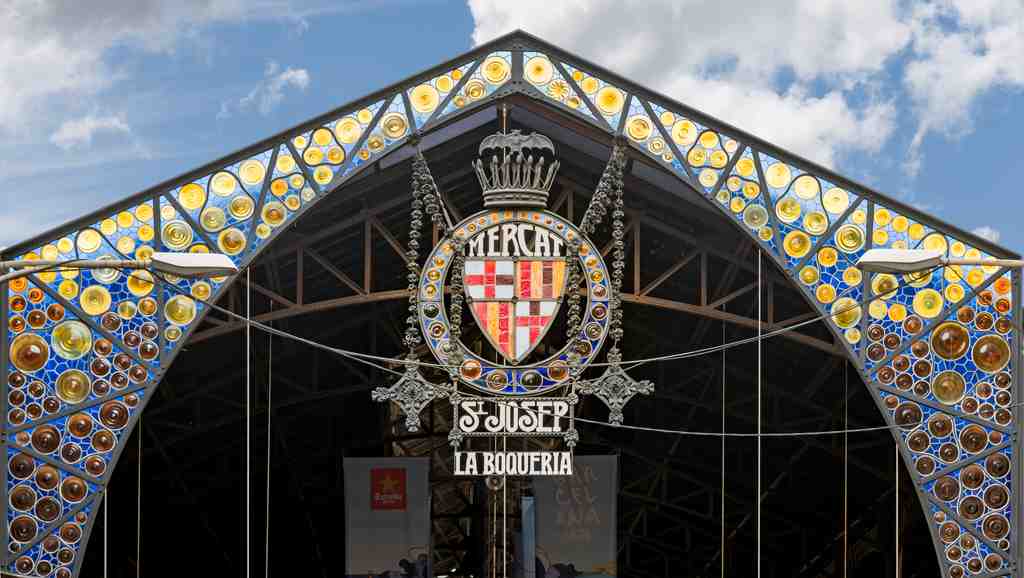
La BoqueriaPhoto: Didier Descouens, Wikimedia Commons, CC BY-SA 4.0. Cropped & resized. Mire hacia arriba al imponente arco de hierro forjado en punta, enmarcado por paneles circulares de vidrieras amarillas y azules, con un gran escudo ornamentado colgando en el centro que reza Mercat Sant Josep La Boqueria.
Este es el mercado más grande y famoso de Cataluña, un espacio inmenso que ofrece desde carne de cabra local hasta frutas exóticas. Pero bajo la brillante y moderna escena culinaria subyace una historia bastante oscura... una nacida de una violencia repentina.
En 1835, un convento de monjes carmelitas se alzaba justo donde usted se encuentra. Ese verano, una corrida de toros notoriamente mala en una plaza cercana desencadenó una inusual cadena de acontecimientos. Al parecer, los toros eran tan pequeños y mansos que la multitud enfurecida arrastró a un toro muerto por las calles, y su frustración mutó rápidamente en un violento motín anticlerical, un levantamiento dirigido contra la riqueza y la influencia social de la iglesia. La turba rodeó el convento en este mismo lugar, prendiendo fuego a sus pesadas puertas y ventanas de madera para obligar a los monjes a salir. La milicia local apenas logró rescatar a los religiosos antes de que los mataran, pero el edificio quedó completamente arruinado, lo que permitió a la ciudad confiscar el terreno y limpiar los escombros para construir un mercado público.
Puede tocar su pantalla para ver una imagen comparativa que muestra la transformación de la entrada de La Boqueria a lo largo de un siglo, evolucionando de una plaza histórica más sencilla al mercado de gran techumbre que atrae a millones de visitantes hoy en día.
Esa fricción entre las sombras del pasado y el implacable empuje del comercio moderno está tejida en el tejido mismo de este lugar. Si mira de nuevo su pantalla, verá una toma interior de la enorme operación moderna, que alberga más de trescientos puestos bajo el techo metálico añadido en 1914.
Muchos de estos puestos han sido regentados por las mismas familias durante más de ciento cincuenta años. Pero incluso en su era dorada de la gastronomía moderna, el mercado nunca ha abandonado del todo su gusto por lo dramático. Tomemos a Ramón Cabau, un farmacéutico local convertido en dandi, que ayudó a popularizar la cocina catalana. Con sus trajes impecables y un bigote que prácticamente desafiaba la gravedad, era una figura diaria muy querida aquí. Entonces, una mañana de 1987, saludó casualmente a sus vendedores favoritos, sacó un vaso de agua y se suicidó tragando una pastilla de cianuro justo en medio de los concurridos pasillos. La pérdida sumió al mercado en un periodo de luto que duró años.
El mercado sigue adelante, absorbiendo cada tragedia y triunfo en su rutina diaria. Por cierto, los puestos abren de lunes a sábado de 8:00 a 20:30, y cierran los domingos.
Sigamos avanzando. Diríjase más abajo por la Rambla hacia el gran teatro de la ópera, y volveremos a conectar en el Liceu.
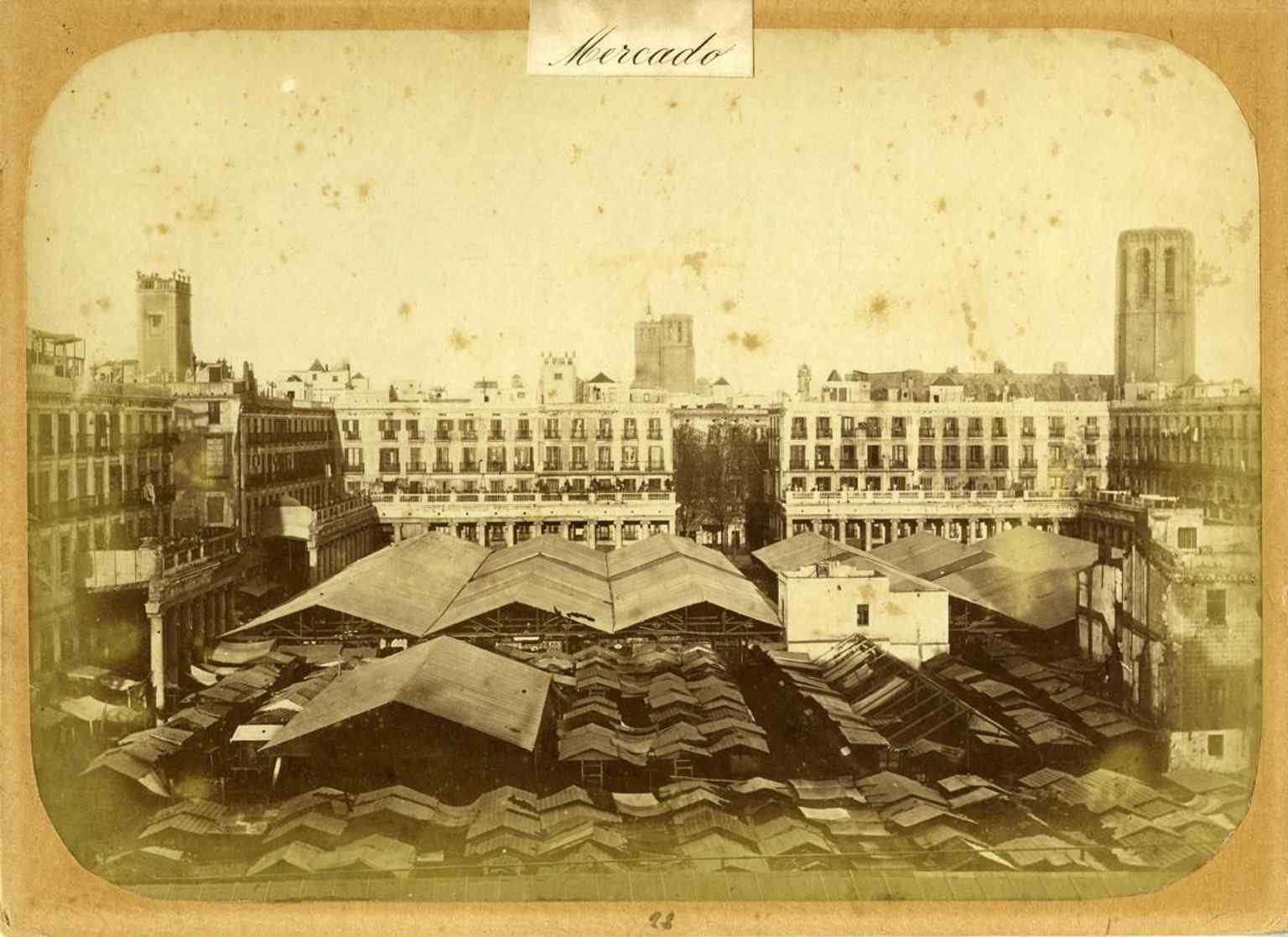
Una vista de 1874 de La Boqueria, que comenzó como un mercado al aire libre fuera de las murallas de la ciudad, ayudando a los vendedores a evitar los impuestos municipales.Photo: Joan Martí Centellas, Wikimedia Commons, Public domain. Cropped & resized. 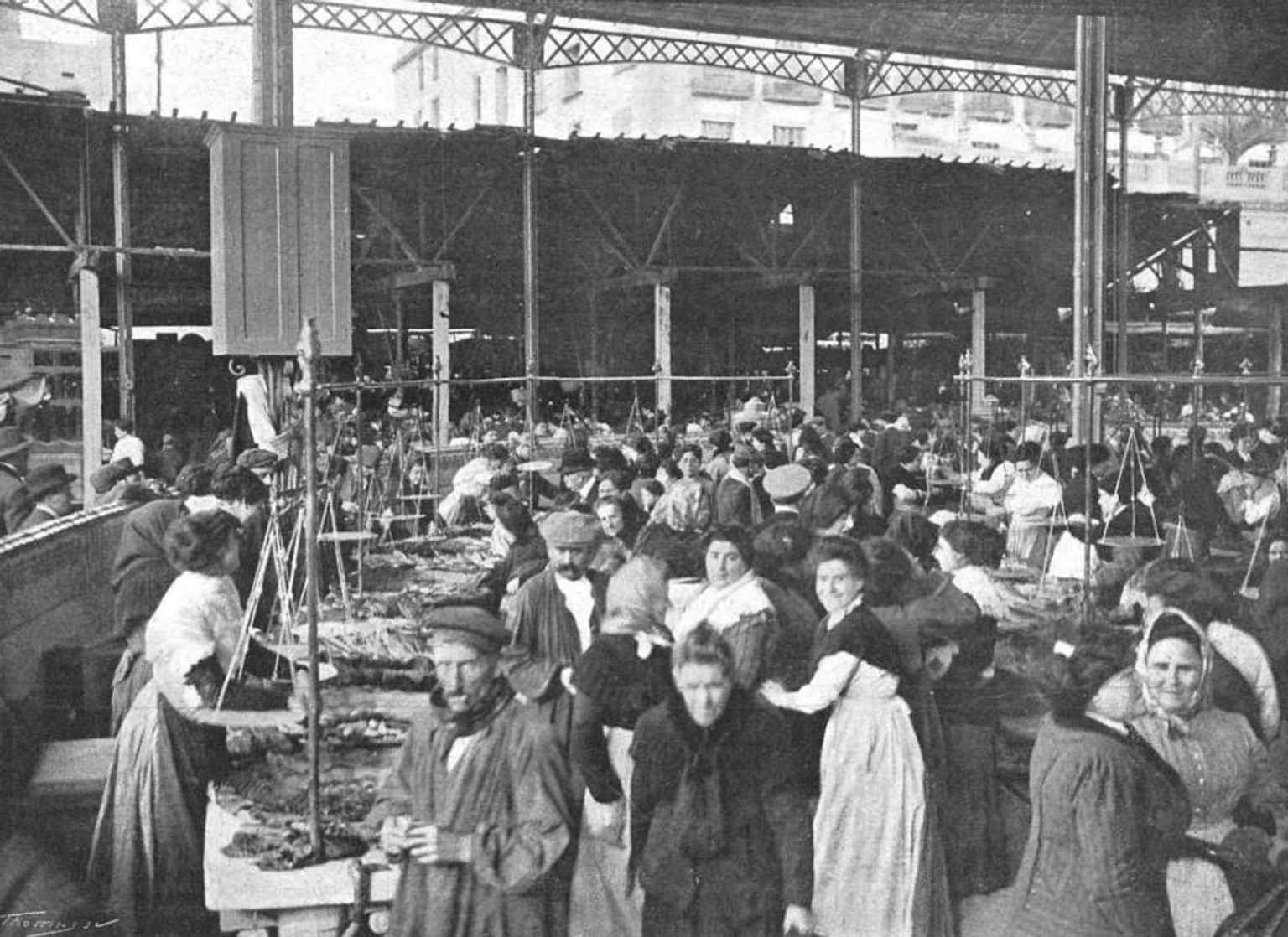
Un vistazo de 1911 a la sección del mercado de pescado, que ilustra la evolución de los puestos especializados dentro de la estructura permanente de La Boqueria.Photo: Frederic Ballell i Maymí, Wikimedia Commons, Public domain. Cropped & resized. 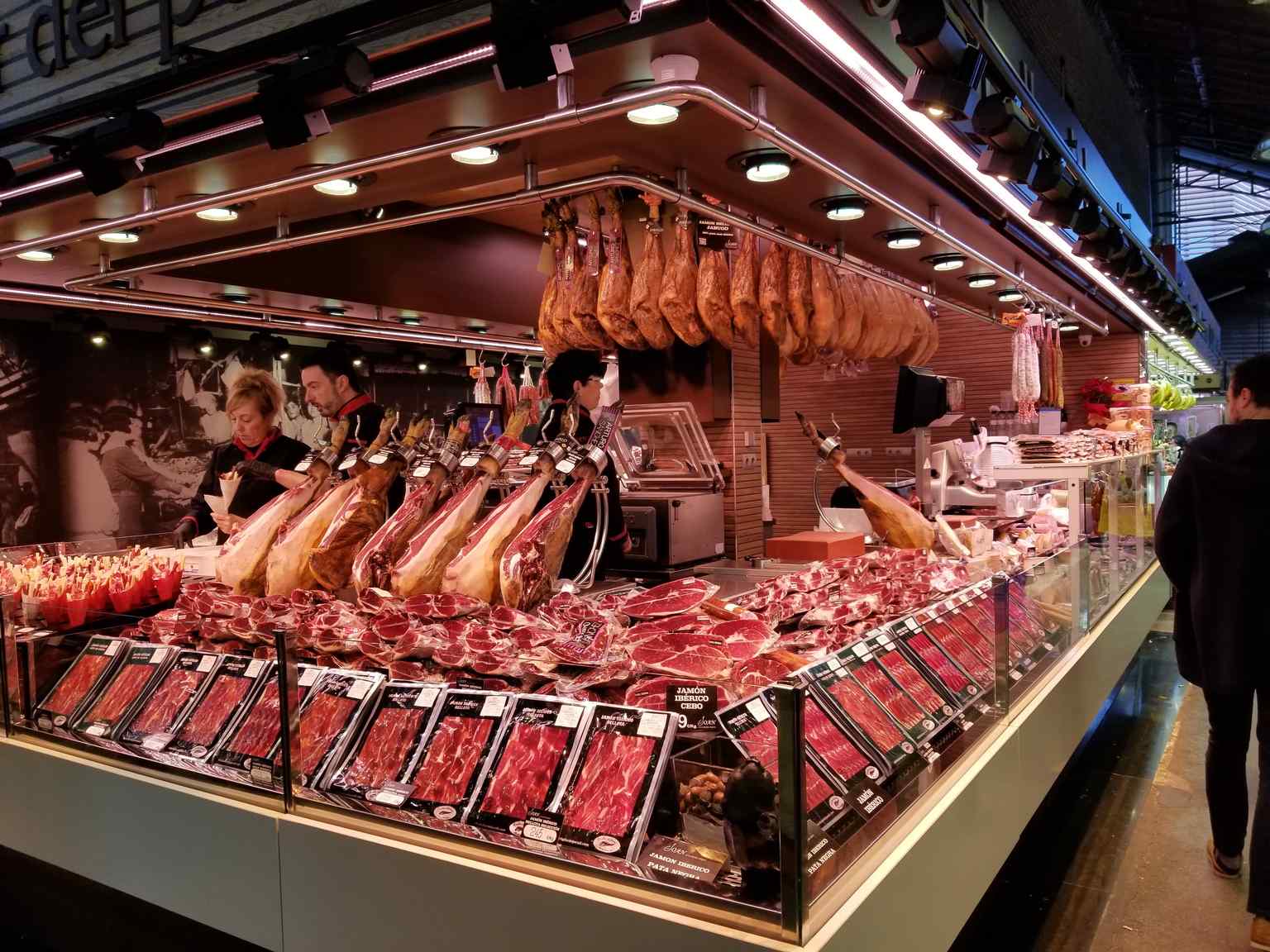
Un puesto de carnicería que recuerda el debatido origen del nombre del mercado, 'Boquería', posiblemente derivado de 'boc' (macho cabrío), en referencia a las primeras ventas de carne de cabra.Photo: DuckWrangler97, Wikimedia Commons, CC BY-SA 4.0. Cropped & resized. 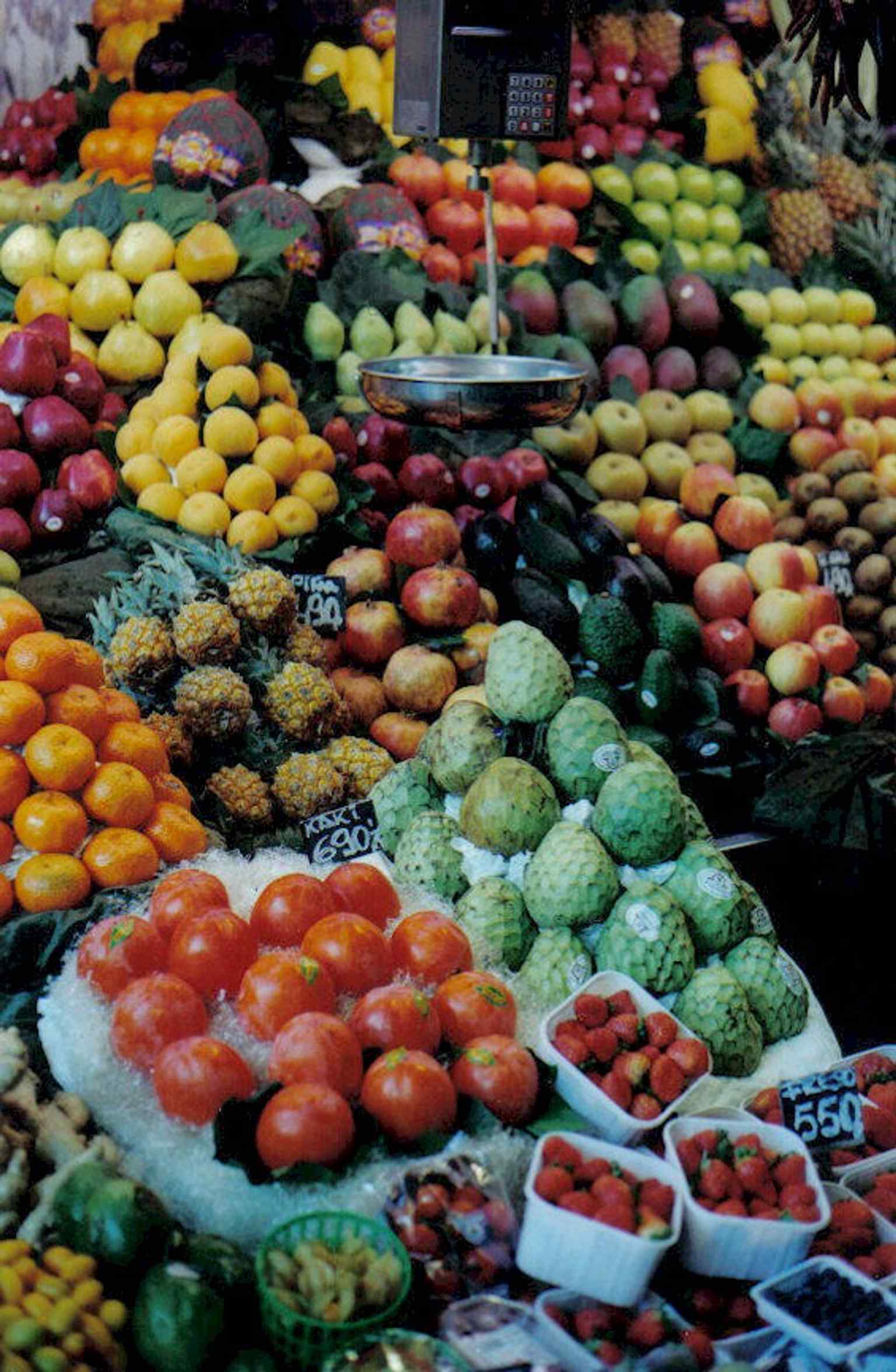
Un vibrante puesto de frutería, que ejemplifica la profunda historia familiar de La Boqueria, donde algunos puestos han pasado de generación en generación durante más de 150 años.Photo: Jruizalvarez, Wikimedia Commons, CC BY-SA 4.0. Cropped & resized. Mira a tu izquierda: ese edificio imponente de piedra color arena, con tres grandes ventanales en arco en el centro, un reloj arriba en un frontón redondeado y ese adorno verde…Leer másMostrar menos
Abrir página dedicada →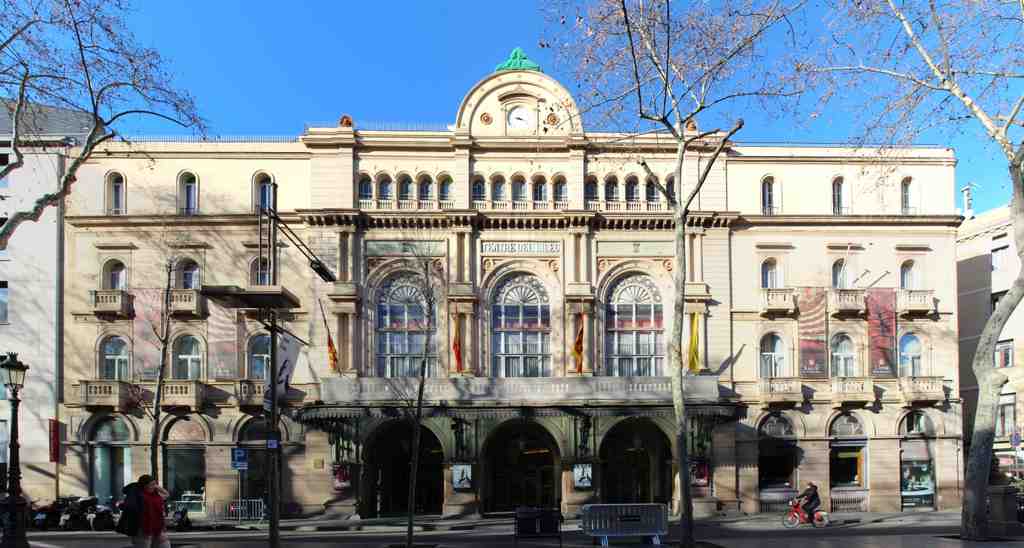
LiceuPhoto: Chabe01, Wikimedia Commons, CC BY-SA 4.0. Cropped & resized. Look to your left and you will spot a grand, tan stone building defined by three prominent arched windows in the center, a rounded clock pediment at the top, and a distinctive green roof ornament crowning the structure. This is the Gran Teatre del Liceu, Barcelona's oldest active theater, and frankly, it is a miracle it is still standing. If buildings have nine lives, this opera house has used up quite a few of them.
When it was built in 1847, it was funded by private citizens rather than a monarchy, which is why you will not find a royal box inside. But they built it right on top of a former convent. According to local lore, the displaced religious figures left behind a curse, dooming the theater to repeatedly burn down. Looking at its history, you might start to believe it.
The first devastating fire hit in 1861, leaving only the facade and a few halls intact. They rebuilt it. Then, during the opening night in 1893, an anarchist threw two bombs from the upper gallery down into the stalls, the main ground floor seating area. Twenty people were killed. The death toll would have been worse, but one bomb miraculously failed to detonate because its fall was broken by a victim. The theater rebuilt again, leaving the seats of the victims conspicuously empty for years as a memorial. Some staff even say they still hear phantom singing and whispers near those private boxes.
But the curse was not finished. In 1994, a workman's blowtorch sparked a fire that raged completely out of control. Huge balls of fire shot into the air, incinerating the instruments in the orchestra pit. Crowds stood weeping in the street, including the famed Catalan soprano Montserrat Caballé, who considered the Liceu her second home.
Yet again, the city refused to let the music die. They rebuilt it, merging the surviving historical architecture with state-of-the-art technology. You can see how the energy outside the theater has evolved over the years in the app's before and after image. Over a century later, La Rambla remains a bustling thoroughfare past the iconic Gran Teatre del Liceu, capturing the shift from early 20th-century pedestrians to modern-day tourists.
My absolute favorite moment of modern resilience happened here in 2020. To mark the end of the strict pandemic lockdown, the Liceu reopened not for humans, but for an audience of 2,292 house plants. A string quartet played Puccini to a sea of green leaves, and afterward, the plants were donated to local healthcare workers. That is the essence of this place, an institution forever caught in a dance between honoring its tragic history and embracing wild, forward-thinking reinvention.
If you want to look inside, the theater is usually open to visitors Monday through Saturday until seven, though it closes at two on Saturdays and is entirely closed on Sundays. For now, we are going to keep moving. Just ahead, look for the narrow street leading off La Rambla, which will take us to our next stop, Palau Güell, about a three-minute walk away.
Mostrar 15 paradas másMostrar menos paradasexpand_moreexpand_less
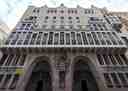
Fíjate en ese edificio monumental de piedra clara… lo reconocerás por dos arcos parabólicos enormes en la planta baja, llenos de rejería finísima, y separados por un remate de…Leer másMostrar menos
Abrir página dedicada →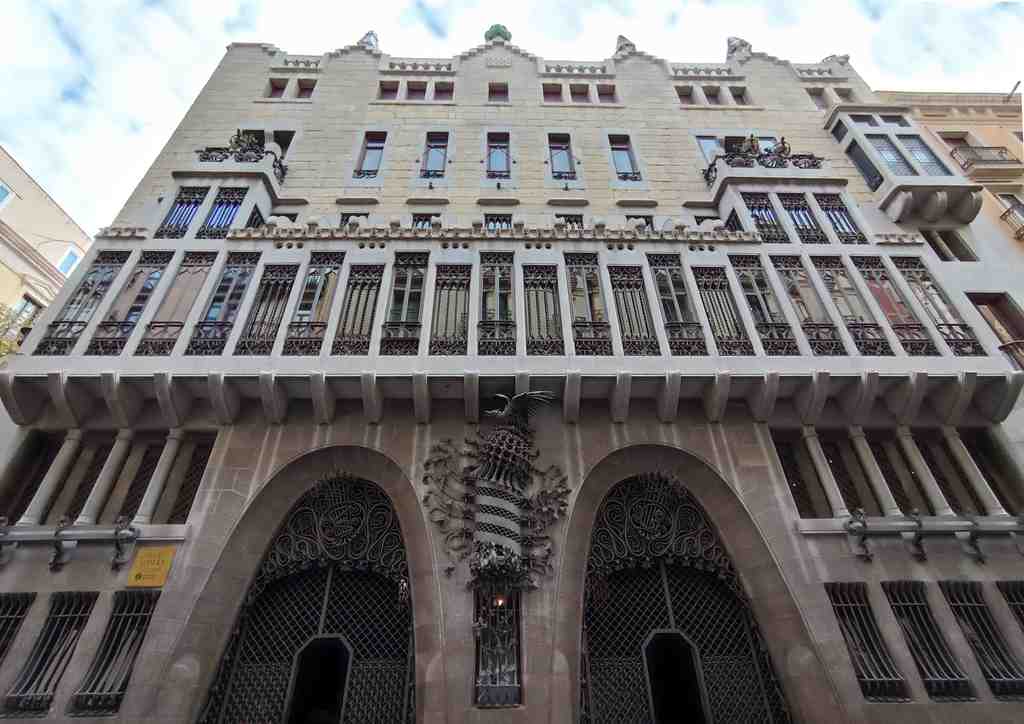
Palacio GüellPhoto: Canaan, Wikimedia Commons, CC BY-SA 4.0. Cropped & resized. Look for a monumental pale stone building dominated by two massive parabolic arches on the ground floor, filled with intricate ironwork and separated by a striking wrought-iron crest.
This is Palau Güell. It was the first major commission for a young, relatively unknown architect named Antoni Gaudi.
Built between 1886 and 1890, this palace belongs to Gaudi's orientalist phase, drawing heavy inspiration from the geometric patterns and elaborate tile work of Near Eastern and Islamic art. It marked the dawn of Catalan Modernism, a regional artistic movement that rejected strict, classical architecture in favor of bold, highly decorative, and often nature-inspired designs. Gaudi poured his absolute soul into this project, coming up with twenty-five different solutions just for the facade you see here.
But the immense wealth that paid for this architectural masterpiece had a deeply troubling origin, as the patron's father, Joan Güell, built his initial fortune in Cuba through the illegal transatlantic slave trade. That dark money laid the foundation for the family's massive industrial empire back in Barcelona.
It is a heavy thing to stand before such brilliance and know exactly what bought it. Eusebio Güell, the son who inherited that fortune and commissioned this palace, wanted a home that would project his absolute power. Just look at those immense entrance doors with their iron mesh. They were designed with those towering parabolic shapes, which are tall curves similar to the path of a tossed object, specifically so that high-society guests could ride their horse-drawn carriages straight into the ground floor. If you look closely, the ironwork at the top of the doors cleverly hides two twisting snakes that form the letters E and G, for Eusebio Güell.
The influence of that dark wealth even bent the city's rules. The municipal architect originally rejected Gaudi's design because the solid stone facade violated city ordinances, which strictly required lighter iron and glass structures for these types of viewing galleries. But Güell simply pulled a few political strings in the local government, and the city magically approved the heavy stone construction anyway. The elite truly wrote their own rules, pushing their bold visions of the future forward while standing on the silent ghosts of the past.
The palace is open Tuesday through Sunday from ten in the morning to eight in the evening, if you ever want to explore the stunning central dome and the wildly colorful chimneys on the roof. For now, let us head back toward the heart of the Gothic Quarter, as our next stop, Plaça Reial, is just a short two-minute walk away.
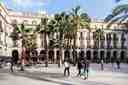
Mira esta plaza rectangular, con fachadas uniformes de piedra clara. Abajo, una arcada continua: una fila de arcos que forma un pasillo cubierto. Y arriba, esos “pilastras”, que…Leer másMostrar menos
Abrir página dedicada →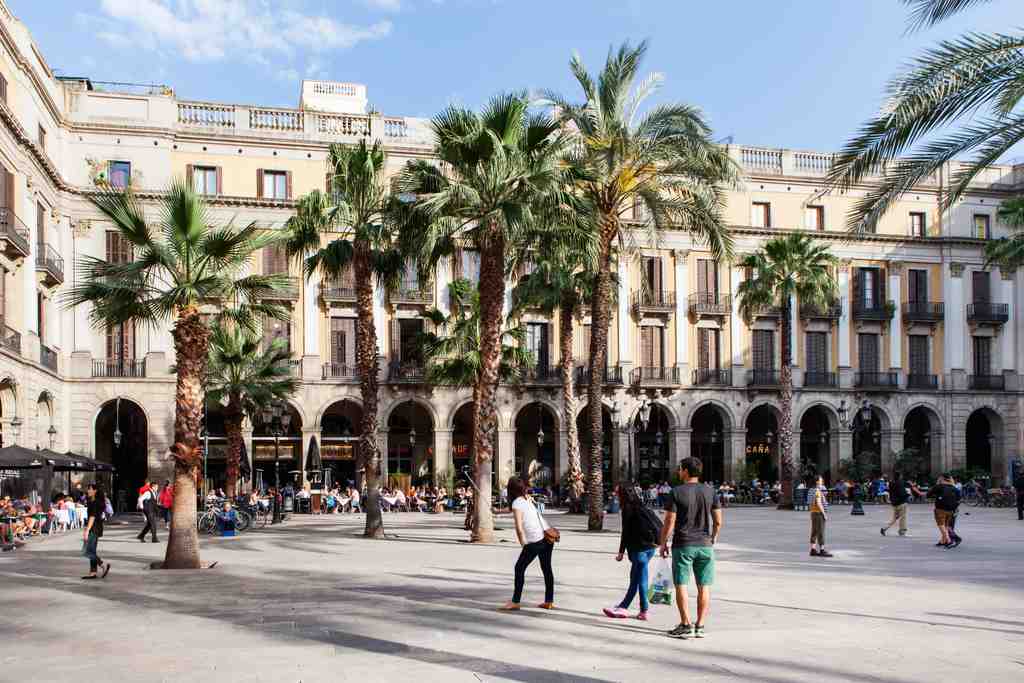
Plaza RealPhoto: Paux127, Wikimedia Commons, CC BY-SA 4.0. Cropped & resized. Contemple esta plaza rectangular bordeada por fachadas uniformes de piedra pálida, anclada por una arcada continua de arcos en la planta baja y altas columnas ornamentales llamadas pilastras que se extienden por los niveles superiores. La Plaza Real fue diseñada en 1850 por Francisco Daniel Molina como una visión de orden neoclásico y moderno para la élite de la ciudad. Incluso empleó un ingenioso truco arquitectónico, desplazando ligeramente el espacio entre las columnas para que el espacio rectangular pareciera perfectamente cuadrado a la vista.
Pero bajo esta geometría calculada subyace un cimiento mucho más antiguo y caótico. Este pulido espacio público se construyó directamente sobre las ruinas demolidas de un monasterio de monjes capuchinos. El choque entre esta nueva visión prístina y la historia enterrada salió a la superficie casi de inmediato. Durante la construcción en 1848, un sereno tropezó con una escena bastante macabra. Un grupo de niños sin hogar jugaba con el cráneo de un monje, que habían extraído de las ruinas del convento. La ciudad deseaba un futuro elegante, pero el pasado estaba aflorando literalmente a la superficie.
La lucha por imponer el orden aquí rara vez fue sencilla. La ciudad planeó originalmente colocar una gran estatua del rey Fernando en el centro. Durante una visita real en 1856, el bronce no estaba terminado, por lo que, de forma un tanto torpe, exhibieron en su lugar un modelo de yeso. Los ciudadanos lo detestaron y pronto lo hicieron pedazos a pedradas. Finalmente se decidieron por la estructura de hierro que ve hoy, la Fuente de las Tres Gracias, que puede examinar más de cerca en la aplicación. Para ver cómo este espacio se asentó en su nueva identidad unas décadas más tarde, eche un vistazo a la fotografía antigua en su pantalla.
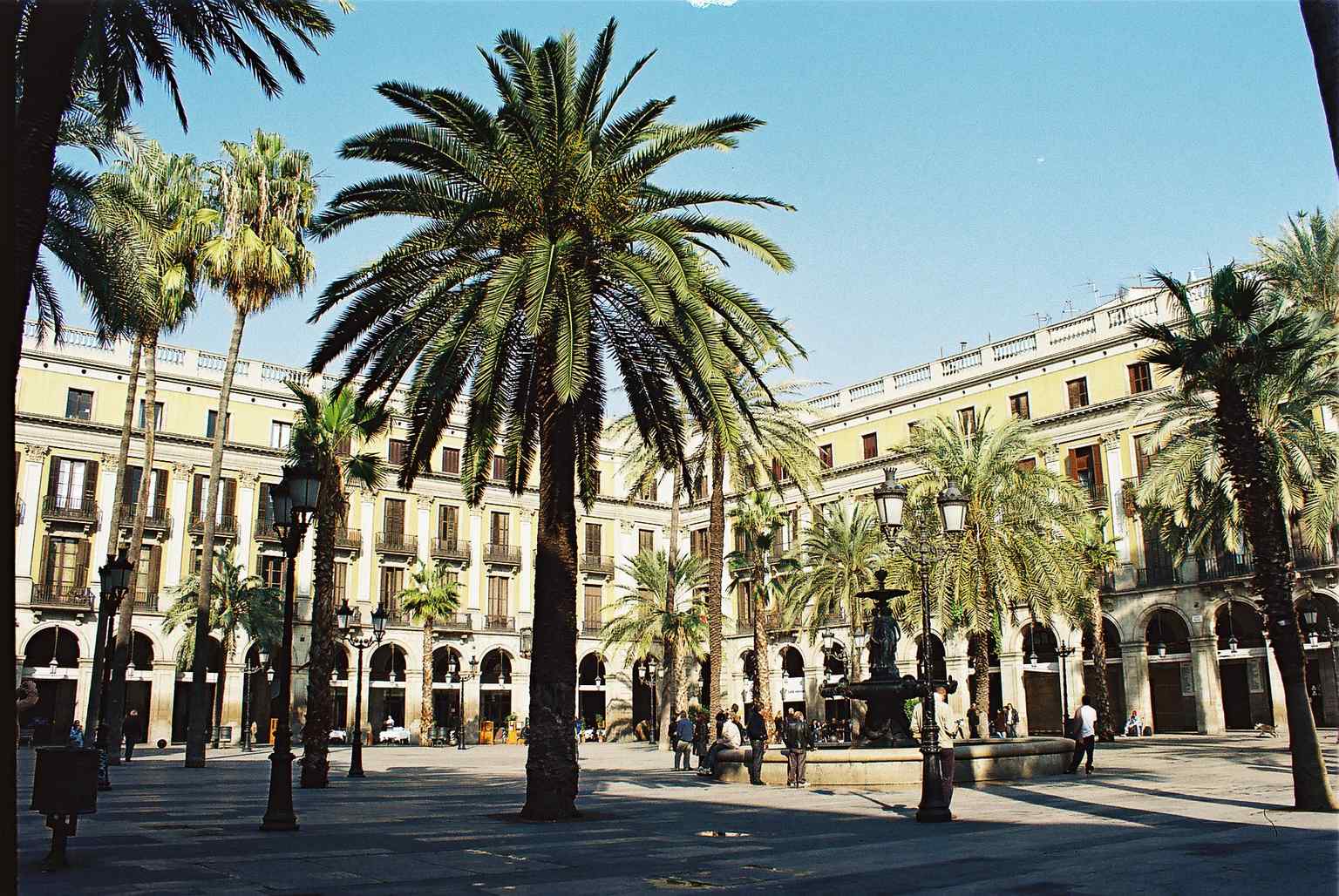
La Fuente de las Tres Gracias, instalada en 1876 por Antoine Durenne, se encuentra en el corazón de la Plaza Real, reemplazando a un monumento anterior y poco popular.Photo: Ralf Roletschek, Wikimedia Commons, CC BY-SA 3.0. Cropped & resized. Hacia el siglo XX, la elegante apariencia de la plaza acogía a algunos personajes deliciosamente excéntricos. En 1919, se inauguró aquí una renombrada tienda de taxidermia, especializada en preservar y montar animales. Atrajo a todo el mundo, desde la estrella de Hollywood Ava Gardner hasta el rey Alfonso XIII, quien hizo preservar la pata de su caballo favorito. Naturalmente, Salvador Dalí era un admirador. En 1960, el pintor surrealista posó justo aquí, en el centro de la plaza, encima de un rinoceronte de Java disecado, pagando a los transportistas veinte duros (unos cincuenta dólares de hoy) por las molestias. Al parecer, también se marchó con un esqueleto de gorila que nunca pagó.
Antes de irnos, fíjese en las elaboradas farolas de hierro. Observe de cerca las serpientes entrelazadas y el casco alado de Mercurio. Esos fueron uno de los primerísimos encargos municipales otorgados a un joven Antoni Gaudí en 1879.
A pesar de todos sus intentos de dignidad real, la Plaza Real siempre ha favorecido a los rebeldes, a los artistas y a los marginados que la reclamaron como propia. Adentrémonos más en las laberínticas calles del Barrio Gótico, dirigiéndonos hacia los grandes muros medievales de Santa María del Pino.
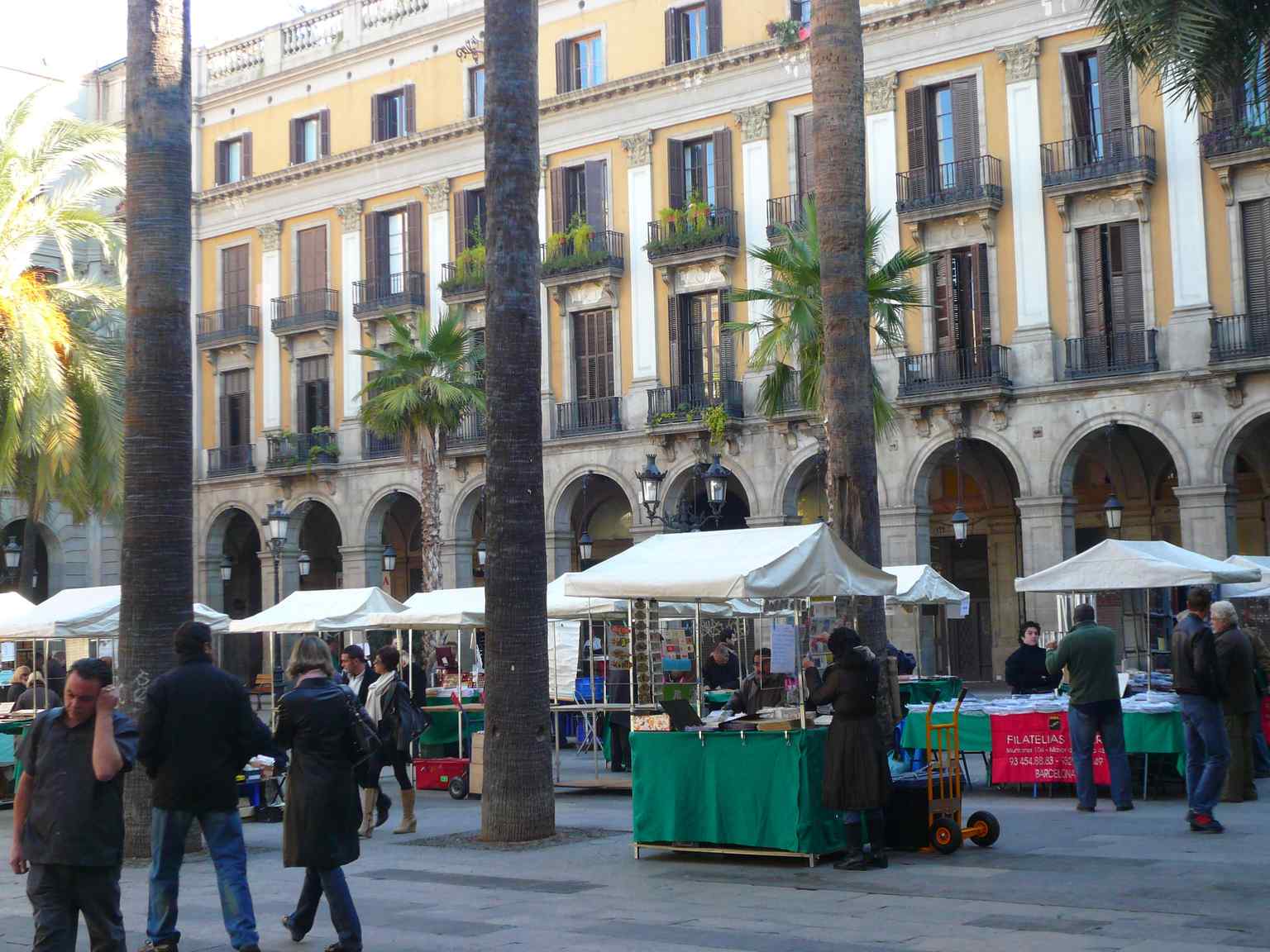
Observe la arquitectura neoclásica de los edificios de la Plaza Real, diseñados por Francisco Daniel Molina, que presentan galerías porticadas en la planta baja y pilastras corintias en los niveles superiores.Photo: Pere prlpz, Wikimedia Commons, CC BY-SA 3.0. Cropped & resized. 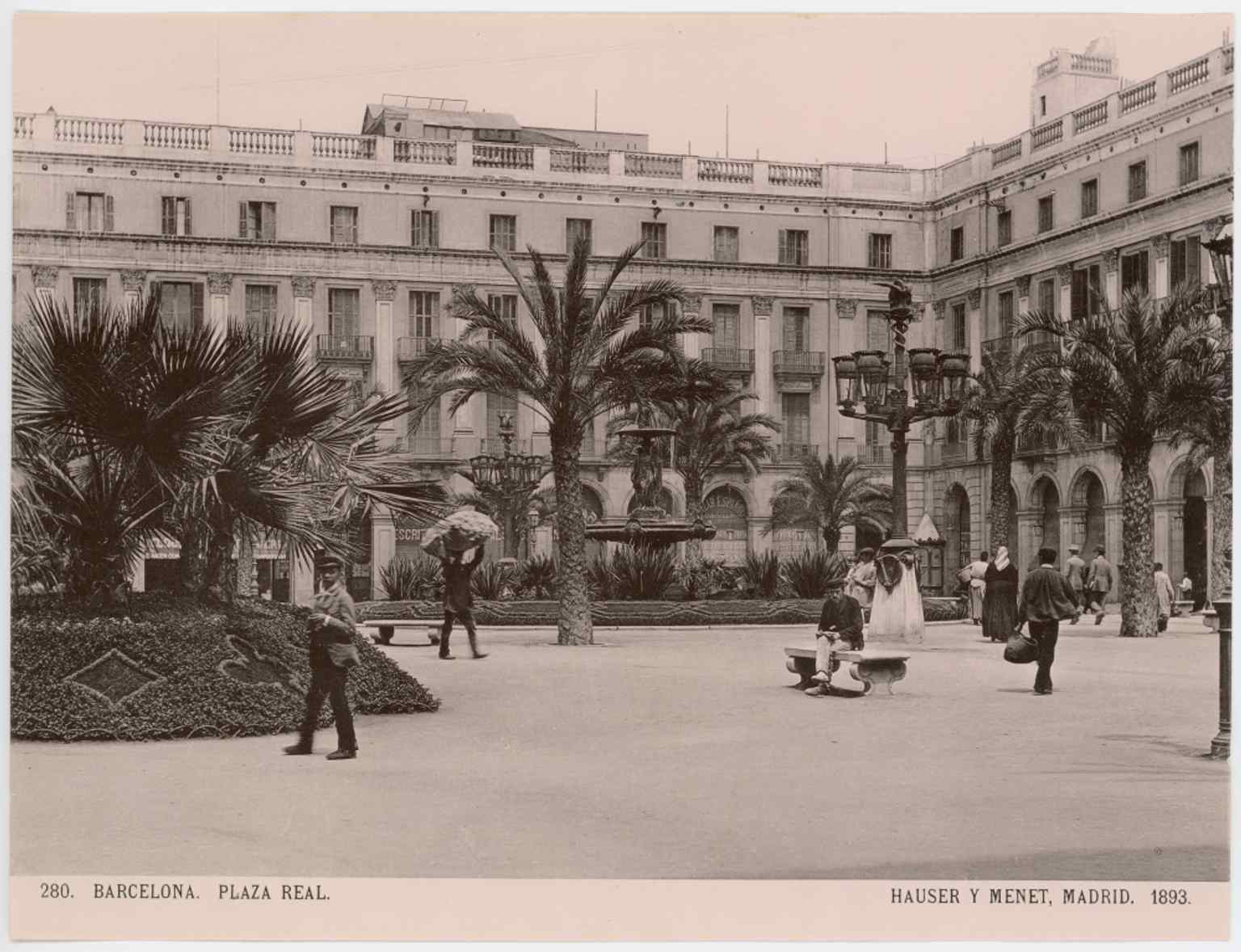
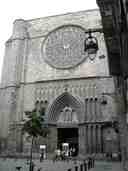
Una vista de la Plaza Real de 1893, capturando la plaza décadas después de su construcción y alrededor de la época de la agitación política de finales del siglo XIX, incluyendo un atentado anarquista en 1892.Photo: SMU Libraries Digital Collections, Wikimedia Commons, No restrictions. Cropped & resized. Fíjate a tu izquierda en Santa Maria del Pi: una fachada enorme, de piedra lisa y contundente, con un rosetón circular gigantesco -esa “ventana-rueda” de vidrieras- de doce…Leer másMostrar menos
Abrir página dedicada →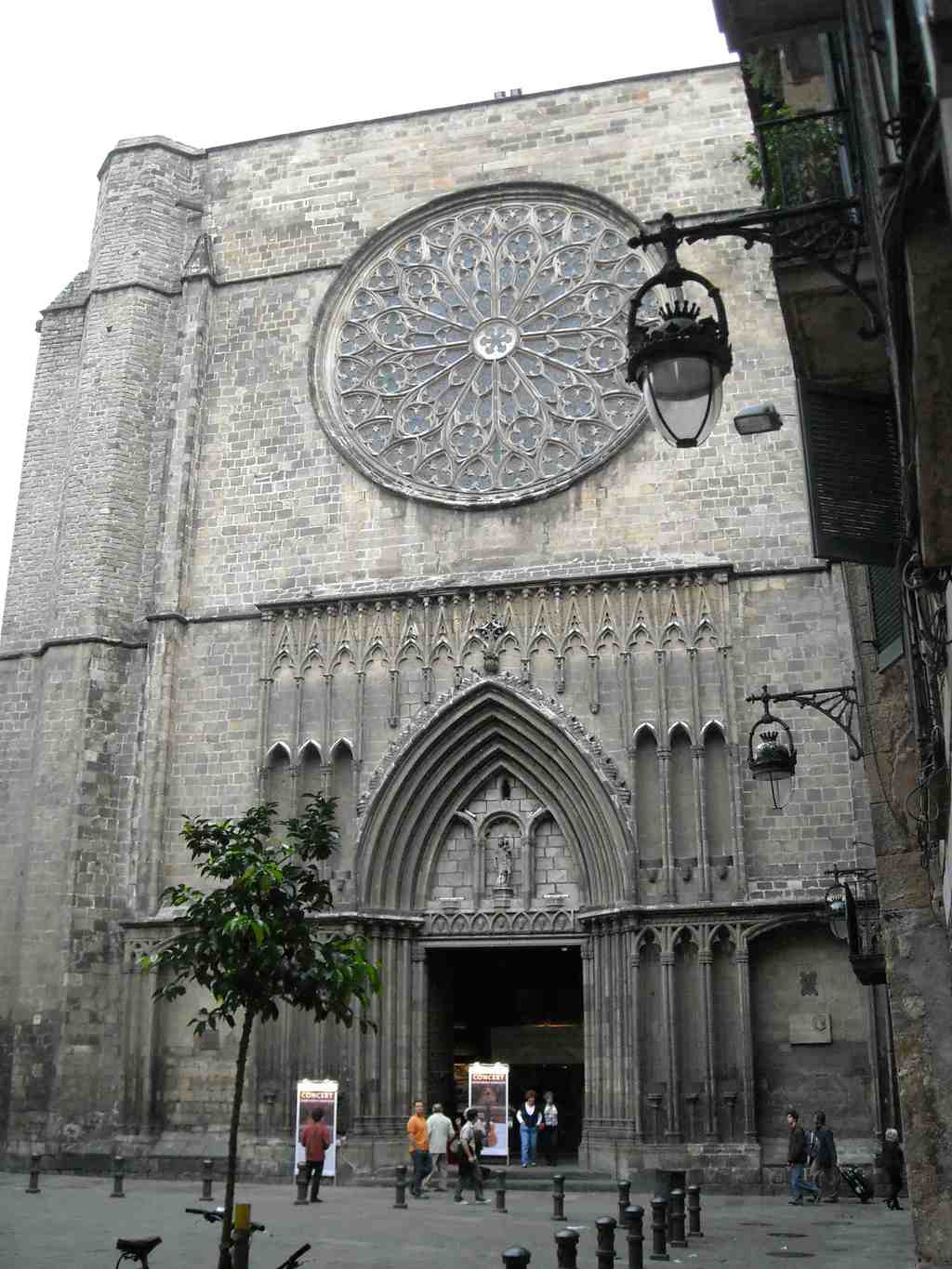
Santa Maria del PiPhoto: Cruccone, Wikimedia Commons, CC BY-SA 3.0 ES. Cropped & resized. Notice Santa Maria del Pi on your left, with its massive facade of flat stone defined by its enormous, twelve-armed circular rose window sitting squarely above a pointed, deeply recessed archway.
The name translates to Saint Mary of the Pine. According to local lore, a wooden image of the Virgin Mary was once found hidden deep inside the heart of a pine tree. To honor this, the community planted a pine right out front. It became a living anchor, a piece of ancient earth holding its ground as the stone city built up and expanded around it.
In the year fifteen sixty-eight, a specific pine was planted that grew as tall as the surrounding rooftops. It survived centuries of urban expansion, only to meet its end in eighteen oh two when a soldier inexplicably stabbed its trunk with his bayonet. The tree died, but the locals simply planted another. They have kept replanting it ever since. That insistence on keeping a green, living monument in a paved square is a quiet rebellion, ensuring old traditions survive even as the modern world encroaches.
The basilica itself knows all about survival. In nineteen thirty-six, at the dawn of the Spanish Civil War, anti-clerical militias set the building on fire. The heat was so intense it collapsed the vaulted ceilings, the curved stone arches supporting the roof, and shattered that magnificent rose window, sending thousands of glass shards raining down onto the square. Yet, as the political forces of tomorrow threatened to completely erase the past, ordinary neighbors rushed into the smoke. They ignored the valuable metals, instead grabbing the parish archives. They hid twelfth-century paper documents in their own homes, protecting the historical memory of their community from the fires of upheaval.
There are older, darker memories woven into these stones, too. Look up toward the top of that towering, eight-sided bell tower. Its construction in the fifteenth century was such a monumental challenge that rumors naturally blamed the supernatural. Legend says the master builder struck a deal with the devil, promising his soul in exchange for completing the tower. The devil would collect his due the moment the architect set foot on the one-hundredth step of the spiral staircase. The architect simply outsmarted him by stopping his work on the stairs at step ninety-nine, focusing on the rest of the church until he died peacefully of old age. When his successor finally added the hundredth step, the devil was so enraged at being cheated that he stomped his foot, leaving a deep hoofprint in the stone. It drew so many curious onlookers that nineteenth-century church authorities eventually had to patch it with cement just to stop the spectacle.
This basilica is a quiet sanctuary where old mysticism still pushes back against a purely rational world. If you want to step inside, the church is open daily, though Sunday hours are a bit shorter. For now, let us head just around the corner to seek out an aristocratic residence, making the short walk over to Palau Maldà.
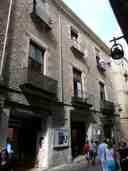
Fíjate en el edificio de piedra a tu izquierda: una fachada plana y rectangular, balcones de hierro forjado en filas muy ordenadas, y un gran arco de piedra moldeada enmarcando la…Leer másMostrar menos
Abrir página dedicada →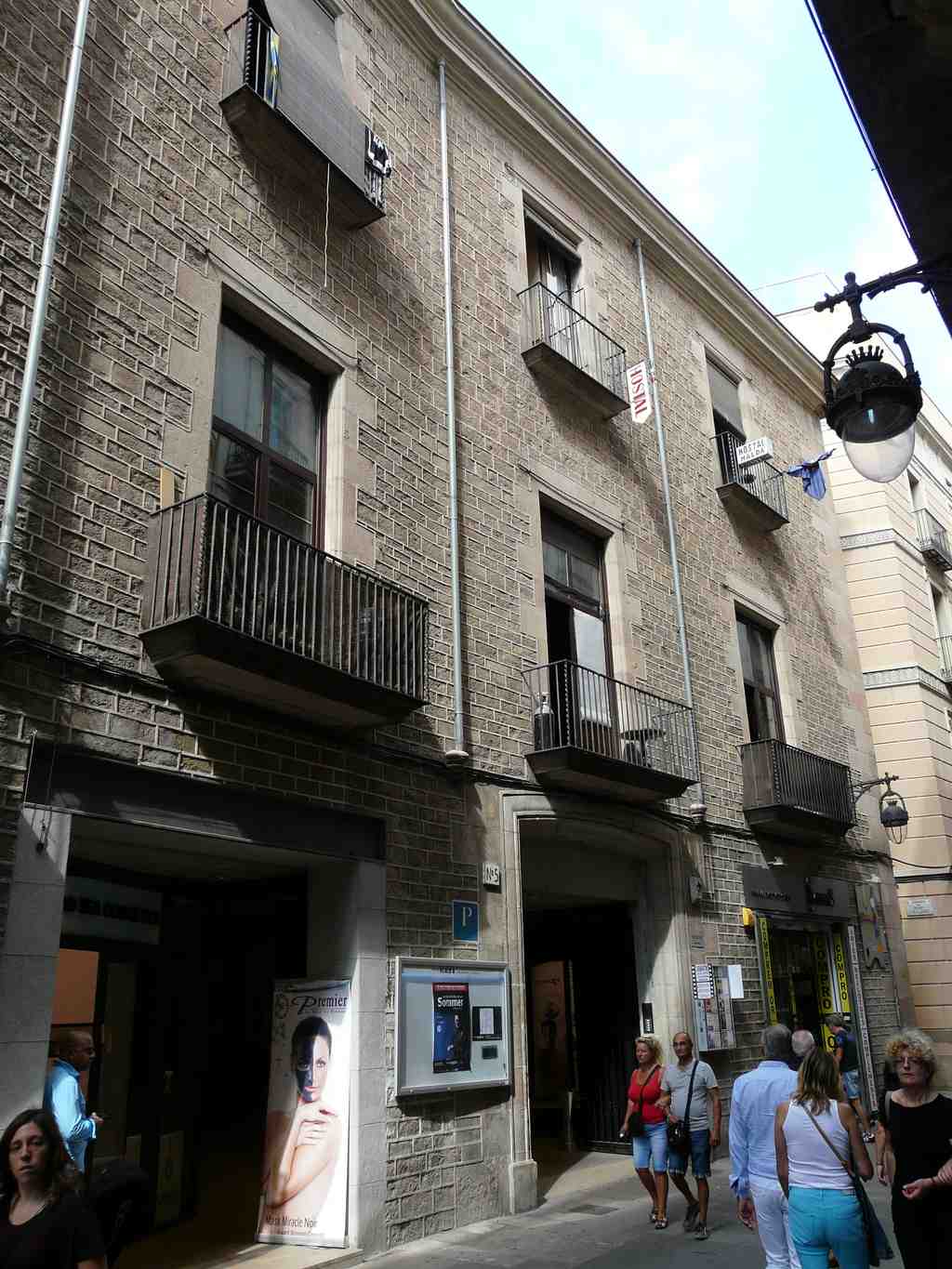
Palau MaldàPhoto: pere prlpz, Wikimedia Commons, CC BY-SA 3.0. Cropped & resized. Observe el edificio de piedra a su izquierda, caracterizado por su fachada rectangular plana, filas ordenadas de balcones de hierro forjado y un gran arco de piedra moldurado que enmarca la entrada principal. Este es el Palau Maldà. Si consulta la primera imagen en su pantalla, podrá ver bien ese arco, que originalmente conducía directamente a las caballerizas del palacio.
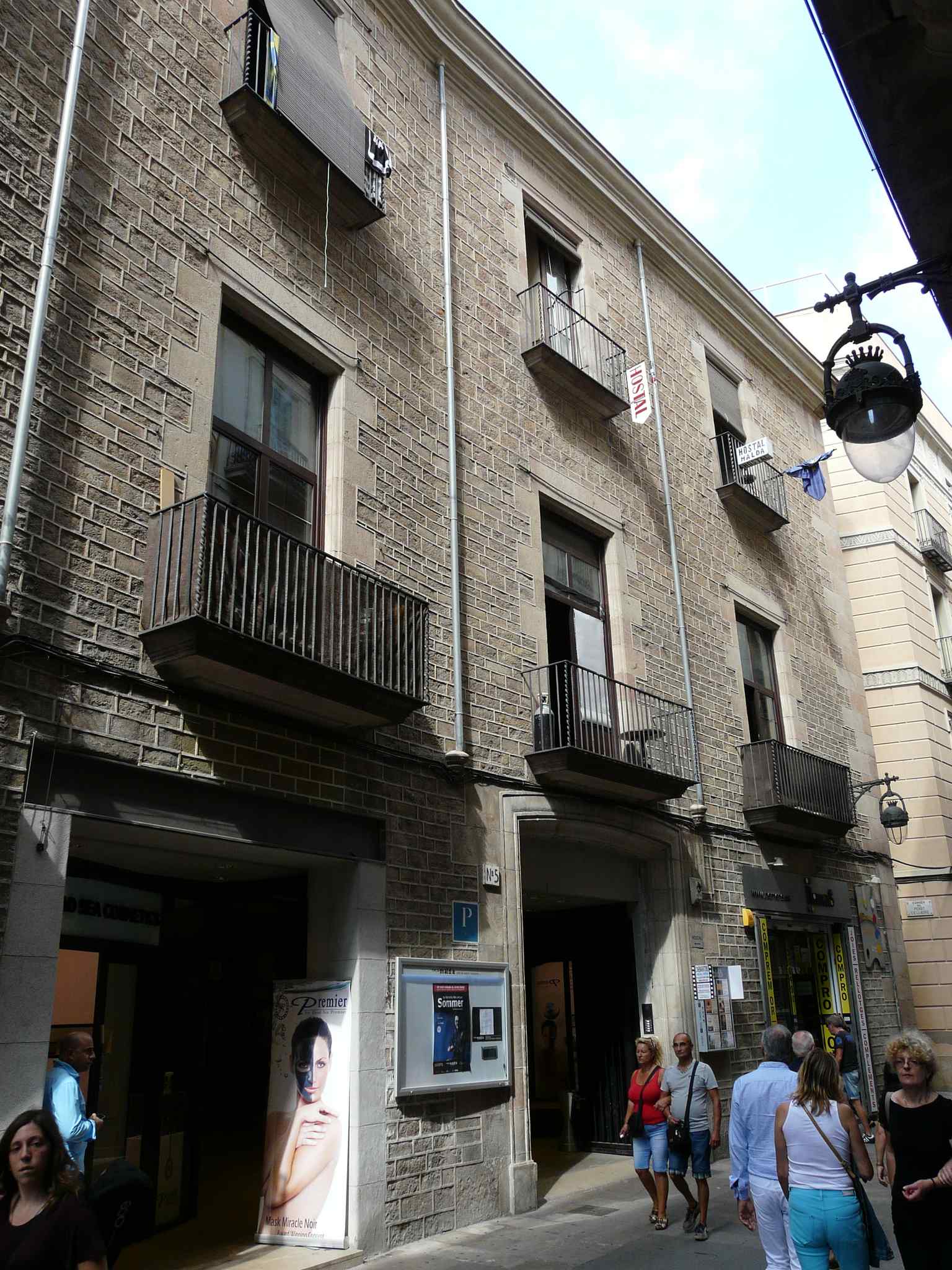
La fachada principal del Palau Maldà en la calle del Pi, con el gran arco de piedra que sirve de entrada a las históricas Galerías Maldà, originalmente las caballerizas del palacio.Photo: pere prlpz, Wikimedia Commons, CC BY-SA 3.0. Cropped & resized. En el siglo XVIII, este palacio perteneció a Rafael de Amat, el primer barón de Maldà. Rafael era un aristócrata excéntrico cuya principal obra de vida fue un diario personal de cincuenta volúmenes. Estaba obsesionado con lo que llamaba la dulce ociosidad de su vida. Lejos de ser un gran intelectual, el barón escribía enteramente para su propio entretenimiento, llenando sus páginas con relatos detallados, casi obsesivos, de sus extravagantes comidas. Defendía ferozmente su derecho a simplemente comer bien y beber mejor, y se negaba rotundamente a escribir en castellano, al que despreciaba como la lengua del recaudador de impuestos.
Pero esa cómoda y frívola burbuja aristocrática estalló en 1808. Cuando los franceses invadieron durante la Guerra de la Independencia, el aterrorizado barón se vio obligado a huir de su amado palacio. Pasó sus últimos años como un fugitivo adinerado, vagando de pueblo en pueblo, escribiendo furiosamente en su diario sobre cuánto extrañaba su acogedora vida aquí.
Desde entonces, este edificio ha intentado constantemente inventarse un nuevo futuro, solo para ser arrastrado de nuevo por su historia. En 1942, la familia se mudó y la planta baja y los jardines se transformaron en las Galerías Maldà. Se trataba de pasillos comerciales cubiertos de cristal inspirados en los pasajes parisinos. Fueron un éxito masivo. Incluso albergaron un querido hospital de muñecas durante más de setenta años, donde cirujanos de juguete reparaban ojos de porcelana y cosían extremidades de tela.
En el piso superior, las antiguas salas de conciertos privados del barón se convirtieron finalmente en un teatro. Eche un vistazo a la segunda imagen de su aplicación para ver la escalera interior que conduce a ese mismo espacio de actuación. Pero esos muros guardan un secreto más profundo. Durante la Guerra Civil Española en la década de 1930, mientras las iglesias de toda la ciudad eran atacadas, una de las pequeñas salas de teatro del palacio funcionó secretamente como una capilla católica vasca. Permaneció abierta al culto con total seguridad ante las narices de todos. Décadas más tarde, cuando se renovaba el cine del edificio en 2006, los trabajadores hicieron un descubrimiento sorprendente. Oculta directamente detrás de la pantalla de cine había una gran hornacina, un nicho decorativo empotrado en la pared, que una vez albergó figuras religiosas para esa congregación secreta de la guerra.
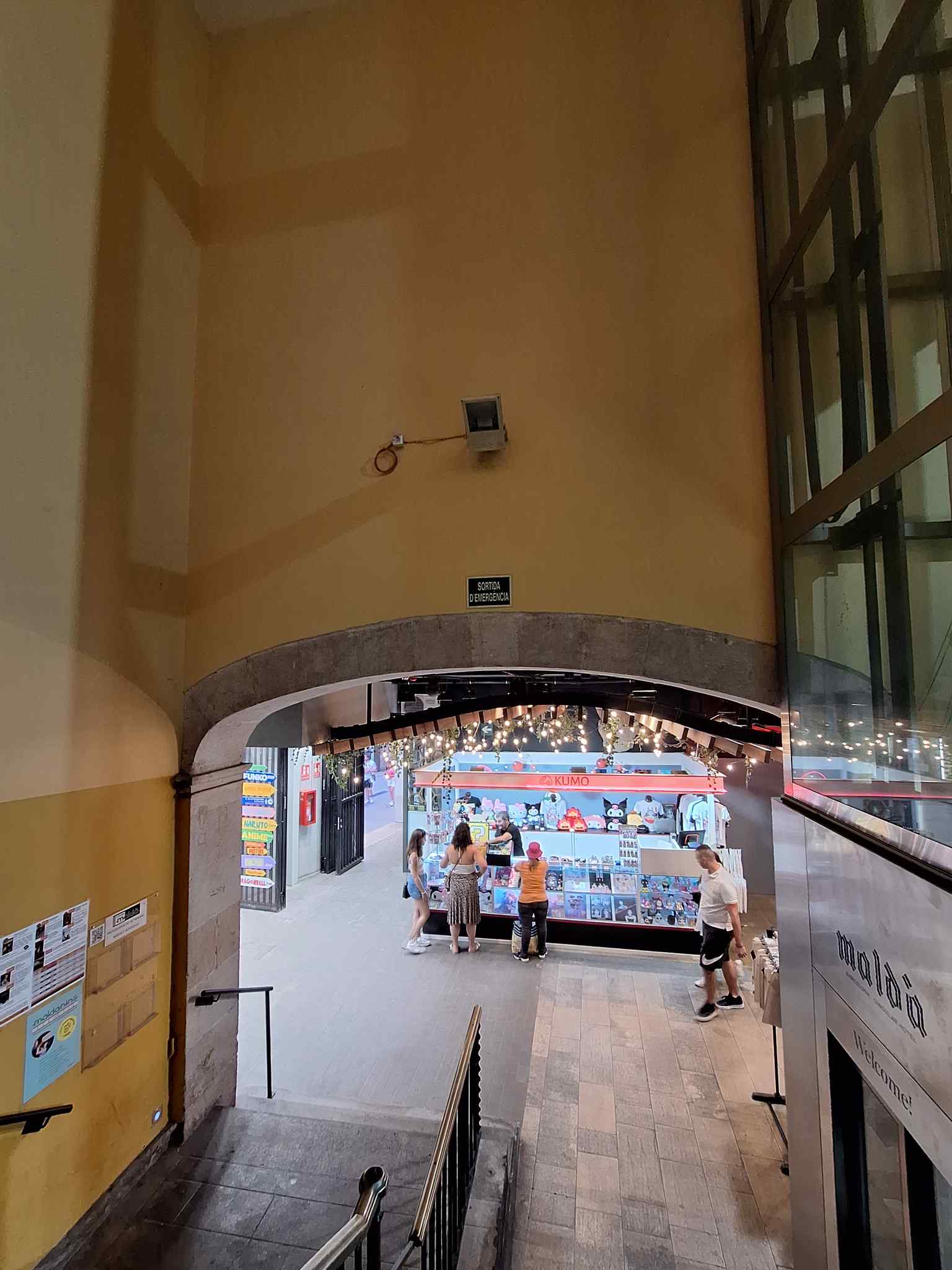
La escalera que conduce al Teatre Maldà, un espacio dentro del palacio utilizado antaño para conciertos privados por el barón de Maldà e inaugurado oficialmente como teatro en 1996.Photo: Pere López Brosa, Wikimedia Commons, CC BY-SA 4.0. Cropped & resized. As for the shopping galleries below, they slowly turned into a ghost town by the 1980s. A sudden burst of modern progress arrived in 2017 when a massive Harry Potter store opened, briefly transforming the crumbling corridors into a booming hub for fantasy and pop culture fans. But the magic did not last. By late 2024, almost all the new themed shops abruptly closed their doors, leaving the historic corridors mostly empty once again.
It seems this palace is always caught in a tug of war between its grand visions of the future and the quiet echoes of its past. Let us leave this fading aristocratic playground behind and head toward an entirely different kind of survival. We are taking a five-minute walk over to our next stop, the Ancient Synagogue.
Mira hacia la izquierda. Tienes delante una fachada rectangular y bastante contundente, hecha con bloques de piedra lisa, de tono arena. El centro lo manda un gran arco que…Leer másMostrar menos
Abrir página dedicada →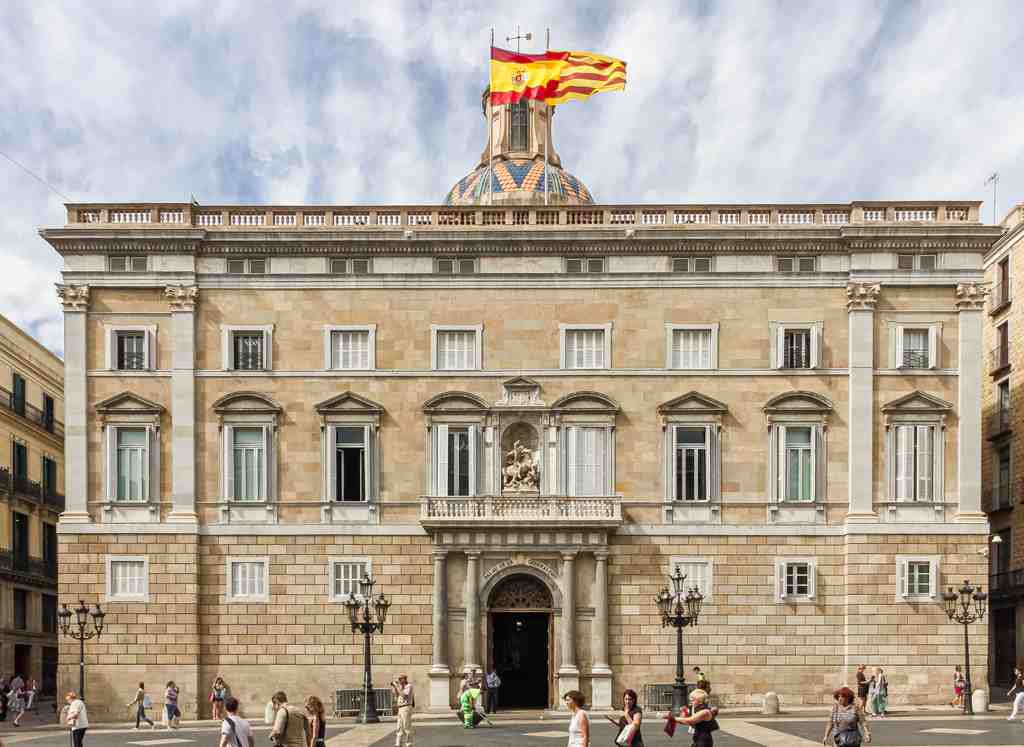
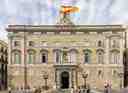
Palacio de la GeneralitatPhoto: AndriySadivskyy, Wikimedia Commons, CC BY-SA 3.0 ES. Cropped & resized. Turn your attention left to the imposing rectangular facade built from smooth, tan stone blocks, anchored by a large central arched doorway and a prominent balcony right above it. Notice the sculpted statue of a knight on horseback nestled into the niche above that balcony.
That knight is Saint George, the patron saint of Catalonia, watching over the Palace of the Generalitat. This is the historic seat of the Catalan government. It is actually one of the very few medieval buildings in Europe that still serves as the headquarters for the exact same institution that built it.
The roots of this government stretch deep into the Middle Ages. Back in 1282, the Catalan courts formed, and by 1359, they created a permanent commission to collect taxes. That humble tax board eventually evolved into the Generalitat, essentially taking on the role of an executive branch of government.
But this palace did not spring up from empty land. It was built directly over a tragic piece of the buried ancient city we explored earlier. These properties originally belonged to the prosperous Jewish Quarter. In 1391, a brutal pogrom... a targeted, violent riot... wiped out the neighborhood. Nine years later, the government purchased the vacant houses, paving over the lost community to build a new center of power.
Take a close look at the four plain stone columns flanking the main entrance door. When the architect designed this Renaissance facade in 1596, he did not carve those columns. He imported them. They are actually almost two thousand years old, carved from granite near the legendary city of Troy. The Romans originally brought them to Spain to build a massive temple. Centuries later, they were salvaged and shipped here to frame this doorway. It is a perfect metaphor for this place. Ancient foundations propping up new political ambitions.
Now, direct your attention to the balcony right above the door. Over the last century, that small ledge has been the stage for profound triumph and devastating tragedy. In 1931, Francesc Macià stepped onto it to boldly declare a Catalan Republic. Three years later, his successor, Lluís Companys, proclaimed a Catalan State from that exact spot. That second declaration provoked a furious response from the central government in Madrid. Artillery shells bombarded this very palace. Following a night of heavy fighting, the Catalan government surrendered, waving a white flag from the balcony. Companys was arrested, and later became the only democratically elected president in European history to be executed in office by the Franco dictatorship.
Yet, the institution survived its ghosts. In 1977, after thirty eight years in exile and the fall of the dictatorship, President Josep Tarradellas returned to Barcelona. He stepped out onto that same balcony, looked down at a massive, euphoric crowd, and shouted... Citizens of Catalonia, I am here.
The Generalitat remains a powerful symbol of endurance. Now, turn your back to the palace and look directly across the plaza. We are heading to its royal counterpart, the Royal Palace, which is just a three minute walk away.
A tu derecha se levanta un conjunto enorme de muros de piedra clara, con una escalinata ancha que sube hacia puertas con arcos… y, dominándolo todo, una torre rectangular alta,…Leer másMostrar menos
Abrir página dedicada →Estas piedras han sido testigos de su ración de sangre. En diciembre de 1492, el rey Fernando el Católico bajaba por los mismos escalones que tiene delante cuando un campesino le atacó por la espalda con una espada ancha. El rey se salvó únicamente gracias a la gruesa cadena de oro de una orden honorífica que llevaba al cuello, la cual desvió la hoja lo justo para convertir un golpe mortal en una profunda herida en el hombro. El atacante afirmó que el Espíritu Santo le ordenó golpear, y su castigo fue absoluto. Fue paseado desnudo por la ciudad en un carro, torturado y descuartizado vivo por el verdugo y la multitud furiosa.
Debido a esa herida, Fernando todavía se estaba recuperando en un monasterio tranquilo a las afueras de la ciudad cuando Cristóbal Colón regresó de las Américas. Por eso, a pesar de las famosas pinturas románticas que muestran a Colón presentando oro y loros a los monarcas en el gran salón gótico de este palacio, el legendario encuentro ocurrió en realidad a kilómetros de distancia. La historia siempre prefiere el escenario más grandioso.
A medida que el poder real acabó alejándose de Barcelona, se impusieron capítulos más oscuros. La Inquisición española se instaló aquí, convirtiendo los exuberantes jardines de los leones en sombrías celdas de detención. Más tarde, en el siglo XVIII, un convento de monjas se hizo cargo del gran salón medieval. Para modernizar el espacio, construyeron una iglesia barroca completamente nueva justo dentro de los muros góticos, enyesando el pasado.
Permaneció así hasta 1936. Durante los disturbios de la Guerra Civil Española, los trabajadores empezaron a desmantelar la iglesia y realizaron un descubrimiento asombroso. Tras el yeso y el ladrillo, los majestuosos arcos de piedra del siglo XIV del salón medieval estaban perfectamente intactos. La ciudad antigua enterrada había estado escondida a plena vista, protegida accidentalmente durante dos siglos por los mismos muros destinados a reemplazarla.
Hoy en día, una parte de aquel histórico espacio del jardín de la Inquisición se ha transformado en la fascinante sede de una enorme colección de objetos históricos excéntricos. El complejo abre casi todos los días de 10:00 a 20:00, aunque cierra los domingos. Caminemos un minuto hasta el peculiar Museo Frederic Marès.
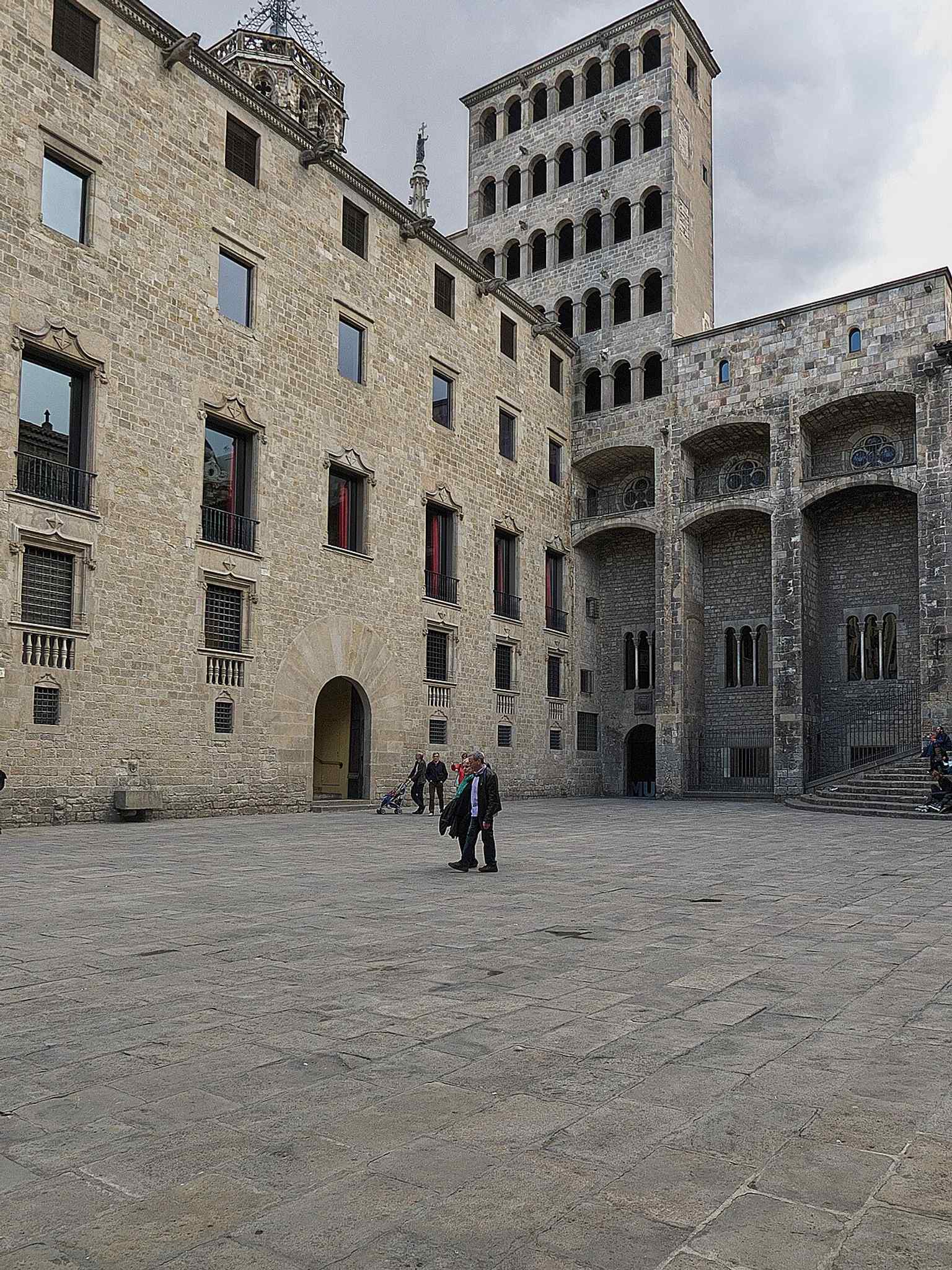
The King Martin's Watchtower, added in 1555, was the last major addition to the Royal Palace, originally serving defensive, observation, and ostentatious purposes.Photo: José Luis Filpo Cabana, Wikimedia Commons, CC BY 3.0. Cropped & resized. These stones have witnessed their share of blood. In December 1492, King Ferdinand the Catholic was walking down the very steps outside when a peasant attacked him from behind with a broadsword. The king was saved only by the thick gold chain of an honorary order around his neck, which deflected the blade just enough to turn a fatal blow into a deep shoulder wound. The attacker claimed the Holy Spirit told him to strike, and his punishment was absolute. He was paraded naked through the city in a cart, tortured, and dismantled alive by the executioner and the furious crowd.
Because of that wound, Ferdinand was still recovering in a quiet monastery outside the city when Christopher Columbus returned from the Americas. So despite the famous romantic paintings showing Columbus presenting gold and parrots to the monarchs in the grand gothic hall of this palace, the legendary meeting actually happened miles away. History always prefers the grander stage.
As royal power eventually shifted away from Barcelona, darker chapters took hold. The Spanish Inquisition moved in, turning the lush lion gardens into grim holding cells. Later, in the seventeen hundreds, a convent of nuns took over the grand medieval hall. To modernize the space, they built a completely new Baroque church right inside the gothic walls, plastering over the past.
It remained that way until 1936. During the upheaval of the Spanish Civil War, workers began dismantling the church and made a stunning discovery. Behind the plaster and brick, the majestic fourteenth century stone arches of the medieval hall were perfectly intact. The buried ancient city had been hiding in plain sight, accidentally protected for two centuries by the very walls meant to replace it.
Today, a piece of that historic Inquisition garden space has been transformed into a fascinating home for a massive collection of eccentric historical objects. The complex is open most days from 10 AM to 8 PM, though it closes on Sundays. Let us take a short walk just a minute away to the quirky Frederic Marès Museum.
A la derecha tienes un edificio de piedra, alto y contundente, con una entrada muy “clásica”: dos columnas sostienen un frontón triangular, y debajo se abre un arco.... Es el…Leer másMostrar menos
Abrir página dedicada →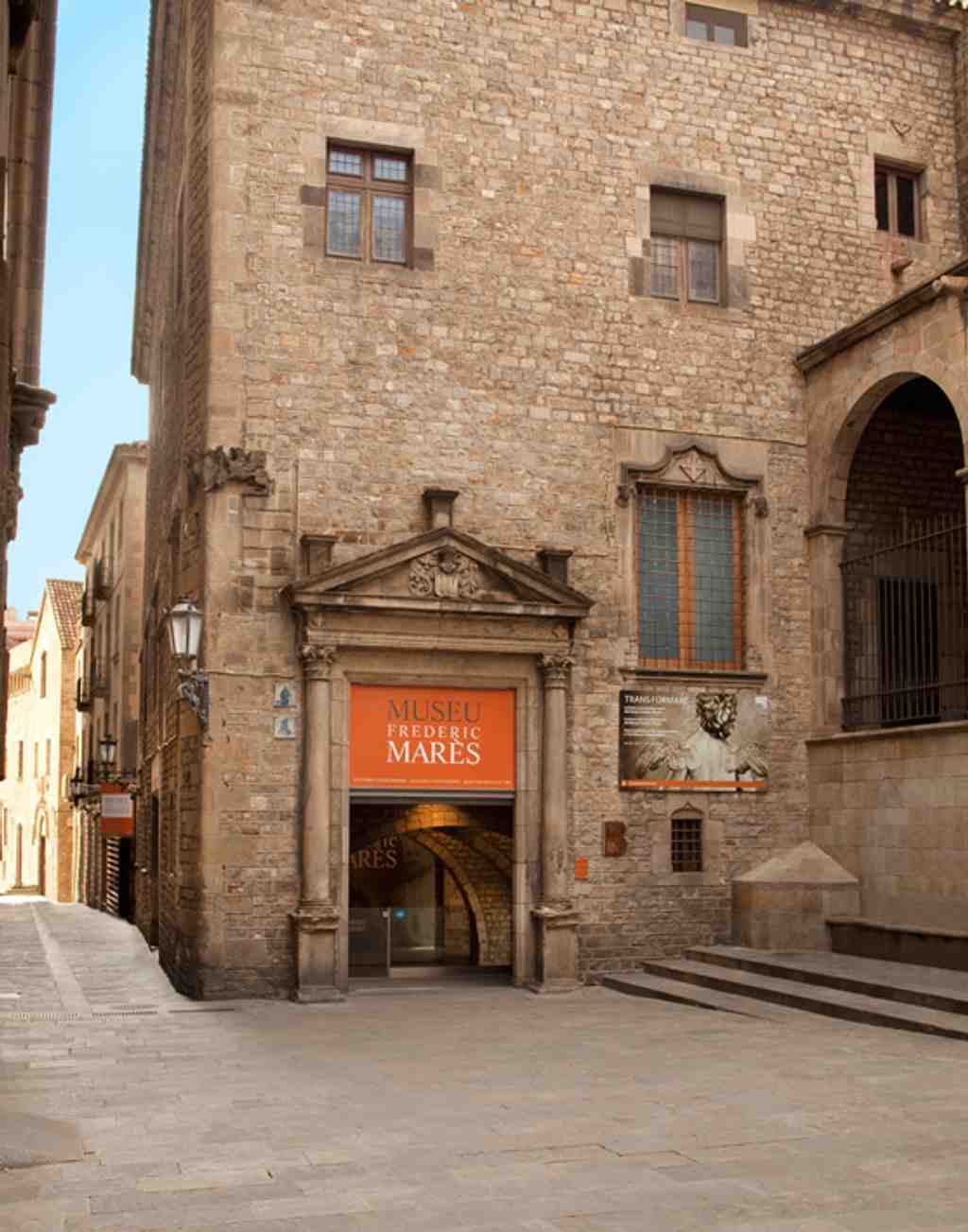
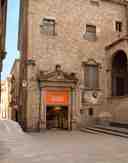
Museo Frederic MarsPhoto: Foto:Guillem F-H, Wikimedia Commons, CC BY-SA 3.0. Cropped & resized. Ahead on the right sits a tall, blocky stone building featuring a classical doorway where two stone columns support a triangular pediment over an arched entrance.
This is the Frederic Marès Museum. Meet Frederic Marès... a sculptor by trade, but an obsessive accumulator of history by nature. His drive to anchor the fleeting past in physical objects started when he was just four years old, carefully saving chocolate wrappers and colorful bits of paper. By the time he was an old man, that childhood habit had ballooned into an astonishing hoard of over fifty thousand items. Before this museum existed, his own house on Mallorca Street had become a chaotic labyrinth where priceless medieval carvings were stacked alongside early printed books and ticking clocks.
Inside, the Collector's Cabinet reveals a deeply intimate, eccentric catalog of human existence. It holds thousands of everyday artifacts... pipes, walking sticks, pocket watches. But the female room contains something a bit more unusual. You will find intricate jewelry and decorative pictures woven entirely out of human hair. This was a nineteenth century mourning tradition, crafting keepsakes from the locks of deceased loved ones. Step into the photography room, and you will find an unsettling collection of post-mortem portraits. Families would dress their recently deceased relatives, posing them as if they were merely sleeping, desperate for one final visual memory. It shows just how fiercely people fought to hold onto what was slipping away as the modern era marched forward.
Marès himself was a complex figure navigating a shifting society. During the Spanish Civil War, he actively rescued religious art from churches being looted or burned by revolutionary committees. He saw himself as a cultural savior. Yet, critical historians point out that the turbulent post-war era allowed wealthy collectors like him to acquire displaced masterpieces for almost nothing, sparking modern legal battles over the rightful ownership of these stolen treasures.
Even his own art was subjected to the push and pull of changing political tides. During the Republic, Marès sculpted a nude female figure called Victory. After the war, the new Franco regime decided to repurpose his statue to celebrate their own triumph. However, the strict national-catholic dictatorship found the statue's bare chest entirely too scandalous. They actually forced Marès to alter his own sculpture to cover her up.
Ironically, despite complying with the conservative dictatorship, Marès earned the nickname the hippie in his later years, simply because he wore his hair unusually long for an eighty year old man in that era.
If you want to explore his vast collections, the museum is open Tuesday through Saturday from 10 AM to 7 PM, and Sundays from 11 AM to 8 PM, remaining closed on Mondays. For now, let your eyes drift toward the towering structure nearby, and we will take a short walk over to the Barcelona Cathedral.
Mira hacia arriba: esa fachada de piedra clara se estira con una aguja central altísima, arcos apuntados llenos de filigrana y una auténtica guardia de estatuas alineadas en…Leer másMostrar menos
Abrir página dedicada →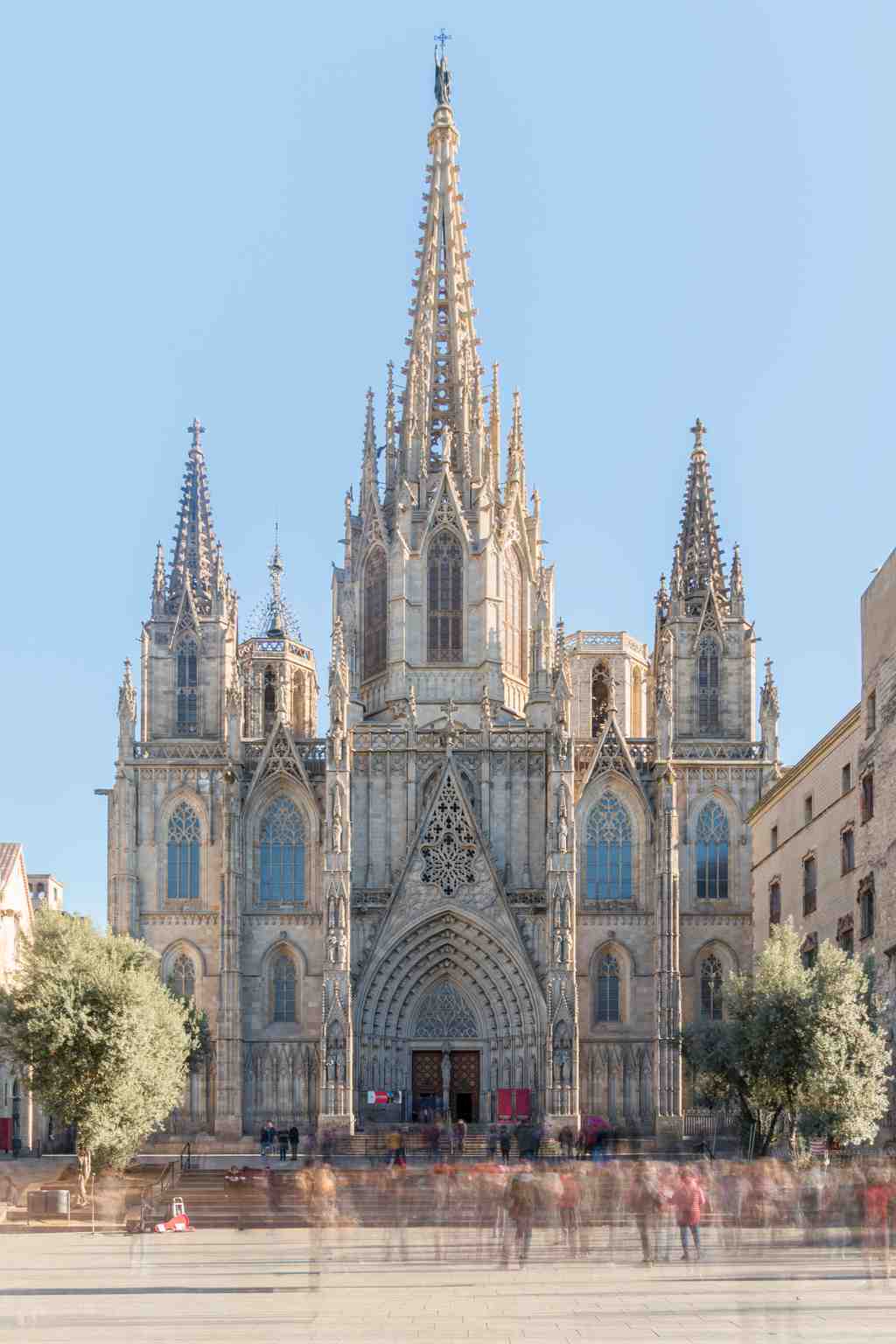
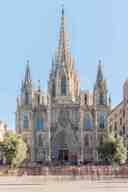
Catedral de BarcelonaPhoto: Fernando, Wikimedia Commons, CC BY-SA 4.0. Cropped & resized. Durante la Guerra Civil Española en 1936, toda esta antigua estructura casi desaparece convertida en cenizas. Anarquistas armados llegaron para incendiarla, pero un poeta anarquista convenció a la multitud de que la arquitectura pertenecía al pueblo. Ese llamamiento a los ideales modernos, combinado con el disparatado rumor de que cinco mil sacerdotes fuertemente armados se escondían en las laberínticas criptas, salvó el edificio. La catedral abre todos los días para visitas, aunque el horario es algo más reducido los domingos por la tarde. Alejémonos ahora de esta majestuosidad gótica y dirijámonos hacia los vibrantes puestos del Mercado de Santa Caterina, a unos cinco minutos a pie.
During the Spanish Civil War in 1936, this entire ancient structure nearly vanished into ash. Armed anarchists arrived to burn it down, but an anarchist poet convinced the mob that the architecture belonged to the people. That appeal to modern ideals, combined with a wild rumor that five thousand heavily armed priests were hiding in the labyrinthine crypts, saved the building.
The cathedral is open daily for visits, though the hours are slightly shorter on Sunday afternoons. Let us walk away from this Gothic majesty now and head toward the vibrant stalls of the Santa Caterina Market, about a five-minute walk away.
Fíjate en el edificio a tu derecha: abajo, una fila de arcos clásicos de piedra blanca, de los de toda la vida… y encima, como si alguien hubiera decidido que las olas también…Leer másMostrar menos
Abrir página dedicada →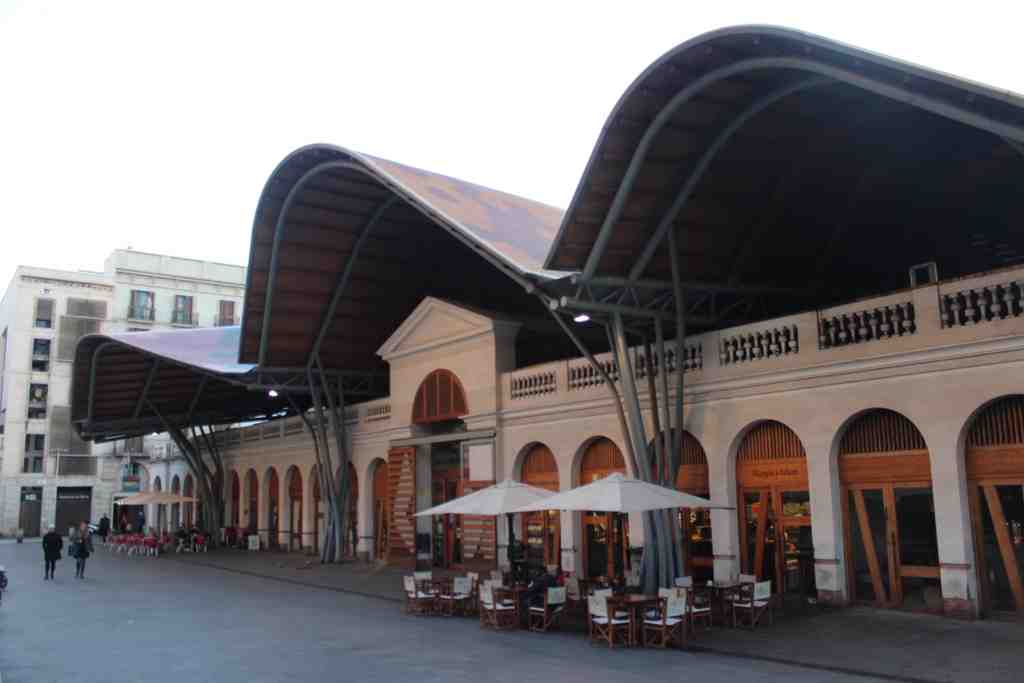
Mercado de Santa CaterinaPhoto: Albert Prat, Wikimedia Commons, CC BY-SA 4.0. Cropped & resized. Notice the building on your right, where a row of traditional white stone arches is dramatically overshadowed by a massive modern wavy roof supported by twisting metal pillars.
This is the Santa Caterina Market, the oldest covered market in the city. But to understand this place, we have to look past that striking roof and dig into the ashes underneath it. You see, this spot was originally a thirteenth-century Dominican convent. That came to a violent end during the same wave of anti-clerical riots in 1835 that we heard about earlier. An angry mob stormed the convent and set it ablaze. The monks fled for their lives as centuries of history, including a massive library, went up in smoke. The city government, practicing a policy of state confiscation, decided not to rebuild. Instead, they cleared the ruined cloisters and built the neoclassical market you see the bones of today.
For a long time, this place was the gritty heart of neighborhood survival. During the harsh years following the Spanish Civil War, marked by extreme rationing, these stalls and the narrow alleys around them became an epicenter for the black market. Underneath the counters, desperate locals and cunning smugglers traded basic food items at astronomical prices, just trying to outlast the economic collapse.
Fast forward to 1997, and the city decided it was time for an upgrade. They brought in a husband and wife architectural team, Enric Miralles and Benedetta Tagliabue, who designed that incredible undulating roof. It is covered in a massive mosaic of over four thousand square meters, using a technique called trencadis, where broken ceramic shards are pieced together to form patterns. The colors represent the vibrant fruits and vegetables sold inside. But it is not just pretty. Those complex parabolic curves act as a natural ventilation system, pulling hot air up and out so the market stays cool without heavy air conditioning.
But pushing into the future is rarely simple, especially when the foundations of your new vision are built on literal ruins. When the construction crews started digging, they hit a massive archaeological jackpot... uncovering the medieval convent foundations, a Roman necropolis, and a Bronze Age settlement. Four thousand years of history were sitting right under the produce aisle. The city mandated that the ruins be preserved, which triggered a logistical nightmare and delayed the grand opening by four long years. The stall owners had to survive in a temporary tent outside, and sadly, many family businesses did not make it.
The project also suffered a profound personal tragedy. In the year 2000, Enric Miralles was diagnosed with a brain tumor and passed away at just forty-five. His wife, Benedetta, had to finish the monumental task alone. When she finally opened the doors in 2005, the market became not just a marvel of modern urban life, but a vibrant tribute to her late husband.
Feel free to step inside if they are open... the market operates Monday through Saturday, though it is closed on Sundays. Next, we are heading toward a true jewel of Catalan music, the Palau de la Musica Catalana, which is just a five-minute walk away.
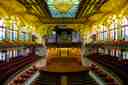
Mira la pantalla un momento e imagina el corazón del Palau: arcos amplios forrados de cerámica, un gran órgano de tubos enmarcando el escenario de madera y, arriba, una cúpula…Leer másMostrar menos
Abrir página dedicada →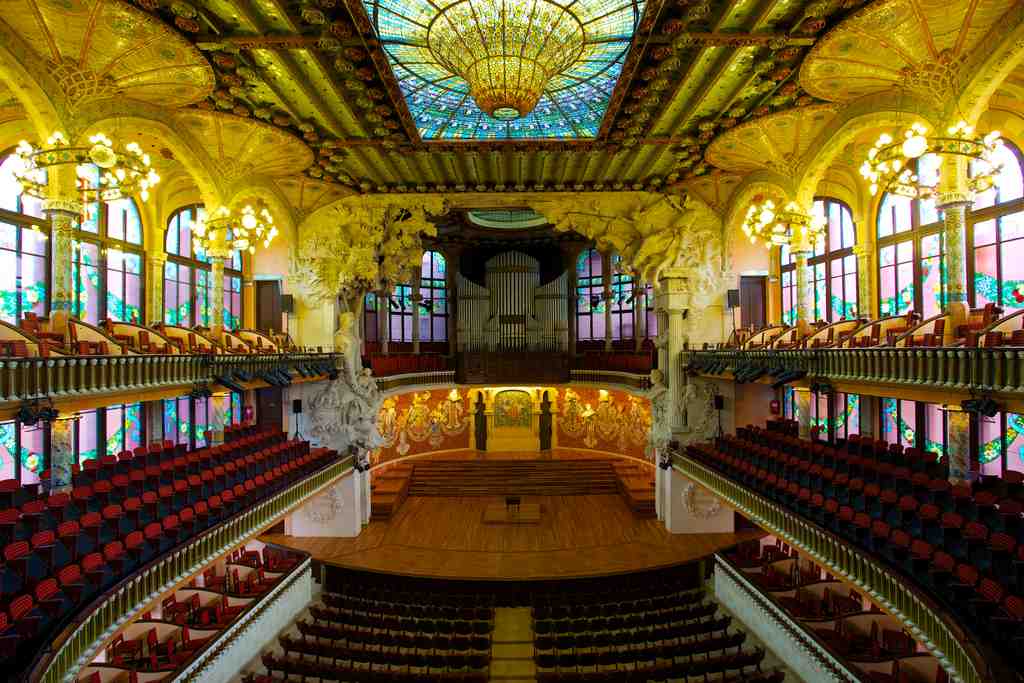
Palacio de la Música CatalanaPhoto: Jiuguang Wang, Wikimedia Commons, CC BY-SA 3.0 ES. Cropped & resized. Mire de cerca su pantalla para imaginar el corazón de este lugar emblemático, un espacio impresionante definido por amplios arcos de baldosas de cerámica, un majestuoso órgano de tubos que enmarca el escenario de madera y una espectacular cúpula invertida de vitrales que irradia desde el techo. Se encuentra frente al Palacio de la Música Catalana, una obra maestra absoluta del modernismo catalán. Diseñado por el visionario arquitecto Lluís Domènech i Montaner y construido entre 1905 y 1908, este edificio fue concebido como la sede de una querida sociedad coral local. Domènech i Montaner era conocido por su obstinación con su arte. Quería construir un faro reluciente para su cultura, negándose a escatimar gastos incluso en un lado del edificio que daba a un callejón estrecho y oculto. Insistió en usar ladrillo rojo de primera calidad y pilares intrincadamente esculpidos donde casi nadie los vería. Esta dedicación sin concesiones hizo que el presupuesto se disparara de 450.000 pesetas a más de 900.000, una cantidad equivalente a unos cuatro millones de dólares actuales. La sociedad coral tuvo grandes dificultades para cubrir los costes, pero su sacrificio le dio a la ciudad una joya de la corona. El interior es tan abrumadoramente bello que los visitantes a veces sufren el síndrome de Stendhal. Se trata de una condición psicológica real en la que la exposición a un arte intenso y magnífico provoca palpitaciones y mareos. El enorme lucernario de vitrales pesa varias toneladas y desciende como un sol radiante y multicolor... bañando al público en una explosión de luz. Este gran salón a menudo ha servido como campo de batalla entre las densas sombras de la historia y un feroz deseo de supervivencia cultural. En 1960, durante una dictadura brutal, las autoridades prohibieron cantar un himno tradicional catalán aquí. Pero cuando comenzó el concierto, el público se puso valientemente de pie y lo cantó de todos modos. Un joven médico fue arrestado y torturado simplemente por su papel en la protesta, y sin embargo, esa canción desafiante resonó mucho más allá de estos muros, provocando un despertar político en la región. Décadas más tarde, el edificio se enfrentó a un tipo de amenaza muy diferente. En 2009, se destapó un enorme escándalo de corrupción. Unos gestores corruptos habían desviado millones de euros de la institución, utilizando incluso fondos públicos para celebrar fastuosas bodas privadas dentro de la histórica sala de conciertos. Fue una traición audaz. Sin embargo, la comunidad se negó a permitir que su amado santuario cayera en la ruina. Cuando el majestuoso órgano de tubos enmudeció tras décadas de deterioro, ciudadanos de a pie y empresas locales se unieron para patrocinar tubos individuales, financiando por completo su intrincada restauración. No importa qué momentos oscuros hayan puesto a prueba este lugar, la música y la visión de la gente de un futuro mejor siempre han avanzado hacia la luz. Mantengamos presente ese espíritu duradero mientras avanzamos hacia un verdadero monumento a la resistencia, el Monumento a Rafael Casanova, que se encuentra a solo siete minutos a pie.
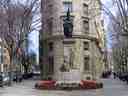
A tu izquierda, fíjate en ese pedestal de piedra tan alto, decorado con figuras femeninas talladas. Encima, una estatua de bronce oscuro: un hombre que sujeta una bandera larga,…Leer másMostrar menos
Abrir página dedicada →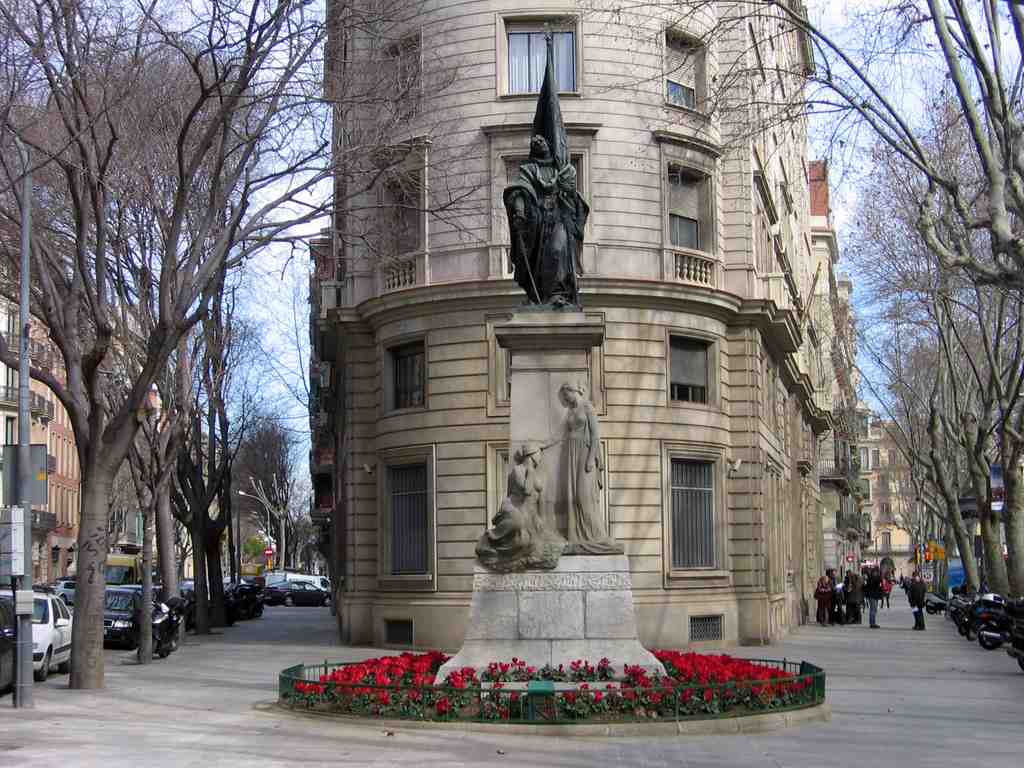
Monumento a Rafael CasanovaPhoto: Canaan, Wikimedia Commons, CC BY-SA 3.0. Cropped & resized. En realidad, Casanova sobrevivió. Fue llevado en secreto a un hospital, se disfrazó de fraile y vivió sus días bajo un nombre falso hasta que fue indultado discretamente años después. Pero el recuerdo de su resistencia se convirtió en un poderoso fantasma que las autoridades posteriores intentaron borrar desesperadamente. En 1939, el nuevo régimen autoritario ordenó que esta estatua fuera fundida para convertirla en bronce bruto y así hacer borrón y cuenta nueva. Pero en un acto silencioso de rebelión, el propio alcalde de la ciudad ignoró la orden en secreto. Hizo desmontar cuidadosamente la figura de bronce y esconderla en un polvoriento almacén de la calle Wellington. Durante casi cuarenta años, este héroe caído permaneció en la oscuridad, una reliquia de un pasado doloroso esperando a que pasara la marea de la historia mientras las visiones de una ciudad modernizada tomaban forma sobre él. Finalmente fue devuelto a la luz en 1977, durante la transición española a la democracia. Si desea ver cómo ha evolucionado este espacio a lo largo del siglo, consulte el control deslizante de antes y después en su pantalla. Muestra una reunión conmemorativa masiva justo aquí en 1908, en comparación con los recientes y cuidadosos esfuerzos de restauración. Es un testimonio de cómo las heridas más profundas de la historia se arrastran hacia adelante, luchando silenciosamente con el empuje hacia el mañana. Mientras le observa, piense qué haría si su ciudad estuviera rodeada y a punto de caer... ¿Mantendría su posición? Al ser un espacio público, este monumento está abierto las veinticuatro horas del día. Ahora, caminemos hacia la gran entrada de la era moderna mientras nos dirigimos al Arco de Triunfo.
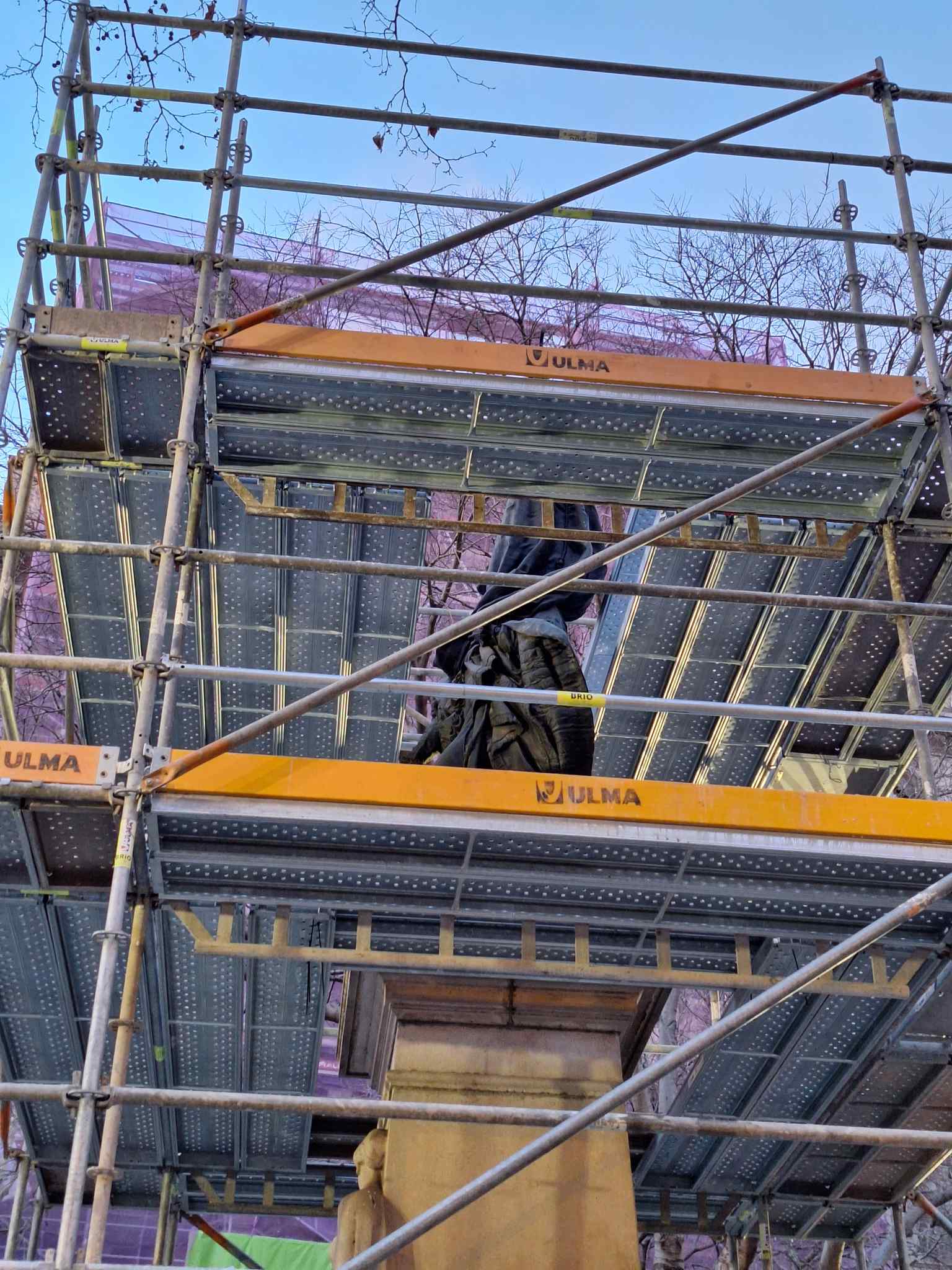
Esta imagen de 1908 de "La Ilustració Catalana" muestra un temprano homenaje de la Diada de Cataluña, ilustrando cómo las ofrendas florales ante el monumento se convirtieron en un potente símbolo de la identidad catalana.Photo: Pere López Brosa, Wikimedia Commons, CC BY-SA 4.0. Cropped & resized. Casanova actually survived. He was smuggled into a hospital, disguised himself as a friar, and lived out his days under a fake name until he was quietly pardoned years later. But the memory of his stand became a powerful phantom that later authorities tried desperately to erase.
In 1939, the new authoritarian regime ordered this statue to be melted down into raw bronze to wipe the slate clean. But in a quiet act of rebellion, the city's own mayor secretly ignored the order. He had the bronze figure carefully dismantled and hidden away in a dusty warehouse on Wellington Street.
For nearly forty years, this fallen hero sat in the dark, a relic of a painful past waiting out the tide of history while visions of a modernized city took shape above him. He was finally brought back into the light in 1977 during Spain's transition to democracy. If you want to see how this space has evolved over the century, check out the before and after slider on your screen. It shows a massive memorial gathering right here in 1908, compared to recent careful restoration efforts. It is a testament to how the deepest wounds of history are carried forward, quietly wrestling with the push toward tomorrow.
As you look up at him, consider what you would do if your city was surrounded and falling... Would you stand your ground?
Since it is a public space, this monument is open twenty-four hours a day. Now, let's walk toward the grand entryway of the modern era, as we make our way to the Arc de Triomf.
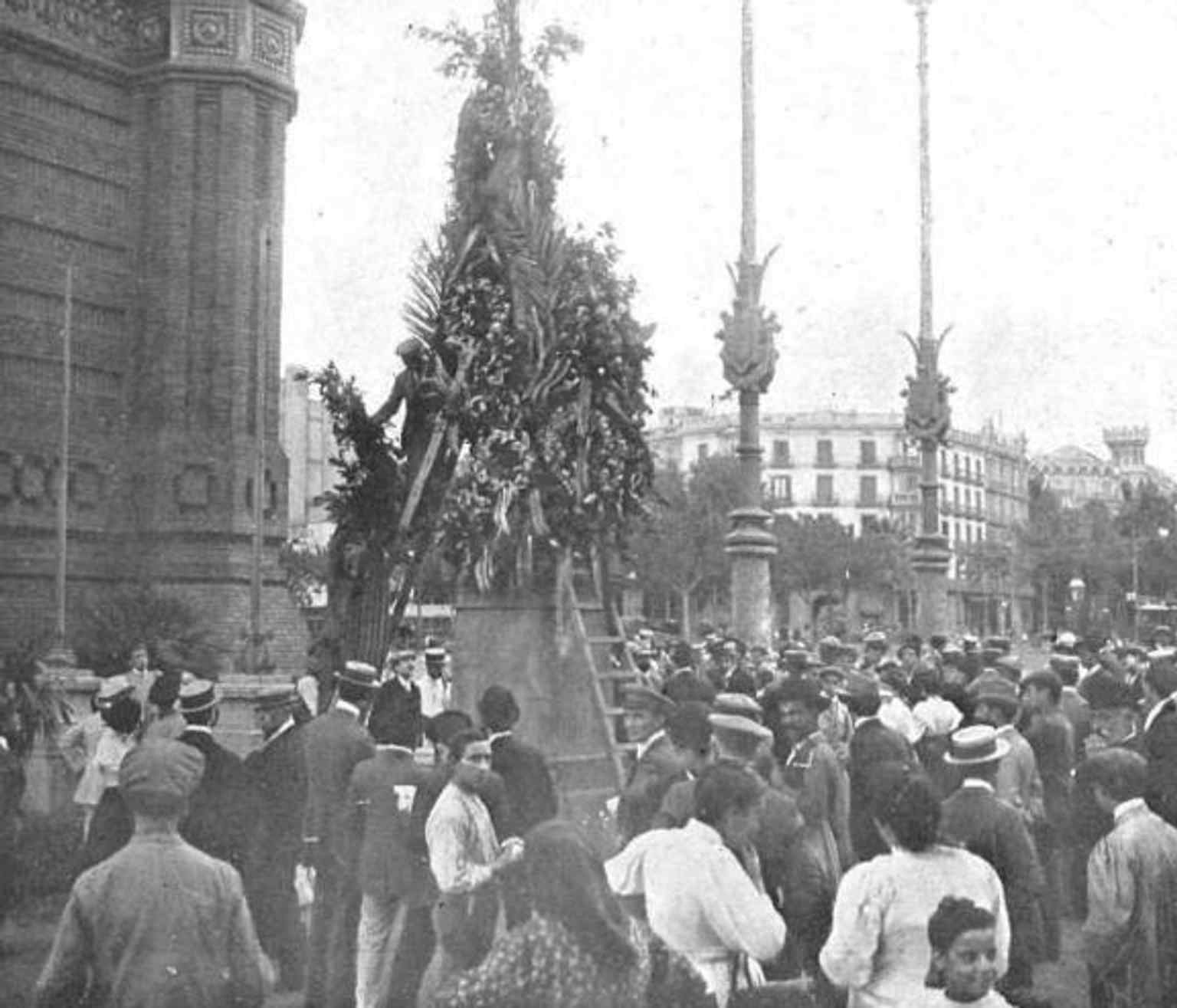
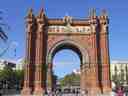
This 1908 image from "La Ilustració Catalana" shows an early Diada de Cataluña tribute, illustrating how floral offerings at the monument became a potent symbol of Catalan identity.Photo: Frederic Ballell i Maymí, Wikimedia Commons, Public domain. Cropped & resized. Justo delante tienes un arco enorme de ladrillo rojo, rematado con frisos de piedra blanca llenos de detalles y escoltado por torres decorativas en las esquinas... Y ojo: esto no…Leer másMostrar menos
Abrir página dedicada →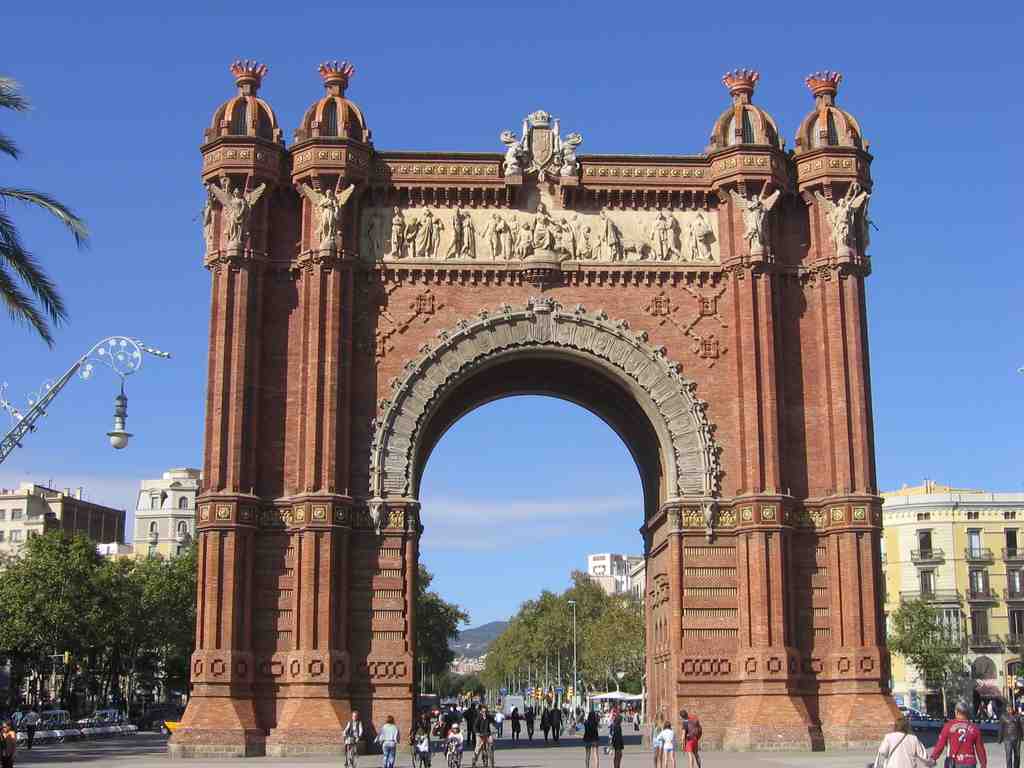
Arco de TriunfoPhoto: Canaan, Wikimedia Commons, CC BY-SA 3.0. Cropped & resized. Straight ahead stands a massive arch made of striking red brick, crowned with intricate white stone friezes and flanked by tall, decorative corner towers.
Unlike the cold marble monuments scattered across Europe that were built to celebrate military conquests and bloody battlefield victories, this gateway was designed to honor a purely civic triumph. It was built as the grand, welcoming entrance for the 1888 Universal Exposition. The 1888 Universal Exposition was a massive global fair that forced the city to modernize rapidly, serving as a glittering stage to show off Barcelona's soaring industrial might to the rest of the world. It fit perfectly into the progressive spirit of Cerda's Ensanche Plan, which was actively pulling Barcelona out of its cramped medieval history and into a bold, expansive new era.
The design of this arch perfectly captures the friction of that changing world. You might hear a very persistent urban legend that a French engineer named Gustave Eiffel actually pitched his famous iron tower for this exact spot, and the city rejected it for being a monstrous, expensive eyesore. While historians have completely debunked that myth, the story survives because it illustrates the real architectural anxiety of the time. It highlights the cultural tug of war between cold, ultra-modern iron structures and the warm, historically rooted brickwork that ultimately won out here.
The architect, Josep Vilaseca, designed this in the neo-Mudejar style, a revival architectural movement that blended traditional Moorish and European elements. Using exposed red brick instead of noble stone was also a brilliant economic move. The arch cost a mere one hundred and fifty four thousand pesetas to build, which equates to just a few thousand dollars today. But more importantly, the humble material connected this grand monument directly to the local working class and the booming regional brick industry.
If you look closely at the columns, you will spot stone bats carved into the structure. The bat was the emblem of King James the First of Aragon, and became a powerful symbol of good fortune in Catalan design.
Yet, the wide avenue leading up to the arch hides a darker tale of how the past is often forcibly erased by new visions of the future. The promenade used to be lined with eight grand bronze statues of Catalan heroes. During the turbulent years of the Spanish Civil War, most were yanked from their pedestals. Then, in 1950, authorities melted down five of those historic bronzes to forge a giant religious statue of the Virgin Mary for a local basilica. The old secular heroes were quite literally consumed to build the new regime's cultural vision. Luckily, as with the monument to Rafael Casanova, one statue was secretly hidden in a dark warehouse, surviving the ideological purge before finally being rescued.
This magnificent gateway is open twenty four hours a day, standing as a permanent welcome to anyone who wanders by. Let us pass straight through the arch now and follow the wide promenade toward the park, where the Castle of the Three Dragons is just a six minute walk away.
A tu derecha tienes una fortaleza cuadrada nada discreta: ladrillo rojo a la vista, almenas defensivas y, en la esquina, una torre tan decorada que parece competir con el…Leer másMostrar menos
Abrir página dedicada →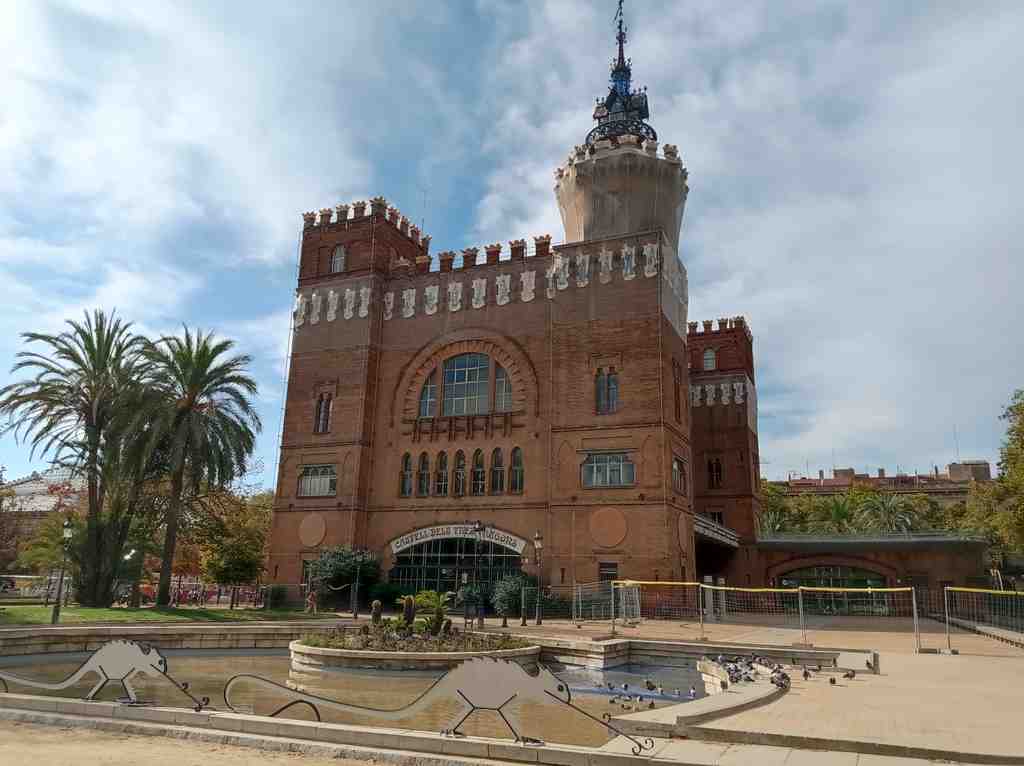
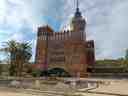
Castillo de los Tres DragonesPhoto: Canaan, Wikimedia Commons, CC BY-SA 4.0. Cropped & resized. Después de la exposición, mientras otros enormes pabellones fueron rápidamente demolidos, este castillo se salvó. El arquitecto finalmente regresó a su obra maestra inacabada y la transformó en un taller enérgico y bohemio. Reunnió a herreros, vidrieros y mosaistas para experimentar. Querían rescatar oficios medievales olvidados de la historia y hacerlos chocar con materiales industriales modernos como el hierro bruto. Esa tensión específica, mirar hacia los oficios tradicionales para alimentar un futuro visionario, sentó las bases prácticas del modernismo catalán. Por supuesto, un edificio así de antiguo acarrea algunas sombras pesadas. Durante la Guerra Civil Española, los bombardeos fascistas destruyeron el colosal vitral del castillo, una obra maestra que antaño inundaba el interior de luz. En los sombríos años de la posguerra, el espacio se convirtió en un comedor de beneficencia. Las estancias enormes y aireadas diseñadas originalmente para que la burguesía internacional tomara finos licores se llenaron de repente de ciudadanos empobrecidos que hacían cola para recibir raciones de supervivencia. Continuemos nuestro paseo adentrándonos más entre los árboles. Entraremos de lleno en el Parque de la Ciudadela en solo unos minutos.
After the exposition, while other massive pavilions were quickly demolished, this castle was spared. The architect eventually returned to his unfinished masterpiece and transformed it into an energetic, bohemian workshop. He gathered blacksmiths, glassmakers, and mosaicists to experiment. They wanted to pull forgotten medieval crafts out of history and collide them with modern industrial materials like raw iron. That specific tension, looking backward to traditional crafts to fuel a visionary future, laid the practical groundwork for Catalan Modernism.
Of course, a building this old carries some heavy shadows. During the Spanish Civil War, fascist bombers destroyed the castle's colossal stained-glass window, a masterpiece that once flooded the interior with light. In the grim post-war years, the space was turned into a charity dining hall. The massive, airy rooms originally designed for the international bourgeoisie to sip fine liqueurs were suddenly filled with impoverished citizens lining up for survival rations.
Let's continue our walk deeper into the trees. We will transition fully into Ciutadella Park in just a few minutes.
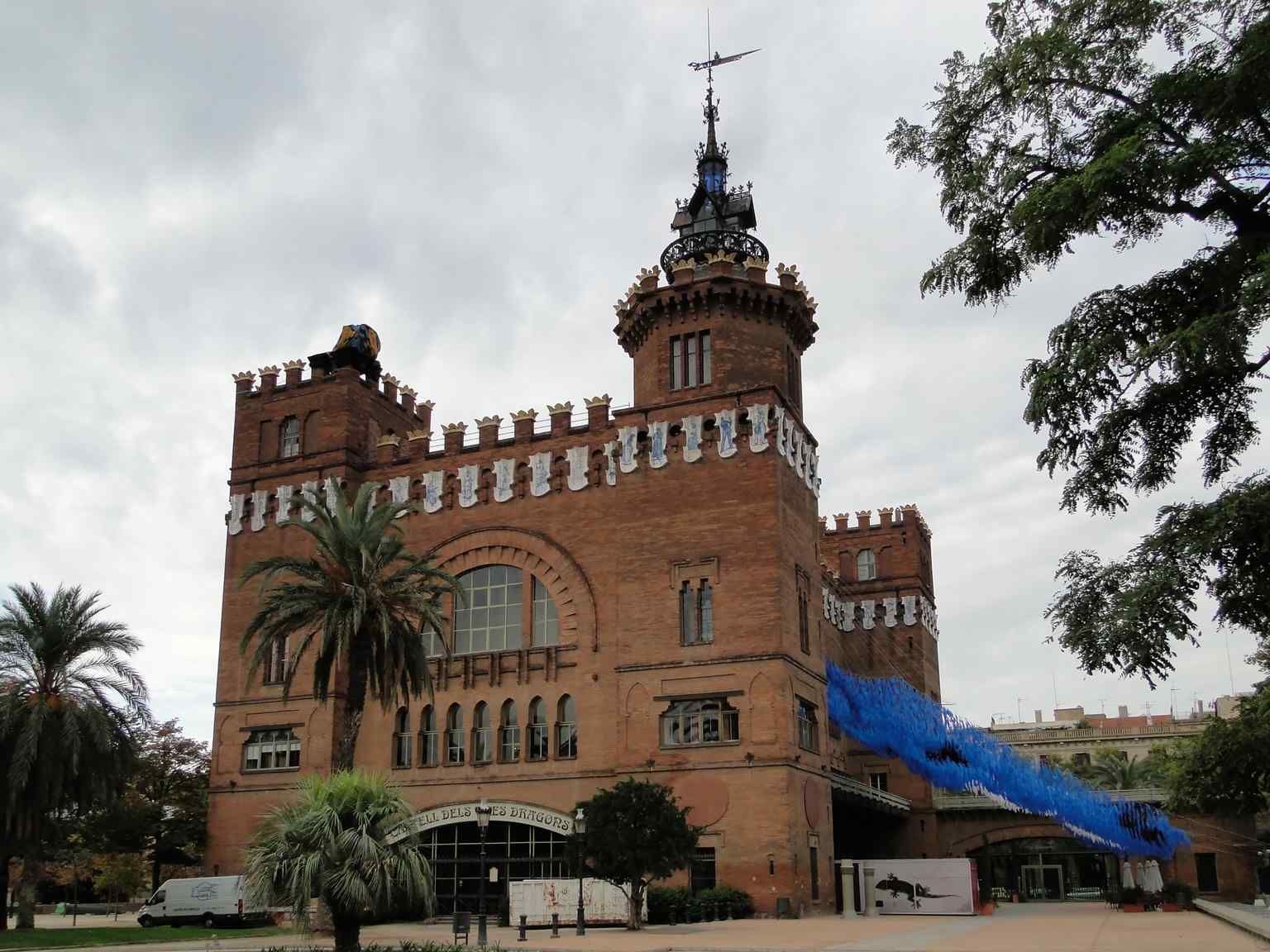
This view captures the striking modernist architecture of the Castle of the Three Dragons, built with visible brick and iron, featuring battlements and a castle-like design.Photo: Bernard Gagnon, Wikimedia Commons, CC BY-SA 3.0. Cropped & resized.
Preguntas frecuentes
¿Cómo empiezo el tour?
Después de la compra, descarga la app AudaTours e ingresa tu código de canje. El tour estará listo para comenzar de inmediato - solo toca play y sigue la ruta guiada por GPS.
¿Necesito internet durante el tour?
¡No! Descarga el tour antes de empezar y disfrútalo completamente sin conexión. Solo la función de chat requiere internet. Recomendamos descargar en WiFi para ahorrar datos móviles.
¿Es un tour guiado en grupo?
No - esta es una audioguía autoguiada. Exploras de forma independiente a tu propio ritmo, con narración de audio reproduciéndose en tu teléfono. Sin guía, sin grupo, sin horario.
¿Cuánto dura el tour?
La mayoría de los tours toman 60–90 minutos para completar, pero tú controlas el ritmo completamente. Pausa, salta paradas o toma descansos cuando quieras.
¿Qué pasa si no puedo terminar el tour hoy?
¡No hay problema! Los tours tienen acceso de por vida. Pausa y continúa cuando quieras - mañana, la próxima semana o el próximo año. Tu progreso se guarda.
¿Qué idiomas están disponibles?
Todos los tours están disponibles en más de 50 idiomas. Selecciona tu idioma preferido al canjear tu código. Nota: el idioma no se puede cambiar después de generar el tour.
¿Dónde accedo al tour después de comprarlo?
Descarga la app gratuita AudaTours desde App Store o Google Play. Ingresa tu código de canje (enviado por email) y el tour aparecerá en tu biblioteca, listo para descargar y comenzar.
Si no disfrutas el tour, te reembolsamos tu compra. Contáctanos en [email protected]
Paga de forma segura con 





.jpg)


