
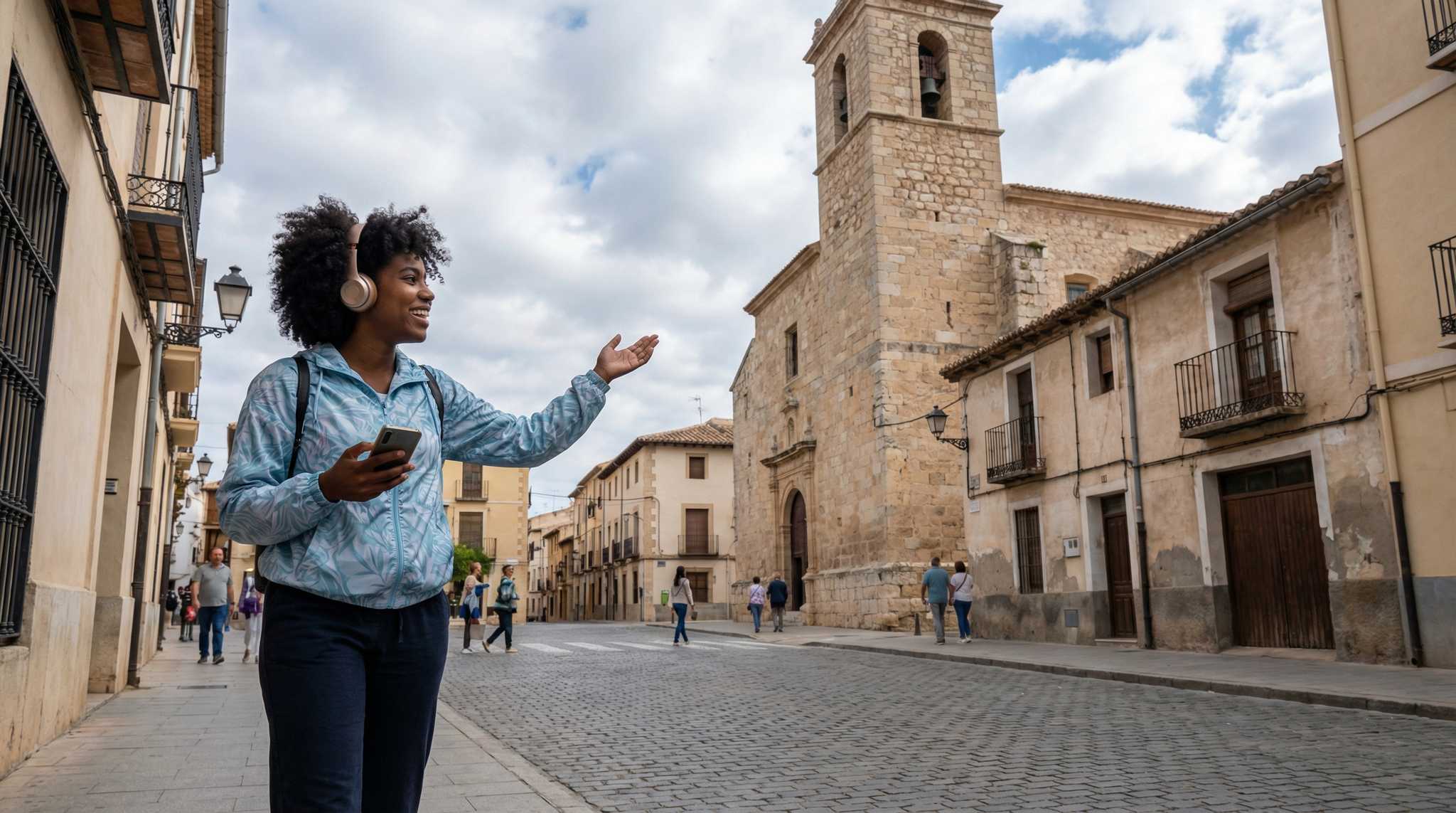
Villena Audio Tour: Echoes of Legends and Timeless Treasures
A lone stone tower rises above Villena throwing its shadow across centuries of ambition betrayal and devotion. Beneath its storied walls and winding streets lie secret histories waiting to be found. This self-guided audio tour leads from the imposing Watchtower Castle to the intricate arches of the Archpriestly Church of Santiago and through labyrinthine lanes of the historic center. Experience Villena by unearthing murmurs and legends most travelers never hear. Why did a midnight uprising nearly set the castle ablaze? What hidden symbols in the church hint at forbidden orders? Who vanished from a sunlit plaza after a scandal so quiet it was nearly erased from every record? Trace footsteps through cobbled alleys and echoing chambers. Each corner pulls you deeper into plots royal and rebellious. See Villena through a lens of danger wonder and the thrill of discovery. Begin the journey and uncover what the shadow of the tower still guards.
Tour preview
About this tour
- scheduleDuration 70–90 minsGo at your own pace
- straighten1.8 km walking routeFollow the guided path
- location_on
- wifi_offWorks offlineDownload once, use anywhere
- all_inclusiveLifetime accessReplay anytime, forever
- location_onStarts at Monument to Ruperto Chapí
Stops on this tour
lock_open 3 free previews · 10 unlock with purchase
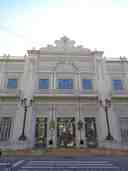
On your left stands a commanding edifice defined by its pale, classical facade with tall columns and a triangular pediment, which oddly contrasts with the reddish, intricate…Read moreShow less
On your left stands a commanding edifice defined by its pale, classical facade with tall columns and a triangular pediment, which oddly contrasts with the reddish, intricate brickwork adorning the side walls. It is magnificent, isn't it? But to understand the soul of this place, we must look past the stone and imagine the sand. Long before this grand theater stood here, there was a simple chapel attached to an old hospital. In eighteen forty-two, that modest space hosted a performance that seems almost dreamlike today. A troupe known as the "Company of Arabs" or "Beni-Zoug-Zoug" arrived in Villena. Thirty performers from the depths of the Sahara Desert stood right here, filling that small religious hall with the rhythms and movements of North Africa. That exotic spark lit a fire in the people of Villena, a hunger for spectacle that would eventually outgrow the chapel walls. The true turning point, however, came from a burst of local pride. A group of neighbors traveled to the coast, to Alicante, to see a performance of La Tempestad, or "The Tempest." It was a zarzuela written by Villena’s own favorite son, Ruperto Chapí. The music was so stirring, so powerful, that the neighbors returned home with a singular resolve. They decided their town deserved a stage worthy of such genius. And so, the first Teatro Chapí rose in eighteen eighty-five. That opening night was legendary. Ruperto Chapí himself stood on the podium, baton in hand, conducting La Tempestad for his own people. The building was mostly wood then, with a floor of simple earth. It was humble, but it was theirs. Yet, wood rots and tastes change. By nineteen fourteen, the town demanded something permanent, something monumental. This is where the story becomes one of collective love. To fund this new palace of the arts, the "Junta Constructora" issued shares for twenty-five pesetas. In the early twentieth century, that was a significant sum, perhaps equal to several days of wages for a laborer. Yet, ordinary citizens scraped their savings together to buy a brick in this dream. Look closely at the building again. Do you notice how the front looks nothing like the sides? The construction was... complicated. The first architect, José María Manuel Cortina, designed a fantasy in the Neo-Mudéjar style. This is an architectural movement that revived the intricate, geometric brickwork of Spain's Islamic past. You can see his vision on the side walls-colorful, textured, and romantic. But money ran out, and he left the project. When new architects took over years later, they ignored his plans and finished the main facade in the serious, classical style you see today. It is a building with two faces, a permanent memory of its troubled birth. When it finally opened in nineteen twenty-five, the maestro Chapí had passed away. But the town honored him. They performed La Tempestad once more. In the box of honor sat his widow, Vicenta Selva. As the music swelled, the applause was as much for her as for the stage. But this theater has seen tragedy as well as triumph. During the Spanish Civil War, the velvet seats and music faded. The theater was seized and transformed into a "Hospital of Blood." Three hundred beds filled these halls, tending to the wounded while bombs fell on the city outside. It was a guardian of life, not just art. It took decades, and a long dispute over the lobby with the neighboring agricultural club, to restore it to the glory you see now. But the people of Villena never let it go. Now, let's discover something far more valuable than a play.
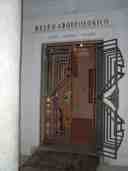
Open dedicated page →Look for the white doorway framing a striking geometric metal gate, with the name "Jose Maria Soler" gleaming in gold letters just above the entrance. You are standing before a…Read moreShow less
Look for the white doorway framing a striking geometric metal gate, with the name "Jose Maria Soler" gleaming in gold letters just above the entrance. You are standing before a place that, for decades, held the heart and history of this region. This building is not just a museum; it is a monument to curiosity and the man whose name is written above the door: José María Soler. To understand the treasures that were kept here, you must first understand the man who found them. Soler was not a wealthy aristocrat or a university professor with endless funding. He was a postman. After the Spanish Civil War, he lost his position at the post office for political reasons. It was a dark time, but Soler did not let it break him. Instead, he turned to the land. He walked every inch of these hills, his eyes scanning the ground, learning to read the soil better than any book could teach. He became a self-taught scholar, a guardian of secrets that had been buried for thousands of years. And then, in 1963, the earth finally spoke back to him. It began with a simple twist of fate. A local mason was sifting sand for construction work when he found a dirty, heavy bracelet. His wife took it to a jeweler, who scraped away the grime and saw the unmistakable glint of gold. They called Soler immediately. The postman-turned-archaeologist traced that sand back to a dry riverbed called the Rambla del Panadero. Imagine the scene. It is the first of December. Soler and his team are digging in the dirt. The sun is setting, the light is failing, and they are exhausted. They are just about to give up for the day when a hoe strikes something hard. Clink. They brushed away the earth and found a ceramic vessel. Inside, and scattered around it, was something that would change history: The Treasure of Villena. It was a hoard of sixty-six pieces. Eleven bowls of beaten gold, twenty-eight bracelets, bottles of silver and gold. In total, they pulled ten kilograms of gold from the ground. It remains the most important prehistoric treasure ever found in Europe, a collection so vast and precious it rivals the great finds of Mycenae. But here is the part of the story that feels most human. That night, after pulling a king's ransom from the mud, Soler and his team realized they had a problem. There was no secure vault, no police escort ready for such a sudden discovery. So, they did what they had to do. They split the treasure up and took it home. Picture these men, simple workers and a former postman, sleeping that night with pounds of ancient gold hidden under their beds and in their wardrobes, guarding a fortune that belonged to history. For years, this building you are looking at served as the home for those wonders. But the collection was more than just shiny metal. Recently, scientists discovered something even more miraculous about the treasure. Two of the iron pieces found with the gold were not made of earth-born metal. They were crafted from meteoritic iron. That means the artisans of the Bronze Age, three thousand years ago, were forging jewelry from a fallen star. Eventually, the treasure outgrew this space. The collection has now moved to a new, larger home in an old flour mill and power plant called the MUVI, ensuring that Soler’s legacy has the room it deserves. But Soler wasn't the only one in Villena with a passion for collecting the past. While he looked for the gold of kings, others looked for the clay of the common people. Let’s continue our walk. We are going to head to a place that celebrates a much more humble, yet equally vital, part of life.
Open dedicated page →
Show 10 more stopsShow fewer stopsexpand_moreexpand_less
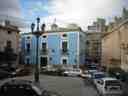
Look for the traditional multi-story house featuring a classic flat facade and simple balconies that blend quietly into the residential street. We have just come from seeing the…Read moreShow less
Look for the traditional multi-story house featuring a classic flat facade and simple balconies that blend quietly into the residential street. We have just come from seeing the golden Treasure of Villena, but this next stop celebrates a treasure made of humble earth and clay. This is the Museo del Botijo, or the Jug Museum. The story of this place is quite literally a love story about loneliness. It all began in nineteen-seventy with a single object... a drinking jug made of cork and metal that belonged to the founder's mother-in-law, Dolores. The founder, a man named Pablo Castelo Villaoz, placed this gift in a special spot in his home. But every time he looked at it, he felt a pang of sadness. He thought the jug looked... lonely. To cure this solitude, Pablo decided to buy a few more jugs to keep the first one company. Well, that cure turned into what his family called a fever. Soon, he was rescuing jugs from all over the world-Russia, Turkey, Argentina. Just like our friend José María Soler, the postman who found the gold at our last stop, Pablo had a special eye for value where others saw only common things. He filled this house, which still preserves its original nineteen-hundreds kitchen and structure, with over twelve hundred examples. You would not believe the shapes they take. Some look like people, others like animals, and some even mimic architecture. His passion was infectious. Once, a pilot from Aeroméxico visited and was so enchanted that he and Pablo shared a bottle of tequila right then and there to celebrate. Months later, a package arrived from Mexico with a new little jug, a gift from the pilot to the guardian of these treasures. While most of these vessels are simple clay, Pablo did find his own version of gold. The crown jewels here are two eighteenth-century pieces from Manises, glowing with a metallic gold luster on white glass. They are rare masterpieces of pottery. Pablo always said, These are not mine, they are everyone's. He turned his private home into a sanctuary for these forgotten objects so we could all enjoy them. Now, let's leave this intimate collection and walk to the open heart of the city at the Plaza de Santiago.
Open dedicated page →On your left opens a spacious, irregularly shaped plaza paved in stone, dominated by the tall, pale masonry of a church and the elegant, arched facade of the Town Hall beside…Read moreShow less
On your left opens a spacious, irregularly shaped plaza paved in stone, dominated by the tall, pale masonry of a church and the elegant, arched facade of the Town Hall beside it. Welcome to the Plaza de Santiago. For centuries, standing right here meant you were standing in the very heart of Christian Villena. It was a deliberate boundary, a world away from the older Arab quarter near the mosque that we will visit later on. This square was designed to be a declaration of identity, built by powerful guardians who wanted to leave a mark that would outlast them. One of those key figures was Pedro de Medina. In fifteen ten, he commissioned the building that serves as the Town Hall today. Back then, however, it was a quiet abbey for the clergy. He didn’t hire just anyone to build it. He brought in Jacopo Torni, a man known as "El Florentino." Jacopo was a disciple of the great Michelangelo. It is fascinating to think of a student of the Italian Renaissance master working right here in Villena. Jacopo actually died here in fifteen twenty-six, leaving his final artistic breath in the courtyard of that building. As you look around, you can see how different centuries serve as guardians of different styles. You have the Gothic grandeur of the church, the Renaissance grace of the Town Hall, and the modern lines of the Casa de la Cultura. That modern building, built in nineteen eighty-seven, sparked quite a conflict. To build it, the city had to sacrifice a block of old homes, including one belonging to a well-known neighbor called "Maria of the Stockings." Many locals were heartbroken. They called the new structure a "monstrosity" because it rose up and blocked the traditional view of the castle. But perhaps the most stubborn guardian of this square was Virtudes Mergelina, who built the Casa Selva here in the nineteenth century. Her family called her "Aunt Vinegar" because of her difficult character. She separated from her husband shortly after their wedding and refused to ever speak his name again. While these stories survived, other treasures were not so lucky. During the Spanish Civil War in nineteen thirty-six, the church’s archives were destroyed. Centuries of history turned to ash. But while the paper is gone, the stone remains. The Church of Santiago holds a rare architectural secret inside-columns that look as if they are spinning, defying the weight they carry. Let’s move toward the church entrance now to see this twist in the stone.
Open dedicated page →Look up at the imposing pale stone facade before you, dominated by a robust square bell tower and the intricate Renaissance carvings that frame the main portal like a stone…Read moreShow less
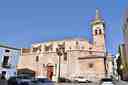
Look up at the imposing pale stone facade before you, dominated by a robust square bell tower and the intricate Renaissance carvings that frame the main portal like a stone tapestry. This grand structure, the Archpriestly Church of Santiago, feels like it has always been here, anchoring the plaza with its silent weight... but its origins are wrapped in a riddle of sudden, unexplained fortune. Let me tell you about Sancho García de Medina, the man who funded this magnificent temple. He was a local boy born into destitution, who spent his childhood collecting refuse in these very streets. How does a garbage collector become a peer of kings? Some whisper he found a hidden pot of gold, much like the Treasure of Villena we spoke of earlier... buried deep in the earth and waiting for a lucky hand. But the church records tell a different, perhaps even stranger tale. It involves a freezing winter day and a passing carriage holding Rodrigo de Borja, the man who would become the infamous Pope Alexander VI. The young Sancho, shivering in rags, climbed onto the carriage step. When the bishop asked if he was cold, the boy replied with a wit that would change his destiny... "And you, sir, is your face cold?" When the bishop said no, Sancho shot back, "Well, my whole body is face." That sharp tongue earned him the Pope’s protection, and eventually, the wealth to build what you see here. With that gold, he commissioned a masterpiece that broke all the rules. Inside, the nave is held up by breathtaking twisted columns... stone that spirals toward the heavens like spun sugar. These helicoidal pillars were revolutionary, imitating the great silk exchanges of Valencia rather than traditional solemn churches. Even the door to the sacristy hides a secret known as an esviaje... an optical illusion where the arch is built on a skew to correct the alignment of the entrance. It was a display of pure, mathematical vanity. But beauty often attracts destruction. The dialogue between Villena's lost treasures and the guardians who save them is nowhere louder than right here. During the Civil War in 1936, this plaza echoed with the sound of breaking stone. The magnificent heraldic shields on the outer wall... carved to honor a visit from the Catholic Monarchs... were smashed simply because they bore royal symbols. For decades, the walls bore those scars, a silent testament to intolerance. It wasn't until 2007 that skilled stonemasons, working from old, grainy photographs, carved them anew, finally healing the wound. We also lost the voice of the church. A glorious baroque organ from 1656, which cost one hundred forty-four thousand maravedis-a sum equal to tens of thousands of dollars today-had its metal pipes ripped out and melted down. It silenced centuries of music. Yet, the building still speaks to us. Look above the door at the Plaza de Santiago. You will see a sundial with the Latin inscription Breves dies hominis sunt... "The days of men are few." It is a reminder that while our time is short, and our treasures may be lost, the stone remembers everything. Now, let us turn our backs to these mysteries and walk towards the stately building nearby, the Villena City Council.
Open dedicated page →Look to your left at the dignified stone facade of the Municipal Palace, defined by its three arched windows on the upper level and the grand, column-framed doorway at street…Read moreShow less
Look to your left at the dignified stone facade of the Municipal Palace, defined by its three arched windows on the upper level and the grand, column-framed doorway at street level. Carved into the lintel above that main portal is a warning that has looked down on the people of Villena for five hundred years. It reads, Sic Transit Gloria Huius Mundi. So passes the glory of this world. It is a sombre reminder from the sixteenth century that power, fame, and life itself are fleeting things. This building was originally raised as a residence for the clergy, a home for men of faith built by Pedro de Medina. Later, it became the seat of the City Council, the Ayuntamiento, witnessing wars and political storms. But for over half a century, this building served a purpose that contradicted the inscription above its door. It proved that while glory might fade, some things endure forever. Deep within the walls of this palace, the city guarded the Treasure of Villena. The story of how that treasure came to rest here is one of the great accidental miracles of history. In nineteen sixty-three, a simple bricklayer was working in a dry riverbed nearby. He pulled a heavy, dirt-encrusted ring from the earth. It was massive, weighing half a kilogram. He didn't see a king's ransom; he saw a piece of scrap metal. Thinking it was a broken gear from a truck engine, he casually hung the solid gold bracelet on a wire fence at a construction site and went back to work. It took the sharp eye of a local jeweler to realize that this piece of "machinery" was actually gold from the Bronze Age, crafted three thousand years ago. The town's archaeologist, José María Soler, immediately rushed to the site. From the dust, they pulled fifty-nine pieces... bowls, bottles, and bracelets, glowing with an eternal luster. It was the second most important gold discovery in all of Europe. For decades, this Renaissance palace became the guardian of that prehistoric gold. The municipality wrapped its stone arms around the treasure, keeping it safe in the archaeological museum that used to reside on the ground floor. There have been other guardians here as well. In the late nineteen twenties, a mayor named Cristóbal Amorós Cerdán sat in these offices. When he learned that the town’s water source, the Fuente del Chopo, was going to be sold off for industrial use-leaving the local farmers with nothing-he did not hesitate. He traveled to Madrid and bought the land with his own personal fortune, gifting it back to the town to ensure his people could water their crops. Today, however, the palace stands silent. Since two thousand nineteen, the heavy wooden doors have been locked to the public. The structure itself, tired from centuries of service, began to buckle. The offices were moved, and the museum was packed away, waiting for the building to be healed and strengthened. Even the famous balcony, usually the vibrant heart of the Moors and Christians festival where the giant effigy of La Mahoma is welcomed each May, is quiet now. The inscription was right... the glory of the moment passes. But the guardians-whether they are stone walls protecting gold, or mayors protecting water-leave a legacy that remains. Let us leave this sleeping giant to its rest. Please continue walking ahead, following the road as we move toward the hermitage just two minutes away.
Open dedicated page →Look to your right at this humble white chapel, easily spotted by its heavy rectangular wooden doors and the distinctive espadaña a flat, arched wall rising from the roof that…Read moreShow less
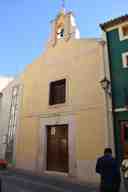
Look to your right at this humble white chapel, easily spotted by its heavy rectangular wooden doors and the distinctive espadaña a flat, arched wall rising from the roof that cradles a single bronze bell. That bell, named the Holy Family, has watched over this street since 1723. But the heartbeat of this place is the festival of San Antón. Records show that as far back as 1709, people gathered right here for bonfires, fireworks, and roasted broad beans. It is a tradition that has outlasted empires. It is here that the memory of a shoemaker named Florencio, known to locals as "Toquis Nonis," truly comes alive. In the late 1800s, he was the master of ceremonies, responsible for lighting the great bonfire at precisely four in the afternoon. But one bitter winter day, he found a homeless man shivering in a doorway at two o'clock. Toquis Nonis broke every rule of protocol. He lit the wood two hours early, declaring to the freezing man, "I always light it at four, but today, you are not going to pass any more cold." That act of kindness is now immortalized in the parade, where a large papier-mâché figure of the shoemaker marches alongside a festive little piglet and the Order of the Tau. This spirit of community is exactly what saved the building itself. By 1996, this 16th-century hermitage was crumbling into ruin. The government didn't save it... the neighbors did. They launched the "Auction of Toñas"-a bidding war for sugary, round sweet breads donated by local bakeries. They literally turned pastry into preservation, raising the funds to reinforce the walls. As they dug up the floors to fix the foundation, they uncovered a surprise... four human skeletons buried by a column, a secret resting place no one knew existed. Today, the hermitage is a vibrant cultural center, and the neighbors still share a "Gran Toñón," a giant sweet bread, to celebrate their victory over time. We have seen how a community can pull a treasure back from the brink. Now, prepare yourself for a story of something that is no longer there. Please walk three minutes to the Torre del Orejón.
Open dedicated page →Visualize a tall, rectangular stone tower rising twenty meters straight up from this corner, capped with a sharp, pointed roof and standing beneath the shadow of the distant…Read moreShow less
Visualize a tall, rectangular stone tower rising twenty meters straight up from this corner, capped with a sharp, pointed roof and standing beneath the shadow of the distant castle. It is strange to stand before a ghost. We are looking at the empty space left behind by the Torre del Orejón, or the Tower of the Big-Eared Man. For centuries, this was not just a clock tower; it was the peculiar, beating heart of Villena. It stood here until 1888, watching over the streets with a wooden face that everyone knew, and everyone lost. Let me introduce you to the tower's soul. His name was El Orejón. He was a grotesque wooden automaton, a mechanical figure hidden behind two small doors near the top of the spire. He wasn't beautiful. He had a wide, cheeky face and enormous ears, dressed in a flamboyant coat of yellow and red stripes with a grand blue bow at his neck. Every time the bells rang, the doors would fly open, and El Orejón would lean out, bowing his head to the town below. Some say his eyes moved and his tongue stuck out, a playful mockery of the passing time. But the tower held more than just a clock. Squeezed into the very stonework of the base was the "Casa del Pregonero," the Town Crier’s House. It was a tiny, suffocating space, barely twelve square meters. Imagine the town crier living there, a man who couldn't read or write, depending on a young boy to read the proclamations for him. He had a secret language of his own, though. When he announced the news, he used a code: a rolling drumbeat meant the conservatives were in power, while a sharp bugle call meant the liberals held sway. Politics and time, all mixed together in this cramped stone needle. But progress can be a cruel thing. In the late nineteenth century, whispers began that the tower was unsafe. It was leaning, they said. It was ruinous. The debate tore the city apart. The bourgeoisie wanted wide, modern streets and saw the old tower as an obstacle. The common people, however, loved their ugly, big-eared guardian. They loved him so much that just months before the demolition, a zarzuela-a musical comedy-premiered in the theater, simply titled La Torre del Orejón. It was art trying desperately to save history, with characters representing the street and the fountain begging for the tower's life. It wasn't enough. The decision was made. The demolition began in 1888. It was a slow, painful surgery on the city’s skyline. By October, the tower was gone. The owner of the house next door, a widow named Doña Patrocinio, bought the tiny slice of land where the crier’s stairs had been. She paid fifty pesetas-a modest sum even then-to smooth over her façade and erase the scar. The street was widened, the sunlight came in, but the magic was extinguished. And what of El Orejón himself? The wooden man who had bowed to generations of villagers? He was saved from the rubble, passed from a councilman to a mayor, and then to a judge. And then... silence. He vanished. There was a flicker of hope in 2005 when a similar head was found in a nearby town, but it was just a small clock parlor piece, not our giant. The real guardian of this lost treasure is now the memory itself. The bell that once rang beside him, the "Campanica," was saved and moved to Santa María church, where it still rings for the curfew. But the Big-Eared Man is gone, leaving only a story and an empty space in the sky. With the ghost of the Orejón behind us, let us walk into the open air of the main square.
Open dedicated page →Look slightly to your left for the wide, semicircular stone basin of the fountain, where water flows steadily from the mouths of dark iron faces mounted on the central…Read moreShow less
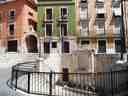
Look slightly to your left for the wide, semicircular stone basin of the fountain, where water flows steadily from the mouths of dark iron faces mounted on the central pillar. This square, the Plaza Mayor, has always been the stage where Villena’s history performs its most dramatic scenes. It feels peaceful now, but if you listen closely, you might hear the echoes of centuries of arguments, celebrations, and losses. The story begins long before the pavement you are standing on was laid. Back in March of 1386, this was just open ground at the foot of the old city walls. The town council gathered right here, in what they called the "tower of the Fountain square," to swear a solemn oath of loyalty to Alfonso de Aragón, the first Marquis of Villena. In those days, the only amenity was a simple, single-spout spring, but it was the lifeline of the medieval town. Water has always defined this space, often in difficult ways. By 1560, the council decided to build the Almudí here. This was a public storehouse for wheat, an essential safety net against famine. But the ground beneath us was a swamp. The master builder, Francisco Rodríguez, actually had to pay his crew a special bonus for working "inside the water," knee-deep in mud and sludge. The records show the building cost four thousand three hundred and eighty-six maravedís. In today's currency, that is roughly equivalent to a few thousand euros... a surprisingly modest sum for such a challenging project. Look at the fountain again. It is known locally as the "Fuente de los Chorros." During the devastating droughts of the early twentieth century, this was one of the only sources that didn't run dry. It became a desperate gathering place, with neighbors waiting in endless lines, praying the water wouldn't stop before they filled their jugs. This plaza teaches us that saving our history is a constant battle. In 1977, developers almost built a modern apartment block here, which would have destroyed the square's harmony. Thankfully, the citizens stopped it. But we were not as lucky in 2010. During construction for a new center for the elderly, workers found ancient Iberian ruins from the fourth century BC. Tragically, to speed up the building process before an election, the ruins were covered over and partially destroyed. The square's history is a reminder that we must be vigilant guardians of the past. Now, let us leave the open plaza and cross into the winding, intimate streets of the Rabal. Our next destination, the Church of Santa María, is just a two-minute walk away.
Open dedicated page →Look up to your left at the imposing fortress atop the hill, defined by its double line of jagged stone walls and the massive square keep towering above the rest of the…Read moreShow less
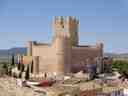
Look up to your left at the imposing fortress atop the hill, defined by its double line of jagged stone walls and the massive square keep towering above the rest of the structure. This is the Castillo de la Atalaya, the Watchtower Castle. For nearly a thousand years, this stone sentinel has stood guard over the frontier between kingdoms. It is the ultimate witness to the story of Villena. It has seen armies rise and fall, it has heard the whispers of prisoners, and it has guarded the land where the Treasure of Villena lay sleeping in the earth. Its story begins with the Almohad Caliphate, a North African Berber empire that built these mighty double walls to hold back the advancing Christians. But even before the castle was fully consolidated by Christian forces, it was the backdrop for a legendary misunderstanding. In the year 1088, the King of León, Alfonso VI, summoned the legendary warrior El Cid to meet him right here. But El Cid never arrived. Whether it was a mistake or a logistical failure, the King was so enraged by the no-show that he exiled El Cid, forcing the hero to fight for his survival far from home. Later, the castle became a golden cage. Imagine a six-year-old girl, the Infanta Constanza of Aragon. She was betrothed to the Prince Don Juan Manuel, a powerful writer and nobleman. But because she was too young for marriage, she was locked inside these cold walls for six years, waiting to turn twelve. While she waited, Don Juan Manuel hunted in these woods and wrote his famous tales, finding inspiration in the very landscape that was her prison. The stones here hold memories of rebellion too. In 1476, the people of Villena had suffered enough under the cruel Marquis Diego López Pacheco. They plotted a revolt with a secret signal. During mass, instead of the usual three bells to mark the holiest moment, the church rang the bells five times. That was the sign. The town rose up in a fury, chasing the Marquis’s men up this very hill into the castle. It was a bloody day that ended the feudal rule here forever, binding Villena directly to the Royal Crown. But the most intimate secrets of this castle are hidden inside the great tower. On the walls, starving prisoners from the War of Succession in the 1700s scratched drawings into the plaster. They drew what they missed most... intricate Italian buildings and sailing ships, dreaming of the ocean while trapped in this dry inland fortress. And deeper still, there is a carving of the Hand of Fatima, a protective symbol etched by a Muslim builder working for Christian masters. It was a quiet act of faith, a spiritual shield hidden in the architecture itself. The castle nearly died in 1813. During the Peninsular War against Napoleon, the French marshal Suchet ordered the beautiful vaulted roofs of the tower blown up as he retreated. For over a century, the castle was abandoned. It became a ruin, a place where stray dogs went to die. It would have disappeared entirely if not for the guardians of Villena’s heritage. In 1958, José María Soler-the same man who found the gold treasure we learned about earlier-began the crusade to restore these walls. He understood that this castle was not just a pile of rocks, but the soul of the city. Today, it no longer fears cannon fire. Instead, during the Moros y Cristianos festival, it is the center of celebration, filled with the smoke of gunpowder and the sound of joy. Now, let us leave the fortress and descend into the town it protected for so long. We will finish our journey in the heart of the old quarter. Please walk to the Historic center of Villena.
Open dedicated page →Look ahead at the narrow, sloping street paved with grey stone that rises steeply between the rustic, whitewashed facades to your left and right. We have reached the end of our…Read moreShow less
Look ahead at the narrow, sloping street paved with grey stone that rises steeply between the rustic, whitewashed facades to your left and right. We have reached the end of our journey, here in the deep, beating heart of the historic center. It feels different here, doesn't it? The streets we walked earlier were wider, flatter... designed for commerce and parades. But here, the ground rises to meet the mountain. This tangle of alleys wrapping around the castle is known as El Rabal. For centuries, this city was a tale of two worlds. Down below, around the Church of Santiago, was the Christian city, walled in by the powerful Don Juan Manuel. But up here, in the shadow of the fortress, lived the Muslim population. This was their home, built upon the rock. But if you listen closely to the wind rushing through these narrow gaps, you might hear the echo of a terrible silence. You see, these stones hold the memory of a deep trauma. In 1609, a royal decree arrived that shattered the life of this neighborhood. The expulsion of the Moriscos. These were the families who had lived here for generations, who knew every curve of this hillside. They were forced to leave their keys in their doors, pack only what they could carry, and march to the port of Alicante to be shipped away to North Africa. Imagine the emptiness they left behind. A silence fell over El Rabal that lasted for decades. It was a demographic void, a hollow place in the city where a vibrant community used to be. The neighborhood lost its people, and for a long time, it seemed like their story might simply vanish. But Villena knows how to mourn its lost treasures. The silence of these streets is matched by another loss, one that happened in the Plaza Mayor we passed just a few minutes ago. There, the city misses a different kind of friend. For centuries, a clock tower known as the Torre del Orejón stood watch over the market. It wasn't just a tower... it had a soul. Inside, there was a wooden automaton, a carved head with enormous ears. Every hour, the "Orejón" would open a window to look out at the square. He was funny, he was strange, and the people loved him dearly. He was as famous to them as the great clock figures of Europe. But in 1888, the authorities decided the tower was unstable. Despite the outcry of the citizens, they tore it down. They destroyed the guardian of the plaza. It was a heartbreaking moment, another piece of the city's identity turned to dust. However, this is not a tragedy without hope. This is a city that refuses to let its history disappear completely. When the tower fell, they saved its voice. The bell, known as the "Campanica de la Virgen," was rescued and moved to the Church of Santa María, where it still rings out today. And look around you now. El Rabal is not empty anymore. The cave houses have been recovered. The Fiestas del Medievo now fill these streets with music and life every year, celebrating the Andalusi heritage that was once banished. We are the guardians of these stories now. By walking here, by remembering the families who left and the tower that fell, you keep them alive. You have walked the path of the castle, the palaces, and the humble streets. You have heard the echoes. You are now part of the city's memory.
Open dedicated page →



Frequently asked questions
How do I start the tour?
After purchase, download the AudaTours app and enter your redemption code. The tour will be ready to start immediately - just tap play and follow the GPS-guided route.
Do I need internet during the tour?
No! Download the tour before you start and enjoy it fully offline. Only the chat feature requires internet. We recommend downloading on WiFi to save mobile data.
Is this a guided group tour?
No - this is a self-guided audio tour. You explore independently at your own pace, with audio narration playing through your phone. No tour guide, no group, no schedule.
How long does the tour take?
Most tours take 60–90 minutes to complete, but you control the pace entirely. Pause, skip stops, or take breaks whenever you want.
What if I can't finish the tour today?
No problem! Tours have lifetime access. Pause and resume whenever you like - tomorrow, next week, or next year. Your progress is saved.
What languages are available?
All tours are available in 50+ languages. Select your preferred language when redeeming your code. Note: language cannot be changed after tour generation.
Where do I access the tour after purchase?
Download the free AudaTours app from the App Store or Google Play. Enter your redemption code (sent via email) and the tour will appear in your library, ready to download and start.
If you don't enjoy the tour, we'll refund your purchase. Contact us at [email protected]
Checkout securely with 




