
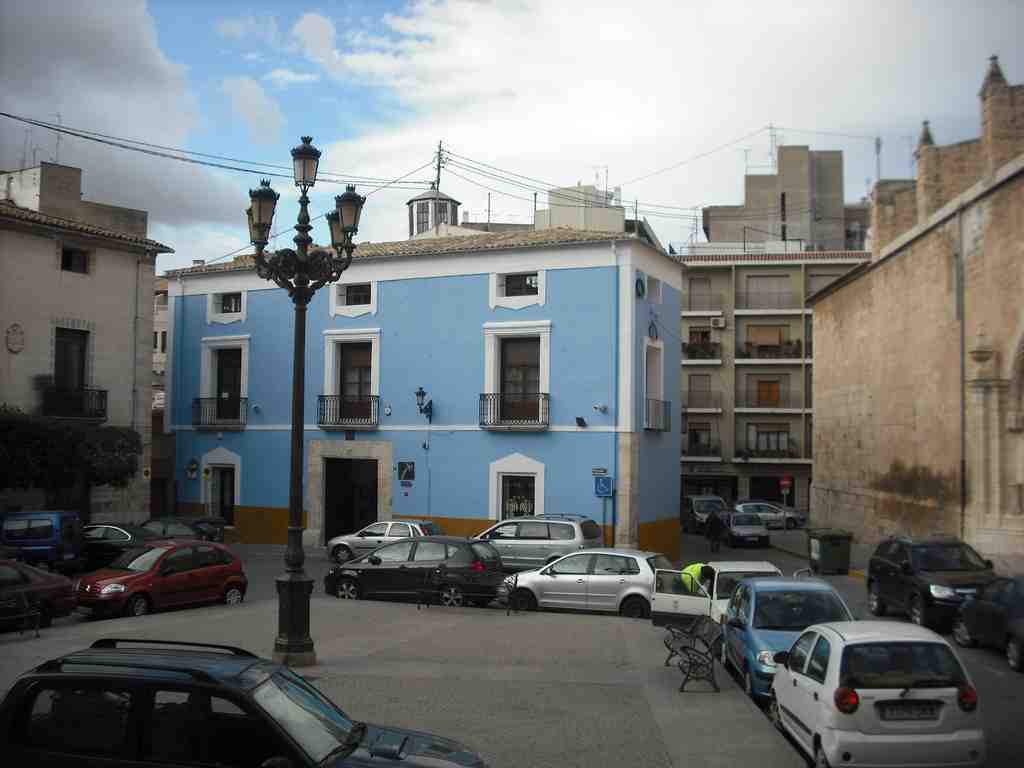
On your left opens a spacious, irregularly shaped plaza paved in stone, dominated by the tall, pale masonry of a church and the elegant, arched facade of the Town Hall beside it.
Welcome to the Plaza de Santiago. For centuries, standing right here meant you were standing in the very heart of Christian Villena. It was a deliberate boundary, a world away from the older Arab quarter near the mosque that we will visit later on. This square was designed to be a declaration of identity, built by powerful guardians who wanted to leave a mark that would outlast them.
One of those key figures was Pedro de Medina. In fifteen ten, he commissioned the building that serves as the Town Hall today. Back then, however, it was a quiet abbey for the clergy. He didn’t hire just anyone to build it. He brought in Jacopo Torni, a man known as "El Florentino." Jacopo was a disciple of the great Michelangelo. It is fascinating to think of a student of the Italian Renaissance master working right here in Villena. Jacopo actually died here in fifteen twenty-six, leaving his final artistic breath in the courtyard of that building.
As you look around, you can see how different centuries serve as guardians of different styles. You have the Gothic grandeur of the church, the Renaissance grace of the Town Hall, and the modern lines of the Casa de la Cultura. That modern building, built in nineteen eighty-seven, sparked quite a conflict. To build it, the city had to sacrifice a block of old homes, including one belonging to a well-known neighbor called "Maria of the Stockings." Many locals were heartbroken. They called the new structure a "monstrosity" because it rose up and blocked the traditional view of the castle.
But perhaps the most stubborn guardian of this square was Virtudes Mergelina, who built the Casa Selva here in the nineteenth century. Her family called her "Aunt Vinegar" because of her difficult character. She separated from her husband shortly after their wedding and refused to ever speak his name again.
While these stories survived, other treasures were not so lucky. During the Spanish Civil War in nineteen thirty-six, the church’s archives were destroyed. Centuries of history turned to ash. But while the paper is gone, the stone remains. The Church of Santiago holds a rare architectural secret inside-columns that look as if they are spinning, defying the weight they carry.
Let’s move toward the church entrance now to see this twist in the stone.




