
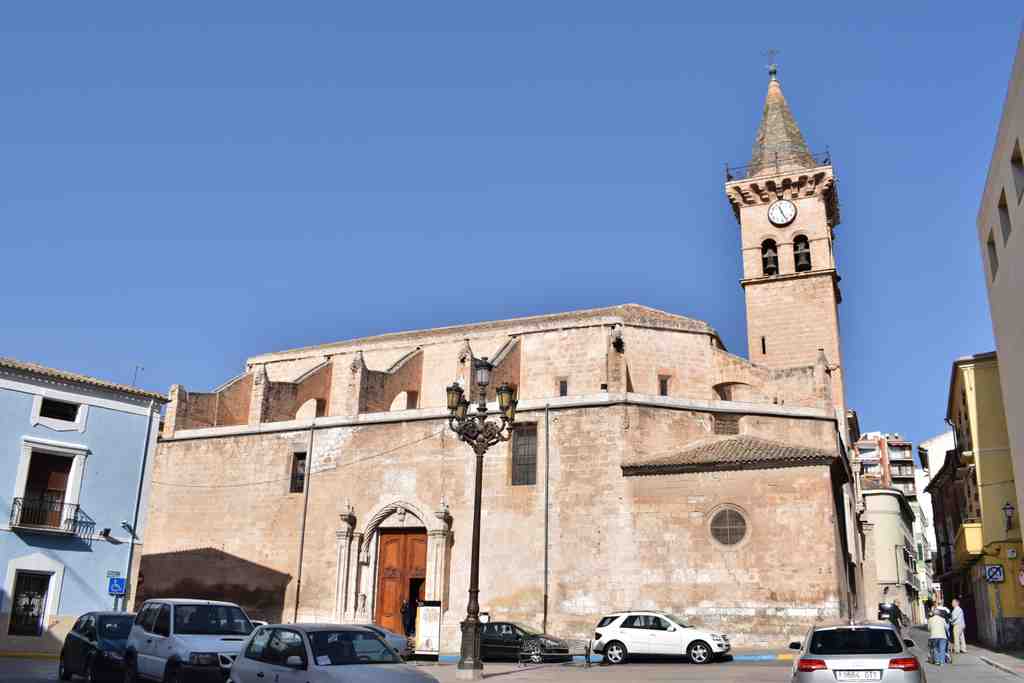
Look up at the imposing pale stone facade before you, dominated by a robust square bell tower and the intricate Renaissance carvings that frame the main portal like a stone tapestry. This grand structure, the Archpriestly Church of Santiago, feels like it has always been here, anchoring the plaza with its silent weight... but its origins are wrapped in a riddle of sudden, unexplained fortune.
Let me tell you about Sancho García de Medina, the man who funded this magnificent temple. He was a local boy born into destitution, who spent his childhood collecting refuse in these very streets. How does a garbage collector become a peer of kings? Some whisper he found a hidden pot of gold, much like the Treasure of Villena we spoke of earlier... buried deep in the earth and waiting for a lucky hand.
But the church records tell a different, perhaps even stranger tale. It involves a freezing winter day and a passing carriage holding Rodrigo de Borja, the man who would become the infamous Pope Alexander VI. The young Sancho, shivering in rags, climbed onto the carriage step. When the bishop asked if he was cold, the boy replied with a wit that would change his destiny... "And you, sir, is your face cold?" When the bishop said no, Sancho shot back, "Well, my whole body is face." That sharp tongue earned him the Pope’s protection, and eventually, the wealth to build what you see here.
With that gold, he commissioned a masterpiece that broke all the rules. Inside, the nave is held up by breathtaking twisted columns... stone that spirals toward the heavens like spun sugar. These helicoidal pillars were revolutionary, imitating the great silk exchanges of Valencia rather than traditional solemn churches. Even the door to the sacristy hides a secret known as an esviaje... an optical illusion where the arch is built on a skew to correct the alignment of the entrance. It was a display of pure, mathematical vanity.
But beauty often attracts destruction. The dialogue between Villena's lost treasures and the guardians who save them is nowhere louder than right here. During the Civil War in 1936, this plaza echoed with the sound of breaking stone. The magnificent heraldic shields on the outer wall... carved to honor a visit from the Catholic Monarchs... were smashed simply because they bore royal symbols. For decades, the walls bore those scars, a silent testament to intolerance. It wasn't until 2007 that skilled stonemasons, working from old, grainy photographs, carved them anew, finally healing the wound.
We also lost the voice of the church. A glorious baroque organ from 1656, which cost one hundred forty-four thousand maravedis-a sum equal to tens of thousands of dollars today-had its metal pipes ripped out and melted down. It silenced centuries of music. Yet, the building still speaks to us. Look above the door at the Plaza de Santiago. You will see a sundial with the Latin inscription Breves dies hominis sunt... "The days of men are few." It is a reminder that while our time is short, and our treasures may be lost, the stone remembers everything.
Now, let us turn our backs to these mysteries and walk towards the stately building nearby, the Villena City Council.




