
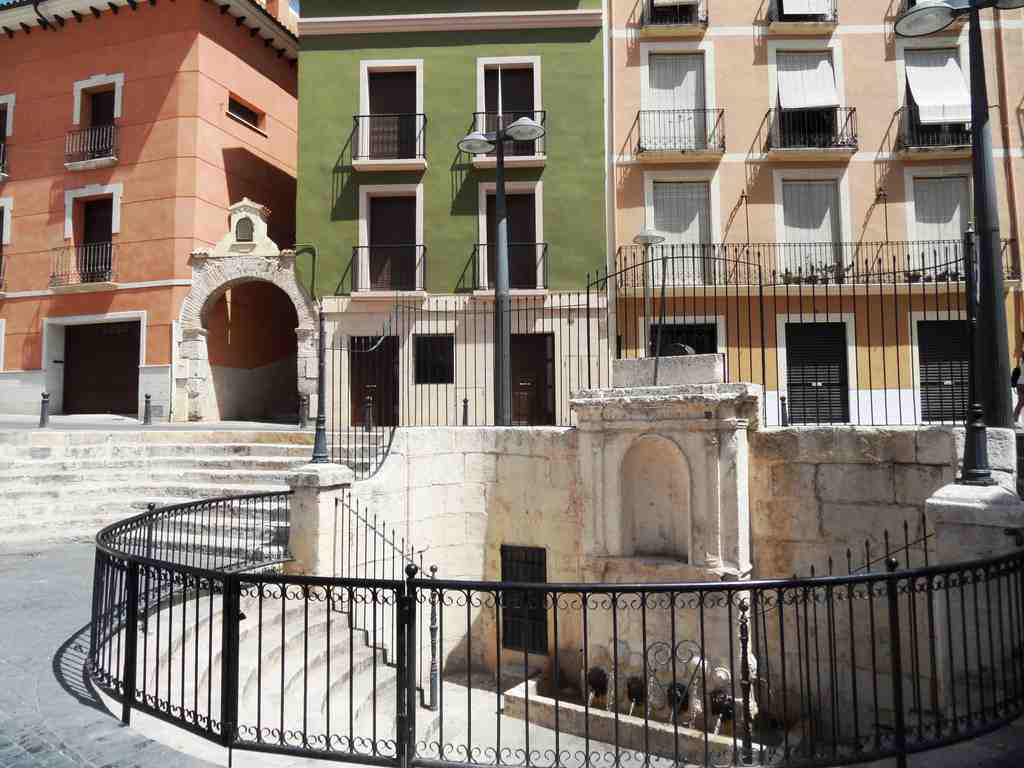
Look slightly to your left for the wide, semicircular stone basin of the fountain, where water flows steadily from the mouths of dark iron faces mounted on the central pillar.
This square, the Plaza Mayor, has always been the stage where Villena’s history performs its most dramatic scenes. It feels peaceful now, but if you listen closely, you might hear the echoes of centuries of arguments, celebrations, and losses.
The story begins long before the pavement you are standing on was laid. Back in March of 1386, this was just open ground at the foot of the old city walls. The town council gathered right here, in what they called the "tower of the Fountain square," to swear a solemn oath of loyalty to Alfonso de Aragón, the first Marquis of Villena. In those days, the only amenity was a simple, single-spout spring, but it was the lifeline of the medieval town.
Water has always defined this space, often in difficult ways. By 1560, the council decided to build the Almudí here. This was a public storehouse for wheat, an essential safety net against famine. But the ground beneath us was a swamp. The master builder, Francisco Rodríguez, actually had to pay his crew a special bonus for working "inside the water," knee-deep in mud and sludge. The records show the building cost four thousand three hundred and eighty-six maravedís. In today's currency, that is roughly equivalent to a few thousand euros... a surprisingly modest sum for such a challenging project.
Look at the fountain again. It is known locally as the "Fuente de los Chorros." During the devastating droughts of the early twentieth century, this was one of the only sources that didn't run dry. It became a desperate gathering place, with neighbors waiting in endless lines, praying the water wouldn't stop before they filled their jugs.
This plaza teaches us that saving our history is a constant battle. In 1977, developers almost built a modern apartment block here, which would have destroyed the square's harmony. Thankfully, the citizens stopped it. But we were not as lucky in 2010. During construction for a new center for the elderly, workers found ancient Iberian ruins from the fourth century BC. Tragically, to speed up the building process before an election, the ruins were covered over and partially destroyed.
The square's history is a reminder that we must be vigilant guardians of the past. Now, let us leave the open plaza and cross into the winding, intimate streets of the Rabal. Our next destination, the Church of Santa María, is just a two-minute walk away.




