
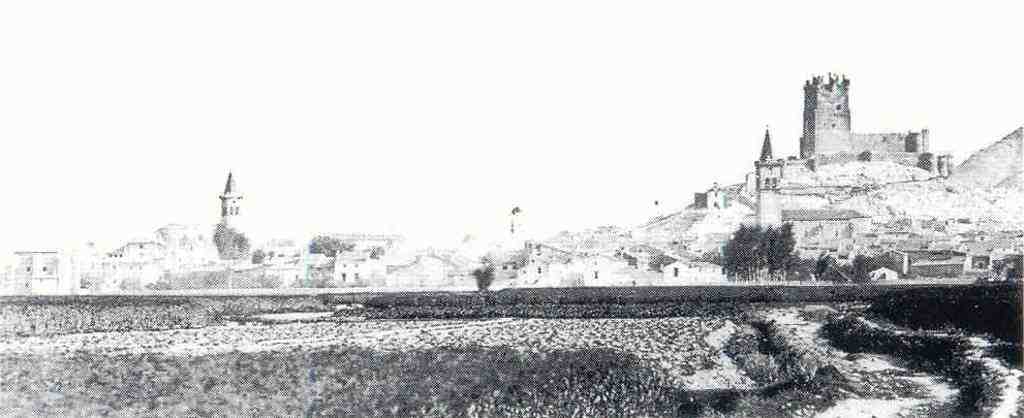
Visualize a tall, rectangular stone tower rising twenty meters straight up from this corner, capped with a sharp, pointed roof and standing beneath the shadow of the distant castle.
It is strange to stand before a ghost. We are looking at the empty space left behind by the Torre del Orejón, or the Tower of the Big-Eared Man. For centuries, this was not just a clock tower; it was the peculiar, beating heart of Villena. It stood here until 1888, watching over the streets with a wooden face that everyone knew, and everyone lost.
Let me introduce you to the tower's soul. His name was El Orejón. He was a grotesque wooden automaton, a mechanical figure hidden behind two small doors near the top of the spire. He wasn't beautiful. He had a wide, cheeky face and enormous ears, dressed in a flamboyant coat of yellow and red stripes with a grand blue bow at his neck. Every time the bells rang, the doors would fly open, and El Orejón would lean out, bowing his head to the town below. Some say his eyes moved and his tongue stuck out, a playful mockery of the passing time.
But the tower held more than just a clock. Squeezed into the very stonework of the base was the "Casa del Pregonero," the Town Crier’s House. It was a tiny, suffocating space, barely twelve square meters. Imagine the town crier living there, a man who couldn't read or write, depending on a young boy to read the proclamations for him. He had a secret language of his own, though. When he announced the news, he used a code: a rolling drumbeat meant the conservatives were in power, while a sharp bugle call meant the liberals held sway. Politics and time, all mixed together in this cramped stone needle.
But progress can be a cruel thing. In the late nineteenth century, whispers began that the tower was unsafe. It was leaning, they said. It was ruinous. The debate tore the city apart. The bourgeoisie wanted wide, modern streets and saw the old tower as an obstacle. The common people, however, loved their ugly, big-eared guardian. They loved him so much that just months before the demolition, a zarzuela-a musical comedy-premiered in the theater, simply titled La Torre del Orejón. It was art trying desperately to save history, with characters representing the street and the fountain begging for the tower's life.
It wasn't enough. The decision was made.
The demolition began in 1888. It was a slow, painful surgery on the city’s skyline. By October, the tower was gone. The owner of the house next door, a widow named Doña Patrocinio, bought the tiny slice of land where the crier’s stairs had been. She paid fifty pesetas-a modest sum even then-to smooth over her façade and erase the scar. The street was widened, the sunlight came in, but the magic was extinguished.
And what of El Orejón himself? The wooden man who had bowed to generations of villagers? He was saved from the rubble, passed from a councilman to a mayor, and then to a judge. And then... silence. He vanished. There was a flicker of hope in 2005 when a similar head was found in a nearby town, but it was just a small clock parlor piece, not our giant.
The real guardian of this lost treasure is now the memory itself. The bell that once rang beside him, the "Campanica," was saved and moved to Santa María church, where it still rings for the curfew. But the Big-Eared Man is gone, leaving only a story and an empty space in the sky.
With the ghost of the Orejón behind us, let us walk into the open air of the main square.




