
Madrid Audio Tour: Time-Travel Walks Through Palacio’s Sacred Stones
In Madrid’s heart, where royal shadow meets rebellion, secrets linger beneath gilded domes and ancient stones. Palaces and churches whisper tales that echo far beyond their walls. This self-guided audio tour pulls you through winding streets and grand halls, revealing stories and legends hidden in plain sight. Encounter moments most travelers overlook and uncover the city’s hidden pulse. Did a royal scandal unravel within the Almudena Cathedral’s sacred silence? What legendary conspiracy still haunts the Church of San Andrés after midnight? Why did a centuries-old document at the Institute of Spain change the fate of so many? Trace a path through intrigue, beauty, and revolution. Feel Madrid’s soul shift under your feet as you step from sunlight into shadow, seeing each landmark with new eyes and a thrill of anticipation at every corner. Begin your quest where history refuses to be silent. Listen closely—the city’s secrets are waiting.
Tour preview
About this tour
- scheduleDuration 40–60 minsGo at your own pace
- straighten2.4 km walking routeFollow the guided path
- location_on
- wifi_offWorks offlineDownload once, use anywhere
- all_inclusiveLifetime accessReplay anytime, forever
- location_onStarts at San Miguel Market
Stops on this tour
To spot San Miguel Market, just look ahead for a striking rectangular building made of airy iron and glass, topped with intricate ironwork and glowing warmly inside-a little…Read moreShow less
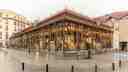
To spot San Miguel Market, just look ahead for a striking rectangular building made of airy iron and glass, topped with intricate ironwork and glowing warmly inside-a little palace of light and metal among the stone facades! Welcome to San Miguel Market, the beating heart of Madrid’s ancient flavor! If the air seems to sizzle with excitement here, don’t adjust your headphones-it’s been that way for centuries! Before you stands this shimmering jewel box of iron and glass, but believe it or not, this site’s story goes all the way back to medieval times, when things were a little more… well, muddy. Picture the scene: horses clattering over stone, vendors hollering, and open-air stalls crammed cheek by jowl selling everything from cabbages to candles. This square once teemed with chaotic energy as local craftsmen hawked their wares within wooden crates and make-do stalls. But if we rewind even further, you’re standing where the church of San Miguel de los Octoes once stood-a place so old, it was mentioned in the city laws as far back as the year 1202! In fact, the legendary playwright Lope de Vega was baptized right here. Imagine the smell of incense and the tolling bells-at least, until disaster struck in 1790. A devastating fire swept through, and even brave attempts at restoration couldn’t save it; by order of King Joseph Bonaparte, it was demolished in 1809, making way for a noisy, open plaza where fishmongers ruled the day and crowds bustled between stalls. As Madrid grew, the mess and muddle of outdoor markets became a real problem. Imagine slipping on a fish tail while dodging a cart-charming at first, not so great for city traffic. By the 1870s, tall minds with fancy mustaches and monocles began dreaming of something cleaner, grander, more... Parisian! They wanted to take inspiration from the grand iron markets you’d see in Paris, like Les Halles, and give Madrid a touch of European elegance. Enter architect Alfonso Dubé y Díez around 1913, who built this iron-and-glass wonder-no magic lamp required. Supported by cast iron columns and crowned with a ceramic crest, the market was like a spaceship of modernity landing on Madrid’s cobbles. When it finally swung its magnificent doors open in 1916, locals gasped at its beauty. No more soggy vegetables-this was the future! And all this happened while making sure not a single tomato’s journey to your basket was interrupted (the market actually opened in phases so as not to stop the trade-talk about multitasking!). Now, originally there were nine bustling rows inside, each crowded with noisy vendors and eager shoppers. Walls of crystal let daylight pour in from all directions, making even an ordinary plate of olives look like a treasure. But as the decades sped by, supermarkets and shopping centers became the cool new kids, and poor San Miguel began to fade from memory. Thing got gloomy-there were whispers that the market might be lost forever. Here’s where the plot twist comes in-like every great Madrid tale, San Miguel had a rescue squad: a group of passionate foodies, architects, and fans of all things delicious banded together to save it. Their idea? Don’t just sell produce-turn the market into a temple of taste, where Madrileños and visitors alike could snack, sip, and celebrate under those century-old beams! In 2009, after a spell of construction dust and tense anticipation, the doors flung open again-shinier, tastier, and busier than ever. Gone were the old stalls; in their place: gourmet counters, buzzing bars, and high tables where you can hoist a glass of Rioja and nibble tapas until the stars come out. Even the pandemic couldn’t keep San Miguel down for long. The market bounced back, and now stands not just as a monument to Madrid’s past, but as a living, breathing feast. So go ahead-step inside and taste what history, resilience, and a splash of Spanish flair really feel like! And remember, you’re not just enjoying a market, you’re experiencing a slice of Madrid’s soul.
Open dedicated page →Right in front of you stands a striking, reddish-pink building with elegant white trim around its tall windows; to spot the Institute of Spain, just look for the grand, sturdy…Read moreShow less
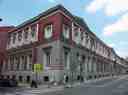
Right in front of you stands a striking, reddish-pink building with elegant white trim around its tall windows; to spot the Institute of Spain, just look for the grand, sturdy structure with a distinguished historic vibe on the corner-almost impossible to miss! Now, imagine it’s the late 1930s in Spain-a moment of great change, curiosity, and let’s be honest, quite a bit of drama. You’re outside what became the headquarters for Spain’s “Senate of Culture:” the Institute of Spain, or as locals call it-the IdeE. But hold onto your hat, because what goes on inside is a world of brains, debates, and a bit of academic mischief! This Institute began life in the shadows of war. Picture the winter of 1937: the city of Burgos is tense, people huddle to talk about knowledge and progress when almost everything else seemed to be falling apart. Visionary Eugeni d'Ors and the clever politician Pedro Sáinz Rodríguez hatched a plan-like two mad scientists-deciding that above all the grand Academies we've got in Spain, there had better be one mighty institution to unite them all. Somewhere wiser heads could prevail, and distinguished professors could debate-without too many flying books, we hope. The Institute quickly gathered Spain’s most ancient and esteemed academies: language, history, fine arts, sciences, medicine, even jurisprudence and pharmacy. If you picture a Hogwarts staff meeting but with even more mustaches and scholarly robes-you’d be close! Gradually, more Real Academies joined: engineering, economics, each one with stories spanning centuries. The IdeE became the brainy glue holding together these centers of Spanish knowledge, and sometimes, the referee to their academic squabbles. After bouncing around beautiful old palaces and even outlasting the odd vanished building-like the now-gone Palacio de Revillagigedo-it finally settled at San Bernardo 49. Don’t be fooled by the grand, slightly faded exterior. Inside, you’ll find sunbeams lighting up rooms where some of Spain’s brightest minds have haggled, lectured, and written history. The IdeE isn’t just about old guys with monocles, mind you. Its halls echo with solemn swearing-in ceremonies, book launches, heated debates, and moments of celebration. They host conferences, university courses, competitions, and events dedicated to both old legends and new discoveries-oh, and let’s not forget the annual “Fiesta de Libro” every April, when the Institute becomes a playground for book lovers. But here's a twist: the IdeE has always looked beyond Spain’s borders. It helped launch research organizations, partnered with international academies, and has even supported sometimes-unlikely scientific alliances-like one between Israeli and Palestinian scientists, focusing on education and collaboration, not conflict. Through it all, the Institute’s emblem evolved too. Once it was the academic “vítor,” but then came a new crest in 1978: a stylized IE crowned in deep red, a modern touch to an ancient tradition. More than 55 “Associated Academies” throughout Spain and beyond look up to the IdeE for guidance, like brainy younger siblings. Anyone who joins their ranks as an academician earns a badge of honor-and a lifetime supply of scholarly debates. So, while this institution might look calm from the outside, inside it’s an ever-buzzing hive of ideas and ambition. If these walls could talk, they’d whisper tales of fierce arguments and friendship, discoveries, and memories of the biggest personalities in Spain’s intellectual history- plus the odd academic who might have nodded off during a long conference. Whether you’re here to daydream about the past or just get a cool photo, the Institute of Spain is no ordinary building: it’s Madrid’s living library of genius and curiosity. Take a good look, because you’re standing right at the crossroads of history and imagination. If you're curious about the object, academies or the headquarters, the chat section below is the perfect place to seek clarification.
Open dedicated page →
Show 11 more stopsShow fewer stopsexpand_moreexpand_less
 4
4Pontifical Basilica of Saint Michael
Buy tour to unlock all 18 tracksTo spot the Pontifical Basilica of St. Michael, look for a grand, curving Baroque facade with two towers topped by ornate spires and plenty of stone sculptures watching from their…Read moreShow less
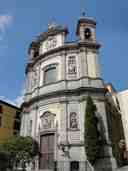
To spot the Pontifical Basilica of St. Michael, look for a grand, curving Baroque facade with two towers topped by ornate spires and plenty of stone sculptures watching from their niches above the main doors, just ahead on Calle de San Justo. Right in front of you stands one of the most theatrical Baroque sights in Madrid-a building that seems to lean just a little closer to check if you’re paying attention! Now, let’s set the scene: it’s the early 1700s. The old church here, one of Madrid’s oldest, had seen better days-by the 18th century, it was more wobbly than a three-legged chair at a family reunion. The local clergy tried to patch it up, but finally had to admit defeat and move services to the nearby Church of San Pedro el Viejo. And just when everyone was about to give up hope, along came Queen Isabel de Farnesio, determined to build a church fit for royalty and a dash of drama. The new temple’s job wasn’t just to serve the faithful; it was to impress the court and even dazzle the new Bourbon dynasty, who had replaced the old Habsburgs on the Spanish throne. The queen didn’t just send any architect-she brought in the Italians, led by Santiago Bonavia and later Virgilio Rabaglio. Construction began with the first stone ceremoniously plopping into place on a September day in 1739--and the basilica was finished in 1746. Picture Madrid in those days: a city bustling with carts, nobles, and the clatter of horses as this unique curved facade rose above the narrow street. The design is so original, you’ll find nothing else quite like it in Madrid-the shape of a grand musical instrument, intentionally created to provide perfect acoustics. Some have even called it a “music box,” and if you step inside one day, you might just agree! Now, look up at those statues. On the upper levels, you’ll see the classic symbols sculpted by artists Michel and Caresana: Charity, Faith, Hope, and Fortitude. Right above the door, there's a dramatic scene carved in stone: the Martyrdom of Saints Justo and Pastor. These two, legends say, were children martyred in the days of Rome’s Diocletian, and the first humble church here was built in their honor-way back before Madrid was even famous for its churros. Fast forward: after a terrible fire in Plaza Mayor in 1790, another nearby parish joined in here, and the basilica became almost a religious “roommate situation” for two different parish families. By the late 19th century, not only was Madrid growing thanks to the railway and industrial revolution, but there was a grand diplomatic shuffle. The basilica passed directly to the Vatican, becoming official papal territory-hence the “Pontifical” part of its name. Want a holy mystery? The famous Italian composer Luigi Boccherini once rested in the crypt below, his gravestone visited by music lovers until the 1920s, when Mussolini himself had Boccherini moved back to Italy. The crowd might have gasped-. Today, this basilica is still bustling around Holy Week, with its grand processions led by the Brotherhood of the Students-a display as colorful and energetic as any university cafeteria at lunchtime. The church holds the title of “Minor Basilica,” a true badge of honor in the Catholic world, and it’s protected as a national artistic monument. A quick fun fact: in this “music box” of a church, the acoustics are so good, you’d almost expect the statues to break into song-but don’t worry, they stick to their day jobs. Whether you admire it for its curving stonework, its centuries of drama, or its stories of faith and royal ambition, the Pontifical Basilica of St. Michael is a must-see symphony in stone.
Open dedicated page → 5
5Spanish Federation of Municipalities and Provinces
Buy tour to unlock all 18 tracksHere you are, standing outside one of Madrid’s more quietly powerful addresses: the Spanish Federation of Municipalities and Provinces, or FEMP if you’re in a rush-just rolls off…Read moreShow less
Here you are, standing outside one of Madrid’s more quietly powerful addresses: the Spanish Federation of Municipalities and Provinces, or FEMP if you’re in a rush-just rolls off the tongue, doesn’t it? Take a good look at the building in front of you. It’s not an imposing fortress or a glittering palace, but believe me, deals struck here ripple out to every corner of Spain-7412 corners, to be exact. That’s how many local entities the FEMP unites, including town halls, provincial councils, and all manner of island authorities. No small feat, keeping all that bureaucracy herded together. If you listen closely, you might imagine the sound of politicians in lively debate, their voices mingling with the gentle groan of 17th-century floorboards under their shoes. Back in June 1981, when disco was still king and mullets were tragically fashionable, mayors and councilors from all over Spain gathered in sun-drenched Torremolinos. There, under swirling fans and plenty of tense glances, they founded the FEMP during its very first assembly. They dreamt up a body that would defend the independence of local entities, stand up for their interests, and promote a spirit of European unity-but with a distinctly Spanish flair, of course. By 1985, the FEMP got its official government recognition-declared a Public Interest Association just as Spain was shaking off decades of dictatorship and racing toward democracy. But the FEMP is more than a gathering of mayors trying to out-shake each other’s hands. Its mission stretches from promoting friendship among Spanish towns, to building bridges with local governments across Europe, Latin America, and even the Arab world. They’re like municipal matchmakers: “Oh Córdoba, have you met Cáceres? I think you’ll get along splendidly at the next summit!” And through all this, they offer a huge menu of services to local governments, so towns big and small can feel a little less alone in the paperwork jungle. Despite their best intentions, not everything here is sunshine and siesta. Sometimes, things get downright dramatic. Picture scandals breaking out, with angry voices and the click-clack of reporters’ cameras outside these historic doors. Recently, political parties-looking at you, PSOE-have accused the FEMP of using their influence as a propaganda tool. Add in the whiff of legal trouble, with a certain director general named Francisco Díaz Latorre involved in the notorious “case Lezo,” and you realize that the FEMP can be as lively as any parliament or reality show. Within these walls, the big decisions are made by the Junta de Gobierno, or Governing Board. Picture a table packed with mayors from Jerez, Santander, Valencia, Zaragoza, and all across the map, each bringing stories and rivalries of their own towns. The current president wears two hats: Maria José García-Pelayo Jurado, guardian of Jerez back in Cádiz-she’s got the unenviable job of keeping order among all these fiercely proud local leaders. The vice presidents and vocales-those are full members-come from everywhere: Palencia, Logroño, Avilés, Albacete… Just imagine the struggles over who brings the best cheese to meetings! Directly beneath all the political wrangling, this baroque palace holds secrets from the late 17th century. Picture candlelight glinting off old stone, and feel how many generations have walked these halls-long before FEMP, before bustling Nuncio Street was even paved. Today, as the Spanish headquarters for the Council of European Municipalities and Regions, the FEMP is the living nerve center for inter-city cooperation, complete with regular guests from around the globe. The FEMP even manages to wrangle regional federations-seventeen of them!-from Andalucía to Asturias to Aragón, and yes, even the Basques and Catalans, each bringing their own flair, traditions, and a certain amount of stubbornness to the table. There’s even a system for including Spaniards who live abroad, giving a voice to the nearly three million citizens scattered worldwide. Now, that’s a long-distance call I wouldn’t want to pay for. So as you stand here, remember: the FEMP is where local Spain gets a seat, a say, and sometimes a scandal or two. And if you hear the muffled thump of files being dropped or a heated debate echoing behind closed doors, just smile. It’s democracy in action-Madrid-style. To expand your understanding of the constitution, governing bodies or the territorial federations, feel free to engage with me in the chat section below.
Open dedicated page →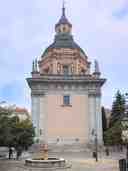 8
8Church of San Andrés Apóstol
Buy tour to unlock all 18 tracksTo spot the Church of San Andrés, look for a grand, pale-pink brick building crowned with a tall dome, stone columns, and statues along the top façade-right where the little…Read moreShow less
To spot the Church of San Andrés, look for a grand, pale-pink brick building crowned with a tall dome, stone columns, and statues along the top façade-right where the little square opens around a golden fountain. Welcome to the Church of San Andrés, one of Madrid’s oldest parishes, and a place that has seen more miracles, mystery, and melodrama than a whole season of Spanish soap operas! Imagine you’re standing here back in the 12th century-the city still feels like a distant outpost, and this spot sits on land that once belonged to a church from the days when Madrid was still ruled by Islamic kings. The Christian roots here run as deep as the stone foundations below your feet. Now, you might notice the air feels thick with centuries of secrets. Listen closely, and you might almost hear the footsteps of San Isidro Labrador, Madrid’s own humble patron saint, and his wife, Santa María de la Cabeza, heading to pray. This was their parish, and it’s said that San Isidro was buried here for a while. Right next door, his master’s old house stood-a place of legends, a miracle-producing well, and for a time, the resting place of the saint’s bones. But the history here is anything but straightforward! Some say this very spot was once graced by a mosque, standing right beside a medieval defensive tower and later overshadowed by palaces that welcomed Catholic kings and cardinals. The church saw Gothic upgrades in the days of Ferdinand and Isabella, with secret passages connecting it to the palace next door-a handy shortcut if you’re running late for royal prayers! Fast forward to the 1600s, when Madrid was brimming with talk of miracles. San Isidro was officially canonized, but his resting place? A little too... modest for a freshly-minted saint! Should they build a grand new church? Or maybe just add a dazzling chapel? They chose the latter, and soon, the most famous architects of the time fought it out for the honor. Pedro de la Torre’s design won, promising a space so lavish it put the old church to shame. They planned marbles, jasper, and shimmering gold, with a dome that would make any neighbor jealous-except, of course, when the money ran out and the building works stopped for nearly a decade! When building resumed, the inside sparkled with wild decorations: swirls of stucco crafted by Flemish masters, grand oil paintings, and statues of San Isidro himself. The most magnificent altar, by Alonso Cano, was supposed to hold his remains-think of it as a heavenly VIP lounge. But as with everything here, drama struck. The body of San Isidro kept moving back and forth between churches like the world’s holiest game of musical chairs, even causing squabbles between the chapels! Oh, and if all that isn’t enough excitement, there were historians squabbling through the centuries-arguing over who actually built what, when exactly the chapel began, how much gold was spent (an eye-watering sum, whatever the number), and whether the art was a masterpiece or just a little... over-the-top. Some called the decorations too fancy, others saw true genius. These debates shaped the way we think about art and history even now. The story takes a dark turn in 1936 with the outbreak of a civil war. Flames engulfed the church; art and treasures were lost in smoke and ash. Only the outer walls, that mighty dome, and a few stone statues survived the inferno. For decades, this very square watched over ruins-painful memories held in stone-until, finally, in the late 1980s, meticulous restorers resurrected the interior with faithful care, piecing together old splendors and secrets. So, as you stand at the fountain and gaze up at that mixture of stone, brick, and dome, you’re not just looking at a church-you’re staring across the centuries at a stage where the people of Madrid have poured their love, their arguments, their miracles, and their hopes. Next time you hear a bell or see a glint of gold through the window, just imagine: San Isidro, kings, artists, and ordinary Madrid locals have passed this exact spot, all part of a story that never seems to finish! Curious about the the primitive church of san andrés, chapel of san isidro or the gallery? Don't hesitate to reach out in the chat section for additional details.
Open dedicated page →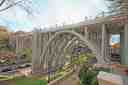 9
9Viaducto de Segovia
Buy tour to unlock all 18 tracksRight in front of you, you’ll see the Segovia Viaduct-a tall, elegant bridge with three sweeping concrete arches stretching over a green valley, just above the winding street…Read moreShow less
Right in front of you, you’ll see the Segovia Viaduct-a tall, elegant bridge with three sweeping concrete arches stretching over a green valley, just above the winding street below; simply look up toward where Calle Bailén seems to float in the air above the trees. Now, let’s take a step-well, maybe a dramatic stroll-back in time! Imagine the Madrid of King Philip II, where the Royal Alcázar stood proud on a hill, while down below, a steep and unruly valley meant that anyone wanting to go from the palace area to the city had to clamber up and down a sloping mess of winding streets, gardens, and even a brook that once ran right through here. You’d need strong legs, good shoes, and maybe a bit of luck not to tumble down the hillside. In those early days, this was considered one of the trickiest parts of Madrid to cross. Visionary architects in Philip II's court dreamed about connecting the city with bridges and viaducts, but for centuries their grand ideas fizzled out due to either empty pockets or too many royal distractions. It wasn’t until 1872 that Madrid finally placed the first iron beam here. The Viaduct of Segovia was born-a gleaming marvel and a true monument to the industrial age, bright with the promise of connecting the Royal Palace to San Francisco el Grande, soaring 23 meters above the chaos below! Of course, you know Madrid wouldn’t let things stay too simple. That first iron viaduct was brilliant, but after less than fifty years, it started to creak and groan under the weight of the city’s growing traffic. Repairs didn’t help much, and by the 1930s, Madrid needed something new. Enter architects and engineers with big ideas and even bigger blueprints-the winning team crafted the very bridge you’re looking at now: a smooth, polished concrete giant, supported by those striking granite-clad pillars. What you see here, completed in 1934, was all about blending new technology with the city’s historic heart. War, of course, leaves its mark-during the Spanish Civil War, the viaduct took a beating, hit by artillery fire and battered by the fighting that swirled across the city. By the 1940s, it had to be repaired yet again, but stood strong through decades of heavy traffic, city buses rumbling back and forth, and all the stories Madrid could throw its way. But you might have heard the bridge’s dark nickname: “el puente de los suicidas,” or the Bridge of Suicides. Yes, this beauty has had a tragic side, attracting stories and sad headlines for more than a century. In the 1990s, the problem was so bad that Madrid installed tall, transparent barriers to save lives. And yet, the viaduct became an almost mythic spot, showing up in all kinds of novels, films, and poems-Valle-Inclán wrote about it, Almodóvar filmed here, and generations of Madrilenians turned it into a symbol of city life, its ups, its downs, and its heart. Stretching over 200 meters today, the Segovia Viaduct is more than just a bridge. It’s a monument to ambition, resilience, and a little bit of Madrid’s mischievous spirit. And if you look through the arches toward Casa de Campo, you might catch a view of the lake-and maybe, if you listen closely, you’ll hear the old city’s secrets echoing across the vaults.
Open dedicated page →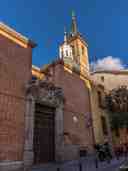 10
10Church of Saint Nicholas
Buy tour to unlock all 18 tracksRight in front of you, you’ll spot a tall, square brick tower topped by a slate spire peeking above the rooftops, and a heavy wooden door framed by a baroque stone arch on a plain…Read moreShow less
Right in front of you, you’ll spot a tall, square brick tower topped by a slate spire peeking above the rooftops, and a heavy wooden door framed by a baroque stone arch on a plain red-brick facade-just a few steps off the quiet street. Now, let’s unravel the story of the Church of San Nicolás! Imagine the streets below your feet centuries ago, dusty and bustling in medieval Madrid, when this church was already marking its spot as one of the city’s oldest temples. If you listen carefully-metaphorically of course, as I haven’t figured out time travel or ghost radios yet-the bricks might be humming tales that go back to the year 1202, when San Nicolás was mentioned in Madrid’s very first laws. Back then, the church’s community would have included families, merchants, and perhaps even the odd knight ducking in for a quick prayer before a busy day. As you gaze up at that marvelous tower-remember, it’s not just any old bell tower. It dates all the way back to the 1100s and was even declared a national monument in 1931. The lower bricks are chunky compared to the daintier ones near the belfry. Historians believe it may have started life as a minaret in Madrid’s Muslim era, when prayers would be called not with bells, but by a lone voice echoing over the rooftops. Later in the fourteenth century, new covers and stonework transformed it for Christian worship, before it received its pointed slate hat-the elegant “herreria” spire-in the 1700s. If buildings could enter costume contests, this tower would definitely win “most versatile,” switching up its style with every century. Most of what you see here is the result of centuries of repairs and reinventions. The main doorway, crafted of solid granite, was designed in the eighteenth century by Luis Salvador Carmona. He adorned it with a dramatic relief of San Nicolás himself. Picture this church shifting shapes like an architectural chameleon! It’s been a parish, an abandoned relic, a home for the Order of the Servites, and, for a while, a neighbor’s leftovers when its status bounced between Madrid’s parishes like a game of ecclesiastical ping-pong. By the 1800s, the poor church lost its parish standing and stood empty-just imagine the creak of the doors opening after years of silence when the Servites arrived to breathe new life into these halls. Check out the walls: some stones are rough and gray, while the rest are sandy red, and if you could see inside, you’d spot the gorgeous wooden ceiling-a classic of Mudéjar craftsmanship. There’s a fifteenth-century apse, with tiny Cretaceous stones from quarries beyond Madrid, and even a patchwork of brickwork and stone nicknamed “Toledano style,” a bit like a historic game of Tetris. Nowadays, Sunday and festival Masses here ring out in Italian, an echo of Madrid’s Italian community. On special holy days-whether it’s the solemnity of Saint Joseph or the raucous excitement of Ferragosto-you’ll hear Italian prayers and songs filling the air. Even the world of literature came calling. Benito Pérez Galdós, one of Spain’s great novelists, once set a deliciously scandalous rumor at San Nicolás in his book “El terror de 1824.” He imagined threatening notes, secret plots, and even some unfortunate caricatures for all Madrid to see at the church’s corner. Forget Netflix-Madrid’s old streets were already full of intrigue! So, as you stand in the shadow of this patchwork of stone and faith, think of San Nicolás as a survivor-a church that’s weathered centuries, slipped between religions, seen parades and everyday prayers, outlasted literary drama, and now speaks with a distinctly Italian lilt. If you ever wondered what it feels like to touch every era of Madrid at once-this spot is it! And watch out, or you might just catch an Italian Mass echoing out to greet you.
Open dedicated page →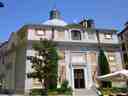 11
11Royal Church of Saint James and Saint John the Baptist
Buy tour to unlock all 18 tracksRight in front of you stands a sturdy-looking, rectangular church with a simple brick and granite façade, a big domed roof, and a plain front door beneath a sculpted scene, making…Read moreShow less
Right in front of you stands a sturdy-looking, rectangular church with a simple brick and granite façade, a big domed roof, and a plain front door beneath a sculpted scene, making it quite easy to spot in this open square. Now, picture this: you’re standing at the official launching pad for thousands of journeying feet-the point where Madrid’s Camino de Santiago begins. The Church of Santiago, or to give it its full, rather grand name, the Royal Parish Church of Santiago and St. John the Baptist, doesn’t just hold services; it practically hands you a pair of walking boots and says, “Off you go!” If you take a good look, you’ll notice the church’s neoclassical look: sturdy, with flat brick- and granite-lined walls-a bit like if a Roman temple decided to dress down for the weekend. But don’t let its simple exterior fool you; this church has a tale or two beneath that tall dome. Back in the early 1800s, this whole block was chaos. The old Royal Fortress nearby was home to two of Madrid’s earliest-and, let’s be honest, quite run-down-parish churches. But along came King José Bonaparte, who had a bit of an obsession with urban tidiness. Down came the old temples so he could widen the Plaza de Oriente. Locals must have rolled their eyes-Paris got grand boulevards, and Madrid just got more drafts in winter. But Madrid is good at bouncing back. Pretty much as soon as rubble filled the streets, architect Juan Antonio Cuervo began the church you see today-one house of worship to replace both lost ones. Over the next decades, precious artworks, rescued statues, and historic paintings found their way inside this new sanctuary, giving it a warm sense of continuity, even if Velázquez’s tomb was lost to the ages. Imagine wandering the aisles with the faintest hope of stumbling on a hidden painter’s grave! Step through those doors and you’d find an inside shaped like a slightly squished Greek cross, topped by a dome so big, it looks ready to float away. The altar? It showcases Francisco Rizi’s dramatic painting of Santiago Matamoros, with figures so vivid, you might expect them to leap out, sword in hand. The walls hold treasures too, like Juan Carreño de Miranda’s glowing painting of Christ’s baptism and a beautifully delicate sculpture of the child St. John, thought to be crafted by Pedro Roldán. Don’t miss the sculpture of the local holy woman, Mariana de Jesús, who began her spiritual journey right here when she was baptized. Up high, colorful neoclassical paintings and 1800s frescos watch over you, while a massive chandelier glows at the center-a true “light of Madrid” moment every evening! And don’t forget, this is the starting gate for two pilgrim routes: Madrid’s Way of St. James and the Camino de Uclés. Pilgrims come here for blessings, stamps, and even certificates when they complete their trek-a tradition that turns the church into a hub of anticipation, excitement, and maybe the occasional sore feet. So there it stands: welcoming, sturdy, and more than a little proud to be at the crossroads of journeys, memories, lost treasures, and new beginnings. If you listen closely, you might even hear the muffled sighs of ancient pilgrims asking, “How far to Santiago, again?” Don’t worry; you can just smile and point them in the right direction!
Open dedicated page →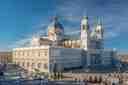 13
13Catedral de Santa María la Real de la Almudena
Buy tour to unlock all 18 tracksTo spot the Almudena Cathedral, look for a grand building with a huge gray dome, two tall towers topped with golden spheres, and a stately neoclassical facade right across from…Read moreShow less
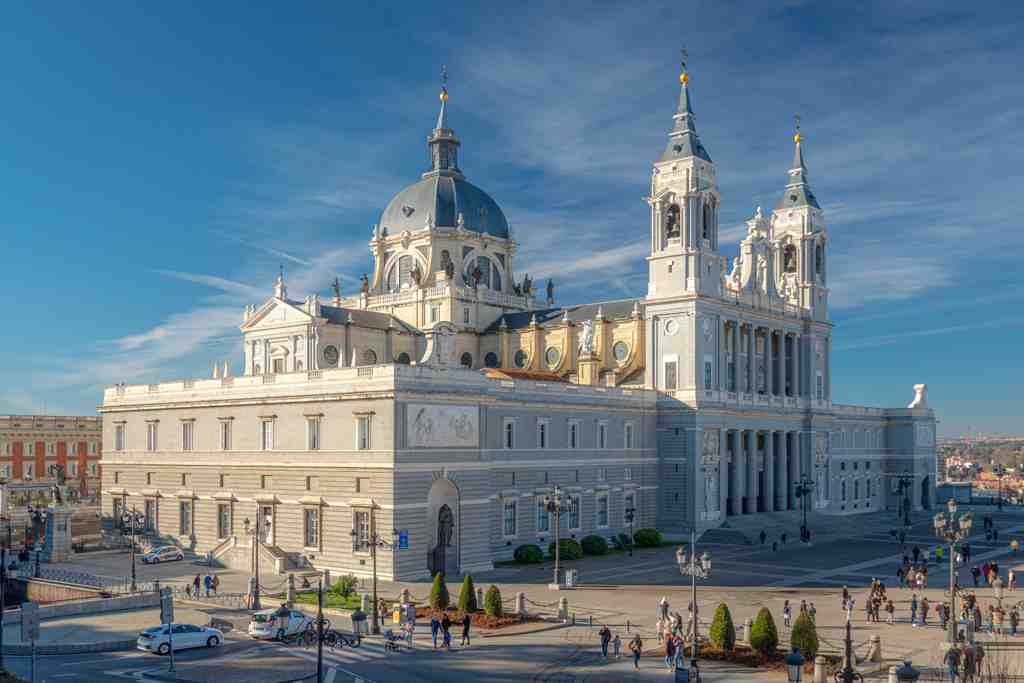
To spot the Almudena Cathedral, look for a grand building with a huge gray dome, two tall towers topped with golden spheres, and a stately neoclassical facade right across from the Royal Palace. Standing here, you’re facing a true heavyweight in Madrid’s story-so big, in fact, that it took over a century to build! The Almudena Cathedral didn’t appear overnight, and it certainly made Madrid wait. Imagine the city in the late 1800s: dusty construction, hopeful crowds, the tap of chisels on stone -and then, even more waiting as wars and debates stopped the project more than once. Legend has it that when Alfonso VI conquered Madrid in 1083, he desperately searched for an ancient figure of the Virgin Mary hidden away from the invading Moors. After much prayer and some royal head-scratching, a section of the wall tumbled down, revealing the statue-miraculously lit by candles still burning centuries later! Out front, tucked into the exterior, you’ll find a niche marking the spot where this so-called miracle happened. The spot became Madrid’s holy ground, first housing a small medieval church, then a busy Jewish neighborhood, and finally this enormous neoclassical-meets-neogothic cathedral. Talk about layers! The plot thickened for centuries as Madrid battled with the powerful archdiocese of Toledo, which didn’t want to give up its churchly influence. Even after the old Santa María church was pulled down for street expansion in 1868, locals wouldn’t let the dream die. Finally, King Alfonso XII laid the first stone in 1883-pickaxe in one hand, royal dignity in the other! The original plan was pure neo-gothic, but as fashions changed (and so did architects), the exterior turned neoclassical to match the nearby Royal Palace. It's a bit like a cathedral wearing a tuxedo on the outside but wild polychrome gothic on the inside. Walk around and you’ll see twelve statues of the apostles atop the octagonal dome, dizzying heights-up to 73 meters!-and marble and granite plucked from quarries all over Spain and Portugal. Listen as the bells ring from the two towers, a gift from Galician donors-each one dedicated to a local Madonna. Look closely, and you’ll also spot statues of Spanish saints, royal coats of arms, even a carillon that fills the square with melody. Inside, the soaring nave is lined with stained glass, echoing with footsteps and Spanish prayers. There’s a modern museum tucked within and a crypt below, filled with nearly 400 unique columns and reminders of Madrid’s most powerful families-and, yes, the odd architect! Queen María de las Mercedes, the driving force behind the cathedral, rests here, finally moved from El Escorial in 2000. In 2004, the cathedral staged the first royal wedding Madrid had seen in almost 100 years, when Prince Felipe-now King!-married Letizia Ortiz. Royals, popes, presidents: if Madrid has a big event, it’s usually here. The most recent stage of drama arrived in 1993, when Pope John Paul II himself came to consecrate the cathedral-a true showstopper for Madrid! Make your way around, pay attention to the bronze doors with their sculpted scenes, and look up at the colorful domes and modern murals; every inch is packed with stories, symbols, and the fiery ambition of a city that simply refused to be ordinary. The Almudena Cathedral is living proof that great things are worth a little waiting (and maybe a miracle or two). To delve deeper into the materials, description or the museum, simply drop your query in the chat section and I'll provide more information.
Open dedicated page →
Frequently asked questions
How do I start the tour?
After purchase, download the AudaTours app and enter your redemption code. The tour will be ready to start immediately - just tap play and follow the GPS-guided route.
Do I need internet during the tour?
No! Download the tour before you start and enjoy it fully offline. Only the chat feature requires internet. We recommend downloading on WiFi to save mobile data.
Is this a guided group tour?
No - this is a self-guided audio tour. You explore independently at your own pace, with audio narration playing through your phone. No tour guide, no group, no schedule.
How long does the tour take?
Most tours take 60–90 minutes to complete, but you control the pace entirely. Pause, skip stops, or take breaks whenever you want.
What if I can't finish the tour today?
No problem! Tours have lifetime access. Pause and resume whenever you like - tomorrow, next week, or next year. Your progress is saved.
What languages are available?
All tours are available in 50+ languages. Select your preferred language when redeeming your code. Note: language cannot be changed after tour generation.
Where do I access the tour after purchase?
Download the free AudaTours app from the App Store or Google Play. Enter your redemption code (sent via email) and the tour will appear in your library, ready to download and start.
If you don't enjoy the tour, we'll refund your purchase. Contact us at [email protected]
Checkout securely with 


