
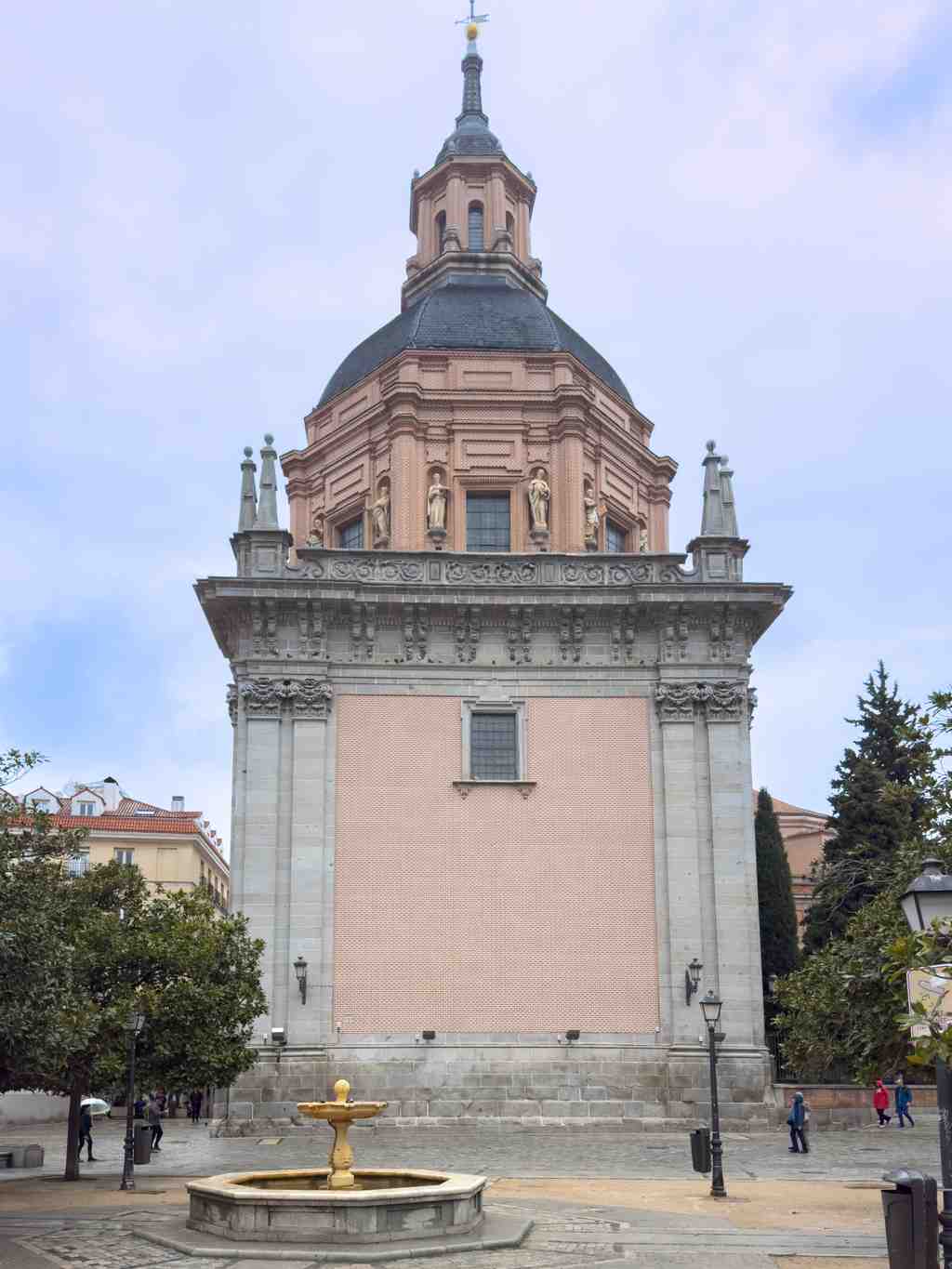
To spot the Church of San Andrés, look for a grand, pale-pink brick building crowned with a tall dome, stone columns, and statues along the top façade-right where the little square opens around a golden fountain.
Welcome to the Church of San Andrés, one of Madrid’s oldest parishes, and a place that has seen more miracles, mystery, and melodrama than a whole season of Spanish soap operas! Imagine you’re standing here back in the 12th century-the city still feels like a distant outpost, and this spot sits on land that once belonged to a church from the days when Madrid was still ruled by Islamic kings. The Christian roots here run as deep as the stone foundations below your feet.
Now, you might notice the air feels thick with centuries of secrets. Listen closely, and you might almost hear the footsteps of San Isidro Labrador, Madrid’s own humble patron saint, and his wife, Santa María de la Cabeza, heading to pray. This was their parish, and it’s said that San Isidro was buried here for a while. Right next door, his master’s old house stood-a place of legends, a miracle-producing well, and for a time, the resting place of the saint’s bones.
But the history here is anything but straightforward! Some say this very spot was once graced by a mosque, standing right beside a medieval defensive tower and later overshadowed by palaces that welcomed Catholic kings and cardinals. The church saw Gothic upgrades in the days of Ferdinand and Isabella, with secret passages connecting it to the palace next door-a handy shortcut if you’re running late for royal prayers!
Fast forward to the 1600s, when Madrid was brimming with talk of miracles. San Isidro was officially canonized, but his resting place? A little too... modest for a freshly-minted saint! Should they build a grand new church? Or maybe just add a dazzling chapel? They chose the latter, and soon, the most famous architects of the time fought it out for the honor. Pedro de la Torre’s design won, promising a space so lavish it put the old church to shame. They planned marbles, jasper, and shimmering gold, with a dome that would make any neighbor jealous-except, of course, when the money ran out and the building works stopped for nearly a decade!
When building resumed, the inside sparkled with wild decorations: swirls of stucco crafted by Flemish masters, grand oil paintings, and statues of San Isidro himself. The most magnificent altar, by Alonso Cano, was supposed to hold his remains-think of it as a heavenly VIP lounge. But as with everything here, drama struck. The body of San Isidro kept moving back and forth between churches like the world’s holiest game of musical chairs, even causing squabbles between the chapels!
Oh, and if all that isn’t enough excitement, there were historians squabbling through the centuries-arguing over who actually built what, when exactly the chapel began, how much gold was spent (an eye-watering sum, whatever the number), and whether the art was a masterpiece or just a little... over-the-top. Some called the decorations too fancy, others saw true genius. These debates shaped the way we think about art and history even now.
The story takes a dark turn in 1936 with the outbreak of a civil war. Flames engulfed the church; art and treasures were lost in smoke and ash. Only the outer walls, that mighty dome, and a few stone statues survived the inferno. For decades, this very square watched over ruins-painful memories held in stone-until, finally, in the late 1980s, meticulous restorers resurrected the interior with faithful care, piecing together old splendors and secrets.
So, as you stand at the fountain and gaze up at that mixture of stone, brick, and dome, you’re not just looking at a church-you’re staring across the centuries at a stage where the people of Madrid have poured their love, their arguments, their miracles, and their hopes. Next time you hear a bell or see a glint of gold through the window, just imagine: San Isidro, kings, artists, and ordinary Madrid locals have passed this exact spot, all part of a story that never seems to finish!
Curious about the the primitive church of san andrés, chapel of san isidro or the gallery? Don't hesitate to reach out in the chat section for additional details.




