
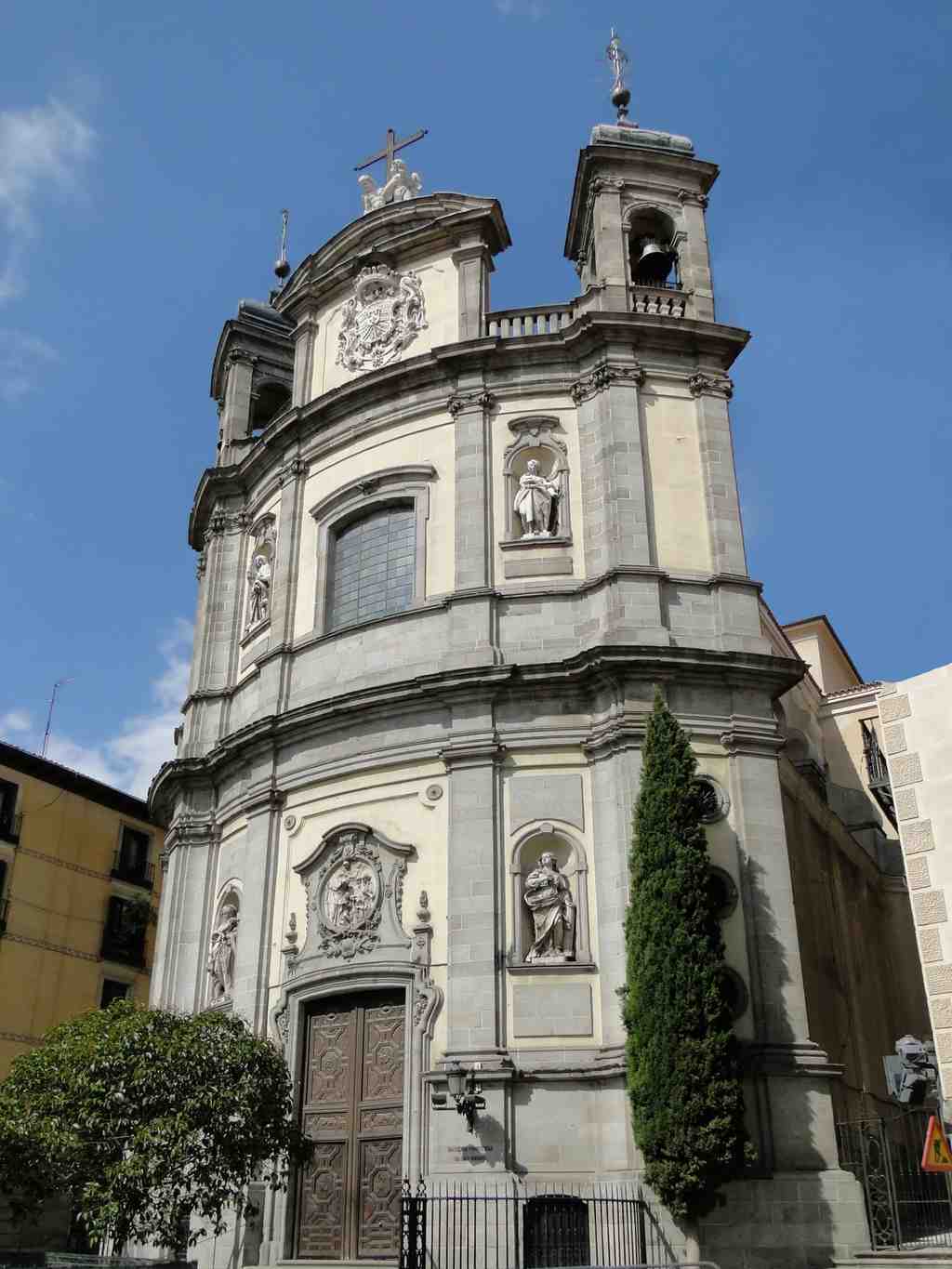
To spot the Pontifical Basilica of St. Michael, look for a grand, curving Baroque facade with two towers topped by ornate spires and plenty of stone sculptures watching from their niches above the main doors, just ahead on Calle de San Justo.
Right in front of you stands one of the most theatrical Baroque sights in Madrid-a building that seems to lean just a little closer to check if you’re paying attention! Now, let’s set the scene: it’s the early 1700s. The old church here, one of Madrid’s oldest, had seen better days-by the 18th century, it was more wobbly than a three-legged chair at a family reunion. The local clergy tried to patch it up, but finally had to admit defeat and move services to the nearby Church of San Pedro el Viejo. And just when everyone was about to give up hope, along came Queen Isabel de Farnesio, determined to build a church fit for royalty and a dash of drama.
The new temple’s job wasn’t just to serve the faithful; it was to impress the court and even dazzle the new Bourbon dynasty, who had replaced the old Habsburgs on the Spanish throne. The queen didn’t just send any architect-she brought in the Italians, led by Santiago Bonavia and later Virgilio Rabaglio. Construction began with the first stone ceremoniously plopping into place on a September day in 1739--and the basilica was finished in 1746.
Picture Madrid in those days: a city bustling with carts, nobles, and the clatter of horses as this unique curved facade rose above the narrow street. The design is so original, you’ll find nothing else quite like it in Madrid-the shape of a grand musical instrument, intentionally created to provide perfect acoustics. Some have even called it a “music box,” and if you step inside one day, you might just agree!
Now, look up at those statues. On the upper levels, you’ll see the classic symbols sculpted by artists Michel and Caresana: Charity, Faith, Hope, and Fortitude. Right above the door, there's a dramatic scene carved in stone: the Martyrdom of Saints Justo and Pastor. These two, legends say, were children martyred in the days of Rome’s Diocletian, and the first humble church here was built in their honor-way back before Madrid was even famous for its churros.
Fast forward: after a terrible fire in Plaza Mayor in 1790, another nearby parish joined in here, and the basilica became almost a religious “roommate situation” for two different parish families. By the late 19th century, not only was Madrid growing thanks to the railway and industrial revolution, but there was a grand diplomatic shuffle. The basilica passed directly to the Vatican, becoming official papal territory-hence the “Pontifical” part of its name.
Want a holy mystery? The famous Italian composer Luigi Boccherini once rested in the crypt below, his gravestone visited by music lovers until the 1920s, when Mussolini himself had Boccherini moved back to Italy. The crowd might have gasped-.
Today, this basilica is still bustling around Holy Week, with its grand processions led by the Brotherhood of the Students-a display as colorful and energetic as any university cafeteria at lunchtime. The church holds the title of “Minor Basilica,” a true badge of honor in the Catholic world, and it’s protected as a national artistic monument.
A quick fun fact: in this “music box” of a church, the acoustics are so good, you’d almost expect the statues to break into song-but don’t worry, they stick to their day jobs. Whether you admire it for its curving stonework, its centuries of drama, or its stories of faith and royal ambition, the Pontifical Basilica of St. Michael is a must-see symphony in stone.




