
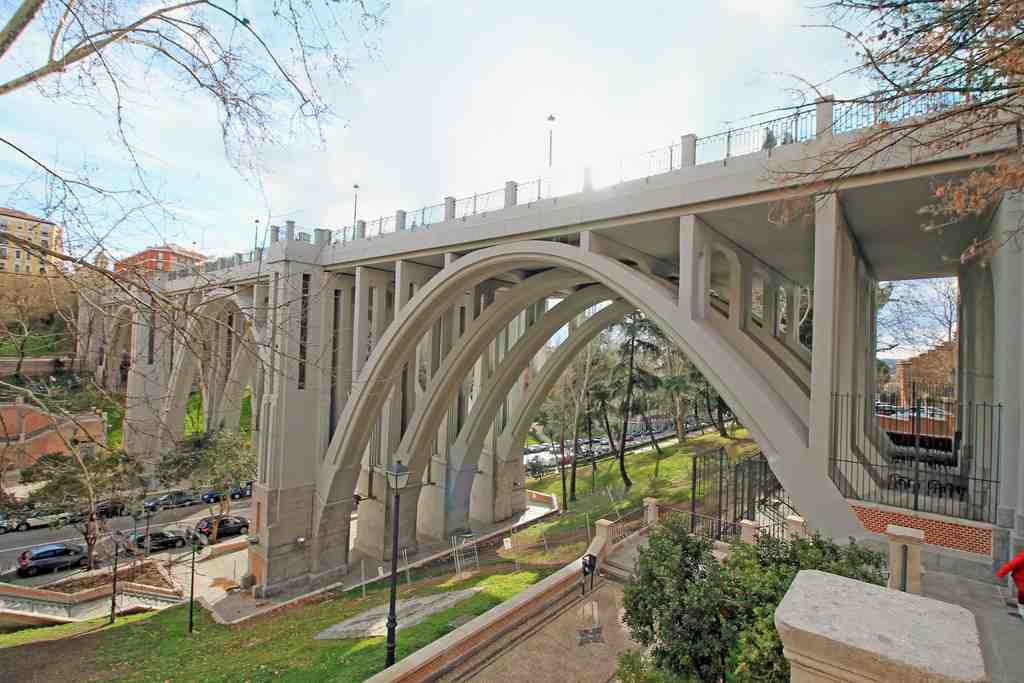
Right in front of you, you’ll see the Segovia Viaduct-a tall, elegant bridge with three sweeping concrete arches stretching over a green valley, just above the winding street below; simply look up toward where Calle Bailén seems to float in the air above the trees.
Now, let’s take a step-well, maybe a dramatic stroll-back in time! Imagine the Madrid of King Philip II, where the Royal Alcázar stood proud on a hill, while down below, a steep and unruly valley meant that anyone wanting to go from the palace area to the city had to clamber up and down a sloping mess of winding streets, gardens, and even a brook that once ran right through here. You’d need strong legs, good shoes, and maybe a bit of luck not to tumble down the hillside.
In those early days, this was considered one of the trickiest parts of Madrid to cross. Visionary architects in Philip II's court dreamed about connecting the city with bridges and viaducts, but for centuries their grand ideas fizzled out due to either empty pockets or too many royal distractions. It wasn’t until 1872 that Madrid finally placed the first iron beam here. The Viaduct of Segovia was born-a gleaming marvel and a true monument to the industrial age, bright with the promise of connecting the Royal Palace to San Francisco el Grande, soaring 23 meters above the chaos below!
Of course, you know Madrid wouldn’t let things stay too simple. That first iron viaduct was brilliant, but after less than fifty years, it started to creak and groan under the weight of the city’s growing traffic. Repairs didn’t help much, and by the 1930s, Madrid needed something new. Enter architects and engineers with big ideas and even bigger blueprints-the winning team crafted the very bridge you’re looking at now: a smooth, polished concrete giant, supported by those striking granite-clad pillars. What you see here, completed in 1934, was all about blending new technology with the city’s historic heart.
War, of course, leaves its mark-during the Spanish Civil War, the viaduct took a beating, hit by artillery fire and battered by the fighting that swirled across the city. By the 1940s, it had to be repaired yet again, but stood strong through decades of heavy traffic, city buses rumbling back and forth, and all the stories Madrid could throw its way.
But you might have heard the bridge’s dark nickname: “el puente de los suicidas,” or the Bridge of Suicides. Yes, this beauty has had a tragic side, attracting stories and sad headlines for more than a century. In the 1990s, the problem was so bad that Madrid installed tall, transparent barriers to save lives. And yet, the viaduct became an almost mythic spot, showing up in all kinds of novels, films, and poems-Valle-Inclán wrote about it, Almodóvar filmed here, and generations of Madrilenians turned it into a symbol of city life, its ups, its downs, and its heart.
Stretching over 200 meters today, the Segovia Viaduct is more than just a bridge. It’s a monument to ambition, resilience, and a little bit of Madrid’s mischievous spirit. And if you look through the arches toward Casa de Campo, you might catch a view of the lake-and maybe, if you listen closely, you’ll hear the old city’s secrets echoing across the vaults.




