

Porto Audio Tour: Noble Palaces, Towering Tales & Cathedral Echoes
A bell tolls over Porto’s crooked rooftops, echoing from the Baroque heights of Clérigos Tower. But beneath these ancient stones beats a rebellious spirit and a labyrinth of stories waiting to be uncovered. With this self-guided audio tour, slip beyond the postcard facades and unmask the city’s true character. Let secret alleys, grand cathedrals, and hidden squares reveal Porto’s untold tales along your own path and pace. Who plotted an explosive uprising from the shadows of Carlos Alberto Square? What keeps watch in the midnight silence inside Porto Cathedral? And why did a forbidden message travel from the tower to the streets below one storm-lashed night? Cobbled lanes twist beneath your feet. Legends flare to life at every turn. Each step peels away centuries, transforming everyday sights into breathtaking discoveries. Answer the bell. Press play. The real Porto waits to be revealed.
Tour preview
About this tour
- scheduleDuration 80–100 minsGo at your own pace
- straighten3.0 km walking routeFollow the guided path
- location_onLocationVila Nova de Gaia, Portugal
- wifi_offWorks offlineDownload once, use anywhere
- all_inclusiveLifetime accessReplay anytime, forever
- location_onStarts at Palacete of the Visconts of Balsemão
Stops on this tour
lock_open 3 free previews · 12 unlock with purchase
On your left, look for a broad stone-paved square framed by granite façades, with a bronze horseman rising on a tall pedestal at its centre. If Porto has a civic stage, this is…Read moreShow less
Open dedicated page →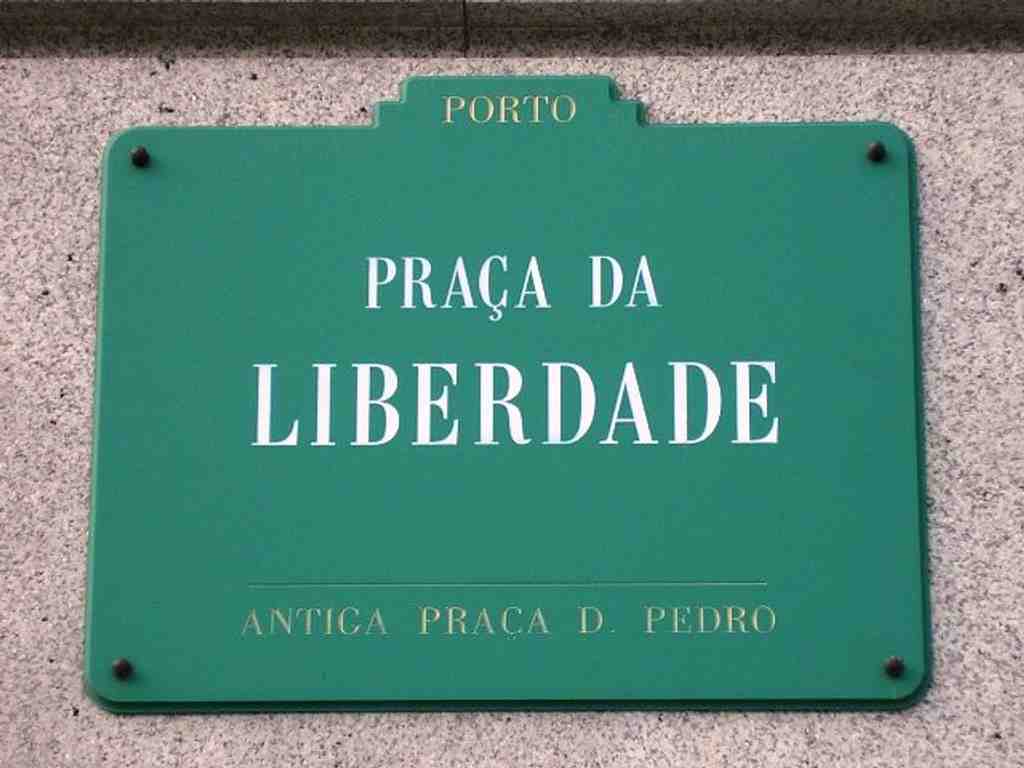
Liberty SquarePhoto: Manuel de Sousa, Wikimedia Commons, Public domain. Cropped & resized. On your left, look for a broad stone-paved square framed by granite façades, with a bronze horseman rising on a tall pedestal at its centre.
If Porto has a civic stage, this is it. Liberty Square looks open and ceremonial, but the ground beneath that elegance has carried several different identities, and not all of them were gentle. Over the centuries this place answered to names as varied as the Place of the Nativity, the Field of the Orchards, Constitution Square, Dom Pedro the Fourth Square, and, for a few days after the revolution of nineteen ten, Republic Square. On the twenty-seventh of October, nineteen ten, the city settled on Liberty Square, turning a political ideal into an address.
This land began outside the Fernandine walls, the medieval ring that once enclosed Porto. It lay between two gates and belonged to the Cabido da Sé, the cathedral chapter, meaning the body of senior clergy who managed cathedral property. Plans for a public square appeared in sixteen ninety-one and seventeen oh nine, then stalled. In seventeen eighteen, the chapter finally released the land, new streets were cut through, and a formal square began to emerge. By the nineteenth century, with the town hall here, the Dom Luís bridge open, and São Bento station nearby, this had become the city’s political, commercial and social centre.
But Liberty Square keeps one memory that slices straight through the postcard view. In eighteen twenty-nine, under Miguelism, the movement that backed Dom Miguel and absolute monarchy, twelve liberals, men who supported constitutional government, died here for their part in the uprisings of eighteen twenty-eight. Ten were hanged on the seventh of May, and two more on the ninth of October. Municipal memory adds an uglier detail: some severed heads were displayed near homes and public places, making the square not merely a place of ceremony, but a theatre of deliberate terror.
That is why the figure in the middle matters. Dom Pedro the Fourth, mounted in bronze, stands here not simply as a king, but as the champion of the liberal cause against his brother Miguel. When the city unveiled this monument in October of eighteen sixty-six, sculptor Célestin Anatole Calmels and architect Joaquim da Costa Lima turned the pedestal into a political argument in stone and bronze. The reliefs show heroic scenes, including the delivery of Pedro’s heart to Porto and the liberal landing at Mindelo. If you glance at the image on your screen, you can see how completely that statue anchors the whole space.
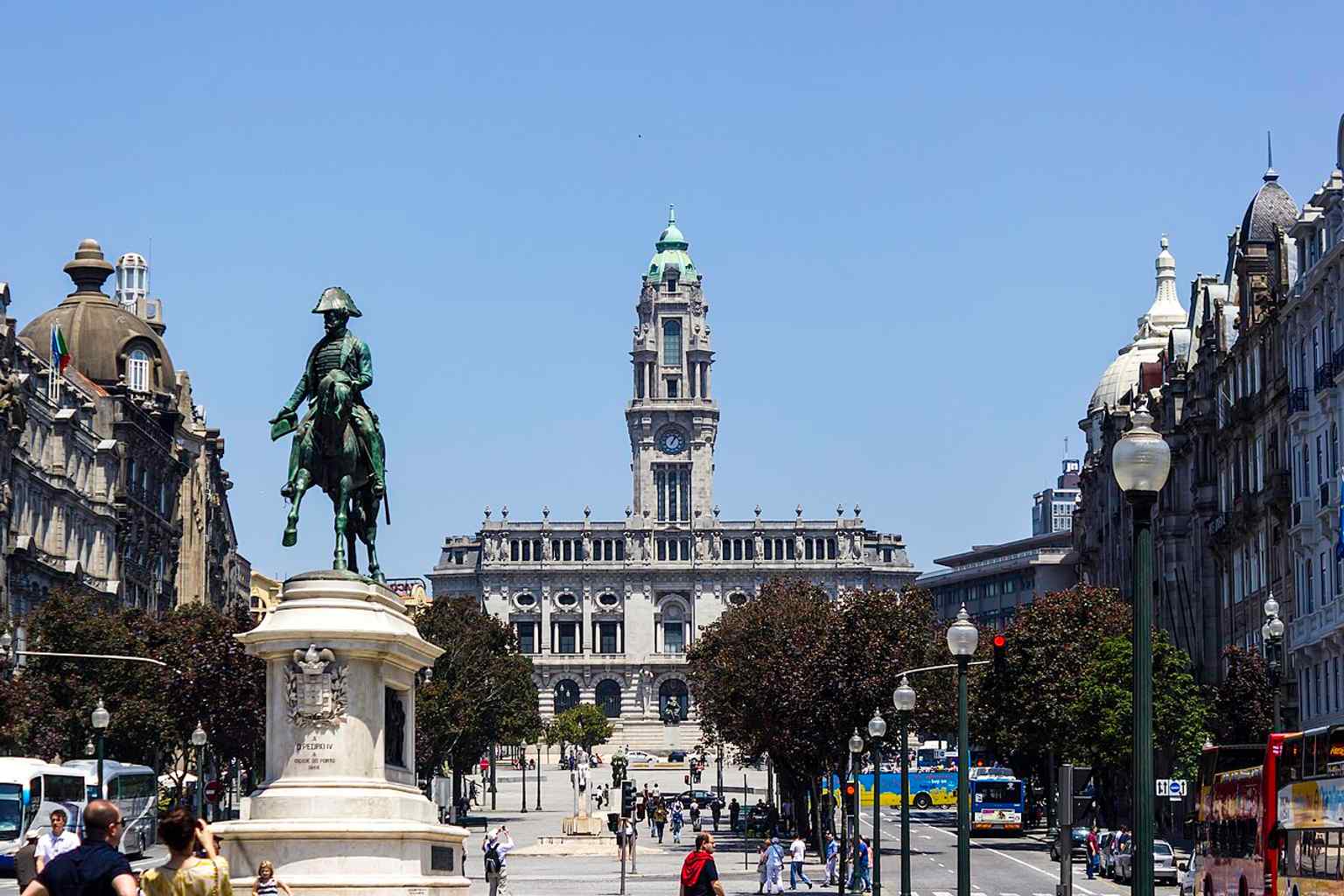
A clear view of Liberty Square in Porto, the historic civic heart of the city where the equestrian statue of D. Pedro IV anchors the square.Photo: Bene Riobó, Wikimedia Commons, CC BY-SA 4.0. Cropped & resized. Then came another struggle: who gets to reshape the city. In nineteen sixteen, with President Bernardino Machado present, workers began demolishing the old municipal building at the north end, and Porto opened the grand axis of the Avenida dos Aliados. Old streets vanished. New banks, insurance companies and offices moved in. The Bank of Portugal claimed a prominent plot soon after. Even later plans imagined sweeping viaducts and the destruction of medieval blocks nearby. In Porto, planning rarely meant only traffic or beauty; it also meant power, visibility and control. The metro works shown in another image remind you that this centre still changes under pressure.
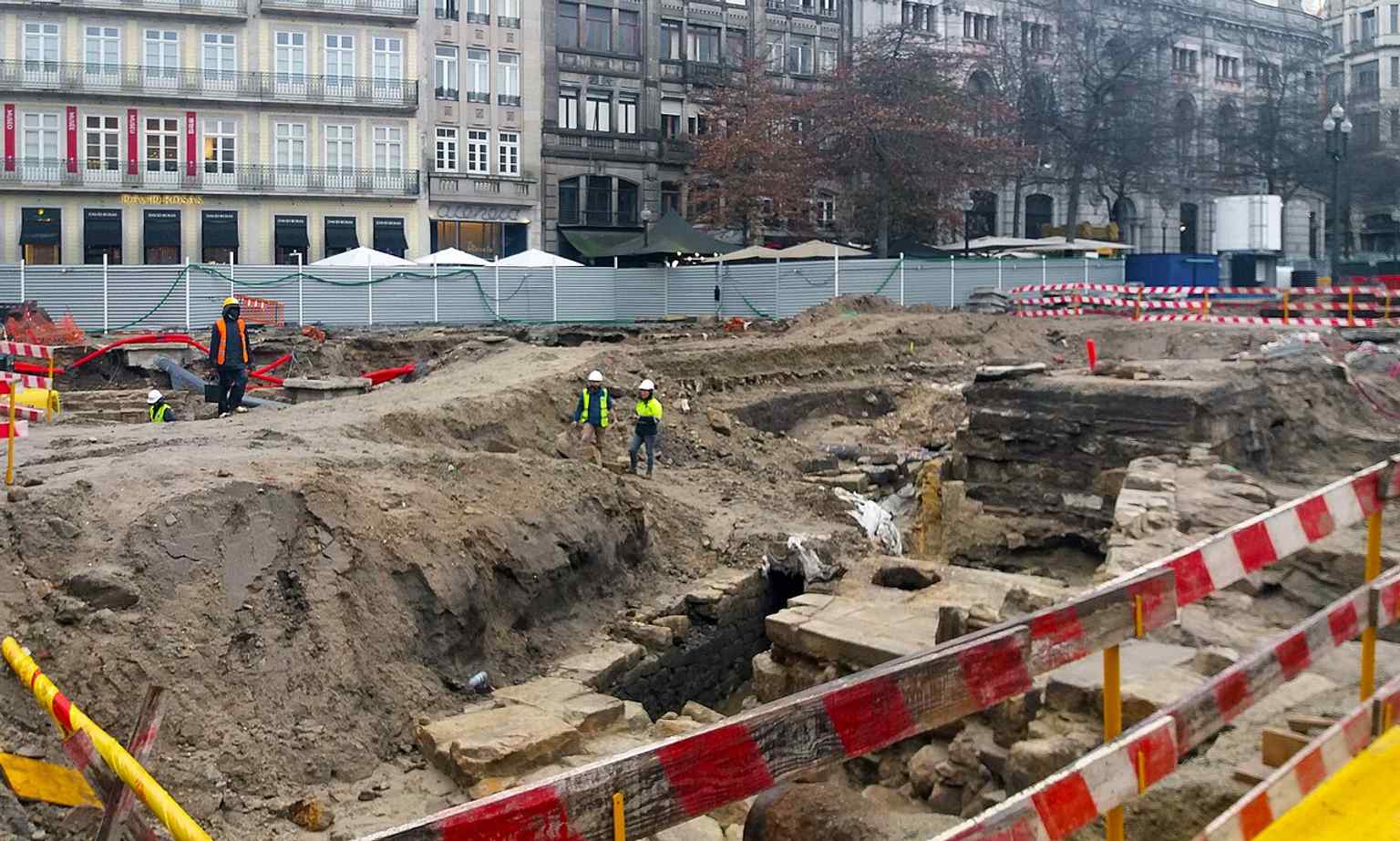
Construction works in Liberty Square during the metro project, showing how this central Porto landmark continues to evolve around the Praça da Liberdade and Avenida dos Aliados axis.Photo: Petnog, Wikimedia Commons, CC BY 4.0. Cropped & resized. From this broad public theatre, we now head toward Santa Clara, where authority and belief retreat behind church walls and speak in a more intimate register. And, fittingly for the city’s public heart, the square itself is open at all hours.
On your right, Carlos Alberto Square opens as a broad paved space of pale limestone and dark basalt, edged with planted areas and formal façades, with a memorial monument standing…Read moreShow less
Open dedicated page →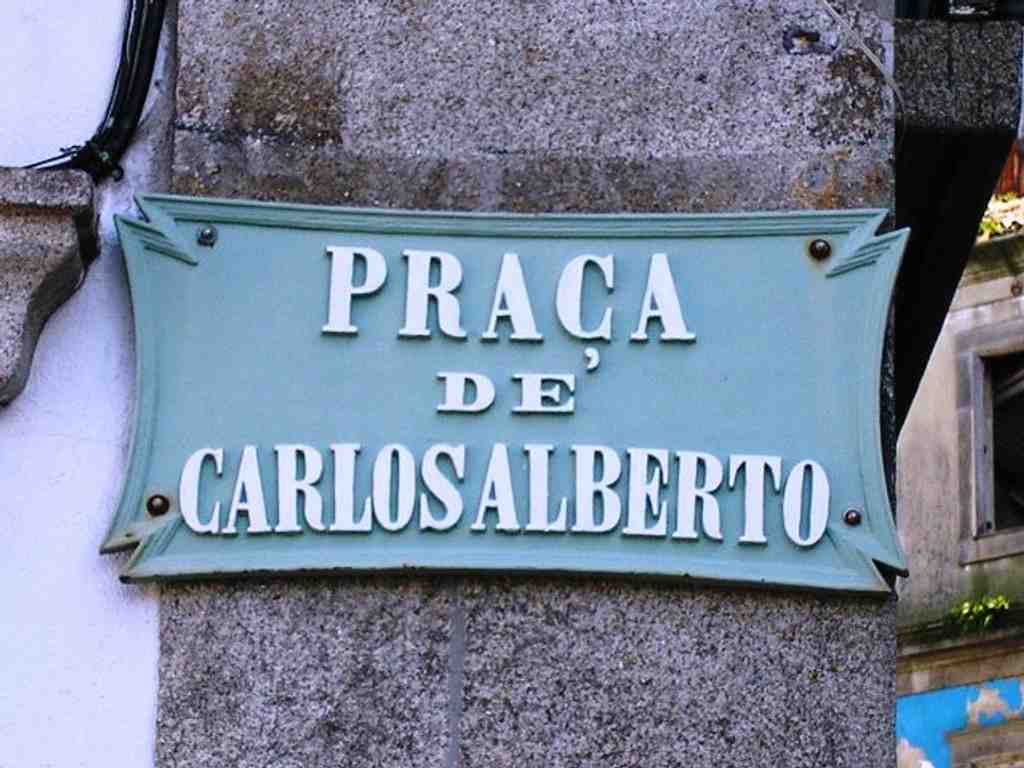
Carlos Alberto SquarePhoto: Manuel de Sousa, Wikimedia Commons, Public domain. Cropped & resized. On your right, Carlos Alberto Square opens as a broad paved space of pale limestone and dark basalt, edged with planted areas and formal façades, with a memorial monument standing as its clearest fixed marker.
This square began as a meeting of roads before it became a meeting of memories. Long before the name Carlos Alberto arrived, this was the Largo dos Ferradores, the square of the farriers, where horses were prepared for long journeys leaving the Porta do Olival and splitting toward Braga by today’s Rua de Cedofeita, or toward Guimarães by Rua das Oliveiras. Inns gathered here too. Travellers rested, tack was tightened, bargains were struck, and Porto watched people depart.
That feeling of departure never quite left. In the seventeenth and eighteenth centuries, the place kept changing its trade: oxen, cloth, animals, grass, coal, firewood. Later, people called it the Feira das Caixas, the fair of boxes, because carpenters here made the trunks that emigrants carried to Brazil. There is something rather moving in that detail: before a family crossed an ocean, part of the journey began here, in a wooden case made for hopes too large to carry by hand.
Then came the man who gave the square its name. On the nineteenth of April, eighteen forty-nine, Carlos Alberto, king of Piedmont and Sardinia, arrived in Porto after defeat at the Battle of Novara and after giving up his throne. His first refuge stood here, in a nearby lodging house. He stayed only briefly. About three months later, he died in Porto. The city did not restore his crown, of course, but it did something quieter and, in its way, more generous: it gave him shelter, and then it kept his name. In a century when Porto also knew political punishment and public fear, this square offered another role for the city: sanctuary.
It remained a place where uncertain lives paused and negotiated their next chapter. For years, farm servants and domestic workers came here to meet future employers and agree the terms of work face to face. Later, new vehicles claimed the same ground. From the eighteen fifties until nineteen ten, the heavy horse-drawn Carros Ripert left from in front of the Havaneza tobacco shop for São Mamede de Infesta. And on the twelfth of August, eighteen seventy-four, Porto’s first carro americano, the forerunner of the tram, departed from here for Cadouços in Foz.
The square also learned how nations remember their wounds. In nineteen twenty-eight, Henrique Moreira’s monument to the dead of the Great War took its place here after an earlier statue had so displeased local taste that the city removed it. Then, in nineteen fifty-eight, the square filled with an immense crowd following General Humberto Delgado to his campaign headquarters above Café Luso. Here he declared, “My heart will remain in Porto.” Fifty years later, José Rodrigues fixed that moment in bronze, showing Delgado wrapped in the national flag.
Even in our own century, the square nearly changed its face again. A radical redesign was proposed, fiercely disputed, and abandoned. Porto kept the gardens and the limestone-and-basalt paving instead. Sensible, I think. Some places earn the right to change slowly.
Now we go to the palacete itself, where exile, nobility, and public reuse meet under one roof: the Palacete of the Viscounts of Balsemão, just a minute away. And if you wish to linger, the square is open at all hours.
Show 12 more stopsShow fewer stopsexpand_moreexpand_less
Look for the long pale-stone façade with its disciplined rows of tall windows, wrought-iron balconies, and dark roof pierced by dormer windows. At first glance, this seems to be…Read moreShow less
Open dedicated page →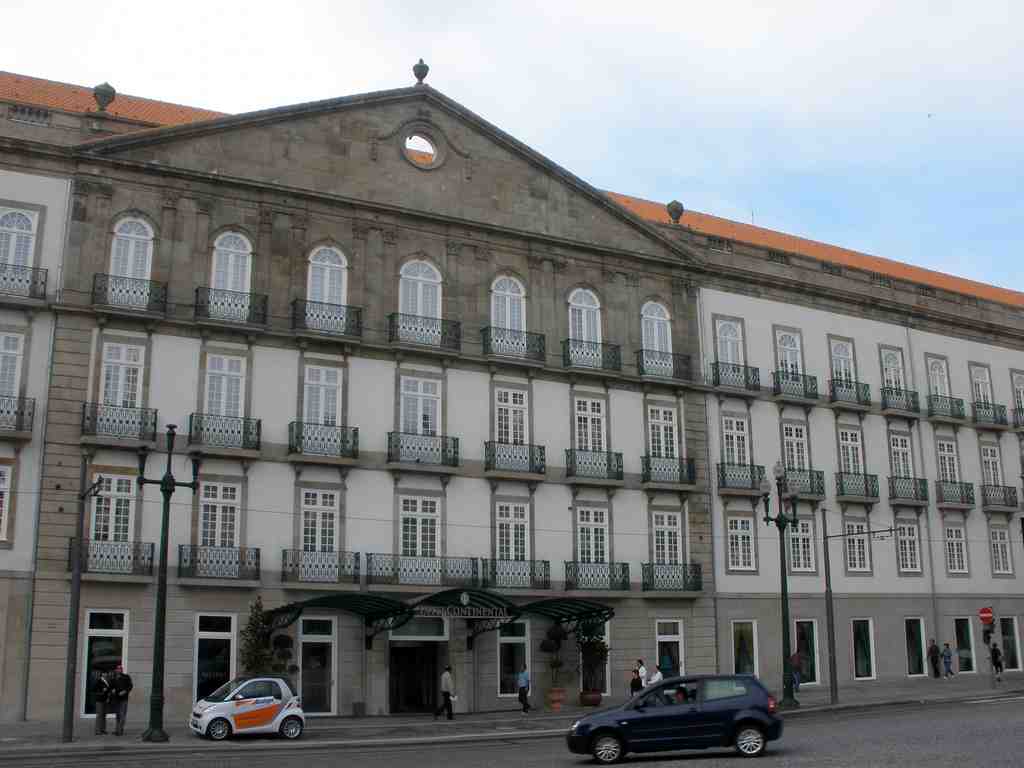
Cardosas PalacePhoto: Manuel de Sousa, Wikimedia Commons, CC BY-SA 3.0. Cropped & resized. Look for the long pale-stone façade with its disciplined rows of tall windows, wrought-iron balconies, and dark roof pierced by dormer windows.
At first glance, this seems to be a very self-assured nineteenth-century palace. But Porto likes to play a quieter game than that. Again and again, the city takes an old institution, keeps part of its skin, and teaches it a new role. This building is one of the clearest lessons in how to read Porto properly: never ask only what a place is. Ask what it used to be.
Beneath this elegant front sits the memory of the Convent of the Lóios, also called the Convent of Santo Elói. Its story began in the late fifteenth century, when Bishop Dom João de Azevedo ordered the convent buildings in fourteen ninety, and on the sixth of November, fourteen ninety-one, the first stone was laid for the church of Nossa Senhora da Consolação.
The convent did not stand still for long. In the late sixteenth century, the community enlarged and rebuilt it. Father Pedro da Assunção laid the first stone of a new main chapel in fifteen ninety-three, with Bishop Dom Jerónimo de Menezes present, and the architect Manuel Garcez guiding the design. In the seventeenth century, craftsmen enriched the church with altarpieces, ceiling work, pulpits for preaching, and even a new organ. So this refined frontage once sheltered a world of prayer, ceremony, timber, gilding, and incense.
Then the city began to lean on it. In seventeen sixty-four, João de Almada e Melo ordered a new square to open in front of the convent. Suddenly this inward-looking religious house had to face a growing public city. In seventeen ninety-eight, José de Champalimaud designed a new front for that purpose, but the upheavals of the early nineteenth century interrupted the work, leaving the building suspended between convent and palace.
Take a good look at the façade now. Its symmetry is calm, almost formal. And yet very few people passing by would guess they are looking at a converted convent rather than a building born as a palace.
The nineteenth century pushed the transformation even further. Between eighteen ten and eighteen twenty-two, Portuguese troops occupied the building and turned it into a military hospital. During the Siege of Porto in eighteen thirty-two, it housed the mint, where coin was produced in the middle of political crisis. Prayer gave way to soldiers, medicine, and money.
After the religious orders were dissolved in eighteen thirty-four, the businessman Jesus Cardoso dos Santos bought the property at public auction for eighty contos de réis. He had to complete the frontage. After his death, the building passed to his wife and three daughters, known as the Cardosas, and they gave the palace the name it still carries.
By the end of the nineteenth century, one damaged tower gave authorities the excuse to demolish the church and the rest of the convent. Only this main façade survived. Even the old stone and bells were reused for practical purposes.
So here, in the polished heart of Porto, a grand civic face still wears the outline of a religious past. When you are ready, continue to Liberty Square, about a minute away, where the city’s public stage opens wide and the layers become harder to miss.
On your left, Carmo Church rises in pale granite with a curving baroque façade, statues along the roofline, and a great blue-and-white tiled wall wrapping its side. This is one…Read moreShow less
Open dedicated page →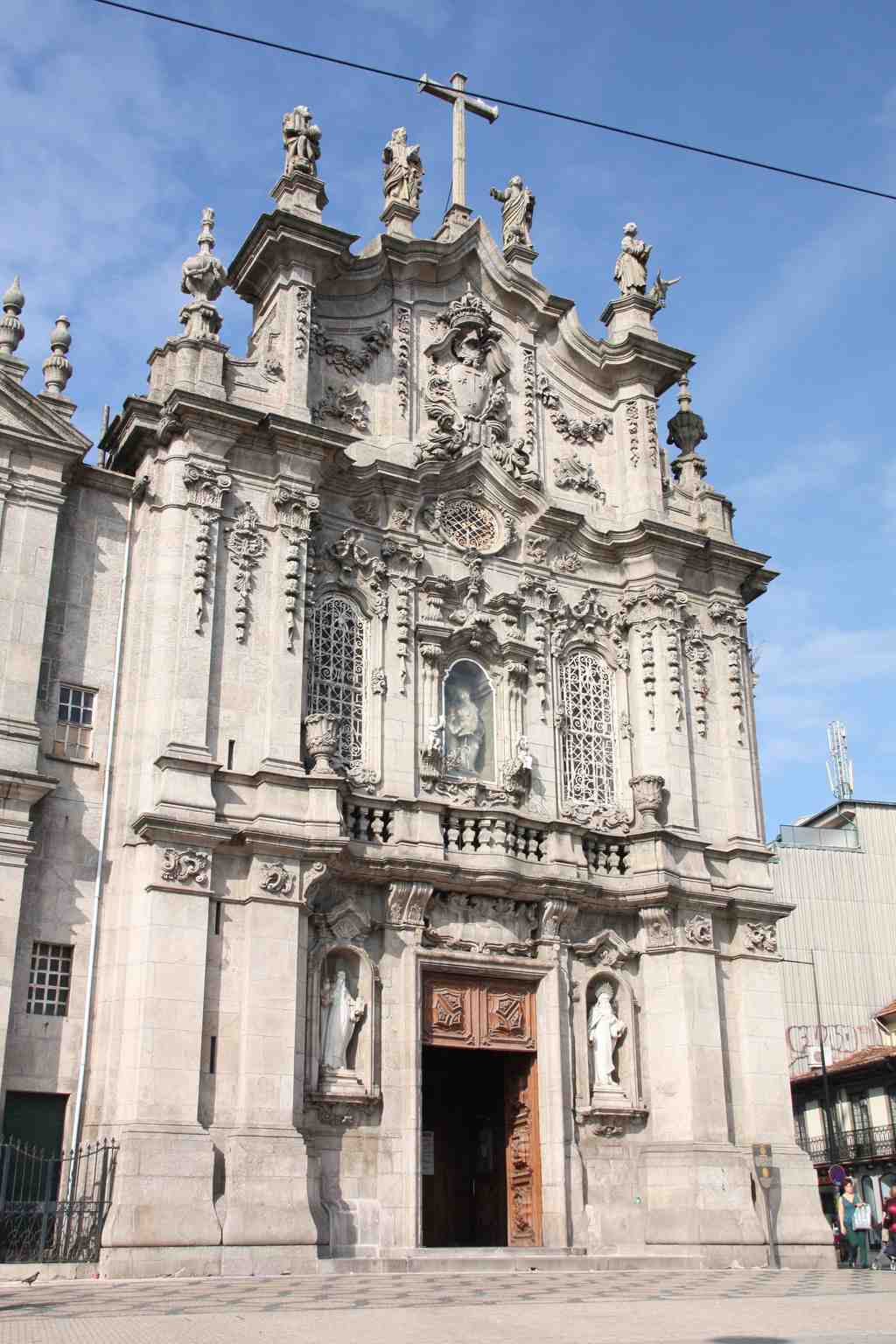
Carmo ChurchPhoto: User:Otourly, Wikimedia Commons, CC BY-SA 3.0. Cropped & resized. On your left, Carmo Church rises in pale granite with a curving baroque façade, statues along the roofline, and a great blue-and-white tiled wall wrapping its side.
This is one of Porto’s most charming acts of architectural mischief. In the second half of the eighteenth century, the Third Order of Our Lady of Mount Carmel wanted its own grand church here, beside the older Church of the Carmelites. There was, however, a snag: city rules did not allow two churches to stand directly wall to wall. So the architect, José Figueiredo Seixas, did what clever architects do when law blocks the front door. He found a side entrance.
Between the two churches he inserted the Casa Escondida, the Hidden House, a strip of building only a little over one and a half metres wide. It began as a practical workaround, but Porto adopted it with delight. A legal necessity turned into a local curiosity, the sort of thing people pass without noticing, then remember for years once they do.
Before we go further, have a look at the narrow gap between the churches and see if you can spot that improbable little house. So many people admire the grand façades and never realise that the slimmest building here once solved a very stubborn urban problem. If you want a clearer view, glance at the image on your screen.
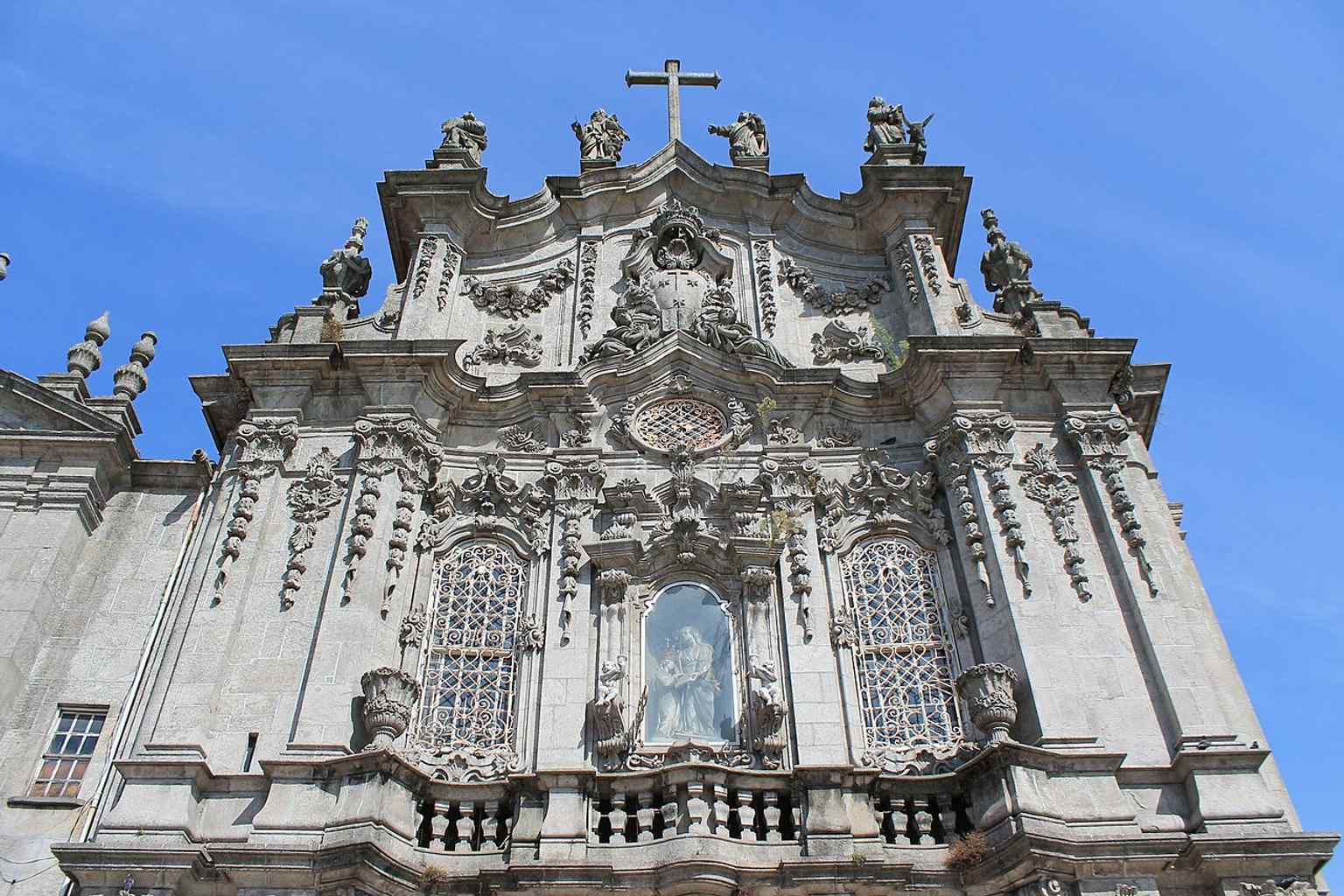
The front view of the Carmo and Carmelitas complex shows the famous side-by-side churches that were forced apart by the tiny “Hidden House” between them.Photo: Jsamwrites, Wikimedia Commons, CC BY-SA 4.0. Cropped & resized. Seixas built the church between seventeen fifty-six and seventeen sixty-eight, and the Order later added its hospital, finished in eighteen oh one. Over roughly two hundred and fifty years, that tiny hidden house served rather less romantic purposes than legend prefers. Local tradition likes to claim it kept friars and nuns from sharing a wall, or even from exchanging dangerous levels of eye contact. More sober accounts say chaplains lodged there, and at times doctors connected to the Order’s hospital did too. Hidden lives behind façades, once again.
Now lift your eyes to the front. High on the façade stands the church’s patron saint, an emblem of Carmelite devotion. In the niches by the doorway are the prophets Elijah and Elisha, spiritual models for the Carmelites. Above them, the four Evangelists gather among pointed finials and sculpted flourishes that show the influence of the Italianate baroque style associated with Nicolau Nasoni, whose theatrical touch you saw at Clérigos. If you want the details laid out neatly, the façade image is worth a quick look.
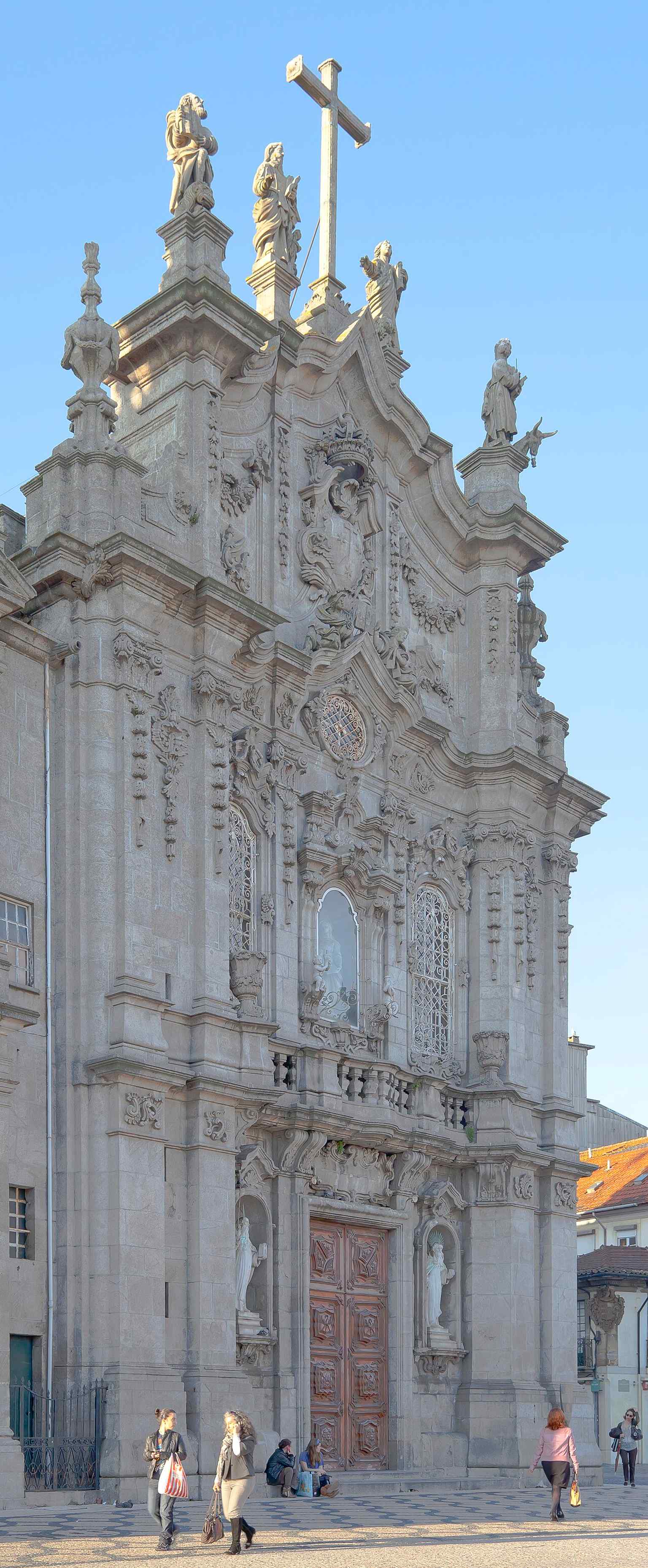
A full-height view of Carmo Church’s Baroque-Rococo facade, where Santa Ana, the prophets Elias and Eliseu, and the Evangelists decorate the front.Photo: Diego Delso, Wikimedia Commons, CC BY-SA 3.0. Cropped & resized. The side wall, though, is the great flourish. In nineteen twelve, artists Silvestre Silvestri and Carlos Branco created the immense tile panel telling stories of the Carmelite order and Mount Carmel. It turns the whole flank of the church into a blue-and-white narrative, less like decoration than a public proclamation in ceramic.
In two thousand and thirteen, Carmo and the adjacent Carmelitas were formally protected together as a National Monument, which feels exactly right. Their odd coexistence is the story. Faith, ambition, regulation, and ingenuity all pressed together until the city produced something no planner would have invented on purpose and no one would now wish away.
If you decide to come back later, the church is generally open daily from half past nine to five, and visits may also include the Hidden House and parts of the Order’s interior circuit.
When you are ready, continue towards Carlos Alberto Square. There the story shifts from ingenious buildings to the drama of a man received here far from home: a king in exile, and a city deciding how to welcome him.
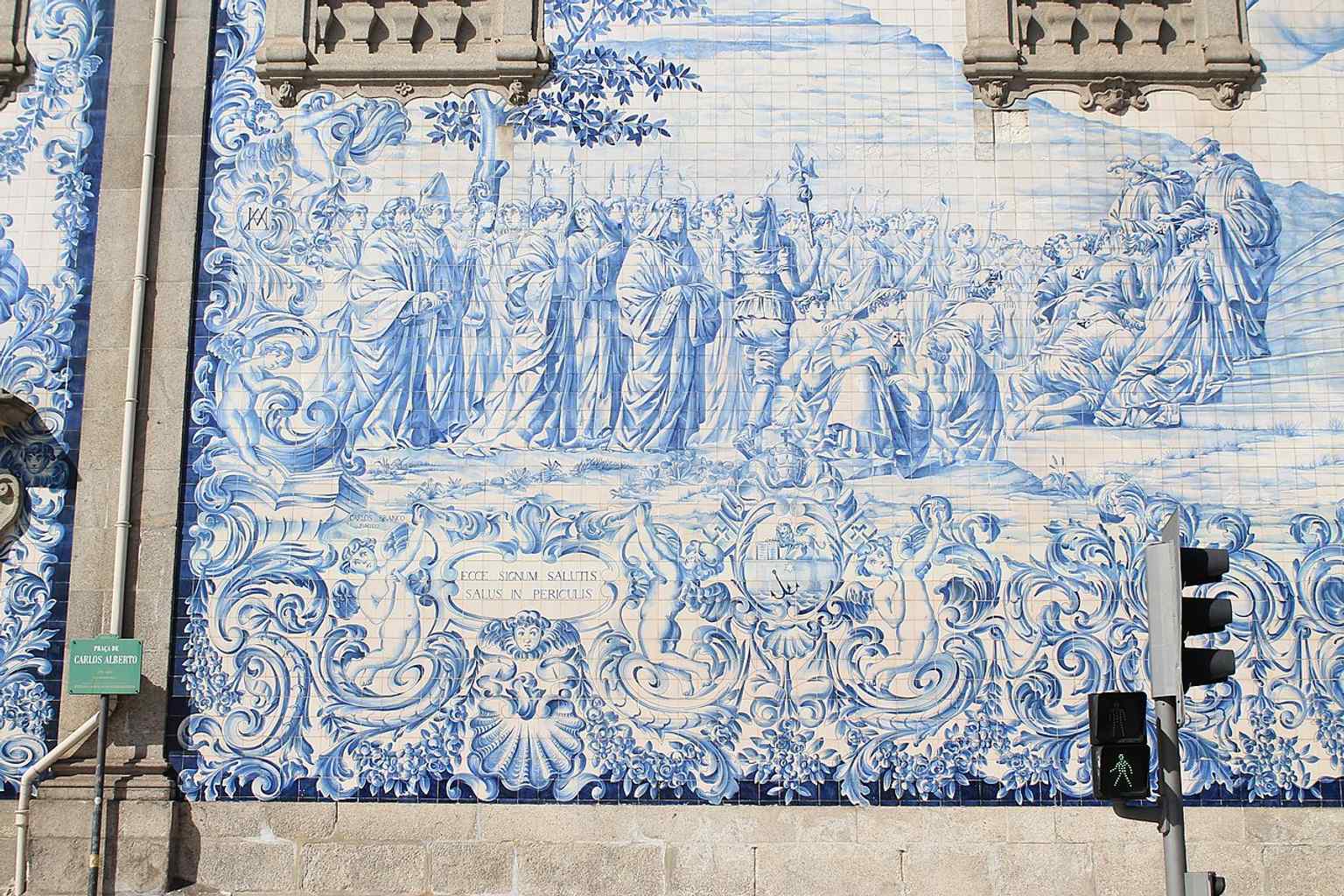
The blue-and-white azulejo wall on the church side captures the 1912 tile panel that tells stories of the Carmelite order and Mount Carmel.Photo: Jsamwrites, Wikimedia Commons, CC BY-SA 4.0. Cropped & resized. 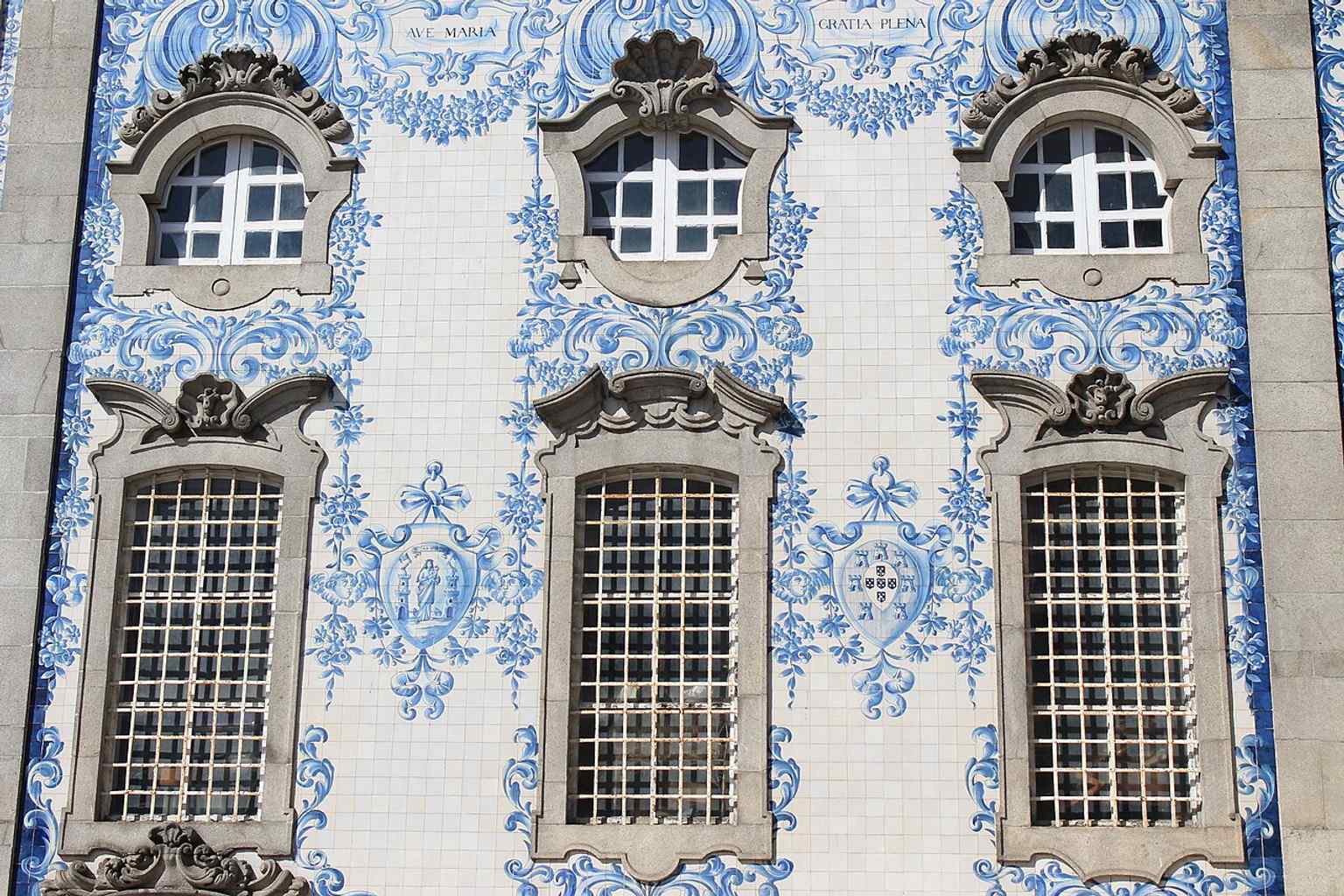
Another view of the immense azulejo façade, one of the most striking features seen from Rua do Carmo and a highlight of the church exterior.Photo: John Samuel, Wikimedia Commons, CC BY-SA 4.0. Cropped & resized. 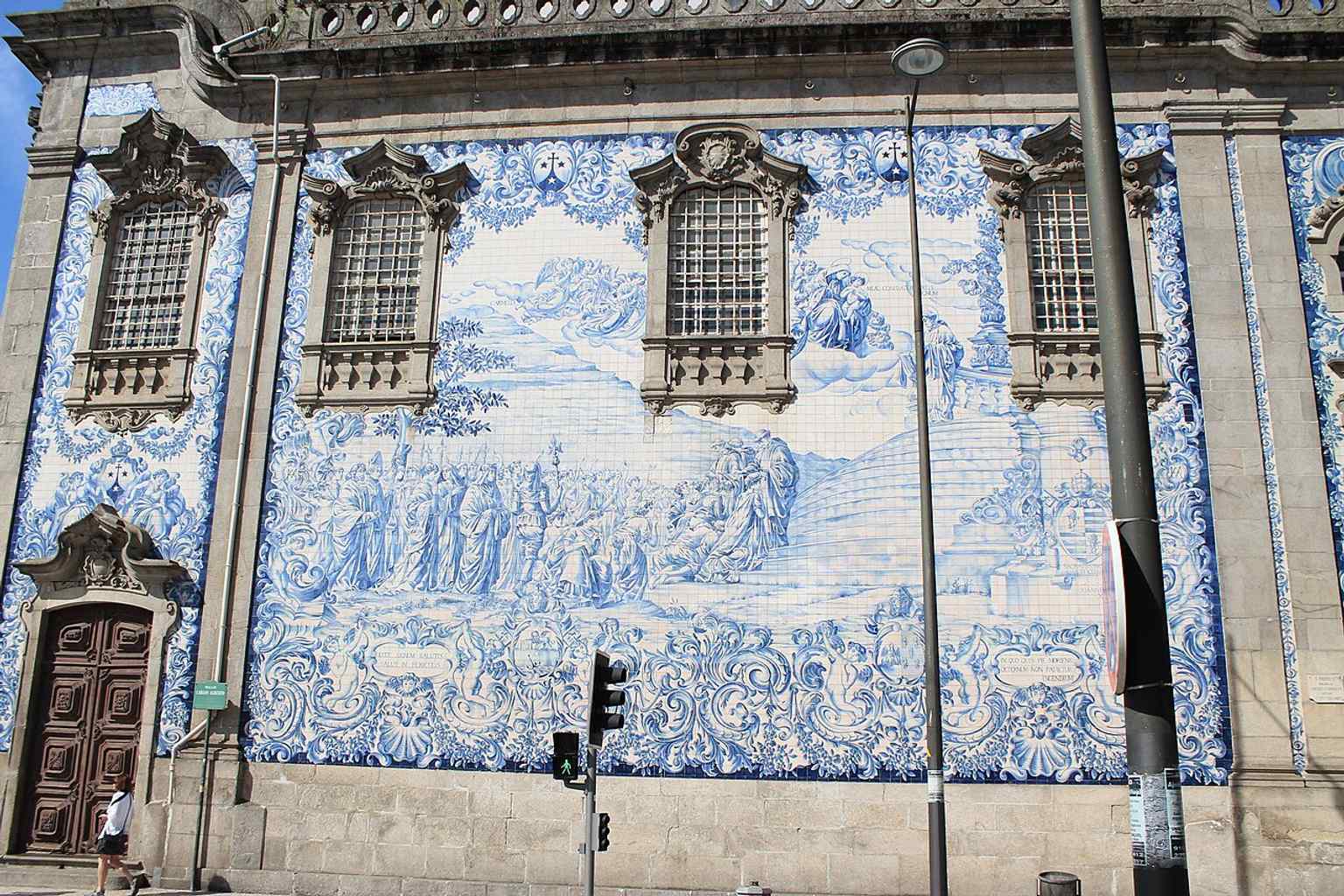
A closer look at the tiled side wall emphasizes the church’s celebrated azulejo decoration, added in 1912 and covering a vast surface.Photo: John Samuel, Wikimedia Commons, CC BY-SA 4.0. Cropped & resized. 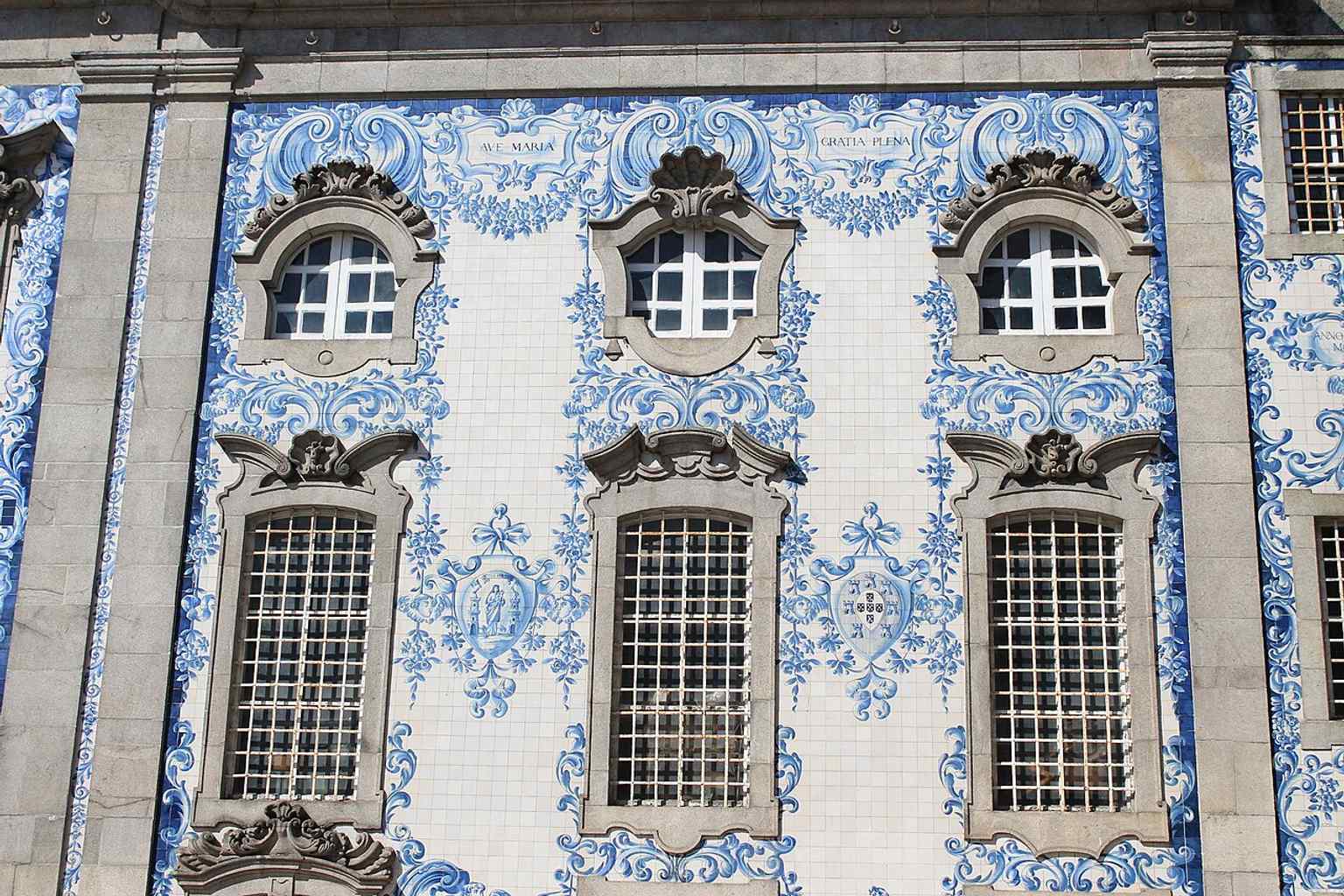
The main altar showcases the church’s rich gilded carving, part of the dramatic interior focused on the Passion of Christ.Photo: John Samuel, Wikimedia Commons, CC BY-SA 4.0. Cropped & resized. 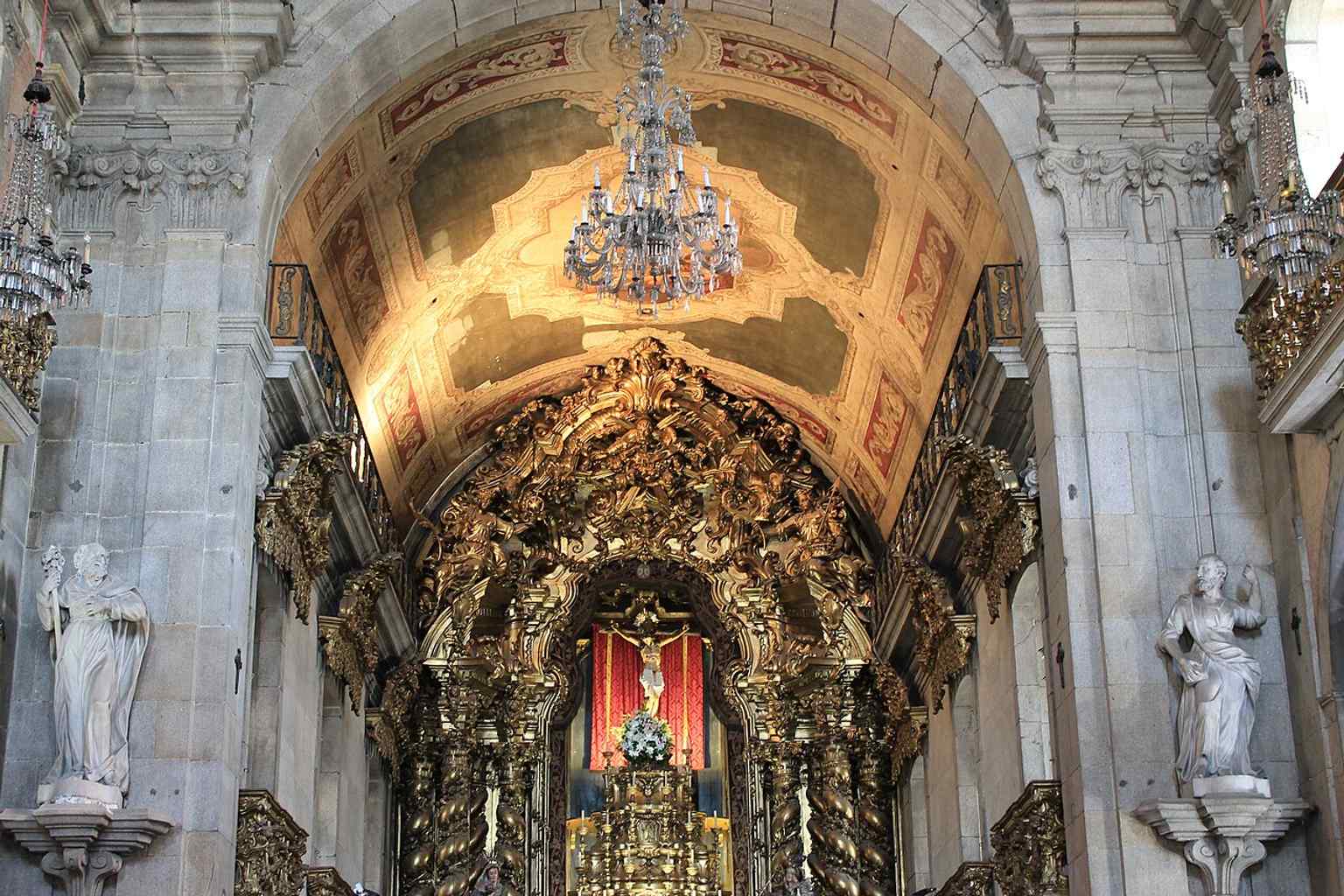
The painted ceiling draws attention to the church’s ornate interior, where the iconography culminates in the Resurrection of Christ above.Photo: T meltzer, Wikimedia Commons, CC BY-SA 4.0. Cropped & resized. 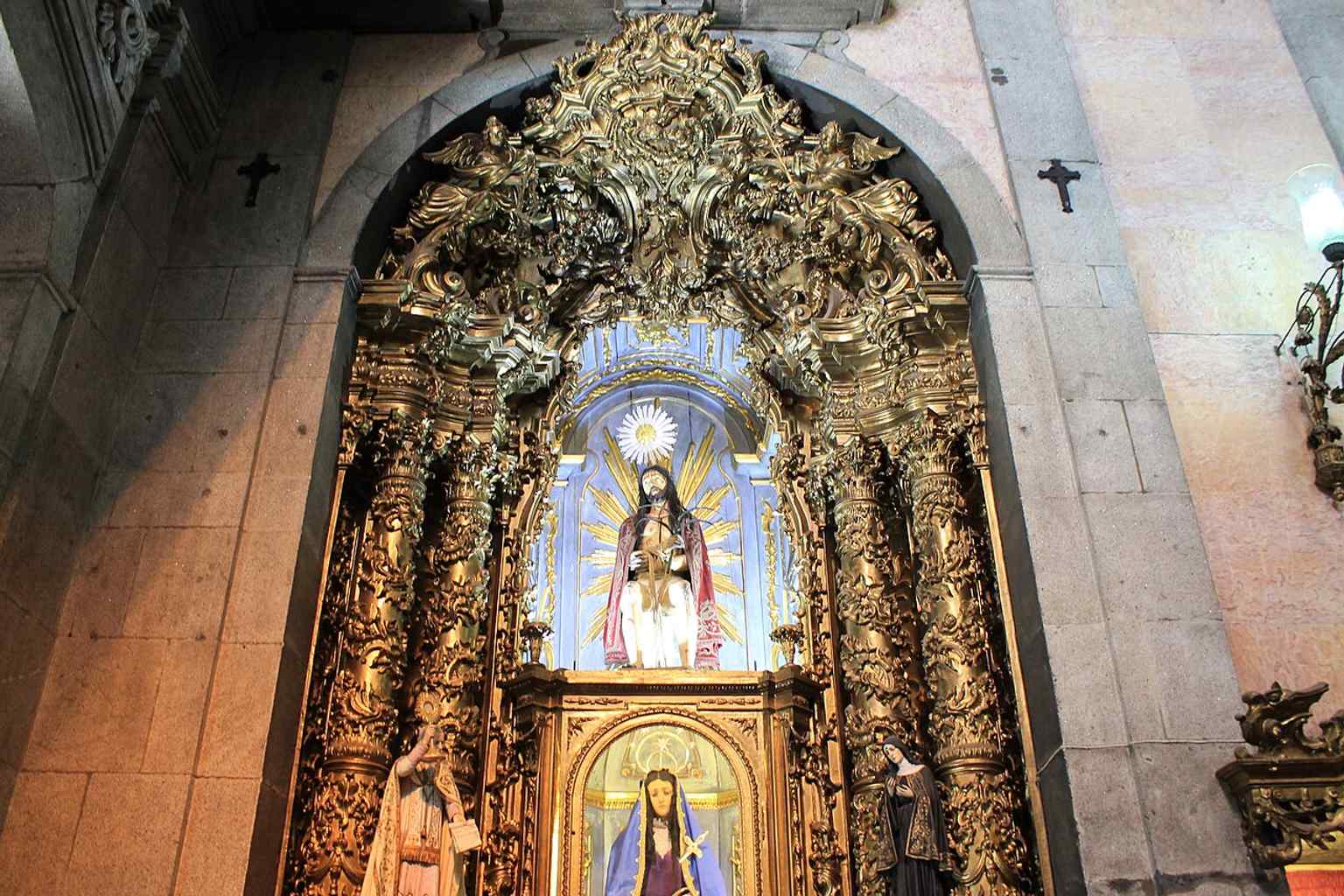
A broad interior view reveals the gilded altars, paintings, and devotional atmosphere that define the Carmo Church’s Baroque setting.Photo: John Samuel, Wikimedia Commons, CC BY-SA 4.0. Cropped & resized. 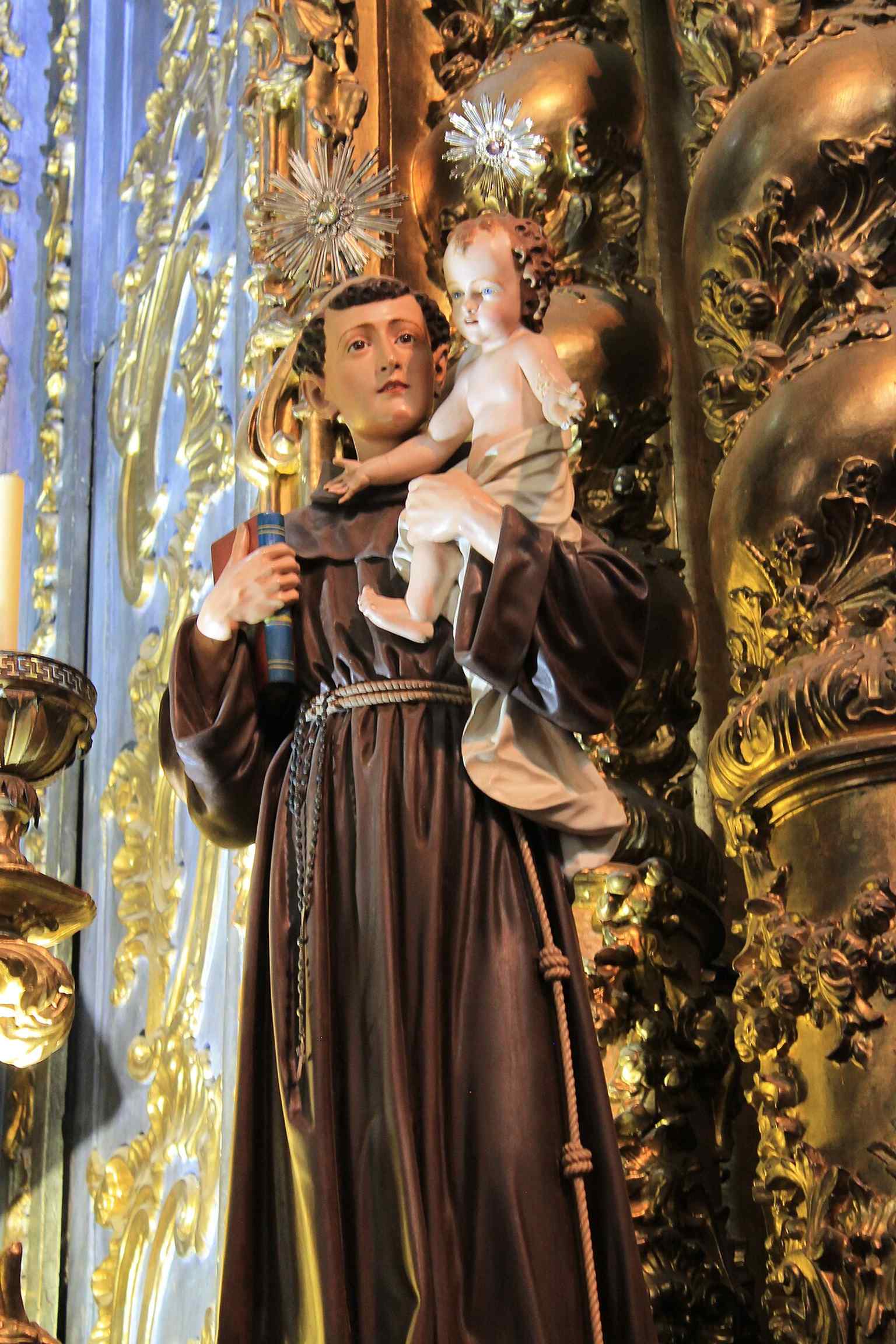
This interior detail adds another angle on the church’s elaborate decoration, reflecting the Carmelite focus on Passion imagery and sacred art.Photo: John Samuel, Wikimedia Commons, CC BY-SA 4.0. Cropped & resized. 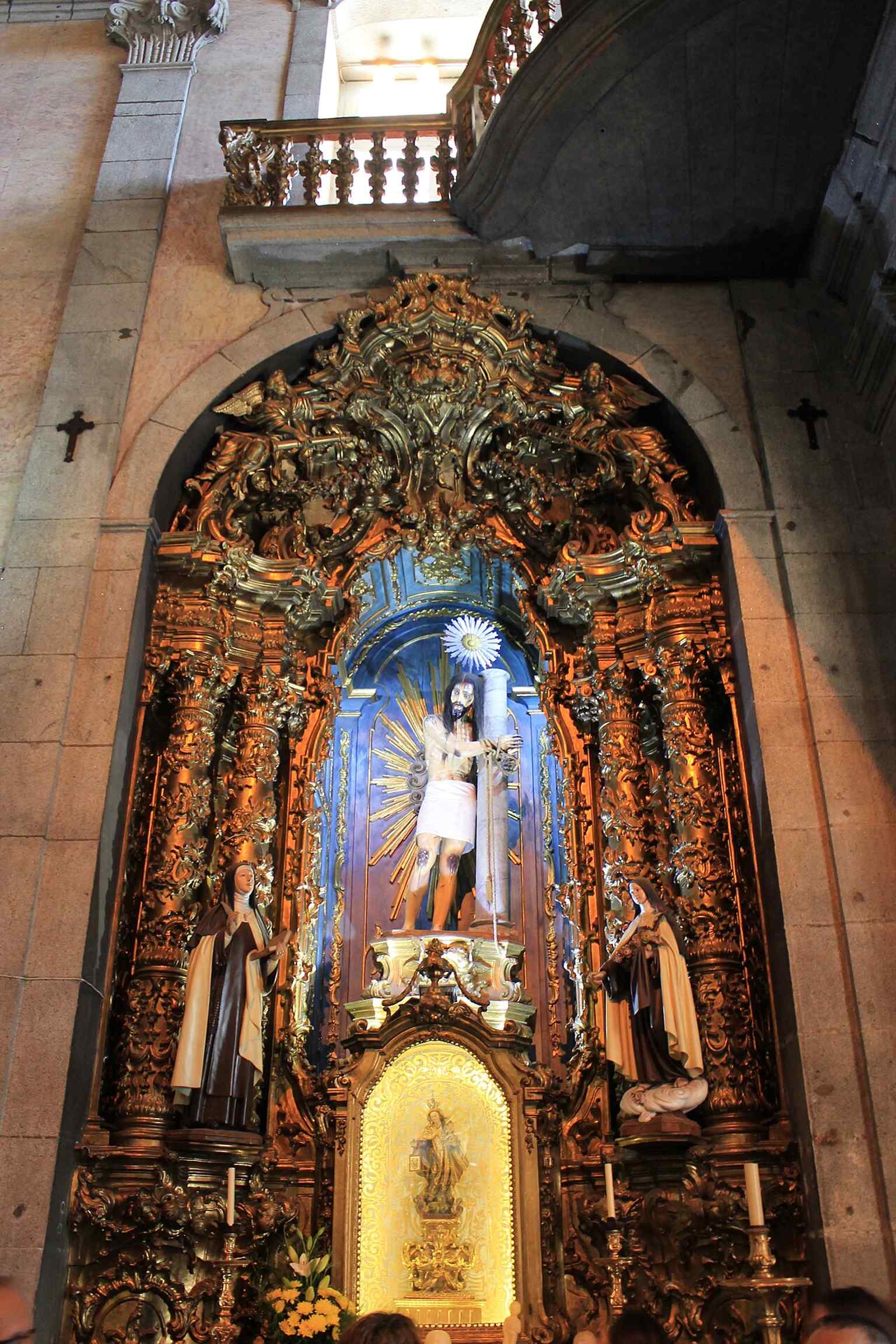
A different exterior angle helps place Carmo Church in the historic center of Porto, near the Clérigos area and its busy urban setting.Photo: John Samuel, Wikimedia Commons, CC BY-SA 4.0. Cropped & resized. On your right, look for a narrow granite façade rising like a carved screen, crowned with a cross and backed by the tall bell tower that marks the Porto skyline. This is…Read moreShow less
Open dedicated page →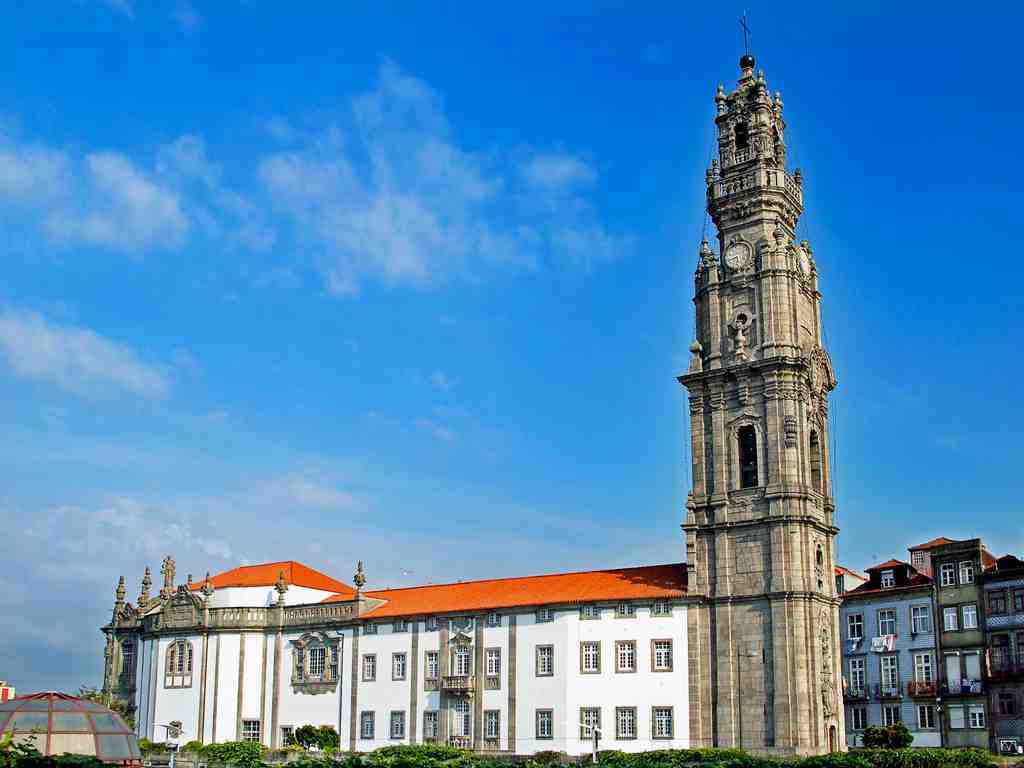
Clérigos Church and TowerPhoto: António Amen, Wikimedia Commons, CC BY-SA 3.0. Cropped & resized. On your right, look for a narrow granite façade rising like a carved screen, crowned with a cross and backed by the tall bell tower that marks the Porto skyline.
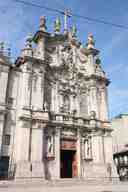
This is Clérigos: church, tower, and the House of the Brotherhood between them, all drawn together by Nicolau Nasoni, the Italian architect from Tuscany who came to Porto from Malta and gave the city one of its boldest signatures. People often treat the tower as a postcard. It is that, certainly. But it began with something quieter and more human.
In the early eighteenth century, Porto had many clergy, and not all of them lived comfortably. Some grew poor, some fell ill, some died without support. So in seventeen oh seven, three local religious brotherhoods joined forces to care for them. Out of that practical act of mercy came this entire complex. Even the choice of patron saint had a touch of theatre: the different groups could not agree, so the name of Our Lady of the Assumption was drawn from an urn.
The site itself carried an awkward memory. This ground lay near the Adro dos Enforcados, a place associated with executions and the burial of the condemned. Yet Porto has a habit of taking troubled ground and giving it a new purpose. The church rose first, from seventeen thirty-two to seventeen forty-nine. The House of the Brotherhood followed, then the tower, finished in seventeen sixty-three.
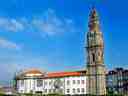
And what a tower it is: seventy-five metres high, stacked in six levels, with two bell chambers, a carillon of forty-nine bells, and a stair of two hundred and twenty-five steps. It did more than call people to worship. It marked time with a daily gunpowder signal at noon, served as a telegraph, guided boats on the Douro, signalled merchants when packets arrived, and even played a part in moments of conflict. Faith gave Porto a lookout.
If you glance at the image on your screen, you can see how the interior opens into an oval nave, the church’s main hall, rather than a long simple rectangle. That shape was unusual here. Outside, Nasoni turned granite into something almost fluid. The façade narrows and rises dramatically, with curves, niches, and ornament so lively that the stone seems carved like wood.
The church interior in 2015, where the oval nave and grand Baroque atmosphere contrast with the restrained exterior.Photo: Joseolgon, Wikimedia Commons, CC BY-SA 4.0. Cropped & resized. But here is the part locals never quite tire of. Nasoni gave decades of his life to this place, and the records say he was buried here as a “poor cleric.” Yet nobody can point to his grave. During the major restoration completed in two thousand and fourteen, workers uncovered an eighteenth-century crypt by accident. Archaeologists found twenty-six bodies there, including António de Santo Ilídio, the bishop-elect of Aveiro, who died in eighteen forty-nine. They also identified four possible candidates for Nasoni. Even so, the architect of Porto’s most recognisable monument remains, in death, uncertain inside his own creation.
If you want a sense of how completely the tower commands the city, the aerial view in the app makes the point rather well. From here, Porto seems to gather around it.
And now we leave this great upward gesture of stone and bells for another kind of ambition: the University of Porto, where the city turned height into thought, and authority into learning. If you plan to go inside later, the Clérigos complex is generally open every day from nine in the morning until seven in the evening.
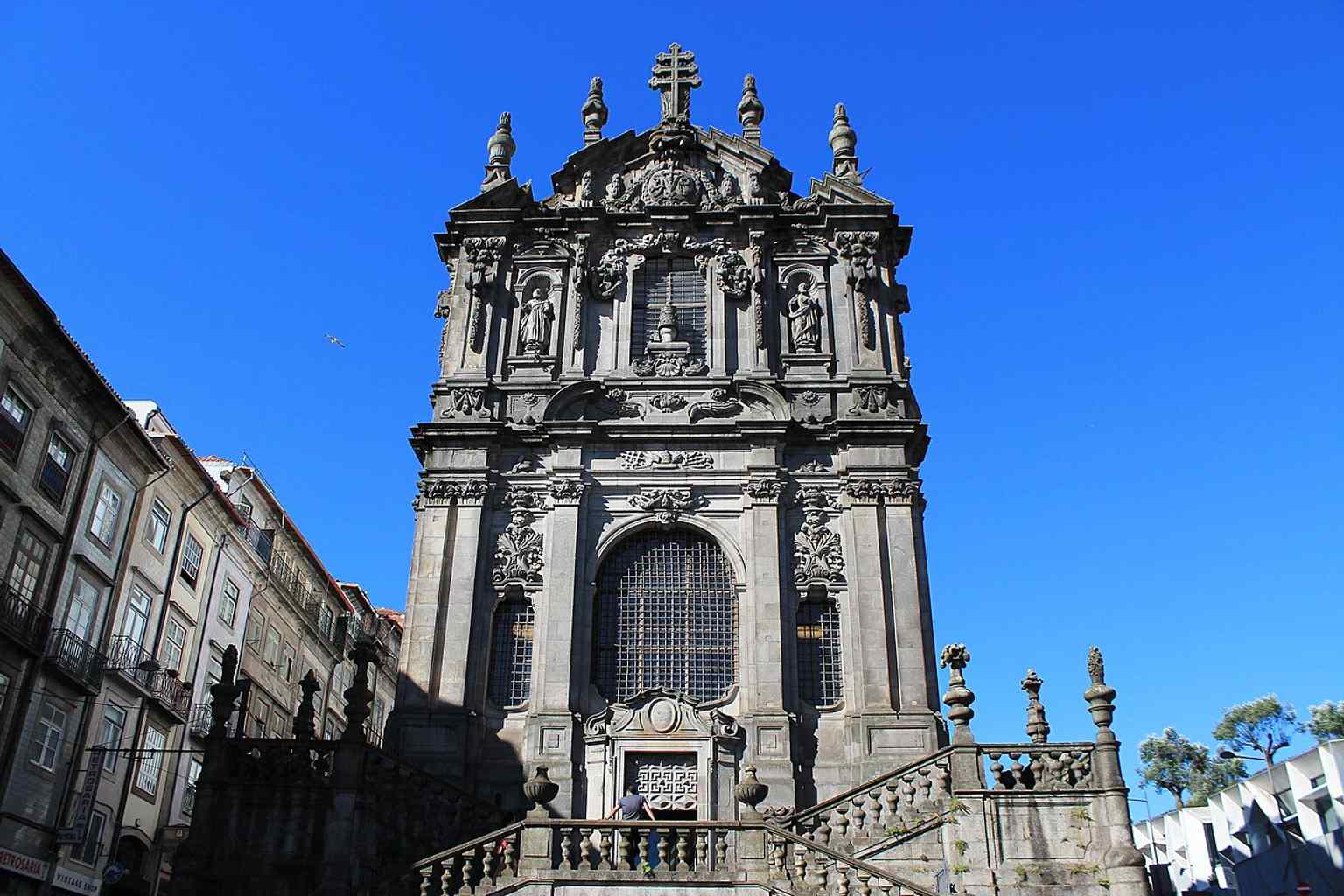
A clear full view of the church façade, showing the narrow, towering front that makes the Clérigos such a dramatic Baroque landmark.Photo: John Samuel, Wikimedia Commons, CC BY-SA 4.0. Cropped & resized. 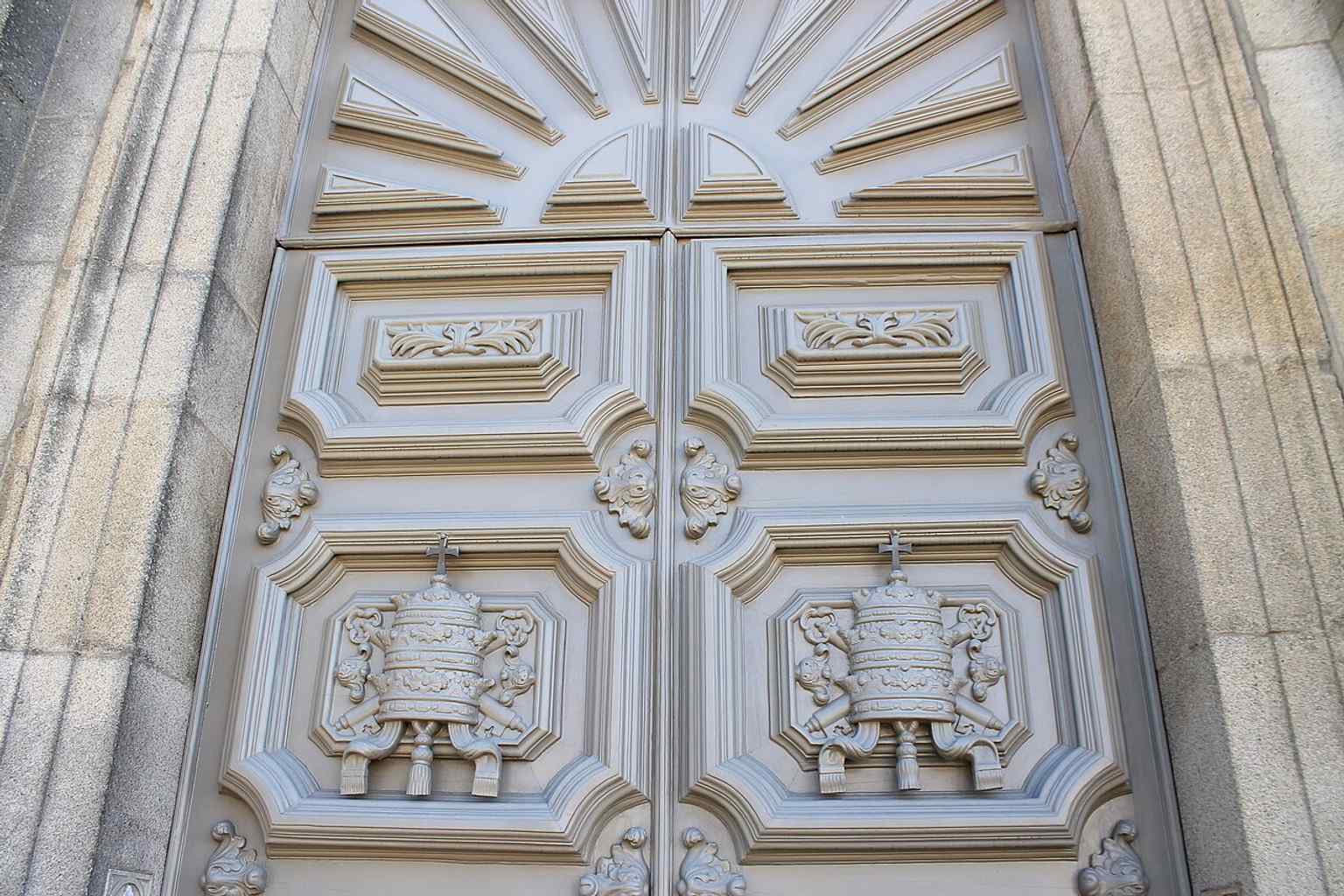
The side portal of the church, a good close look at Nasoni’s granite craftsmanship and the ornate entryway details.Photo: John Samuel, Wikimedia Commons, CC BY-SA 4.0. Cropped & resized. 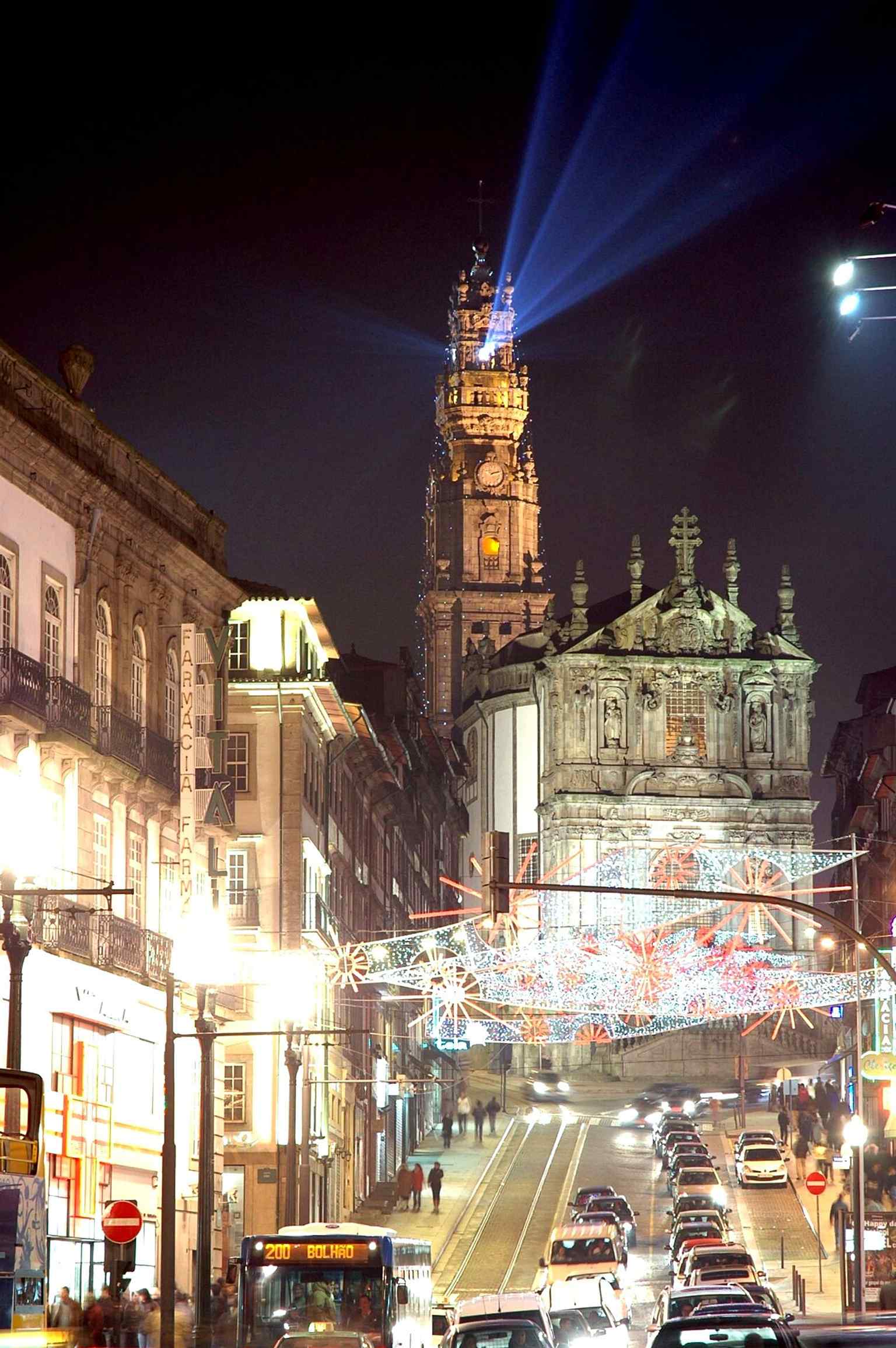
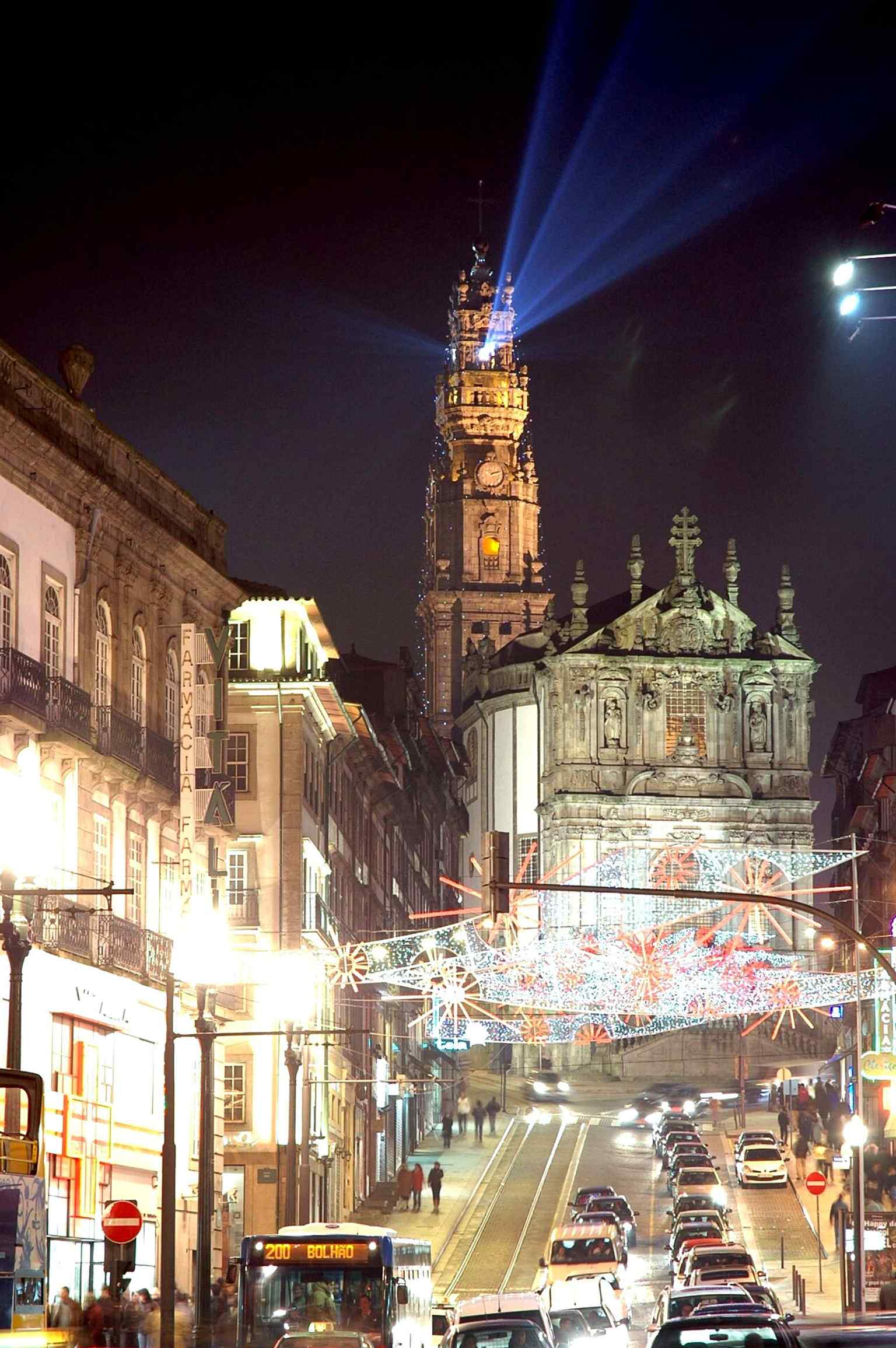
The tower at night, when the Clérigos become one of Porto’s most recognizable silhouettes over the city center.Photo: Josep Renalias, Wikimedia Commons, CC BY-SA 3.0. Cropped & resized. 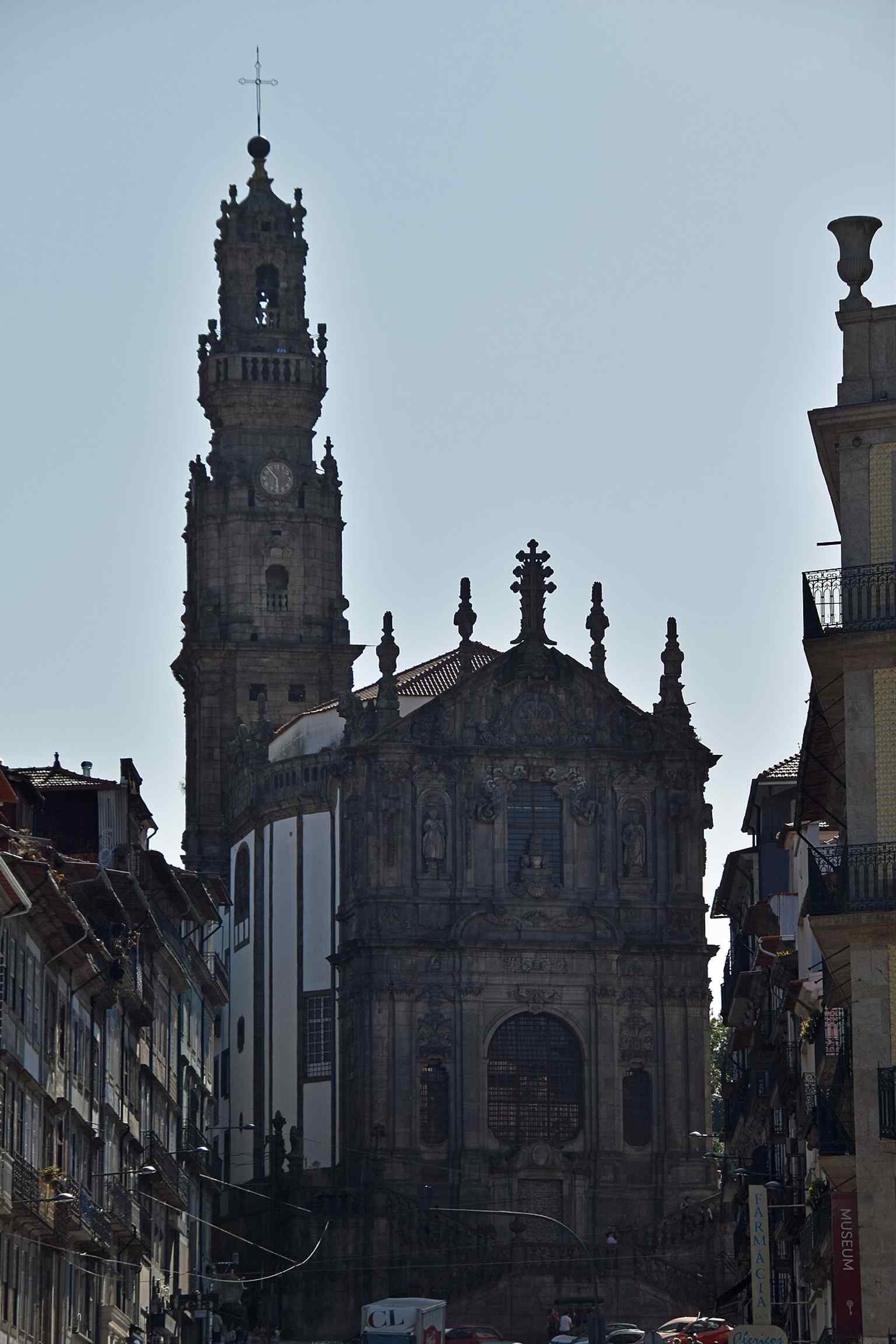
A recent view of the Clérigos Tower, the 75-meter bell tower that became the city’s iconic lookout.Photo: Thomas Dahlstrøm Nielsen, Wikimedia Commons, CC BY 4.0. Cropped & resized. 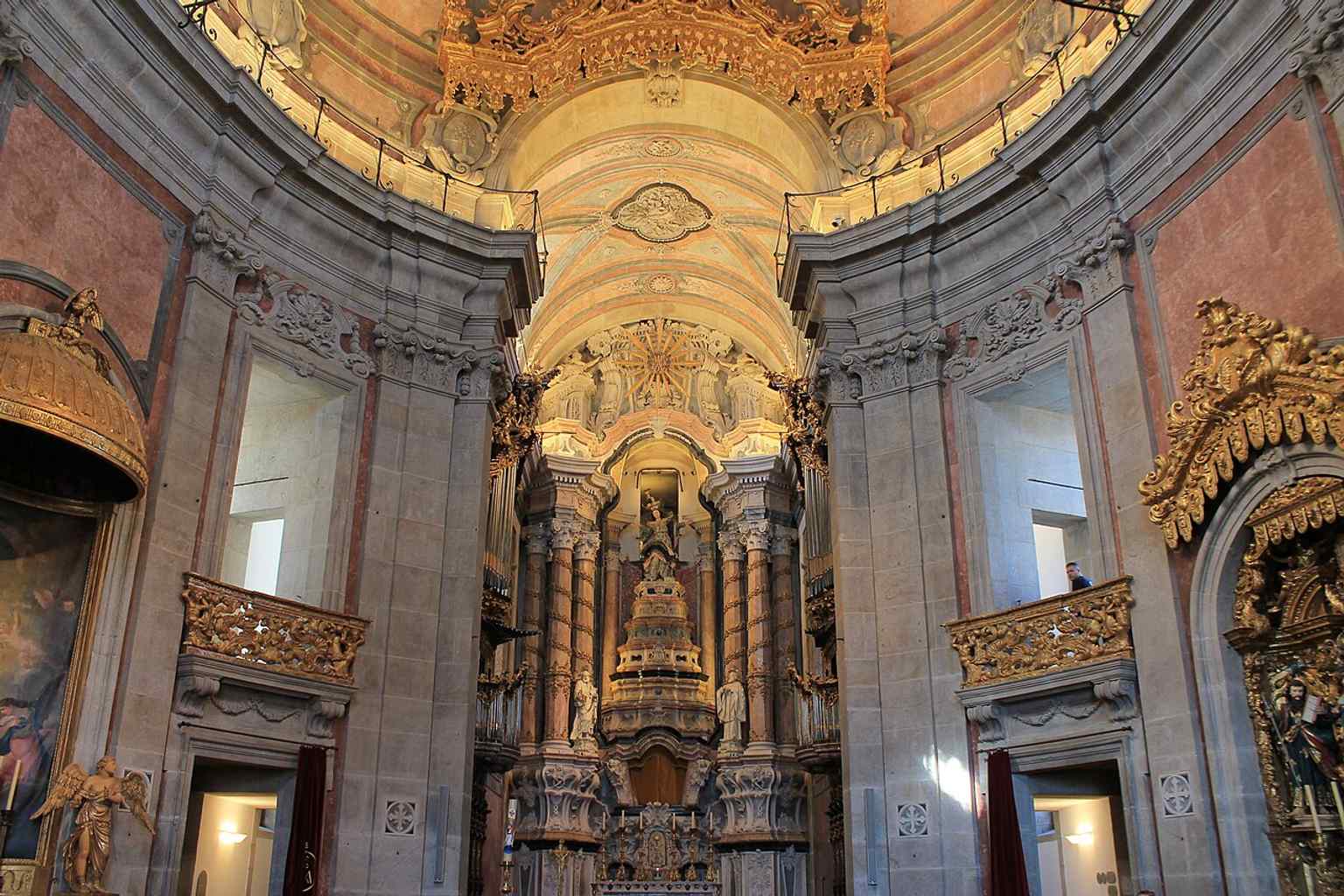
An interior perspective that helps show the church’s long central space and the light-filled Baroque composition.Photo: John Samuel, Wikimedia Commons, CC BY-SA 4.0. Cropped & resized. 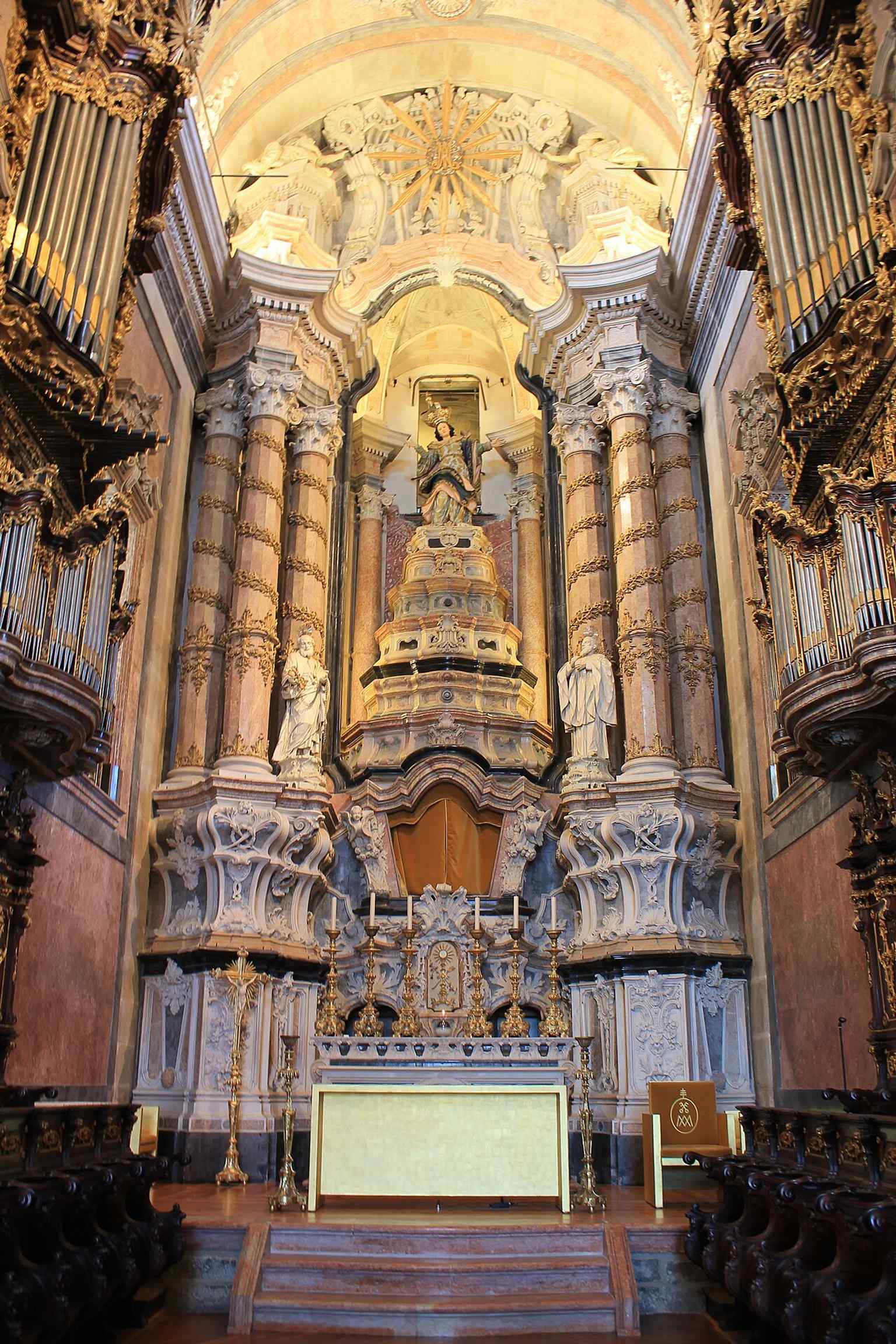
The main altar, reflecting the richly decorated capela-mor described in the source text with its rococo-inspired finish.Photo: John Samuel, Wikimedia Commons, CC BY-SA 4.0. Cropped & resized. 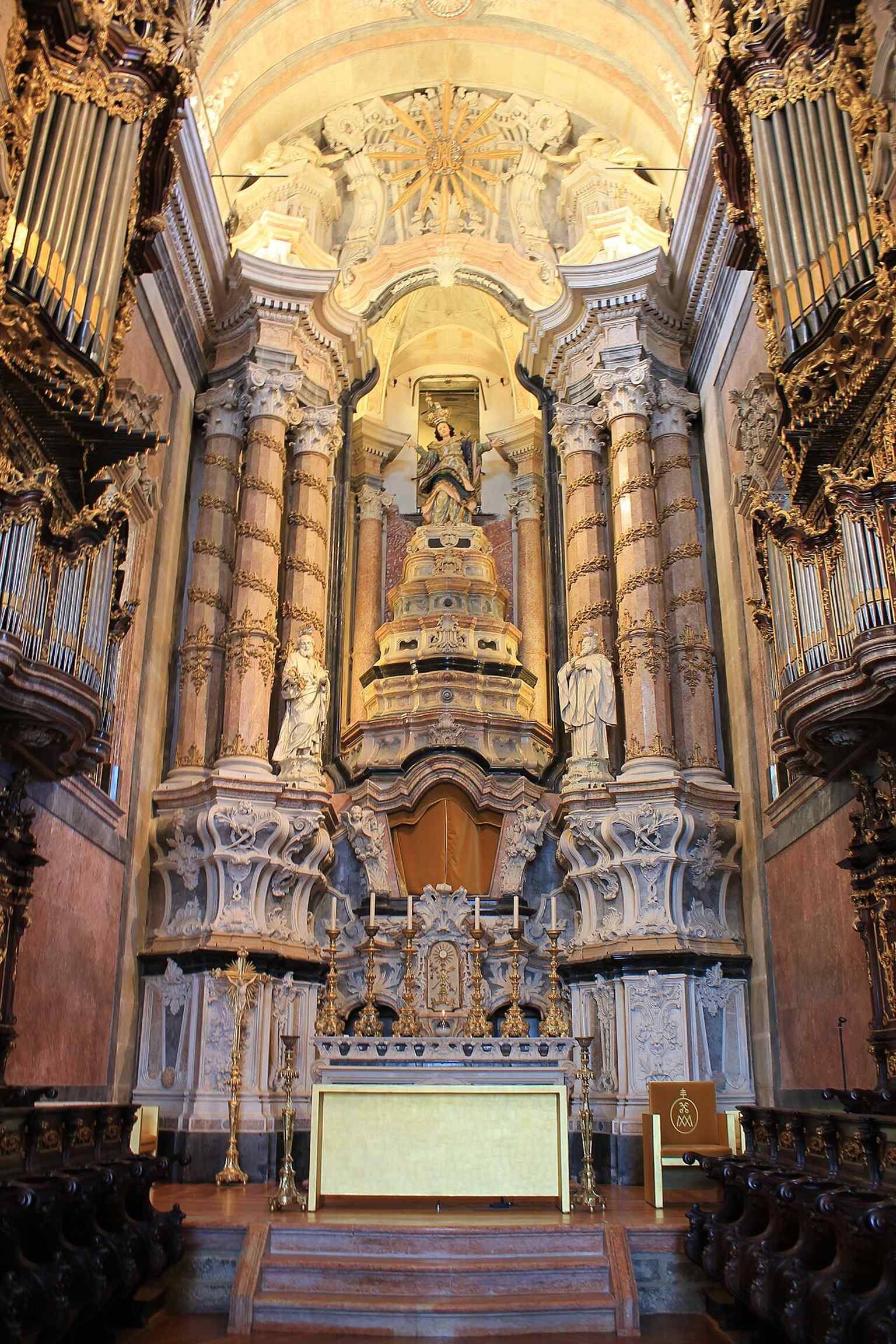
Another interior view focused on the church’s decorative richness, useful for the altars and liturgical furnishings mentioned in the story.Photo: John Samuel, Wikimedia Commons, CC BY-SA 4.0. Cropped & resized. On your right, look for a pale granite church with a plain, block-like façade, a Baroque doorway framed by twisted columns, and the medieval wall running close beside it. Santa…Read moreShow less
Open dedicated page →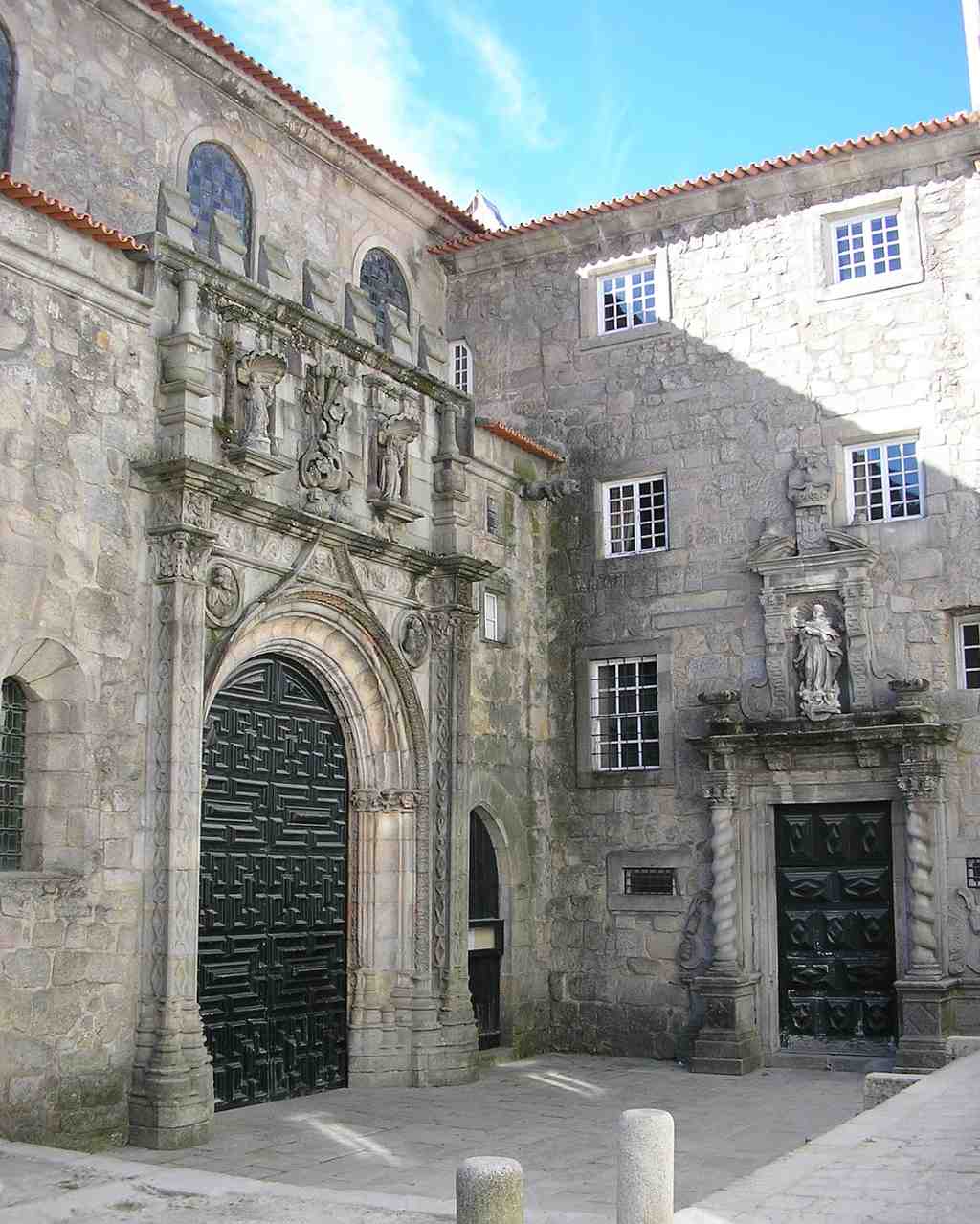
Church of Santa ClaraPhoto: Manuel de Sousa, Wikimedia Commons, CC BY-SA 4.0. Cropped & resized. On your right, look for a pale granite church with a plain, block-like façade, a Baroque doorway framed by twisted columns, and the medieval wall running close beside it.
Santa Clara keeps its greatest surprise indoors. From the street, it seems almost restrained; inside, the church opens into one of Porto’s most astonishing displays of carved wood covered in gold leaf, a Baroque skin laid over centuries of prayer. Places like this remind you that Porto often hides its splendour behind severe exteriors, and that the brilliance usually rests on lives history barely names: enclosed women, hired craftsmen, donors, organ tuners, sacristans, all working beyond the public gaze.
The women here were the Clarissas, Franciscan nuns who moved into this new monastery in fourteen twenty-seven after asking to leave their older thirteenth-century house at Entre Ambos-os-Rios, in what is now Torrão. The church itself took longer, reaching completion in fourteen fifty-seven. Records say the king financed much of the work, and the dedication was celebrated in the presence of Fernando da Guerra, the royal family, and the court. So although the sisters lived behind enclosure, their house stood at the centre of powerful networks.
Over time, smaller convents were closed and more nuns joined Santa Clara, bringing income with them. One revenue stream even came from a toll charged on goods moving along the Douro. That money fed a living institution, not a silent relic. Locals who know the archives will tell you the proof survives in expense books: in August of sixteen thirty, the organist was paid to repair the organs, and in July of sixteen sixty, a priest from Braga, Sebastião de Araújo, tuned and repaired both the main organ and the little regal, a small portable keyboard, for four thousand réis. It is such a precise, ordinary note, and it changes everything. Suddenly the gilding is not decoration but the backdrop to daily Mass, music, and routine devotion.
If you glance at the app, the interior image reveals that transformation. Between seventeen thirty and seventeen thirty-two, Miguel Francisco da Silva enlarged the church and wrapped it in gilded carving, while an earlier main altar structure had already been executed by Bartolomeu Gomes on a base by Bento Cordeiro. The crown even sent four thousand cruzados to Mother Clara de São Francisco through Teodósio Pereira. Later, Abbess Guiomar Jerónima da Visitação founded a confraternity here in seventeen forty-eight, binding new devotion into the old house.
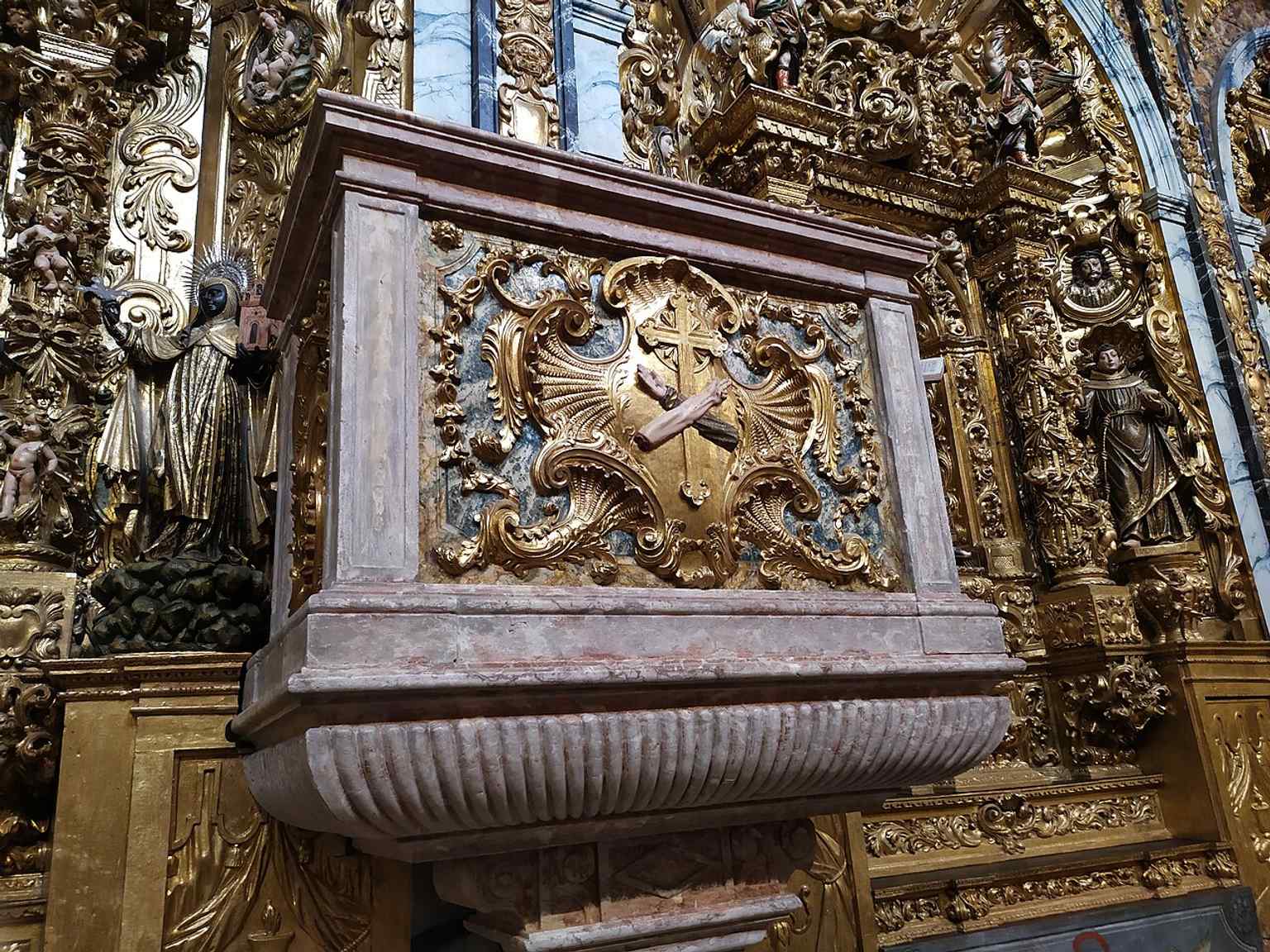
An interior glimpse of Santa Clara, giving context for the church’s richly ornamented Baroque environment beyond the main altar.Photo: Joseolgon, Wikimedia Commons, CC0. Cropped & resized. Then came loss and reinvention. French troops carried off part of the convent treasure, the religious orders were suppressed in eighteen thirty-four, and Santa Clara endured only until the last nun died in nineteen oh one. After that, the complex served the state, a health dispensary, and other institutions. Recent conservation, from two thousand and sixteen to two thousand and twenty-one, stabilised the building and uncovered painted saints on wood, a granite slab from sixteen forty-five, and older winged angels hidden beneath later gilding. You can see the care of that work on your screen. Here, beside the Fernandine wall, enclosure meets defence. In about four minutes, at Porto Cathedral, we’ll see how that same edge of the city turned faith into something more openly commanding. If you plan to go in, the church generally opens in the morning and again in the afternoon, with a midday closure.
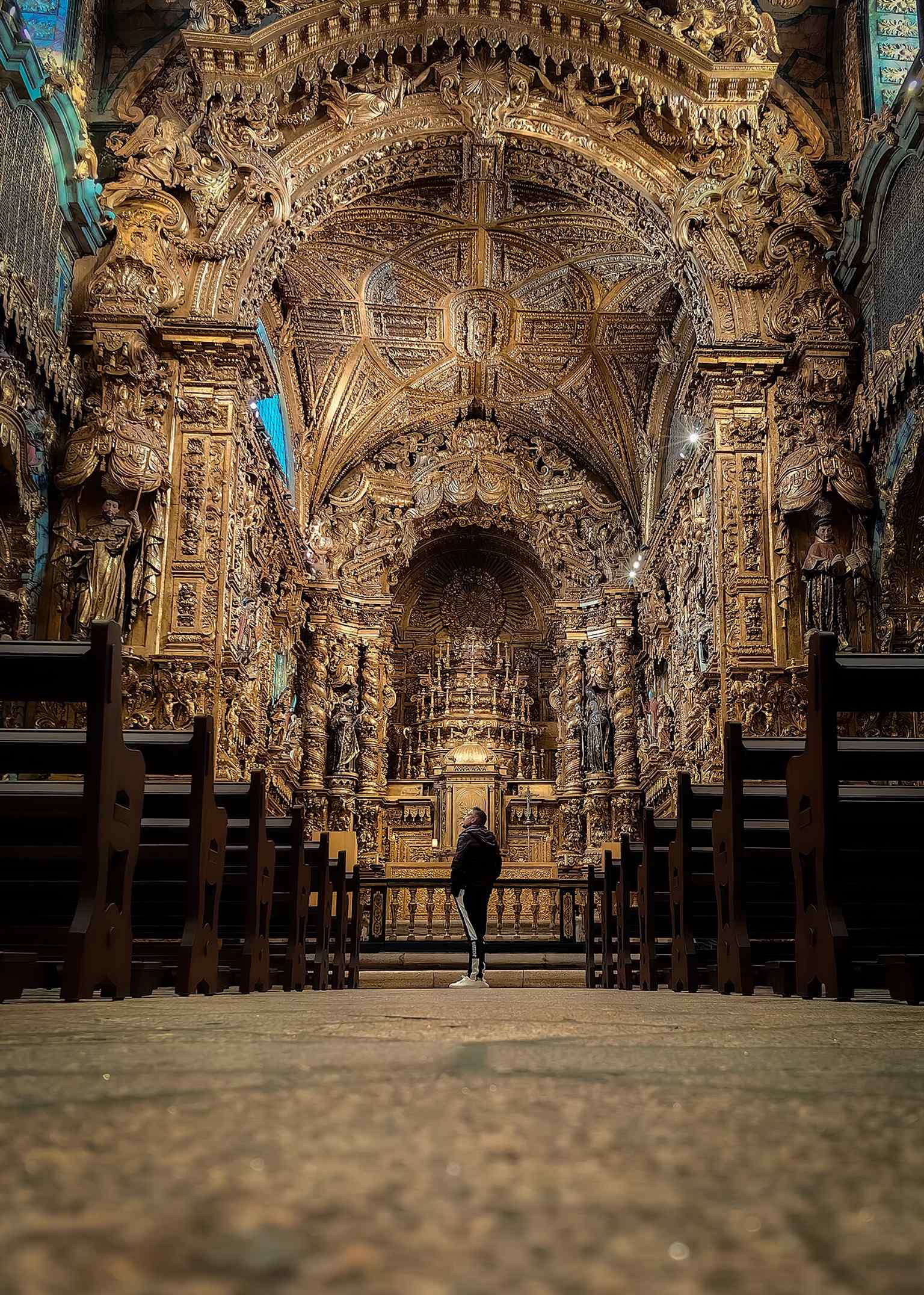
This image fits the restoration narrative: the church’s interior fabric was carefully conserved, from stone and wood to the gilded surfaces.Photo: 19bfc03, Wikimedia Commons, CC BY-SA 4.0. Cropped & resized. 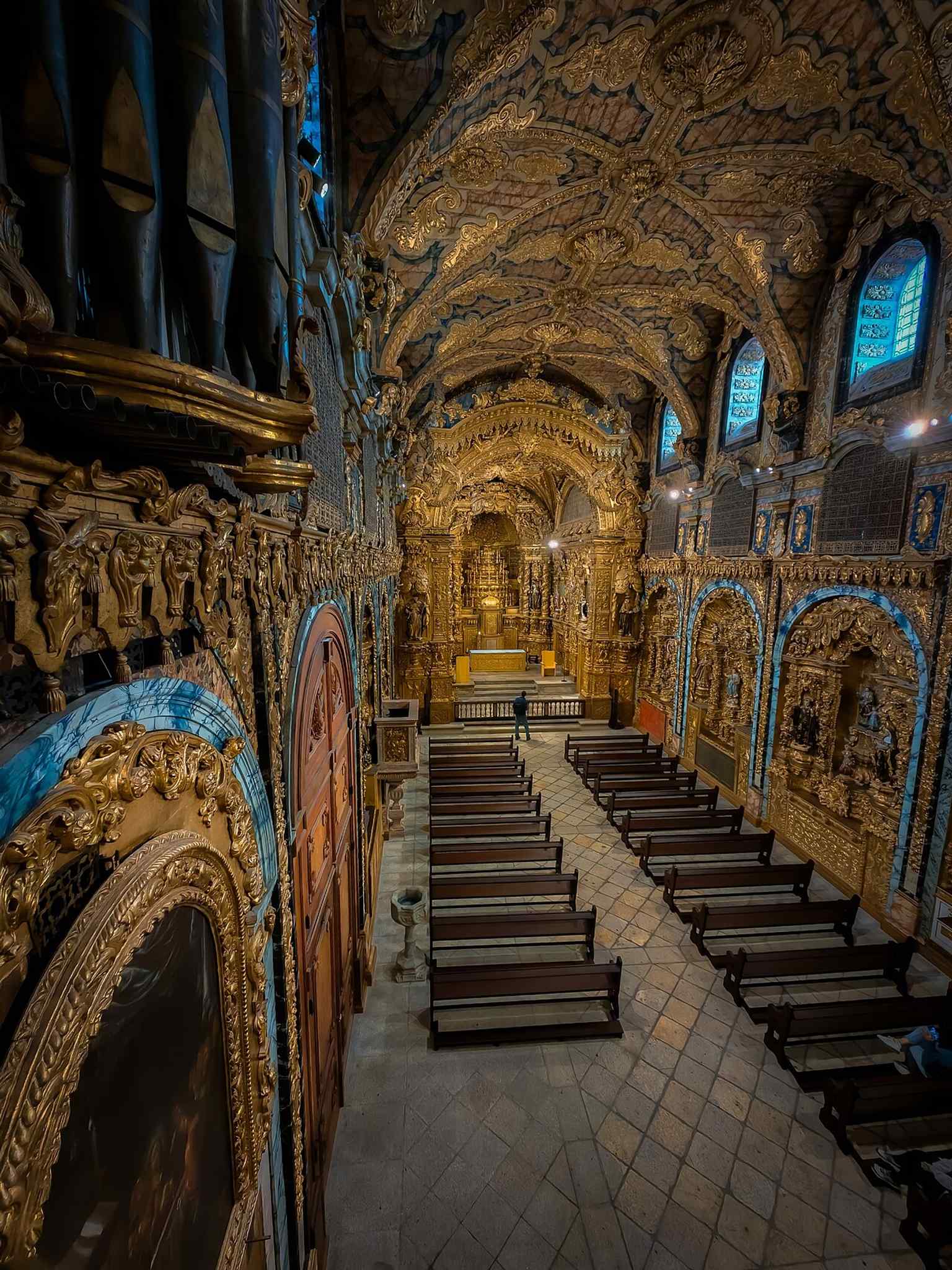
A recent heritage documentation view of Santa Clara, capturing the church as a restored monument after the 2016–2021 conservation campaign.Photo: 19bfc03, Wikimedia Commons, CC BY-SA 4.0. Cropped & resized. 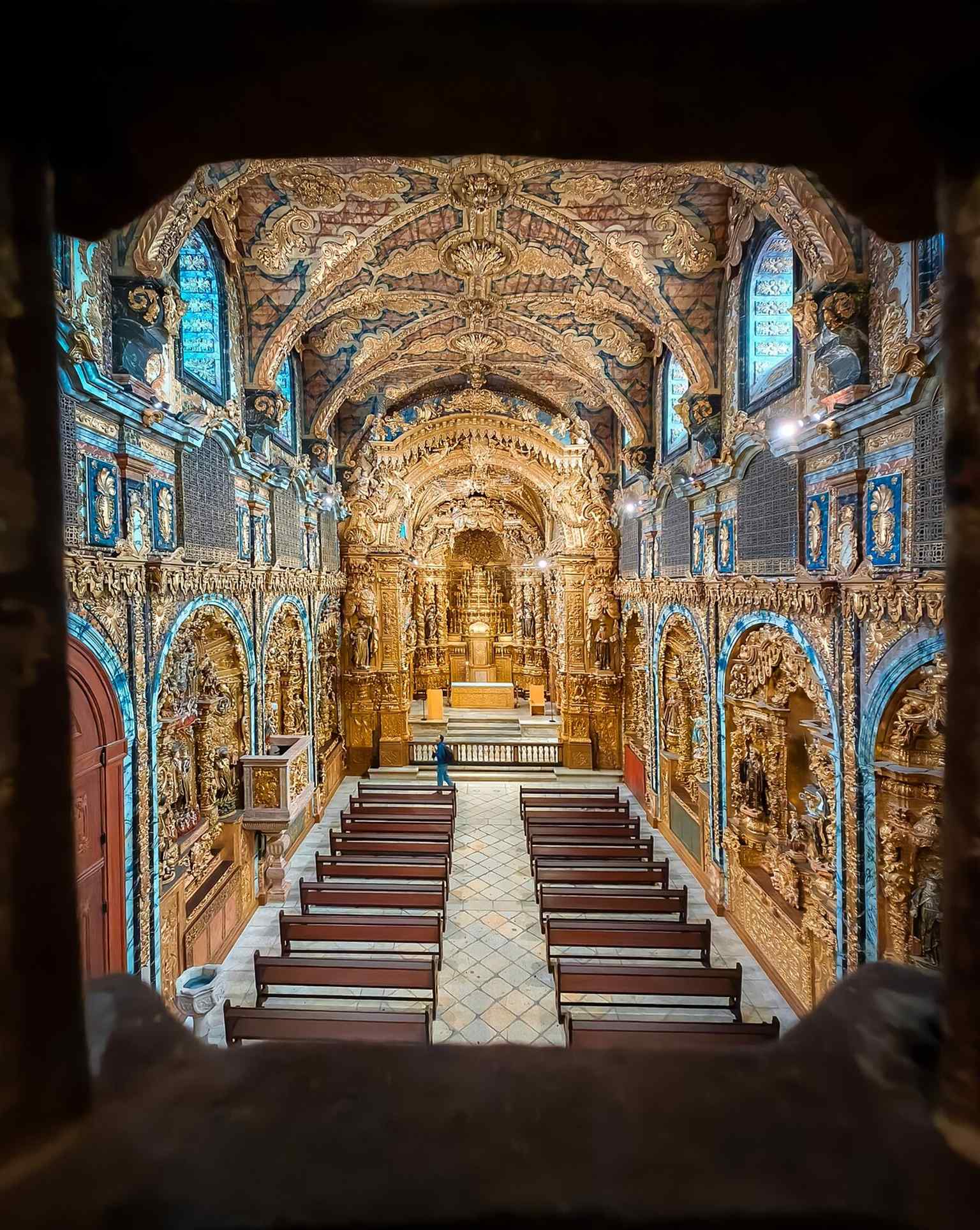
A close structural view that supports the story of the modern restoration work carried out to stabilize and reopen the church to visitors.Photo: 19bfc03, Wikimedia Commons, CC BY-SA 4.0. Cropped & resized. 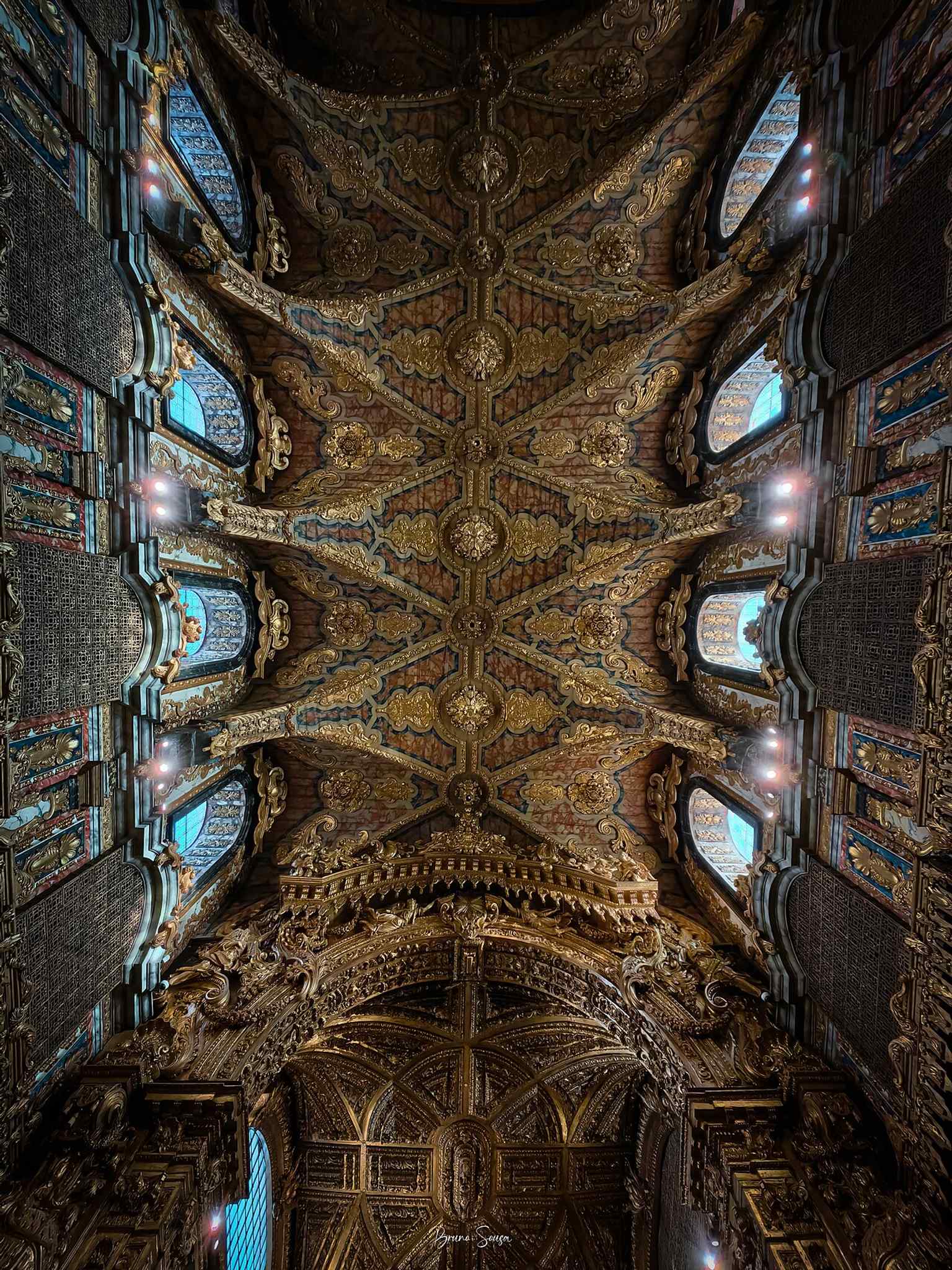
A contemporary documentation shot of the church in Porto, useful as a post-restoration reference view for the landmark today.Photo: 19bfc03, Wikimedia Commons, CC BY-SA 4.0. Cropped & resized. 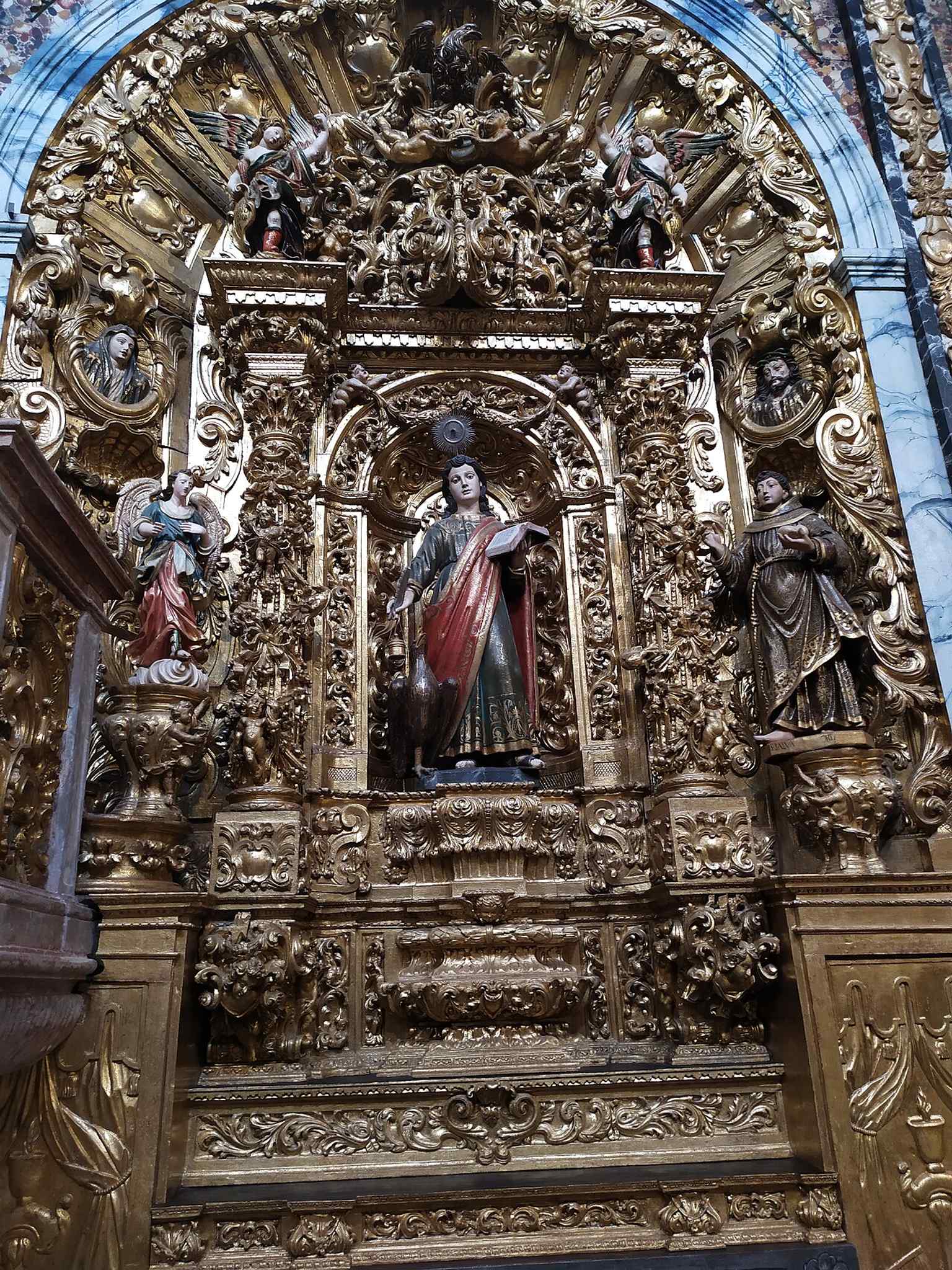
Another interior view that helps show the church as a single integrated space of worship, decoration, and devotional artwork.Photo: Joseolgon, Wikimedia Commons, CC0. Cropped & resized. On your left, look for a narrow stone house with a simple rectangular façade, unevenly cut window openings, and old defensive wall masonry fused into the structure. At first…Read moreShow less
Open dedicated page →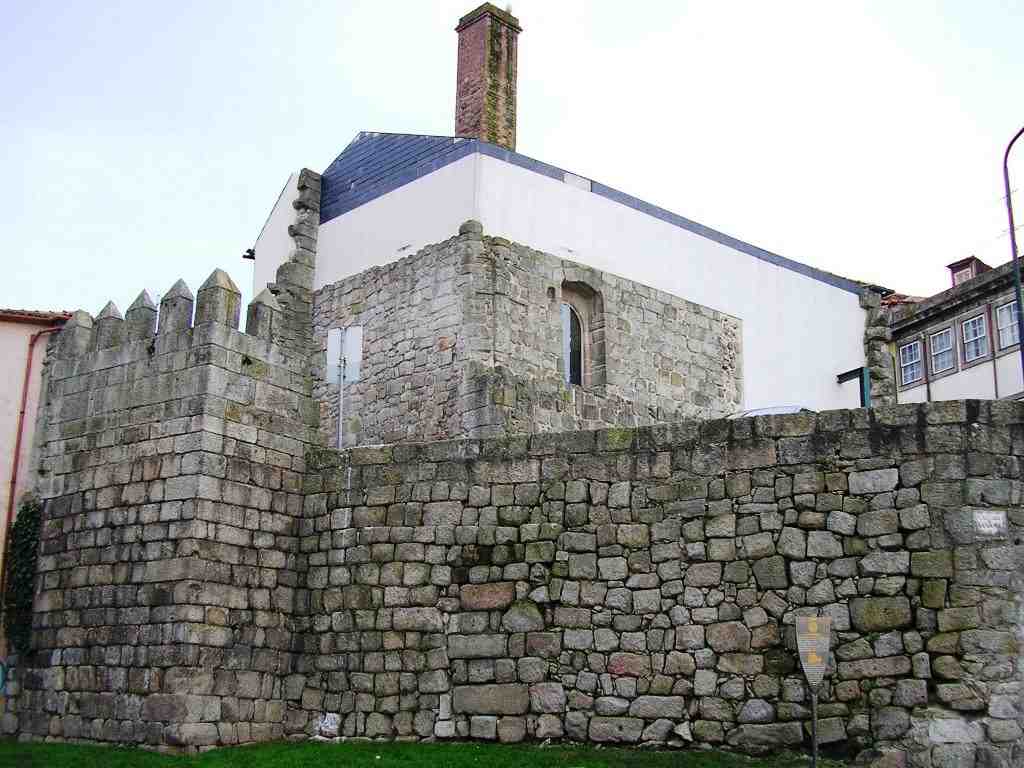
Casa da Rua de D. HugoPhoto: Manuel de Sousa, Wikimedia Commons, Public domain. Cropped & resized. On your left, look for a narrow stone house with a simple rectangular façade, unevenly cut window openings, and old defensive wall masonry fused into the structure.
At first glance, Casa da Rua de D. Hugo can seem almost modest. That is the trick of it. Most tourists pass thinking this is merely an old house beside the cathedral precinct. In fact, this address turned into one of Porto’s sharpest arguments about what a “house” really is.
When archaeologists opened the interior in the nineteen eighties, they did not find a single neat layer of history. They found about twenty layers, reaching roughly three metres down, with traces of human occupation from the fourth or fifth century onward. That sequence ran from a proto-historic castro - a fortified hill settlement - into the Roman city, then Suevo-Visigothic and early medieval phases. In other words, Porto survives not only in monuments above ground, but underground and inside later buildings that quietly swallowed the older city whole.
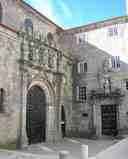
And this building itself joined the argument. Records show it was not just a residence standing over ancient remains, but a late medieval house-tower: part home, part statement of status, with a defensive edge. Look closely at the façade and you are seeing later openings cut into an older body. What specialists call its reversed Gothic face still keeps an entrance and a light opening from that earlier structure. The street view understates it; the bones are tougher than they look.
One of the last private names attached to the property was Manuel Cardoso Corte Real, the owner in eighteen seventy-one. After him, the story shifts from ordinary property history to public excavation. In nineteen ninety-three, architects restored the building for the northern branch of Portugal’s Order of Architects, and the project won the João de Almada prize a year later. Rather fitting, really: a house that had spent centuries concealing the city became a place devoted to reading it.
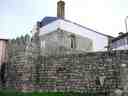
If you glance at the image in the app, you’ll see the kind of primitive wall this quarter absorbed and later revealed again. That same habit of concealment continues at our next stop, Casa-Museu Guerra Junqueiro, only a minute away, where domestic rooms prove every bit as revealing as churches and palaces.
On your left, João Chagas Garden opens as a formal green space with curving paths, a cast-iron bandstand, and a stone-edged lake set among long-established trees. It looks gentle…Read moreShow less
Open dedicated page →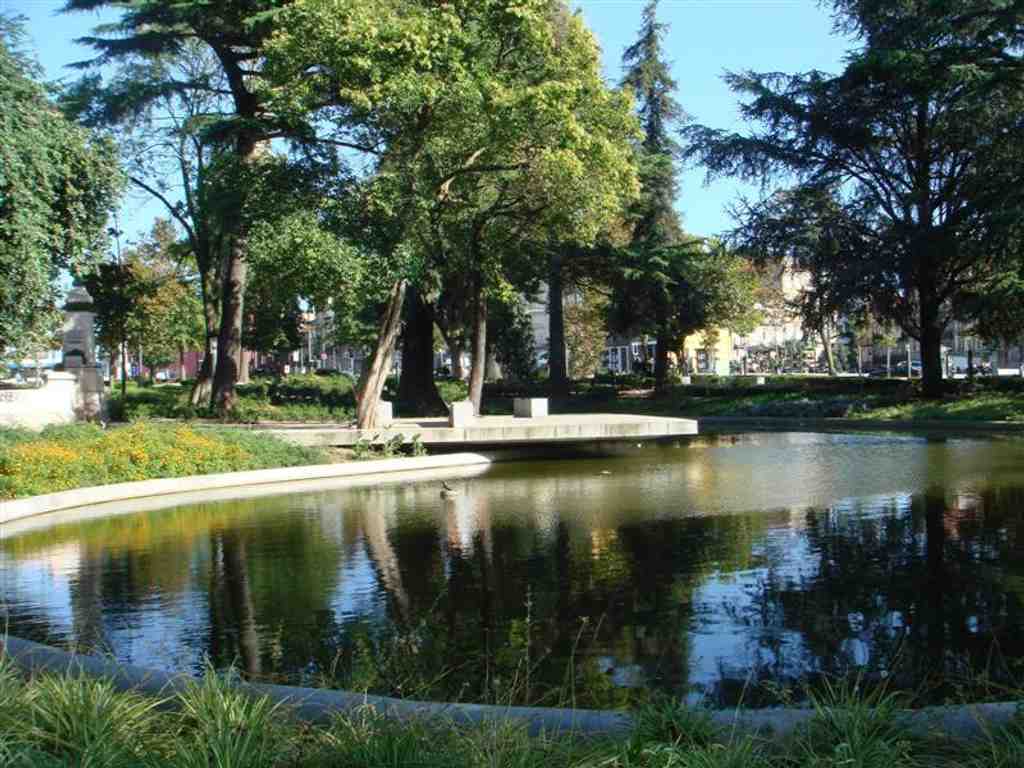
João Chagas GardenPhoto: Jose Goncalves, Wikimedia Commons, Public domain. Cropped & resized. On your left, João Chagas Garden opens as a formal green space with curving paths, a cast-iron bandstand, and a stone-edged lake set among long-established trees.
It looks gentle now, but this ground carries harder memories. During the Siege of Porto, in eighteen thirty-two and eighteen thirty-three, people cut down many of the trees here for fuel for the Military Hospital and the Recolhimento dos Meninos Órfãos, a home for orphaned boys. One tree, remembered as the Gallows Tree, seems to have survived only because a Misericórdia official intervened. A garden, then, can remember violence just as surely as a wall can.
In eighteen sixty-five, the Viscount of Vilar d'Allen founded this place as a public garden, and the German landscape designer Émile David gave it romantic curves and pauses, turning damaged ground into somewhere people could stroll, sit, and think. If a city under siege must burn its own trees to survive, what does it choose to save from itself?
That question never quite left. A cyclone in nineteen forty-one changed much of the garden’s appearance. Then, for Porto 2001, the architect Camilo Cortesão reshaped it again, aiming for something modern, safe, and transparent. Many in Porto thought the result too bold, too severe, and the debate lingered, helped along by practical troubles with lighting and the lake’s water system.
Among the sculptures, Flora, dedicated to the gardener Marques Loureiro, feels especially fitting: cultivation, memory, and survival in one figure. Next, we leave this broad, haunted calm for a clever urban oddity at Carmo Church, about a three-minute walk away. The garden remains open at all hours.
Look for a pale stone town house with a tall, narrow façade, wrought-iron balconies, and a carved baroque doorway set neatly into Rua de Dom Hugo. This house has the excellent…Read moreShow less
Open dedicated page →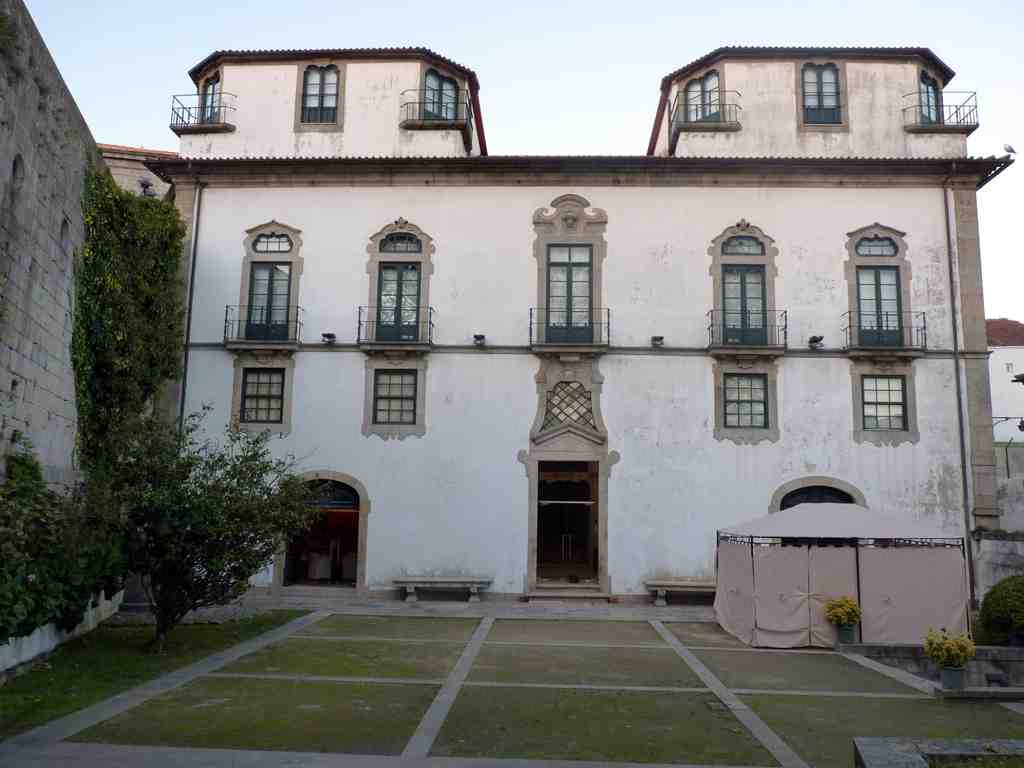
Casa-Museu Guerra JunqueiroPhoto: MariaCartas, Wikimedia Commons, CC BY-SA 3.0. Cropped & resized. Look for a pale stone town house with a tall, narrow façade, wrought-iron balconies, and a carved baroque doorway set neatly into Rua de Dom Hugo.
This house has the excellent manners of a place that knows exactly how it wishes to be seen. Between seventeen thirty and seventeen forty-six, Domingos Barbosa, a senior church official from Porto Cathedral, ordered its construction. He did not want a modest cleric’s lodging. He wanted a residence that could perform status from the street outward, then deepen the impression once a guest stepped inside.
And here, we meet a delicious Porto uncertainty. Nicolau Nasoni, the Italian architect whose name turns up all over this city, and whose burial in Porto carries its own little whiff of mystery, was long credited with this house as well. But the case is not settled at all. More recent study nudges the credit toward António Pereira, partly because this façade resembles the Palácio de São João Novo so closely that scholars began to suspect the same hand. In other words, the stones have started arguing back against legend.
If you glance at the older photograph on your screen, you can see the house identified as the Casa do Doutor Domingos Barbosa, which is exactly how this authorship debate stayed alive for so long. It is a fine reminder that buildings keep changing their biographies, even when their walls stand still.
From out here, the front seems composed, almost restrained. But inside survives one of the great gestures of the house: a monumental staircase rising from the entrance hall to the upper floor. That stair matters because it turns the residence into theatre. A noble house was never only for living in; it staged arrival, rank, and deference. Elegant façades like this one usually hide whole chains of inheritance, servants, patrons, and private rituals behind the polished rooms.
Those chains became especially tangled here. After Domingos Barbosa, the property passed through relatives and descendants for generations. Then, in nineteen thirty-four, Maria Isabel Guerra Junqueiro, daughter of the poet Abílio Guerra Junqueiro, bought the house from the family line that still held it. That choice is the key to the place. Junqueiro was born in eighteen fifty, in Freixo de Espada à Cinta, not here. His daughter selected this older baroque residence as the proper setting for his legacy, almost as if she were casting a role.
In nineteen forty, Maria Isabel and her mother, Filomena Neves, donated the house to the city of Porto on the condition that it become a museum for Junqueiro’s collections. The gift included roughly six hundred pieces: furniture, sculptures, Nuremberg plates, ceramics, and other works gathered by a man with a sharp eye and a collector’s appetite. Among them is the rare Virgem do Leite, a Madonna nursing the Christ child, an image once common and later discouraged by church reform because it seemed too physically intimate.
If you look at the exterior view in the app, the point becomes quite clear: this is a museum, yes, but it still reads first as a grand private house. That doubleness is its charm.
The story did not stop in nineteen forty-two, when the museum opened to the public. In the nineteen nineties, architect Alcino Soutinho reshaped parts of it for exhibitions, an auditorium, and other public uses, and later interventions kept it active rather than embalmed. Even now, the house does not simply preserve memory; it keeps renegotiating it.
Nearby, that same language of prestige grows more official, more commanding, and far less domestic. When you are ready, continue to the Episcopal Palace of Porto, about three minutes away.
On your right rises a broad granite church with twin square towers and a round rose window tucked beneath a crenellated arch, giving the whole façade the look of a fortress. This…Read moreShow less
Open dedicated page →On your right rises a broad granite church with twin square towers and a round rose window tucked beneath a crenellated arch, giving the whole façade the look of a fortress.
This is Porto Cathedral, one of the city’s oldest monuments, and it occupies this hill like a statement of intent. Here in Porto, belief did not simply fill a church; it helped organise rank, memory, and authority. Bishops ruled from nearby, kings sought blessing here, and the city learned to read power through sacred stone.
This precinct is Porto’s oldest sacred core, the point from which so much else takes its bearings. Long before the later palaces, squares, and grand civic gestures below, this height held a chapel or hermitage founded by Henry of Burgundy and his wife in eleven oh eight. The older church still stood in eleven forty-seven, but in the second half of the twelfth century people began the building you see now, and they kept altering it right through the sixteenth century, then again in the eighteenth and twentieth.
Take a slow look at the front. Notice how the façade seems to belong to several centuries at once: the severe Romanesque body, the Baroque porch, the towers with their cupolas, the almost military outline. It is a church, certainly, but it also announces watchfulness, command, and survival.
That mixed face tells the truth. The central hall inside, the nave, is narrow and covered with a barrel vault, and its heavy stone roof needed flying buttresses outside to help carry the load, making this one of the earliest Portuguese buildings to use that device. Yet later generations kept revising it. If you look at the image in the app, you can see the Gothic cloister added in the fourteenth and fifteenth centuries, then dressed in Baroque blue-and-white tiles by Valentim de Almeida in the seventeen twenties and thirties. The cathedral we meet today is the work of many hands, many intentions, and many acts of correction.
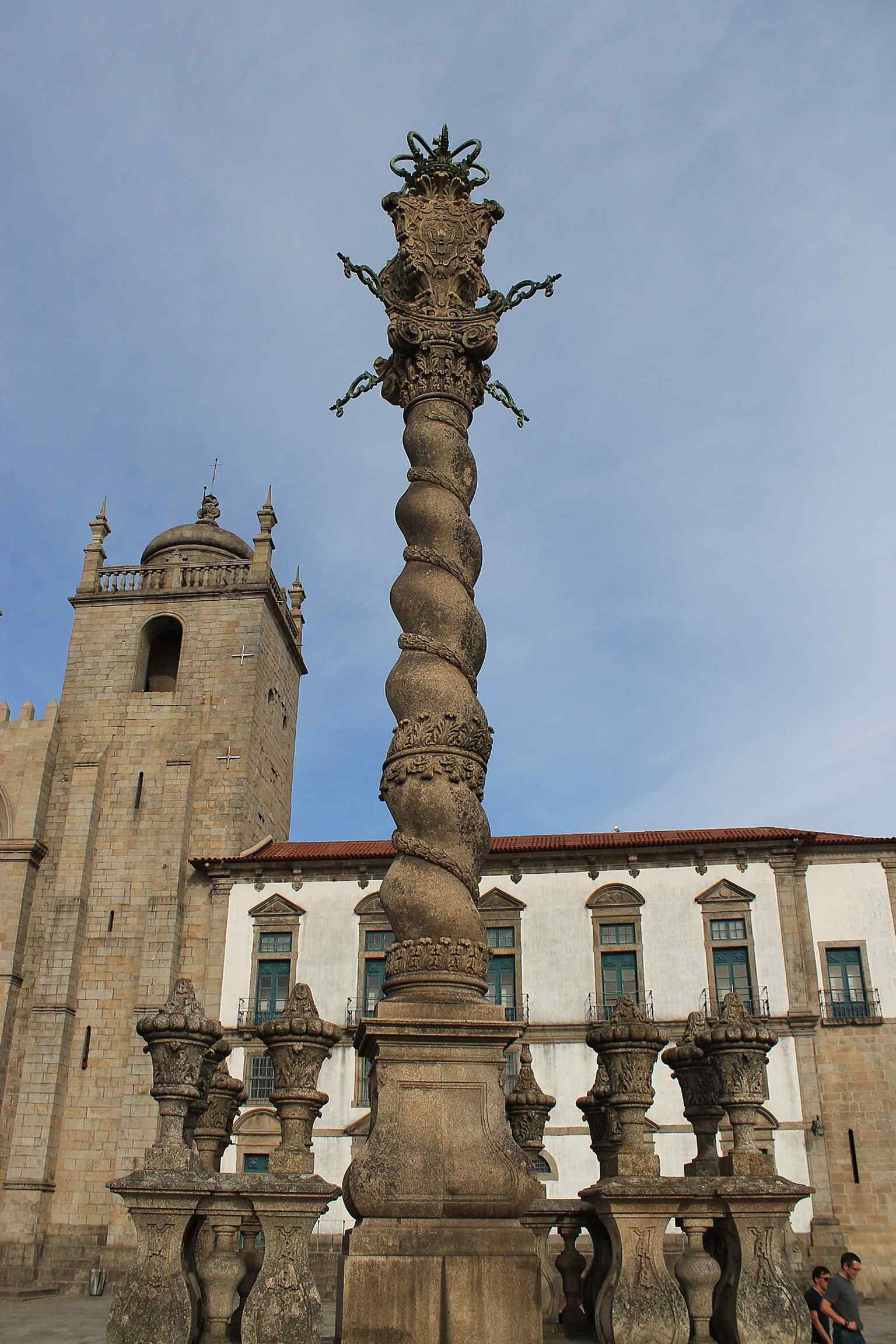
The Gothic cloister of Porto Cathedral, built in the 14th and 15th centuries and later lined with distinctive azulejo panels.Photo: Cardilio, Wikimedia Commons, CC BY-SA 4.0. Cropped & resized. Its most famous human moment came in thirteen eighty-seven. King John the First and Philippa of Lancaster received a blessing here on the second of February, then married here on the fourteenth. That ceremony mattered far beyond Porto. It helped secure the long Anglo-Portuguese alliance, and Philippa later became known as the mother of Portugal’s so-called Illustrious Generation. If you want one scene that shows this hill binding faith to statecraft, that is it.
Another life began here as well. Tradition says Prince Henry the Navigator was baptized in this cathedral, tying the building to the earliest story of Portugal’s maritime expansion. If you open the baptistery image in the app, you’ll see the place associated with that memory. And like the city itself, the cathedral has endured conflict. During the War of the Oranges in eighteen oh one, Spanish soldiers briefly seized it before local residents drove them out. In the Napoleonic invasion, a legend says a sacristan, or perhaps canon Pedro Breiner, saved the great silver altarpiece by disguising it with plaster or bargaining for its survival. Whether every detail is exact matters less than what the story reveals: Porto expected this place to be defended.
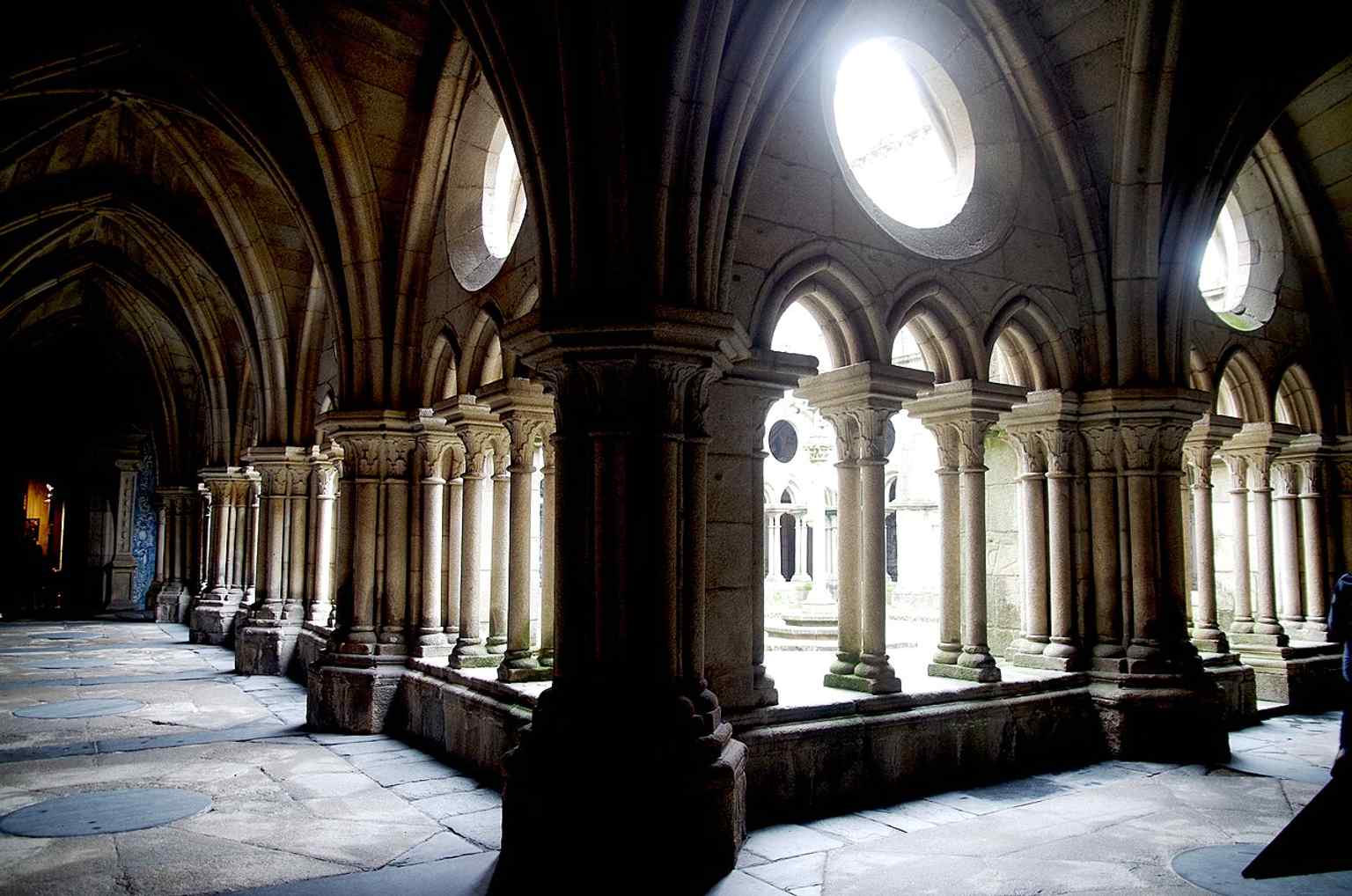
The baptistery, where Prince Henry the Navigator was baptized according to tradition, linking the cathedral to Portugal’s age of discovery.Photo: John Samuel, Wikimedia Commons, CC BY-SA 4.0. Cropped & resized. Yet even here, authority is never the whole story. Around this mighty church stood smaller houses, servants’ routes, workshops, and private lives that made the hill human as well as ceremonial. We’ll find that quieter texture at Casa da Rua de D. Hugo, about a minute away. If you plan to return inside later, the cathedral generally opens from nine in the morning until six thirty in the evening.
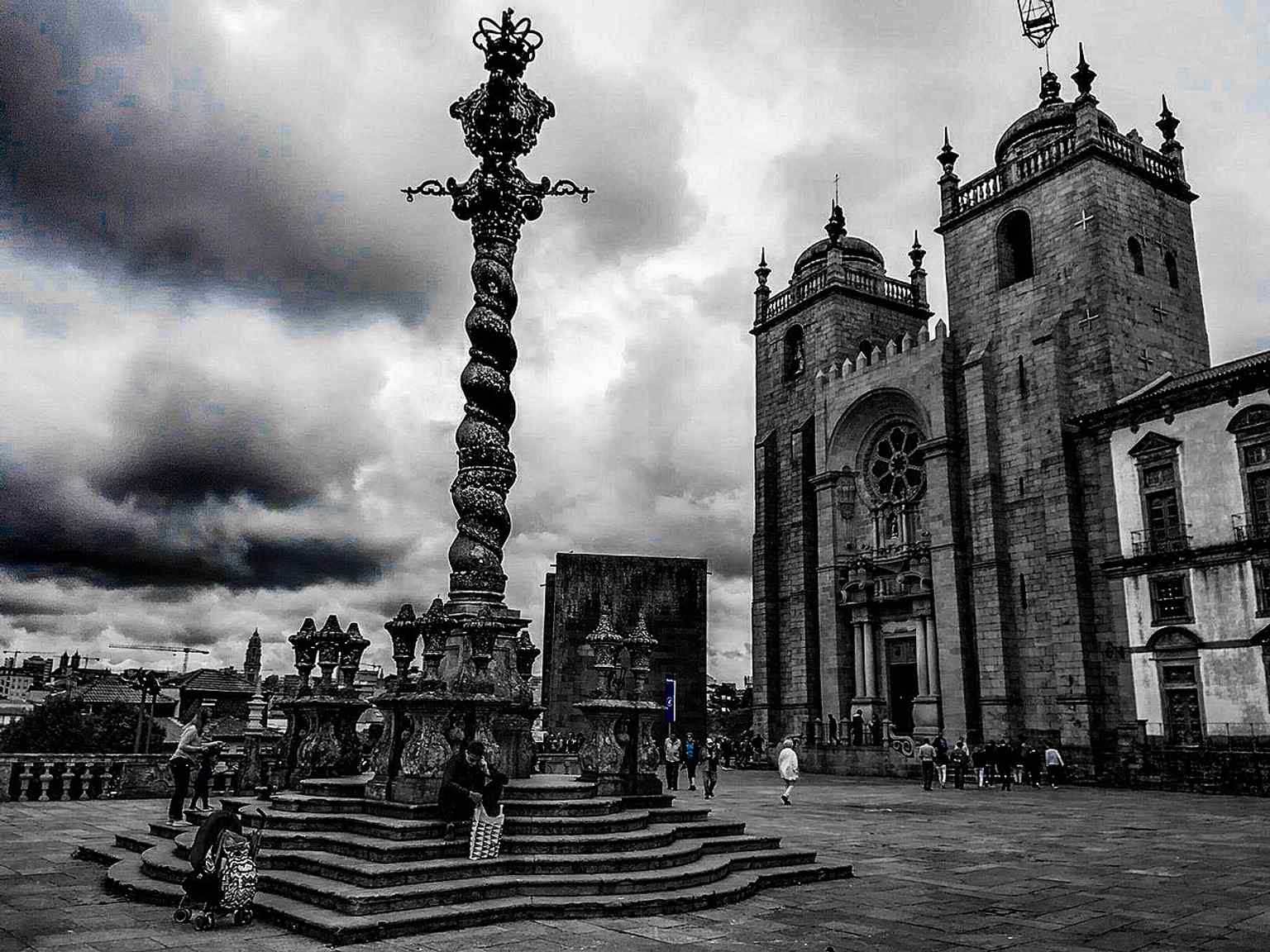
A broad daytime view of Porto Cathedral’s fortified Romanesque exterior, with the plain façade that still preserves its medieval character.Photo: John Samuel, Wikimedia Commons, CC BY-SA 4.0. Cropped & resized. 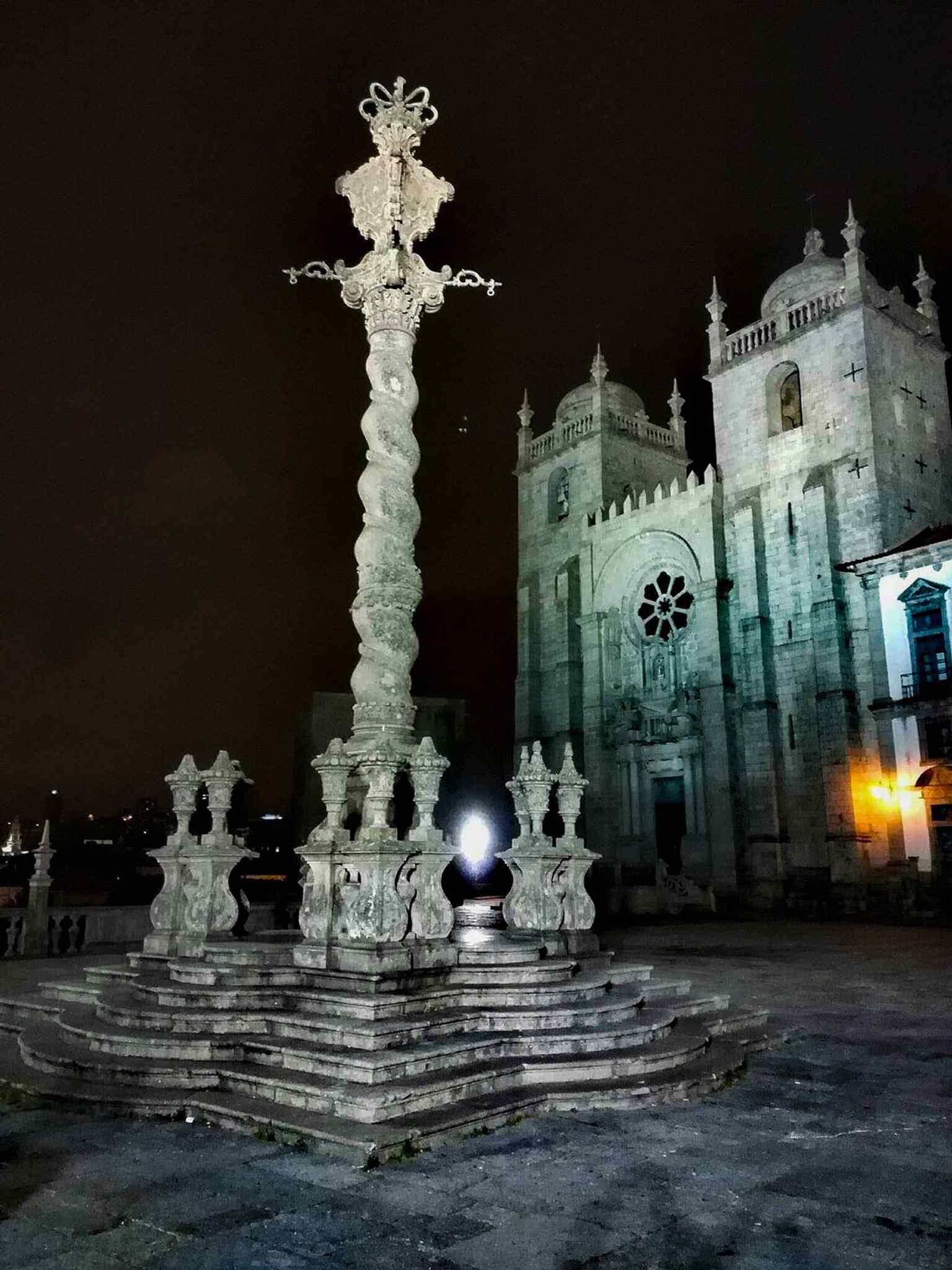
The cathedral under dramatic clouds, showing the twin towers and the sober stone frontage that made it look almost like a fortress.Photo: Ivan Stesso, Wikimedia Commons, CC BY-SA 4.0. Cropped & resized. 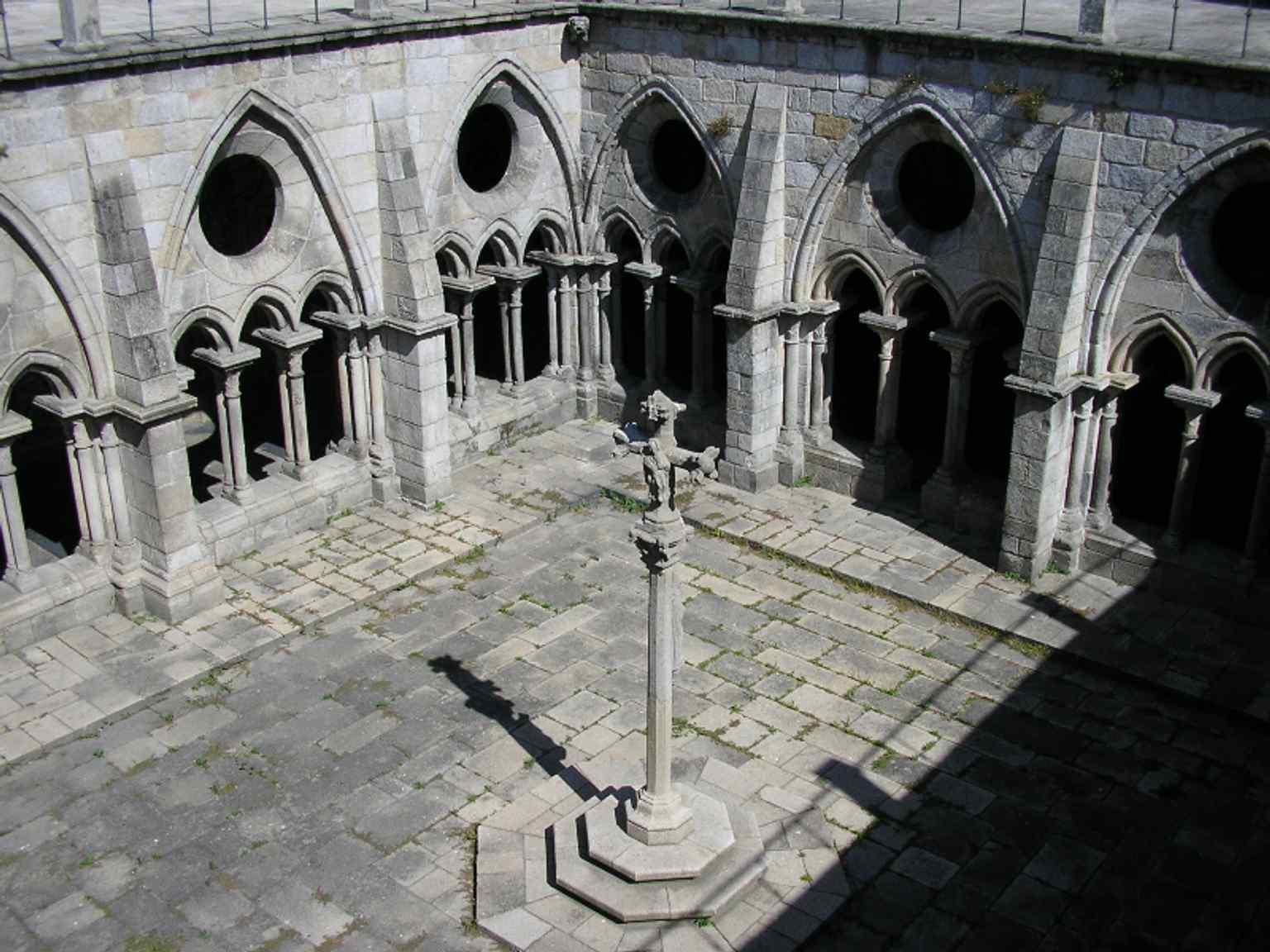
A closer baptistery view highlighting the bronze relief of Christ’s baptism, paired with the cathedral’s 17th-century holy-water fonts.Photo: John Samuel, Wikimedia Commons, CC BY-SA 4.0. Cropped & resized. 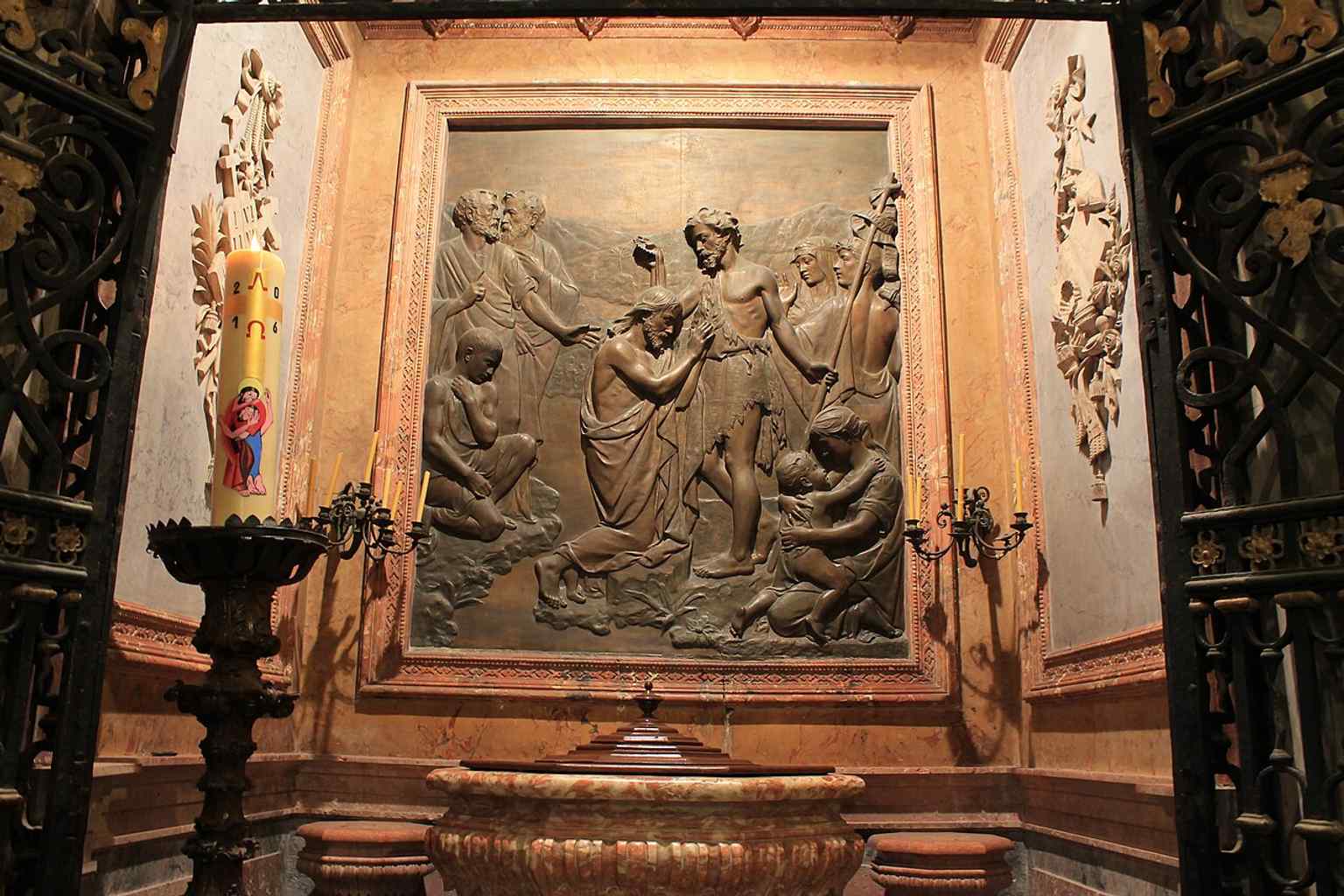
The Chapel of the Blessed Sacrament, home to one of the cathedral’s major Baroque chapels and altar works.Photo: John Samuel, Wikimedia Commons, CC BY-SA 4.0. Cropped & resized. 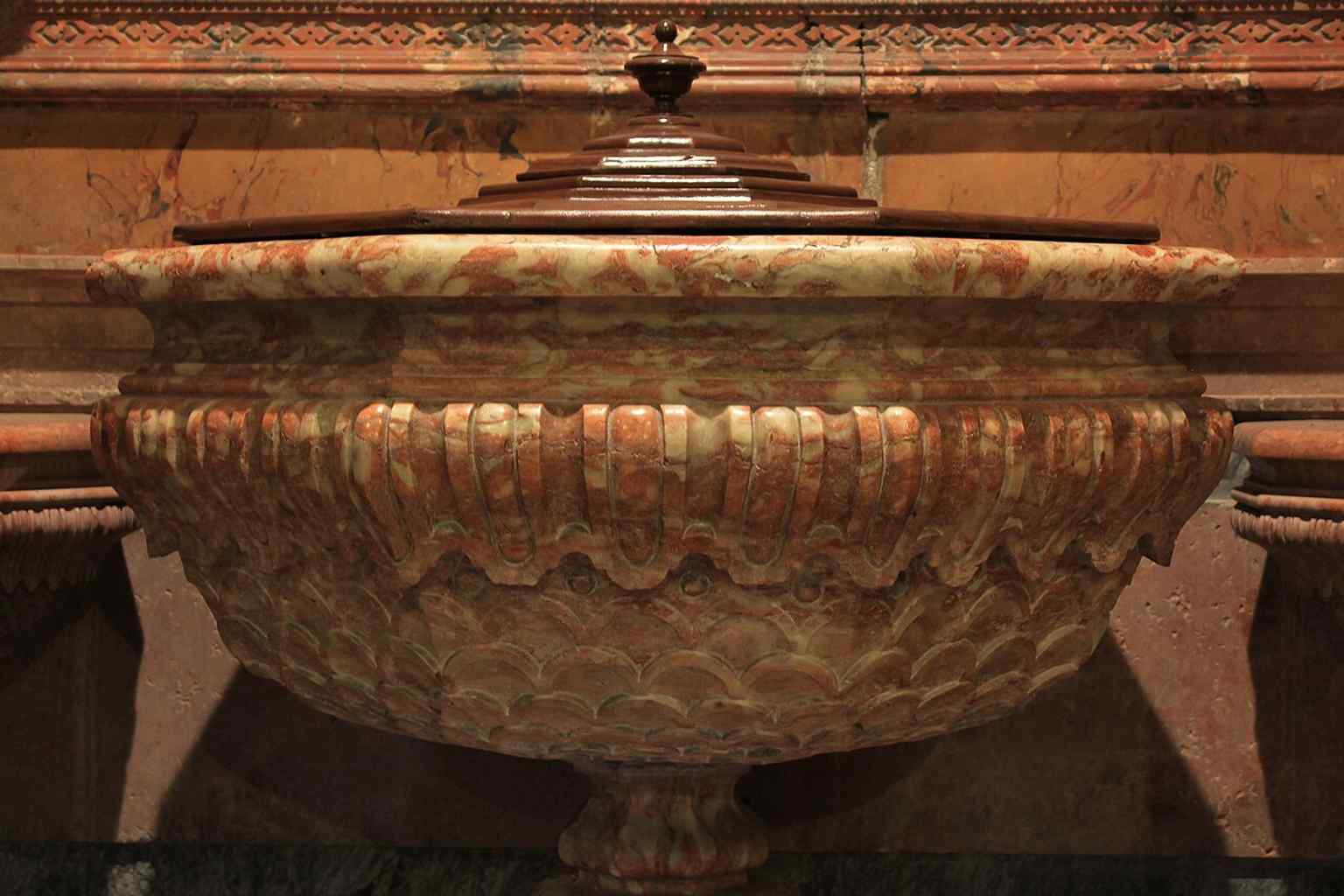
The altar of Our Lady of Vandoma, a good example of the richly layered devotional interiors added over centuries.Photo: John Samuel, Wikimedia Commons, CC BY-SA 4.0. Cropped & resized. 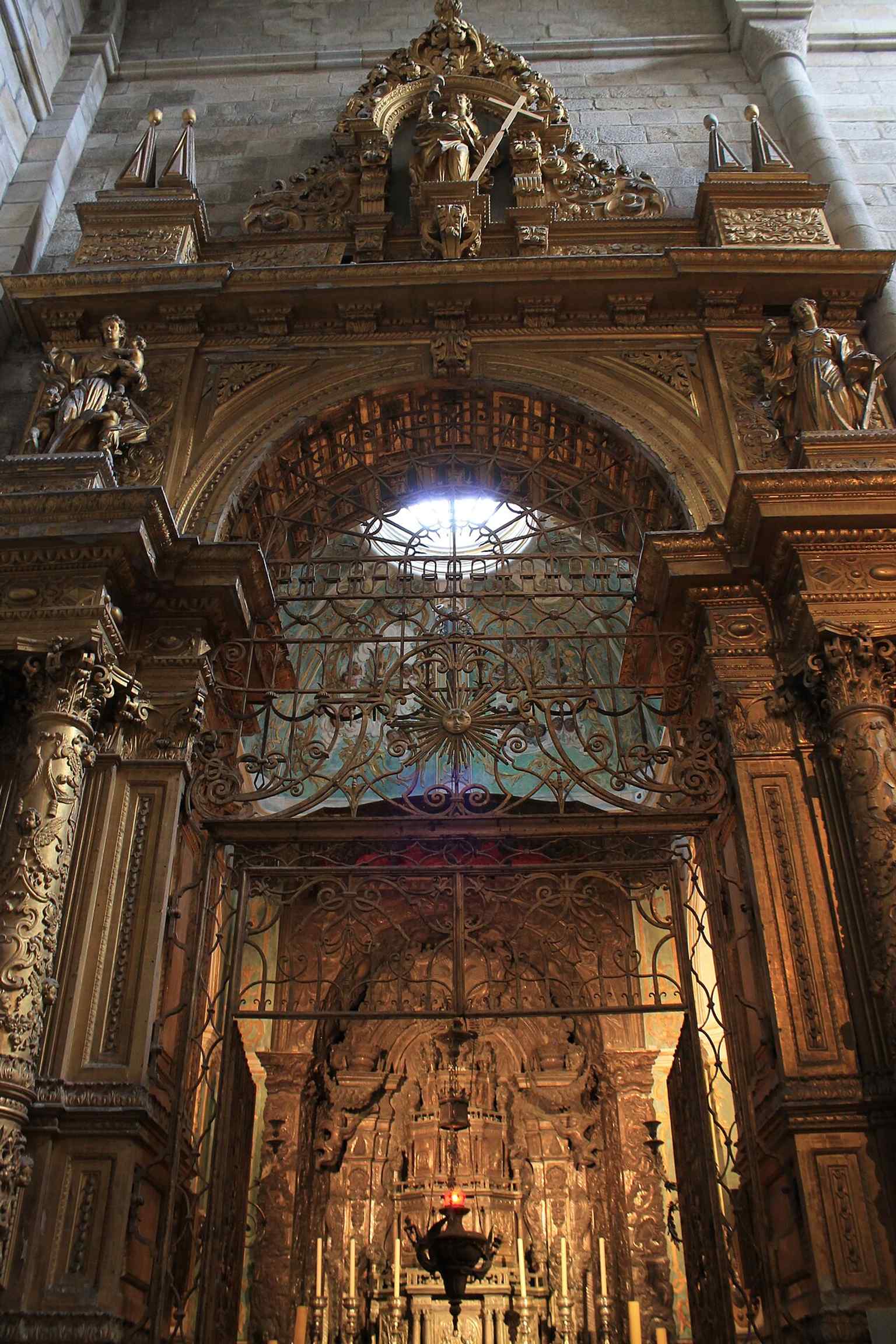
A chapel interior in the cathedral complex, showing the Baroque-era sacred spaces that transformed the medieval building.Photo: John Samuel, Wikimedia Commons, CC BY-SA 4.0. Cropped & resized. 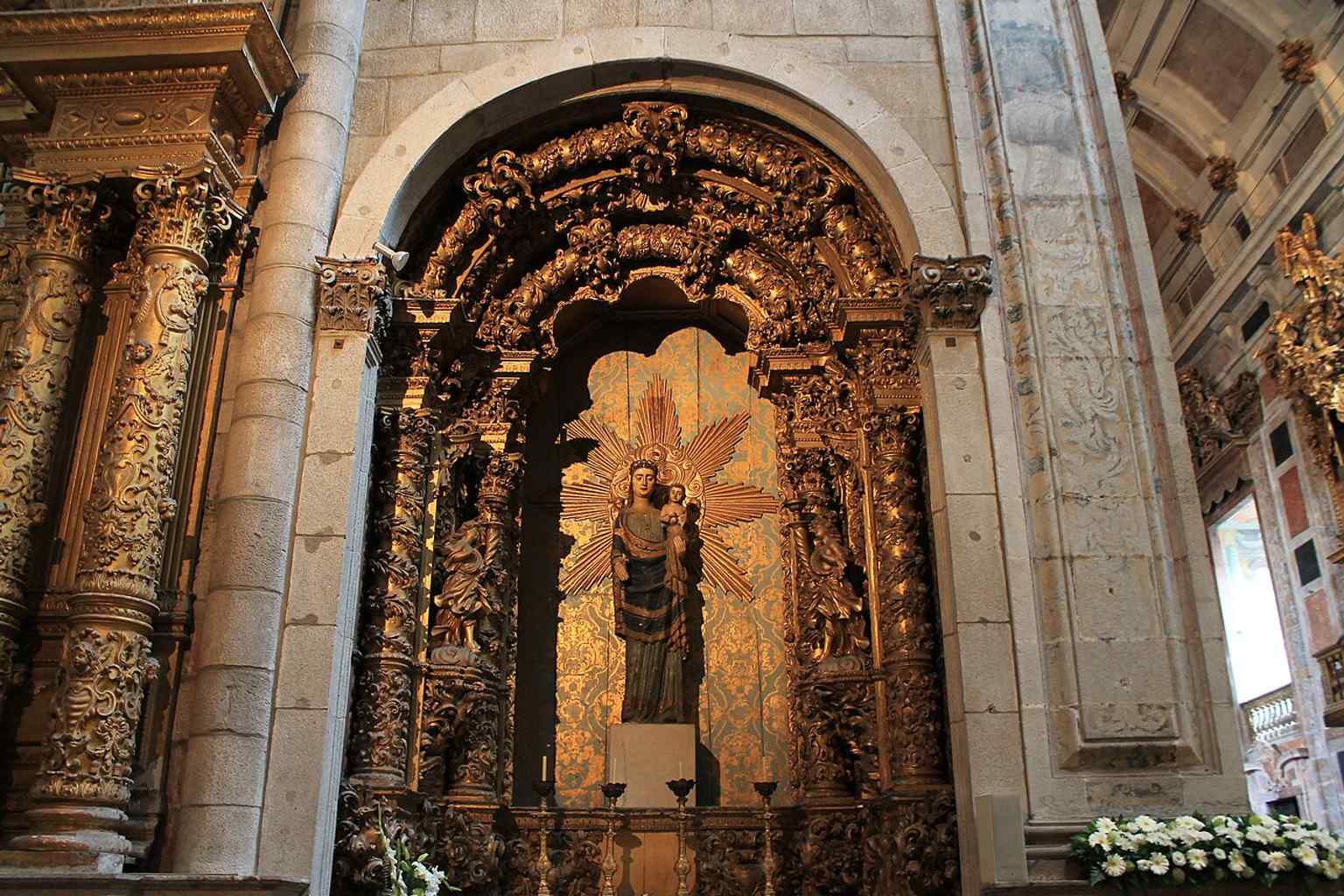
The cathedral’s galilé with azulejos, reflecting the 18th-century decorative program that gave the entrance area a colorful Baroque touch.Photo: John Samuel, Wikimedia Commons, CC BY-SA 4.0. Cropped & resized. 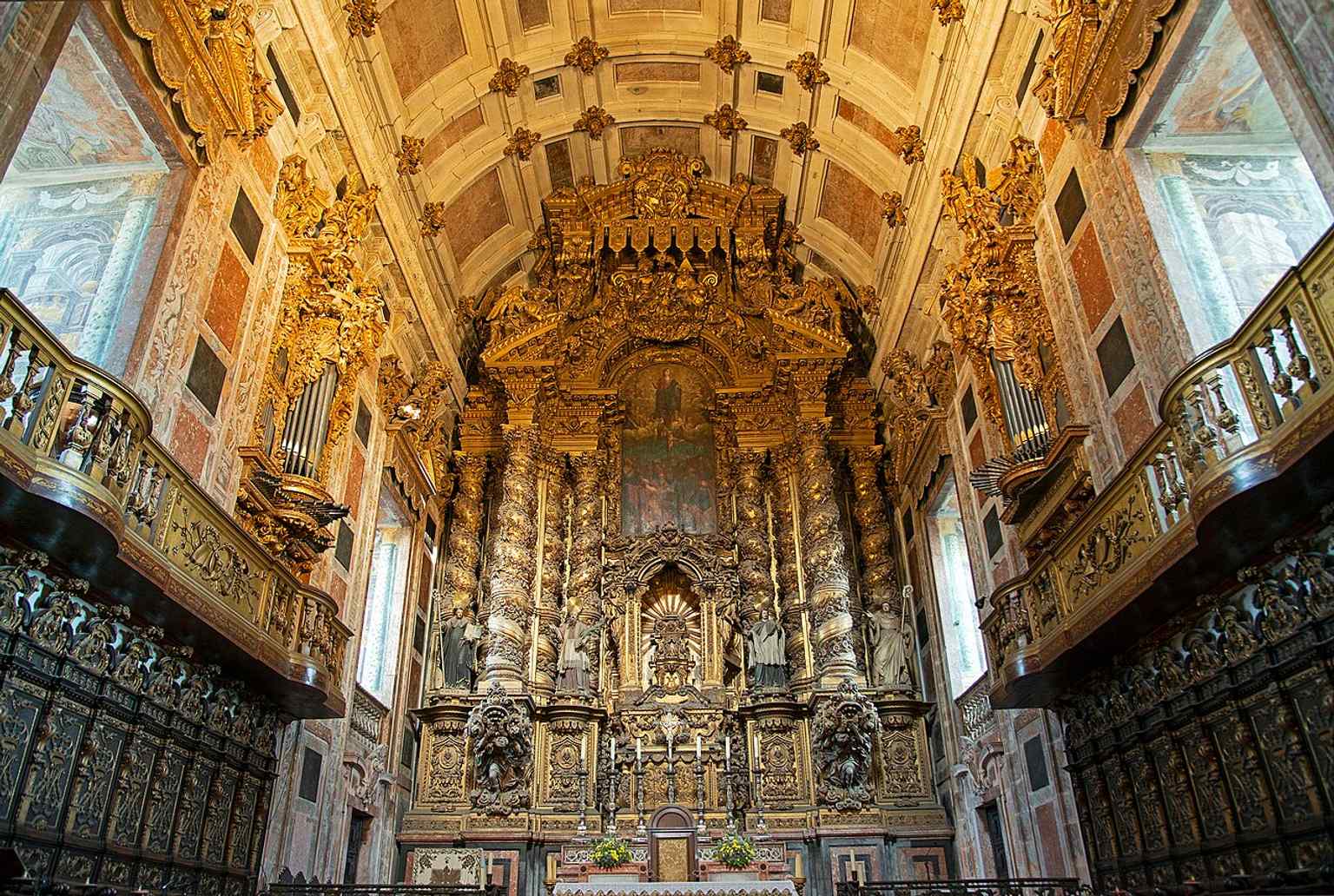
A view from the cathedral tower over Porto, connecting the monument to the historic city it has watched over for centuries.Photo: JensKunstfreund, Wikimedia Commons, CC BY-SA 4.0. Cropped & resized. On your right, look for a compact granite tower made of two joined rectangular blocks, topped with red roof tiles and marked by tooth-like triangular battlements on the taller…Read moreShow less
Open dedicated page →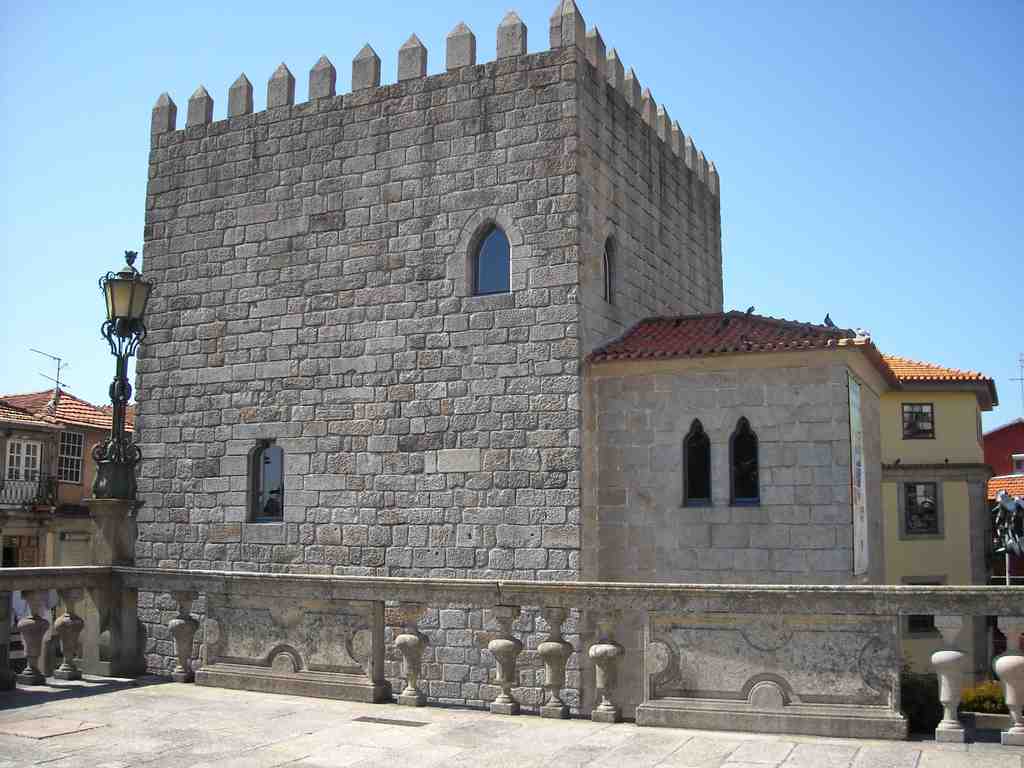
Tower of D. Pedro PitõesPhoto: Béria Lima de Rodríguez, Wikimedia Commons, CC BY-SA 3.0. Cropped & resized. On your right, look for a compact granite tower made of two joined rectangular blocks, topped with red roof tiles and marked by tooth-like triangular battlements on the taller side.
It looks like a clean survivor from the Middle Ages, but Porto has played a subtler game here. This tower carries the name of D. Pedro Pitões, a twelfth-century archdeacon of Porto remembered for his part in the Reconquista, the long Christian campaign to retake Iberian territory, and for supporting the First Crusade. The name gives the place a stern medieval pedigree. Yet the odd thing is this: nobody can say for certain what the original tower actually was. A fortification, perhaps. Or the home of a wealthy burgher, meaning a prosperous town resident, built to look secure in unsettled times.
That uncertainty suits it. Even from here, you can see how the building hesitates between house and stronghold. Above the entrance, the twin trilobe windows, openings shaped like three rounded leaves, feel almost domestic. Then your eye climbs to the battlements, and the place hardens again.
Most visitors miss the real twist. This “survivor” survives because Porto nearly erased it. In nineteen forty, during demolitions around the cathedral hill to open up the new Terreiro da Sé, workers uncovered the tower in the old Largo do Açougue. Medieval Porto has a habit of returning like that, not in triumph, but in fragments exposed by a falling wall. The city made a late rescue decision and shifted the tower roughly fifteen meters instead of clearing it away. So the monument in front of you is both old and relocated, rescued and rearranged. Locals know that this is not simply a relic; it is a relic that moved.
Architect Rogério de Azevedo led the reconstruction and gave the tower some of the silhouette you see now, including the stone balcony with its distinctly Gothic flavour. If you glance at the image on your screen, the tower’s compact, almost theatrical outline becomes clearer, tucked into the slope beside the cathedral quarter. It is medieval in spirit, certainly, but also a twentieth-century act of interpretation.
Then the building changed roles again. Between nineteen forty and nineteen sixty, Porto installed the Gabinete de História da Cidade, the City History Cabinet, inside, and people called it the Torre da Cidade, the City Tower. After the Carnation Revolution on the twenty-fifth of April, nineteen seventy-four, residents occupied it and created the Centro Social e Cultural da Sé. In nineteen ninety-seven, Manuel Magalhães rehabilitated it, and by nineteen ninety-eight it had become a tourist post. Today it serves as the official tourist office of the Sé, which is rather marvellous when you think about it: a place once uncertain in purpose now hands out certainty to strangers.
Soon, power changes its language again. At the Church of Misericórdia do Porto, about eight minutes away, influence will work not through defense or civic record, but through organised charity. And if you ever wish to linger, this stop is listed as open twenty-four hours a day.
On your right stands a pale granite façade like a stone theatre set, with three open arches at ground level, richly curling split pediments above, and a carved stone cross rising…Read moreShow less
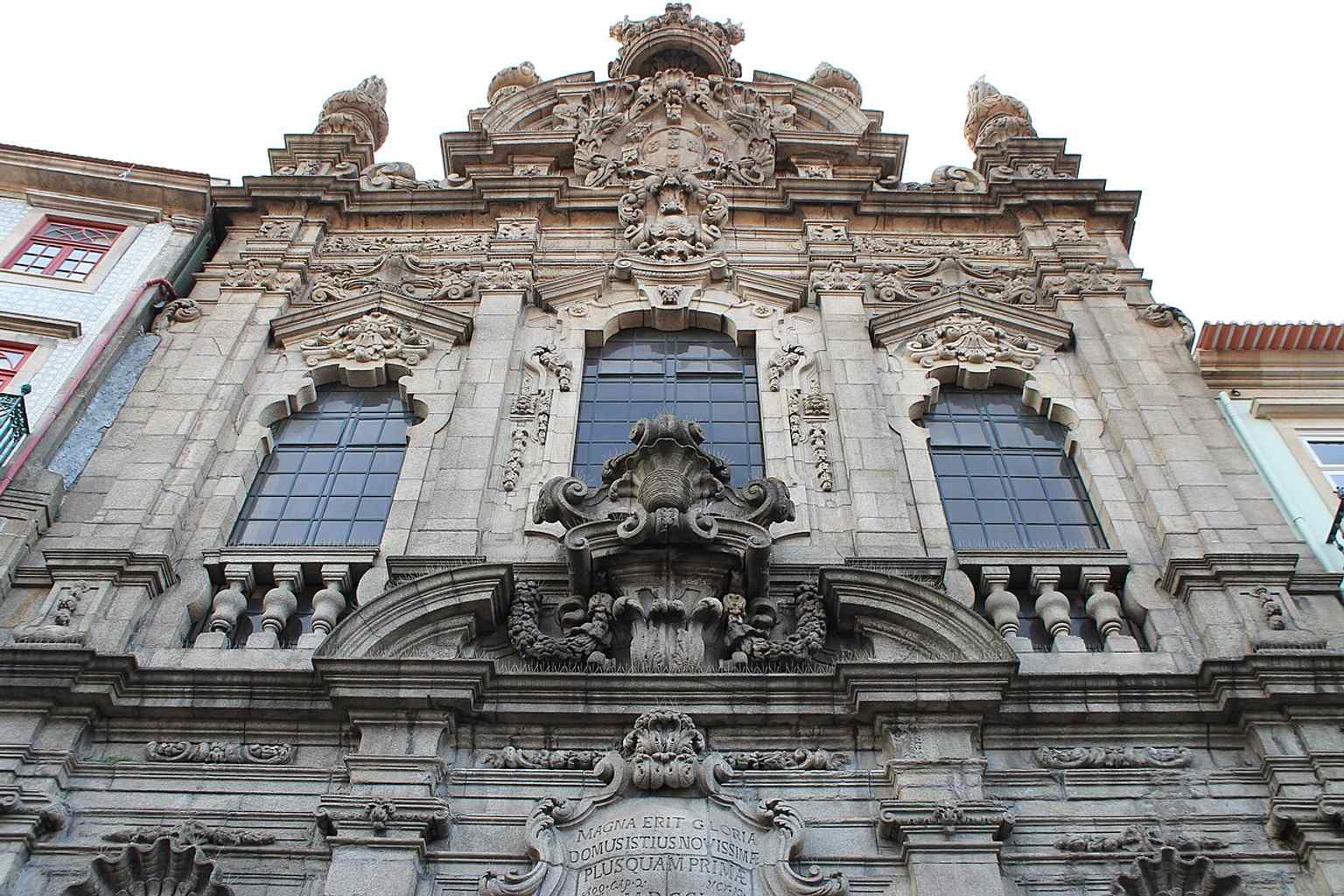
Open dedicated page →On your right stands a pale granite façade like a stone theatre set, with three open arches at ground level, richly curling split pediments above, and a carved stone cross rising from the crown.
This is the Church of Misericórdia do Porto, on Rua das Flores, and it tells you something important about Porto: care here did not live only in private kindness. It took offices, money, stone, signatures, and influence. The Santa Casa da Misericórdia was a brotherhood of charity, certainly, but also an engine of urban power, managing help for the vulnerable through a very public institution.
Its story begins with royal encouragement. Around fifteen hundred, King Dom Manuel the First urged Porto’s leading citizens to found a confraternity like the one in Lisbon. They did, and by fifteen hundred and two the Misericórdia had taken shape. At first it worked from a chapel by the cathedral, but Rua das Flores had become one of the city’s important arteries, so in fifteen fifty-five the brotherhood moved its administrative house here and began this church.
If you glance at the image in the app, you can see how theatrical the front is, almost all façade and flourish, as if the church is presenting itself to the street in a single dramatic gesture. Yet most visitors never realise they are not looking at the original church entire. Only the chancel, the sacred eastern end around the main altar, truly survives from the sixteenth-century building. In April of sixteen twenty-one, lightning struck and destroyed the façade. People sometimes confuse the date because new interior tiles arrived in sixteen twenty-eight, but the blow came earlier, and it changed everything.
A clear street-level view of the Church of Misericórdia do Porto, matching the text’s emphasis on its unusually theatrical Baroque façade on Rua das Flores.Photo: John Samuel, Wikimedia Commons, CC BY-SA 4.0. Cropped & resized. That is where the human story sharpens. Dom Lopo de Almeida helped make the chancel possible through his patronage, and he lies buried here. The stone came from the quarry at Monte de Mijavelhas. Father Gonçalo Vieira supervised the work. And the noble idea of charity met a stubborn reality: the project kept stopping because people worried it was becoming too expensive. Even the organ joined the trouble. Salvador Rebelo built one in the fifteen nineties, only for it to fall badly out of tune within a few years, forcing repairs and promises of regular maintenance.
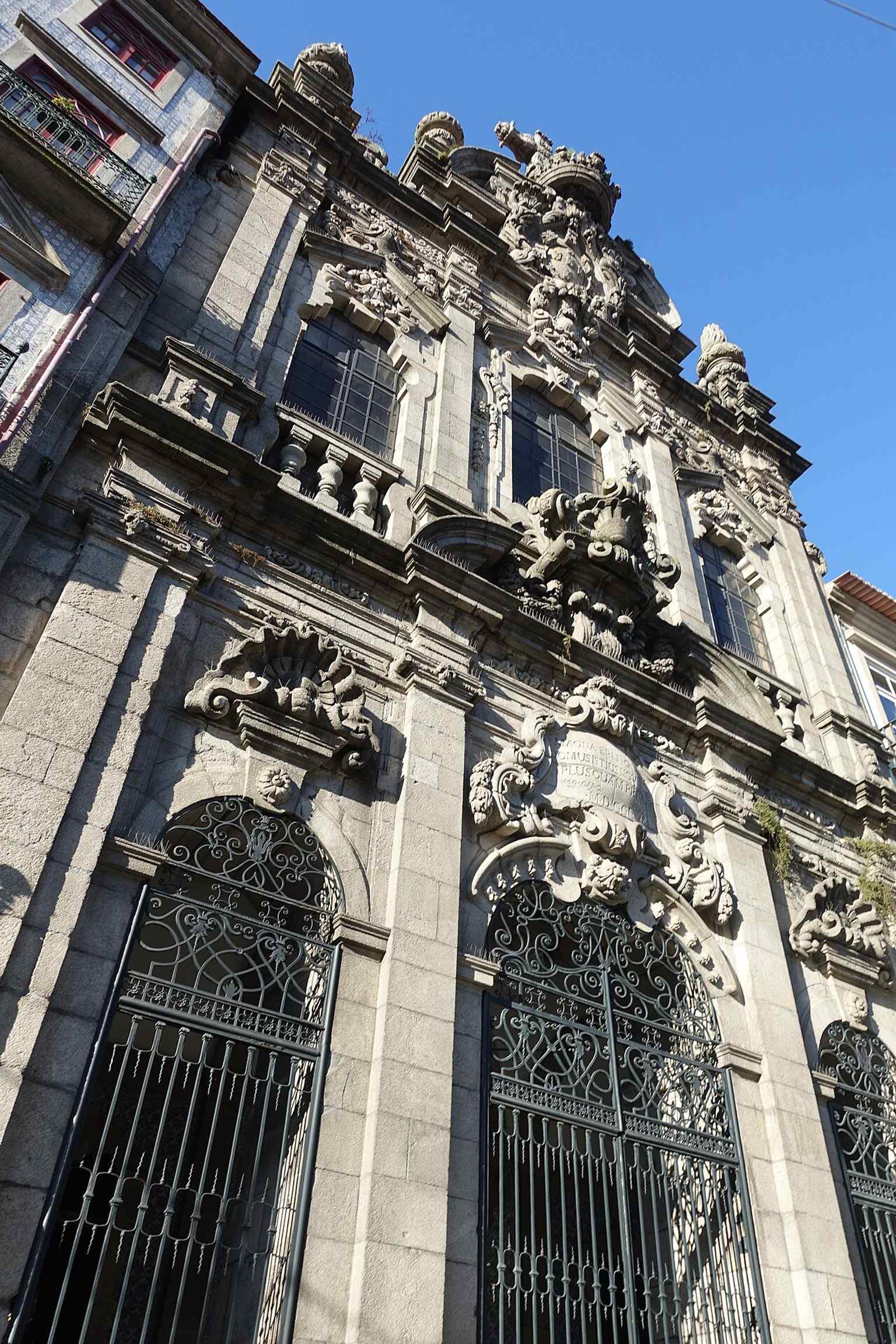
By the eighteenth century the church had become dangerously neglected. In seventeen forty, the brotherhood called in experts, including Nicolau Nasoni, to judge whether the structure was safe. After the vault fell, Nasoni prepared several designs. The Misericórdia chose the simplest option in seventeen forty-eight, which in Porto rather amusingly still meant abundance: heavy sculpture, swelling curves, shells over the side arches, and that great crest of the brotherhood under the royal crown. If you look at the second image, you can read the rebuilding in the stone itself: an eighteenth-century face laid over a much older devotional core. So ask yourself this: which leaves the deeper mark on a city, the men who rule it from above, or the institutions that quietly organise care, burial, memory, and relief for those history usually forgets?
Another exterior angle of the Porto church, useful for showing the rebuilt 18th-century front after the lightning strike that destroyed the original façade in 1621.Photo: John Samuel, Wikimedia Commons, CC BY-SA 4.0. Cropped & resized. From here, let your eyes travel toward the landmark where faith, ambition, and a single soaring tower claim the skyline more boldly still: Clérigos is about ten minutes away. If you want to come back inside later, the church is generally open every day from ten in the morning until half past six.
A higher-resolution exterior photo of the church, ideal for highlighting the ornate façade crowned by the Misericórdia emblem and stone cross.Photo: Joseolgon, Wikimedia Commons, CC BY 4.0. Cropped & resized. On your right, look for a pale granite palace with a long rectangular façade, rows of tall baroque windows, and a central curved pediment crowned by a stone coat of arms. This is…Read moreShow less
Open dedicated page →On your right, look for a pale granite palace with a long rectangular façade, rows of tall baroque windows, and a central curved pediment crowned by a stone coat of arms.
This is the Episcopal Palace of Porto, the old residence of the bishops of Porto, men who were not only church leaders but lasting urban powers, shaping both the skyline and the politics of this hill. Here, beside the cathedral, sacred authority and civic authority stood almost shoulder to shoulder.
The palace you see is grand, but it stands on top of an older memory. Before this baroque residence took shape, a medieval fortified palace occupied this same site. In drawings from sixteen sixty-eight, the artist Pier Maria Baldi showed it as a defensive building with towers, more fortress than refined residence. One bishop, Dom Frei João Rafael de Mendonça, chose to sweep that structure away and commission a new palace. It was a bold decision, and a ruthless one too: centuries of medieval history vanished, apart from small traces, including a narrow Romanesque slit window near the main entrance.
If you glance at the image on your screen, you can study the façade more calmly. Much of its outward character carries the hand of Nicolau Nasoni, the Italian architect so closely tied to Porto. He received payment for the design in seventeen thirty-four, but he did not control the whole build. Miguel Francisco da Silva directed the work from seventeen thirty-seven, and as the years dragged on, other hands simplified and altered the plan. That helps explain why the palace feels both majestic and slightly unsettled, elegant without complete unity.
And then history kept interrupting it. In eighteen oh eight, during the French invasions, the palace became headquarters for the Provisional Junta of the Supreme Government of the Kingdom, led here by Bishop Dom António de São José de Castro, who declared the restoration of Portuguese authority against Junot. A generation later, during the Siege of Porto in eighteen thirty-two and eighteen thirty-three, bombardment battered the still unfinished building and left it in serious decline. Only later restoration rescued it.
The building changed roles again in the twentieth century. After the Republic nationalised church property in nineteen ten and pushed the bishops out, Porto’s city hall moved in and stayed here from nineteen sixteen to nineteen fifty-six. So this palace of bishops briefly turned into a machine for municipal paperwork. If you look at the interior photo in the app, you can sense that layered life: domestic rooms, ceremonial scale, and a house adapted for bureaucracy before later recovery.
One bishop’s story lingers here with particular force. Dom António Ferreira Gomes lived in this palace and, in nineteen fifty-eight, wrote to Salazar criticising poverty and the lack of freedom in Portugal. Salazar answered with punishment, barring him from the country in nineteen fifty-nine. The bishop spent ten years in exile and only returned here in nineteen sixty-nine, after Salazar left office. So even in the modern age, this commanding residence remained a stage for conflict between conscience and authority.
From this seat of power, our attention now narrows to a nearby survivor with a more uncertain identity: the Tower of Dom Pedro Pitões.
If you want to visit the interior later, the palace usually opens from nine to one-thirty and from two to five-thirty, Monday to Saturday, and closes on Sunday.
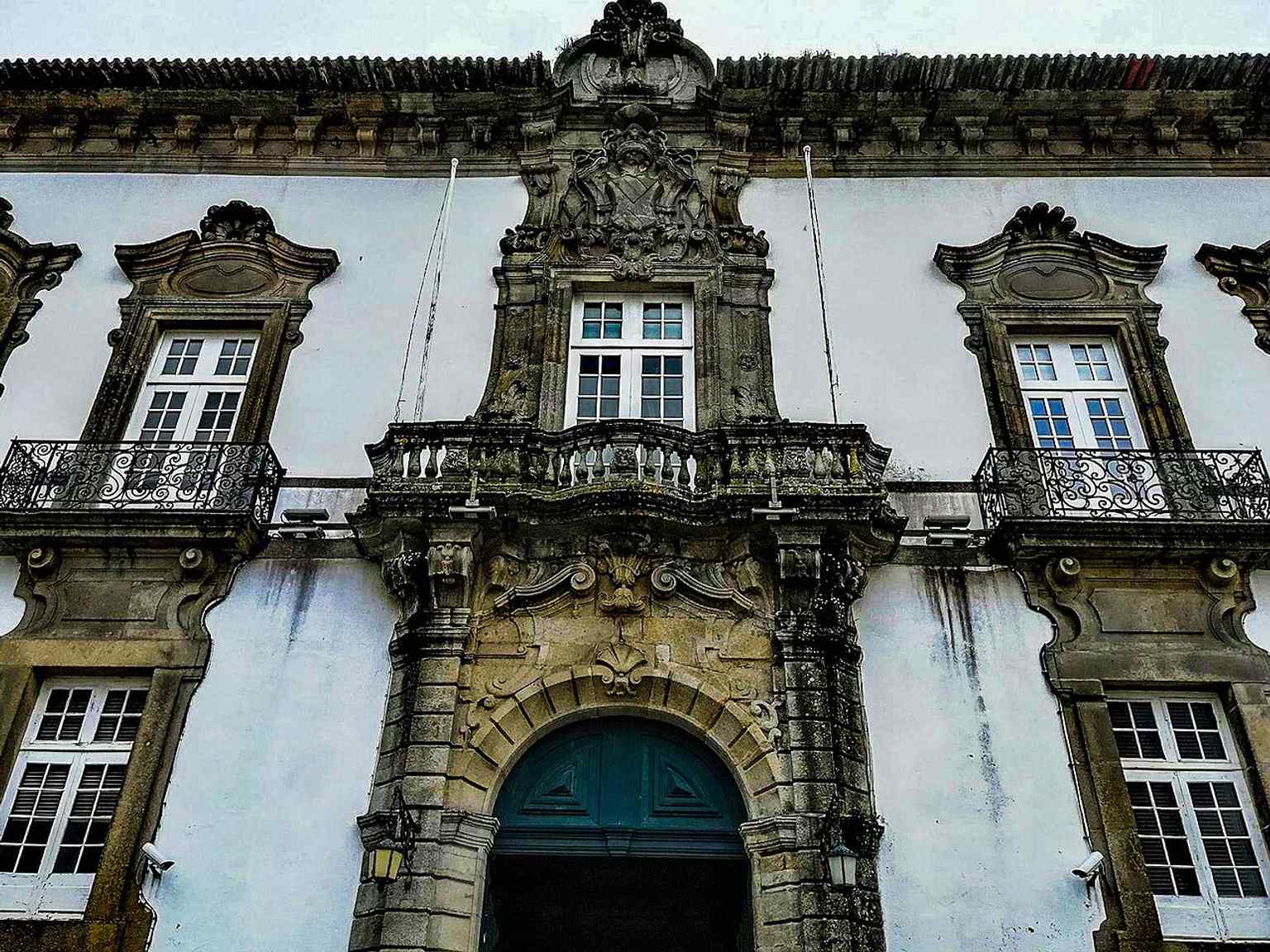
The baroque façade of Porto’s Episcopal Palace, the grand bishop’s residence beside the cathedral.Photo: Ivan Stesso, Wikimedia Commons, CC BY-SA 4.0. Cropped & resized. 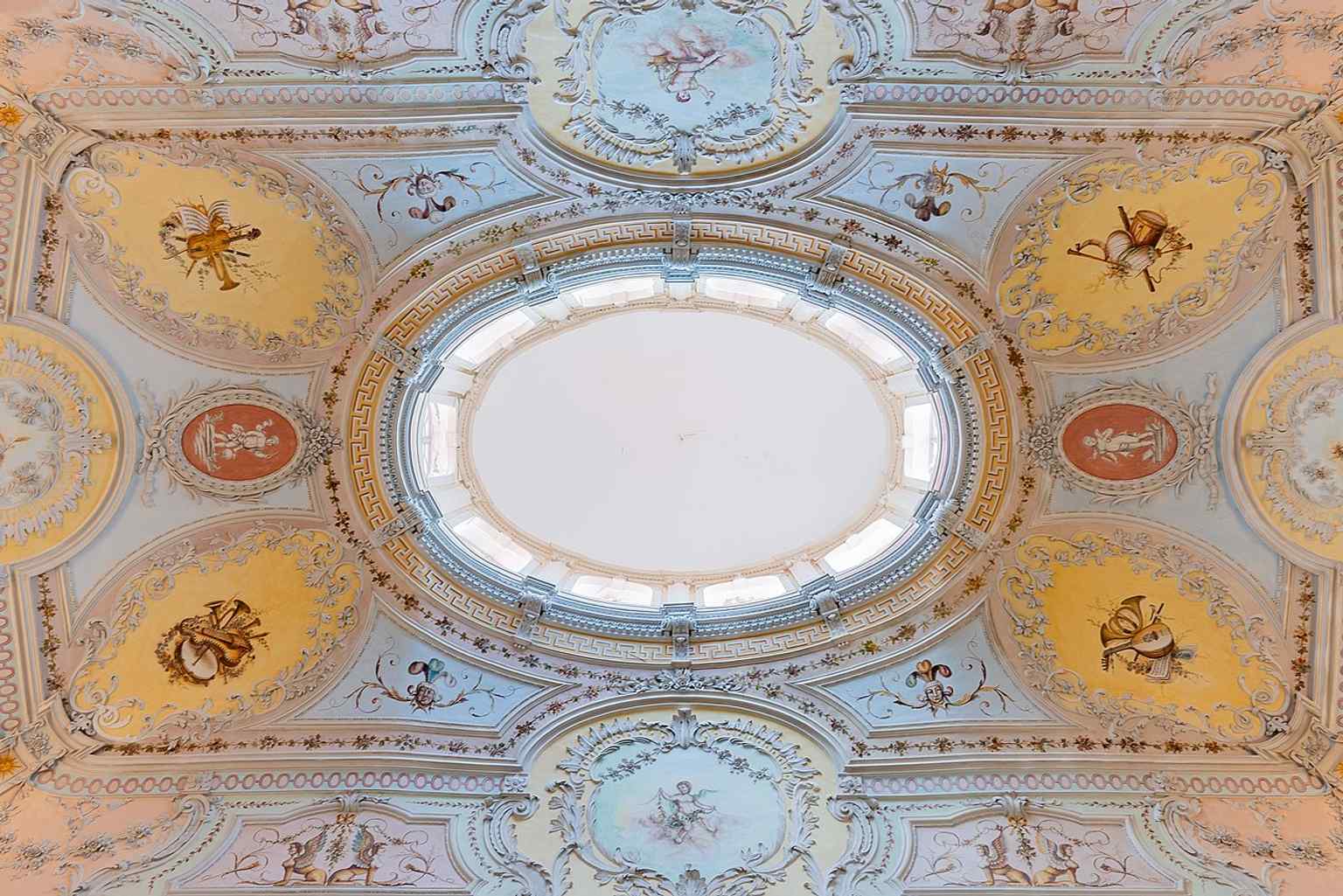
An interior view of the palace, where the bishops once lived before the building became city hall in the 20th century.Photo: T meltzer, Wikimedia Commons, CC BY-SA 4.0. Cropped & resized. 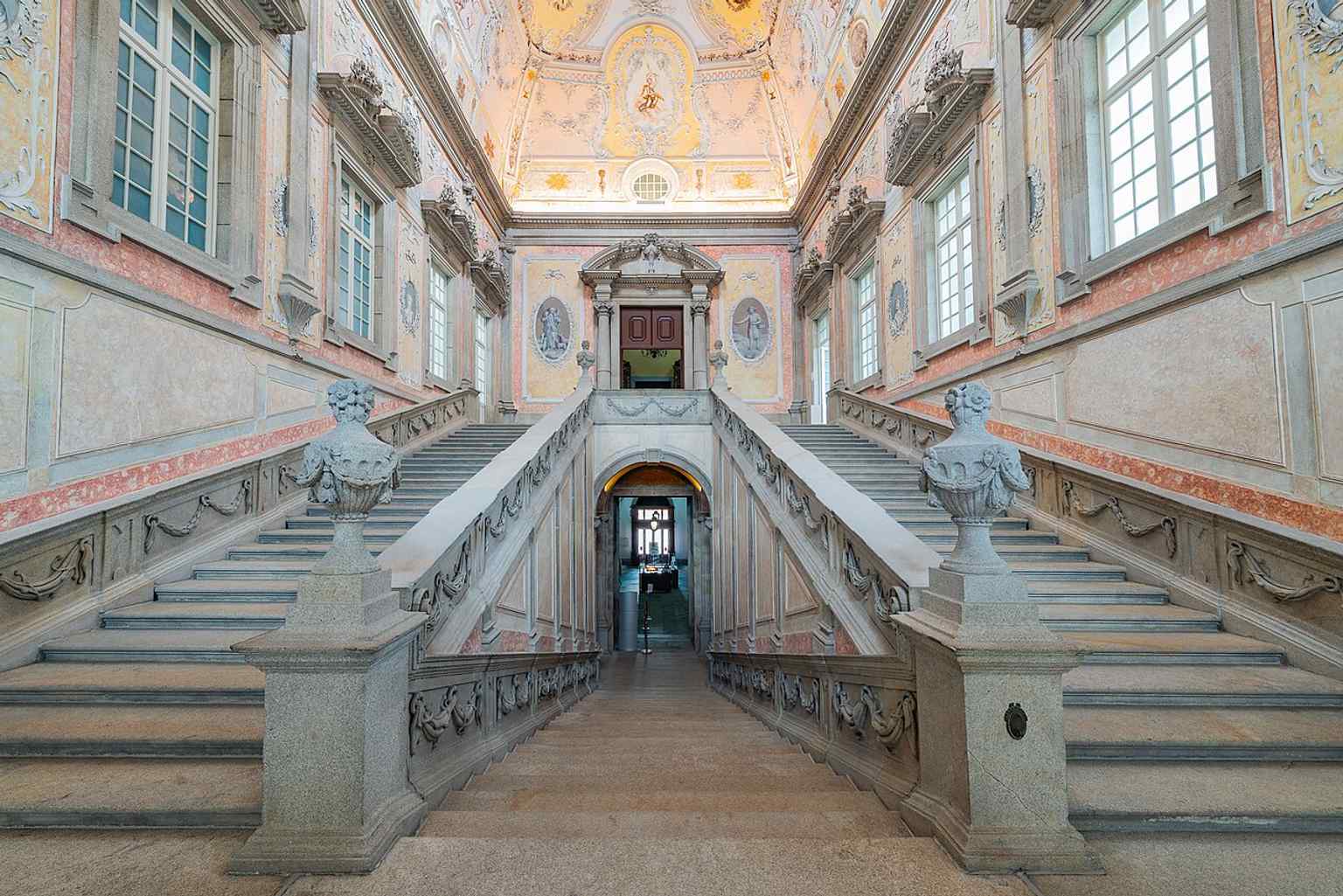
A high-resolution interior shot that helps show the palace’s restored rooms and historic domestic atmosphere.Photo: T meltzer, Wikimedia Commons, CC BY-SA 4.0. Cropped & resized. 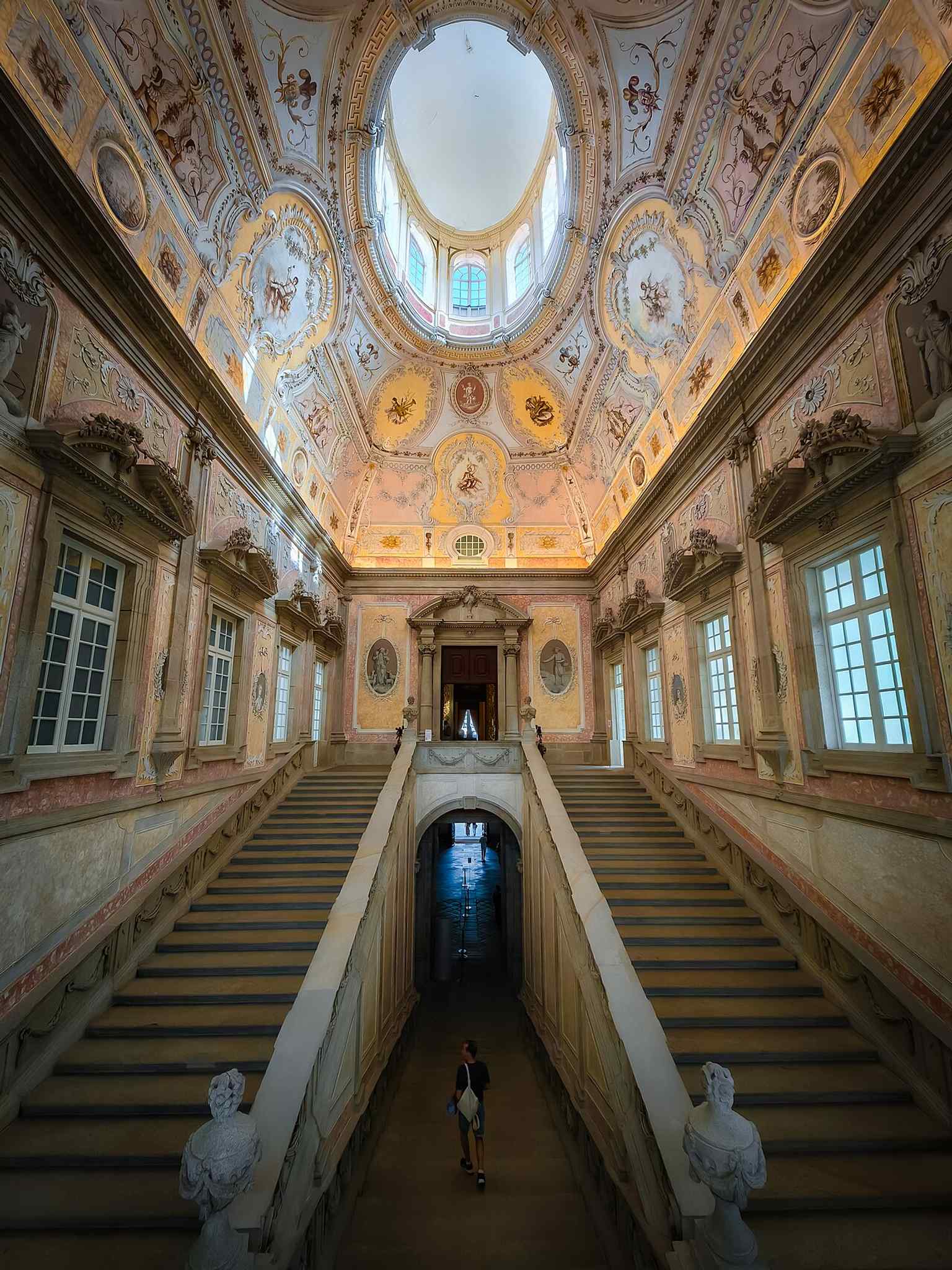
Another interior scene from the Episcopal Palace, reflecting the building’s recovered state after years of civic use.Photo: 19bfc03, Wikimedia Commons, CC BY-SA 4.0. Cropped & resized.
Frequently asked questions
How do I start the tour?
After purchase, download the AudaTours app and enter your redemption code. The tour will be ready to start immediately - just tap play and follow the GPS-guided route.
Do I need internet during the tour?
No! Download the tour before you start and enjoy it fully offline. Only the chat feature requires internet. We recommend downloading on WiFi to save mobile data.
Is this a guided group tour?
No - this is a self-guided audio tour. You explore independently at your own pace, with audio narration playing through your phone. No tour guide, no group, no schedule.
How long does the tour take?
Most tours take 60–90 minutes to complete, but you control the pace entirely. Pause, skip stops, or take breaks whenever you want.
What if I can't finish the tour today?
No problem! Tours have lifetime access. Pause and resume whenever you like - tomorrow, next week, or next year. Your progress is saved.
What languages are available?
All tours are available in 50+ languages. Select your preferred language when redeeming your code. Note: language cannot be changed after tour generation.
Where do I access the tour after purchase?
Download the free AudaTours app from the App Store or Google Play. Enter your redemption code (sent via email) and the tour will appear in your library, ready to download and start.
If you don't enjoy the tour, we'll refund your purchase. Contact us at [email protected]
Checkout securely with 






.JPG)


%2001.jpg)
.jpg)
.jpg)


