
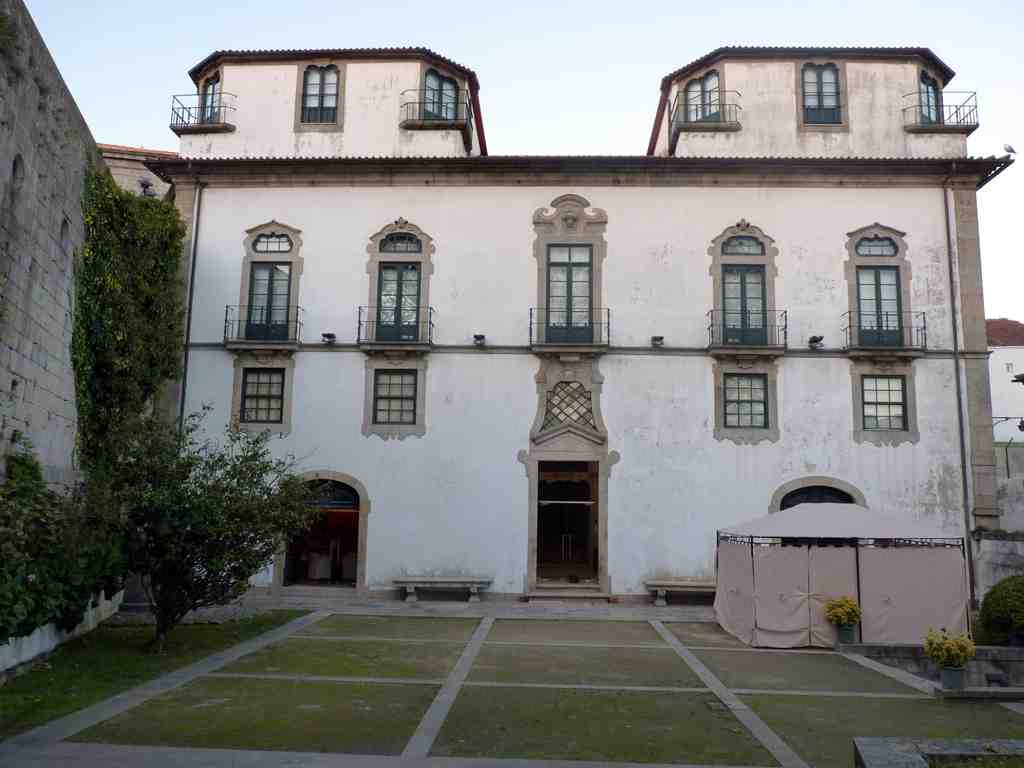
Look for a pale stone town house with a tall, narrow façade, wrought-iron balconies, and a carved baroque doorway set neatly into Rua de Dom Hugo.
This house has the excellent manners of a place that knows exactly how it wishes to be seen. Between seventeen thirty and seventeen forty-six, Domingos Barbosa, a senior church official from Porto Cathedral, ordered its construction. He did not want a modest cleric’s lodging. He wanted a residence that could perform status from the street outward, then deepen the impression once a guest stepped inside.
And here, we meet a delicious Porto uncertainty. Nicolau Nasoni, the Italian architect whose name turns up all over this city, and whose burial in Porto carries its own little whiff of mystery, was long credited with this house as well. But the case is not settled at all. More recent study nudges the credit toward António Pereira, partly because this façade resembles the Palácio de São João Novo so closely that scholars began to suspect the same hand. In other words, the stones have started arguing back against legend.
If you glance at the older photograph on your screen, you can see the house identified as the Casa do Doutor Domingos Barbosa, which is exactly how this authorship debate stayed alive for so long. It is a fine reminder that buildings keep changing their biographies, even when their walls stand still.
From out here, the front seems composed, almost restrained. But inside survives one of the great gestures of the house: a monumental staircase rising from the entrance hall to the upper floor. That stair matters because it turns the residence into theatre. A noble house was never only for living in; it staged arrival, rank, and deference. Elegant façades like this one usually hide whole chains of inheritance, servants, patrons, and private rituals behind the polished rooms.
Those chains became especially tangled here. After Domingos Barbosa, the property passed through relatives and descendants for generations. Then, in nineteen thirty-four, Maria Isabel Guerra Junqueiro, daughter of the poet Abílio Guerra Junqueiro, bought the house from the family line that still held it. That choice is the key to the place. Junqueiro was born in eighteen fifty, in Freixo de Espada à Cinta, not here. His daughter selected this older baroque residence as the proper setting for his legacy, almost as if she were casting a role.
In nineteen forty, Maria Isabel and her mother, Filomena Neves, donated the house to the city of Porto on the condition that it become a museum for Junqueiro’s collections. The gift included roughly six hundred pieces: furniture, sculptures, Nuremberg plates, ceramics, and other works gathered by a man with a sharp eye and a collector’s appetite. Among them is the rare Virgem do Leite, a Madonna nursing the Christ child, an image once common and later discouraged by church reform because it seemed too physically intimate.
If you look at the exterior view in the app, the point becomes quite clear: this is a museum, yes, but it still reads first as a grand private house. That doubleness is its charm.
The story did not stop in nineteen forty-two, when the museum opened to the public. In the nineteen nineties, architect Alcino Soutinho reshaped parts of it for exhibitions, an auditorium, and other public uses, and later interventions kept it active rather than embalmed. Even now, the house does not simply preserve memory; it keeps renegotiating it.
Nearby, that same language of prestige grows more official, more commanding, and far less domestic. When you are ready, continue to the Episcopal Palace of Porto, about three minutes away.




