AudaTours logoAudaTours

Lisbon Audio Tour: Time Travel from Glória to Belém

Audio guide7 stops

Above Lisbon's seven hills, the Tagus shines like steel, and high above the alleys, Castelo de São Jorge watches over centuries of power, fear, and hope. This self-guided audio tour leads through the city, revealing voices, rumors, and details that often go unnoticed. Perfect for seeing Lisbon without just looking. Which decision at Castelo de São Jorge overturned a political power struggle and brought the city to the brink of rebellion. What does the Elevador de Santa Justa hide behind its elegant lattice, a technical marvel or a silent secret. Why did a specific stair step at sunset play a role in an embarrassing scandal. Each section moves on, from views to shadows, from stone to voices. Drama, discovery, and a new Lisbon with every step. Start now and listen to the hills.

Tour preview

map

About this tour

  • schedule
    Duration 30–50 minsGo at your own pace
  • straighten
    3.4 km walking routeFollow the guided path
  • location_on
    LocationLisbon, Portugal
  • wifi_off
    Works offlineDownload once, use anywhere
  • all_inclusive
    Lifetime accessReplay anytime, forever
  • location_on
    Starts at Ascensor da Glória

Stops on this tour

  1. Before you stands the Ascensor da Glória: a yellow-and-white, box-shaped carriage with large windows, sitting diagonally on tracks on the hillside, covered by a network of…Read moreShow less

    Before you stands the Ascensor da Glória: a yellow-and-white, box-shaped carriage with large windows, sitting diagonally on tracks on the hillside, covered by a network of overhead lines. This is Lisbon's very pragmatic answer to the question: 'How on earth do you get up there?' The Ascensor da Glória connects the area around Restauradores Square below with the Bairro Alto up by the São Pedro de Alcântara Garden. And yes, it's officially a funicular, but it also feels a bit like a tram that decided to make mountaineering its profession. Along with Lavra and Bica, it's one of the city's three classic inclined lifts - essentially the small team 'Saving knees since the 19th century'. The line opened in 1885. Back then, technology here wasn't just transport, it was a show: two vehicles balancing each other. When one goes up, the other goes down - both are permanently coupled to the same underground traction cable. The slope is considerable: 17.7 percent gradient. That's the kind of incline where, after 30 seconds of walking, you pretend you urgently need to type a message, just to stop for a moment. The very first version was even more dramatic: initially, the system ran on water weight, and shortly after, on steam. Imagine the sounds: the hiss, the rumbling cable, the smell of oil and hot metal between these densely built 19th-century houses. Safety was not an afterthought. In the early days, there was a rack-and-pinion system for braking - an 'If all else fails, we'll stop even without the cable' plan. Tests back then showed: the thing could be controlled, even if the cable didn't help. Reassuring when you're being pulled up a steep street. Then came the big change in 1915: electric. And here's where it gets typically Lisbon: a funicular with a classic counterweight, but the traction is provided by electric motors directly on the axles, powered by overhead lines like a trolleybus - 600 volts DC, two pantographs, beautifully efficient. The traction cable has since been more of a silent team player, balancing the load between the carriages so the motors don't have to do all the heavy lifting alone. The ride itself is short: about 275 meters, around three minutes. Inside: wooden bench on the side, people packed closely, and that view through the windows, as if the city is slowly sliding downwards. Today's carriages - 42 passengers plus driver - were built as an identical pair by the German engineering company Maschinenfabrik Esslingen. A nice detail, considering how internationally technology traveled even back then. In 2002, the system was declared a National Monument. Deserved, but also a bit ironic: a monument that simply has to function reliably every day. And that's where the tension lies. The Ascensor has had derailments repeatedly. In 2018, it ended fortunately; inadequate wheel maintenance was involved, but no one was injured. Then in 2025 came the harsh cut: a carriage lost control, derailed, and crashed into a building - 16 people died, many were injured, and operations were suspended afterward. This is the dark side of nostalgia: when old systems operate in a modern city, they must not only look beautiful but also be uncompromisingly safe.

    Open dedicated page →
  2. To your left, a slender, grey-metallic tower with delicate iron ornaments and an observation deck at the very top rises into the sky between the building facades - that's the…Read moreShow less

    To your left, a slender, grey-metallic tower with delicate iron ornaments and an observation deck at the very top rises into the sky between the building facades - that's the Santa Justa Lift. If Lisbon has one thing in abundance, it's hills. Rome has seven; Lisbon sometimes seems to have bought them on sale. This very elevation problem is solved by the Elevador de Santa Justa, also known as the Carmo Lift: it connects the flat, bustling streets of the Baixa down here with the higher Largo do Carmo up there. In the past, it was a small expedition on foot. Today, it's an elegant shortcut - and incidentally, a rather photogenic metal giant. The idea of bringing people up more comfortably is older than the lift itself. As early as 1874, engineer Roberto Arménio presented plans. There were even considerations of having carriages pulled up on rails by animals. Imagine that: a 'lift' that sounds and probably smells like a horse. Then Raoul Mesnier du Ponsard entered the scene: an engineer born in Porto with French roots, who convinced the city in 1882 to explore mechanical solutions. Decades later, in 1896, he applied for the actual concession - not without opposition. But the city stood behind him, and suddenly an idea became a project with contracts, companies, and plenty of paperwork. In 1900, it became official: the city signed a contract, and construction gained momentum. Foundations were laid below, machine rooms planned, metal parts fabricated. And then came the moment for the grand show: On August 31, 1901, the metal bridge, complete with its canopy, was ceremoniously inaugurated - with King Carlos and all the dignitaries. The catch: the cabin itself took its time. Operations truly began only in 1902. A classic case of 'ribbon-cutting, but the product comes later'. Initially, the whole thing actually ran on steam. Yes, an elevator that functioned like a small locomotive - in a narrow city shaft. In 1907, it was converted to electricity, implemented by a British company. And because transport in Lisbon is often conceived as a large network, operations later ended up with the tram people: first with the Lisbon Electric Tramway, then moving towards Carris. By the 1970s at the latest, the lift was definitively part of the urban transport system - even if today most passengers carry cameras rather than briefcases. Look at the architecture: Neo-Gothic ironwork, 45 meters high, about seven stories. These pointed arches and lattice work look a bit like a cathedral meeting an engine room. Above, the view awaits; below, the hustle and bustle of the Baixa - and in between, two cabins, with wood, mirrors, and windows inside. Around 1900, iron was the material of the future, and such a vertical lift was a promise: modernity, speed, progress. In Lisbon, it's also unique because the city's other 'lifts' are actually funiculars. When you're at the top, depending on your vantage point, you'll see Castelo de São Jorge, the Tagus, and the pattern of the streets below - as if someone carefully folded the city and then unfolded it again.

    Open dedicated page →
  3. Now look to your right: Before you rises a mighty, cream-colored stone arch with tall columns and a whole series of statues at the very top, like a stone stage against the…Read moreShow less

    Now look to your right: Before you rises a mighty, cream-colored stone arch with tall columns and a whole series of statues at the very top, like a stone stage against the sky. That's the Arco da Rua Augusta, Lisbon's rather self-assured way of saying: 'Yes, it was bad back then, but look at us now.' The arch stands at the edge of Praça do Comércio and commemorates the city's reconstruction after the devastating earthquake of 1755, when parts of Lisbon collapsed, burned, and were further swept away by water. Imagine the smell of smoke and dust, the crashing of stone, and then the silence afterward. And into that silence came the will to reorganize everything. If you look up, you'll notice: the thing looks heavy. That's also because the structure above the arch is extremely tall, like a stone 'We mean business.' As a result, the figures at the top had to be enormous, otherwise, from below, they would look like randomly placed decorations. At the very top, an allegorical scene is enthroned: 'Glory' rewards 'Valor' and 'Genius' - a concept about as subtle as fireworks at noon. Glory wears a robe, stands on a three-tiered throne, and holds two crowns, just in case one isn't enough. Valor appears as an Amazonian figure with a helmet, and in 'Genius,' Jupiter himself is hidden as a hint of divine support for art and writing. Below that, Portugal's great names stand above the columns: among others, Vasco da Gama and the Marquis of Pombal, who significantly spearheaded the reconstruction. And at the bottom, two river gods lie relaxed: Tagus and Douro, as if to say they've seen worse drama. Fun Fact: This arch even made it onto television - as a backdrop through which Gulliver was rolled by the Lilliputians. If you look closely, it suddenly doesn't seem so far-fetched anymore.

    Open dedicated page →
Show 4 more stopsShow fewer stopsexpand_moreexpand_less
  1. As you continue: To your right, Praça do Comércio opens up, vast and immaculate, as if Lisbon took a deep breath here and said: 'Alright. Now we'll build this properly.' The…Read moreShow less

    As you continue: To your right, Praça do Comércio opens up, vast and immaculate, as if Lisbon took a deep breath here and said: 'Alright. Now we'll build this properly.' The square is almost perfectly square, about 175 by 175 meters. And it lies like a stage directly by the water, open towards the Tagus. You often feel a light breeze from the river, hear seagulls, and when the light is right, the bright facade looks freshly washed. Most Lisboetas still call this not just 'Praça do Comércio,' but also 'Terreiro do Paço' - the Palace Yard. Because for centuries, the Ribeira Palace, the royal residence, stood right here on the waterfront. In the early 16th century, King Manuel I had this area outside the old city walls developed: port, shipyards, authorities - including the Casa da Índia, which regulated trade with Europe and the colonies. News, spices, gold, people, and power converged here. If Lisbon had a desk back then, it was probably right here. Then came November 1, 1755. An earthquake, then a tsunami, then fire - and suddenly, what had just been the 'center' was rubble and ash. The palace vanished, and with it, one of the great tragedies for culture lovers: the royal library with over 200,000 books. Imagine the smell of smoke, the crashing of walls, and paper turning to ash in between. History can be brutally brief. After this shock, the Marquis of Pombal took command of the reconstruction. Architect Eugénio dos Santos planned this square as a large U, open to the river: arcades below for walking in the shade, with two towers at the ends - like an architectural echo of the lost palace. The whole thing took forever; some details weren't finished until the 19th century. Lisbon simply has patience, especially when stone is involved. In the center, you'll see the equestrian statue of King José I, erected in 1775. Bronze, majestic, and a small sensation at the time: the first monumental royal statue in the city, designed by Joaquim Machado de Castro. And by the water, the wide marble staircase leads down to the river. It's older than the square itself - a royal arrival staircase, from a time when guests had to be impressed with marble steps, not Wi-Fi. The square later became the government quarter: financial authorities, the Ministry of Interior, even War and Navy were located here, which is why 'Terreiro do Paço' eventually became a nickname for the central government. But this place can also be somber: in 1908, King Carlos I was assassinated here in the open, his heir to the throne died shortly after. Two years later, the monarchy was history. If you fancy something very Lisboeta: Under the arcades sits Martinho da Arcada, a café from 1782 - old enough to have outlived many governments.

    Open dedicated page →
  2. To your right rises a massive, sand-colored stone facade with two square towers, battlements on top, and a round rosette above a deep entrance portal - that's the Sé, Lisbon…Read moreShow less

    To your right rises a massive, sand-colored stone facade with two square towers, battlements on top, and a round rosette above a deep entrance portal - that's the Sé, Lisbon Cathedral. It looks a bit like a church that, for safety, also became a castle. And honestly: in a city regularly shaken by earthquakes, 'robustly built' isn't a bad life philosophy. Officially, it's called Basílica de Santa Maria Maior, but almost everyone just says 'Sé.' It is the ecclesiastical heart of Lisbon - seat of the Patriarchate - and it stands here because history sometimes thinks quite practically. After 1147, when King Afonso Henriques reconquered Lisbon from the Moors, construction began. It is assumed to be precisely on the site of the former main mosque. This is a classic move in the Middle Ages: new center of power, new house of worship, same prime location. Shortly thereafter, Afonso Henriques also brought relics of Saint Vincent to Lisbon and had them venerated here. Pilgrims, after all, are not only pious; they also bring life and money to the city. The first major construction was Romanesque: thick walls, few windows, the interior more dim than 'Instagrammable.' Look up at the towers: the basic scheme with a central portal and rosette above follows this early plan, even if it was heavily tinkered with later. The main portal area is still Romanesque - with several arches and carved capitals adorned with plant tendrils and small dramatic scenes. A stone picture story for people who rarely had a book at hand back then. Then came the Middle Ages with ambitions. In the 13th and 14th centuries, the Gothic cloister was built, and a new, more elaborate chancel was added at the back. King Afonso IV wanted his family pantheon there - and even received an exception, although laypeople generally had no place in the main chapel. His heroic deed at the Battle of Salado in 1340 made him virtually 'VIP enough' for the Holy of Holies. For pilgrims, this renovation was also practical: with an ambulatory and chapels, one could visit the relics without disturbing the main service. Medieval crowd control, without any barrier tape. Of course, Lisbon has a specialty: earthquakes. In 1755, the Sé was also hit hard - parts collapsed, the south side of the tower had to be rebuilt later, and much of the interior was renovated in Baroque style. The stone vaulting of the main nave ceiling? Partially replaced by wood afterward, because wood yields during tremors. Not romantic, but quite clever. In the 20th century, efforts were made to give the cathedral more of a 'medieval look' again: windows were opened, the rosette was redone, and the battlements at the top today almost seem like a statement. Since 1910, the Sé has been a National Monument - which, given all it has survived, feels like a well-deserved promotion.

    Open dedicated page →
  3. To your left, high on the hill, you see a long, crenellated stone wall with angular towers, standing like a stone backbone above the trees and the city's red roofs. That's the…Read moreShow less

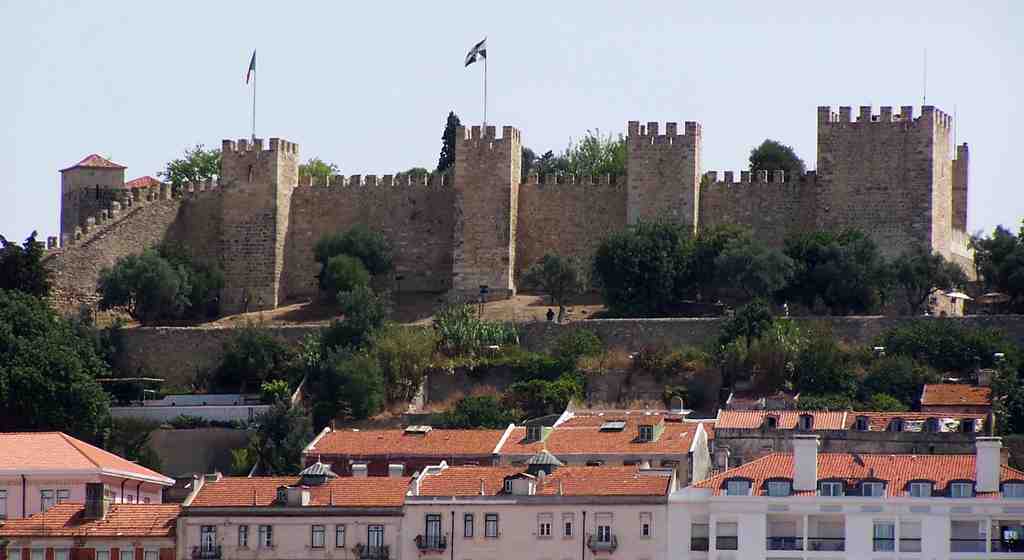
    To your left, high on the hill, you see a long, crenellated stone wall with angular towers, standing like a stone backbone above the trees and the city's red roofs. That's the Castelo de São Jorge - and yes, it has that 'I've seen it all' aura, because it truly has. This hill wasn't just important since the Middle Ages: archaeologists find traces of human presence in the Tagus Valley here dating back to the 8th century BC. Before anyone even thought of calling Lisbon 'Lisbon,' this was a strategic vantage point over the river, port, and inland routes. And whoever has a good balcony gets visitors - not always invited. The first truly ancient fortifications on the hill date from before the Romans; later, the Romans made it into something that suited them: organized, fortified, official. Around 48 BC, the city became a Roman 'Municipium' class, and suddenly this place had even more weight. After that, it continued in a relay race: Celtic groups, Phoenicians, Greeks, Carthaginians - and then new masters again, Suebi, Visigoths, Moors. If these walls could talk, they'd probably sigh first. In the 10th century, Berber forces expanded the fortifications, including the 'Cerca Moura,' the Moorish enclosure. Imagine the sound of hammers on stone, the dust in the air, sentries squinting into the distance. Up here, security was never a given, but rather a project. Then comes 1147: the Siege of Lisbon. Afonso Henriques, later the first King of Portugal, and Crusaders from Northern Europe captured the city. For the Second Crusade, this was, of all things, one of the few real successes - a bit like taking a long, chaotic journey and at least bringing home a good photo at the end. This ties into the famous story of Martim Moniz: allegedly, he saw a gate standing ajar and threw himself into the opening so it couldn't be slammed shut. Whether it happened exactly that way or was dramatically embellished later - the idea is clear: these walls were held together not just with stone, but also with stories. When Lisbon became the capital in 1255, this was suddenly not just a fortress, but also a prestigious address. The Moorish Alcáçova became a royal residence, later extensively rebuilt around 1300 under King Dinis. And in the 14th century, even more protection was added: King Ferdinand had the great city wall extended, with dozens of towers and many gates - a medieval 'Please secure all around'. Later, the castle got its name: King João I dedicated it to Saint George, the dragon slayer - fitting if one likes to see oneself as a defender against all sorts of 'dragons.' One of the towers even housed the state archive, the famous Torre do Tombo: documents, chronicles, the memory of the empire, safely preserved - until the earthquake of 1755 dismantled much of it. Afterward, the complex served for a long time as a barracks, partly also as a prison. Romantic is different, but history is rarely comfortable. And yet: what you see today is also the result of a major restoration in the 20th century. In the 1930s, later added structures were removed, and the Castelo was spruced up again as a national symbol - a bit like uncovering an old painting beneath too many layers of varnish. If you have time, walk up onto the walls here: the view is still the real star. And when you're ready, next head to Padrão da Légua - just walk about 6 minutes east.

    Open dedicated page →
  4. So there it is: Padrão da Légua, right on your right. And I'll put it this way: this isn't a single monument neatly posing for postcards. Padrão da Légua is more of a 'Where…Read moreShow less

    So there it is: Padrão da Légua, right on your right. And I'll put it this way: this isn't a single monument neatly posing for postcards. Padrão da Légua is more of a 'Where exactly am I?' kind of place. A border zone divided among four municipalities: Custóias, Leça do Balio, Senhora da Hora, and São Mamede de Infesta. That sounds bureaucratic, but in everyday life, it's quite concrete: some institutions list addresses here with two or more place names because no one is entirely solely responsible. A bit like a shared fridge without name tags. The name reveals its original purpose: 'Légua' means 'mile' or 'unit of distance.' Padrão da Légua was the point where two old arterial roads from Porto separated: the Via Veteris towards Vila do Conde (today roughly the area around Rua da Fonte Velha) and the Karraria Antiqua towards Barcelos (today around Rua de Recarei). Precisely at such a fork, orientation is needed. So, a cross was erected here, a cruzeiro - the 'Cruz do Padrão.' Around this sign, the settlement began to gather: first a waypoint, then a neighborhood, then everyday life. And, a little bonus for pilgrim fans: the Portuguese Coastal Route to Santiago de Compostela also branches off from the Central Way here - again along these historic roads. A place that has been sorting people for centuries: you go that way, you go this way. In historical sources, Padrão da Légua appears as a geographical reference as early as 1768. In the 19th century, its affiliation wandered through documents like an unsettled postal package: sometimes to Leça do Balio, sometimes to Custóias, later - after administrative shifts in 1896 - to São Mamede de Infesta. On maps from the 1830s, it's sometimes listed as 'Padrão da Legôa,' sometimes as 'Cruz do Padrão.' And in 1833, during the Cerco do Porto, the Siege of Porto, this area was even the scene of liberal actions. Not exactly what you'd expect when you only see road traffic and residential buildings today. Religiously, the place received its own parish in 1964, with 'Senhor Jesus' as its patron - a direct homage to the old veneration of the cross. The church opened in 1980, and every year in the second week of September, the Feast of Senhor Jesus is celebrated: three days from Friday to Sunday, very local, very communal. Speaking of community: On several occasions, there were attempts to officially make Padrão da Légua its own 'Freguesia' (parish/civil parish). In 1981, 7,000 signatures were even collected for it. The arguments were solid: rapid urban development, schools, associations, its own social center - and around 13,000 people spread across four administrations for official matters. It still didn't happen. Some places are just too independent to be neatly categorized. And that's precisely the point here: Padrão da Légua isn't a single eye-catcher. It's a crossroads - of paths, responsibilities, everyday life, stubbornness, and neighborhood. A place that has been saying for centuries: 'You can map me. But it won't be easy.'

    Open dedicated page →

Frequently asked questions

How do I start the tour?

After purchase, download the AudaTours app and enter your redemption code. The tour will be ready to start immediately - just tap play and follow the GPS-guided route.

Do I need internet during the tour?

No! Download the tour before you start and enjoy it fully offline. Only the chat feature requires internet. We recommend downloading on WiFi to save mobile data.

Is this a guided group tour?

No - this is a self-guided audio tour. You explore independently at your own pace, with audio narration playing through your phone. No tour guide, no group, no schedule.

How long does the tour take?

Most tours take 60–90 minutes to complete, but you control the pace entirely. Pause, skip stops, or take breaks whenever you want.

What if I can't finish the tour today?

No problem! Tours have lifetime access. Pause and resume whenever you like - tomorrow, next week, or next year. Your progress is saved.

What languages are available?

All tours are available in 50+ languages. Select your preferred language when redeeming your code. Note: language cannot be changed after tour generation.

Where do I access the tour after purchase?

Download the free AudaTours app from the App Store or Google Play. Enter your redemption code (sent via email) and the tour will appear in your library, ready to download and start.

verified_user
Satisfaction guaranteed

If you don't enjoy the tour, we'll refund your purchase. Contact us at [email protected]

Checkout securely with

Apple PayGoogle PayVisaMastercardPayPal

AudaTours: Audio Tours

Entertaining, budget-friendly, self-guided walking tours

Try the app arrow_forward

Loved by travelers worldwide

format_quote This tour was such a great way to see the city. The stories were interesting without feeling too scripted, and I loved being able to explore at my own pace.
Jess
Jess
starstarstarstarstar
Tbilisi Tour arrow_forward
format_quote This was a solid way to get to know Brighton without feeling like a tourist. The narration had depth and context, but didn't overdo it.
Christoph
Christoph
starstarstarstarstar
Brighton Tour arrow_forward
format_quote Started this tour with a croissant in one hand and zero expectations. The app just vibes with you, no pressure, just you, your headphones, and some cool stories.
John
John
starstarstarstarstar
Marseille Tour arrow_forward

Unlimited Audio Tours

Unlock access to EVERY tour worldwide

0 tours·0 cities·0 countries
all_inclusive Explore Unlimited

