
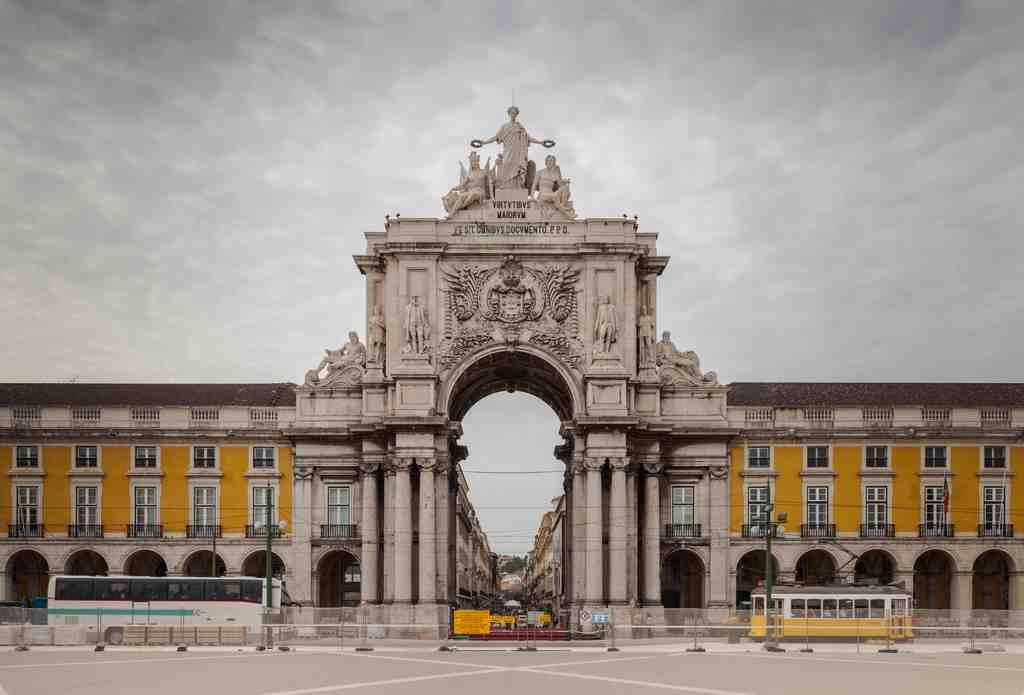
Now look to your right: Before you rises a mighty, cream-colored stone arch with tall columns and a whole series of statues at the very top, like a stone stage against the sky.
That's the Arco da Rua Augusta, Lisbon's rather self-assured way of saying: 'Yes, it was bad back then, but look at us now.' The arch stands at the edge of Praça do Comércio and commemorates the city's reconstruction after the devastating earthquake of 1755, when parts of Lisbon collapsed, burned, and were further swept away by water. Imagine the smell of smoke and dust, the crashing of stone, and then the silence afterward. And into that silence came the will to reorganize everything.
If you look up, you'll notice: the thing looks heavy. That's also because the structure above the arch is extremely tall, like a stone 'We mean business.' As a result, the figures at the top had to be enormous, otherwise, from below, they would look like randomly placed decorations. At the very top, an allegorical scene is enthroned: 'Glory' rewards 'Valor' and 'Genius' - a concept about as subtle as fireworks at noon. Glory wears a robe, stands on a three-tiered throne, and holds two crowns, just in case one isn't enough. Valor appears as an Amazonian figure with a helmet, and in 'Genius,' Jupiter himself is hidden as a hint of divine support for art and writing.
Below that, Portugal's great names stand above the columns: among others, Vasco da Gama and the Marquis of Pombal, who significantly spearheaded the reconstruction. And at the bottom, two river gods lie relaxed: Tagus and Douro, as if to say they've seen worse drama.
Fun Fact: This arch even made it onto television - as a backdrop through which Gulliver was rolled by the Lilliputians. If you look closely, it suddenly doesn't seem so far-fetched anymore.




