
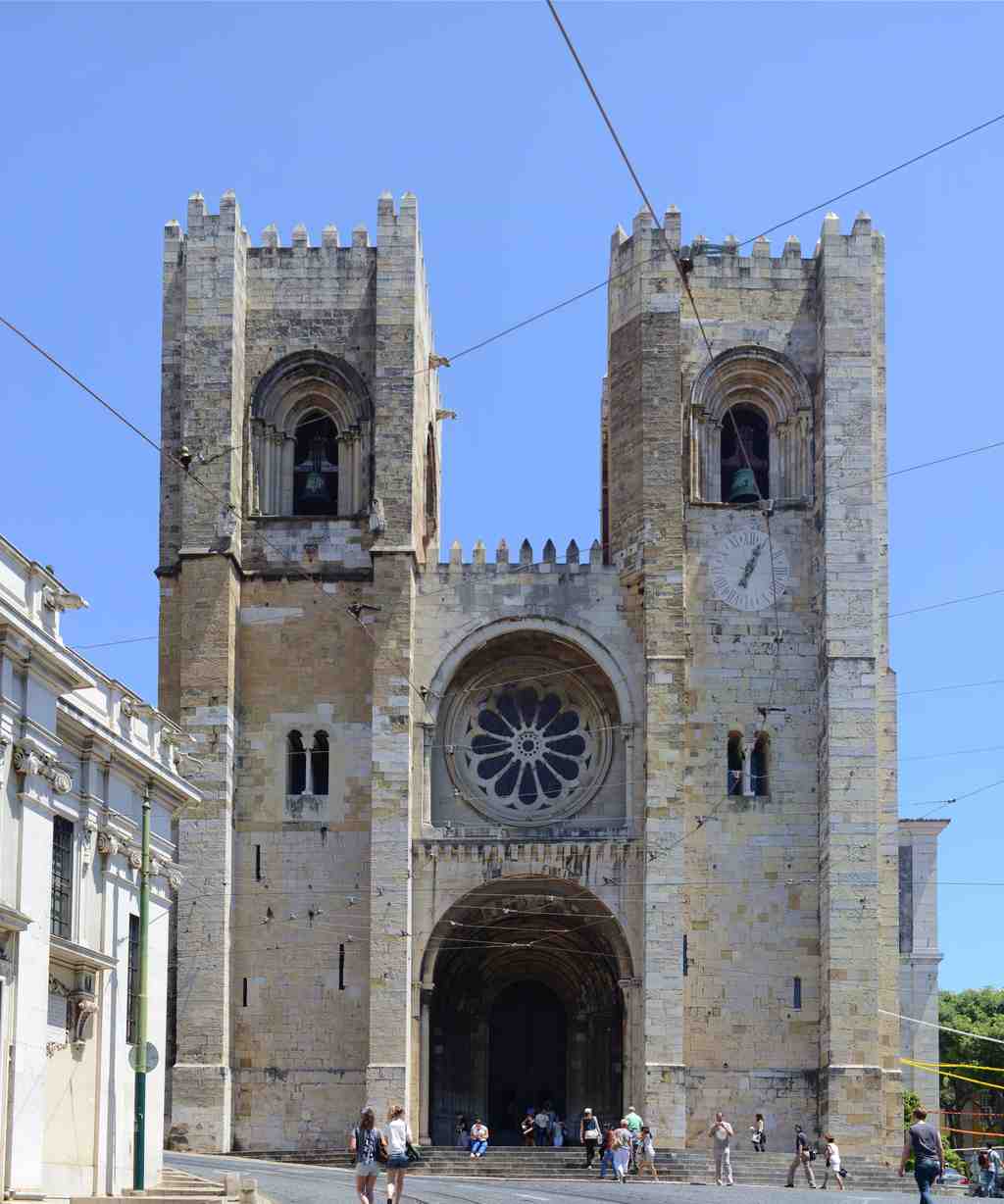
To your right rises a massive, sand-colored stone facade with two square towers, battlements on top, and a round rosette above a deep entrance portal - that's the Sé, Lisbon Cathedral.
It looks a bit like a church that, for safety, also became a castle. And honestly: in a city regularly shaken by earthquakes, 'robustly built' isn't a bad life philosophy. Officially, it's called Basílica de Santa Maria Maior, but almost everyone just says 'Sé.' It is the ecclesiastical heart of Lisbon - seat of the Patriarchate - and it stands here because history sometimes thinks quite practically.
After 1147, when King Afonso Henriques reconquered Lisbon from the Moors, construction began. It is assumed to be precisely on the site of the former main mosque. This is a classic move in the Middle Ages: new center of power, new house of worship, same prime location. Shortly thereafter, Afonso Henriques also brought relics of Saint Vincent to Lisbon and had them venerated here. Pilgrims, after all, are not only pious; they also bring life and money to the city.
The first major construction was Romanesque: thick walls, few windows, the interior more dim than 'Instagrammable.' Look up at the towers: the basic scheme with a central portal and rosette above follows this early plan, even if it was heavily tinkered with later. The main portal area is still Romanesque - with several arches and carved capitals adorned with plant tendrils and small dramatic scenes. A stone picture story for people who rarely had a book at hand back then.
Then came the Middle Ages with ambitions. In the 13th and 14th centuries, the Gothic cloister was built, and a new, more elaborate chancel was added at the back. King Afonso IV wanted his family pantheon there - and even received an exception, although laypeople generally had no place in the main chapel. His heroic deed at the Battle of Salado in 1340 made him virtually 'VIP enough' for the Holy of Holies. For pilgrims, this renovation was also practical: with an ambulatory and chapels, one could visit the relics without disturbing the main service. Medieval crowd control, without any barrier tape.
Of course, Lisbon has a specialty: earthquakes. In 1755, the Sé was also hit hard - parts collapsed, the south side of the tower had to be rebuilt later, and much of the interior was renovated in Baroque style. The stone vaulting of the main nave ceiling? Partially replaced by wood afterward, because wood yields during tremors. Not romantic, but quite clever.
In the 20th century, efforts were made to give the cathedral more of a 'medieval look' again: windows were opened, the rosette was redone, and the battlements at the top today almost seem like a statement. Since 1910, the Sé has been a National Monument - which, given all it has survived, feels like a well-deserved promotion.




