
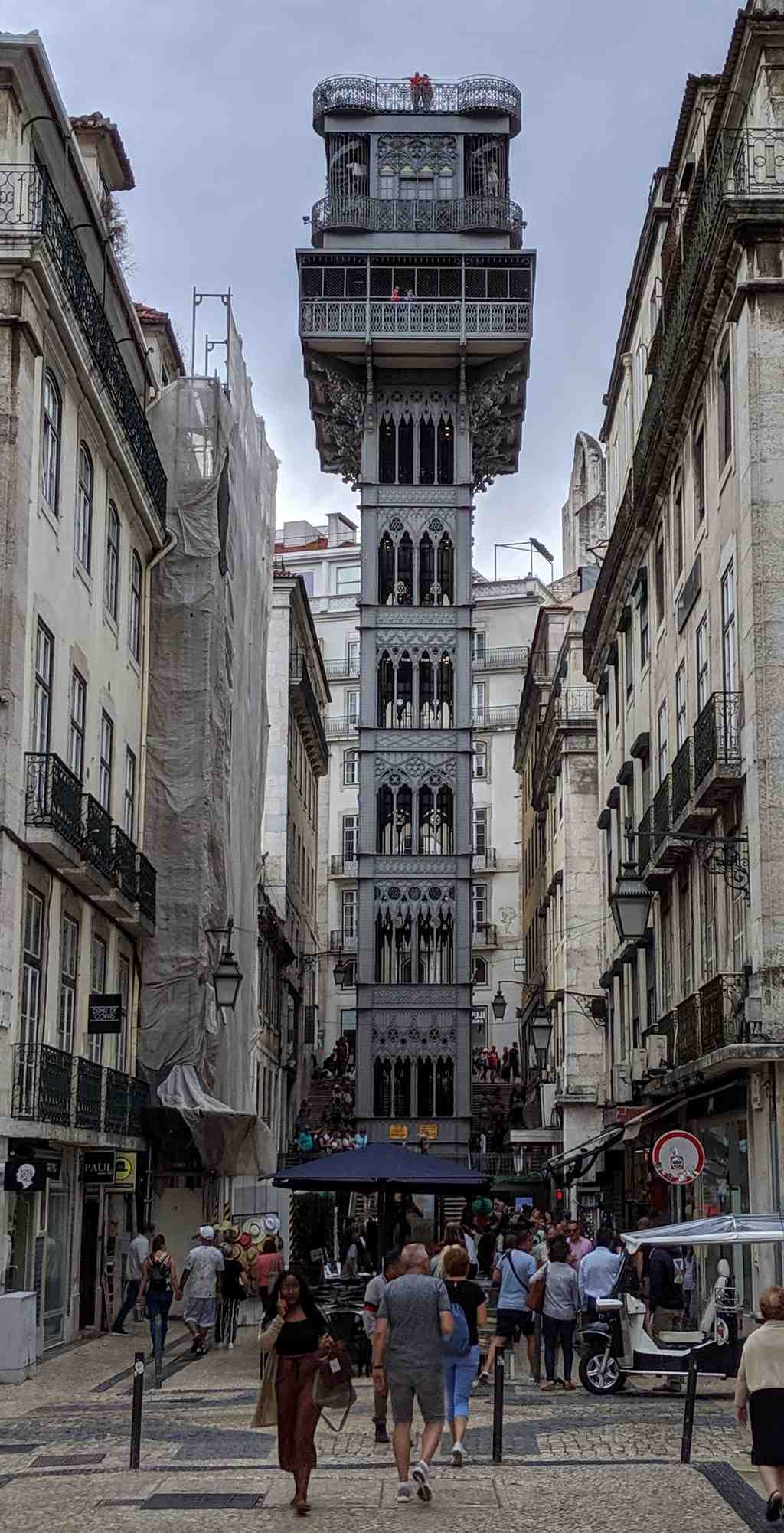
To your left, a slender, grey-metallic tower with delicate iron ornaments and an observation deck at the very top rises into the sky between the building facades - that's the Santa Justa Lift.
If Lisbon has one thing in abundance, it's hills. Rome has seven; Lisbon sometimes seems to have bought them on sale. This very elevation problem is solved by the Elevador de Santa Justa, also known as the Carmo Lift: it connects the flat, bustling streets of the Baixa down here with the higher Largo do Carmo up there. In the past, it was a small expedition on foot. Today, it's an elegant shortcut - and incidentally, a rather photogenic metal giant.
The idea of bringing people up more comfortably is older than the lift itself. As early as 1874, engineer Roberto Arménio presented plans. There were even considerations of having carriages pulled up on rails by animals. Imagine that: a 'lift' that sounds and probably smells like a horse. Then Raoul Mesnier du Ponsard entered the scene: an engineer born in Porto with French roots, who convinced the city in 1882 to explore mechanical solutions. Decades later, in 1896, he applied for the actual concession - not without opposition. But the city stood behind him, and suddenly an idea became a project with contracts, companies, and plenty of paperwork.
In 1900, it became official: the city signed a contract, and construction gained momentum. Foundations were laid below, machine rooms planned, metal parts fabricated. And then came the moment for the grand show: On August 31, 1901, the metal bridge, complete with its canopy, was ceremoniously inaugurated - with King Carlos and all the dignitaries. The catch: the cabin itself took its time. Operations truly began only in 1902. A classic case of 'ribbon-cutting, but the product comes later'.
Initially, the whole thing actually ran on steam. Yes, an elevator that functioned like a small locomotive - in a narrow city shaft. In 1907, it was converted to electricity, implemented by a British company. And because transport in Lisbon is often conceived as a large network, operations later ended up with the tram people: first with the Lisbon Electric Tramway, then moving towards Carris. By the 1970s at the latest, the lift was definitively part of the urban transport system - even if today most passengers carry cameras rather than briefcases.
Look at the architecture: Neo-Gothic ironwork, 45 meters high, about seven stories. These pointed arches and lattice work look a bit like a cathedral meeting an engine room. Above, the view awaits; below, the hustle and bustle of the Baixa - and in between, two cabins, with wood, mirrors, and windows inside. Around 1900, iron was the material of the future, and such a vertical lift was a promise: modernity, speed, progress. In Lisbon, it's also unique because the city's other 'lifts' are actually funiculars.
When you're at the top, depending on your vantage point, you'll see Castelo de São Jorge, the Tagus, and the pattern of the streets below - as if someone carefully folded the city and then unfolded it again.




