
Auckland Audio Tour: From Towers to Treasures
A single tower pierces Auckland’s skyline, but beneath its gaze lie stories far more towering—of revolt, reinvention, and restless ambition. This self-guided audio tour unlocks the secrets of Auckland Central, guiding you down vibrant Queen Street, through the rhythm of Aotea Square, and to vantage points where history shifts in the shadows. Uncover hidden chapters most visitors miss as city legends, scandals, and struggles come alive around every corner. What turned a soaring icon into a symbol of protest overnight? Why did an entire city freeze in silence under Queen Street’s neon glare one unforgettable evening? And who painted a secret on Aotea Square that not even security could spot? Trace rebellious footsteps and wild dreams as each step sends you tumbling through time. The beating heart of Auckland is ready to reveal its untold layers. Start walking—one secret awaits around every corner.
Tour preview
About this tour
- scheduleDuration 100–120 minsGo at your own pace
- straighten3.5 km walking routeFollow the guided path
- location_onLocationAuckland, New Zealand
- wifi_offWorks offlineDownload once, use anywhere
- all_inclusiveLifetime accessReplay anytime, forever
- location_onStarts at Deloitte Centre
Stops on this tour
lock_open 3 free previews · 12 unlock with purchase
Look for the towering eighteen-story block of reflective blue glass rising out of a contrasting beige stone grid framework at its base. Welcome to the start of our walk. This is…Read moreShow less
Look for the towering eighteen-story block of reflective blue glass rising out of a contrasting beige stone grid framework at its base. Welcome to the start of our walk. This is 80 Queen Street, known for years as the Deloitte Centre. Just take a look at where you are standing. It feels solid enough, right? But if you were standing exactly here in the early nineteenth century, you would likely be soaking wet. This "island" site, bordered by Queen and Shortland streets, marks the beginning of the original shoreline. Everything north of this tower was once under the waters of the Waitematā Harbour. To get a true sense of that deep history, look near the Queen Street entrance for a sleek black steel sculpture. That is Kaitiaki II by the renowned artist Fred Graham. It represents a whatu, or anchor stone, marking the foreshore where the waka-the canoes-of the Ngāti Pāoa people were once beached to trade. It is a quiet, permanent reminder that this bustling financial district is floating on top of waters where Māori navigators once sailed. Building a skyscraper on top of the ocean floor wasn't exactly easy. Because this is waterlogged reclaimed land, the engineers faced a massive headache. They had to construct a secant pile wall-essentially a watertight underground dam-to hold back the harbour’s water table just so they could dig out the basement. At the time of construction, it was the deepest and most complex foundation build in all of New Zealand. But the mud wasn't the only thing causing trouble. This site is famous for one of Auckland’s fiercest heritage brawls. Before this glass tower existed, the site held the Jean Batten Building. It was a cherished Art Deco structure that served as the World War Two headquarters for the US Pacific Command. In the early two thousands, heritage advocates realized the bank that owned the site, the BNZ, had found a loophole. They held a demolition consent from years prior that was still valid. Technically, they could legally bulldoze the historic building. It turned into a desperate standoff between preservationists and the developers. The Mayor eventually had to step in and cajole the bank into a "moratorium." The result? Well... it was a compromise. They saved the external walls you see on the rear and sides, but they completely gutted the interior. Witnesses described the demolition site inside those saved walls as looking like "Ground Zero" as the Art Deco interiors were stripped away. The new tower was set back five meters from the old facade, connected by what they call a "reconciliation wall." Here is the kicker. In 2010, the project won a heritage award. Critics called it a bad joke, claiming it rewarded "facadism"-the practice of keeping just the front of a building like a movie set while destroying its soul. History has a habit of repeating itself here. Back in 1978, the BNZ had already demolished the Victoria Arcade on this same site to build their previous low-rise headquarters. That arcade was a cultural hub for artists, and its destruction was mourned as a "brutal expunging" of the city’s past. Today, the building is fully occupied by BNZ again, alongside retailers like The North Face and Lacoste on the ground floor. It is high-tech, boasting a five-star green environmental rating, a long way from the muddy shoreline that started it all. Take a moment to check out the sculpture or the facade details. When you are ready, we will head toward our next destination.
Open dedicated page →To find our next stop, scan the building signage for a vibrant pink circle stamped with the words "THE HITS" in thick, black, interlocking block letters. This is the nerve center…Read moreShow less
To find our next stop, scan the building signage for a vibrant pink circle stamped with the words "THE HITS" in thick, black, interlocking block letters. This is the nerve center for one of New Zealand’s most far-reaching radio networks. Today, it’s a sleek operation broadcasting to twenty-six markets, but its history is a bit like a radio dial that’s been spun too quickly-full of static, sudden changes, and some truly bizarre local characters. You see, for a long time, the New Zealand government held a monopoly on the airwaves. It wasn't until the 1990s that things really cracked open. The government broadcaster, Radio New Zealand, began consolidating its local stations into a single commercial brand, originally known as "Classic Hits." The idea was to save money by networking-broadcasting one voice from a central studio to the entire country. But before the corporate suits fully took over, these local stations were fiefdoms of personality. Take the Southland station, for instance. For thirty-three years, the morning host was a local legend named John "Boggy" McDowell. But Boggy didn't work alone. His on-air partner was a live budgerigar named Bertie who lived in a cage in the station foyer. Bertie was a genuine celebrity, visiting schools and opening events. Things got strange when a receptionist decided the bird was suffering from "nervous tension" and whisked it off to a vet. The station, needing to cover the absence, concocted a lie that Bertie had been headhunted for a movie role in Hollywood. The joke went so far that a staff member later flew back from Christchurch in a giant budgie costume, greeted at the airport by hundreds of cheering fans. That sort of local flavor is harder to find these days. In 2014, the network rebranded from "Classic Hits" to simply "The Hits" to chase a younger demographic-specifically, socially active parents and homeowners. This building here in Auckland became the mothership. The transition was efficient, but brutal. Industry insiders called it a "bloodbath" for regional talent. Long-standing local voices were made redundant, replaced by networked shows beamed out from this very location. In the town of Ashburton, listeners were so furious about losing their local host, Phil Hooper, that the company actually had to move him to a different station brand just to stop the revolt. The drama hasn't been limited to the provinces, either. The network saw a major shakeup in 2017 when the long-running morning duo, Polly Gillespie and Grant Kereama, suddenly disappeared from the airwaves. Polly took to Facebook claiming they were "gagged" by their contracts, sparking a public feud with management. Today, the vibe is less about budgies and more about high-production stunts. The current breakfast team, Jono and Ben, are known for elaborate pranks. They once convinced a co-host she was flying to London for the King's coronation, dragging out the ruse for weeks, only to reveal her "flight" was a simulation inside a local warehouse. It’s a different world from the old days of AM radio, but it certainly keeps people listening. The Hits has come a long way from its government roots, evolving into a content factory that dominates the drive home
Open dedicated page →

Show 12 more stopsShow fewer stopsexpand_moreexpand_less
Look up to your right at the colossal grey concrete shaft rising vertically, capped by a multi-level glass observation pod and a slender white antenna mast piercing the sky. It…Read moreShow less
Look up to your right at the colossal grey concrete shaft rising vertically, capped by a multi-level glass observation pod and a slender white antenna mast piercing the sky. It is hard to miss, isn’t it? This is the Sky Tower. At 328 meters, or about 1,076 feet, it held the title of the tallest freestanding structure in the Southern Hemisphere from the moment it opened in 1997 all the way until 2022. It defines the Auckland skyline, but its design didn't come from a team of engineers sweating over blueprints in a boardroom. It came from a drink at 30,000 feet. The architect, Gordon Moller, was flying home from a research trip when a colleague asked him what this new tower should actually look like. Moller didn't have a design yet. So, he picked up the clutch pencil he was holding, set it upright on his tray table, and sketched that very pencil on a napkin. He wanted the tower to mimic that elegant, utilitarian form. The public, however, wasn't initially impressed by this "pencil." During the planning hearings, locals called the rising concrete shaft a giant "sewer pipe." But to ensure that "pipe" went up perfectly straight, the construction team used a surveying technique called resection. Essentially, they used lasers and measurements from three fixed points around the city-including Mount Eden-to triangulate the tower's exact center. They verified the vertical alignment to within mere millimeters as the concrete rose. The tower is the centerpiece of the SkyCity complex, which includes the casino below. While the views up here are the main attraction, the casino operations downstairs have occasionally made headlines for the wrong reasons. In 2024, the casino agreed to a historic five-day closure, costing them around five million dollars, as a penalty for a major failure in their "host responsibility." They had allowed a customer to play slot machines for 18 hours straight without a single staff member checking in on him. If you look at the observation deck, you might see people throwing themselves off it. That is the SkyJump, a wire-controlled descent where you can reach speeds of 85 kilometers per hour. It attracts all sorts. The boy band One Direction took the plunge a few years back, with Louis Tomlinson colorfully complaining that the harness was a bit tight in the groin area. But it’s not just for the young; the tower has hosted jumpers as old as 91. The structure is built to withstand high winds, designed to sway up to one meter. But that flexibility can be terrifying for the staff. Bruce Stewart, an electrician who has worked here since the beginning, recalls the first anniversary in 1998. A massive canvas flag lashed to the top of the needle broke loose in a gale. Stewart and a colleague had to climb the external ladder to the very top of the mast, in the dark and howling wind, to secure it. He later admitted he never told his wife about that particular night shift. People have a strange connection to this building. One local resident named Dashper loved the tower so much he had a detailed image of it tattooed on his ribcage. He said he wanted a permanent marker of his home city, though he did admit that about halfway through the needle work, the pain on his ribs was so bad he started to regret the tribute. Hopefully, looking at it from down here is a slightly less painful experience. Take a moment to crane your neck and appreciate the height one last time. When you are ready, we will head toward the main street.
Open dedicated page →You are standing in a long, straight urban canyon where modern glass towers loom over ornate, cream-colored stone buildings from the turn of the last century. Beneath the asphalt…Read moreShow less
You are standing in a long, straight urban canyon where modern glass towers loom over ornate, cream-colored stone buildings from the turn of the last century. Beneath the asphalt you are standing on... quite literally under the soles of your shoes... runs the Waihorotiu Stream. Today it is contained in a concrete pipe, but if you were standing here in the 1840s, you would be looking at a gully with a fresh water creek running down the middle. However, that freshness did not last long. By the 1860s, the stream had been turned into the Ligar Canal, an open sewer that was notorious for its overwhelming stench. One local writer at the time described the aroma as being worse than an American skunk. It was a hazardous place. In 1860, after heavy rains, a diversion trench collapsed, splitting the street open with a gash that newspapers compared to an earthquake crack. Pedestrians had to navigate this mire on rickety wooden footbridges, and it was not uncommon for the intoxicated or the clumsy to fall right into the filth. But the danger on Queen Street hasn't always been subterranean. This pavement has seen its share of chaos. In 1932, during the Great Depression, a massive crowd of unemployed workers gathered here. When their leader, Jim Edwards, was struck by a police baton, the crowd erupted. They surged down the street, smashing windows and looting. It was a surreal scene. One witness reported seeing a man staggering away with a grandfather clock strapped to his back, while staff at a department store wept over their smashed wax mannequins. Violence returned in 1984 during a free concert. When the power failed, the crowd became agitated, and a comment from the stage sparked a confrontation with police. Let's just say the riot squad did not take it well. The mob went on a rampage, causing one million dollars in damage while the staff of "The White Lady"-a famous mobile food truck that has been parked on this street since 1948-watched helplessly as a jewelry store nearby was smashed open. It is not all riots and open sewers, though. This street also gave birth to a very specific New Zealand character type: the "Queen Street Farmer." This was a biting nickname for wealthy urban professionals-lawyers and financiers working in these high-rises-who bought rural land purely for tax write-offs without knowing the first thing about actual farming. In 1955, the street was the backdrop for a moral panic about "bodgies and widgies." These were young people inspired by rock and roll culture-essentially New Zealand's version of greasers and teddy boys. After two high-profile murders on the street that year, including one in a milk bar, the public terrified themselves into believing that youth culture was destroying the social fabric. Today, the milk bars are gone, and the stream is buried, but Queen Street remains the restless, beating heart of the city. Take a moment to look up the street and imagine that old stream flowing beneath the traffic. When you are ready, we can head to the next stop.
Open dedicated page →To your right, you will see a tiered pedestrian plaza defined by a long flight of stone steps and a vibrant, multi-colored tiled mural wrapping around a central water feature, all…Read moreShow less
To your right, you will see a tiered pedestrian plaza defined by a long flight of stone steps and a vibrant, multi-colored tiled mural wrapping around a central water feature, all sheltered by mature trees. This stepped layout is actually the result of some aggressive Victorian engineering. Back in the eighteen-seventies, this area was a steep, rugged hillock known as Coburg Street. City commissioners decided it was too difficult to navigate, so they ordered massive earthworks to essentially slice the hill down, smoothing the terrain into the terraces you see now to prepare the site for the Art Gallery above. The name of this place has shifted just as much as the earth itself. It was originally Coburg Place, but during the intense anti-German sentiment of World War One, the city erased the German royal name "Saxe-Coburg." They renamed it Kitchener Place after Lord Kitchener, the field marshal famous for his military campaigns in Sudan. In nineteen-thirty-nine, it became Khartoum Place, doubling down on the military theme. It is a bit rich, really. For decades, a square named after a hyper-masculine war hero has served as the primary memorial for New Zealand's women's suffrage movement. That colorful artwork is the Auckland Women's Suffrage Memorial. Designed by Jan Morrison and Claudia Pond Eyley, it was unveiled in nineteen-ninety-three to mark one hundred years of women having the vote. The unveiling was... let's call it chaotic. The Royal New Zealand Air Force had suspended a massive cargo parachute over the square to hide the work for the big reveal. But just as the Irish President Mary Robinson was waiting to speak, artist Claudia Pond Eyley was frantically rushing around inside the fountain, wiping visible marker-pen numbers off the tiles seconds before the water was turned on. If you look closely at the mural, find the "bicycle women" panel. It depicts suffragists cycling to collect signatures for the eighteen-ninety-three petition and features the face of the artist's own great-grandmother. The bicycle was a major tool of emancipation, allowing women to travel independently to outlying areas to canvas for votes. You might assume a monument to civil rights would be safe here, but in two-thousand-and-five, the City Council effectively tried to bulldoze it. They held a design competition for a two point two million dollar upgrade, and shockingly, not a single finalist design kept the memorial. The "high art" critics were brutal. One commentator, Hamish Keith, called this mural a "makeshift urinal" and a "sordid blot." Another proposal even suggested relocating the mural to the entrance of Myers Park, directly next to a notorious brothel. They picked the wrong fight. A "feisty fightback" was led by four formidable women, all titled Dames, including Dame Catherine Tizard. The artists refused to back down, and the controversy raged until two-thousand-and-eleven, when the Council finally admitted defeat and protected the memorial as a "national treasure." In two-thousand-and-sixteen, the lower section was rightfully renamed Te Hā o Hine Place, which comes from a whakataukī-or Māori proverb-meaning "pay heed to the dignity of women." It took over a century, but the geography and the history finally match up. When you are ready to move on, we will head toward the theatre district.
Open dedicated page →Look to your right at the towering cream-colored building featuring a curved corner facade and huge vertical windows topped with decorative Moorish turrets. Welcome to the Civic.…Read moreShow less
Look to your right at the towering cream-colored building featuring a curved corner facade and huge vertical windows topped with decorative Moorish turrets. Welcome to the Civic. This is not just a theater; it is a rare survivor of the "atmospheric cinema" style. The idea was to make you feel like you were not inside a building at all, but sitting in an open-air auditorium at night. The interior is designed as a Moorish garden, complete with turrets, minarets, and tiled roofs. Inside the main hall, the ceiling twinkles with stars, and they even use a special "sunset machine" to project drifting clouds overhead. It is pure illusion. The man behind this fantasy was Thomas O'Brien. He persuaded wealthy businessmen to back this massive project in 1929, securing a loan that ballooned to over two hundred thousand pounds-that is roughly nineteen million dollars today. Construction was a chaotic race against time. On opening night, workmen were reportedly still nailing down floorboards in the auditorium while crowds pounded on the front doors. When the doors finally burst open, people surged past the ticket booths so fast that staff had to throw uncounted handfuls of cash directly into the office safe. The celebrations were so wild that spilled champagne completely soaked the manager's office carpet. But the party ended quickly. The Great Depression hit, and "talkies"-films with sound-arrived, requiring expensive equipment O'Brien had not budgeted for. He went bankrupt and fled to Australia. The man who built Auckland's grandest palace reportedly died penniless on a park bench. The Civic found a second wind during World War II, specifically in the Wintergarden, the underground ballroom. It became a hub for American soldiers stationed here. The star attraction was Freda Stark, a dancer already famous for being a key witness in a sensational murder trial. She was legendary for her "gold paint" routine, performing clad only in a G-string, a feather headdress, and a layer of gold body paint that glistened under the lights. The soldiers loved it. Things got rowdy. During the "Gorgeous Girl Shows," dancers wore balloons over their scantily clad bodies, and soldiers sitting on the floor would pop them with lit cigarettes as the women danced by. By the nineties, the theater was almost demolished. A group called "Friends of the Civic" fought to save it, comparing its destruction to the Vatican destroying the Sistine Chapel. The city council listened, spending nearly forty-two million dollars to restore it. They even fixed the ceiling. Architects realized the original 1929 stars were placed at random, so they replaced them with a fibre-optic starscape that maps the actual Auckland sky exactly as it appeared at ten p.m. on April twentieth. If you ever see a show here, keep an eye out for the "Abyssinian panthers" guarding the proscenium arch-that is the large decorative frame around the stage. Their eyes flash with an eerie green glow, a signature effect that has startled generations of moviegoers. Take a moment to admire the scale of this place. When you are ready, we will keep moving toward the Aotea Centre.
Open dedicated page →Look to your right at the narrow, steep-sided green gully lined with an avenue of tall, rough-barked Phoenix palm trees and a white marble statue resting near the base of a long…Read moreShow less
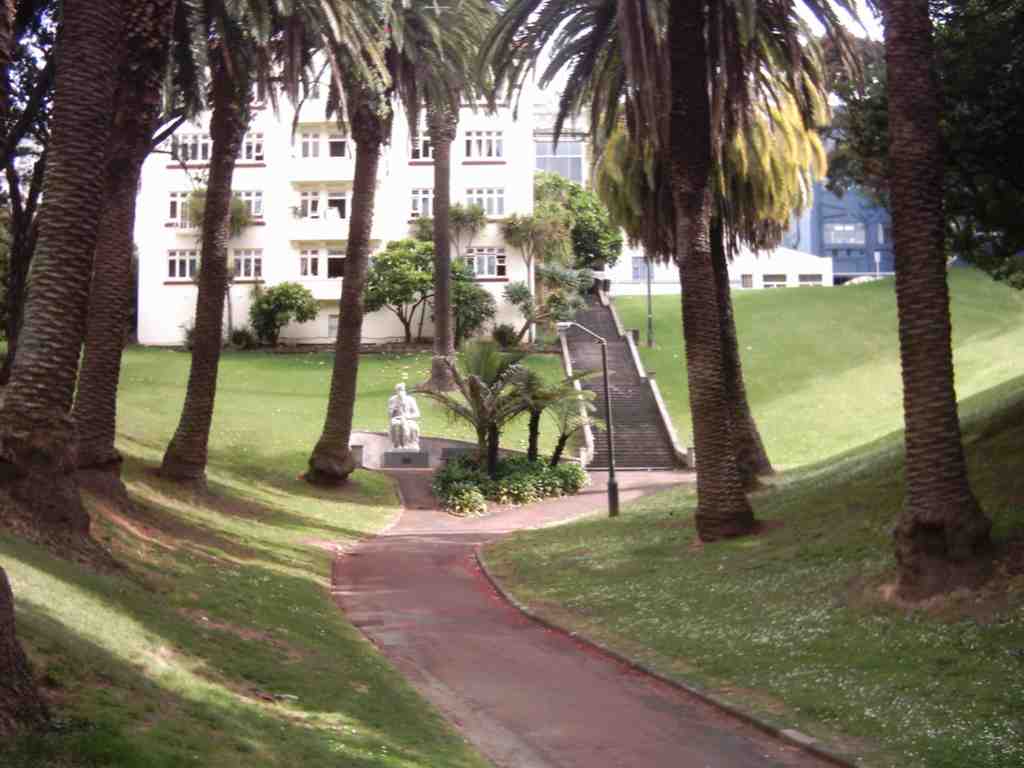
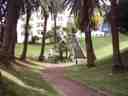
Look to your right at the narrow, steep-sided green gully lined with an avenue of tall, rough-barked Phoenix palm trees and a white marble statue resting near the base of a long concrete staircase. It looks peaceful, doesn’t it? A slice of greenery carved right out of the city grid. But if you were standing here in the late nineteenth century, the view would have been very different, and the smell......well, let’s just say it wouldn’t have been pleasant. This gully, now known as Myers Park, was once the lower end of the Queen Street Valley. By the 1890s, it wasn't a park at all, but a cramped collection of working-class cottages that had deteriorated into a slum. It had a lurid reputation as a "den of iniquity," infamous for illicit gambling, prostitution, and opium dens. The city fathers didn't just want a park here; they wanted what they called "social hygiene." That is a polite, historical way of saying they wanted to clear out the poor residents and bulldoze the "undesirables" along with their ramshackle housing. In nineteen thirteen, a man named Arthur Myers stepped in. He was a brewer and politician who donated nine thousand pounds to the city to purchase this land-a massive fortune equivalent to well over one and a half million dollars today. But the real visionary was arguably his sister-in-law, Martha Washington Shainwald. She was an American visiting from San Francisco, and she was appalled that Auckland children had nowhere safe to play. She brought the American "playground movement" philosophy here, convincing Myers that this shouldn't just be a place for polite strolling, but a dedicated space for child welfare. That philosophy is built right into the architecture. You might see the white kindergarten building in the park. Opened in nineteen sixteen, it was designed with circular walls and no sharp edges to protect the children. However, that innocence was short-lived. Just two years later, during the nineteen eighteen influenza pandemic, that cheerful building was commandeered as a desperate overflow hospital for the dying. There are persistent local rumors that the park grounds were used as an open-air mortuary when the city couldn't keep up with the bodies. That grim history has lingered. Despite being designed as a children's paradise, the park has a well-known "dark repute." It has been the site of modern tragedies, including a fatal attack in twenty thirteen on a man who had simply stopped there to eat his dinner. Locals often speak of the park being haunted, particularly the steep staircase leading up to St Kevins Arcade. People have reported hearing disembodied screams or feeling unseen hands pushing them on the stairs. On a lighter note, look for the marble statue of Moses near the stairs. He looks quite dignified, but his arrival here was a bit of a comedy. In nineteen seventy-one, a department store tried to gift the city replicas of both Michelangelo’s Moses and his famous David. The council happily took Moses, but they rejected David. Apparently, the city council decided a nude statue was a bit too scandalous for the public, so poor David was sold off, leaving Moses here all alone. Beneath the grass you are looking at, the ancient Waihorotiu stream still flows in pipes. It usually stays hidden, but during the massive floods of early twenty twenty-three, the stream "remembered" its old path, bursting from the drains and briefly turning this valley back into a raging river. This valley certainly has a way of holding onto its history, whether it is the water beneath the ground or the stories in the shadows. When you feel ready to move on, we can make our way toward the Town Hall.
Open dedicated page →Look to your right for the large concrete underpass entrance, marked by intricate carved patterns on the curved walls and modern lighting fixtures embedded in the structure. You…Read moreShow less
Look to your right for the large concrete underpass entrance, marked by intricate carved patterns on the curved walls and modern lighting fixtures embedded in the structure. You are standing on top of a ghost. Well... a ghost river, to be precise. Beneath the concrete pavement and the bustle of the city lies the Waihorotiu Stream. It was once the lifeblood of this valley, carving out the gully millions of years ago and flowing all the way down to the harbour. Before the asphalt and the high-rises, this was a place of lush abundance. It was the water source for the village of Ngā Wharau a Tako, which sat on the ridge nearby. The stream’s mouth was a famous food basket, teeming with shellfish and fish. But abundance can be volatile. Oral history tells us of a "children’s war" that broke out right on the mudflats where the stream met the sea. It started innocently enough. Children from two different settlements went down to spear pātiki-that is, flounder. A squabble over the catch escalated into a full-scale battle between the groups, turning a playground into a site of bloodshed. As European settlers arrived, the stream’s fate took a darker, grimier turn. As the city expanded, the clear waters of the Waihorotiu were treated as a convenient drain. By the mid-19th century, it was known as the "Ligar Canal," named after the Surveyor General Charles Ligar, who tried to tame the stream with sound walls. It didn’t work. The "canal" became an open sewer, famously described by locals as a "pestiferous ditch." It was a receptacle for every imaginable filth. By 1911, the situation was the stuff of nightmares. A City Council inspector found that hotel kitchen staff were working knee-deep in sewage when the drains backed up. In one particularly stomach-churning incident, a inspector discovered a Queen Street baker’s shop where sewage was dripping from leaking pipes directly onto the tables where dough was being prepared. It gives a whole new meaning to "local flavor," doesn't it? Charles Ligar, the man whose name became synonymous with this incompetence and stench, eventually retired to a ranch in Texas. He got the wide-open spaces; Auckland got the smell. Eventually, the stream was bricked over and buried, but it never really left. In Māori mythology, this stream is the home of Horotiu, a taniwha. A taniwha is a powerful local nature spirit or guardian, often depicted as a dragon or serpent-like creature in the water. For decades, city planners ignored Horotiu, assuming that burying the stream buried the spirit too. That changed in 2011 during the planning for the City Rail Link. Glen Wilcox, a representative for the local Māori people, challenged the council by asking, "What's being done about the taniwha Horotiu who lives just outside here?" He warned that the new train tunnels would cut directly through the taniwha’s rohe-his spiritual domain or territory. One councillor accused him of dropping a "T-bomb" to stall the project, but it forced a serious conversation. It proved that even under layers of concrete, the mana whenua-the indigenous people with authority over this land-and their guardians were still very much part of the city’s fabric. Today, the stream has a new voice through the artwork you see here, called Waimahara. Created by artist Graham Tipene, it uses sensors to listen for specific songs. If you sing the correct melody, the artwork responds with light and sound, allowing you to literally sing to the river that still flows beneath your feet. Take a moment to imagine the water rushing silently beneath the pavement
Open dedicated page →Look to your left at the wedge-shaped building featuring a dark volcanic stone base that contrasts with the pale limestone upper stories and a forty-meter tall clock tower rising…Read moreShow less
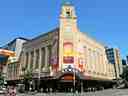
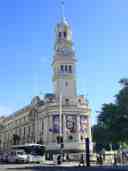
Look to your left at the wedge-shaped building featuring a dark volcanic stone base that contrasts with the pale limestone upper stories and a forty-meter tall clock tower rising above Queen Street. We have just walked up from the path of the old Waihorotiu Stream, and now we are standing before what became the city's first permanent seat of administration and entertainment. This is the Auckland Town Hall. It opened its doors in 1911, costing one hundred and twenty-six thousand pounds... which is about twenty-one million dollars in today's money. A decent investment, considering it is still standing. The design is Italian Renaissance Revival, though when it was first built, locals were not entirely sold on the shape. Some called it a flat iron, while others affectionately dubbed it the cheese wedge. Take a look at that dark stone on the ground floor. It is heavily rusticated, meaning the masonry has been left with a rough, textured finish to give the building a sense of weight and solidity. You might assume that dark rock is local Auckland basalt, but it is actually bluestone shipped all the way from Melbourne. The architects claimed they needed Australian stone because they had the heavy-duty steam saws required to cut it, though I suspect they just wanted to give the contract to the quarries back home. Inside, the Great Hall was modeled on the famous Gewandhaus concert hall in Leipzig, giving it some of the finest acoustics in the world. But it has not always been polite symphonies in there. In June 1964, The Beatles arrived. Seven thousand screaming fans crushed against the front of this building where we are standing. John Lennon was so rattled after a fan pulled his hair in the chaos that he threatened to cancel the show. The structural integrity of the building was actually tested by rock and roll. In 1979, a local group called Citizen Band played here, and the crowd swayed so violently that the floor of the Great Hall started bouncing. Officials were terrified it would collapse. The next morning, the Mayor was on the front page of the paper, furious that two thousand stamping fans nearly brought the house down. It also survived the nineteen-eighties, a decade of renovations and riots. During the infamous Queen Street Riot in 1984, while a concert in the square next door erupted into violence, Prime Minister David Lange was safely inside the Town Hall at a function. He was completely oblivious to the chaos engulfing the civic center just on the other side of the doors. By the nineties, the unreinforced masonry was a major earthquake risk. Engineers had to save the cheese wedge without ruining its look. They installed a massive, invisible diaphragm-basically a horizontal brace made of multi-layered plywood-inside the roof cavity to hold the walls together. They also restored the Town Hall Organ, the largest musical instrument in the country. In the sixties, many of its original pipes were chopped down in a misguided attempt to make it sound more Baroque. Thankfully, the 2010 restoration fixed that and added something unique. They installed genuine Māori instrument stops... the kōauau, or flute, and the pūkāea, or trumpet. It is now the only pipe organ in the world that can authentically produce those indigenous sounds. From near-collapses at rock concerts to hidden plywood skeletons, this building has survived a lot more than just bad reviews of its shape. Take a moment to admire the stonework. When you are ready, we can head to the next stop.
Open dedicated page →Look for the long stretch of ridge-top road lined with heritage brick buildings and distinctive iron awnings that shelter the eclectic shopfronts below. You are standing on the…Read moreShow less
Look for the long stretch of ridge-top road lined with heritage brick buildings and distinctive iron awnings that shelter the eclectic shopfronts below. You are standing on the oldest thoroughfare in the city. Before European surveyors arrived, this ridge was a walking track used by Māori travelers. It carries the name Karangahape, which comes from a legend about a priest named Hape. The story goes that Hape was left behind in the Polynesian homeland because he had a club foot, which his people saw as a bad omen. He refused to stay put. He prayed for assistance and was picked up by a giant stingray, which delivered him here to this ridge before his people’s canoes even arrived. When they finally sailed into the harbour, Hape was standing right here, calling out to them. That call, or karanga, gave the ridge its name: Karanga-a-Hape. For the first half of the 20th century, this wasn't just a road; it was the "Great White Way." In 1935, the city installed electric lighting under all these shop awnings, creating a mile-long tunnel of light for late-night shopping. It was the glamour mile, packed with department stores, tea rooms, and cinemas. But glamour has a way of fading when the economy crashes. In 1932, during the Great Depression, a riot surged up from Queen Street. It was a raw explosion of frustration from the unemployed. Windows were smashed along this entire strip. The looting was... well, opportunistic. Looters grabbed whatever they could carry, leaving the street looking like a war zone as shopkeepers struggled to defend their property. The police were overwhelmed, and shopkeepers had to defend their shattered windows with whatever they could find. The real blow to the area, however, came in the 1960s. Urban planners decided to build a massive motorway system through the nearby gully. To do it, they displaced fifty thousand residents who were the local customer base. They even dug up over four thousand bodies from the Symonds Street Cemetery. It was described by critics as archaeology by bulldozer. With the shoppers gone, rents collapsed, and the red-light district moved in. This era gave rise to characters like Rainton Hastie, the self-proclaimed "King of the G-String." He ran the Pink Pussycat Club just down the road and was a master of shameless publicity. He drove a fleet of pink Cadillacs around Auckland to advertise his club. He even did time in prison for a show that exposed a little more than the law allowed back then. Today, that gritty reputation lingers, but the reality has shifted again. It is now the bohemian heart of Auckland, a mix of artists, vibrant queer culture, and heritage architecture. It has survived riots, bulldozers, and pink Cadillacs to remain the city's most interesting ridge. Take a moment to look down the street and imagine those pink Cadillacs cruising by. When you are ready to move on, we can head to the next stop.
Open dedicated page →


Frequently asked questions
How do I start the tour?
After purchase, download the AudaTours app and enter your redemption code. The tour will be ready to start immediately - just tap play and follow the GPS-guided route.
Do I need internet during the tour?
No! Download the tour before you start and enjoy it fully offline. Only the chat feature requires internet. We recommend downloading on WiFi to save mobile data.
Is this a guided group tour?
No - this is a self-guided audio tour. You explore independently at your own pace, with audio narration playing through your phone. No tour guide, no group, no schedule.
How long does the tour take?
Most tours take 60–90 minutes to complete, but you control the pace entirely. Pause, skip stops, or take breaks whenever you want.
What if I can't finish the tour today?
No problem! Tours have lifetime access. Pause and resume whenever you like - tomorrow, next week, or next year. Your progress is saved.
What languages are available?
All tours are available in 50+ languages. Select your preferred language when redeeming your code. Note: language cannot be changed after tour generation.
Where do I access the tour after purchase?
Download the free AudaTours app from the App Store or Google Play. Enter your redemption code (sent via email) and the tour will appear in your library, ready to download and start.
If you don't enjoy the tour, we'll refund your purchase. Contact us at [email protected]
Checkout securely with 




