
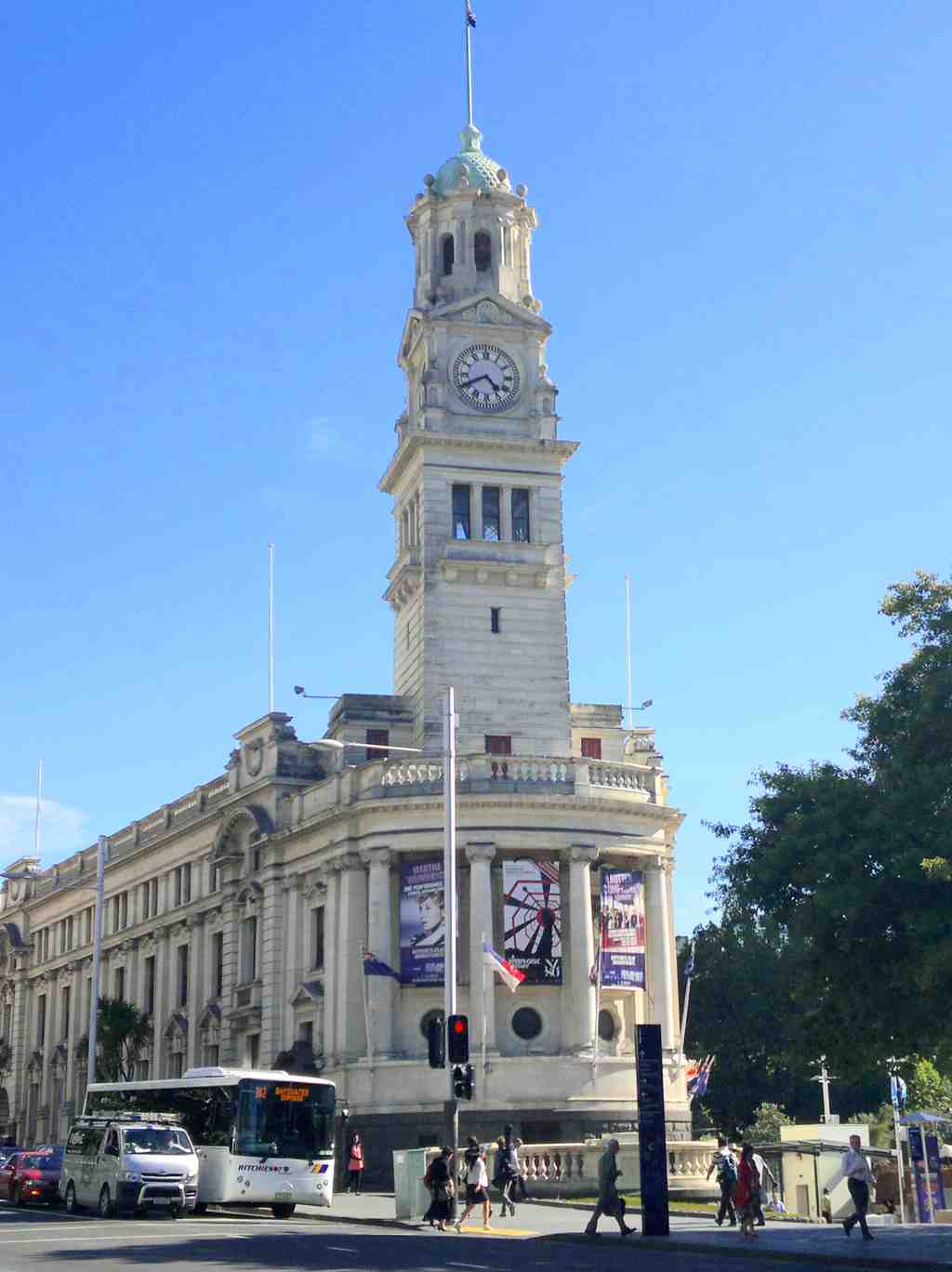
Look to your left at the wedge-shaped building featuring a dark volcanic stone base that contrasts with the pale limestone upper stories and a forty-meter tall clock tower rising above Queen Street.
We have just walked up from the path of the old Waihorotiu Stream, and now we are standing before what became the city's first permanent seat of administration and entertainment. This is the Auckland Town Hall. It opened its doors in 1911, costing one hundred and twenty-six thousand pounds... which is about twenty-one million dollars in today's money. A decent investment, considering it is still standing.
The design is Italian Renaissance Revival, though when it was first built, locals were not entirely sold on the shape. Some called it a flat iron, while others affectionately dubbed it the cheese wedge. Take a look at that dark stone on the ground floor. It is heavily rusticated, meaning the masonry has been left with a rough, textured finish to give the building a sense of weight and solidity. You might assume that dark rock is local Auckland basalt, but it is actually bluestone shipped all the way from Melbourne. The architects claimed they needed Australian stone because they had the heavy-duty steam saws required to cut it, though I suspect they just wanted to give the contract to the quarries back home.
Inside, the Great Hall was modeled on the famous Gewandhaus concert hall in Leipzig, giving it some of the finest acoustics in the world. But it has not always been polite symphonies in there. In June 1964, The Beatles arrived. Seven thousand screaming fans crushed against the front of this building where we are standing. John Lennon was so rattled after a fan pulled his hair in the chaos that he threatened to cancel the show.
The structural integrity of the building was actually tested by rock and roll. In 1979, a local group called Citizen Band played here, and the crowd swayed so violently that the floor of the Great Hall started bouncing. Officials were terrified it would collapse. The next morning, the Mayor was on the front page of the paper, furious that two thousand stamping fans nearly brought the house down.
It also survived the nineteen-eighties, a decade of renovations and riots. During the infamous Queen Street Riot in 1984, while a concert in the square next door erupted into violence, Prime Minister David Lange was safely inside the Town Hall at a function. He was completely oblivious to the chaos engulfing the civic center just on the other side of the doors.
By the nineties, the unreinforced masonry was a major earthquake risk. Engineers had to save the cheese wedge without ruining its look. They installed a massive, invisible diaphragm-basically a horizontal brace made of multi-layered plywood-inside the roof cavity to hold the walls together.
They also restored the Town Hall Organ, the largest musical instrument in the country. In the sixties, many of its original pipes were chopped down in a misguided attempt to make it sound more Baroque. Thankfully, the 2010 restoration fixed that and added something unique. They installed genuine Māori instrument stops... the kōauau, or flute, and the pūkāea, or trumpet. It is now the only pipe organ in the world that can authentically produce those indigenous sounds.
From near-collapses at rock concerts to hidden plywood skeletons, this building has survived a lot more than just bad reviews of its shape.
Take a moment to admire the stonework. When you are ready, we can head to the next stop.




