
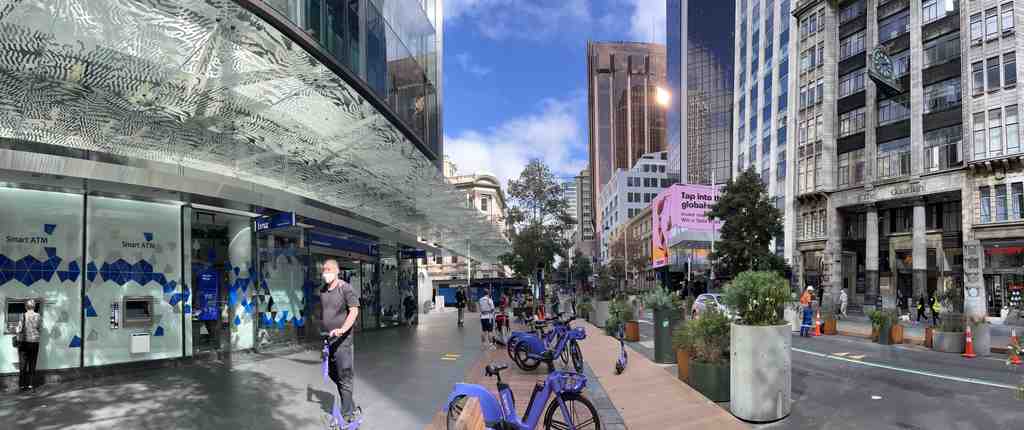
You are standing in a long, straight urban canyon where modern glass towers loom over ornate, cream-colored stone buildings from the turn of the last century.
Beneath the asphalt you are standing on... quite literally under the soles of your shoes... runs the Waihorotiu Stream. Today it is contained in a concrete pipe, but if you were standing here in the 1840s, you would be looking at a gully with a fresh water creek running down the middle.
However, that freshness did not last long. By the 1860s, the stream had been turned into the Ligar Canal, an open sewer that was notorious for its overwhelming stench. One local writer at the time described the aroma as being worse than an American skunk. It was a hazardous place. In 1860, after heavy rains, a diversion trench collapsed, splitting the street open with a gash that newspapers compared to an earthquake crack. Pedestrians had to navigate this mire on rickety wooden footbridges, and it was not uncommon for the intoxicated or the clumsy to fall right into the filth.
But the danger on Queen Street hasn't always been subterranean. This pavement has seen its share of chaos. In 1932, during the Great Depression, a massive crowd of unemployed workers gathered here. When their leader, Jim Edwards, was struck by a police baton, the crowd erupted. They surged down the street, smashing windows and looting. It was a surreal scene. One witness reported seeing a man staggering away with a grandfather clock strapped to his back, while staff at a department store wept over their smashed wax mannequins.
Violence returned in 1984 during a free concert. When the power failed, the crowd became agitated, and a comment from the stage sparked a confrontation with police. Let's just say the riot squad did not take it well. The mob went on a rampage, causing one million dollars in damage while the staff of "The White Lady"-a famous mobile food truck that has been parked on this street since 1948-watched helplessly as a jewelry store nearby was smashed open.
It is not all riots and open sewers, though. This street also gave birth to a very specific New Zealand character type: the "Queen Street Farmer." This was a biting nickname for wealthy urban professionals-lawyers and financiers working in these high-rises-who bought rural land purely for tax write-offs without knowing the first thing about actual farming.
In 1955, the street was the backdrop for a moral panic about "bodgies and widgies." These were young people inspired by rock and roll culture-essentially New Zealand's version of greasers and teddy boys. After two high-profile murders on the street that year, including one in a milk bar, the public terrified themselves into believing that youth culture was destroying the social fabric.
Today, the milk bars are gone, and the stream is buried, but Queen Street remains the restless, beating heart of the city.
Take a moment to look up the street and imagine that old stream flowing beneath the traffic. When you are ready, we can head to the next stop.




