
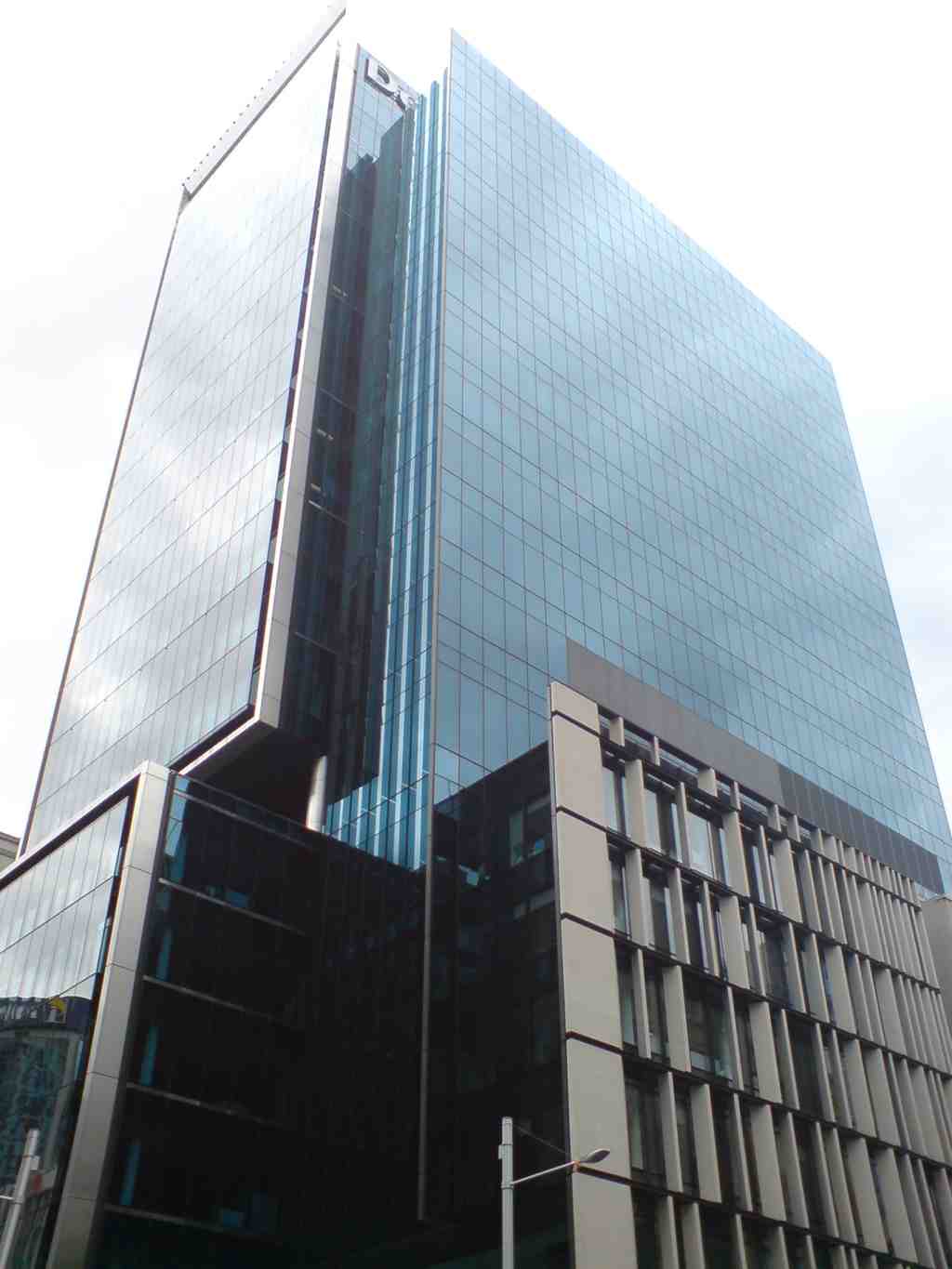
Look for the towering eighteen-story block of reflective blue glass rising out of a contrasting beige stone grid framework at its base.
Welcome to the start of our walk. This is 80 Queen Street, known for years as the Deloitte Centre. Just take a look at where you are standing. It feels solid enough, right? But if you were standing exactly here in the early nineteenth century, you would likely be soaking wet. This "island" site, bordered by Queen and Shortland streets, marks the beginning of the original shoreline. Everything north of this tower was once under the waters of the Waitematā Harbour.
To get a true sense of that deep history, look near the Queen Street entrance for a sleek black steel sculpture. That is Kaitiaki II by the renowned artist Fred Graham. It represents a whatu, or anchor stone, marking the foreshore where the waka-the canoes-of the Ngāti Pāoa people were once beached to trade. It is a quiet, permanent reminder that this bustling financial district is floating on top of waters where Māori navigators once sailed.
Building a skyscraper on top of the ocean floor wasn't exactly easy. Because this is waterlogged reclaimed land, the engineers faced a massive headache. They had to construct a secant pile wall-essentially a watertight underground dam-to hold back the harbour’s water table just so they could dig out the basement. At the time of construction, it was the deepest and most complex foundation build in all of New Zealand.
But the mud wasn't the only thing causing trouble. This site is famous for one of Auckland’s fiercest heritage brawls. Before this glass tower existed, the site held the Jean Batten Building. It was a cherished Art Deco structure that served as the World War Two headquarters for the US Pacific Command.
In the early two thousands, heritage advocates realized the bank that owned the site, the BNZ, had found a loophole. They held a demolition consent from years prior that was still valid. Technically, they could legally bulldoze the historic building. It turned into a desperate standoff between preservationists and the developers. The Mayor eventually had to step in and cajole the bank into a "moratorium."
The result? Well... it was a compromise. They saved the external walls you see on the rear and sides, but they completely gutted the interior. Witnesses described the demolition site inside those saved walls as looking like "Ground Zero" as the Art Deco interiors were stripped away. The new tower was set back five meters from the old facade, connected by what they call a "reconciliation wall."
Here is the kicker. In 2010, the project won a heritage award. Critics called it a bad joke, claiming it rewarded "facadism"-the practice of keeping just the front of a building like a movie set while destroying its soul.
History has a habit of repeating itself here. Back in 1978, the BNZ had already demolished the Victoria Arcade on this same site to build their previous low-rise headquarters. That arcade was a cultural hub for artists, and its destruction was mourned as a "brutal expunging" of the city’s past.
Today, the building is fully occupied by BNZ again, alongside retailers like The North Face and Lacoste on the ground floor. It is high-tech, boasting a five-star green environmental rating, a long way from the muddy shoreline that started it all.
Take a moment to check out the sculpture or the facade details. When you are ready, we will head toward our next destination.




