
Look to your right for the large concrete underpass entrance, marked by intricate carved patterns on the curved walls and modern lighting fixtures embedded in the structure.
You are standing on top of a ghost. Well... a ghost river, to be precise.
Beneath the concrete pavement and the bustle of the city lies the Waihorotiu Stream. It was once the lifeblood of this valley, carving out the gully millions of years ago and flowing all the way down to the harbour. Before the asphalt and the high-rises, this was a place of lush abundance. It was the water source for the village of Ngā Wharau a Tako, which sat on the ridge nearby. The stream’s mouth was a famous food basket, teeming with shellfish and fish.
But abundance can be volatile. Oral history tells us of a "children’s war" that broke out right on the mudflats where the stream met the sea. It started innocently enough. Children from two different settlements went down to spear pātiki-that is, flounder. A squabble over the catch escalated into a full-scale battle between the groups, turning a playground into a site of bloodshed.
As European settlers arrived, the stream’s fate took a darker, grimier turn. As the city expanded, the clear waters of the Waihorotiu were treated as a convenient drain. By the mid-19th century, it was known as the "Ligar Canal," named after the Surveyor General Charles Ligar, who tried to tame the stream with sound walls. It didn’t work.
The "canal" became an open sewer, famously described by locals as a "pestiferous ditch." It was a receptacle for every imaginable filth. By 1911, the situation was the stuff of nightmares. A City Council inspector found that hotel kitchen staff were working knee-deep in sewage when the drains backed up. In one particularly stomach-churning incident, a inspector discovered a Queen Street baker’s shop where sewage was dripping from leaking pipes directly onto the tables where dough was being prepared. It gives a whole new meaning to "local flavor," doesn't it?
Charles Ligar, the man whose name became synonymous with this incompetence and stench, eventually retired to a ranch in Texas. He got the wide-open spaces; Auckland got the smell.
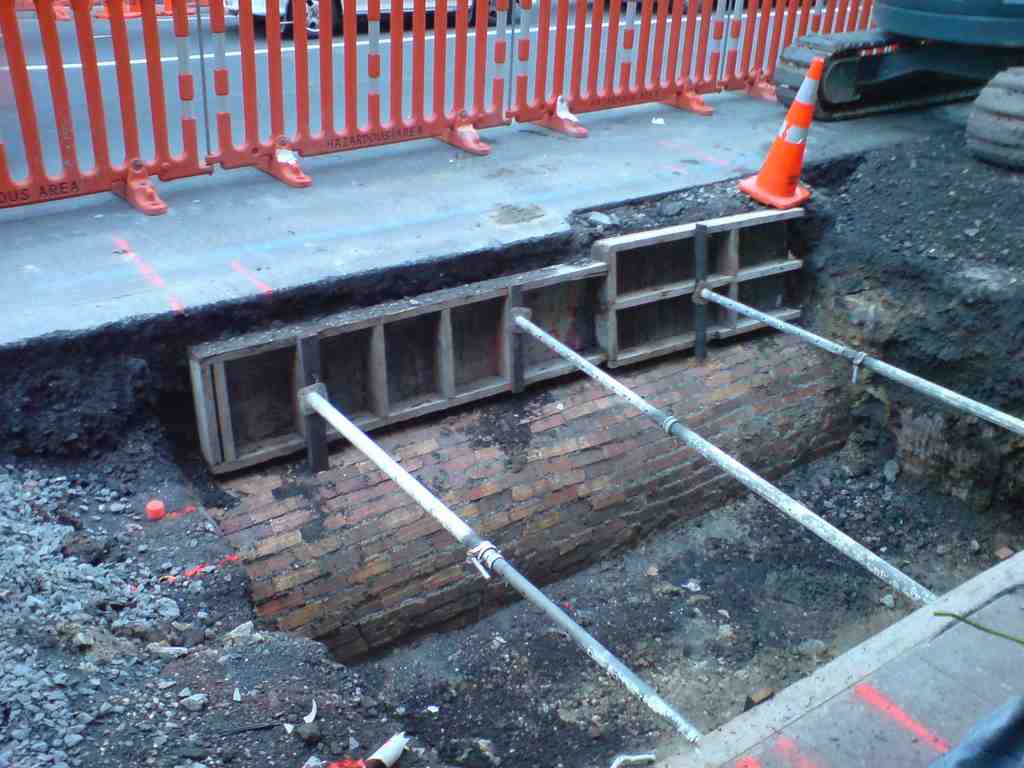
Eventually, the stream was bricked over and buried, but it never really left. In Māori mythology, this stream is the home of Horotiu, a taniwha. A taniwha is a powerful local nature spirit or guardian, often depicted as a dragon or serpent-like creature in the water. For decades, city planners ignored Horotiu, assuming that burying the stream buried the spirit too.
That changed in 2011 during the planning for the City Rail Link. Glen Wilcox, a representative for the local Māori people, challenged the council by asking, "What's being done about the taniwha Horotiu who lives just outside here?" He warned that the new train tunnels would cut directly through the taniwha’s rohe-his spiritual domain or territory. One councillor accused him of dropping a "T-bomb" to stall the project, but it forced a serious conversation. It proved that even under layers of concrete, the mana whenua-the indigenous people with authority over this land-and their guardians were still very much part of the city’s fabric.
Today, the stream has a new voice through the artwork you see here, called Waimahara. Created by artist Graham Tipene, it uses sensors to listen for specific songs. If you sing the correct melody, the artwork responds with light and sound, allowing you to literally sing to the river that still flows beneath your feet.
Take a moment to imagine the water rushing silently beneath the pavement




