
Prague Audio Tour: Charles Bridge Statues
Beneath the shimmering surface of Prague lies a labyrinth of ghosts, where every cobblestone whispers of failed rebellions and forgotten scandals. Unlock these secrets with a self-guided audio tour designed to bypass the tourist crowds and pull you into the city’s raw, unfiltered history. Did the library’s ancient archives truly hide a pact with the devil? Why does the shadow of a saint on the Charles Bridge seem to shift when you look away? Can you find the exact spot where a single, whispered word once sparked a royal downfall? Follow the path of hidden power, moving from the silent vaults of the National Library to the haunting theatrics of Laterna Magika. Feel the weight of centuries beneath your feet as you trade common sightseeing for a visceral hunt through time. Ready to unmask the city. Press play to start your descent into the dark.
Tour preview
About this tour
- scheduleDuration 60–80 minsGo at your own pace
- straighten1.4 km walking routeFollow the guided path
- location_on
- wifi_offWorks offlineDownload once, use anywhere
- all_inclusiveLifetime accessReplay anytime, forever
- location_onStarts at National Library of the Czech Republic
Stops on this tour
lock_open 3 free previews · 10 unlock with purchase
To understand how this massive structure came to be, we have to look back to the Jesuits, a powerful Catholic order heavily focused on education and intellectual rigor. When they…Read moreShow less
Open dedicated page →Welcome. Standing before you is the National Library of the Czech Republic, housed within the immense historical complex known as the Klementinum.
To understand how this massive structure came to be, we have to look back to the Jesuits, a powerful Catholic order heavily focused on education and intellectual rigor. When they expanded into Prague, they possessed a fierce drive for artistic legacy. They used monumental architecture to physically assert their dominance over the city, building the Klementinum to be the third-largest Jesuit college in the entire world. This was not just a religious center. It was a true fortress of science and art, where astronomers watched the stars and meteorologists recorded data that continues to this very day.
Naturally, this intellectual powerhouse became deeply entwined with Charles University. Charles University, founded in the fourteenth century, originally had its libraries scattered across different colleges around the city. But in sixteen twenty-two, the university was placed under Jesuit control, and its vast libraries were moved right here into the Klementinum. This massive centralization of books created an incredible hub of knowledge. If you glance at your screen, you can see the breathtaking Baroque Library Hall hidden inside, a soaring space lined with ancient globes and dramatic frescoes. You can also see the old Summer Refectory, a beautifully vaulted hall that now serves as the General Reading Room.
But preserving knowledge is rarely easy. Over the centuries, this library has faced a relentless battle to protect its treasures from destruction. During the Nazi occupation, brave librarians secretly smuggled the most valuable manuscripts out of the city, hiding them behind the thick stone walls of a rural castle to survive the war.
Then, in the catastrophic floods of two thousand and two, the nearby river swelled directly into the library basements. As electrical transformers threatened to explode, conservators desperately hauled rare prints up the stairs. Thousands of soaked books were saved through an agonizingly slow process where each individual book had to be carefully wrapped in absorbent paper to pull the moisture out without warping the ancient spines.
And the threats are not just environmental. In twenty twenty-four, the library realized it was the victim of an international heist. An organized gang of thieves registered as researchers and requested rare first editions by Russian authors, like Gogol and Pushkin. While sitting quietly in the reading rooms, they secretly swapped the priceless originals with high-tech, digital counterfeits. The fakes were so perfectly crafted that they sat completely unnoticed on the shelves for months. Who knew library science could feel like an international spy thriller? It just goes to show that protecting human memory is an ongoing, high-stakes battle.
The library is open Monday through Saturday from nine A-M to seven P-M, if you want to take a look inside. For now, we are heading to the Křižovnické Square, just a three minute walk away, to see a somewhat controversial statue of Charles the Fourth.
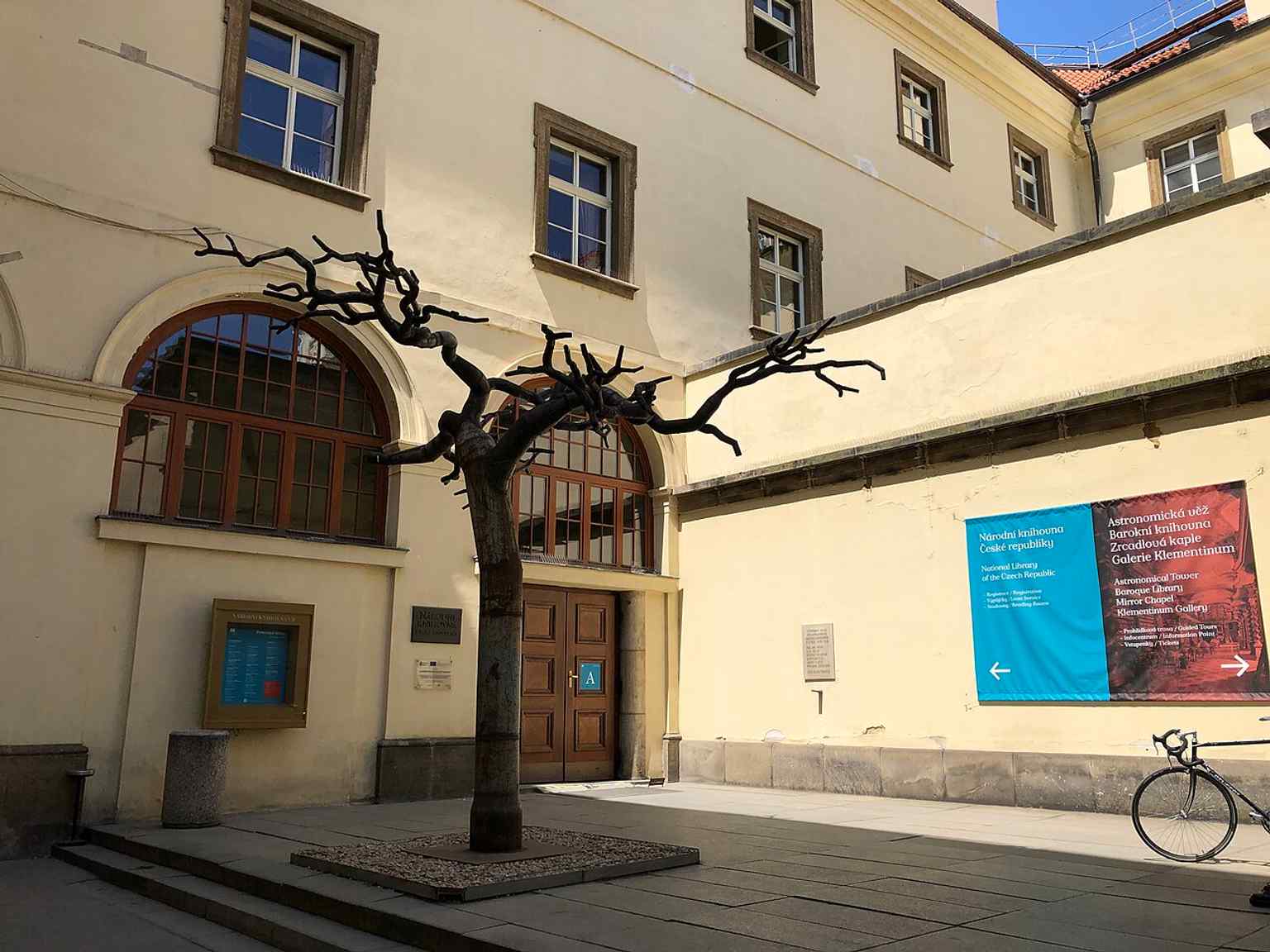
The main entrance welcomes visitors to the National Library of the Czech Republic, the largest and central library in the Czech Republic, housed in the historic Klementinum.Photo: Petra Stastna, Wikimedia Commons, CC BY-SA 4.0. Cropped & resized. 
This is the Central Depository in Hostivař, a crucial facility addressing the library's critical storage needs with ongoing expansion.Photo: Petra Stastna, Wikimedia Commons, CC BY-SA 4.0. Cropped & resized. 
Inside the Central Depository in Hostivař, countless volumes are stored, including the National Conservation Fund, as the library addresses its critical need for space.Photo: Skot, Wikimedia Commons, CC BY-SA 4.0. Cropped & resized. Look to your right for the towering bronze figure of a crowned emperor, standing atop an intricately carved Neo-Gothic pedestal, a nineteenth-century revival of medieval…Read moreShow less
Open dedicated page →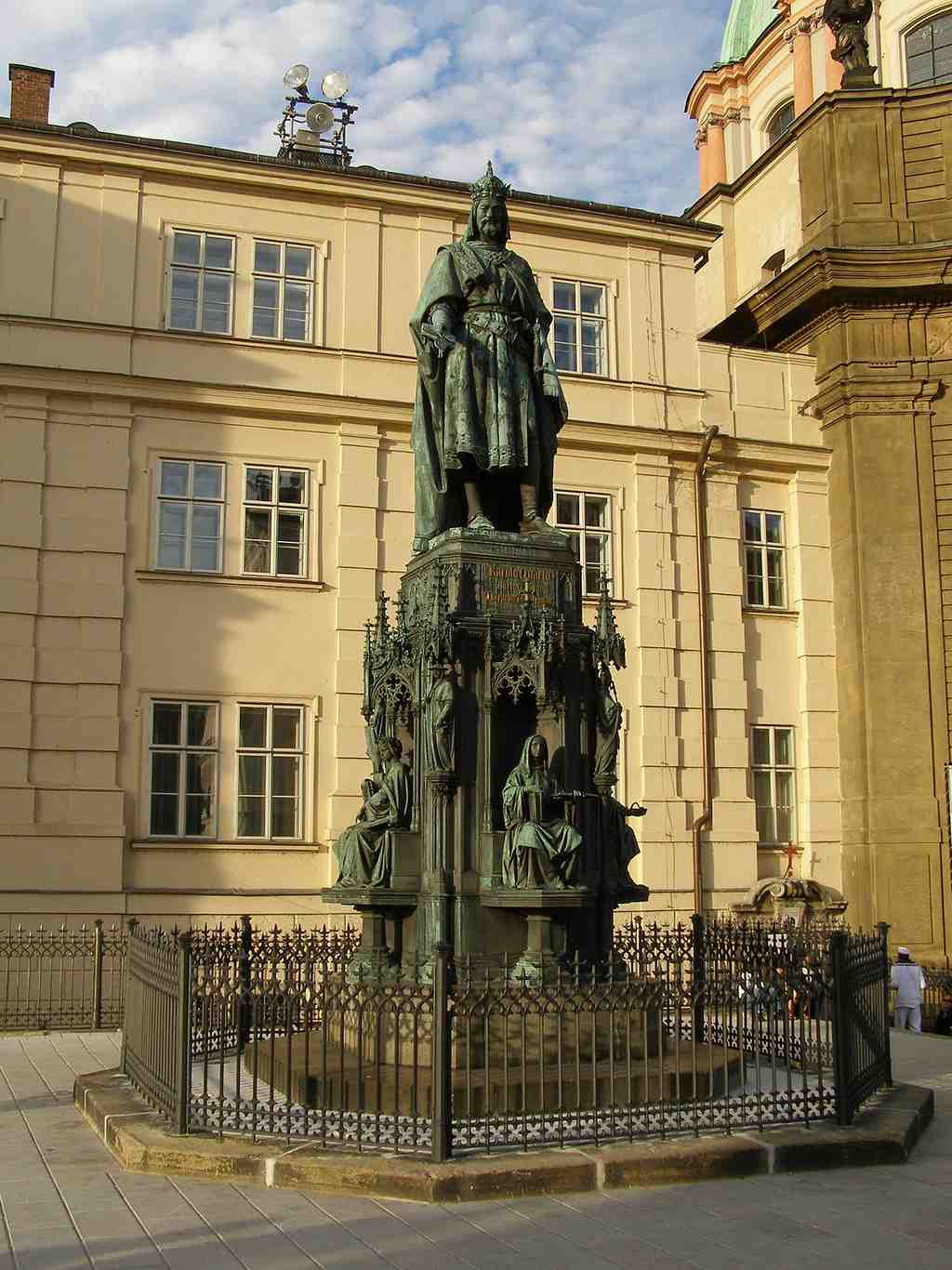
Statue von Charles IV, Křižovnické SquarePhoto: Michal Kmínek, Wikimedia Commons, CC BY-SA 3.0. Cropped & resized. Look to your right for the towering bronze figure of a crowned emperor, standing atop an intricately carved Neo-Gothic pedestal, a nineteenth-century revival of medieval architecture, surrounded by a wrought-iron fence.
This monument was meant to be the centerpiece for the five hundredth anniversary of Charles University in eighteen forty-eight. But the grand unveiling was abruptly canceled when the eighteen forty-eight revolution erupted, turning this square into a theater of violent street fighting.
The drama actually began earlier, fueled by a fierce debate over Czech national identity. Locals demanded a Bohemian sculptor to honor the Father of the Fatherland. Instead, the committee awarded the job to a German artist, sparking outrage that the project was outsourced. He ultimately crafted a pedestal acting as a visual curriculum of the university, with figures representing Theology, Law, Medicine, and Philosophy.
This square has constantly oscillated between destruction and rebirth. Beyond monumental celebrations, it has seen profound tragedy. In nineteen forty-five, the square was scarred by further conflict during the Prague Uprising. Tap your screen to see how more than one hundred and fifty years of history unfold around the steadfast bronze figure of Emperor Charles the Fourth, standing proudly as generations of travelers pass by his namesake bridge.
For a lighter perspective, check the app for a specific right-side angle of the statue. The Emperor’s sword and robes align to create a rather unfortunate silhouette... a local secret that perfectly undercuts the serious tone.
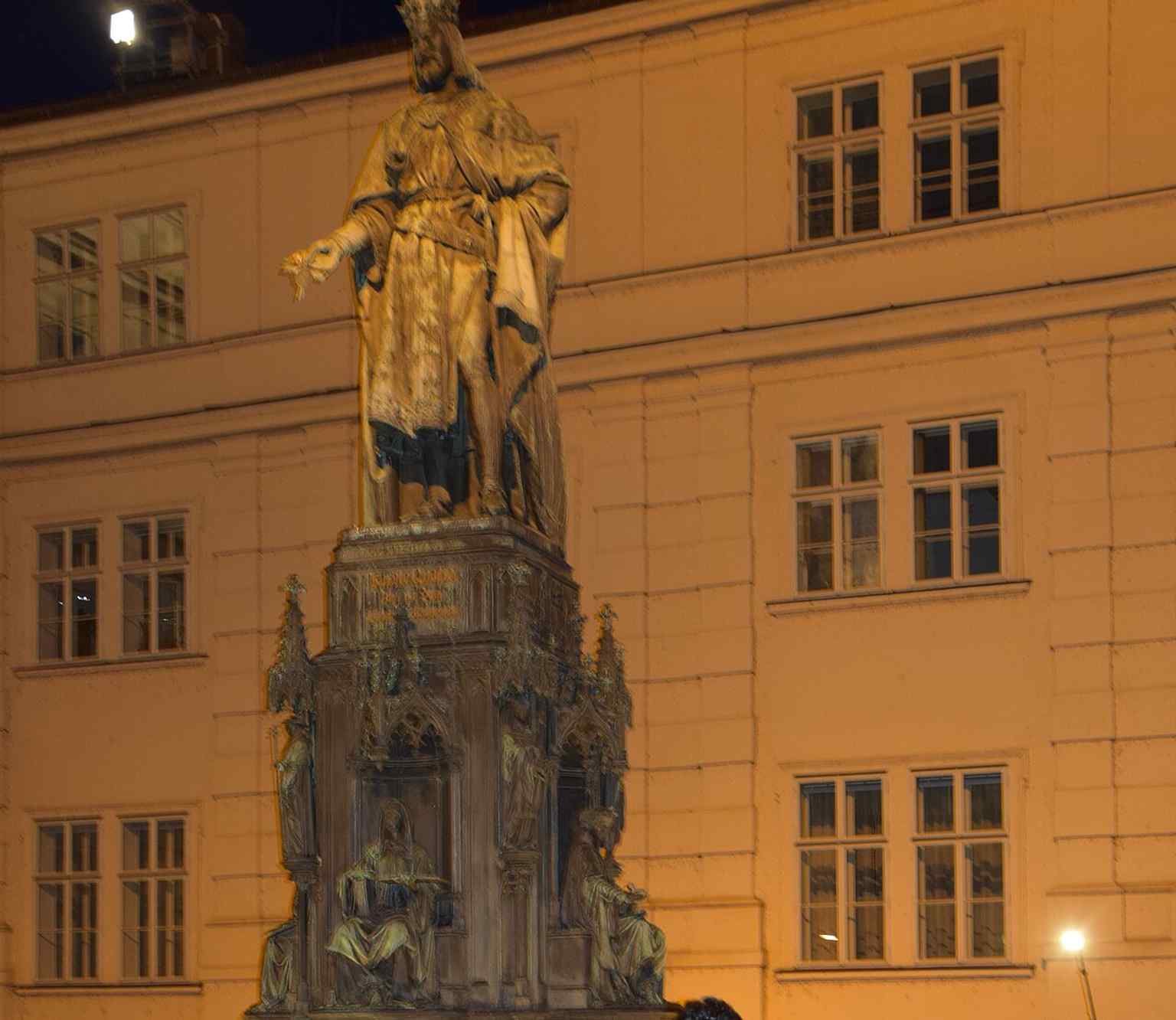
From this specific right-side angle, a curious alignment of the Emperor's sword and coronation robes creates a quirky, unintentional silhouette, a local secret shared by tour guides.Photo: Ank Kumar, Wikimedia Commons, CC BY-SA 4.0. Cropped & resized. The square is open twenty-four hours a day, so Charles is always watching. Let us move onto the Charles Bridge to meet the first saint, just a one-minute walk away at the statue of Ivo of Kermartin.
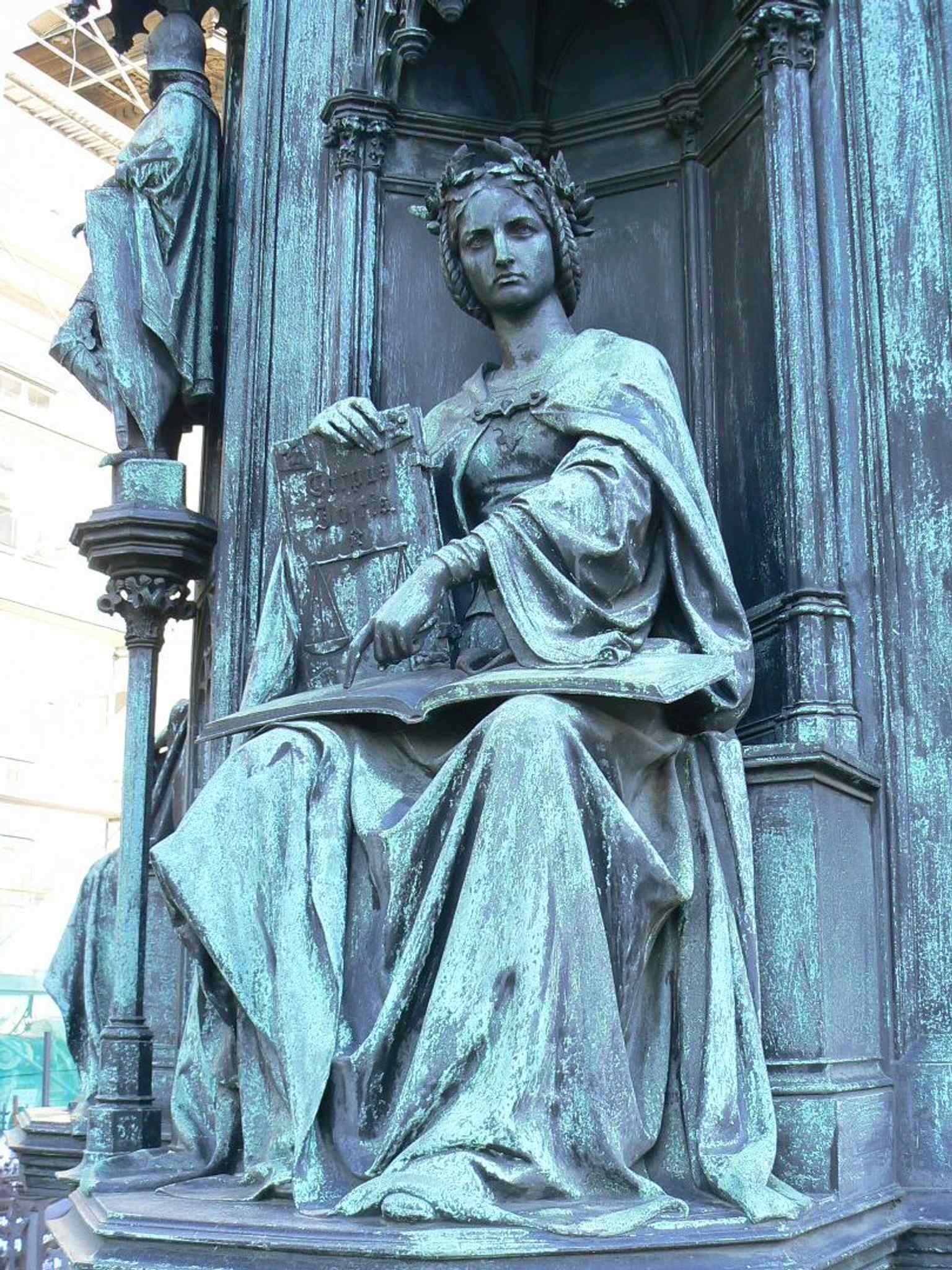
This allegorical figure for the Faculty of Law reminds us of the 'visual curriculum' on the pedestal, celebrating the medieval university founded by Charles IV.Photo: Joker Island, Wikimedia Commons, Public domain. Cropped & resized. 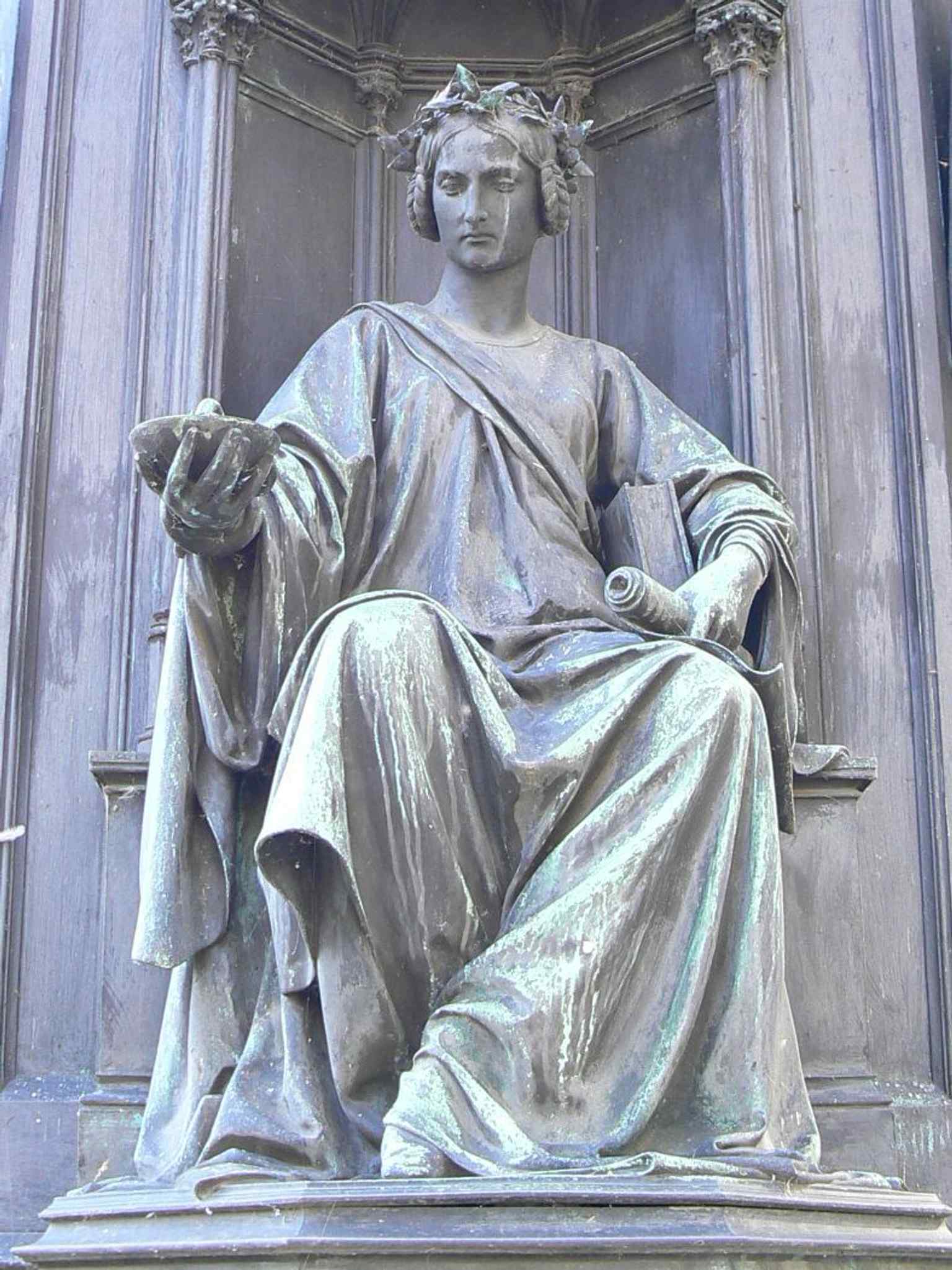
The Faculty of Medicine is honored by this figure on the pedestal, part of the statue's tribute to Charles IV's role in establishing the university.Photo: Joker Island, Wikimedia Commons, Public domain. Cropped & resized. 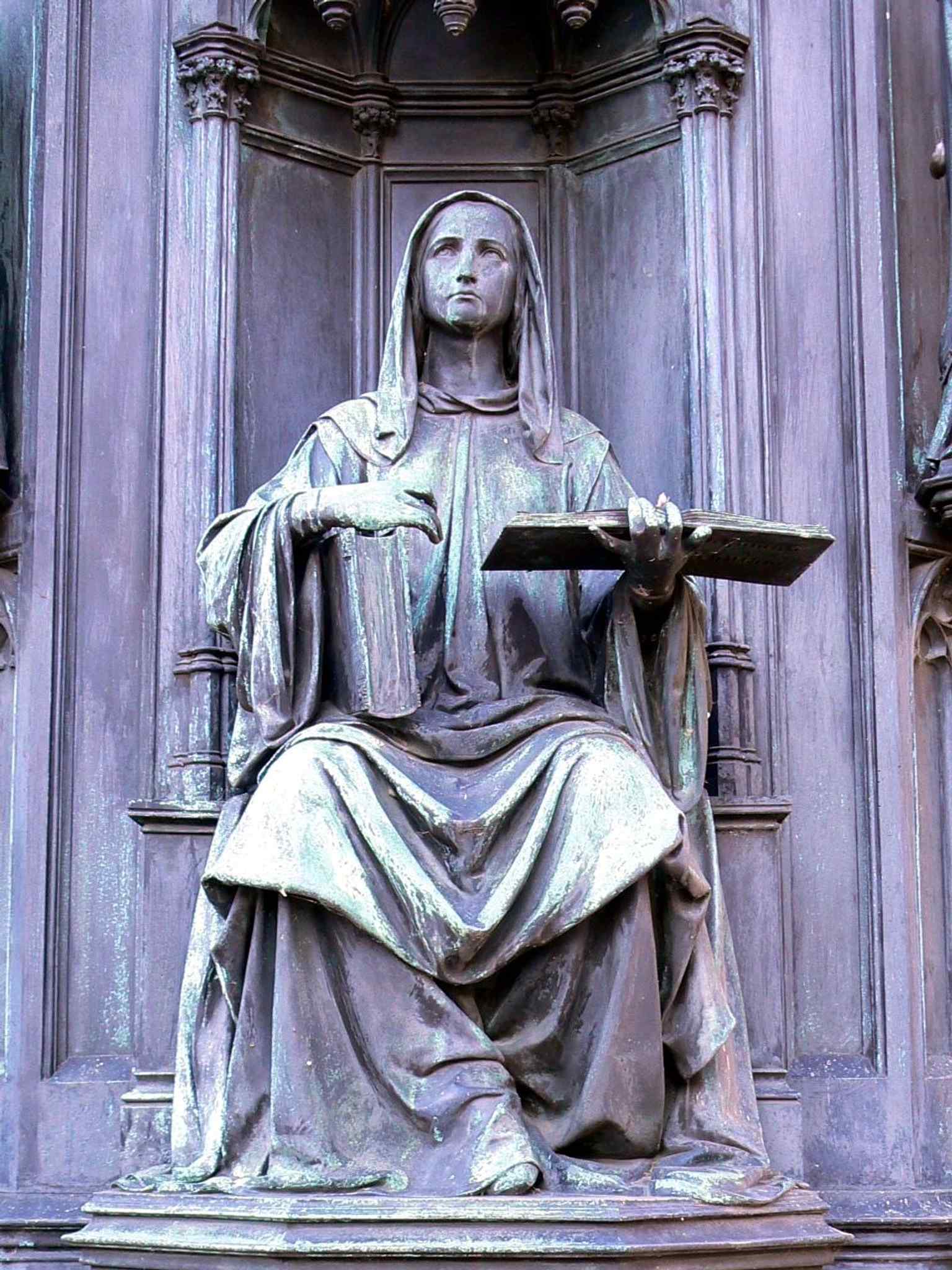
Representing the Faculty of Theology, this allegorical figure is one of the four seated statues adorning the statue's pedestal.Photo: Joker Island, Wikimedia Commons, Public domain. Cropped & resized. 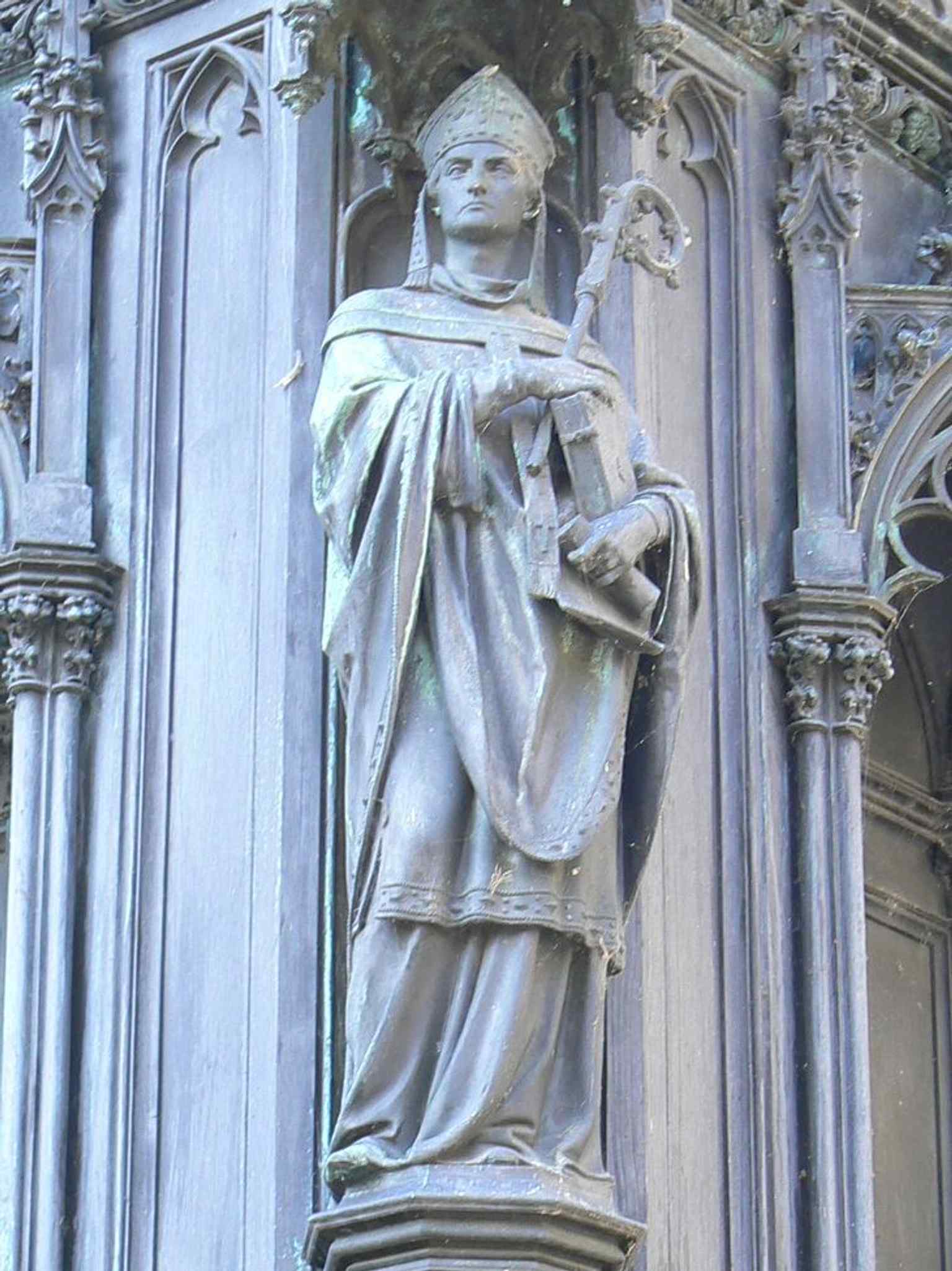
Arnošt of Pardubice, the first Archbishop of Prague, is depicted as one of Charles IV's closest advisors at the corners of the statue's base.Photo: Joker Island, Wikimedia Commons, Public domain. Cropped & resized. 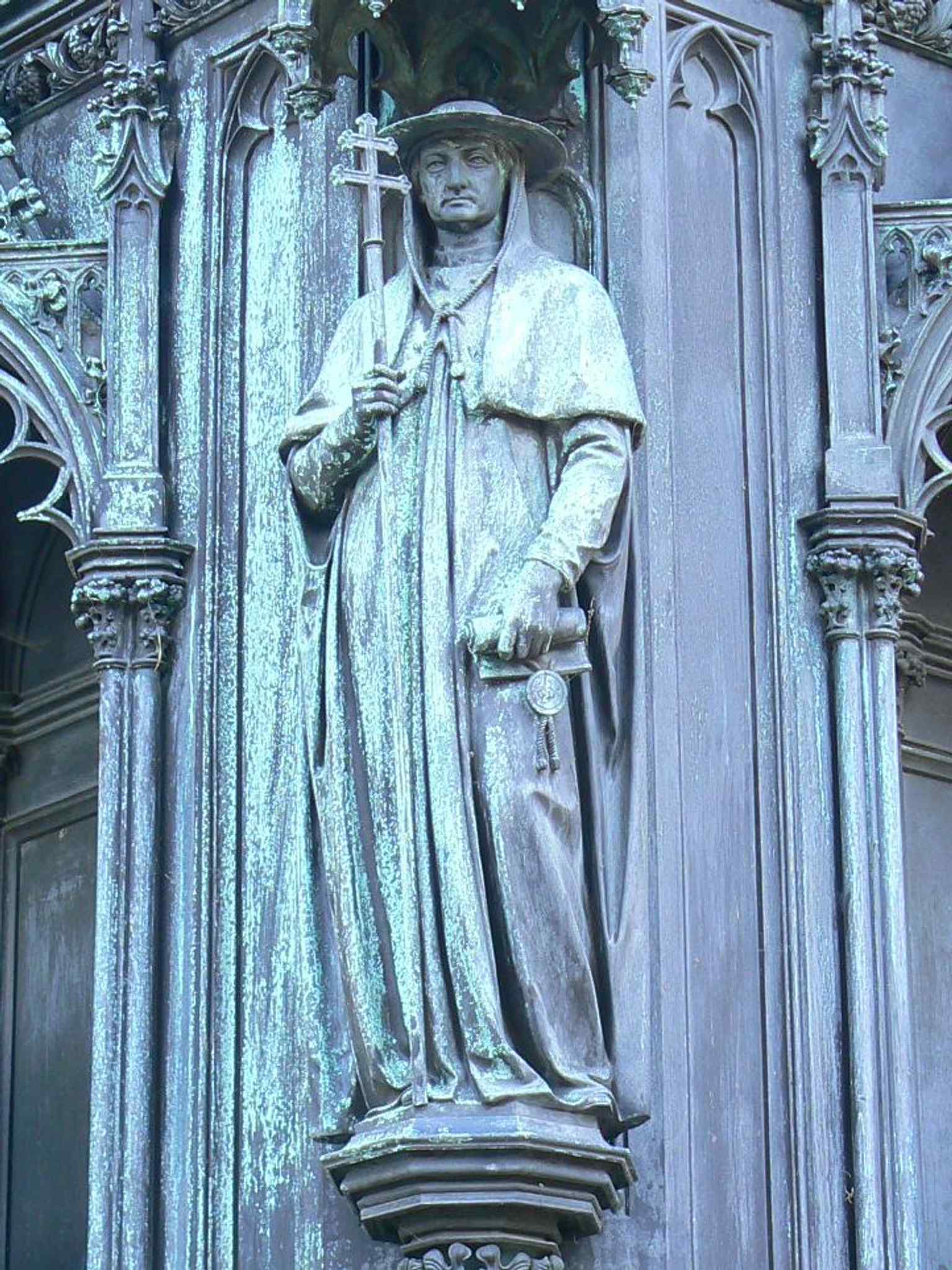
Jan Očko of Vlašim, Arnošt's successor and the first Czech cardinal, stands as another key contemporary on the pedestal.Photo: Joker Island, Wikimedia Commons, Public domain. Cropped & resized. 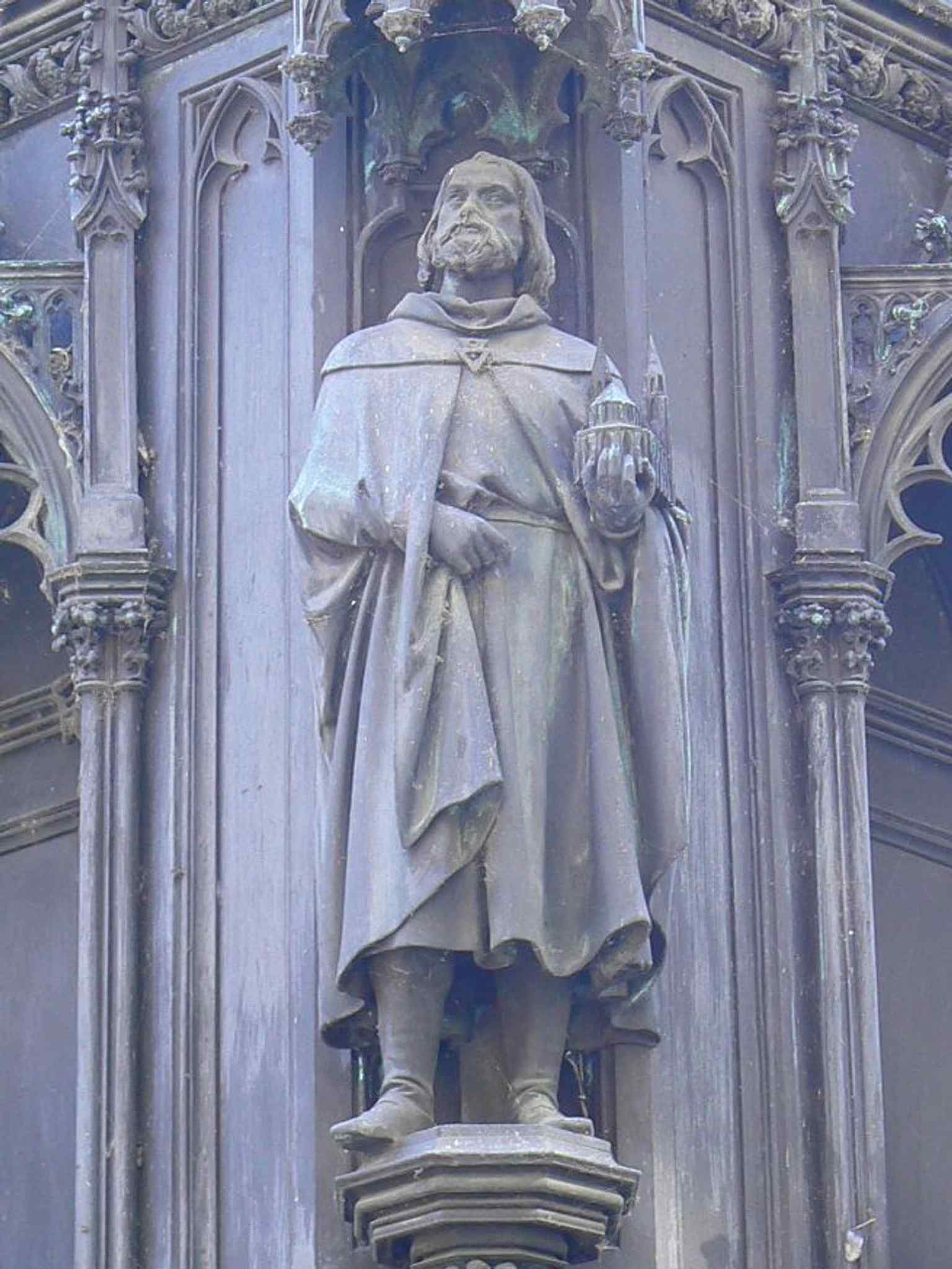
This statue, traditionally identified as architect Matthias of Arras, is debated by historians, who sometimes suggest it might be his successor, Peter Parler.Photo: Joker Island, Wikimedia Commons, Public domain. Cropped & resized. 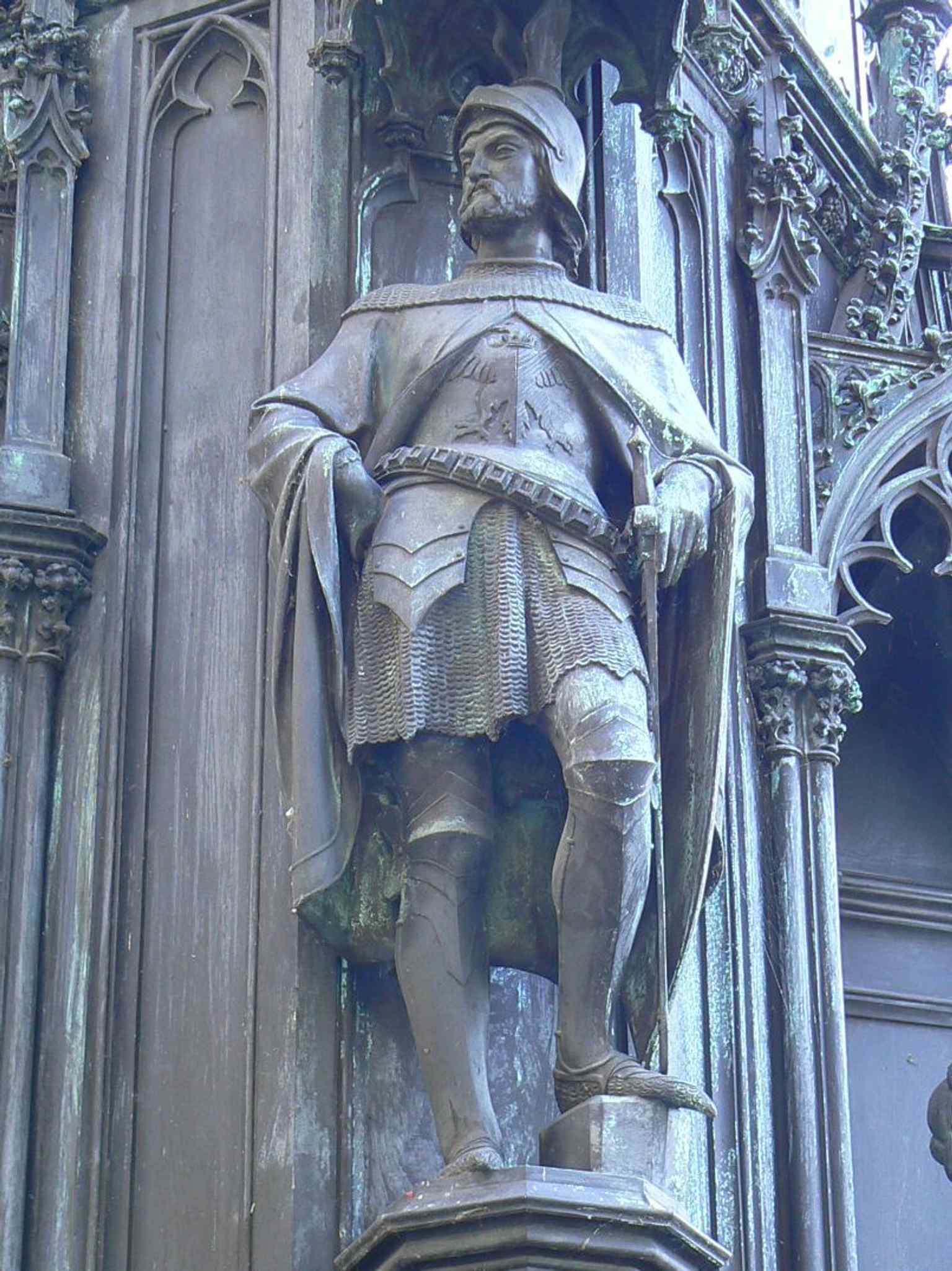
One of the standing figures on the pedestal, possibly chronicler Beneš of Weitmühle or another of Emperor Charles IV's advisors.Photo: Joker Island, Wikimedia Commons, Public domain. Cropped & resized. You are looking at a dark, weathered sandstone monument featuring a central figure in flowing robes atop a thick cylindrical pedestal, surrounded by a group of smaller, expressive…Read moreShow less
Open dedicated page →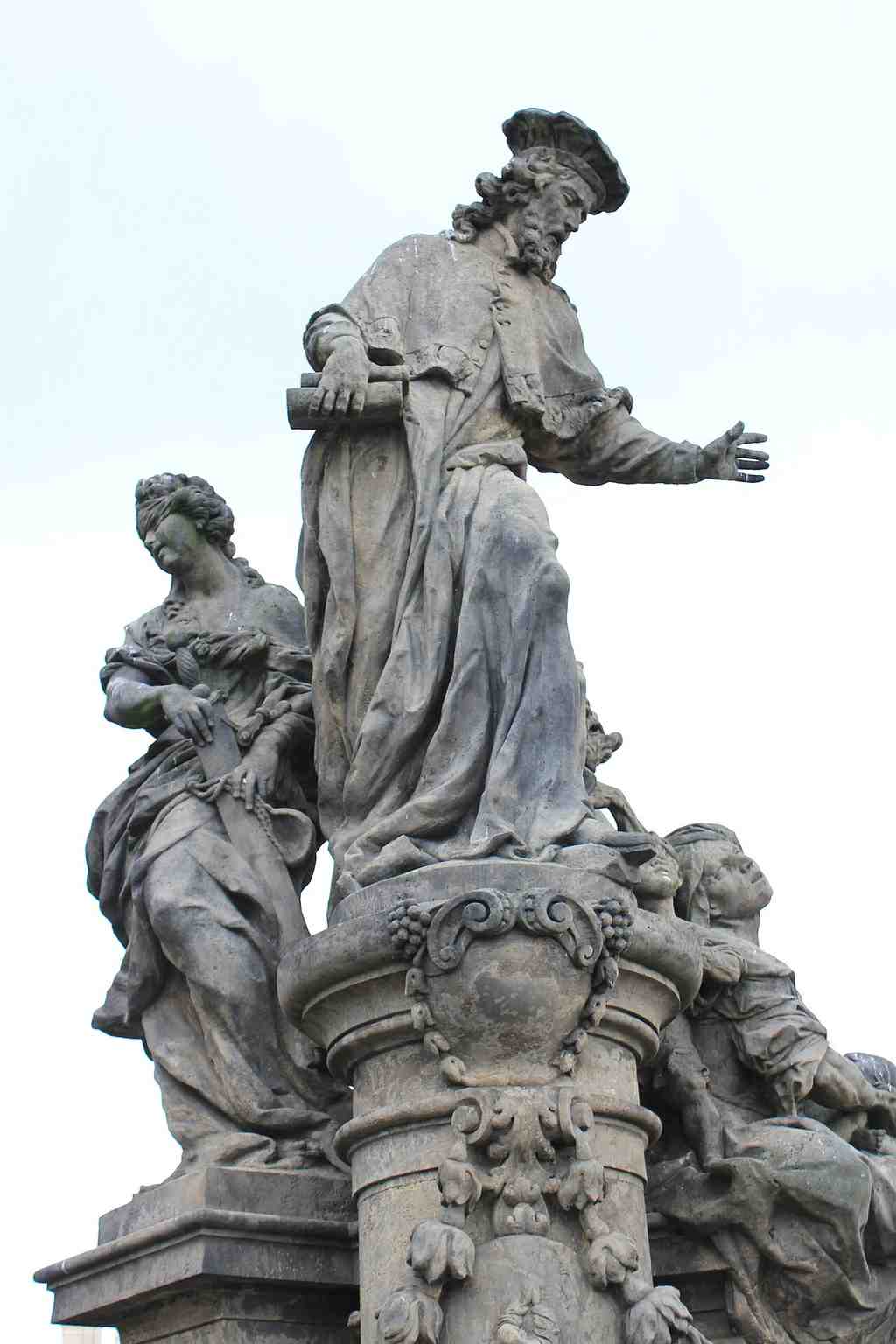
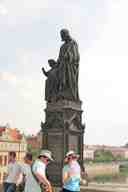
Statue des Ivo von Kermartin, Charles BridgePhoto: Øyvind Holmstad, Wikimedia Commons, CC BY-SA 3.0. Cropped & resized. You are looking at a dark, weathered sandstone monument featuring a central figure in flowing robes atop a thick cylindrical pedestal, surrounded by a group of smaller, expressive figures at his feet. This is Saint Ivo of Kermartin, the patron saint of lawyers, commissioned in seventeen eleven by the Faculty of Law at Charles University.
To create this grand display, they hired a young newcomer from Salzburg named Matthias Braun. The university paid twelve hundred guilders for the work. That was a massive sum equal to about two years of wages for a skilled laborer at the time, or roughly one hundred thousand dollars today. No pressure for the new guy, right? But Braun delivered. This piece sparked what locals called Braun mania, allowing him to open the largest sculpture workshop in Prague.
Take a close look behind Saint Ivo. Can you spot the blindfolded figure of Justice holding her sword and scales? It is a brilliant piece of staging. Ivo was a thirteenth-century Breton priest who became a judge in an ecclesiastical court, which was a special legal tribunal run by the church. Braun dressed him in a contemporary judge's robe and cap. But notice his posture. Ivo is physically turning his back on the rigid symbol of blind Justice, leaning down instead to minister to the weeping widow, a child, and an old man below. He prioritizes compassion over strict legality.
You can clearly see this dynamic composition if you check the third photo in your app. Ivo was famous for his clever mercy. Once, two extortionists left money with a widow, stating it could only be returned if both men were present. Later, one man tricked her into handing it over alone. The second man then sued her for the missing funds. Ivo simply ruled that the second man would not get a single penny until his missing partner appeared in court alongside him, instantly exposing their fraud.
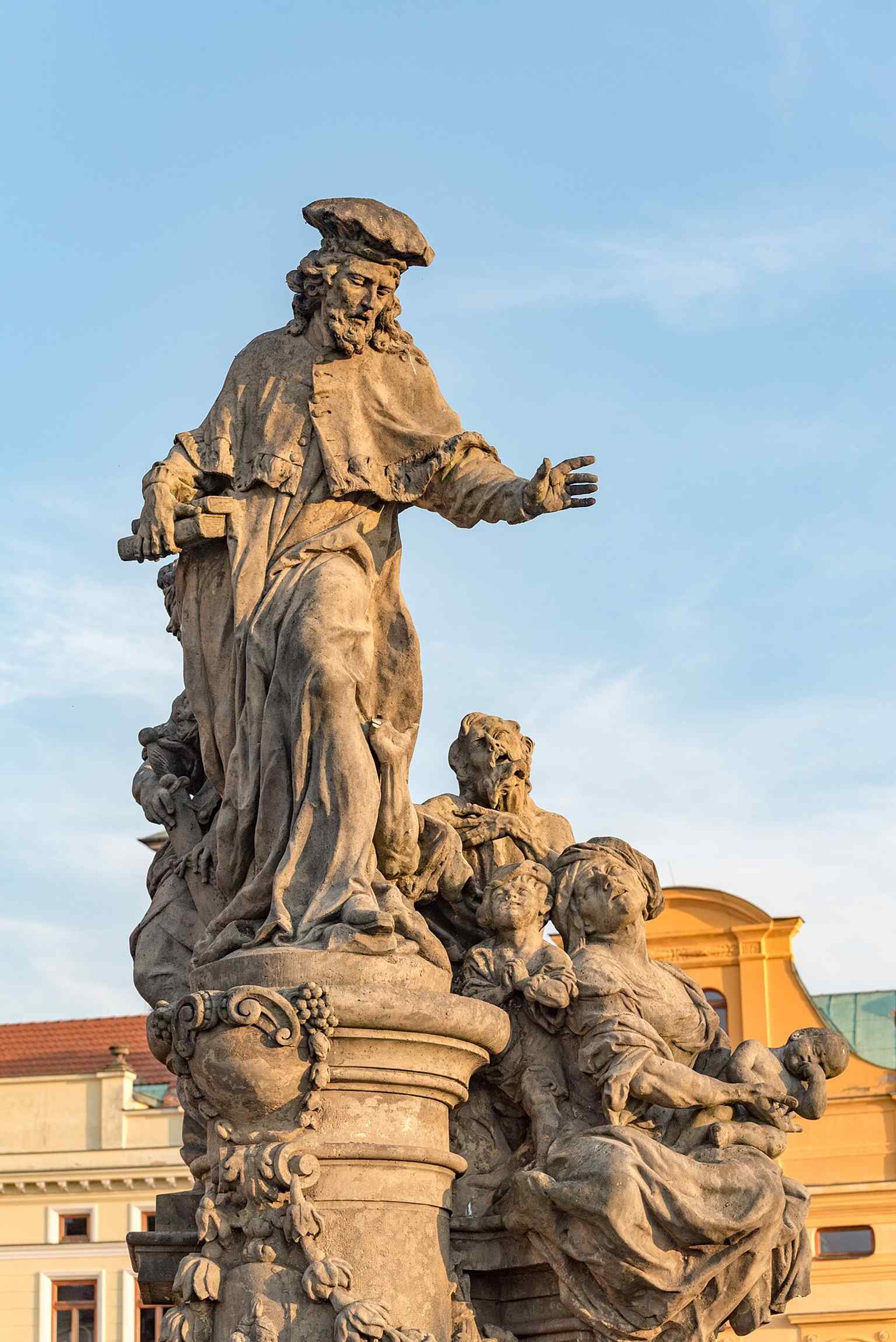
Matthias Braun's dynamic composition shows Saint Ivo turning from the rigid figure of Justice towards the suffering, reminding lawyers of their duty to show mercy.Photo: Tilman2007, Wikimedia Commons, CC BY-SA 4.0. Cropped & resized. But creating masterpieces takes a toll. As Braun grew older, he contracted tuberculosis. The grueling physical labor of carving heavy stone became impossible for him. Yet, he refused to stop creating. He transitioned into a designer, making small clay models for his assistants to carve, stepping in only at the very end to chisel the delicate, expressive details of the faces and hands.
The sandstone itself eventually needed a similar kind of protection. The weathering effects of the river wore down the original stone over the centuries. In nineteen oh eight, the masterpiece was moved safely indoors to a museum, and replaced here by a faithful copy. It ensures that the legacy of a brilliant sculptor, and a remarkably compassionate judge, remains standing right where it belongs.
Let us keep walking to the next statue group by a different master, as we step over to the Statuen von Madonna und Saint Bernard, Charles Bridge.
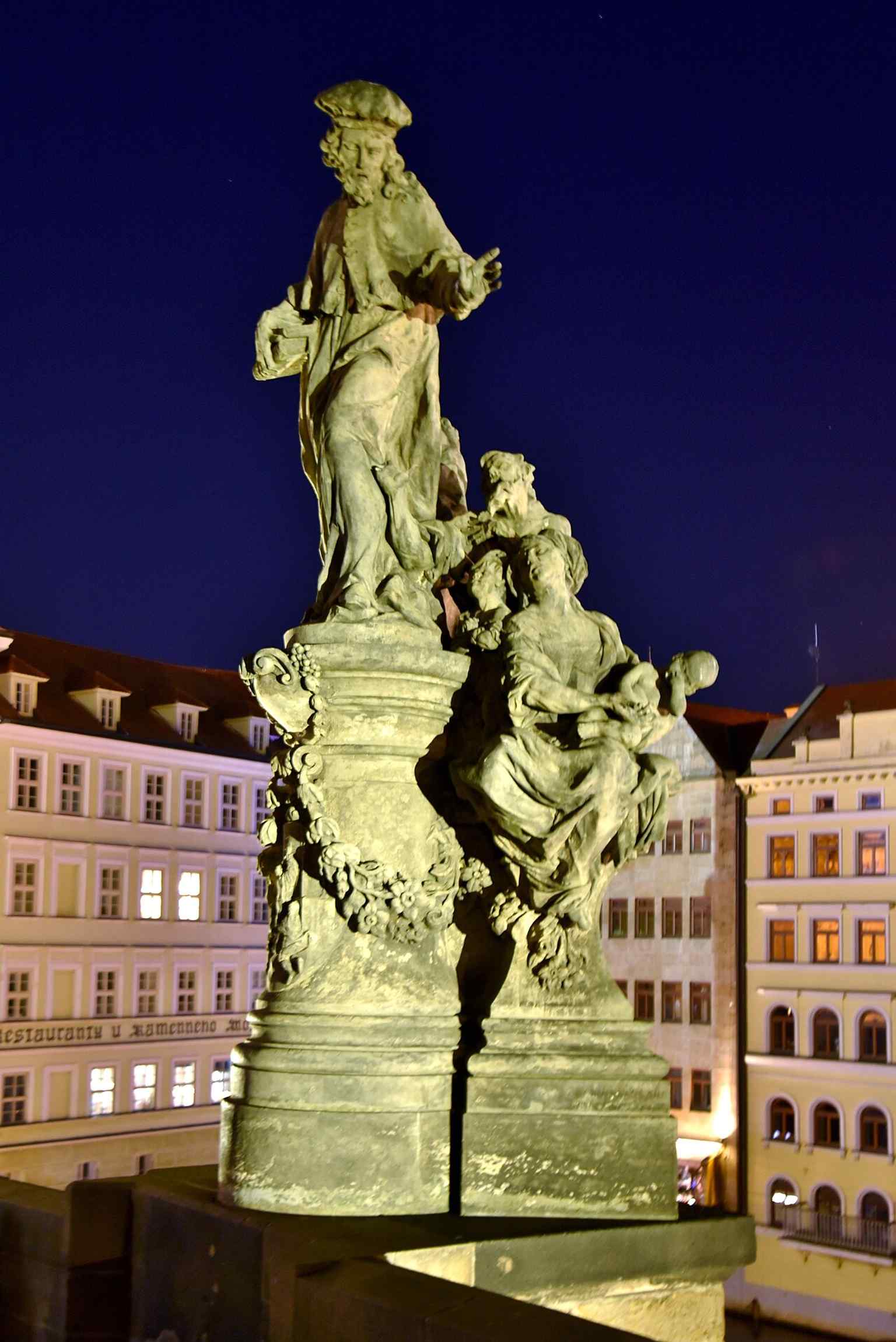
The Statue of Ivo of Kermartin on the Charles Bridge, a grand display commissioned in 1711 by Charles University's Faculty of Law to honor their patron saint.Photo: Bahnfrend, Wikimedia Commons, CC BY-SA 4.0. Cropped & resized. 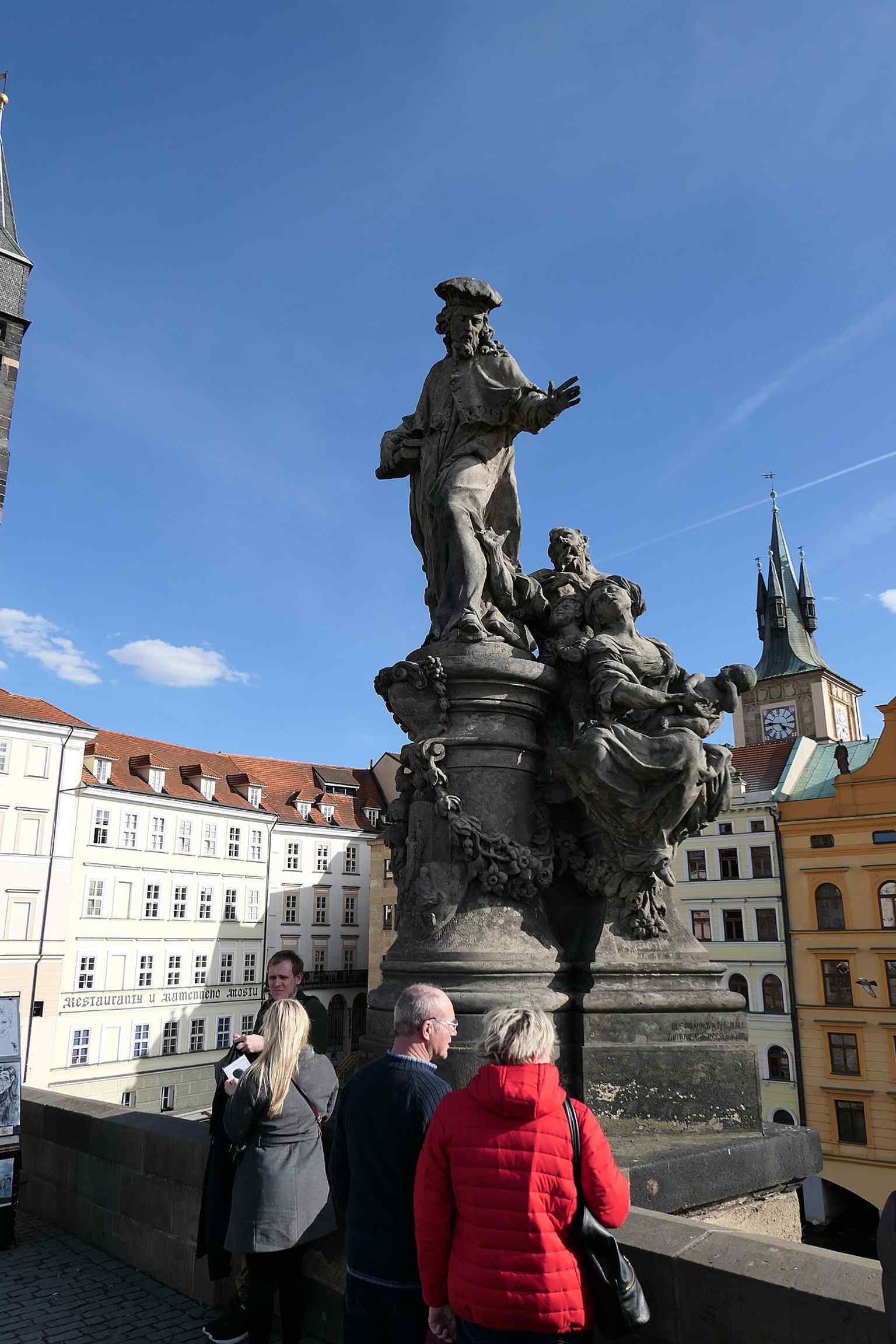
The Statue of Saint Ivo stands as one of the many Baroque sculptures adorning Charles Bridge, a traditional spot where law students once prayed for luck before exams.Photo: MartinThoma, Wikimedia Commons, CC0. Cropped & resized. 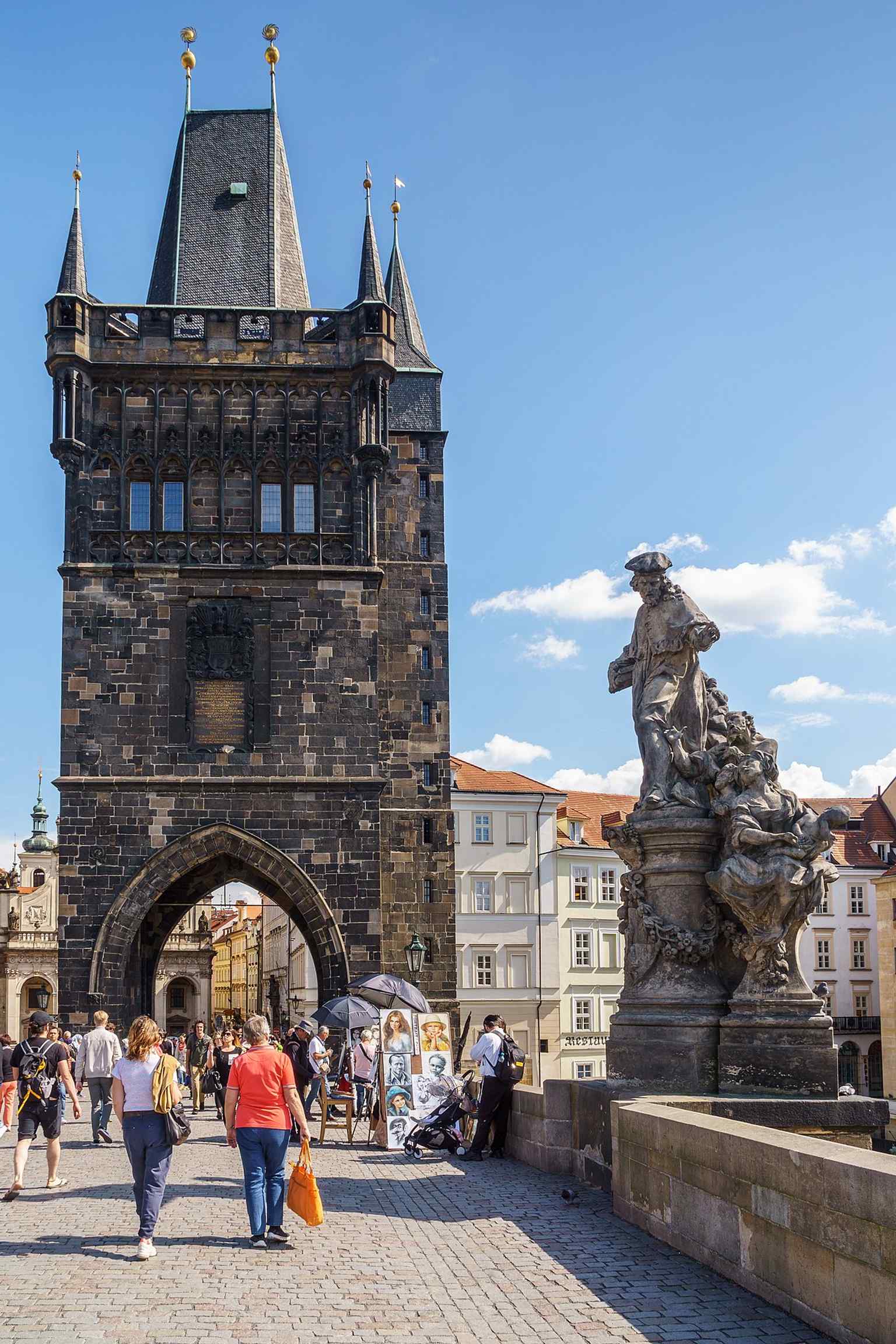
The Statue of Saint Ivo, seen here with the Old Town Bridge Tower, marks the Old Town end of Charles Bridge where it was originally commissioned.Photo: Radler59 (talk), Wikimedia Commons, CC BY-SA 4.0. Cropped & resized. 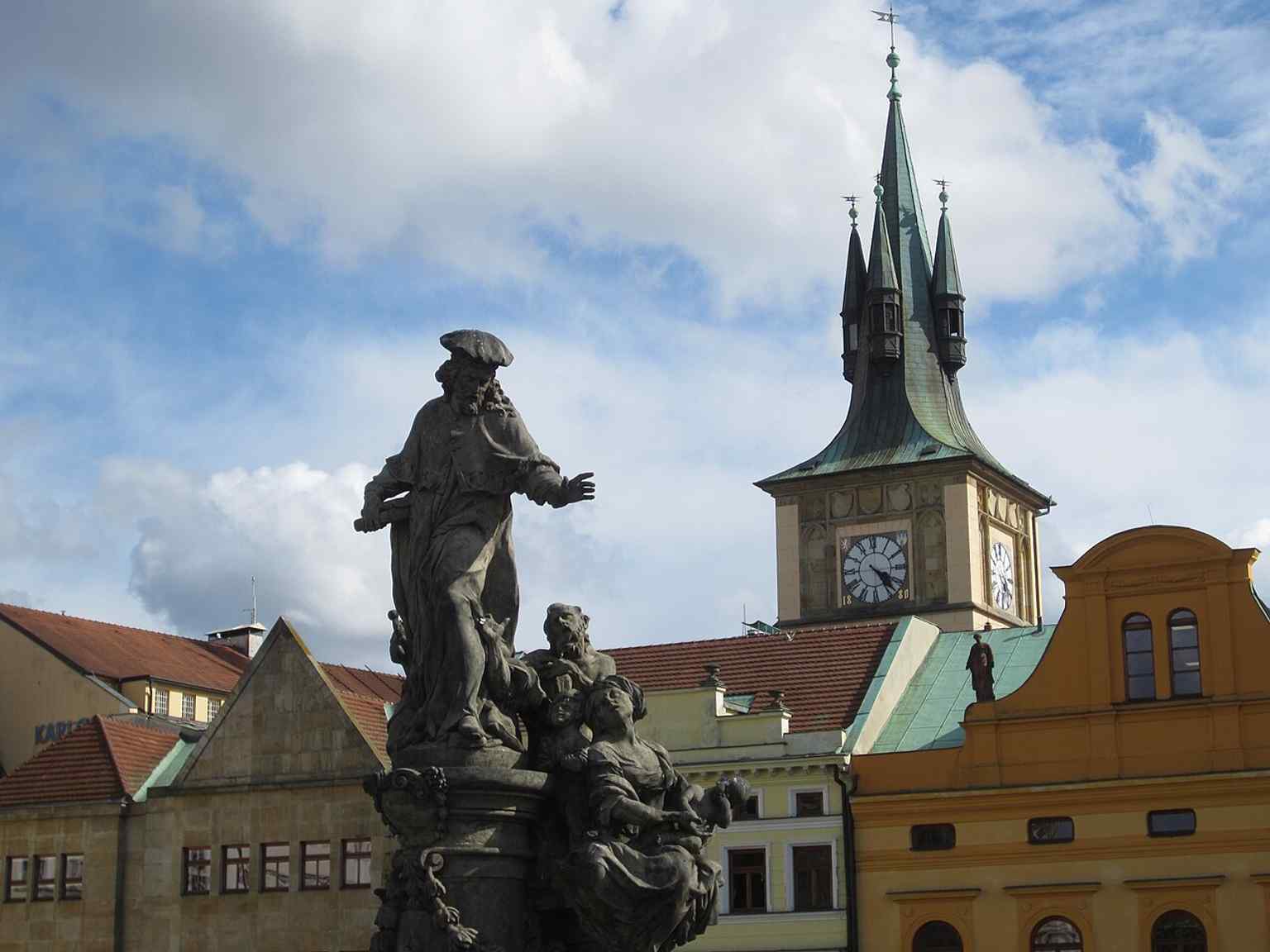
Crowds gather around the statues on Charles Bridge, reminiscent of the centuries-old tradition where Charles University law students would offer prayers to Saint Ivo before their examinations.Photo: Another Believer, Wikimedia Commons, CC BY-SA 4.0. Cropped & resized. 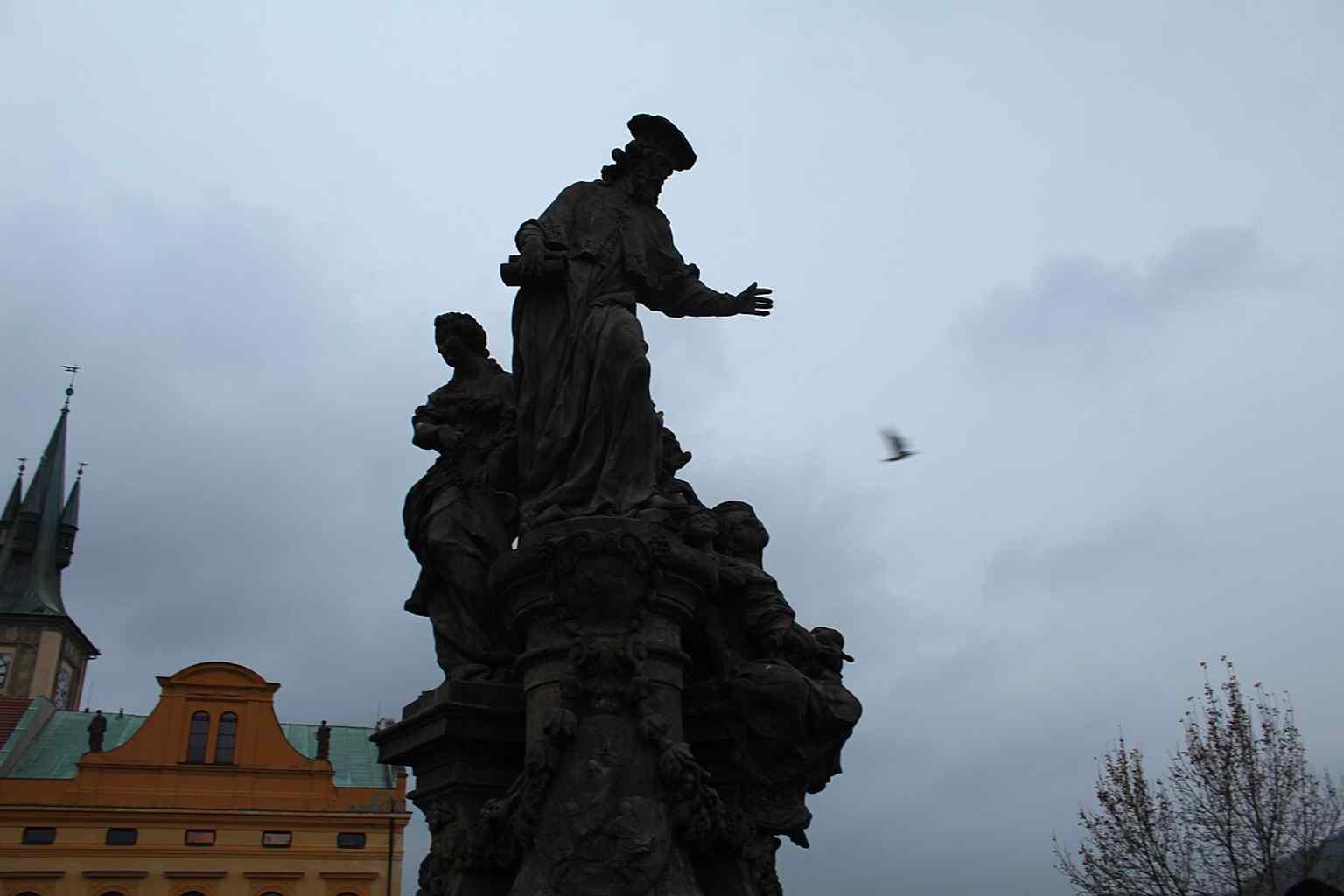
The intricate Baroque style of the Saint Ivo sculpture showcases Matthias Braun’s mastery, a pivotal work that led him to establish Prague's largest sculpture workshop.Photo: Chabe01, Wikimedia Commons, CC BY-SA 4.0. Cropped & resized. 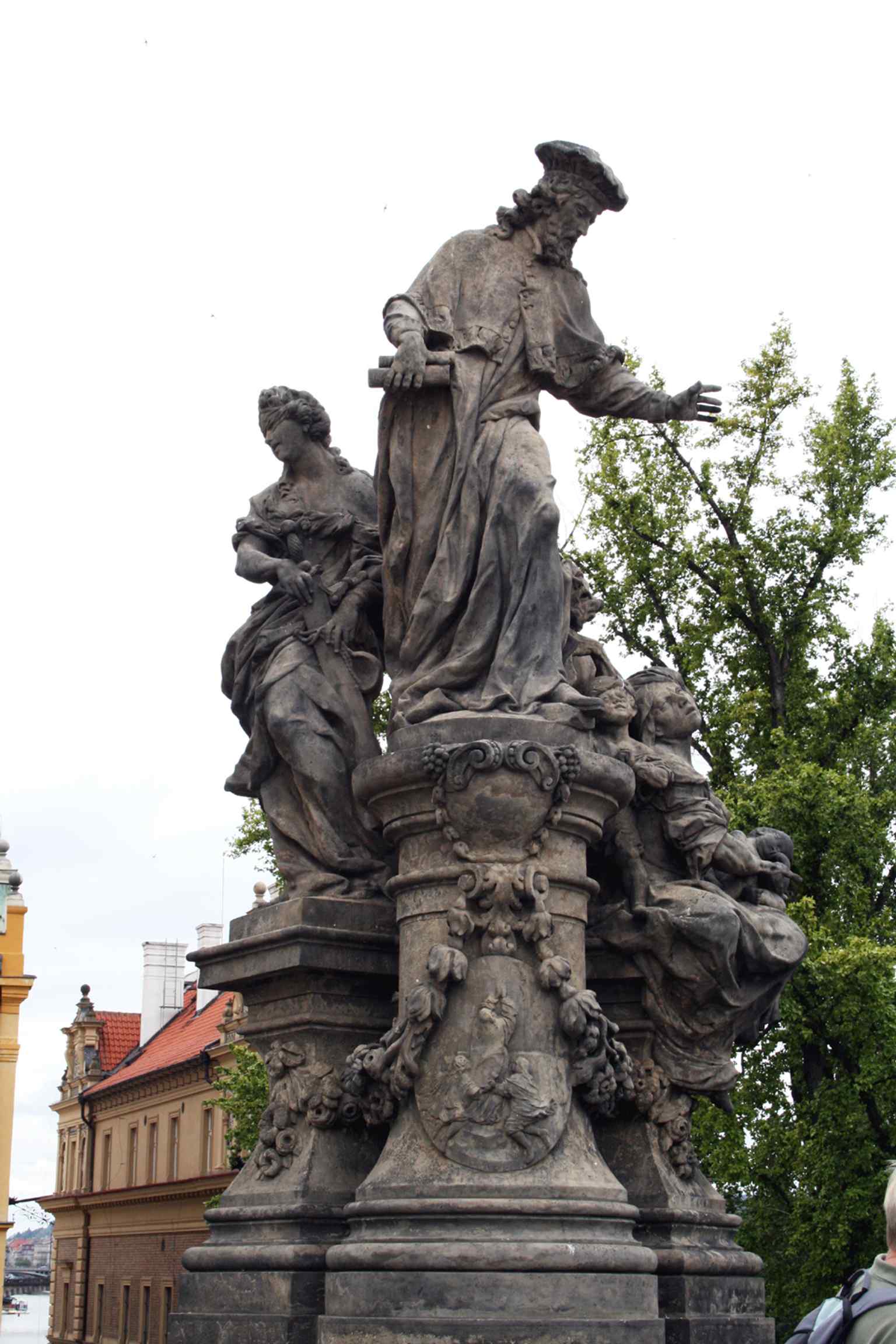
Saint Ivo is depicted in a contemporary judge's robe and cap, reflecting his role as a 13th-century Breton priest and judge of the ecclesiastical court.Photo: Karelj, Wikimedia Commons, Public domain. Cropped & resized.
Show 10 more stopsShow fewer stopsexpand_moreexpand_less
Look for a light-colored sandstone sculpture forming a distinct pyramid shape, with the Virgin Mary and infant Jesus at the very top and a kneeling saint gazing up at them from…Read moreShow less
Open dedicated page →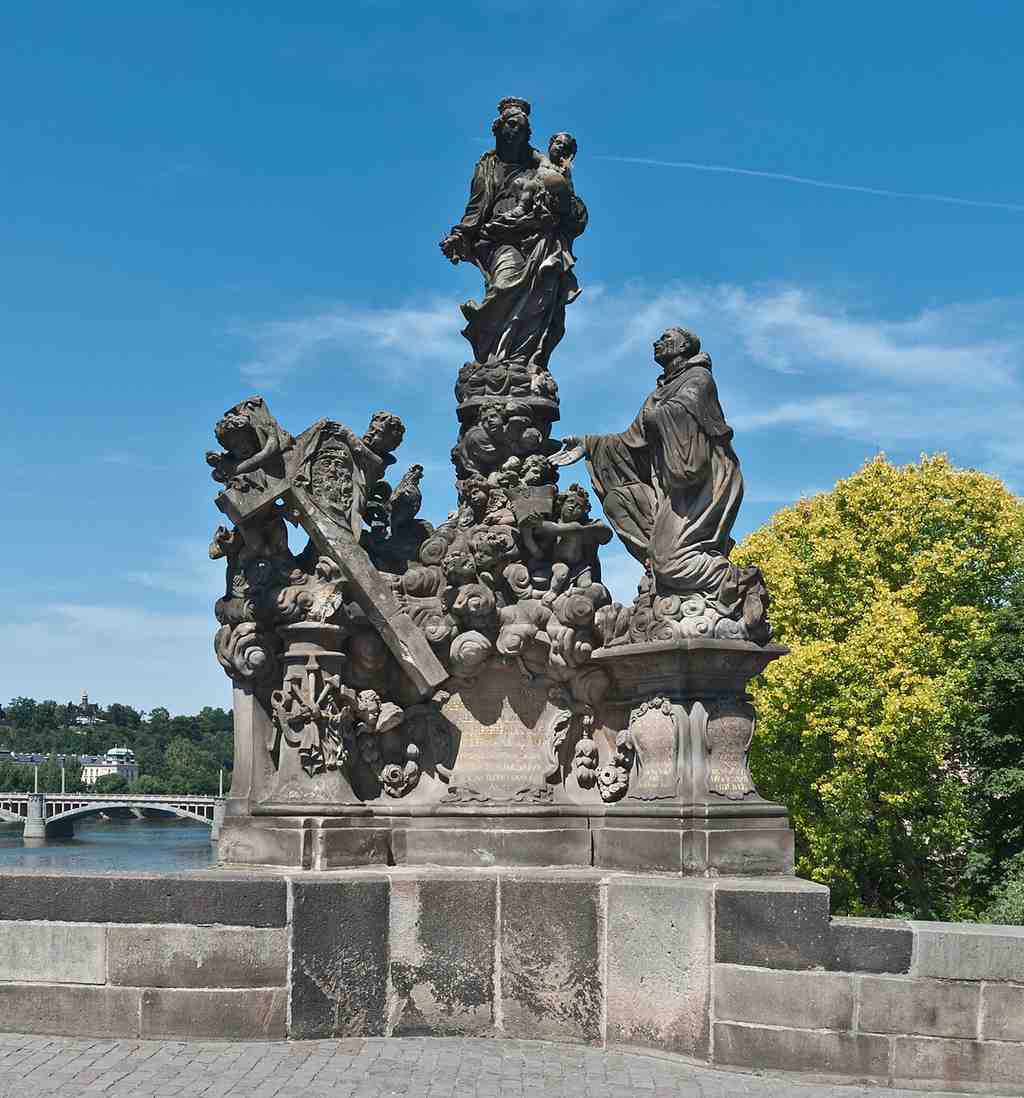
Statuen von Madonna und Saint Bernard, Charles BridgePhoto: Jacek Halicki, Wikimedia Commons, CC BY-SA 3.0. Cropped & resized. Look for a light-colored sandstone sculpture forming a distinct pyramid shape, with the Virgin Mary and infant Jesus at the very top and a kneeling saint gazing up at them from below.
This piece was commissioned back in seventeen oh nine by Benedikt Littwerig, the abbot of a Cistercian monastery, as part of a massive effort to turn this bridge into a theatrum sacrum, or a sacred stage, for the public. To bring his vision to life, Littwerig hired the talented sculptor Matěj Václav Jäckel. The Cistercians had very specific theological demands to honor their founder, Saint Bernard. Jäckel delivered an intricate scene, but he also added a rather unexpected touch.
Originally, there were actual metal speech scrolls attached to the figures' mouths, making this perhaps the world's grandest Baroque comic strip. If you check out your screen, you can see a close-up of the figures' faces where these bands once rested. Saint Bernard's metal bubble read Ave Maria, and the Madonna's scroll replied Salve Bernarde. Those bands are gone now, but the literal dialogue remains a charming piece of the bridge's lore.
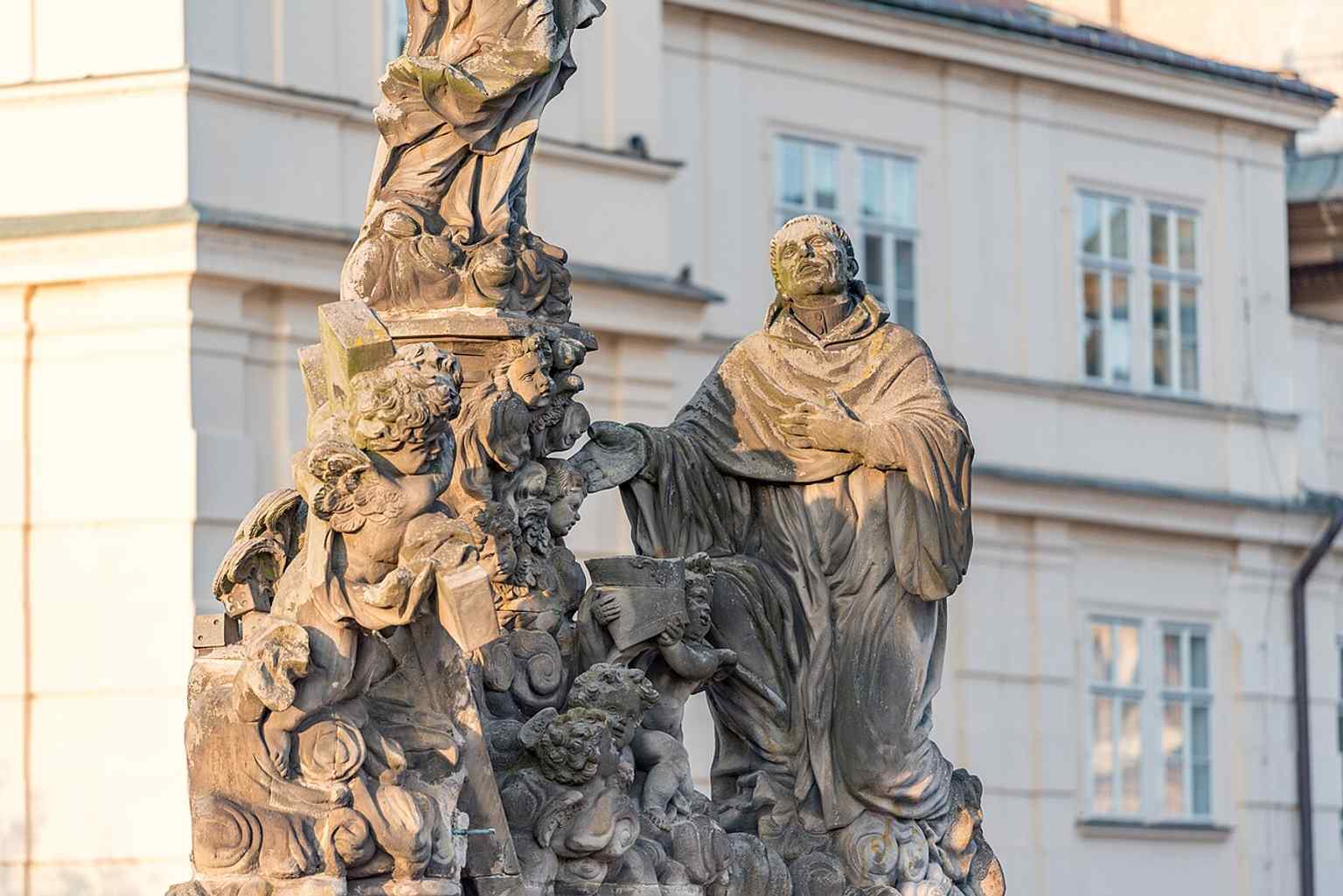
A close-up of the figures' faces, recalling the "Baroque comic strip" where metal bands once simulated a dialogue between Saint Bernard and the Madonna.Photo: Tilman2007, Wikimedia Commons, CC BY-SA 4.0. Cropped & resized. Jäckel packed the rest of the sculpture with incredibly deliberate details. On the left are the instruments of Christ's passion, including an architectural column modeled directly after a famous holy relic in Rome, physically linking Prague to the wider Catholic world. And if you glance at the app again, you will spot a small angel, or putto, hanging out near Bernard, holding an abbot's pointed hat called a mitre. This subtly honored Abbot Littwerig, ensuring the guy footing the bill got a little divine nod.
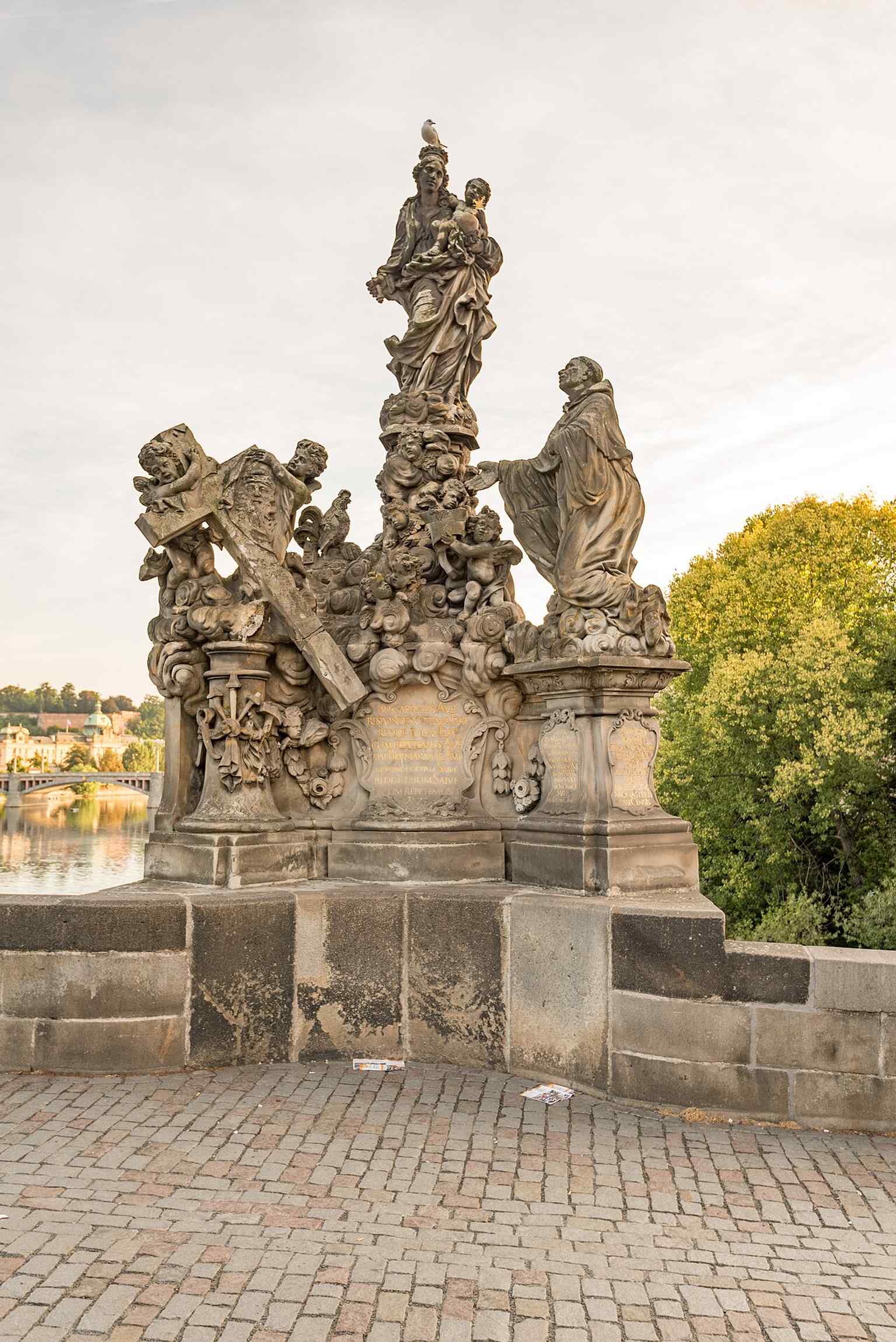
A small angel, or putto, accompanies Saint Bernard, holding an abbot’s mitre (infula) to signify Bernard’s high ecclesiastical rank and honor the donor, Abbot Littwerig.Photo: Tilman2007, Wikimedia Commons, CC BY-SA 4.0. Cropped & resized. What you are looking at today, however, is a modern replica carved from pale sandstone. The original Jäckel masterpiece stood its ground against centuries of wind, rain, and pollution until the late nineteen seventies, when the stone simply could not fight the bitter elements any longer. To ensure the art survived, the fragile original was carefully dismantled and relocated safely indoors to the Gorlice hall at Vyšehrad, perfectly preserved for future generations while its lighter copy takes over the watch.
Move to the south side to see a youthful masterpiece born of a tragic commission, then transition to Statuen der Heiligen Barbara, Margaret und Elizabeth, Charles Bridge.
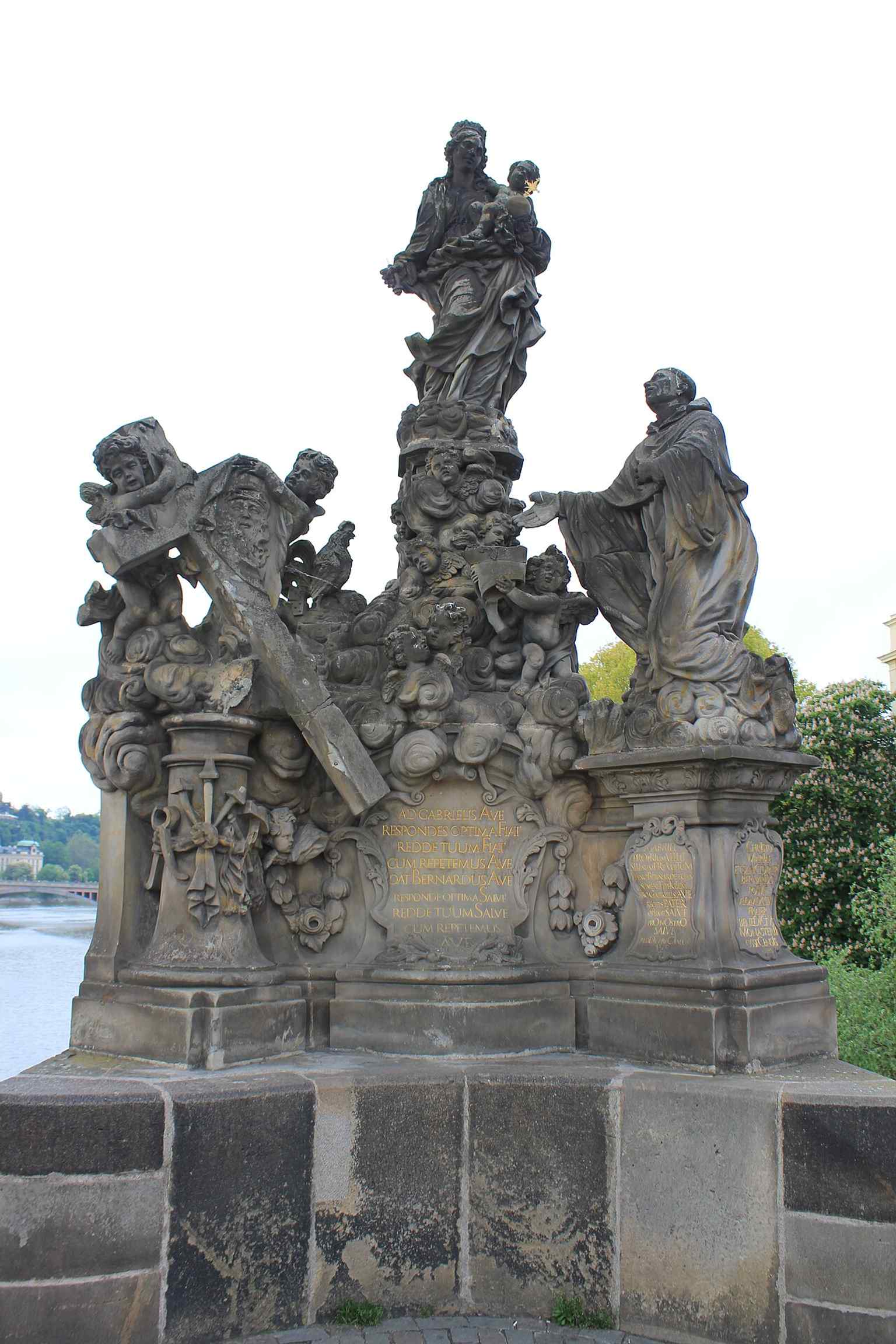
An iconic view of the replica of the Madonna and Saint Bernard sculpture, part of the 'theatrum sacrum' on Charles Bridge.Photo: Øyvind Holmstad, Wikimedia Commons, CC BY-SA 3.0. Cropped & resized. 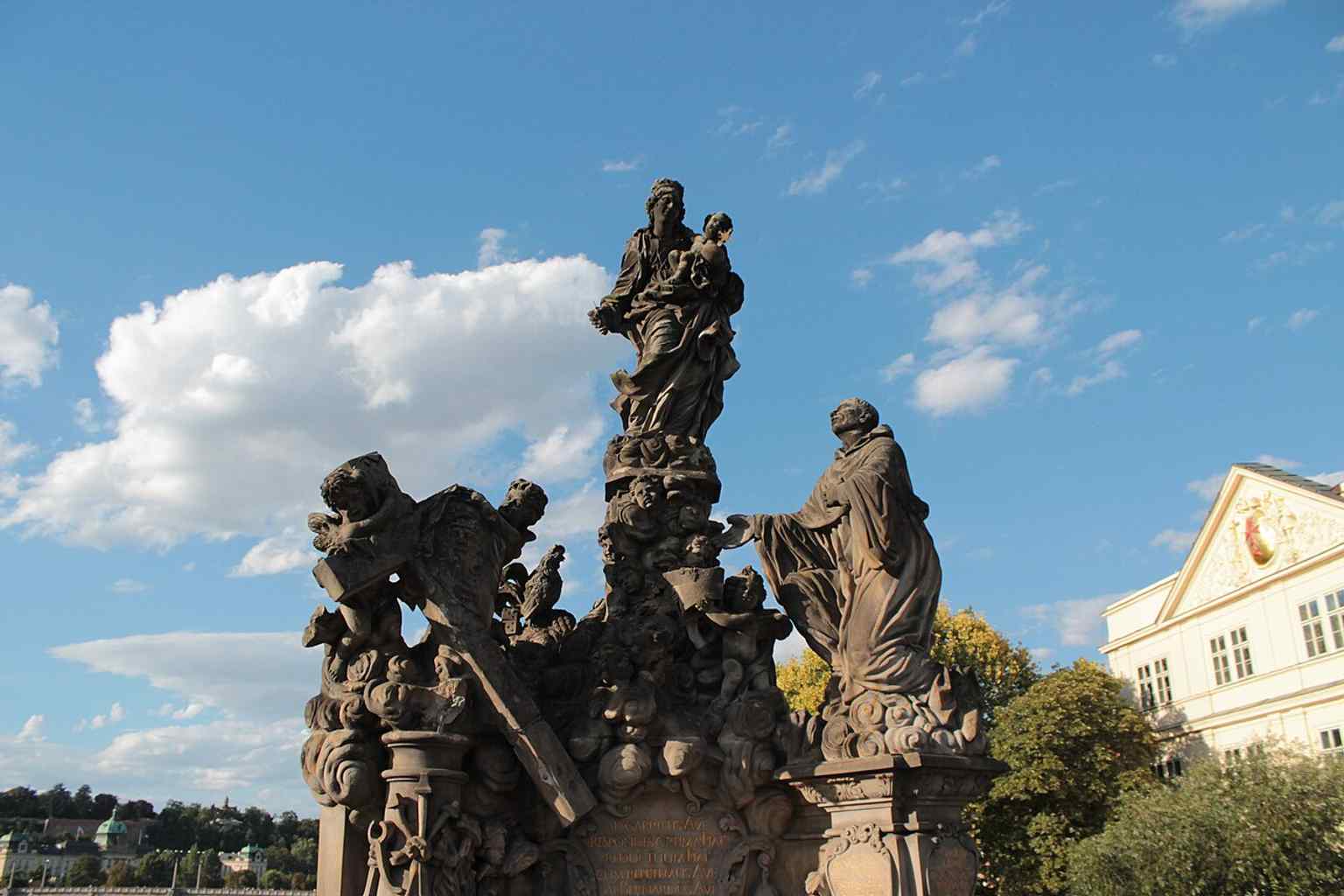
The replica of the statues bathed in sunset light, highlighting the "lighter color" mentioned for newer copies compared to the weathered originals.Photo: John Samuel, Wikimedia Commons, CC BY-SA 4.0. Cropped & resized. 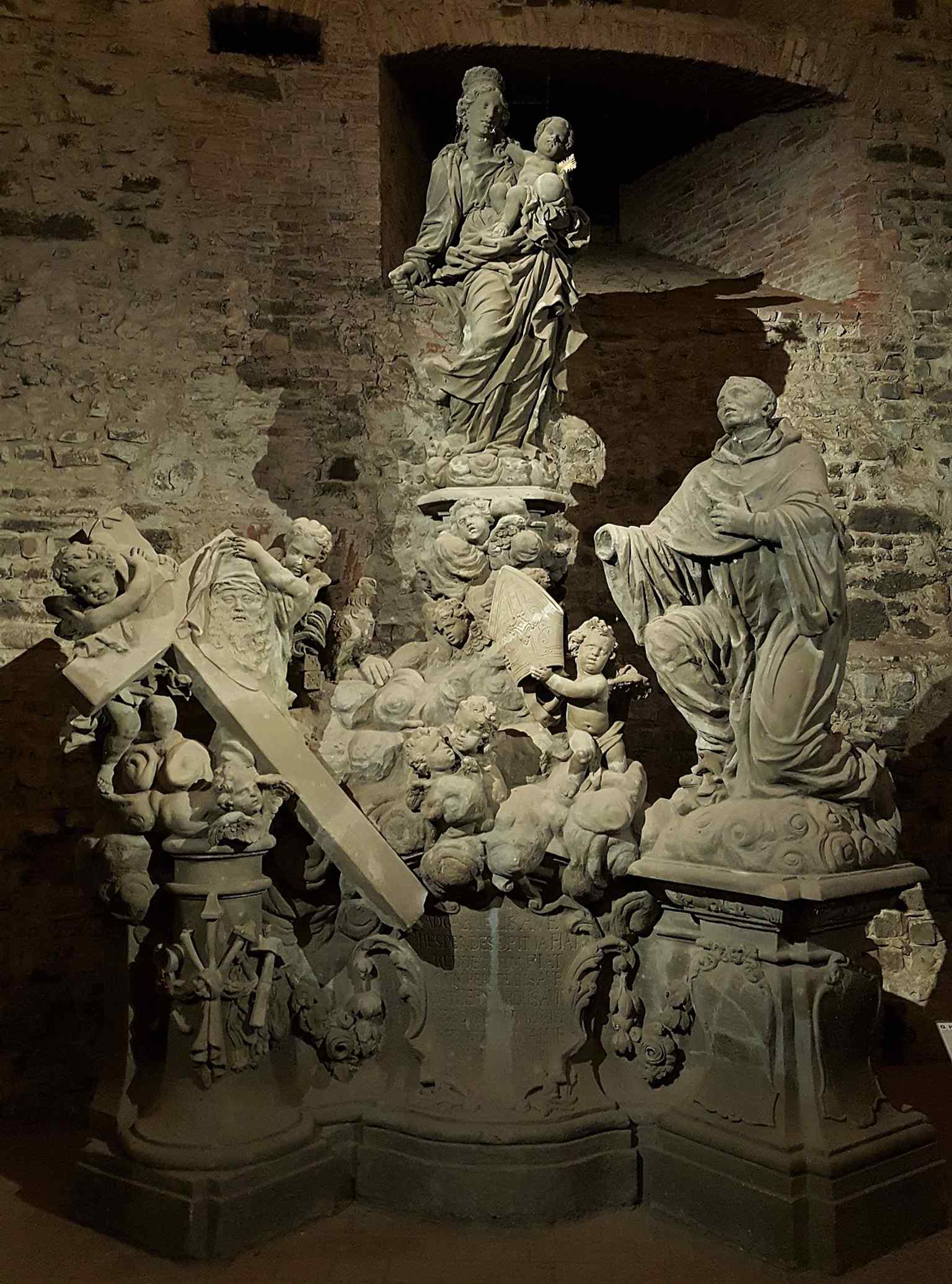
The original 1709 Jäckel masterpiece of Madonna and Saint Bernard, now preserved in the Gorlice Hall to protect it from harsh weather and pollution.Photo: Ondraness, Wikimedia Commons, CC BY-SA 4.0. Cropped & resized. 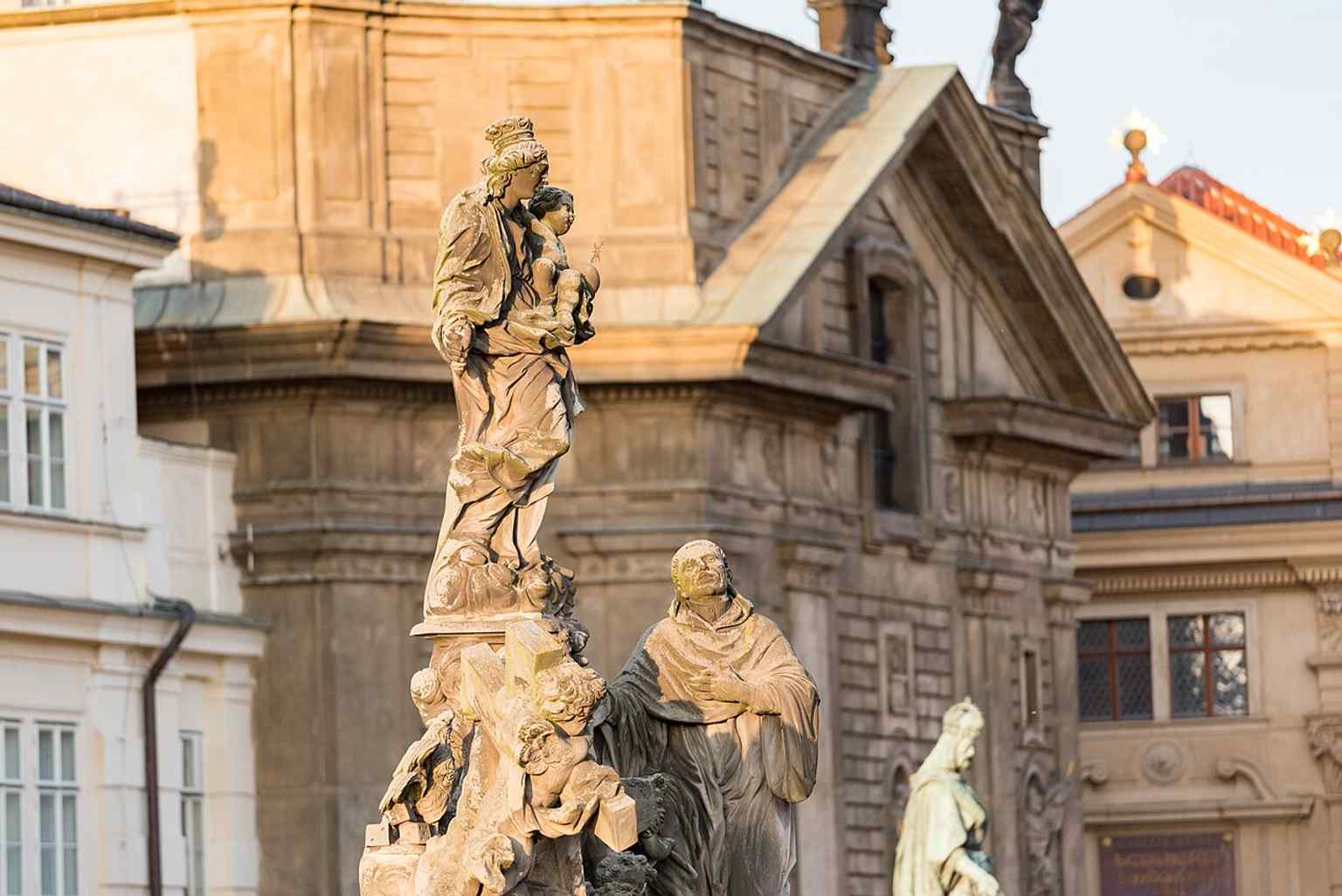
The left side of the statuary, dedicated to the 'Arma Christi,' features a large cross and the 'Veraikon' or Veil of Veronica.Photo: Tilman2007, Wikimedia Commons, CC BY-SA 4.0. Cropped & resized. 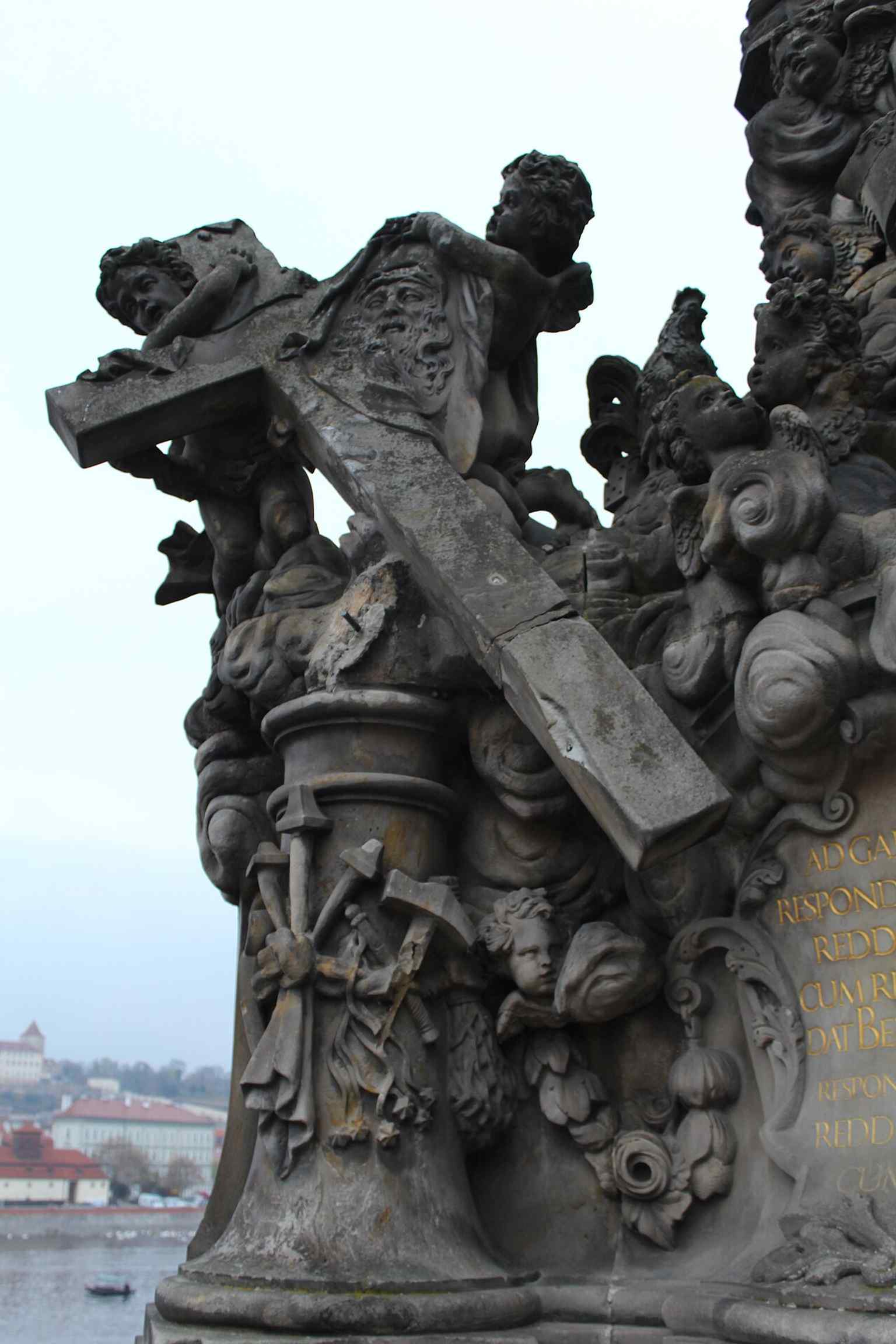
This detail shows the architectural column representing the scourging of Christ, modeled by Jäckel after a famous relic in Rome, connecting Prague to wider Catholic veneration.Photo: Chabe01, Wikimedia Commons, CC BY-SA 4.0. Cropped & resized. Look for the tall sandstone sculpture featuring three women, with the central figure raised on a pedestal holding a golden chalice and a small carved tower resting at her feet.…Read moreShow less
Open dedicated page →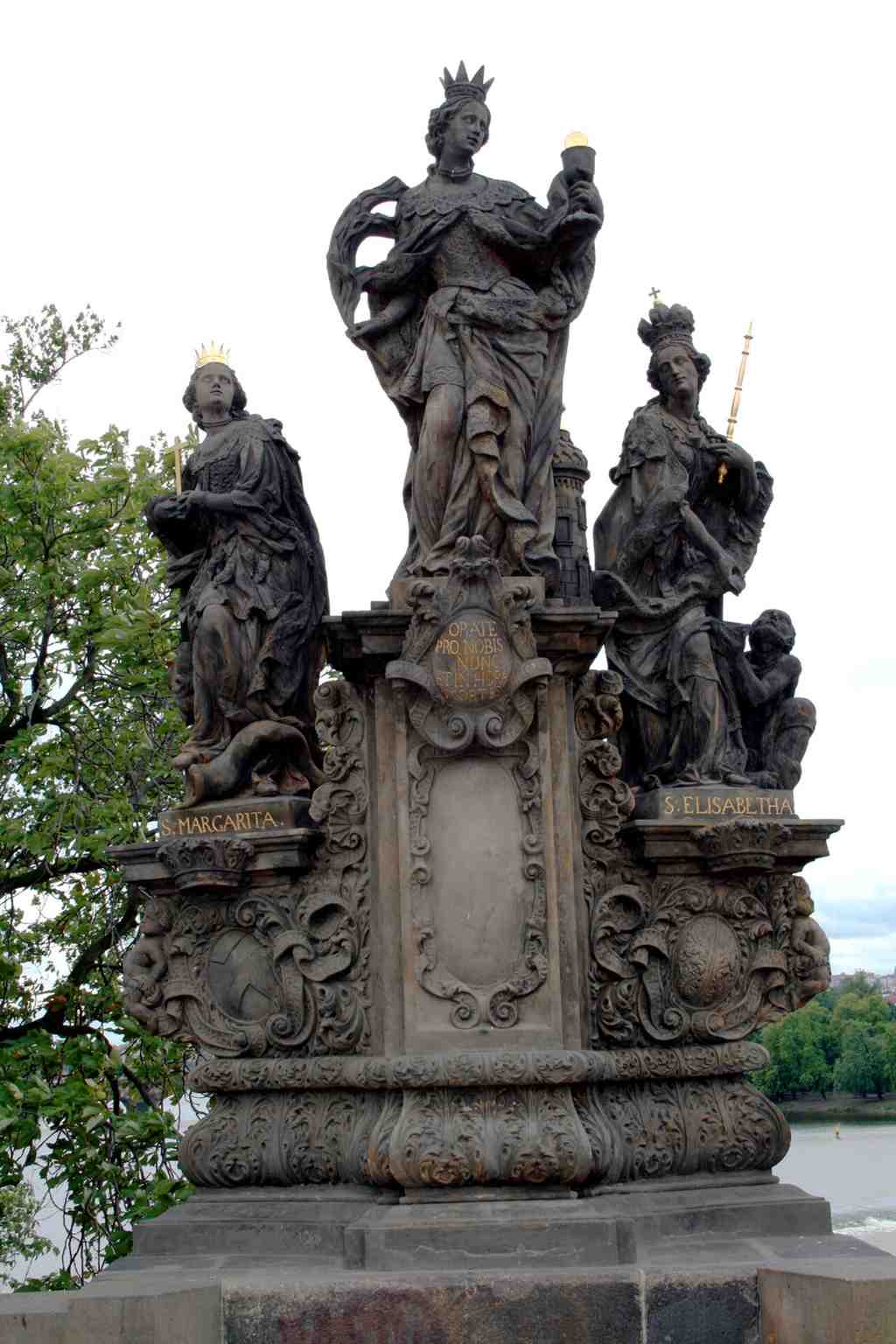
Statuen der Heiligen Barbara, Margaret und Elizabeth, Charles BridgePhoto: Karelj, Wikimedia Commons, Public domain. Cropped & resized. Look for the tall sandstone sculpture featuring three women, with the central figure raised on a pedestal holding a golden chalice and a small carved tower resting at her feet. This is the statue of Saints Barbara, Margaret, and Elizabeth. It was commissioned in seventeen oh seven by an Imperial Councillor who was suffering from a terminal illness. He knew his time was up, so he paid for a permanent visual prayer to save his soul. The central figure, Saint Barbara, was the patroness of a happy death. If you look at your screen you can see a close up of the golden chalice she holds, symbolizing the final sacrament. The other two saints, Margaret stepping on a dragon and Elizabeth offering bread, were named after his wife and mother.
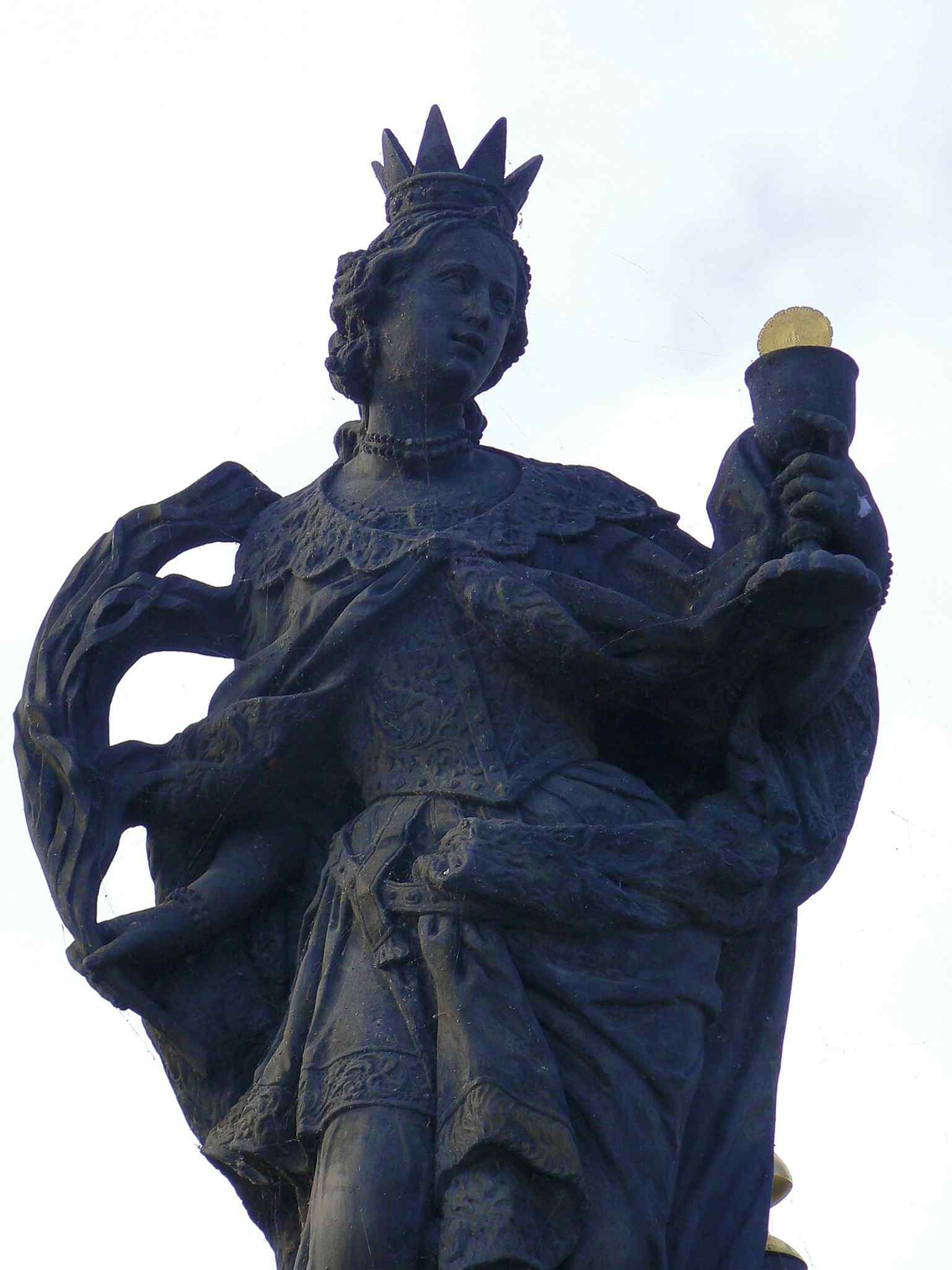
A close-up of Saint Barbara holding a chalice with a gilded host, symbolizing the final sacrament, with a miniature tower at her feet representing her imprisonment.Photo: Joker Island, Wikimedia Commons, Public domain. Cropped & resized. The inscription on the base credits the famous master sculptor Jan Brokoff. But that is not exactly the whole truth. The true genius behind this carving was actually his nineteen-year-old son, Ferdinand Brokoff. This was the teenager's debut on the bridge. Instead of his father's rigid, old-fashioned style, young Ferdinand introduced a breathtaking new realism. Take a look at your app again to focus on the beggar at Saint Elizabeth's feet. Ferdinand carved human dignity and suffering into the stone with a mastery of deep, fluid clothing folds that instantly made his name.
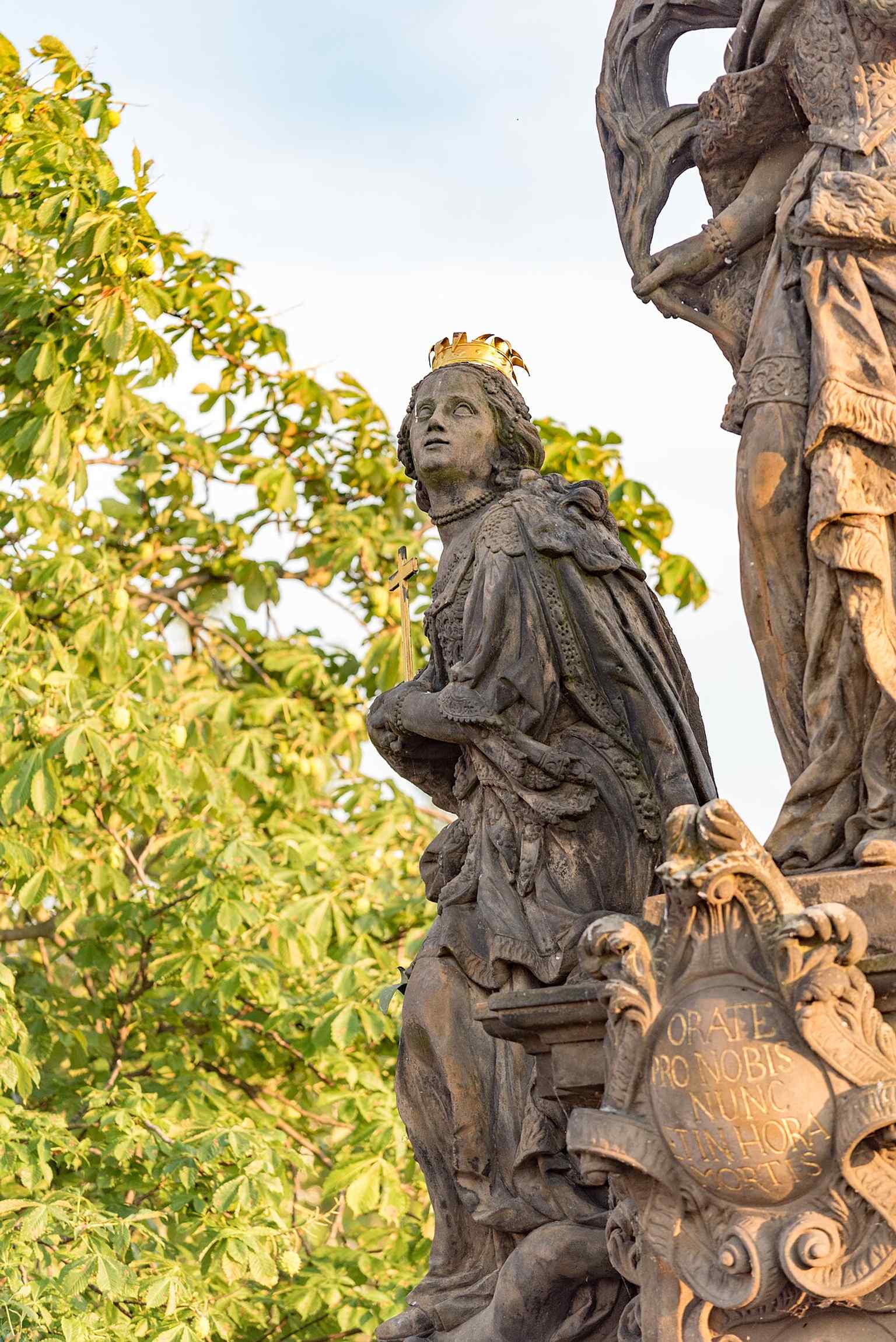
Saint Elizabeth of Hungary offering bread to a beggar, showcasing Ferdinand Brokoff’s unusual ability to portray human suffering with dignity and realism.Photo: Tilman2007, Wikimedia Commons, CC BY-SA 4.0. Cropped & resized. That nineteen-year-old's work proved remarkably tough. Carved from fine-grained sandstone, this monument held its ground when revolutions brought cannon fire to the bridge in eighteen forty-eight, and it stood firm against the catastrophic floods of eighteen ninety. Aside from a major restoration in eighteen fifty-two, it has survived largely intact for over three centuries, stubbornly protecting a doomed man's final wish from both the elements and the chaos of human history.
Since the bridge is open twenty-four hours a day, this stone vigil never actually stops. Now, let us cross back to the north side for another of Jäckel's works, as we step right next door to the statues of the Madonna, Saint Dominic, and Thomas Aquinas.
The full sculptural group of Saints Barbara, Margaret, and Elizabeth, prominently standing on the Charles Bridge, marking Ferdinand Brokoff's debut on the bridge.Photo: Øyvind Holmstad, Wikimedia Commons, CC BY-SA 3.0. Cropped & resized. 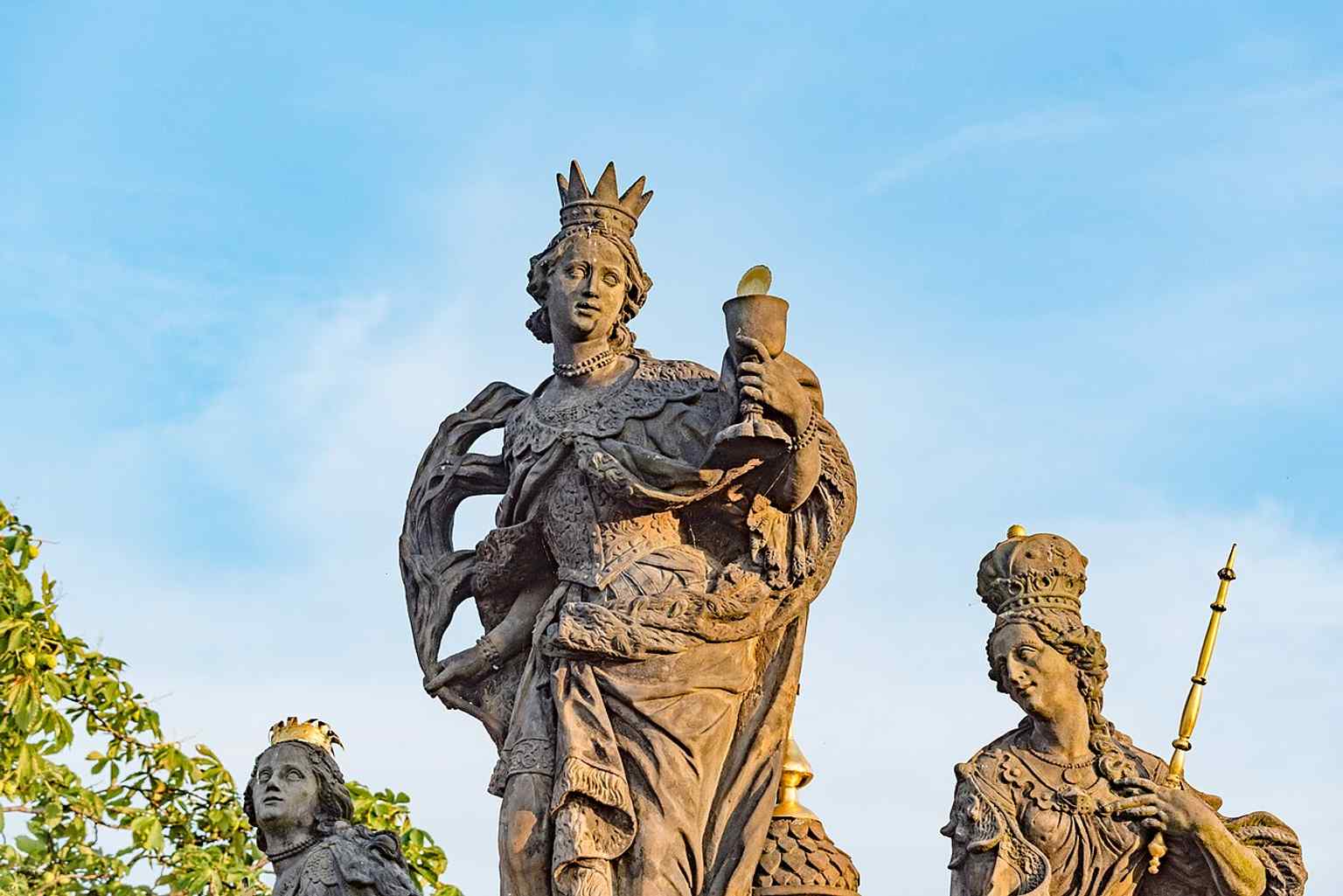
A panoramic view of the sculptural group on the Charles Bridge, commissioned by Jan Václav Obytecký z Obytec as a visual prayer for his soul.Photo: Tilman2007, Wikimedia Commons, CC BY-SA 4.0. Cropped & resized. 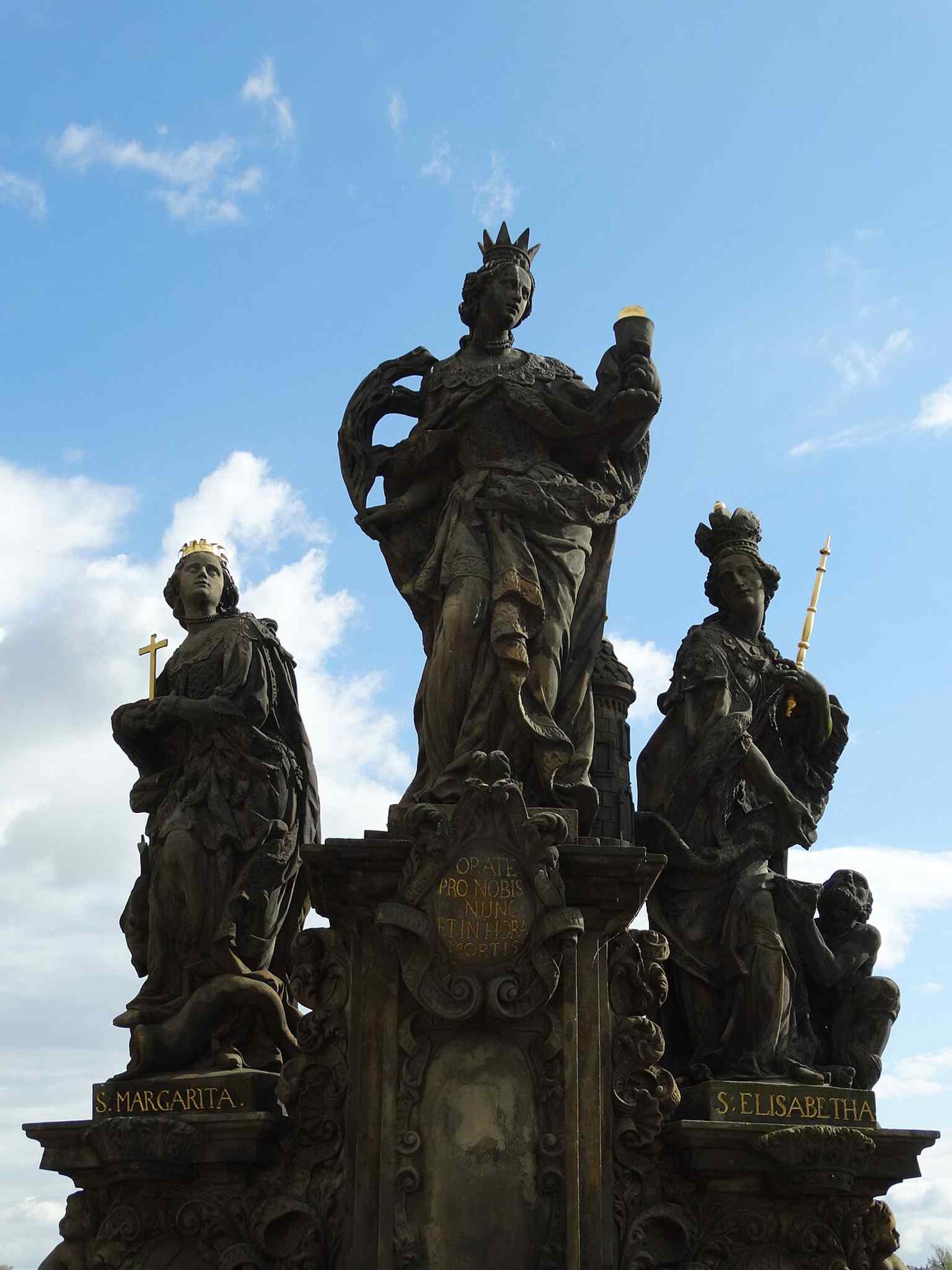
The monumental base of the sculptural group, crafted from fine-grained sandstone, which has remained largely intact for over three centuries on the Charles Bridge.Photo: kikiwis, Wikimedia Commons, CC BY 3.0. Cropped & resized. 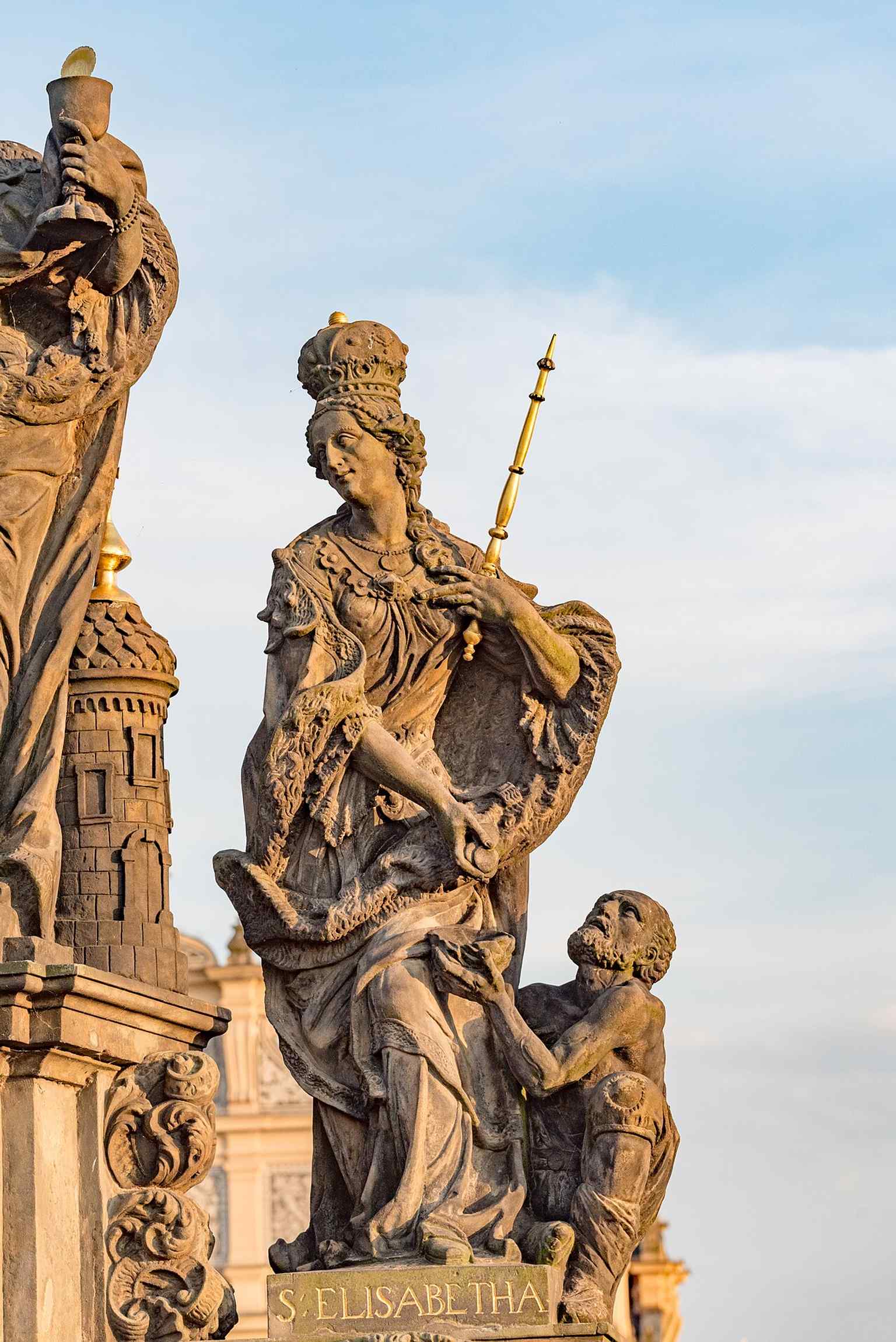
This detail of Saint Barbara highlights Ferdinand Brokoff's hallmark realism and mastery of deep, fluid drapery, a transition from his father's more rigid style.Photo: Tilman2007, Wikimedia Commons, CC BY-SA 4.0. Cropped & resized. 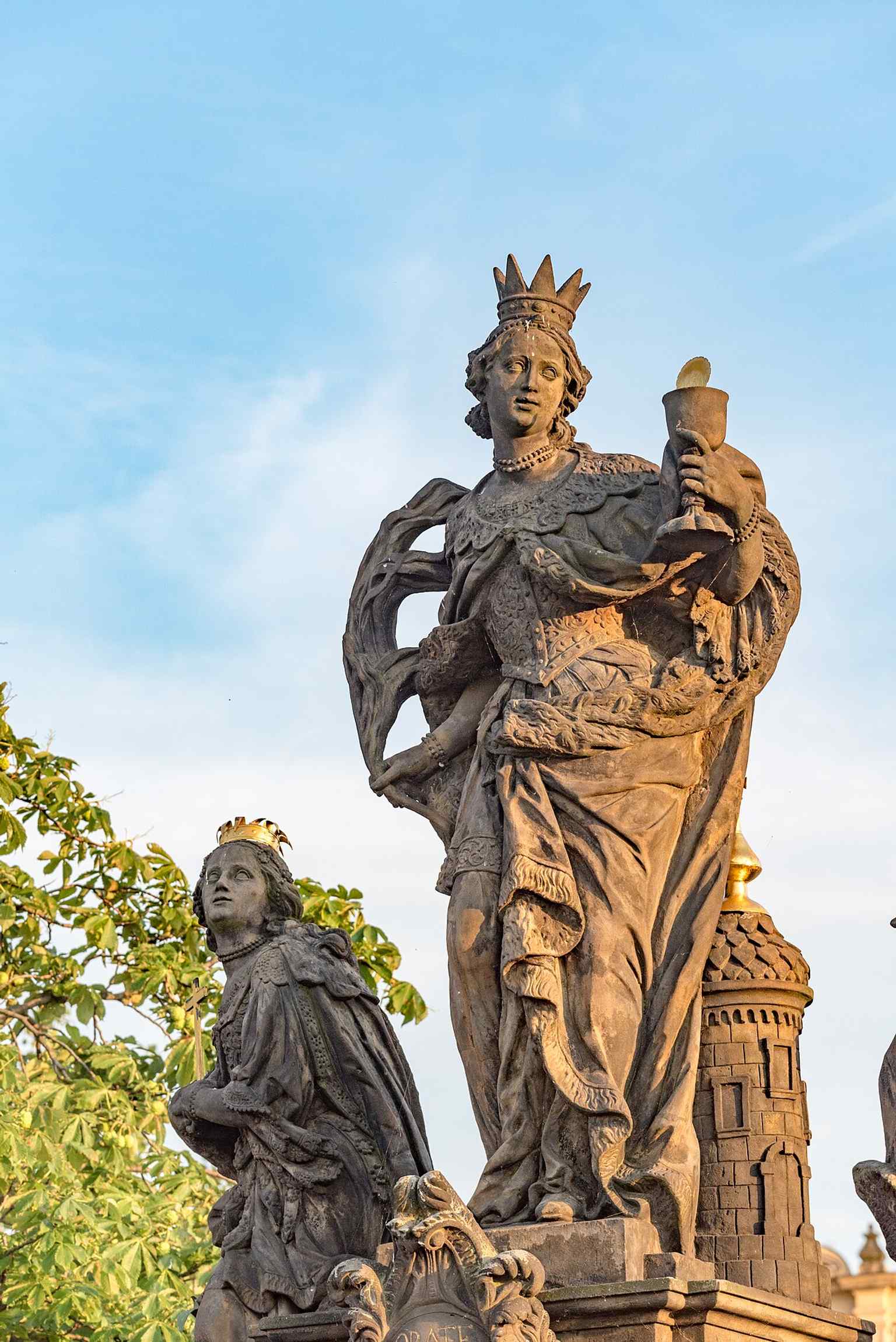
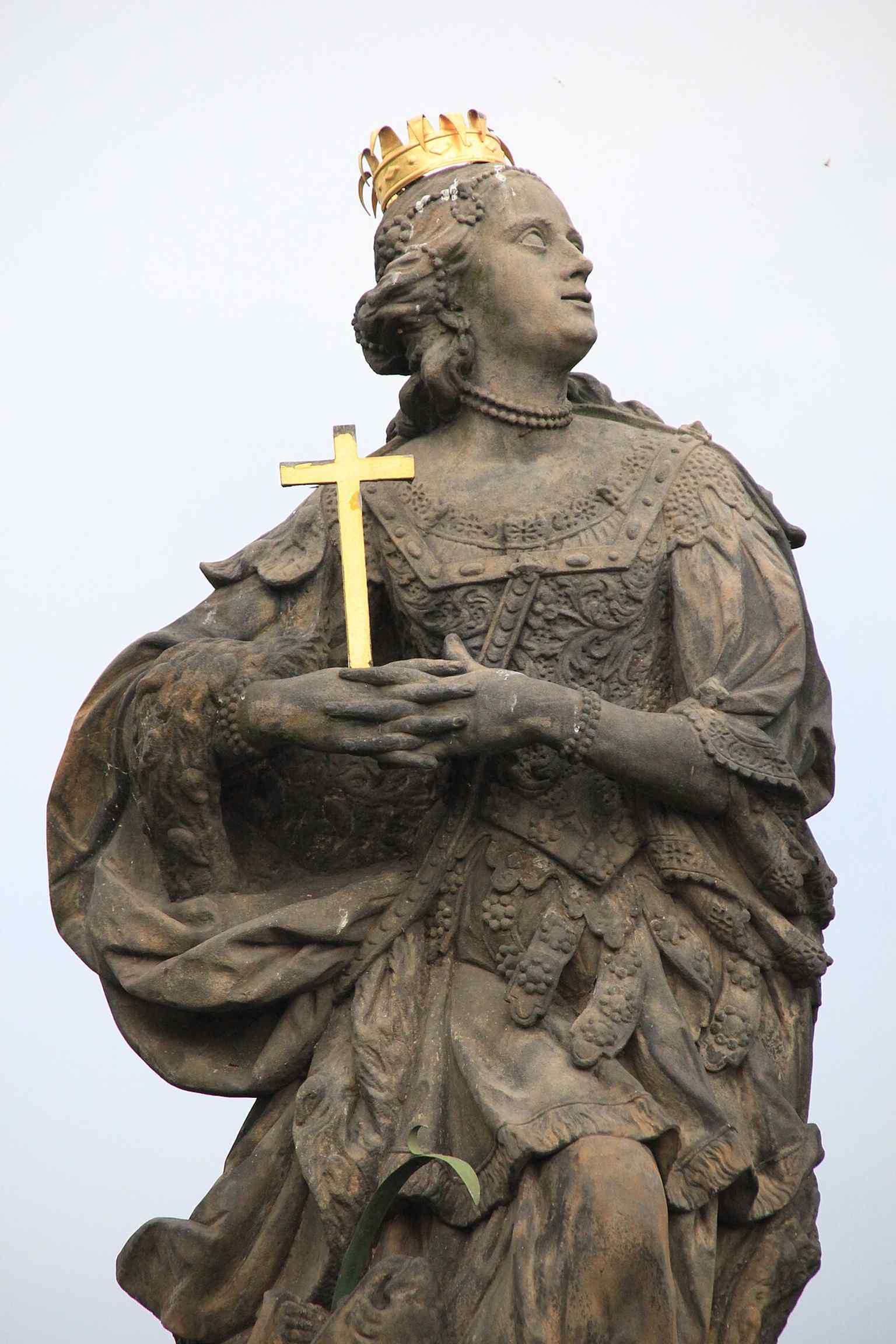
Saint Margaret of Antioch triumphantly resting her foot on a dragon, clutching a gilded cross, symbolizing her escape and faith that overcame the devil.Photo: Tilman2007, Wikimedia Commons, CC BY-SA 4.0. Cropped & resized. 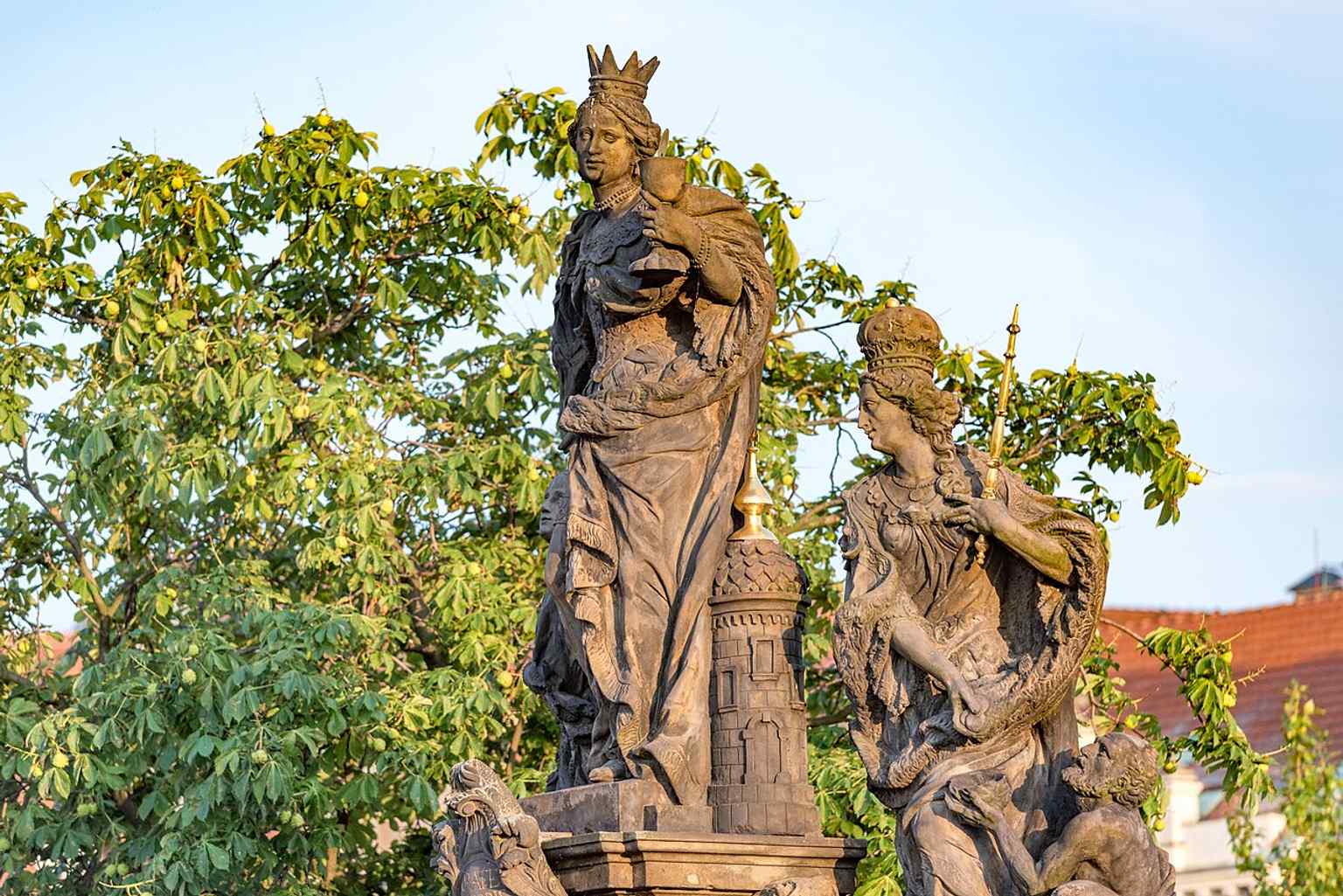
The central figure of Saint Barbara on a raised pedestal, flanked by Saint Margaret and Saint Elizabeth, forming a poignant composition for the donor, Jan Václav Obytecký z Obytec.Photo: Tilman2007, Wikimedia Commons, CC BY-SA 4.0. Cropped & resized. 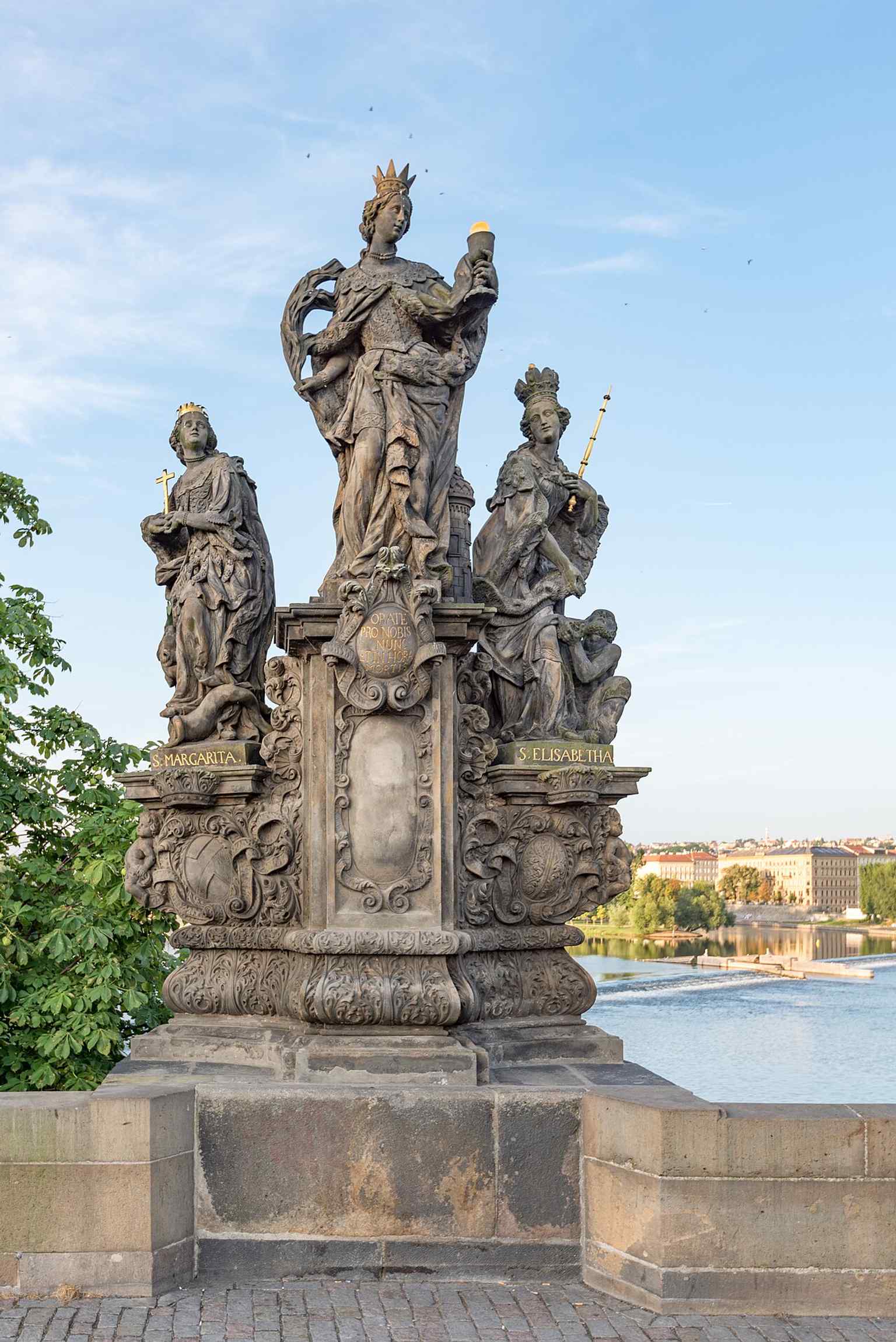
A different perspective of Saint Barbara, emphasizing the expressive facial features and the detailed carving that signifies Ferdinand Brokoff's new artistic direction.Photo: Tilman2007, Wikimedia Commons, CC BY-SA 4.0. Cropped & resized. Look for the towering stone sculpture group featuring a central figure of the Madonna perched on a rounded globe, flanked by two men and an unmistakable little stone dog holding a…Read moreShow less
Open dedicated page →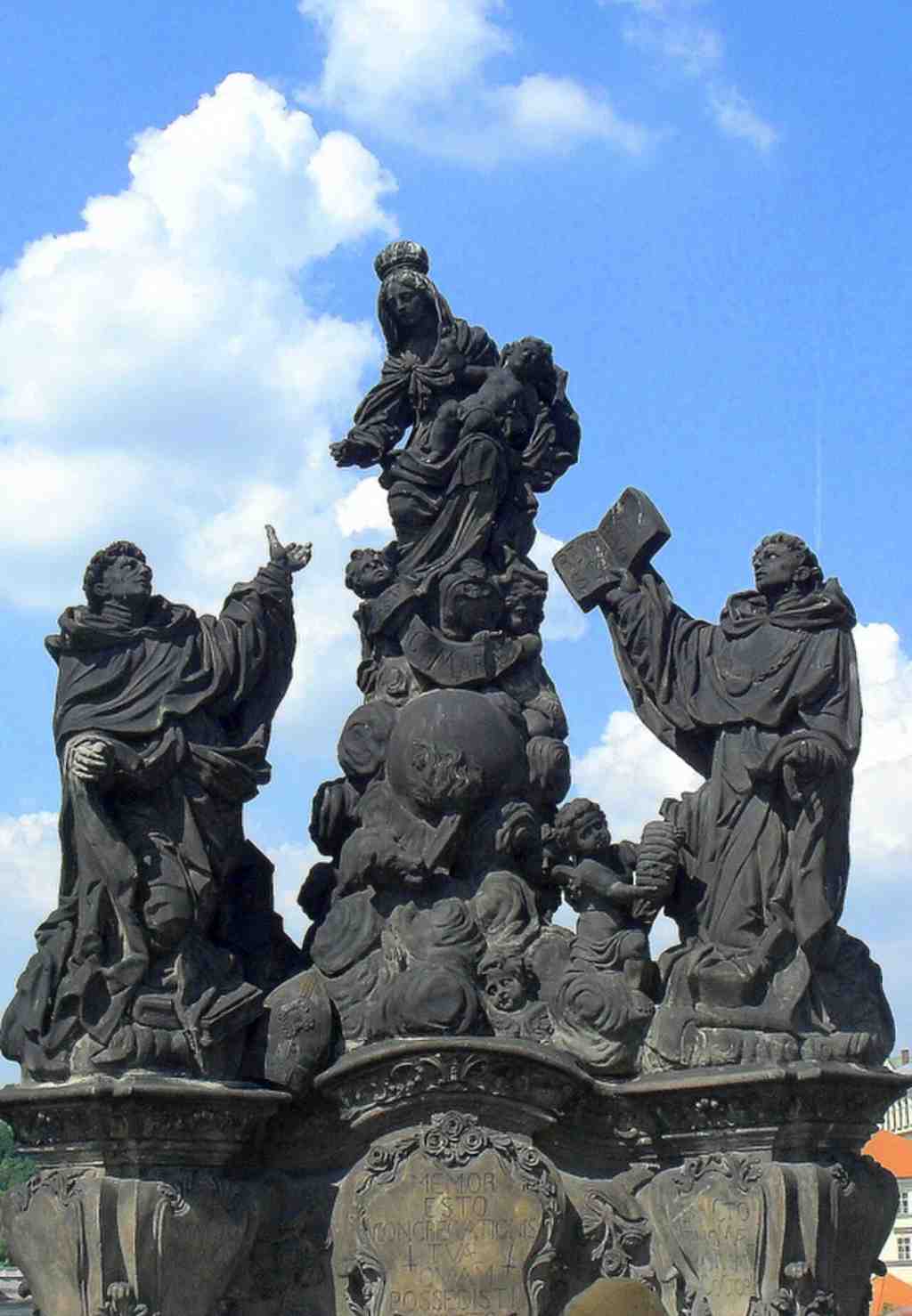
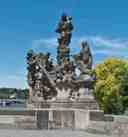
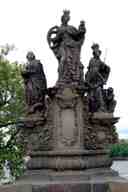
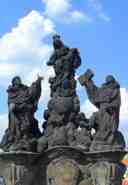
Statuen von Madonna, Saint Dominic und Thomas Aquinas, Charles BridgePhoto: Aw58, Wikimedia Commons, CC BY-SA 3.0. Cropped & resized. Look for the towering stone sculpture group featuring a central figure of the Madonna perched on a rounded globe, flanked by two men and an unmistakable little stone dog holding a torch at the base. This dynamic scene was carved in seventeen oh eight by Matěj Václav Jäckel, the same artist we ran into earlier on the bridge. He was commissioned by the Dominican order to create a grand, theatrical vision descending from the clouds.
Notice the dog at the feet of the Madonna. It is actually a centuries-old visual pun. In Latin, the Dominican order is called Dominicanes, which sounds an awful lot like Domini canes, or the dogs of the Lord. The torch refers to a legend that Saint Dominic's mother dreamed she would give birth to a dog carrying a torch to set the world ablaze with the gospel. On the right stands Saint Thomas Aquinas with a sun pendant, and below him, a cherub holds a beehive, representing his honey-sweet words.
These intricate details were originally carved from local sandstone. But standing out over the river means facing the relentless dampness of the water year after year. The original stone eventually became too fragile to withstand the natural environment and was moved to a museum in nineteen fifty-eight to keep it from crumbling away entirely. If you want to see how this masterpiece has weathered time, take a look at your screen for a comparison of the stone from the nineteen seventies. Thanks to these faithful replicas, this dramatic vision survives against the odds.
Let us continue along the bridge to another spot with a history of extreme vulnerability, leading us right to the statue of the Pietà.
Look to your right at this fine-grained sandstone sculpture, where the seated figure of the Virgin Mary forms a triangular shape holding the body of Christ beneath a prominent,…Read moreShow less
Open dedicated page →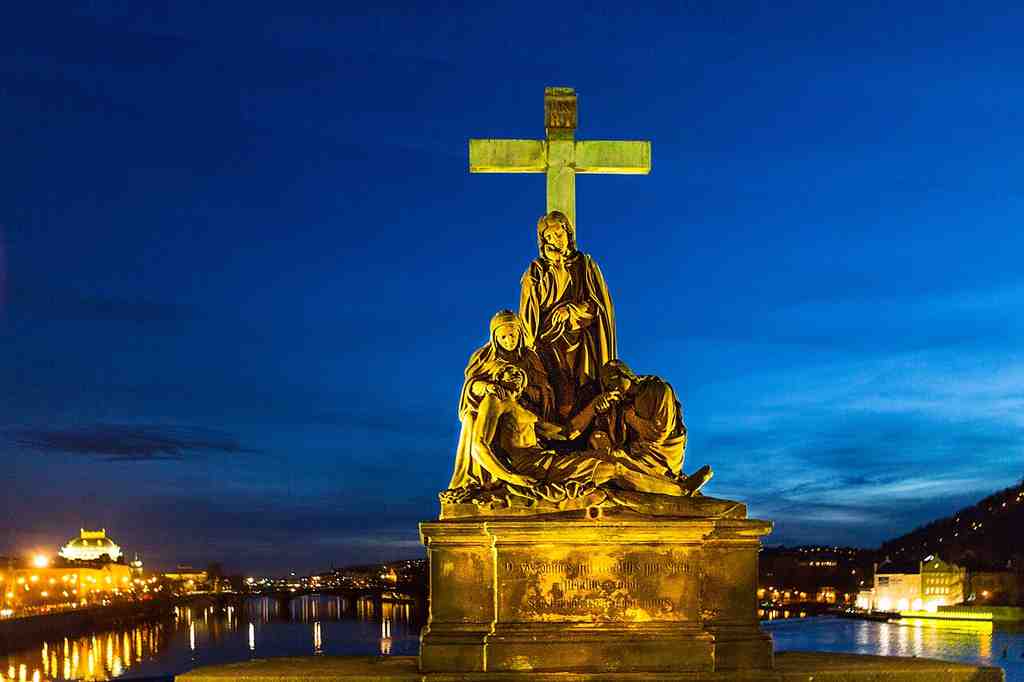
Statue von Pietà, Charles BridgePhoto: Sebaso, Wikimedia Commons, CC BY-SA 3.0. Cropped & resized. Look to your right at this fine-grained sandstone sculpture, where the seated figure of the Virgin Mary forms a triangular shape holding the body of Christ beneath a prominent, copper-covered wooden cross.
This third pillar of the bridge has always been something of a cursed spot, historically vulnerable to the raging river below. A catastrophic flood in fourteen ninety-six completely swept away a simple wooden crucifix that first marked this location.
For nearly two centuries, the pillar sat empty until a dramatic Baroque Pietà was installed in sixteen ninety-five. But that sculpture's reign ended violently during the eighteen forty-eight Revolution. As barricades went up across Prague, the bridge was caught in the crossfire, and the artwork was heavily damaged by cannon balls and musket shots. Take a glance at your screen to see a historical drawing of that lost original.
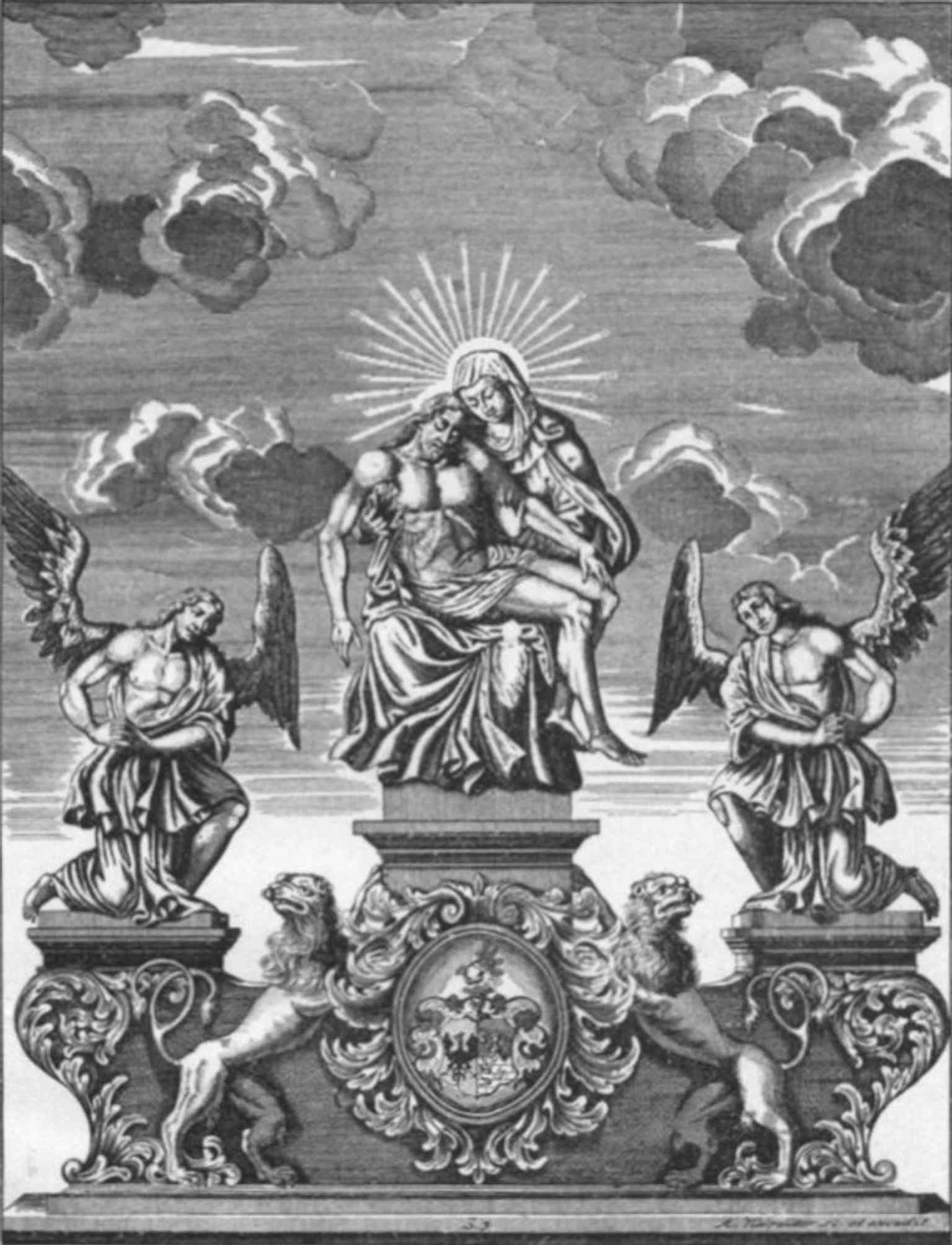
This historical artwork depicts the Baroque Pietà created by Jan Brokoff in 1695, which stood on Charles Bridge for over 150 years before being severely damaged in the 1848 Revolution.Photo: Augustin Neureuter (Neuräutter) (1685-1719), Wikimedia Commons, Public domain. Cropped & resized. The story of what happened next involves a rather convenient expert opinion. Sculptor Josef Max was asked if the ruined piece should be restored. He strongly recommended removing it entirely, which, by a pure coincidence I am sure, paved the way for his brother, Emanuel Max, to win the new commission.
But Emanuel Max's eighteen fifty-nine replacement marked a meaningful shift in the city's history. While older statues were bankrolled by wealthy aristocrats, this restrained Neoclassic piece was funded entirely through a public collection. It was a true project of the people.
The figures form a deeply intimate scene. Mary Magdalene kneels to kiss Christ's hand, while Saint John stands in mourning. Keeping this people's monument intact requires a continuous cycle of destruction and rebirth. Between two thousand and twenty-two and two thousand and twenty-three, restorer Miroslav Žán led a major intervention to remove thick sulfate crusts and biological colonization, which is really just a polite scientific term for decades of stubborn moss and algae eating into the stone.
Step over to see a tender scene born from the ashes of revolution, then we will transition to the Statue of Saint Joseph right next door. And in case you were wondering, the bridge is open twenty-four hours a day, all week long.
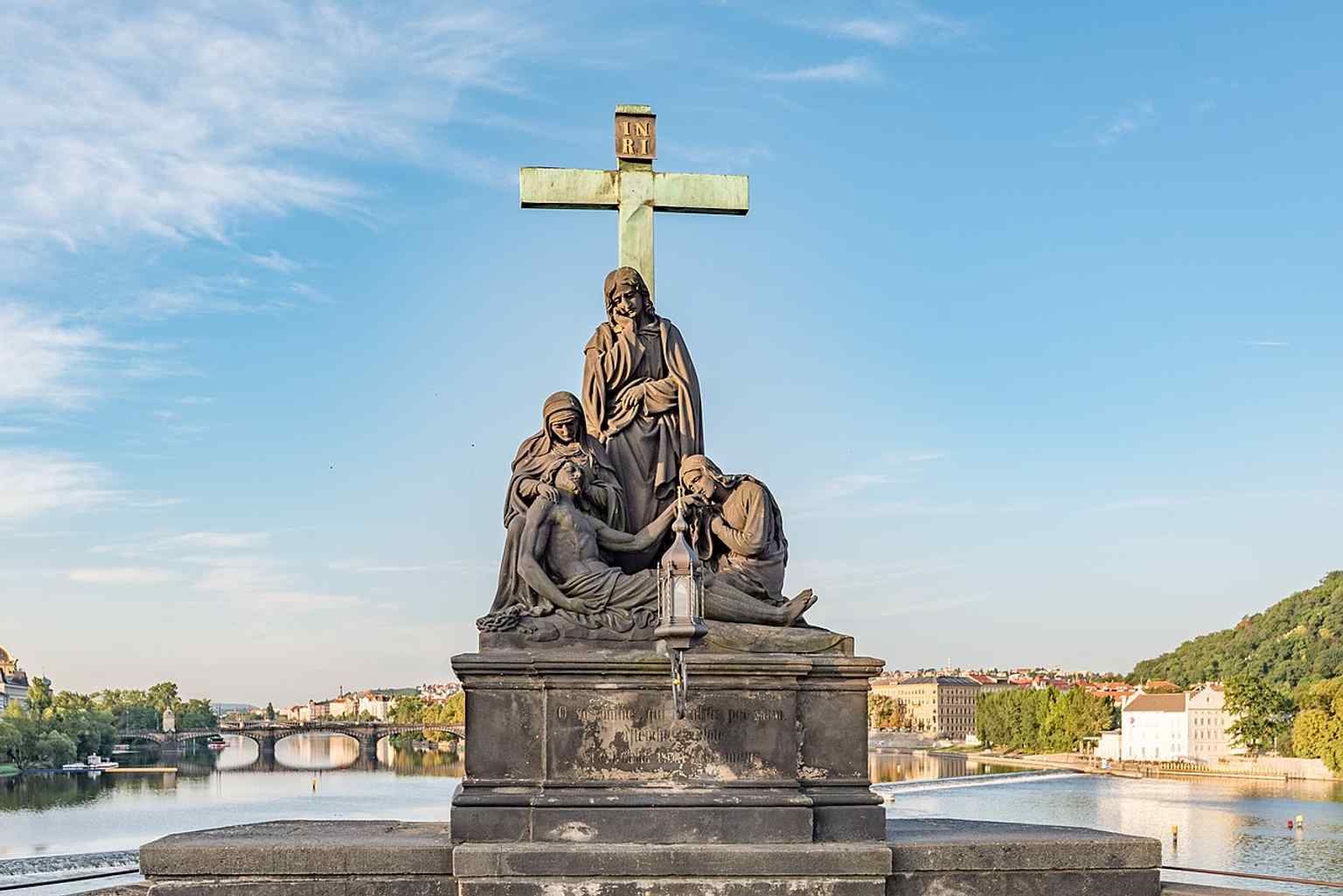
This image shows Emanuel Max's Pietà, commissioned by the Prague municipality in 1859, a project notably funded through a public collection.Photo: Tilman2007, Wikimedia Commons, CC BY-SA 4.0. Cropped & resized. 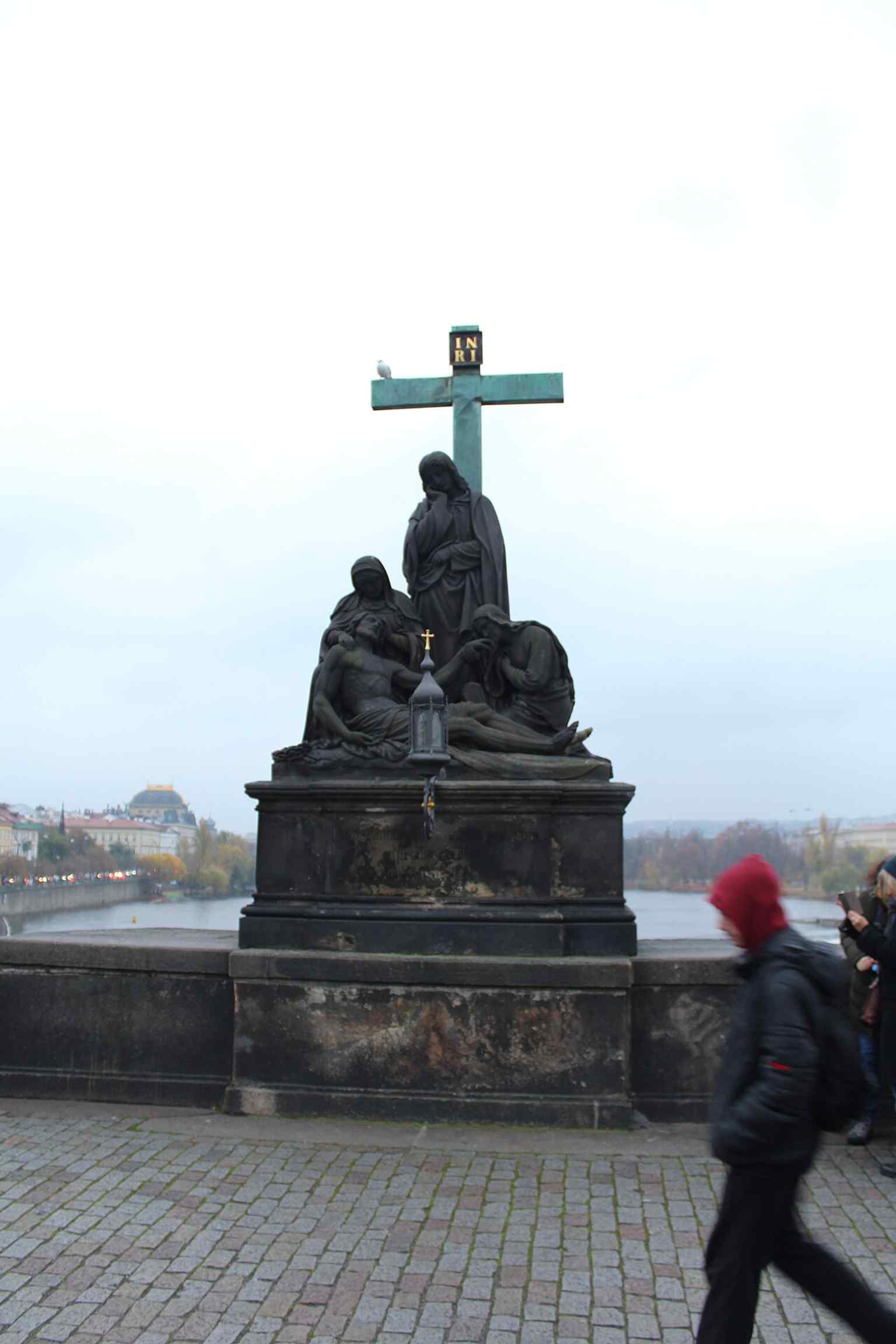
A close look at Emanuel Max's Neoclassic Pietà reveals the Virgin Mary cradling Christ, with Mary Magdalene kneeling to kiss his hand and St. John the Evangelist standing in mourning.Photo: Chabe01, Wikimedia Commons, CC BY-SA 4.0. Cropped & resized. 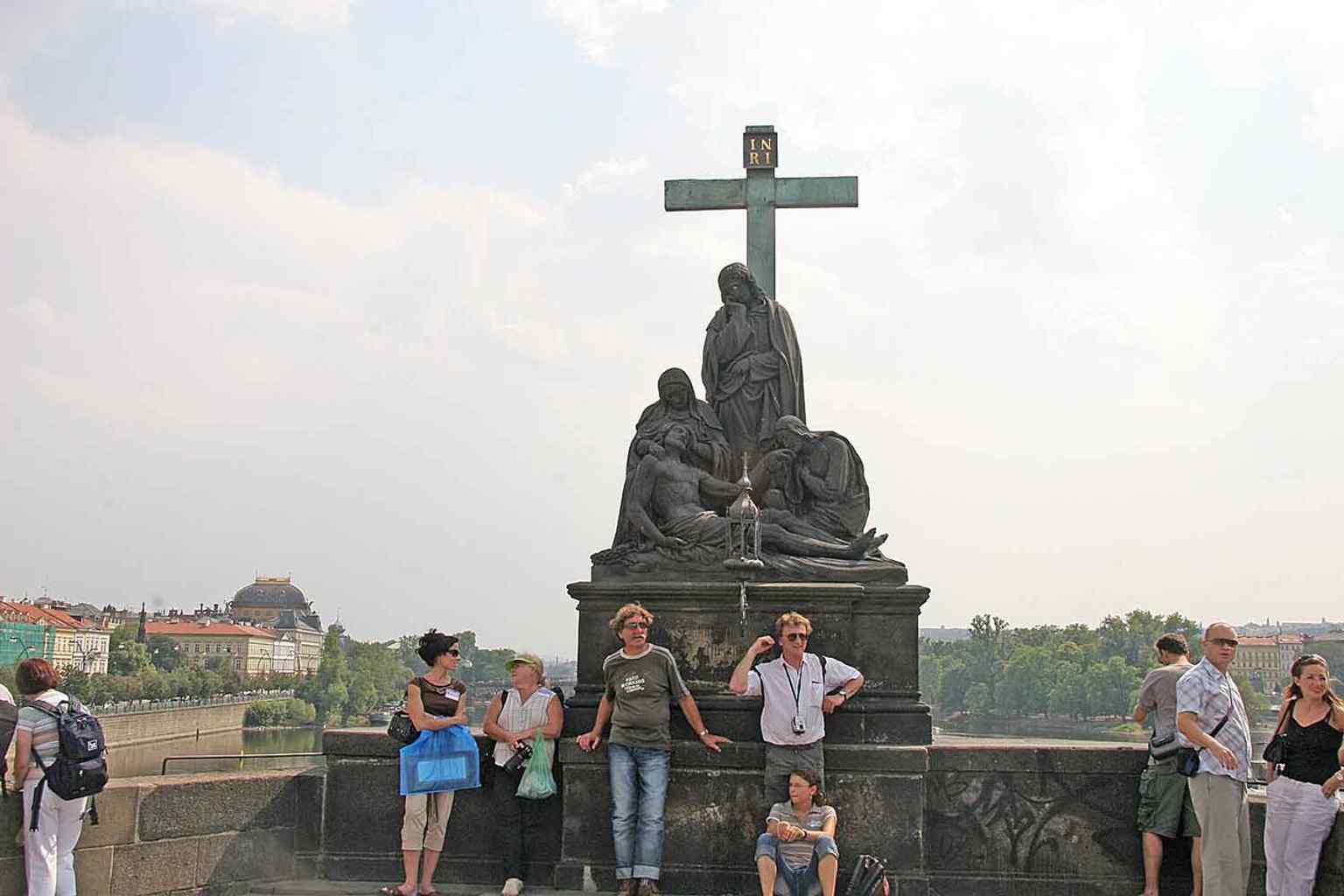
The Pietà stands on the south side of the Charles Bridge, marking the third pillar—a spot that has held religious markers since a wooden crucifix was destroyed by a catastrophic flood in 1496.Photo: The original uploader was Zp at Czech Wikipedia., Wikimedia Commons, CC BY-SA 3.0. Cropped & resized. 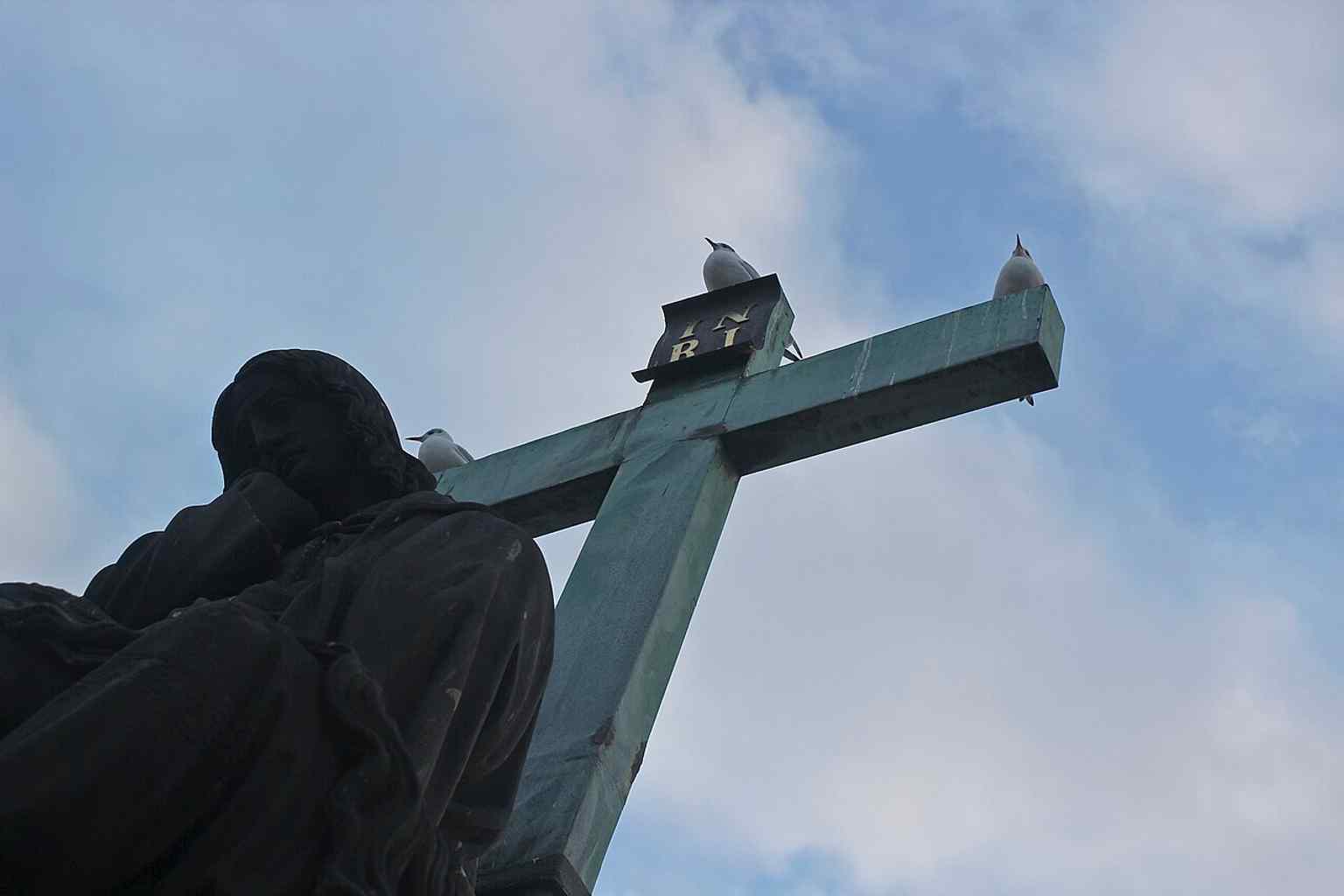
The Pietà statue stands resiliently on Charles Bridge, here seen amidst snowy conditions, reflecting its history of surviving natural elements and historical events.Photo: Sarah Wattouat, Wikimedia Commons, CC BY-SA 3.0. Cropped & resized. 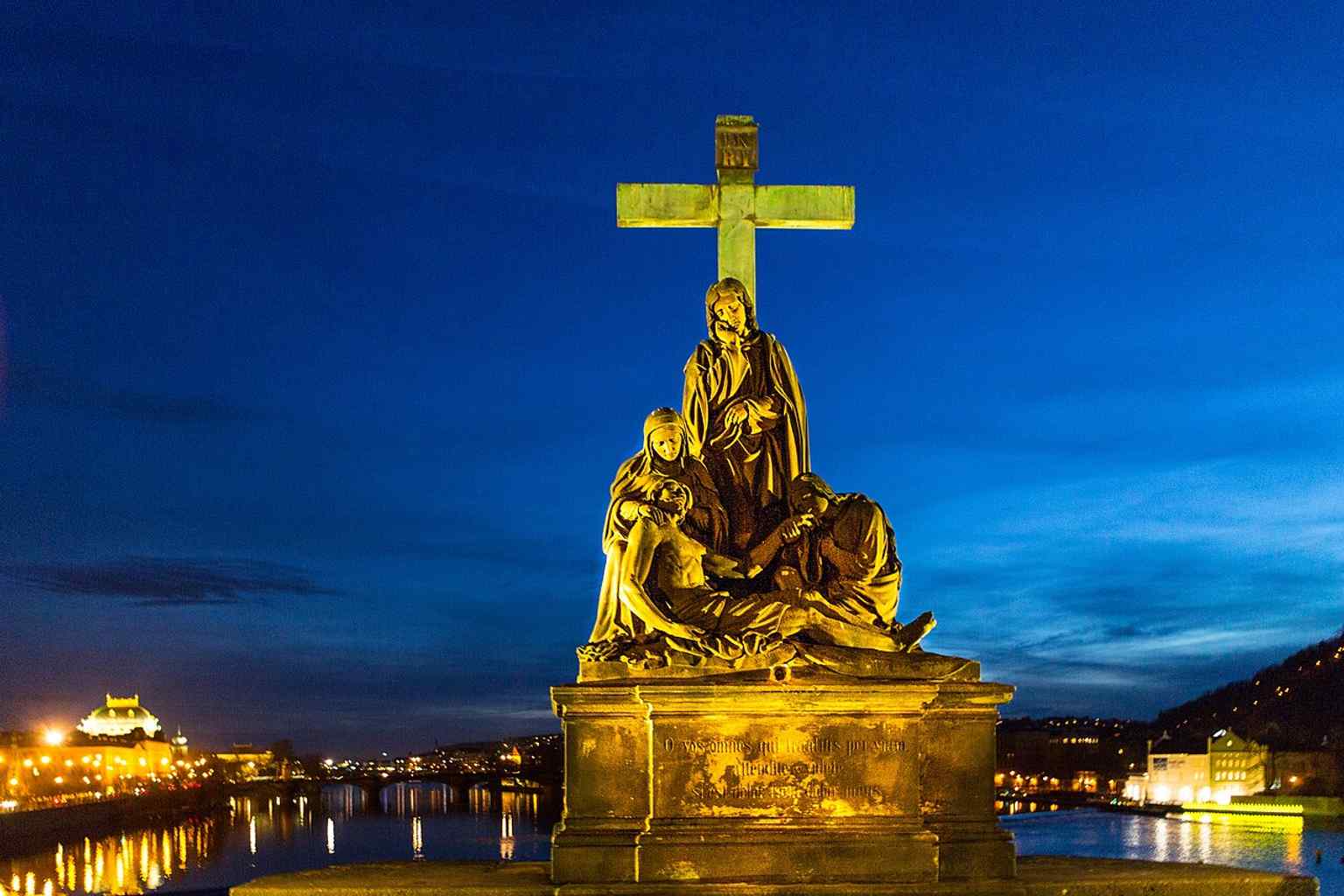
This daytime view showcases the restrained, Neoclassic style of Emanuel Max's sculpture, a deliberate contrast to the dramatic Baroque energy of its predecessor.Photo: Sebaso, Wikimedia Commons, CC BY-SA 3.0. Cropped & resized. 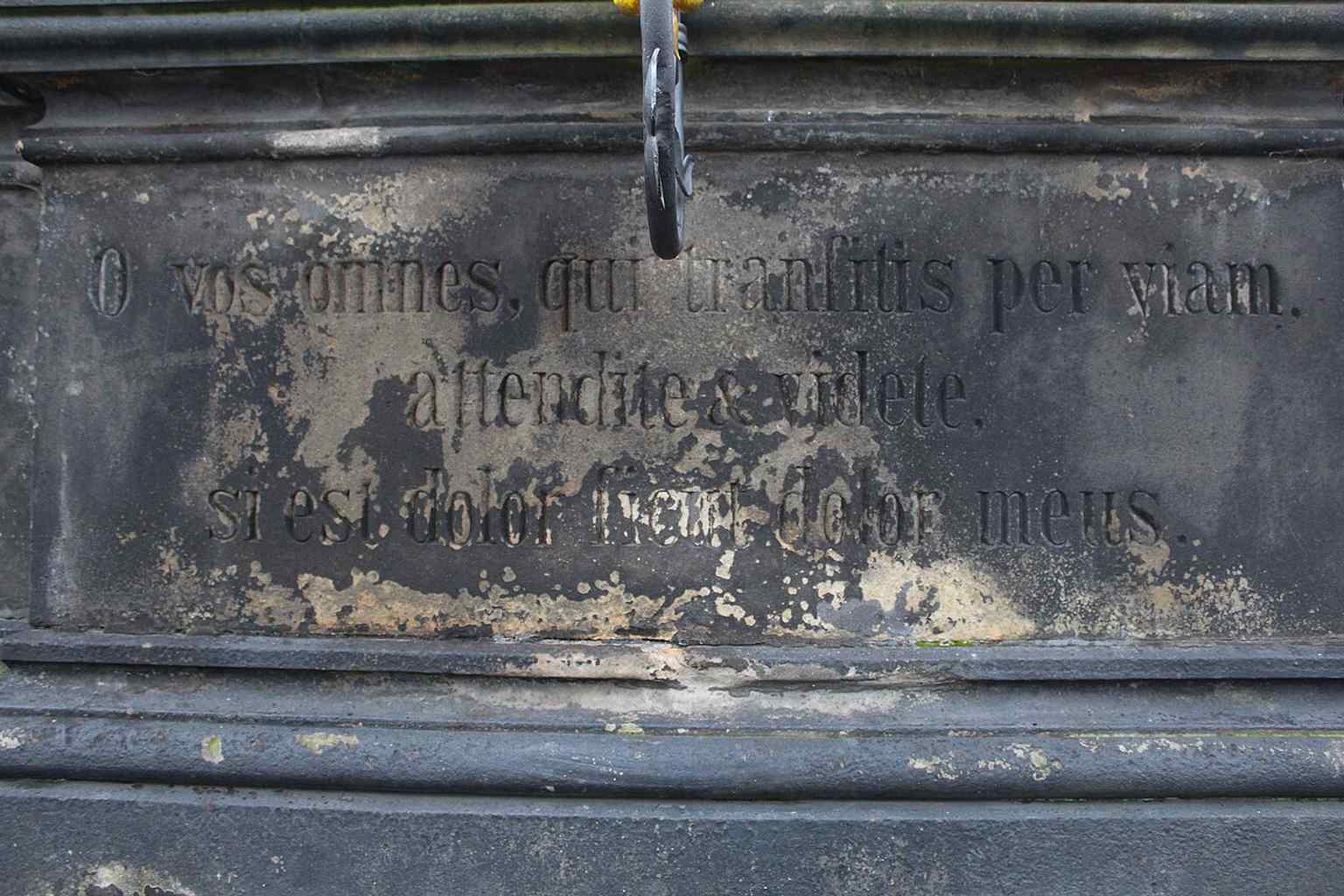
This wider view emphasizes the Pietà's integration into the historic row of statues along the Charles Bridge, a landmark frequently exposed to the elements and millions of tourists.Photo: Chabe01, Wikimedia Commons, CC BY-SA 4.0. Cropped & resized. 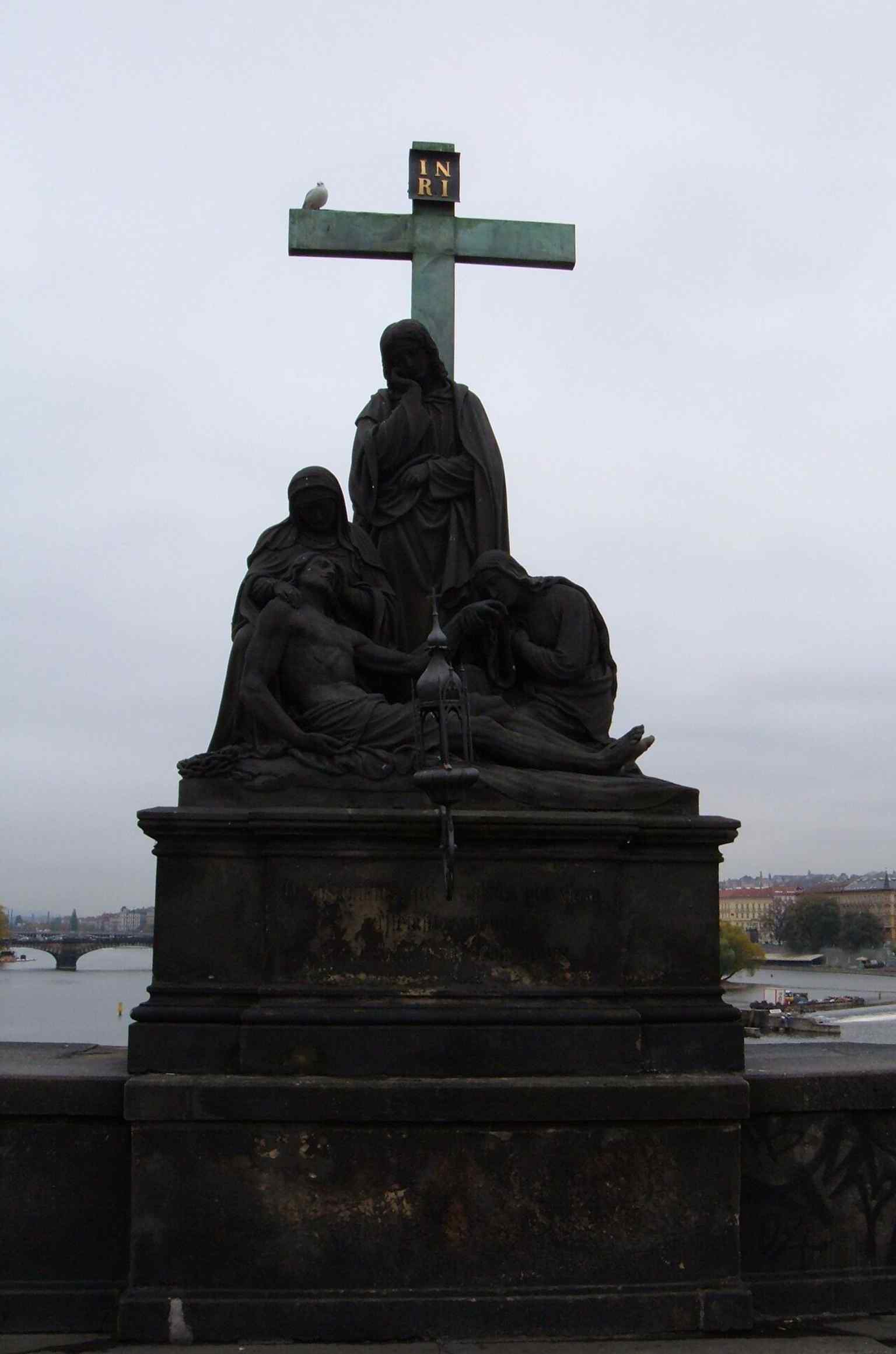
A detailed view captures the emotional depth of the sculpture, portraying the profound grief of the Virgin Mary holding the deceased Christ.Photo: BrokenSphere, Wikimedia Commons, CC BY-SA 3.0. Cropped & resized. 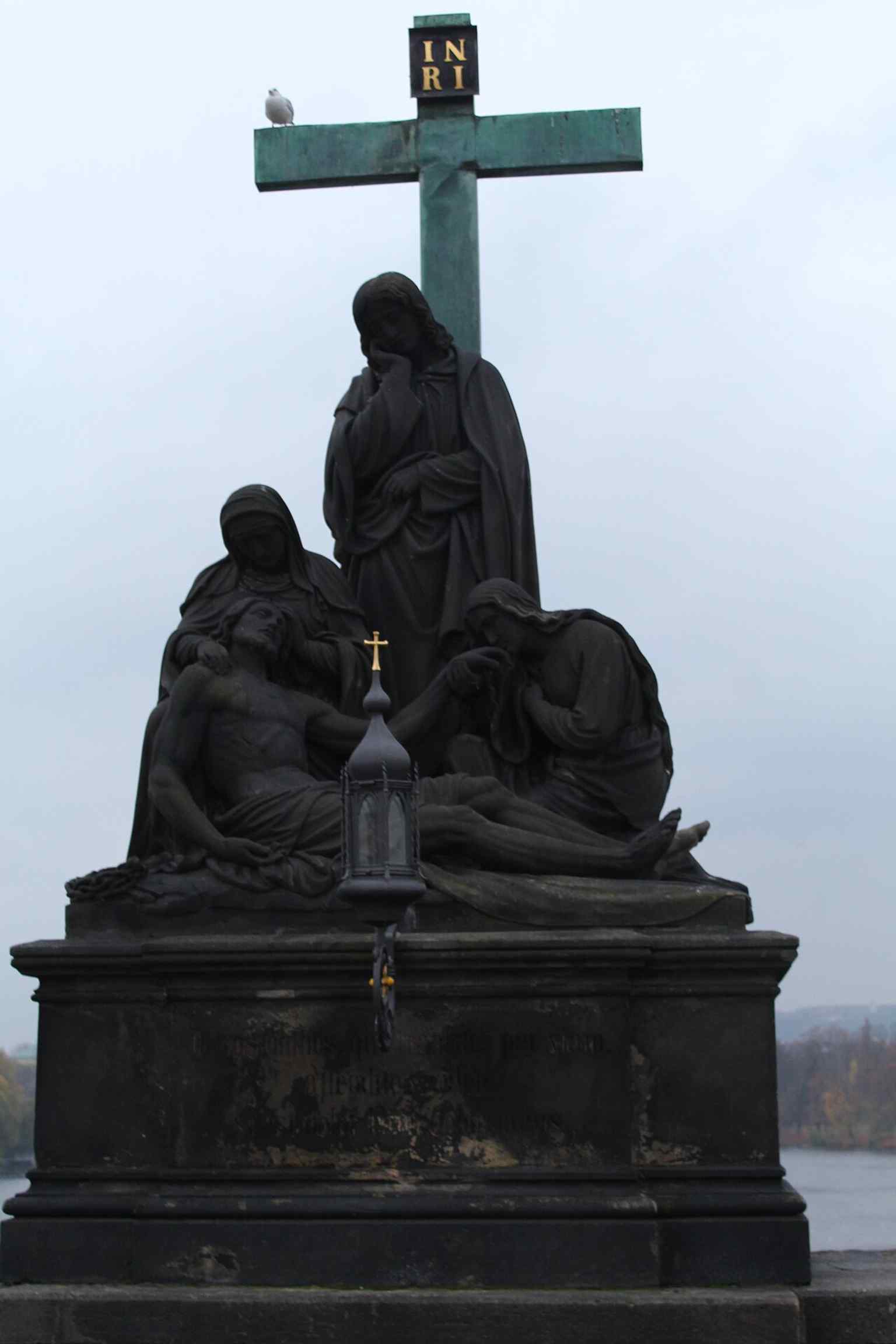
This close-up highlights the intricate sandstone work and details of the figures, which required extensive care in recent years to combat erosion and 'biological colonization'.Photo: Chabe01, Wikimedia Commons, CC BY-SA 4.0. Cropped & resized. Here on the stone railing, look for a tall sandstone pseudo-Gothic base supporting a sculpture of Saint Joseph gently leading a young Jesus by the hand. As we saw at our last stop…Read moreShow less
Open dedicated page →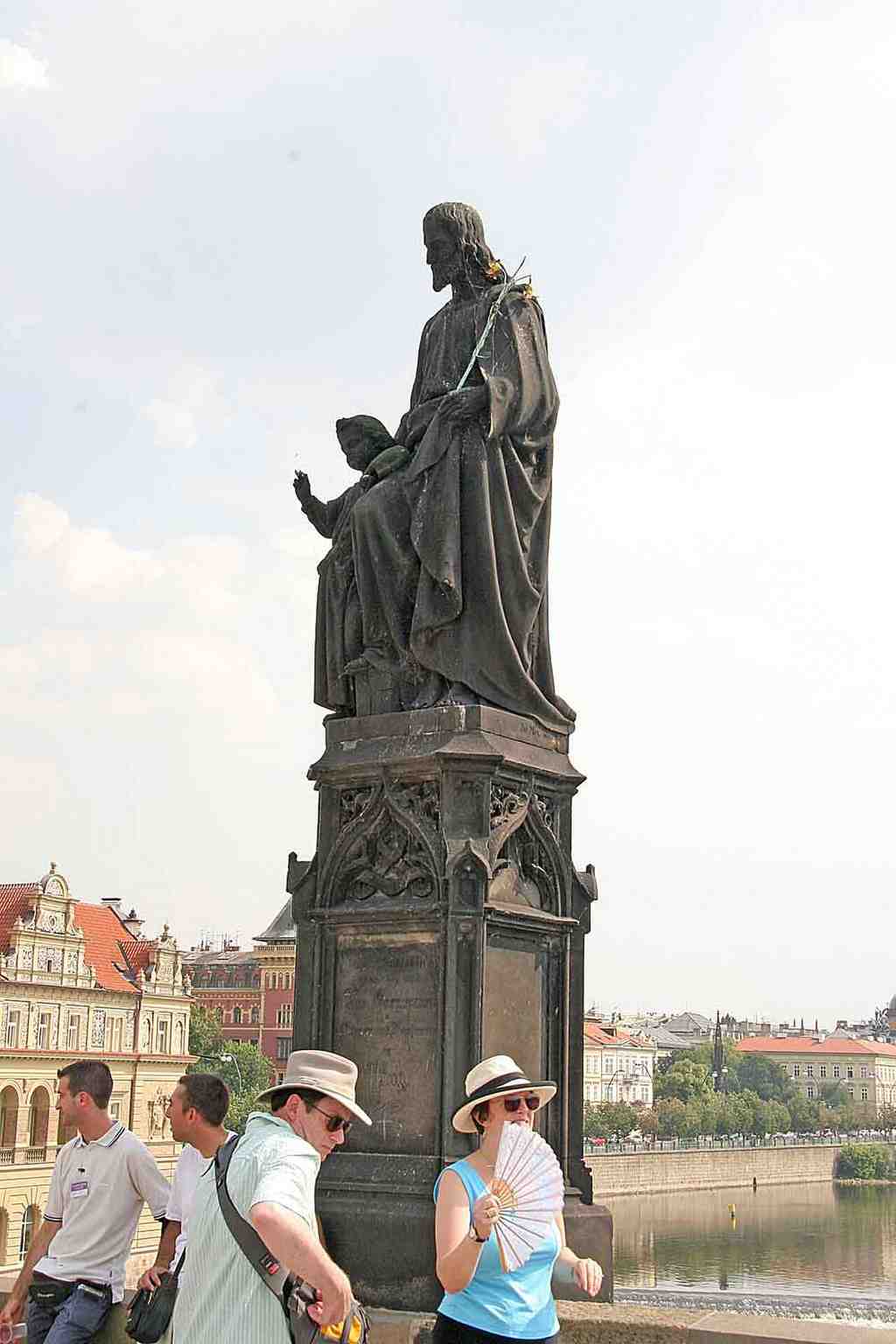
Statue von Saint Joseph, Charles BridgePhoto: cs user Zp, Wikimedia Commons, CC BY-SA 3.0. Cropped & resized. Here on the stone railing, look for a tall sandstone pseudo-Gothic base supporting a sculpture of Saint Joseph gently leading a young Jesus by the hand. As we saw at our last stop with the Pietà, art often gets caught in the crossfire of history.
The sculpture you see today is an eighteen fifty-four replacement. For nearly a century and a half, a grand Baroque masterpiece stood right here, sculpted in seventeen-o-six by the renowned Jan Brokoff. But then came the eighteen forty-eight Uprisings. As nationalist forces clashed with the Austrian Empire, the Charles Bridge became a literal battlefield. Cannon fire ripped across the river, and the original Saint Joseph took a direct, devastating hit. The damage was so catastrophic, the statue could not be saved.
If you pull up the photo in your app, you can see the surviving pieces of that original Baroque sculpture, which now rest in a local museum, bearing the scars of the city's turbulent past.
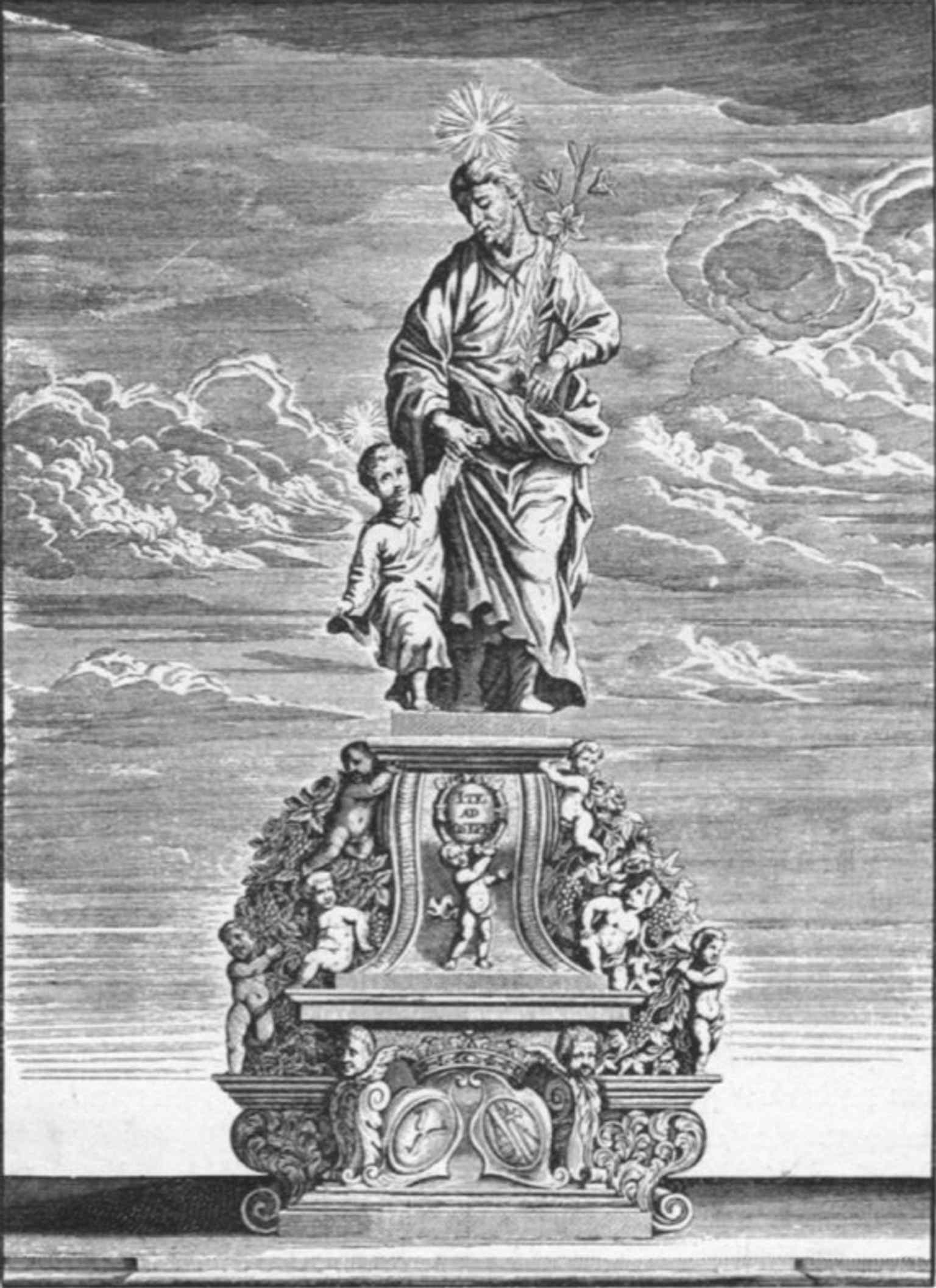
This image shows the original Baroque statue of Saint Joseph by Jan Brokoff, created in 1706, which now rests in the Lapidarium after being severely damaged in 1848.Photo: Augustin Neureuter (Neuräutter) (1685-1719), Wikimedia Commons, Public domain. Cropped & resized. But a destroyed monument is rarely the end of the story. A local tradesman stepped up to fund a new version by sculptor Josef Max. Take a glance at the next image on your screen. Max kept the tender motif of Joseph and Jesus but placed them on that uniquely tall pedestal, a style meant to modernize the bridge. It is fitting that Joseph, the patron saint of carpenters, stands as a testament to the fact that whatever history tears down, skilled hands will build back up.
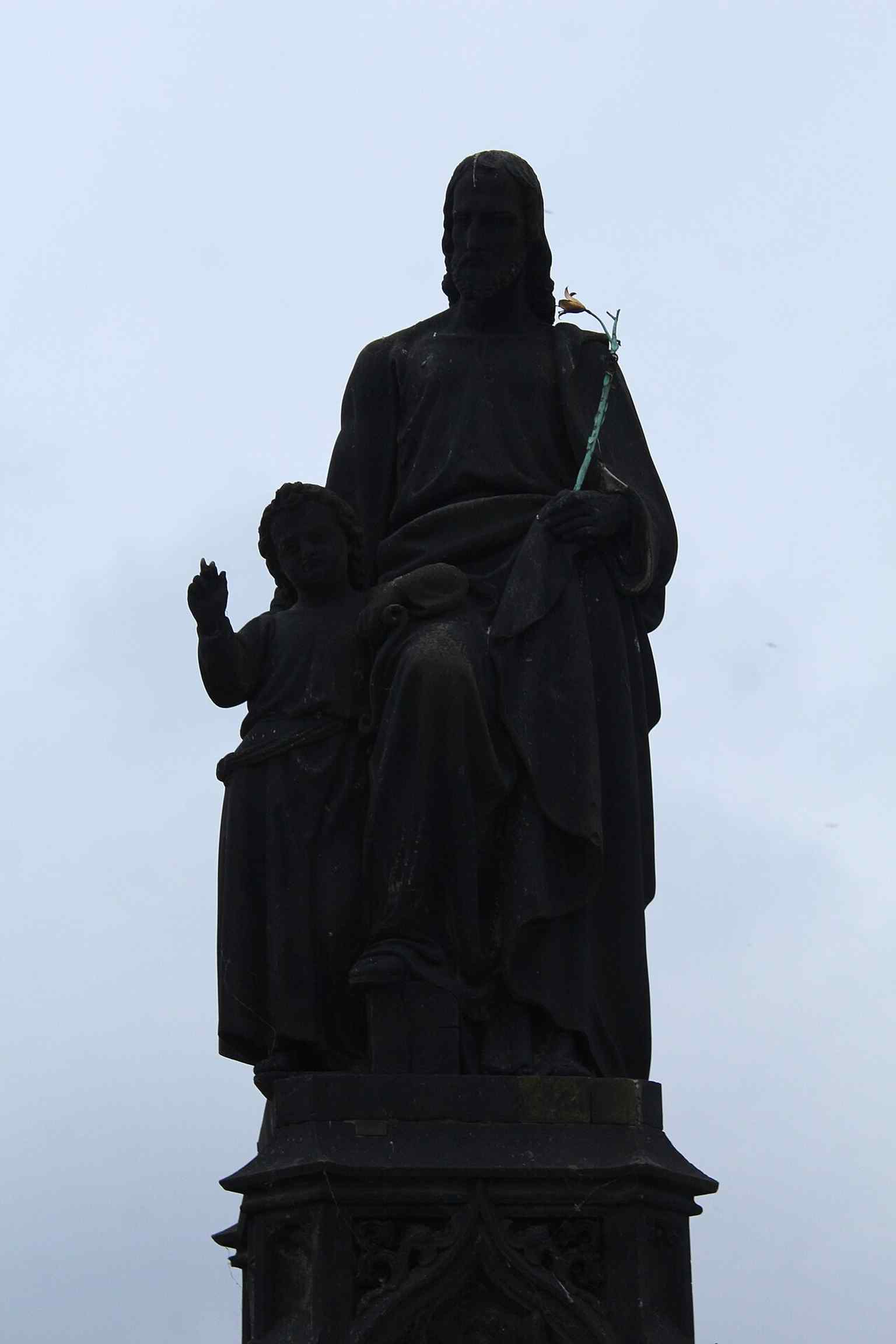
Josef Max's 1854 design for the current statue features a distinctively tall, pseudo-Gothic base, marking a stylistic departure from the bridge’s predominantly Baroque statuary.Photo: Chabe01, Wikimedia Commons, CC BY-SA 4.0. Cropped & resized. Let us keep walking along this bridge, which remains open twenty-four hours a day all week, to meet the protective matriarch of the bridge, Saint Anne.
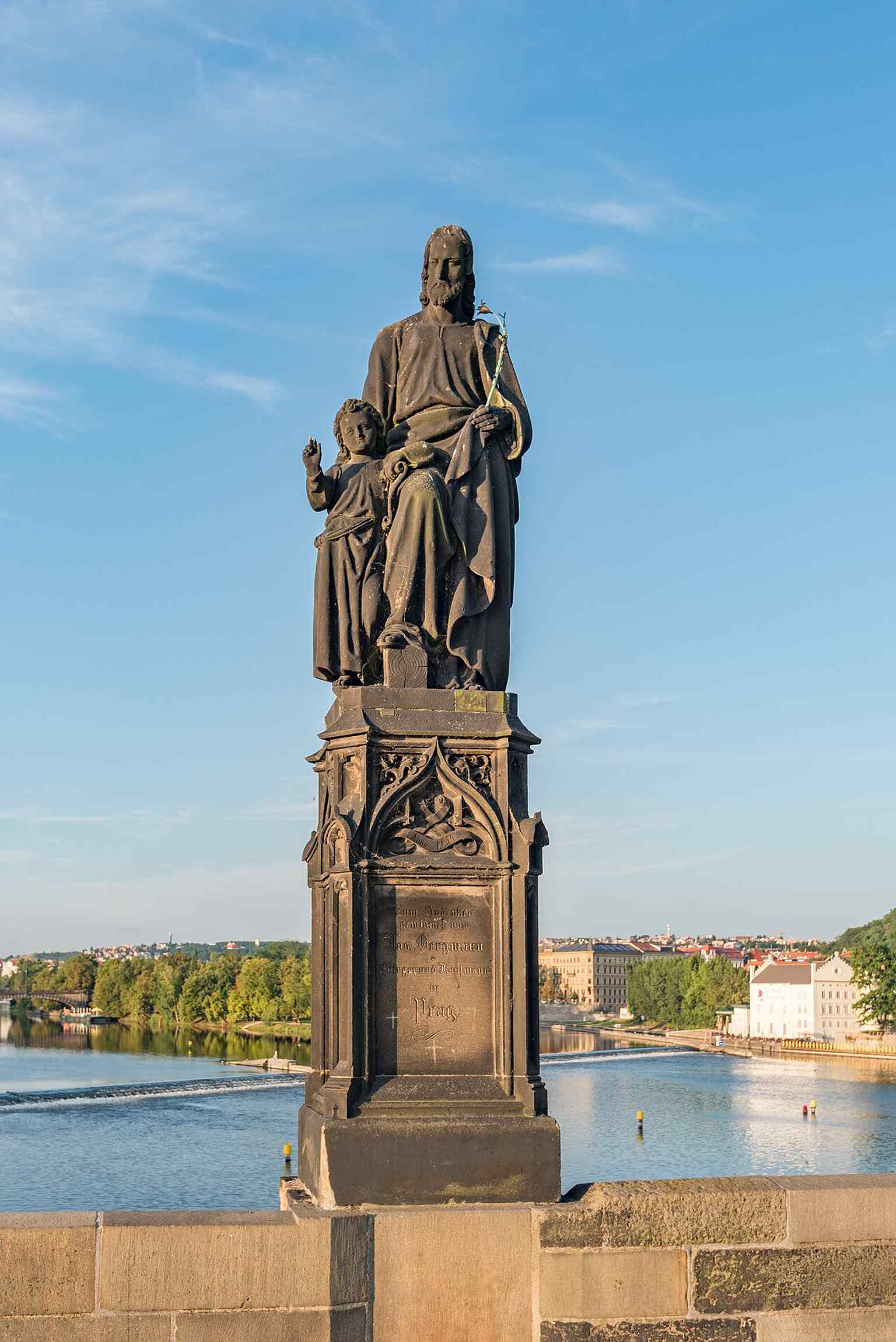
The current 19th-century sculpture by Josef Max depicts Saint Joseph tenderly leading the young Jesus by the hand, a motif retained from the original Baroque work.Photo: Tilman2007, Wikimedia Commons, CC BY-SA 4.0. Cropped & resized. 
Saint Joseph is the patron saint of carpenters, making this statue on the Charles Bridge a historically significant symbol for Prague's labor community.Photo: BrsJvnvc, Wikimedia Commons, CC BY 3.0. Cropped & resized. Look to your right for a pale sandstone sculpture group where a central matriarch cradles an infant, while a younger girl stands at her feet offering a carved bouquet of roses.…Read moreShow less
Open dedicated page →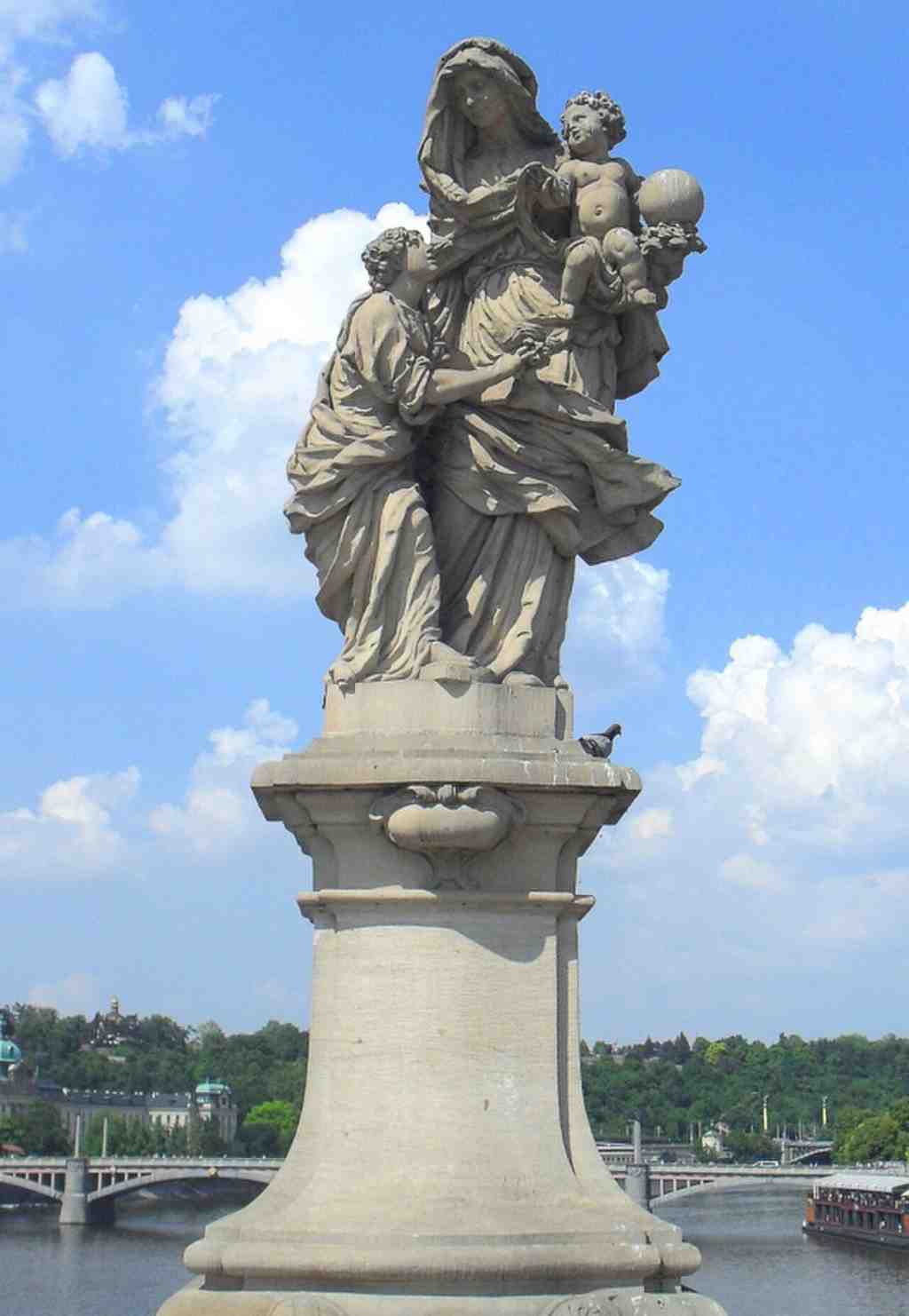
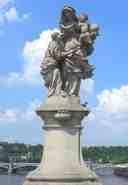
Statue von Saint Anne, Charles BridgePhoto: Aw58, Wikimedia Commons, CC BY-SA 3.0. Cropped & resized. Look to your right for a pale sandstone sculpture group where a central matriarch cradles an infant, while a younger girl stands at her feet offering a carved bouquet of roses. This is Saint Anne, created in seventeen oh seven by the sculptor Matěj Václav Jäckel.
The monument was bankrolled by Count Rudolf of Lisov, a powerful official in the Prague administration. For eighteenth-century nobles, sponsoring religious art here was the ultimate status symbol, essentially a Baroque billboard of piety and wealth.
Jäckel designed a Holy Kinship scene. Saint Anne holds her grandson, the infant Jesus, who grasps a globus cruciger, a globe topped with a cross symbolizing worldly dominion. Below them, a young Virgin Mary offers her mother those roses, balancing immense cosmic power with simple domestic affection.
While an aristocrat paid for the stone, the city's working-class millers claimed its soul. They adopted Saint Anne as their patron, seeking her divine protection against the devastating river floods that threatened their vital grain trade.
Over centuries, relentless weather and urban pollution slowly dissolved the soft stone. Refusing to let history be washed away, the city moved the original statue indoors to safety, installing this faithful replica in nineteen ninety-nine. Since the bridge is open twenty-four hours a day, she remains a constant presence.
Why do you think the city's working-class millers felt such a strong connection to this specific maternal figure?
Let that linger as we move straight ahead to the statue of Francis Xavier, where we will uncover one of the bridge's most dramatic tales of destruction.
On your right stands a dark stone monument shaped like a massive pyramid where a towering central figure is held aloft by a struggling group of men. Commissioned by Charles…Read moreShow less
Open dedicated page →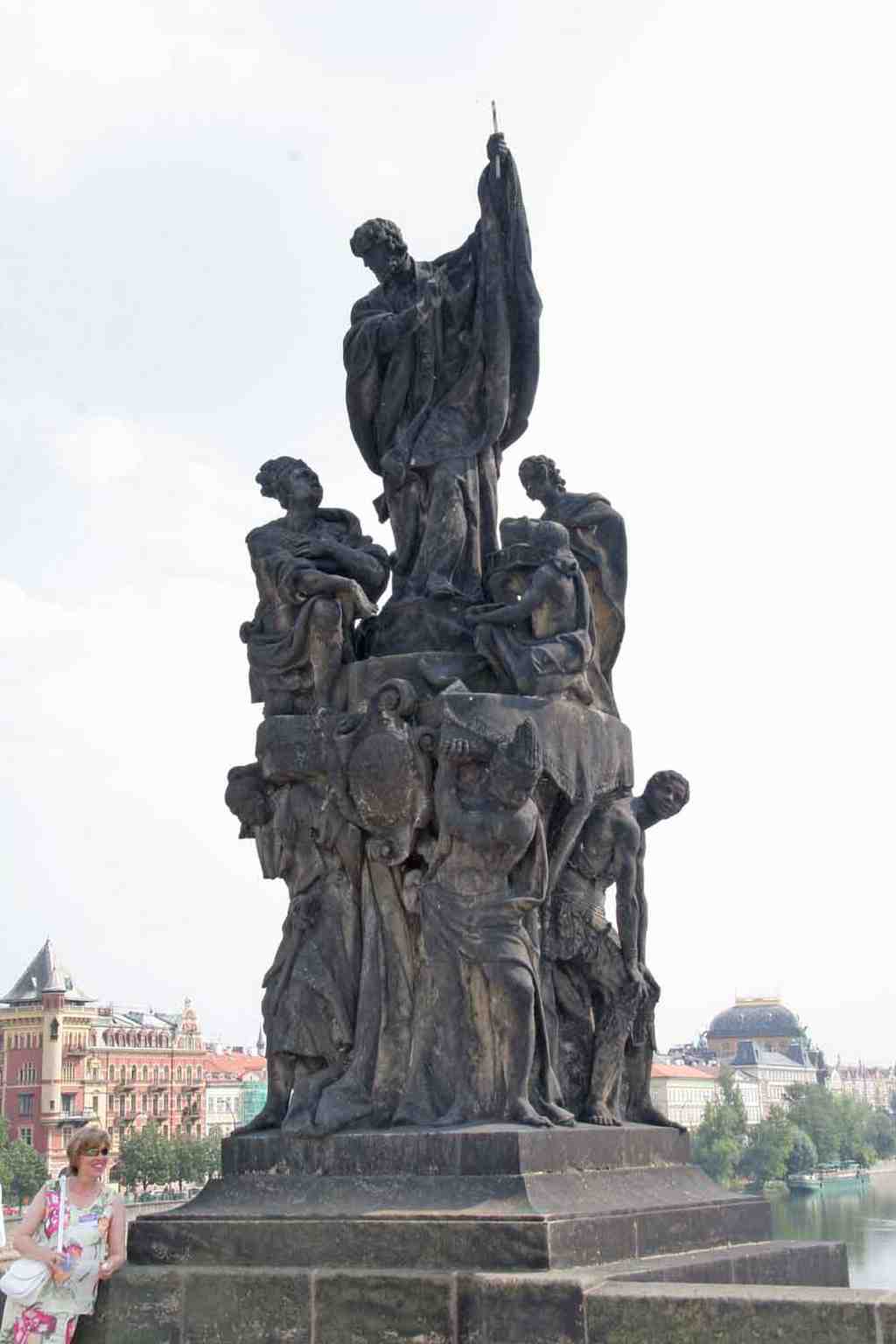
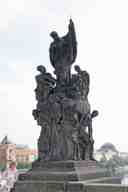
Statue von Francis Xavier, Charles BridgePhoto: Zp, Wikimedia Commons, CC BY-SA 3.0. Cropped & resized. On your right stands a dark stone monument shaped like a massive pyramid where a towering central figure is held aloft by a struggling group of men. Commissioned by Charles University in seventeen eleven, this ambitious sculpture of Francis Xavier is widely considered the undisputed masterpiece of Ferdinand Brokoff. Amazingly, he was only twenty-three years old when he carved this.
Scan the crowded base supporting the saint and see if you can find the young man standing directly beneath the saint's hand, holding a cross. That is Brokoff himself, carving his own confident legacy right into the stone. Check your app for a close-up of his hidden portrait.
But that youthful triumph met a brutal reality during The Great Flood of eighteen ninety. Heavy rains turned the river into a battering ram of debris, collapsing three arches of this very bridge. Brokoff’s masterpiece plummeted into the raging water. For over a decade, his proud self-portrait sat buried in the mud.
When salvage crews pulled the heavy fragments from the riverbed in nineteen o one, it marked a profound moment of destruction and rebirth. You can look at your screen to see the original shattered pieces, now resting safely in a museum. This meticulous nineteen thirteen replica stands exactly where the original fell.
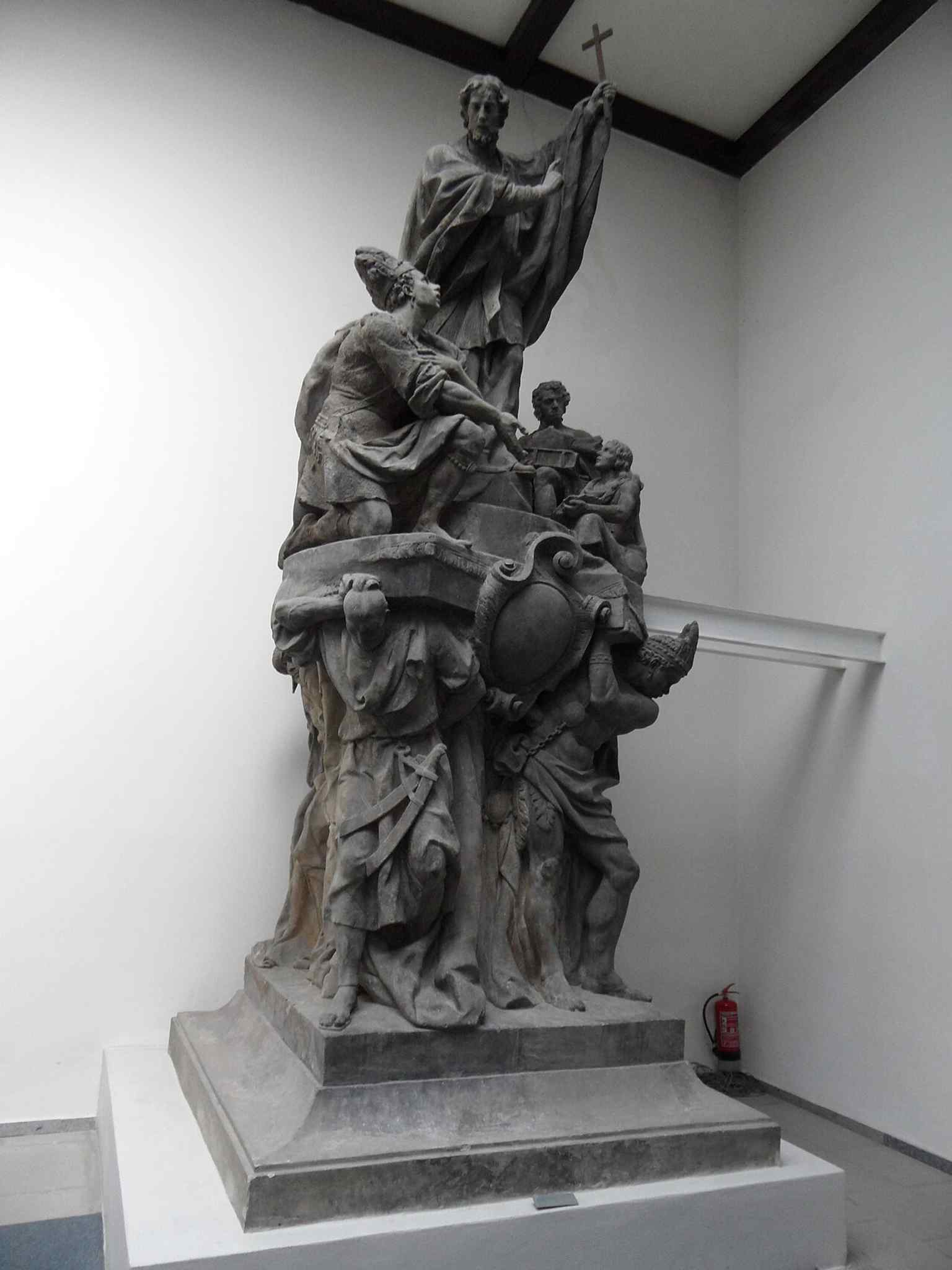
Fragments of the original sandstone sculpture, which suffered a catastrophic fate during the Great Flood of 1890 and remained submerged, now preserved in the Lapidarium of the National Museum.Photo: Ondraness, Wikimedia Commons, CC BY-SA 4.0. Cropped & resized. Look across the bridge at the water below, imagining the flood's longest-lasting scar, before we step right over to the nearby Statues of Saints Cyril and Methodius. You can visit this spot whenever you like since the bridge is open twenty-four hours a day.
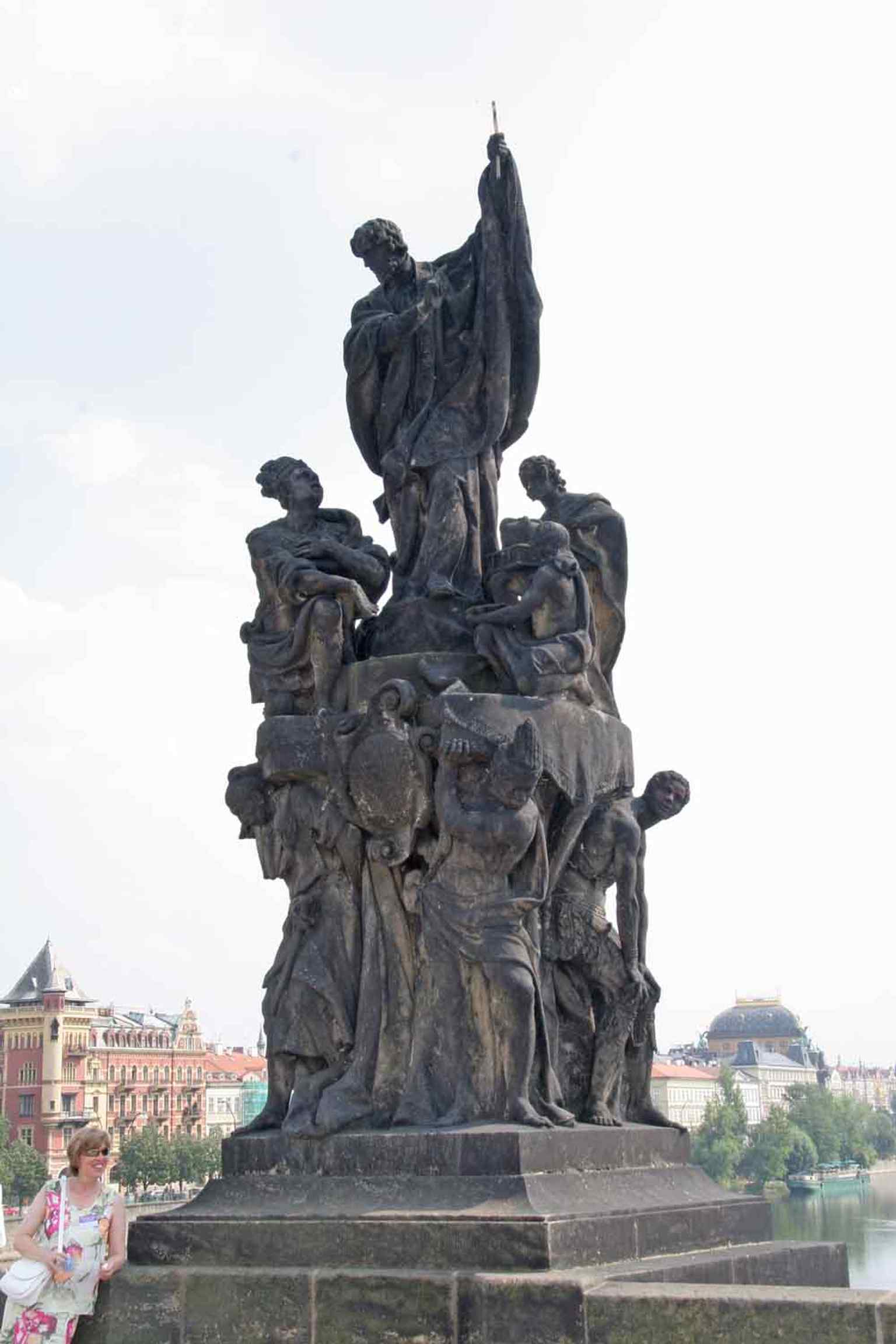
The meticulously crafted replica of the Statue of Francis Xavier by Čeněk Vosmík, installed on the Charles Bridge in 1913, preserving Brokoff's original Baroque vision.Photo: Zp, Wikimedia Commons, CC BY-SA 3.0. Cropped & resized. 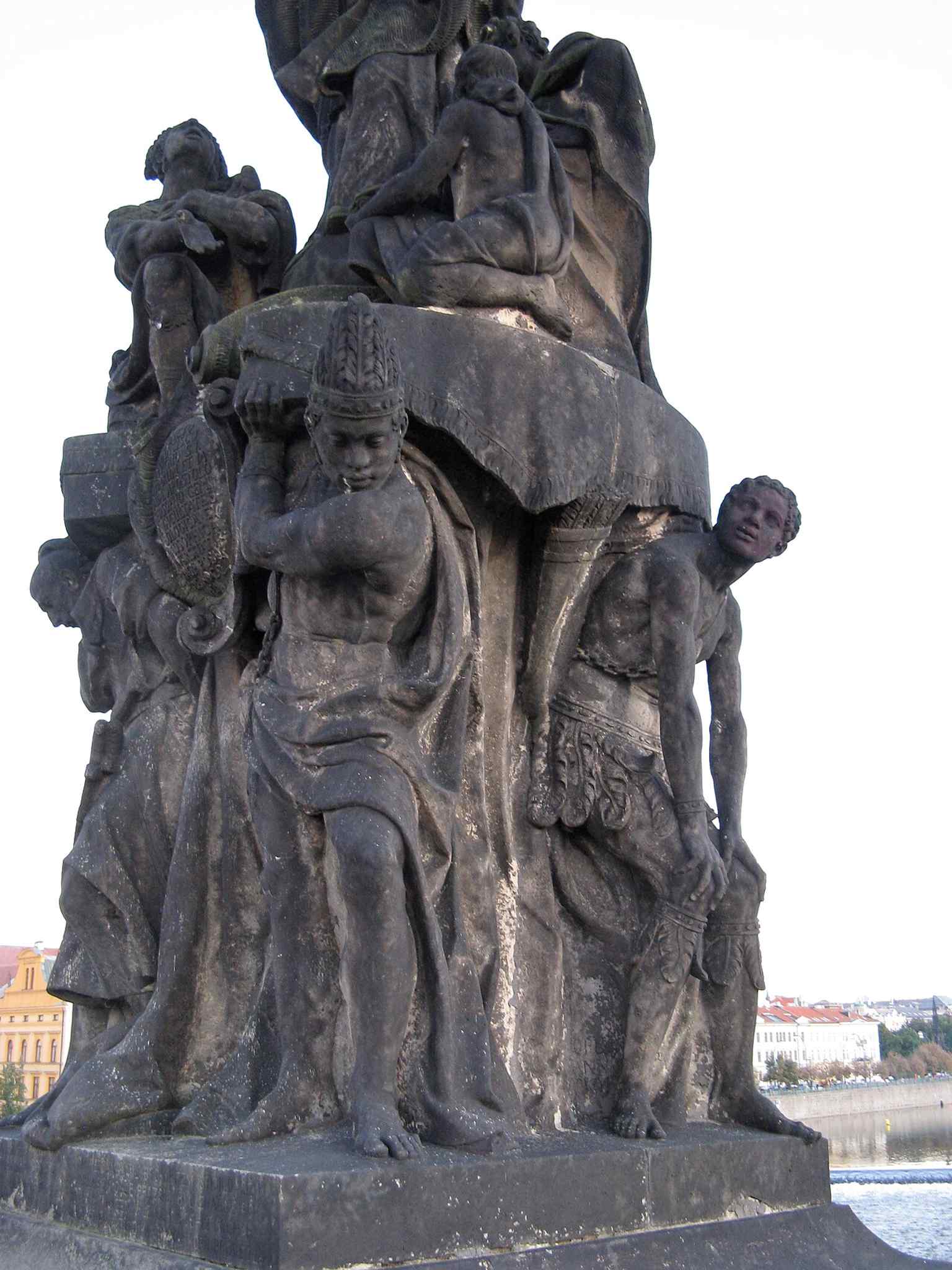
The replica of the statue on Charles Bridge, noted for its ambitious scale as the entire central group is held aloft by figures representing regions where Xavier preached.Photo: Yair Haklai, Wikimedia Commons, CC BY-SA 3.0. Cropped & resized. 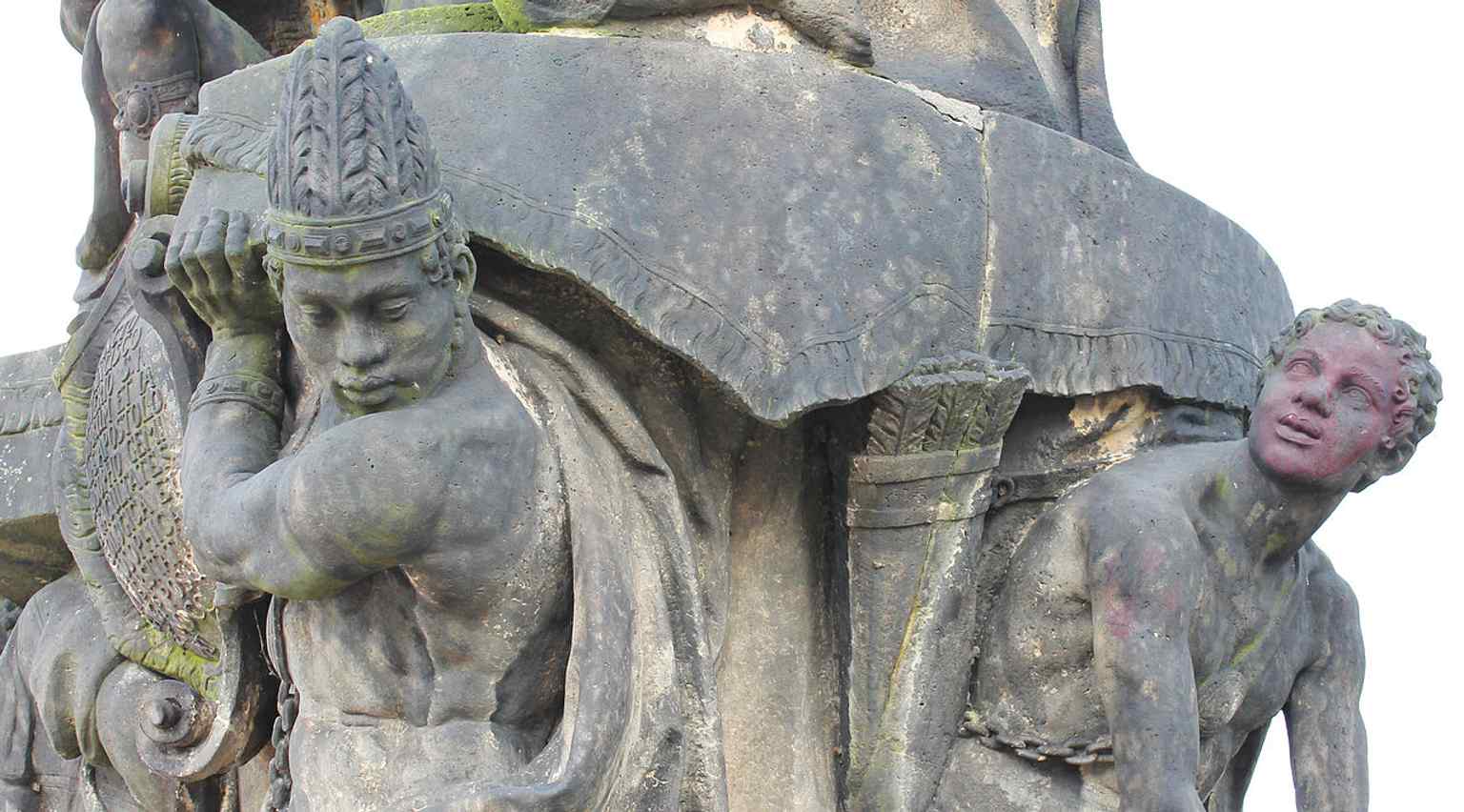
One of the diverse figures at the base of the statue, representing a Moor, symbolizing one of the 'four corners of the world' reached by Saint Xavier's missions.Photo: Sarah Stierch, Wikimedia Commons, CC BY 4.0. Cropped & resized. 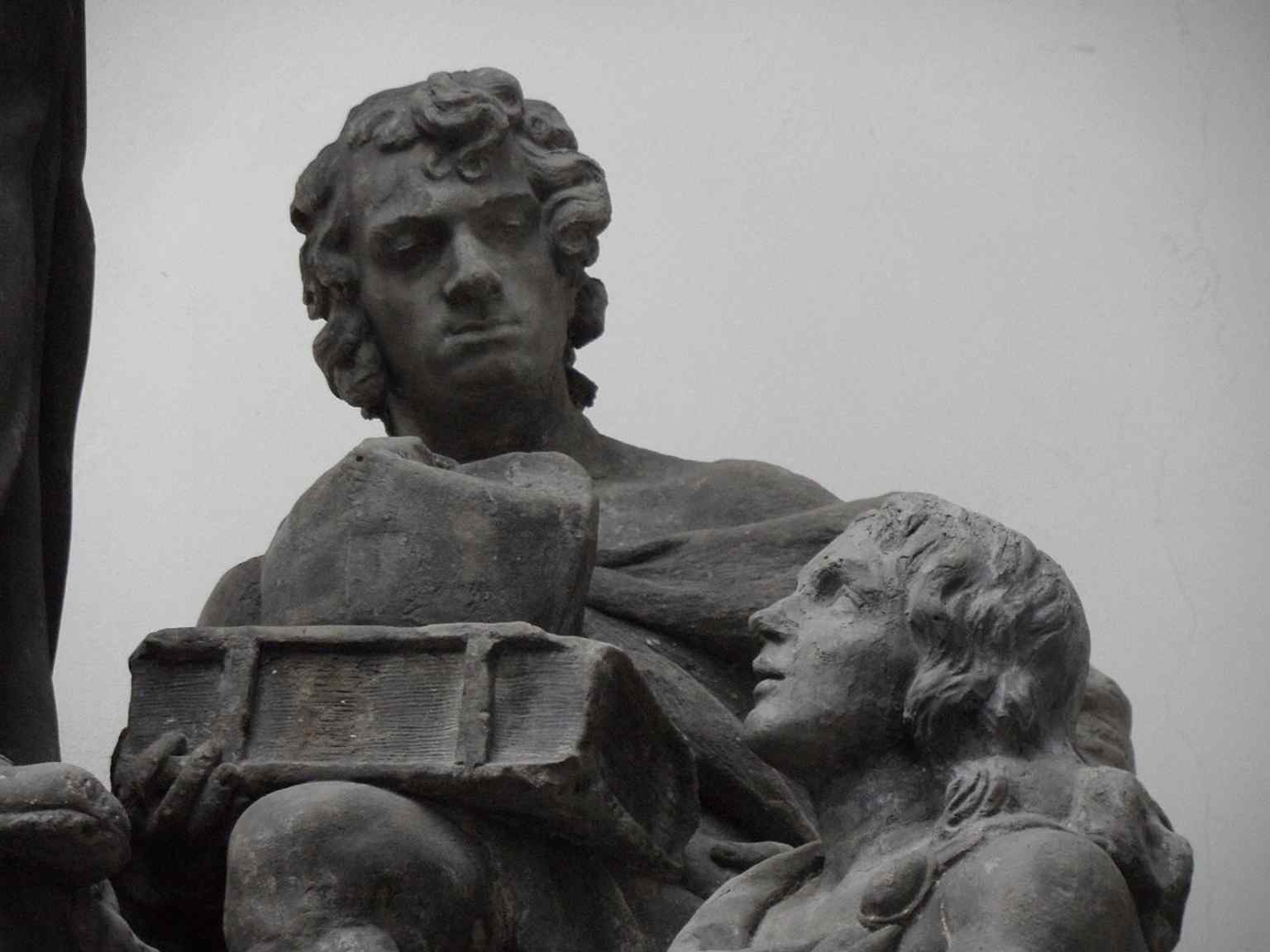
The notable fragment of the original statue containing Brokoff’s self-portrait (the head of the young man), which was reportedly kept for a time by sculptor Josef Václav Myslbek.Photo: Ondraness, Wikimedia Commons, CC BY-SA 4.0. Cropped & resized. 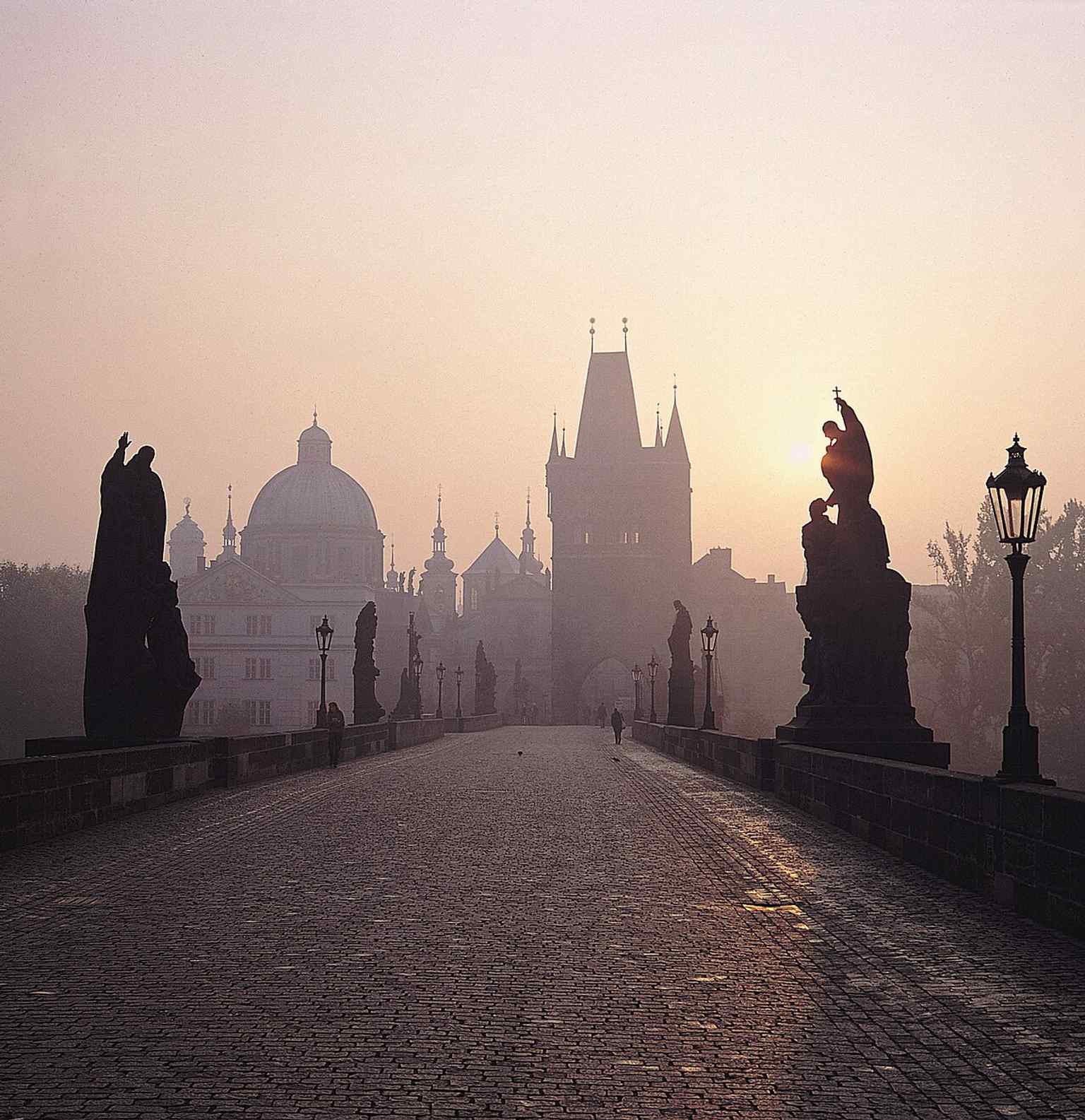
A morning view of the Charles Bridge, where the statue stands on the south side, serving as a lasting reminder of the bridge's vulnerability to the elements.Photo: Estec GmbH, Billig Hotel in Prag, Wikimedia Commons, CC BY 3.0. Cropped & resized. 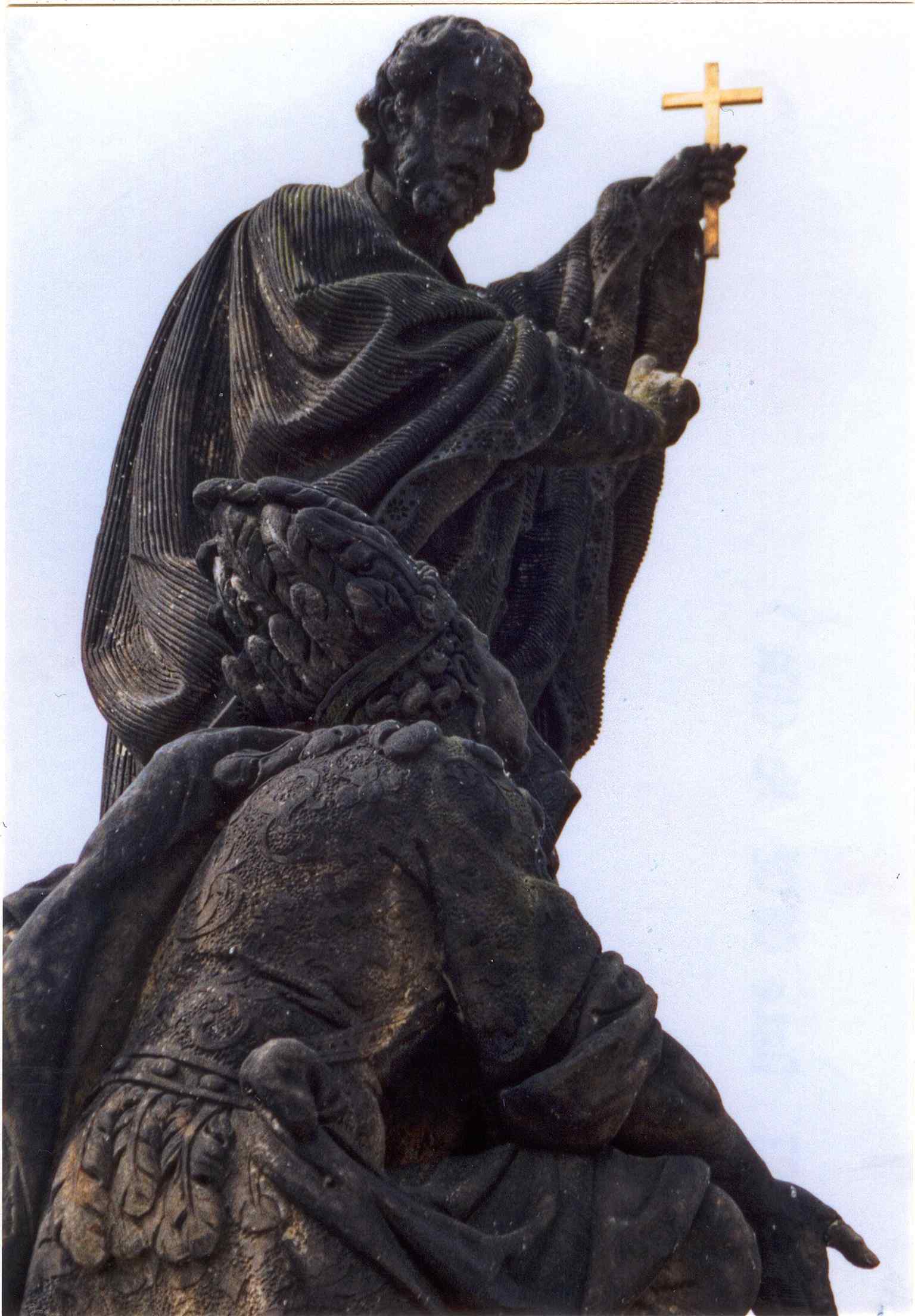
The dramatic composition of the Saint Francis Xavier statue in its context on the Charles Bridge, which had a significant impact on later Czech art, inspiring works like the Monument to Marshal Radetzky.Photo: Txllxt TxllxT, Wikimedia Commons, CC BY-SA 4.0. Cropped & resized. 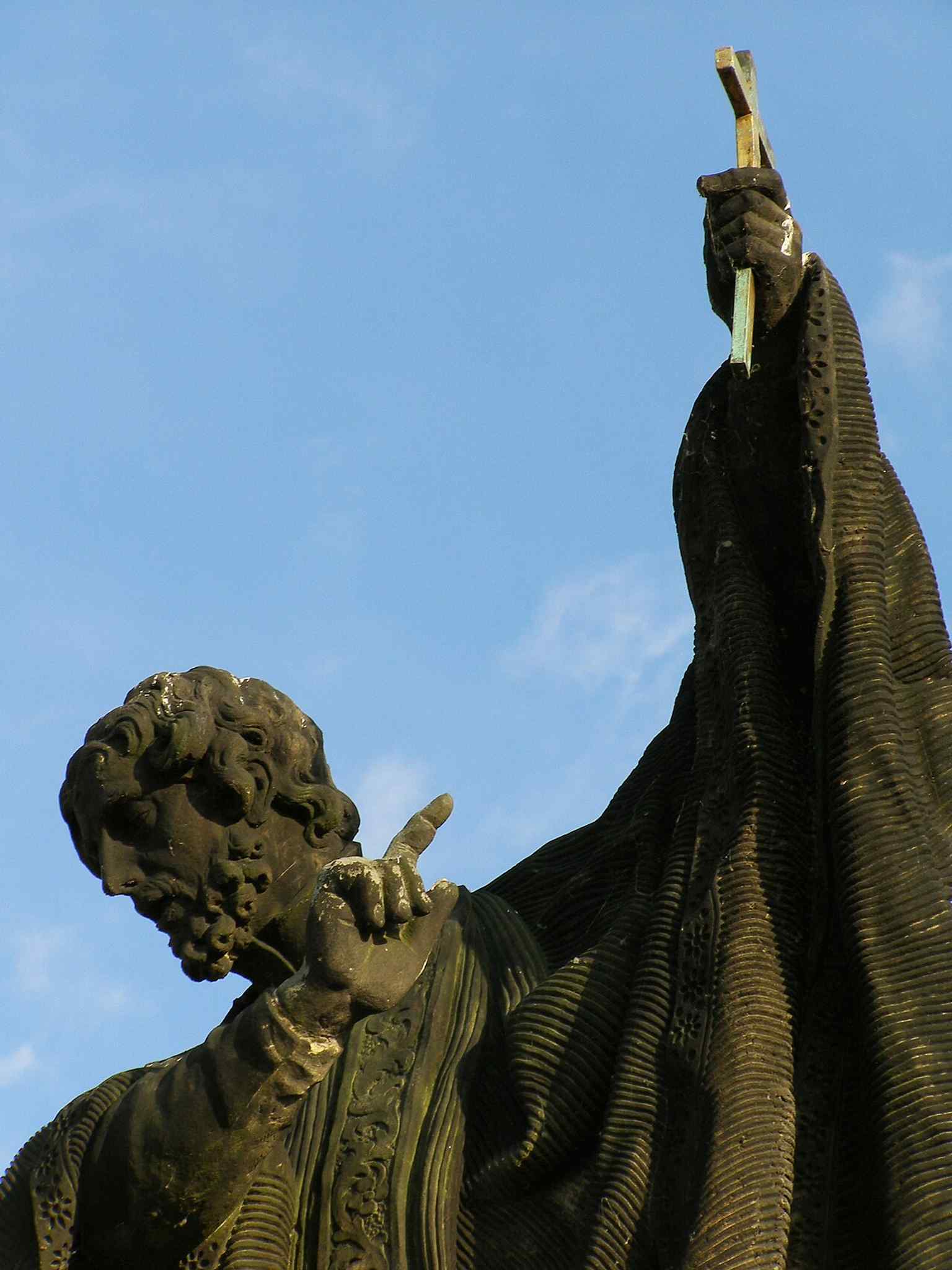
The nearby sculpture of Saint Ignatius of Loyola, which, like Brokoff’s statue of Francis Xavier, plummeted into the raging Vltava River during the Great Flood of 1890.Photo: Michal Kmínek, Wikimedia Commons, CC BY-SA 3.0. Cropped & resized. On your right, you will see a dark stone monument where the tallest figure stands with one hand raised in blessing, towering over smaller figures on a rocky base. This spot holds…Read moreShow less
Open dedicated page →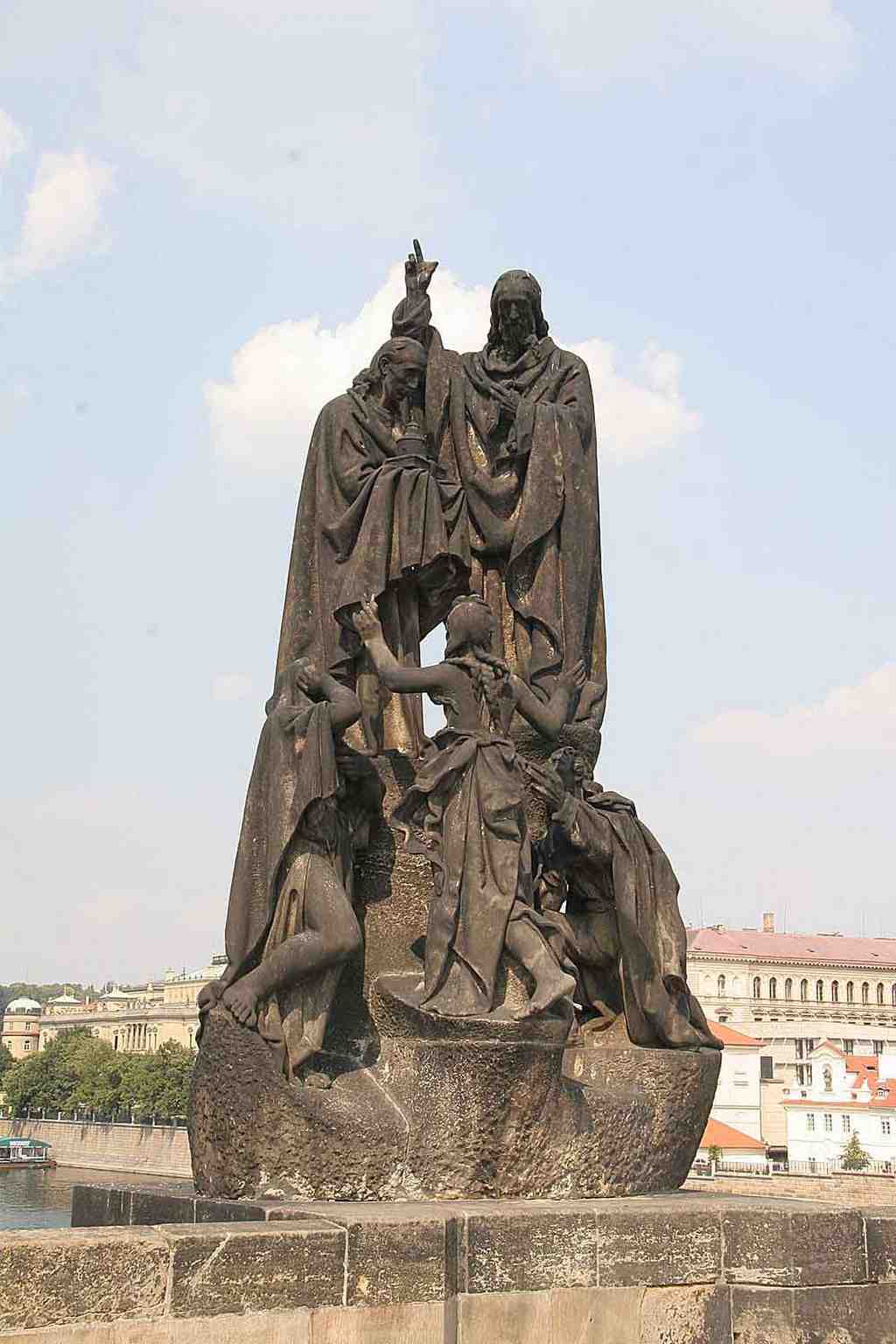
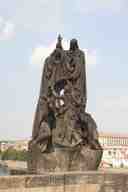
Statuen der Heiligen Cyril und Methodius, Charles BridgePhoto: Zp, Wikimedia Commons, CC BY-SA 3.0. Cropped & resized. On your right, you will see a dark stone monument where the tallest figure stands with one hand raised in blessing, towering over smaller figures on a rocky base.
This spot holds a ghost story of sorts. For nearly one hundred and eighty years, a magnificent Baroque statue of Saint Ignatius of Loyola stood exactly where you are looking. But on the fourth of September, eighteen ninety, during that same Great Flood, the Vltava River turned into a battering ram. After relentless rain, heavy logging rafts and debris surged downstream, forming a massive, deadly barrier against the arches of the bridge. The immense pressure eventually snapped three arches and two pillars, sending Saint Ignatius crashing into the dark torrent below, along with several unfortunate souls who were standing right where you are now.
Take a look at the fifth image in your app to see a striking artistic rendition of what eventually took its place.
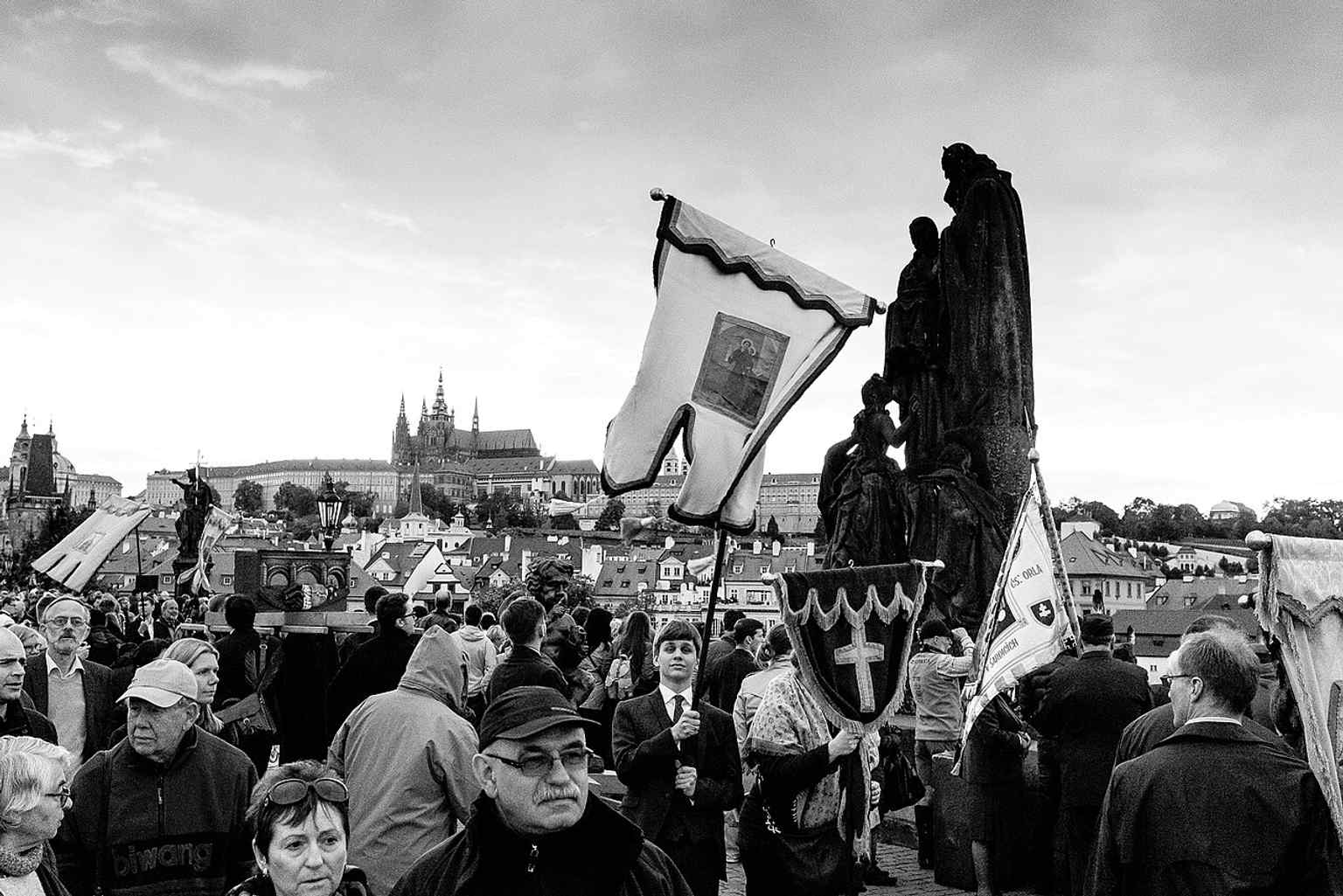
A striking black and white rendition of the statuary, highlighting Karel Dvořák's strongly composed figures and the artistic sensibilities of the First Czechoslovak Republic.Photo: Fleeting Pix, Wikimedia Commons, CC BY-SA 3.0. Cropped & resized. For decades, this pedestal sat empty, a painful reminder of what was lost. It was not until nineteen twenty-eight that a newly independent Czechoslovak Republic decided to fill the void. Instead of replacing the Jesuit saint, they chose figures deeply rooted in their own national identity, the ninth-century Slavic missionaries, Saints Cyril and Methodius.
The sculptor, Karel Dvořák, spent ten agonizing years perfecting this piece. You can see his highly structured, modern style in the towering Saint Methodius offering a blessing, while Saint Cyril holds a newly translated Bible and a small model of a rotunda, a round stone church representing the earliest Christian sanctuary in the Czech lands. The figures reaching up from the bottom represent Bohemia, Moravia, and Slovakia, receiving the gift of faith.
It took a tragic loss to clear the way, but this monument stands as a lasting testament to destruction and rebirth. Since the bridge is open twenty-four hours a day, these figures keep a constant, quiet watch over the water. Let us leave the bridge behind and head toward the museum of a musical legend, making our way to the statue of Bedřich Smetana.
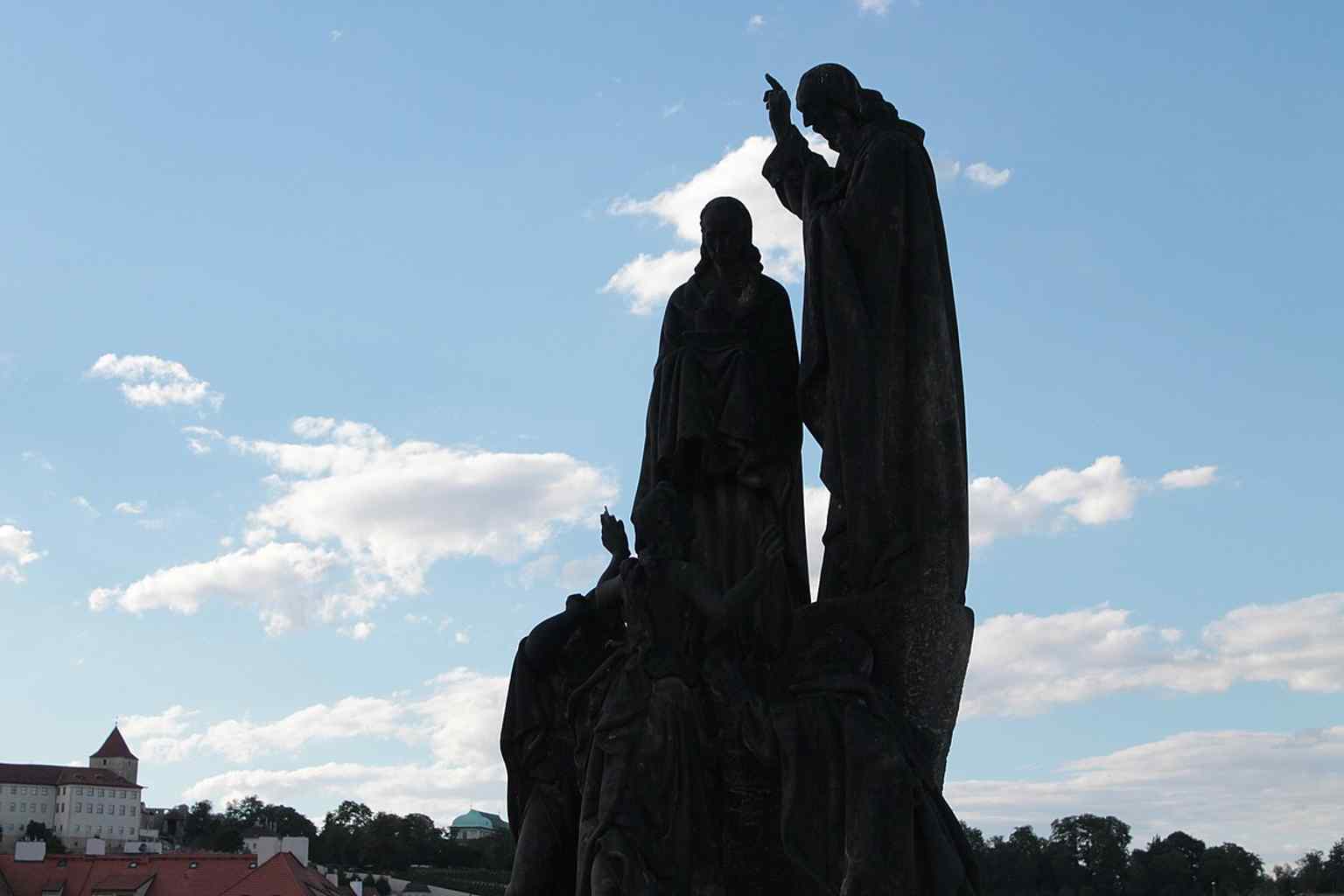
The Saints Cyril and Methodius statuary bathed in the warm light of sunset, representing a symbolic bridge between medieval history and modern Czech identity.Photo: John Samuel, Wikimedia Commons, CC BY-SA 4.0. Cropped & resized. 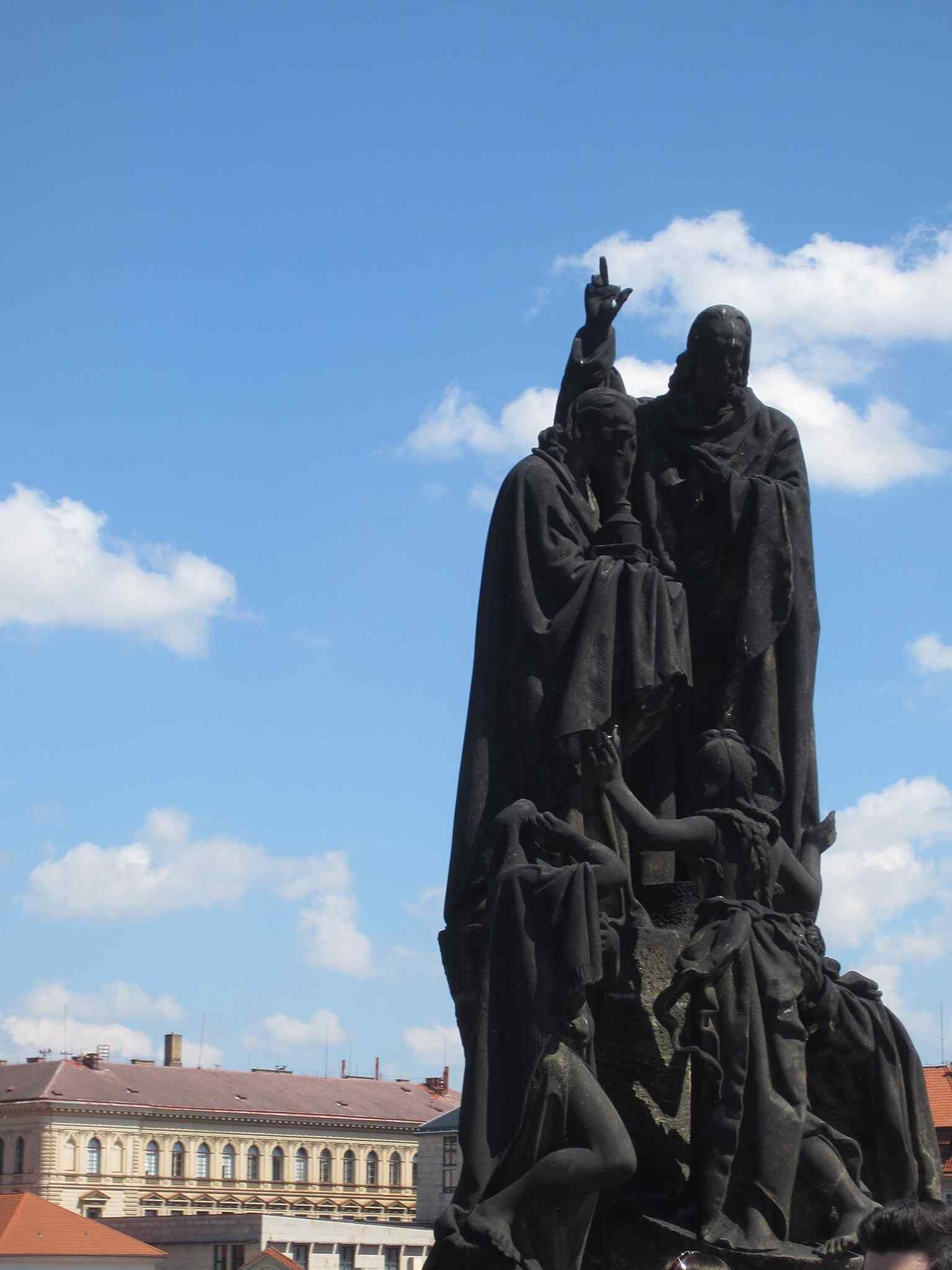
Observe Saint Methodius, the dominant figure, depicted with his hand raised in a gesture of blessing over the converts.Photo: Another Believer, Wikimedia Commons, CC BY-SA 4.0. Cropped & resized. 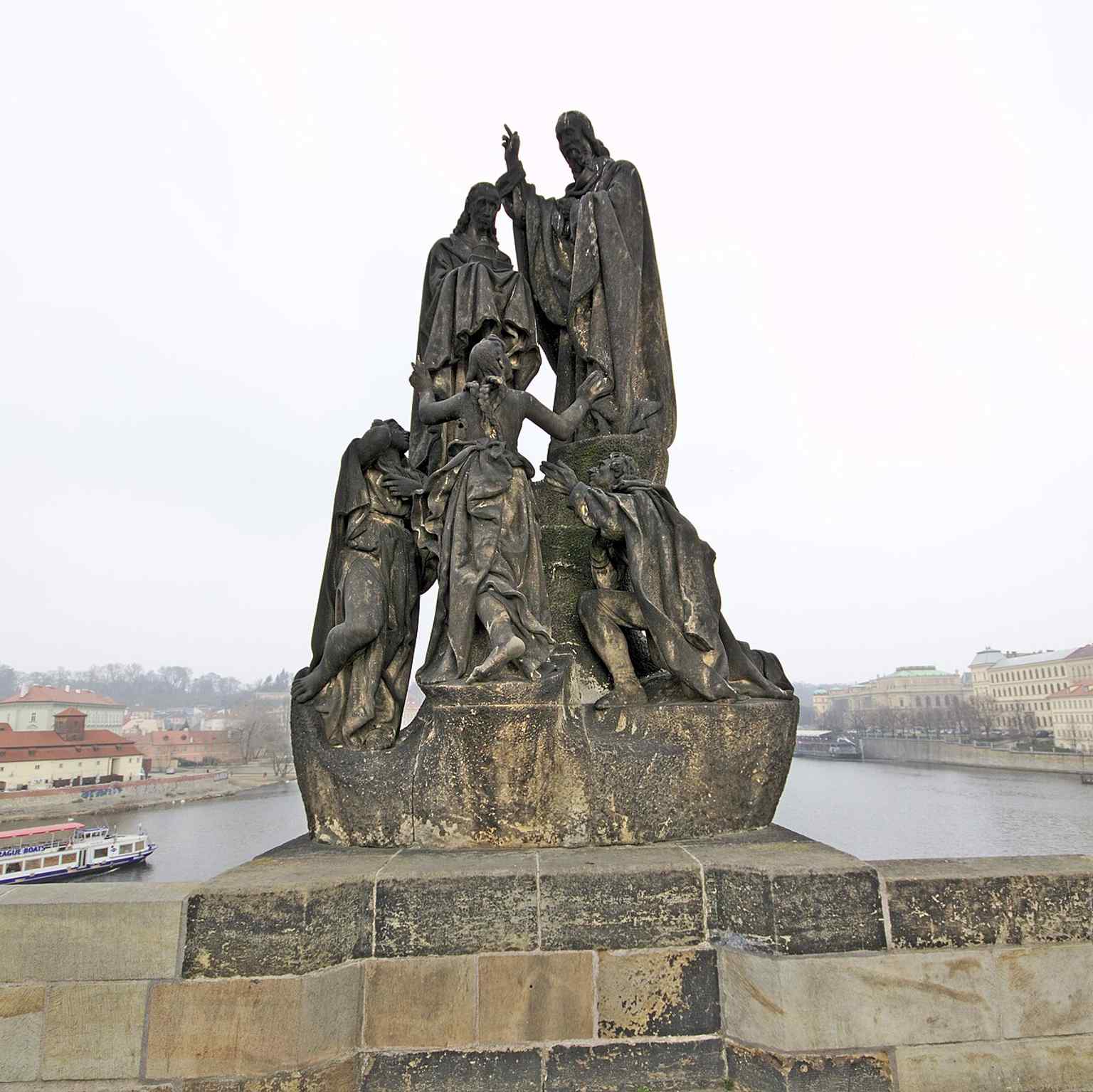
A closer look at Saint Cyril, presenting a newly translated Bible and holding a model of a Romanesque rotunda, representing the earliest Christian sanctuary in the Czech lands.Photo: Sage Ross, Wikimedia Commons, CC BY-SA 3.0. Cropped & resized. 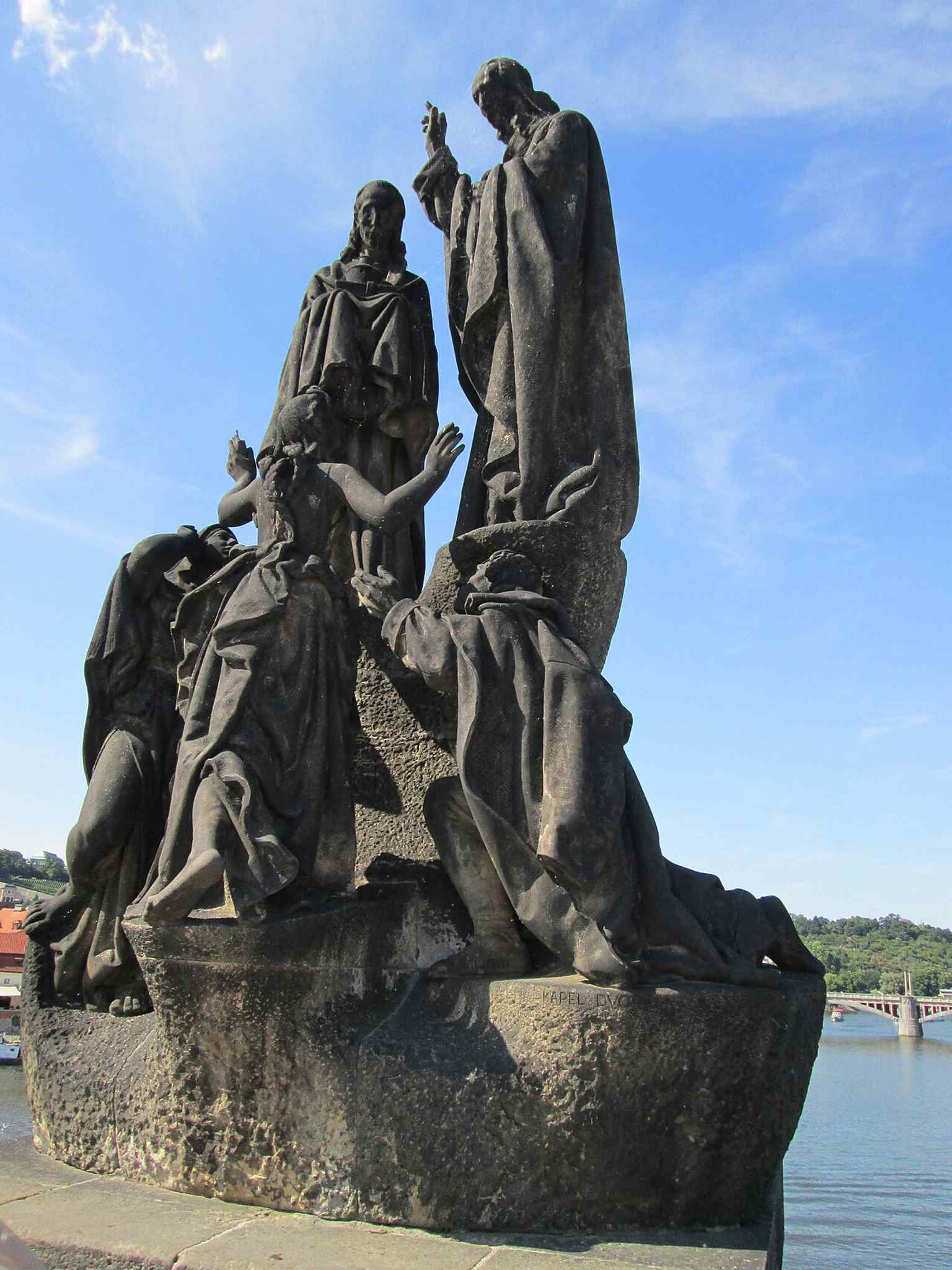
The figures at the base, with outstretched arms, symbolize Bohemia, Moravia, and Slovakia, representing the nations of Czechoslovakia receiving the gift of faith and literacy.Photo: Mahufi, Wikimedia Commons, CC BY-SA 4.0. Cropped & resized. 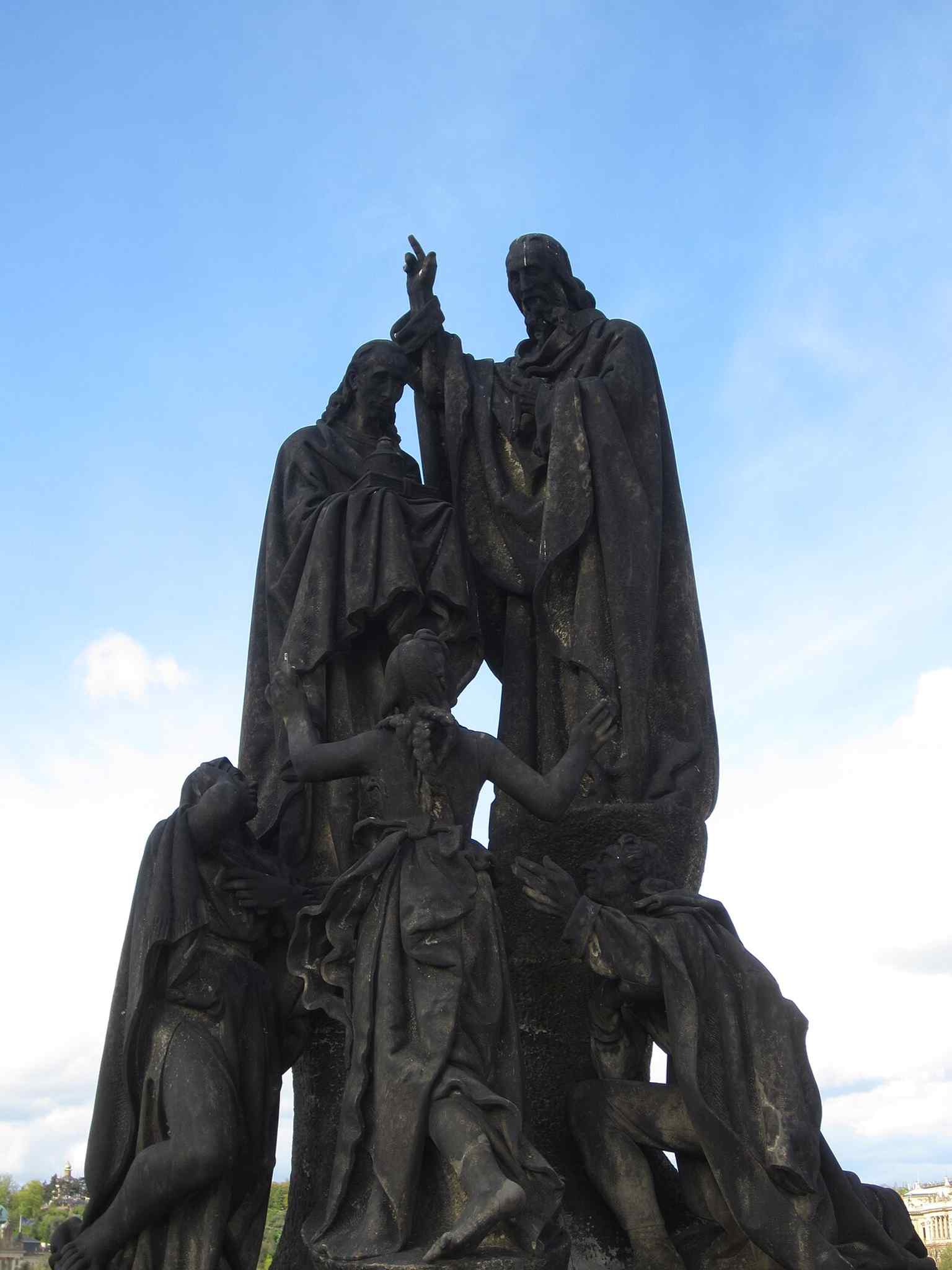
The monumental Saints Cyril and Methodius sculpture, standing prominently on the north side of the Charles Bridge, overlooking the Vltava River.Photo: Another Believer, Wikimedia Commons, CC BY-SA 4.0. Cropped & resized. 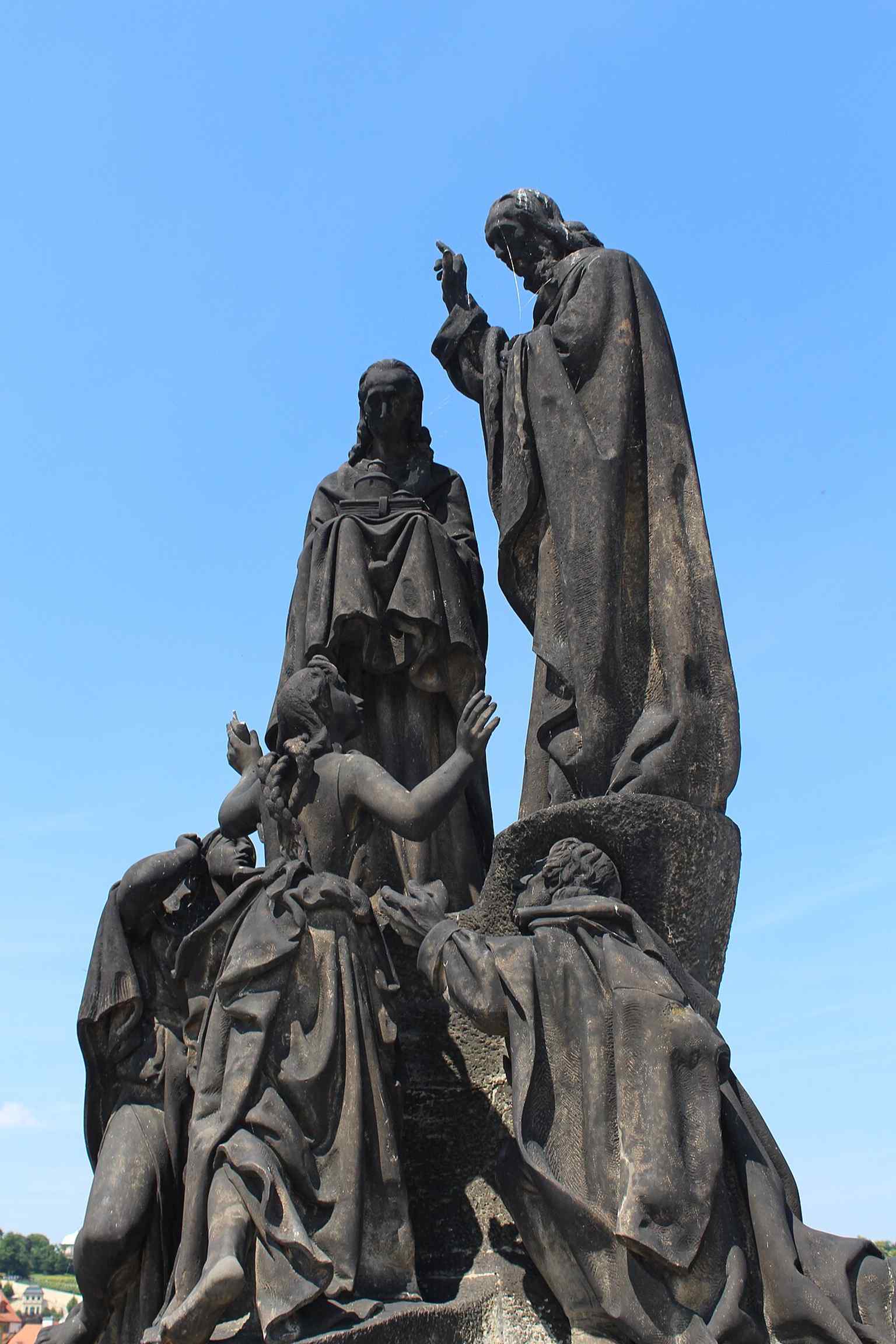
A side perspective of the Saints Cyril and Methodius sculpture, showcasing its integration among the many revered statues lining the historic Charles Bridge.Photo: Deror_avi, Wikimedia Commons, CC BY-SA 4.0. Cropped & resized. 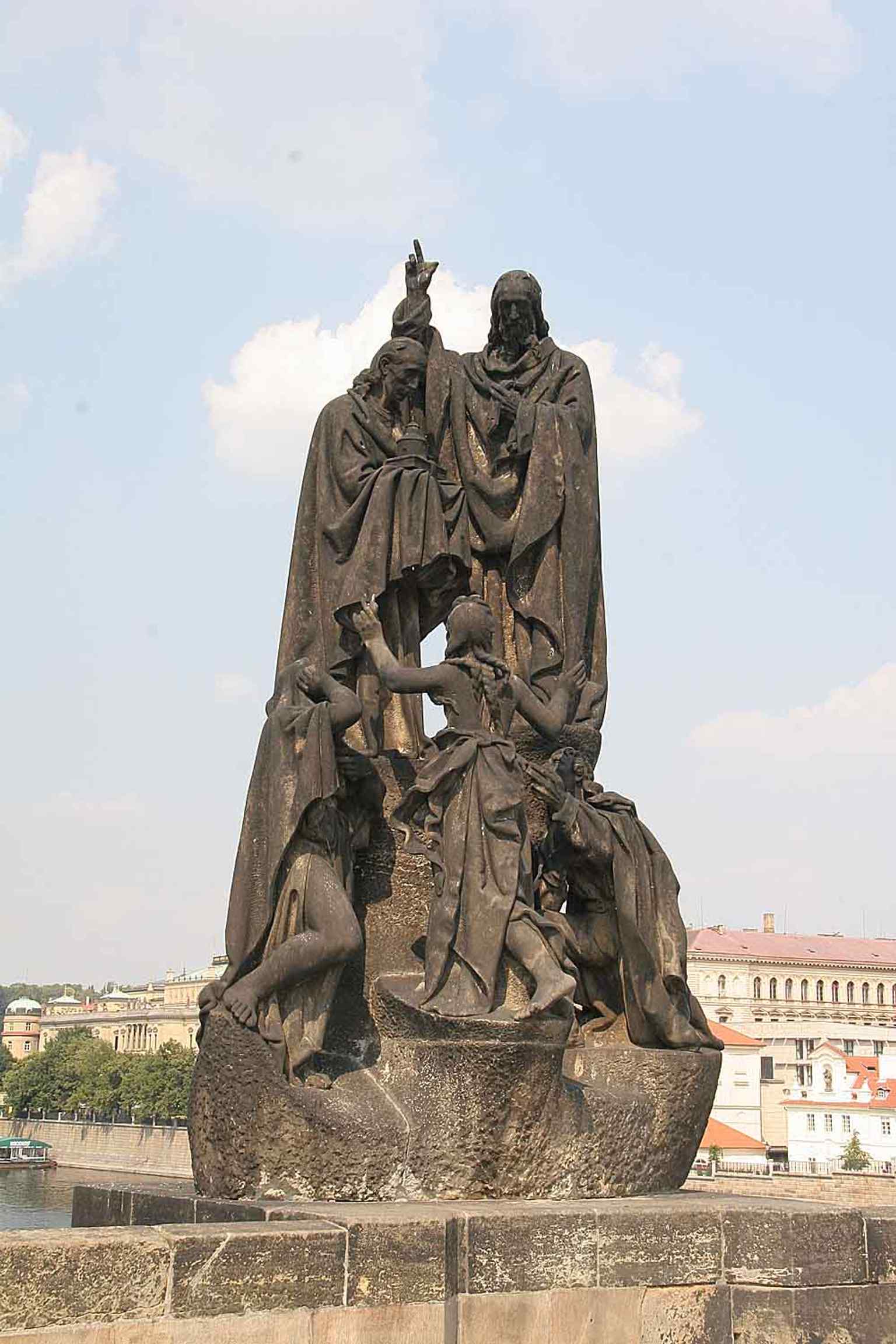
This sculpture replaced a Baroque statue of Saint Ignatius of Loyola, which was tragically lost along with parts of the bridge during the catastrophic 1890 Vltava River flood.Photo: Zp, Wikimedia Commons, CC BY-SA 3.0. Cropped & resized. 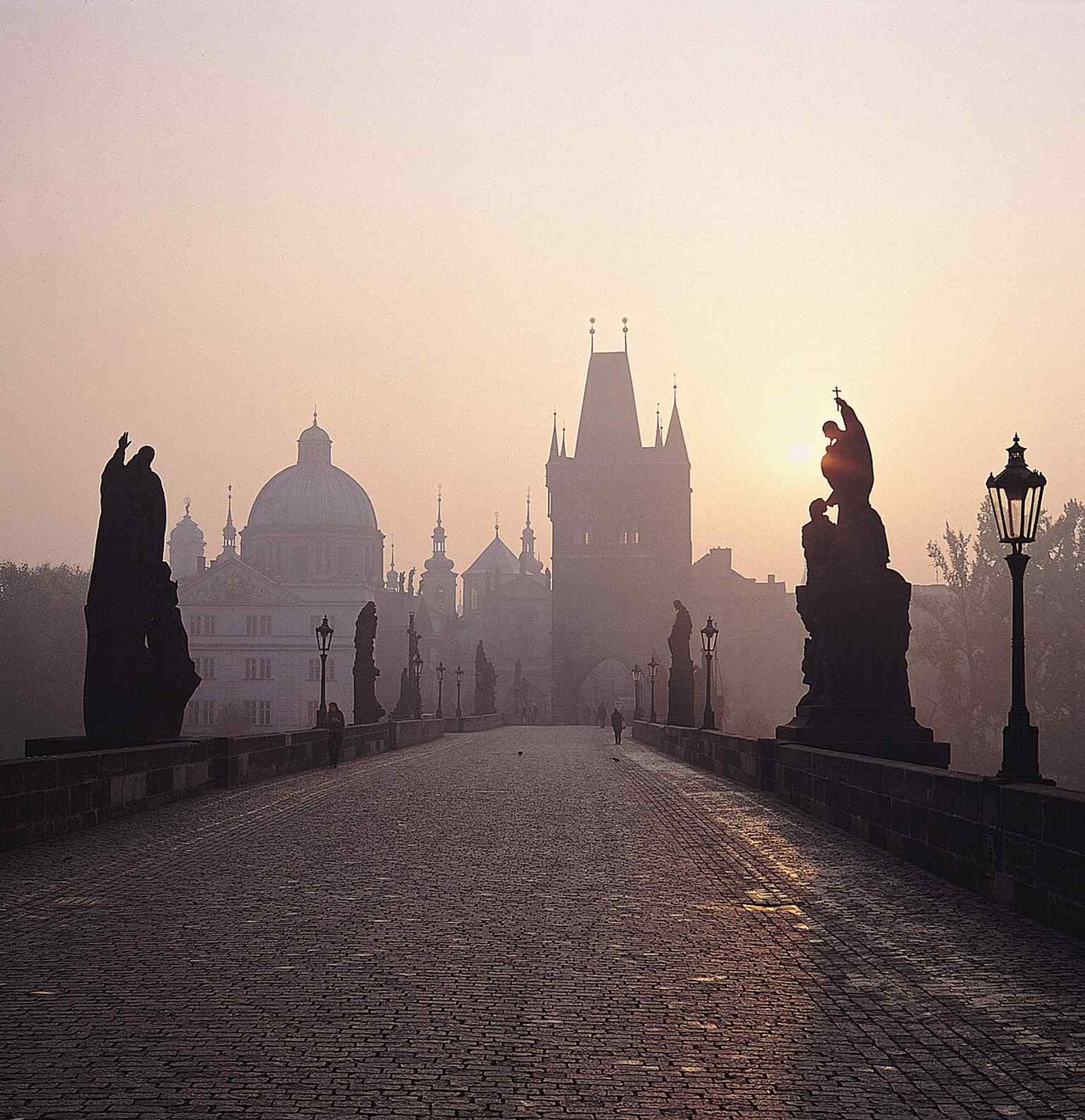
The Saints Cyril and Methodius statuary visible on the Charles Bridge, its 20th-century style a notable contrast to the surrounding Baroque monuments.Photo: Estec GmbH, Billig Hotel in Prag, Wikimedia Commons, CC BY 3.0. Cropped & resized. On your left, you will spot a heavy, bronze figure seated squarely on a polished stone block, complete with his signature cast right into the front of the pedestal. That is…Read moreShow less
Open dedicated page →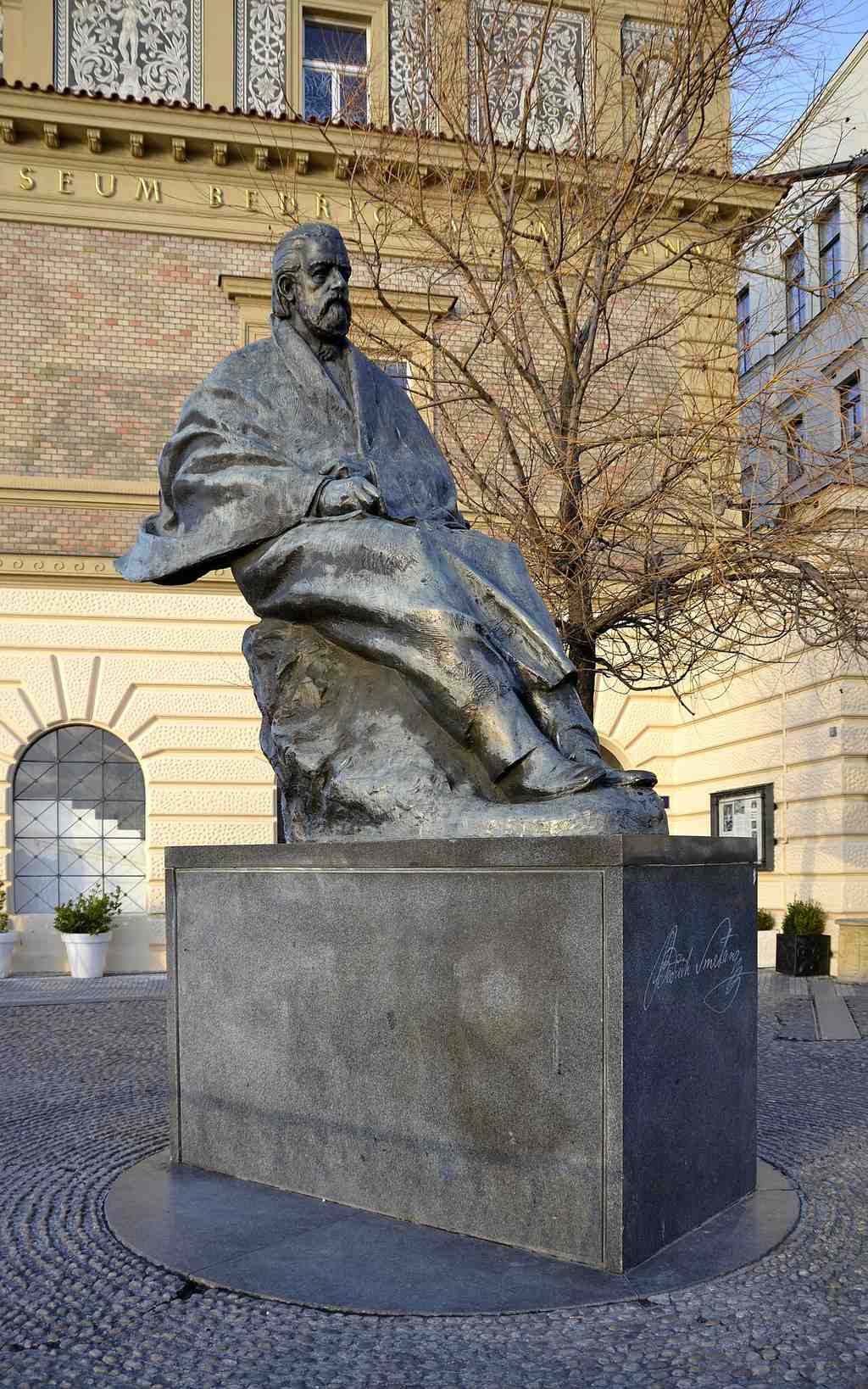
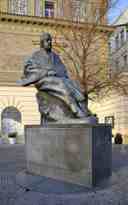
Statue von Bedřich Smetana, PragPhoto: High Contrast, Wikimedia Commons, CC BY 3.0 DE. Cropped & resized. On your left, you will spot a heavy, bronze figure seated squarely on a polished stone block, complete with his signature cast right into the front of the pedestal. That is Bedřich Smetana, a composer who gave a musical voice to the Czech national identity.
You would think a man of his stature would have gotten a monument right after his death in eighteen eighty-four. Well, it took seventy-five years of bickering just to find a location that would honor his drive for artistic legacy without disrupting the historic skyline. The idea was first pitched in nineteen oh nine, but this statue, weighing about a ton, was not unveiled until nineteen eighty-four.
The socialist government pushed it through to celebrate the Year of Czech Music. They placed him here so he could gaze out over the Vltava river, the very waters that inspired his most famous symphonic poem. While the striking Neo-Renaissance architecture of the museum behind him has anchored the riverbank for over a century, you can see how the surrounding waterfront subtly modernized around him if you check out the historic before and after image in your app.
The public reaction, however, was not exactly reverent. Locals immediately noticed Smetana’s stiff posture with his hands resting awkwardly in his lap. They gave the monument a mocking nickname... Sleighing Smetana. They thought he looked less like a musical genius gazing over the water, and more like a man clumsily sliding down a hill on an invisible sled. Even the chief conductor of the Czech Philharmonic strongly protested the rigid socialist design, though the state authorities completely ignored him.
Today, the statue guards the Smetana Museum, which holds a rather unexpected artifact... the composer's preserved earbone. It is a stark reminder that Smetana wrote some of his most triumphant music while totally deaf, proving that true creative vision outlasts both physical decline and political squabbles.
Since this outdoor area is open twenty-four hours a day, Smetana is always here, silently sledding toward the river. Now, let us head to our final stop, where Prague's artistic spirit meets modern technology, as we take a nine minute walk to Laterna Magika.
Look to your right, and you will see a massive, box-like building wrapped entirely in an armor of textured glass blocks, resting on a sturdy dark stone base. We have spent our…Read moreShow less
Open dedicated page →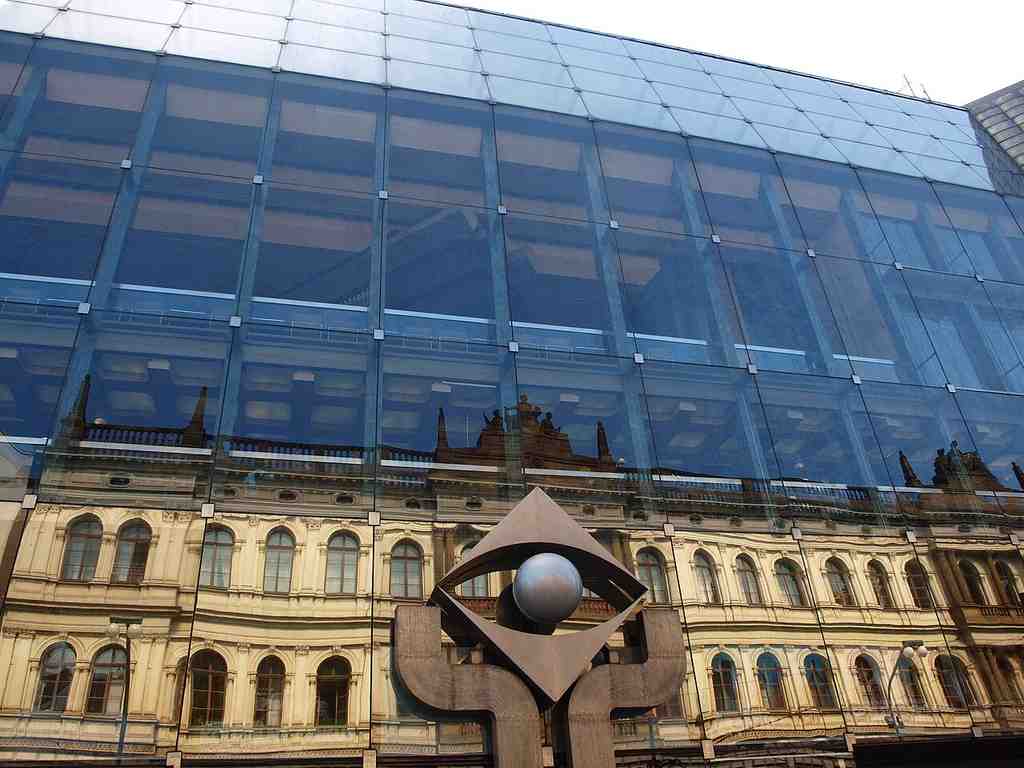
Laterna MagikaPhoto: VitVit, Wikimedia Commons, CC BY-SA 4.0. Cropped & resized. Look to your right, and you will see a massive, box-like building wrapped entirely in an armor of textured glass blocks, resting on a sturdy dark stone base. We have spent our time today walking among centuries-old stone and silent statues, but here, the artistic spirit of Prague takes a completely different form. This is Laterna Magika, and it is the perfect place to end our journey.
In nineteen fifty-eight, Czechoslovakia was tasked with creating a cultural pavilion for the World Expo in Brussels. Director Alfréd Radok and set designer Josef Svoboda did not want to just put on a traditional play. They invented a totally new theatrical language, blending live actors on stage with synchronized film projections.
At the premiere, a young woman stood on stage speaking French. Behind her on massive screens, two pre-recorded versions of herself answered her back in German and English, perfectly timed. Audiences were mesmerized. It was a technological magic trick that required absolute discipline from the performers. The pavilion won a Gold Star, and global icons like Walt Disney stood in long lines just to see it. Here, a new layer of Czech national identity was born, proving their avant-garde creativity, their highly experimental and boundary-pushing art, could rival the most advanced technology on earth.
But art rarely has an easy path when authoritarian regimes are involved. Back home, a communist government minister hated one of the pieces, claiming it ignored the glorious modern socialist economy. He launched a vicious ideological attack, forcing Radok out of the very theater he founded. The visionaries were pushed out, but their creation survived.
It always does. In nineteen seventy-seven, the theater premiered a show called Magic Circus. The director nervously asked the lead dancer if he thought the show might survive for at least a year. It played for forty-five years. Over the decades, something deeply poetic happened. Audiences watched the dancers' youthful, immortalized selves on the film screens, moving in perfect synchronization with the older, living dancers on the stage below.
This space even shaped world events. In November nineteen eighty-nine, the communist regime was finally collapsing. Laterna Magika temporarily abandoned its artistic repertoire. Its underground spaces became the nerve center for the Velvet Revolution. While armored vehicles roamed the streets, political dissidents, citizens who bravely opposed the authoritarian state, crammed into tiny theater offices. They fielded non-stop phone calls and coordinated a peaceful uprising. Famous American news anchors walked the halls of this theater, broadcasting the bloodless fall of an empire live to the world. The actors were not dancing. They were operating the switchboards of history.
From the moment we started our walk to right now, you have seen how deeply creativity is woven into the D-N-A of this city. Kings build bridges, empires fall, and regimes come and go. Yet the ideas, the stories, and the theater remain, forever looking forward. Thank you for walking with me today. Take your time here, and enjoy the rest of your adventure in Prague.

Frequently asked questions
How do I start the tour?
After purchase, download the AudaTours app and enter your redemption code. The tour will be ready to start immediately - just tap play and follow the GPS-guided route.
Do I need internet during the tour?
No! Download the tour before you start and enjoy it fully offline. Only the chat feature requires internet. We recommend downloading on WiFi to save mobile data.
Is this a guided group tour?
No - this is a self-guided audio tour. You explore independently at your own pace, with audio narration playing through your phone. No tour guide, no group, no schedule.
How long does the tour take?
Most tours take 60–90 minutes to complete, but you control the pace entirely. Pause, skip stops, or take breaks whenever you want.
What if I can't finish the tour today?
No problem! Tours have lifetime access. Pause and resume whenever you like - tomorrow, next week, or next year. Your progress is saved.
What languages are available?
All tours are available in 50+ languages. Select your preferred language when redeeming your code. Note: language cannot be changed after tour generation.
Where do I access the tour after purchase?
Download the free AudaTours app from the App Store or Google Play. Enter your redemption code (sent via email) and the tour will appear in your library, ready to download and start.
If you don't enjoy the tour, we'll refund your purchase. Contact us at [email protected]
Checkout securely with 






%2C%20Prague%2C%20Czech%20Republic%20(%20Ank%20Kumar%20)%2003.jpg)
-2.jpg)
-1.jpg)
-1.jpg)


.jpg)


.jpg)


%2020170810%20001.jpg)


.jpeg)


.jpeg)


