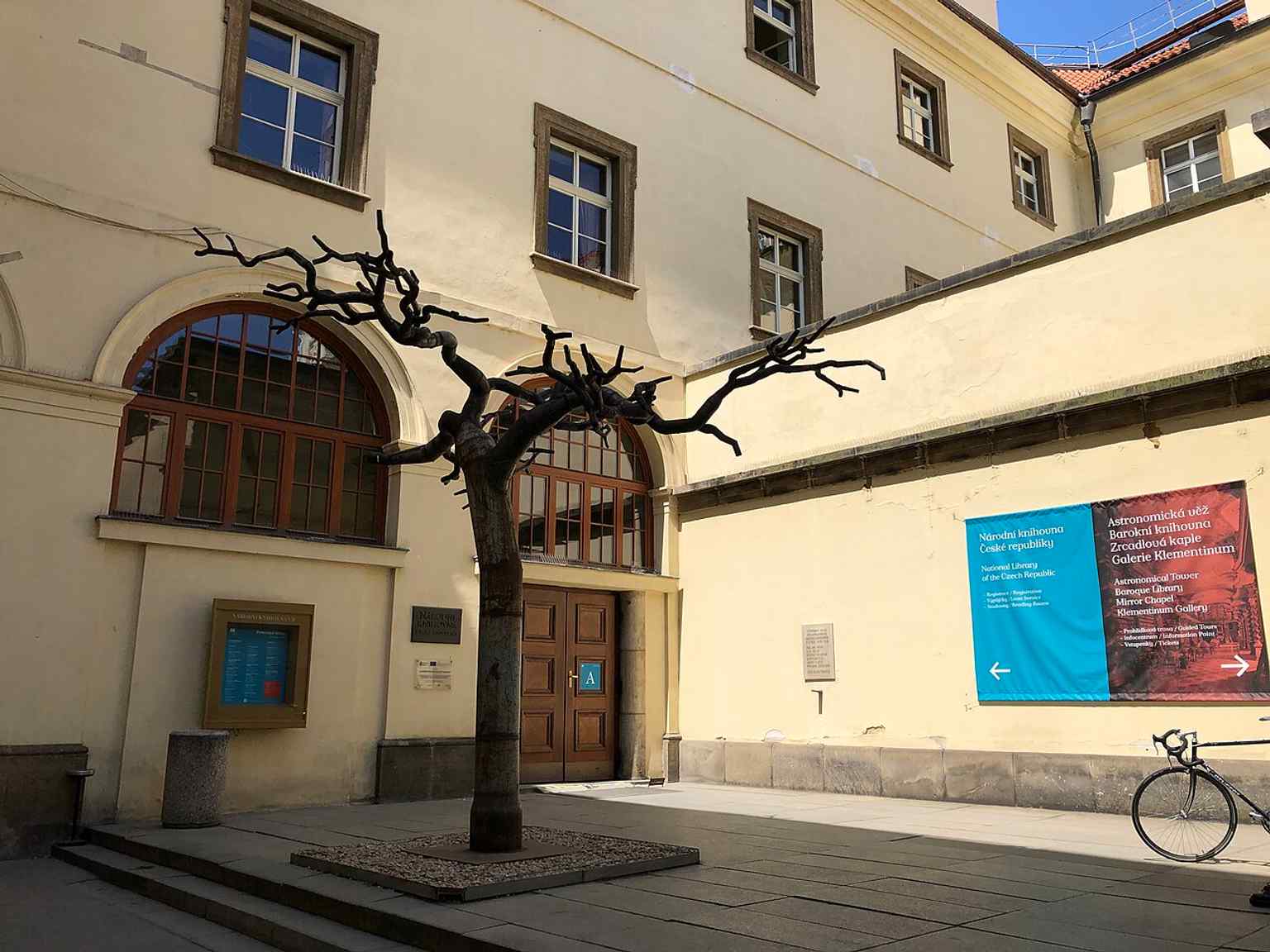
Welcome. Standing before you is the National Library of the Czech Republic, housed within the immense historical complex known as the Klementinum.
To understand how this massive structure came to be, we have to look back to the Jesuits, a powerful Catholic order heavily focused on education and intellectual rigor. When they expanded into Prague, they possessed a fierce drive for artistic legacy. They used monumental architecture to physically assert their dominance over the city, building the Klementinum to be the third-largest Jesuit college in the entire world. This was not just a religious center. It was a true fortress of science and art, where astronomers watched the stars and meteorologists recorded data that continues to this very day.
Naturally, this intellectual powerhouse became deeply entwined with Charles University. Charles University, founded in the fourteenth century, originally had its libraries scattered across different colleges around the city. But in sixteen twenty-two, the university was placed under Jesuit control, and its vast libraries were moved right here into the Klementinum. This massive centralization of books created an incredible hub of knowledge. If you glance at your screen, you can see the breathtaking Baroque Library Hall hidden inside, a soaring space lined with ancient globes and dramatic frescoes. You can also see the old Summer Refectory, a beautifully vaulted hall that now serves as the General Reading Room.
But preserving knowledge is rarely easy. Over the centuries, this library has faced a relentless battle to protect its treasures from destruction. During the Nazi occupation, brave librarians secretly smuggled the most valuable manuscripts out of the city, hiding them behind the thick stone walls of a rural castle to survive the war.
Then, in the catastrophic floods of two thousand and two, the nearby river swelled directly into the library basements. As electrical transformers threatened to explode, conservators desperately hauled rare prints up the stairs. Thousands of soaked books were saved through an agonizingly slow process where each individual book had to be carefully wrapped in absorbent paper to pull the moisture out without warping the ancient spines.
And the threats are not just environmental. In twenty twenty-four, the library realized it was the victim of an international heist. An organized gang of thieves registered as researchers and requested rare first editions by Russian authors, like Gogol and Pushkin. While sitting quietly in the reading rooms, they secretly swapped the priceless originals with high-tech, digital counterfeits. The fakes were so perfectly crafted that they sat completely unnoticed on the shelves for months. Who knew library science could feel like an international spy thriller? It just goes to show that protecting human memory is an ongoing, high-stakes battle.
The library is open Monday through Saturday from nine A-M to seven P-M, if you want to take a look inside. For now, we are heading to the Křižovnické Square, just a three minute walk away, to see a somewhat controversial statue of Charles the Fourth.