Bydgoszcz Audio-Tour: Inseln, Mönche & Marktgeheimnisse
Ein versteckter Tunnel verlief einst unter den Straßen von Bydgoszcz, von dem man flüsterte, dass er nach jedem Schritt Geheimnisse widerhallen ließ. Diese Stadt birgt mehr, als man auf den ersten Blick sieht. Begeben Sie sich auf eine selbstgeführte Audio-Tour durch Bydgoszcz, um Geschichten aufzudecken, die sich direkt vor Ihren Augen verbergen. Gehen Sie über die Reiseführer hinaus und lassen Sie jede Station Rätsel, dunkle Ecken und vergessene Legenden enthüllen. Warum zitterte der Alte Marktplatz einst unter dem Gewicht einer wütenden Rebellion? Welches erschreckende Relikt wurde auf der Burg ausgegraben, das auf eine Verschwörung hindeutete, die die Geschichte beinahe neu geschrieben hätte? Und warum meiden einige Einheimische immer noch eine bestimmte Kirchenbank in der Kathedrale St. Martin und Nikolaus? Verfolgen Sie einen Pfad durch jahrhundertealte Intrigen und stille Ruinen. Spüren Sie das Drama in den Steinen der Stadt und lassen Sie die Geschichte beim Gehen vor Ihren Füßen entfalten. Wagen Sie es, den Schleier über Bydgoszcz zu lüften. Ihr Abenteuer beginnt jetzt.
Tourvorschau
Über diese Tour
- scheduleDauer 40–60 minsEigenes Tempo
- straighten3.1 km FußwegDem geführten Pfad folgen
- location_on
- wifi_offFunktioniert offlineEinmal herunterladen, überall nutzen
- all_inclusiveLebenslanger ZugriffJederzeit wiederholen, für immer
- location_onStartet bei Opera Nova
Stopps auf dieser Tour
Ahead of you is a striking cluster of glass and concrete circles, with broad curved walls and a smooth rounded mass that makes Opera Nova look a little like a modern ship moored…Mehr lesenWeniger anzeigen
Eigene Seite öffnen →
Opera NovaPhoto: Mariusz Guć, Wikimedia Commons, CC BY-SA 4.0. Cropped & resized. Ahead of you is a striking cluster of glass and concrete circles, with broad curved walls and a smooth rounded mass that makes Opera Nova look a little like a modern ship moored beside the Brda.
It’s a bold first impression, isn’t it? This isn’t some dusty old opera house dressed in velvet nostalgia. Opera Nova feels futuristic even now, and that fits the story. Bydgoszcz founded its permanent opera company in nineteen fifty-six, after decades of trying to give the city a true musical stage of its own. The spark came from Felicja Krysiewicz, a singer, pianist, and tireless organizer who pushed the idea forward when it still sounded a little impossible. The first team prepared its opening production almost entirely out of sheer devotion, and that debut mixed Moniuszko’s Flis and Verbum nobile with the ballet Wesele w Ojcowie.
For years, the company had talent but no proper home. Performers rehearsed wherever they could, then appeared on borrowed stages around the city. Even so, the opera grew fast. It turned state-run in nineteen sixty, built its own orchestra a few years later, and eventually became the only opera house in the whole Kuyavian-Pomeranian region, and one of only ten opera stages in Poland.
Now look at the building itself. In the early nineteen sixties, architect Józef Chmiel won a national competition with a daring design made of intersecting circles. That’s why the whole complex feels like geometry set loose beside the river bend. The plan first imagined four circles, then shifted and shrank during redesigns, and the version in front of you settled into three major ones. Inside, one holds the main auditorium, with an amphitheater-style seating bowl - meaning the audience rises in tiers like in an ancient theater, without aristocratic boxes separating people into ranks. It was meant to feel communal, like everyone shares the same breath before the first note lands.
And getting this place finished... well, that took a stubborn kind of faith. Builders began work in the early nineteen seventies. Then came shortages, funding problems, and long pauses. The half-finished shell turned into a local legend, the “eternal construction site.” But in nineteen ninety-four, instead of waiting politely for perfection, the city did something brilliant: it staged the first Bydgoszcz Opera Festival right inside the raw unfinished building. Audiences sat on five hundred wooden chairs borrowed from the army, surrounded by bare walls, and somehow that rough setting only made the performances feel more electric. That festival helped save the project. After thirty-four years and five months of building, Opera Nova finally opened officially in two thousand six.
Today the place carries opera, operetta, ballet, musicals, education programs, and a major annual festival. So this building isn’t just a venue; it’s a victory lap poured into concrete and glass.
If you need practical details later, the administrative side generally operates Monday through Friday from seven A-M to three thirty P-M, and stays closed on weekends.
Opera Nova shows you exactly how patient a city can be when it decides culture matters.
Take a moment to soak in those sweeping curves, and when you’re ready, we’ll wander on to the Poor Clares Monastery.
Look for the red-brick church with its long single hall, a three-sided end, and a sturdy tower capped with a baroque-style helmet beside the former convent building. What you’re…Mehr lesenWeniger anzeigen
Eigene Seite öffnen →
Poor Clares Monastery in BydgoszczPhoto: Pit1233, Wikimedia Commons, CC0. Cropped & resized. Look for the red-brick church with its long single hall, a three-sided end, and a sturdy tower capped with a baroque-style helmet beside the former convent building.
What you’re seeing began with a much humbler setup. In the fourteen forties, townspeople funded a wooden Church of the Holy Spirit here, next to a shelter for the elderly, the sick, and the poor. Then, in the late sixteen hundreds... no, make that the late fifteen hundreds... local donors Grzegorz Gracza and Stanisław Diabełek pushed for a brick replacement, and by around sixteen hundred there stood a small masonry chapel on this spot.
Then the Poor Clares arrived, and the whole place changed scale. In sixteen fourteen, three determined founders - Zofia z Potulic Czarnkowska, Andrzej Rozdrażewski, and Kacper Zebrzydowski - asked the bishop and King Sigismund the Third Vasa for permission to create a convent here. Rome agreed. Pope Paul the Fifth confirmed the foundation on the fifteenth of May, sixteen fifteen, and chose Anna of the Rozdrażewski family, remembered here as Zofia Anna Smoszewska, as the first superior. She and two companions came from Poznań on the thirteenth of July, sixteen fifteen.
At first the sisters stayed near Saint Giles Church, but the city gave them a better future. In April of sixteen sixteen, Mayor Jan Piekarski and the town council donated two houses with gardens opposite the Church of the Holy Spirit. That kicked off the new convent here on the Gdańsk suburb, outside the old walls. By the eleventh of November, sixteen eighteen, the nuns moved into their new two-story house north of the church.
Their order followed papal enclosure, which meant strict separation from everyday city life. The sisters lived behind walls, prayed in silence, and guarded that private world carefully. And yet this place never floated completely above ordinary life. The convent also taught girls reading, writing, arithmetic, and practical household skills. By seventeen sixty, the monastery library held one hundred sixty-one religious books, from Bibles and sermons to saints’ lives and even collections of moral sayings.
The church itself kept growing. Builders added a larger nave - the main hall of the church - from the west in sixteen sixteen. In sixteen forty-five, clergy consecrated the enlarged church and added new patrons: Saint Adalbert, Saint Clare, and Saint Barbara. A year later, Mayor Wojciech Łochowski funded a priest’s chapel with a crypt for the nuns. Then came one of my favorite details: because this road mattered strategically, builders added a tower in the sixteen forties with loopholes for firearms in its lower level. So yes, this convent could pray like a sanctuary and glare at the road like a little fortress.
Prussian rule slowly unraveled that world. After seventeen seventy-two, officials demanded loyalty declarations and inventories of convent property. Later, the state blocked new novices, and the community shrank. In eighteen thirty-five, authorities sent the last sisters to Gniezno. After that, the church turned into a warehouse and even held the city weigh station, while the convent building served as the municipal hospital from eighteen thirty-seven to nineteen thirty-seven. Since nineteen forty-six, the former convent has housed the district museum, and the church returned to worship, eventually passing to the Capuchins in nineteen ninety-three.
This place carries prayer, discipline, loss, and reinvention all in the same brick shell.
Take one more look, and when you’re ready, we can head on to Theatre Square.
You’re looking at a broad green square by the Brda, edged with tram lines and roadway, with a wall of tall stone townhouses along the eastern side. This place feels a little…Mehr lesenWeniger anzeigen
Eigene Seite öffnen →
Theatre Square in BydgoszczPhoto: Mariusz Guć, Wikimedia Commons, CC BY-SA 4.0. Cropped & resized. You’re looking at a broad green square by the Brda, edged with tram lines and roadway, with a wall of tall stone townhouses along the eastern side.
This place feels a little strange on purpose... because Theatre Square is really a space shaped by something missing. Under your feet lies a stack of vanished worlds. In two thousand and nine, archaeologists found burial urns here from the Pomeranian culture, reaching all the way back to the Iron Age. Long before city traffic and tram bells, this was a burial ground.
By the late fourteenth century, the Carmelites moved in and built a monastery and a church dedicated to the Virgin Mary. In the sixteenth century they rebuilt both in masonry, and their walls even joined the city’s defenses. The Gdańsk Gate stood at the northern edge, folded right into that fortified line. So yes... this calm square once worked like a monastery yard, a church precinct, and part of the city wall all at once.
Then the whole script changed. Prussian authorities dissolved the Carmelite order in eighteen sixteen. In eighteen twenty-two, workers tore the church down to its foundations and raised Bydgoszcz’s first theater here. Fire destroyed that building, then another fire wrecked its successor. So in eighteen ninety-five the city went big and hired Berlin architect Heinrich Selling for a grand Municipal Theatre. It opened in October of eighteen ninety-six with Emperor Wilhelm the Second in attendance. The façade carried twin towers and a loggia, which is basically an open gallery built into the front, and inside it seated eight hundred people.
If you glance at the image in the app, the aerial view makes the story click: this open gap near the river is the footprint of a lost landmark.

A bird’s-eye view of Theatre Square in Bydgoszcz, showing the open green space and its position beside Jagiellońska Street and the city center.Photo: Mariusz Guć, Wikimedia Commons, CC BY-SA 4.0. Cropped & resized. The square became a kind of urban switchboard. Horse trams rolled through in eighteen eighty-eight, electric trams followed in eighteen ninety-six, and before the Second World War all four daytime tram lines crossed here. Imagine the sound of steel, conversation, and theater crowds all mixing together.
In the interwar years, actress Wanda Siemaszkowa tried to turn this stage into a home for ambitious Polish drama. Money problems and audience taste pushed things toward lighter operettas and farces, but the theater still pulled off a technical marvel: in nineteen thirty-seven it installed a revolving stage, the biggest in Poland and the second biggest in Europe.
Then came nineteen forty-five. Polish soldiers shelled the building while trying to force out German defenders inside. Days later, Red Army soldiers lit a bonfire on the wooden stage to warm themselves, and the whole interior burned. The outer walls survived well enough to rebuild, but city officials demolished them in nineteen forty-six anyway. Locals still repeat the story that millions of bricks traveled from this theater to help rebuild Warsaw.
So this square is beautiful, but also haunted by its own missing center... and it never really closes, since it stays open all day and all night.
Take one last look across the empty space, and when you’re ready, we’ll wander on to the next stop.
12 weitere Stationen anzeigenWeniger Stationen anzeigenexpand_moreexpand_less
Look for a broad concrete bridge with one low, straight span, dark metal railings, and lantern-style lamps set on solid stone bases. This is Bydgoszcz’s oldest bridge site in…Mehr lesenWeniger anzeigen
Eigene Seite öffnen →
Jerzy Sulima-Kamiński Bridge in BydgoszczPhoto: Mariusz Guć, Wikimedia Commons, CC BY-SA 4.0. Cropped & resized. Look for a broad concrete bridge with one low, straight span, dark metal railings, and lantern-style lamps set on solid stone bases.
This is Bydgoszcz’s oldest bridge site in the Old Town, and it has carried the city’s weight for centuries. A document from the year twelve fifty-two already mentioned a permanent bridge near the local stronghold, with customs collected from goods moving toward Gdańsk. After King Casimir the Great founded the chartered town in thirteen forty-six, the main crossing shifted onto the line of Mostowa Street... right here.
And this was no quiet little footbridge. It handled trade on a serious scale. In the fifteenth, sixteenth, and seventeenth centuries, merchants used this crossing as part of the grain trade, even pouring grain straight from the bridge into boats below, then sending it down the Brda and Vistula rivers to Gdańsk. So yes, this bridge acted like a street, a toll gate, and a loading dock all at once.
Its name kept changing as history kept rearranging the map: Gdańsk Bridge, Theatre Bridge, Roman Dmowski Bridge, Old Town Bridge, and now the Old Town Bridge of Jerzy Sulima-Kamiński. Every name catches a different version of Bydgoszcz.
One of the fiercest episodes came on the second of October, seventeen ninety-four. During the Kościuszko Uprising, Polish artillery opened fire on Prussian hussars trying to cross here. Their commander, Colonel Székely, suffered fatal wounds, and the battle ended with a Polish victory. For one bridge, that is a lot of drama.
Then the future rolled in on rails. A horse-drawn tram crossed here in eighteen eighty-eight, and electric trams followed in eighteen ninety-six. That made Bydgoszcz an early adopter of electric trams. Not bad for a river crossing.
War hit the bridge hard. Polish sappers blew it up on the fourth of September, nineteen thirty-nine during their retreat. The Germans patched it with timber, then blew it up again on the twenty-second of January, nineteen forty-five as they withdrew. The bridge in front of you rose in nineteen sixty and nineteen sixty-one, wider than the older versions and planned for cars, pedestrians, and tram tracks. In two thousand fourteen, the city gave it some character back with stylized gas lamps and railings decorated with one thousand six hundred metal leaves and flowers.
If you glance at the app, the aerial photo makes its job crystal clear: this span stitches the Old Town to the city center in one clean line. And that postcard-style riverside view shows why people keep falling for this panorama.

Aerial view of the bridge over the Brda, showing its position linking Old Town with the city center.Photo: Mariusz Guć, Wikimedia Commons, CC BY-SA 4.0. Cropped & resized. Since it’s a public bridge, you can cross it anytime, day or night.
This bridge feels less like a structure and more like Bydgoszcz telling its story out loud.
When you’re ready, let’s drift onward to Mostowa Street.

Night view of the Old Town Bridge, the modern crossing that replaced earlier wartime and prewar bridges over the Brda.Photo: Pit1233, Wikimedia Commons, CC0. Cropped & resized. 
Mostowa Street, the historic route carried by the bridge and one of the oldest streets in Bydgoszcz.Photo: Mariusz Guć, Wikimedia Commons, CC BY-SA 4.0. Cropped & resized. 
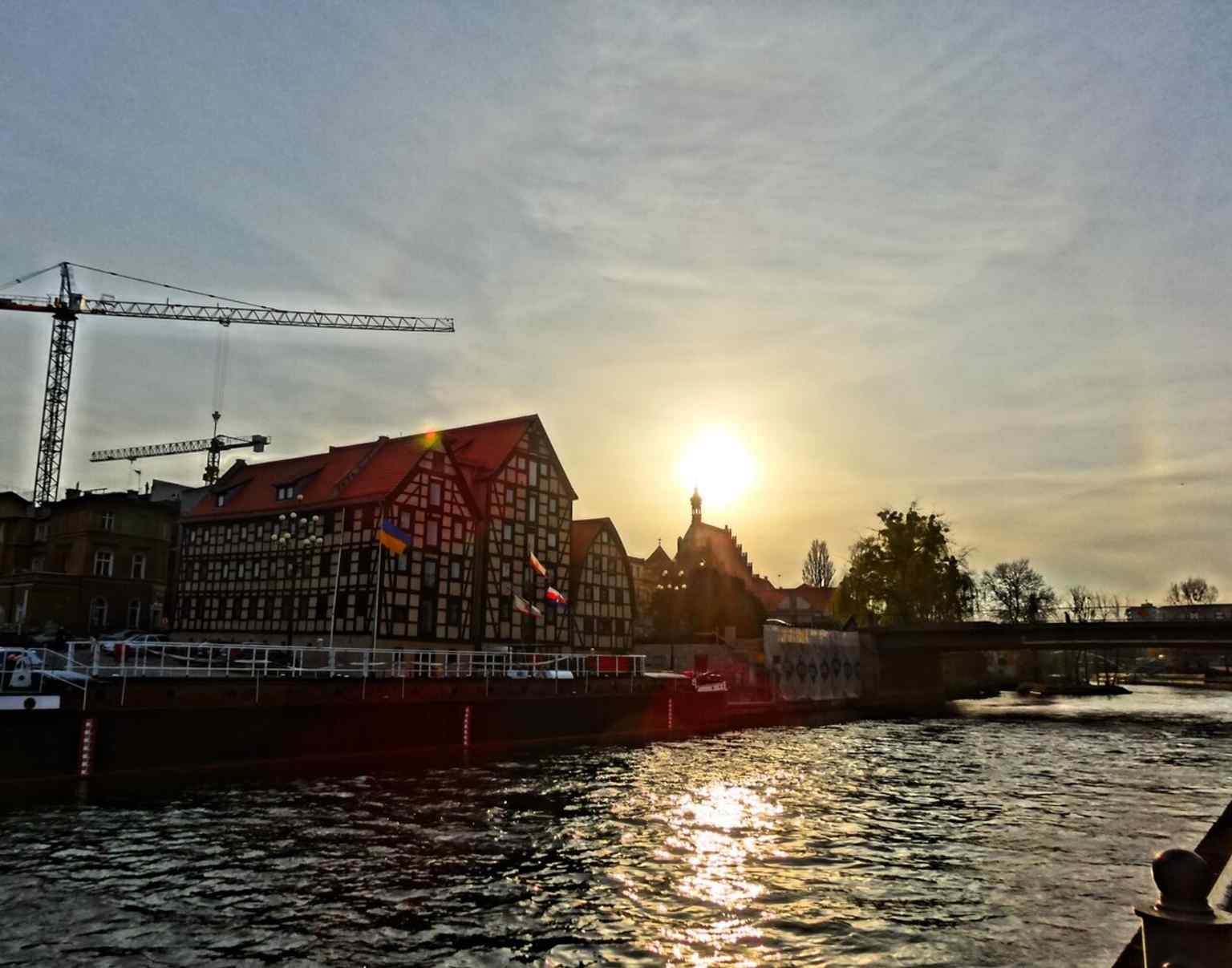
The bridge beside the riverside granaries, matching the landmark’s setting on the Brda in Bydgoszcz’s Old Town.Photo: Mariusz Guć, Wikimedia Commons, CC BY-SA 4.0. Cropped & resized. 
East-facing view of the bridge and waterfront panorama, the classic postcard angle often seen from this spot.Photo: Mariusz Guć, Wikimedia Commons, CC BY-SA 4.0. Cropped & resized. 
The River Crosser statue by the bridge, added in 2004 and now one of the area’s best-known attractions.Photo: Mariusz Guć, Wikimedia Commons, CC BY-SA 4.0. Cropped & resized. Look for the straight stone-paved street lined with plaster-and-brick townhouses, with a wedge-shaped corner tenement anchoring the Old Market Square end. Mostowa sounds…Mehr lesenWeniger anzeigen
Eigene Seite öffnen →
Mostowa Street in BydgoszczPhoto: Mariusz Guć, Wikimedia Commons, CC BY-SA 4.0. Cropped & resized. Look for the straight stone-paved street lined with plaster-and-brick townhouses, with a wedge-shaped corner tenement anchoring the Old Market Square end.
Mostowa sounds simple... just Bridge Street. But this slim stretch carried the pulse of Bydgoszcz for centuries. City planners laid it out in the mid-fourteenth century, when they shaped the new chartered town and needed one clear line from the Old Market Square to the bridge over the Brda, then onward to the Gdańsk suburb. The crossing that gave the street its name stands on the oldest bridge location in Bydgoszcz. Trade rolled through here from Gdańsk toward Inowrocław, Gniezno, and Poznań, so this was never just a local lane. It was a funnel for merchants, travelers, rumors, and money.
And here comes the surprise: in thirteen forty-six, when the town was founded, this ground was marshy, empty, and repeatedly flooded by the river. Under your feet there was once mud, water, and stubborn reeds. The town claimed it bit by bit. Archaeologists digging here in two thousand and six found traces of the first wooden buildings from the late fourteenth century, along with a square oak-lined well from the end of that century. They also uncovered the little everyday things that make history feel less like a textbook and more like a pocket emptied onto a table: pottery with potters' marks, whole medieval shoes, hundreds of leather scraps from a shoemaker's workshop, belts with metal buckles, knife sheaths, keys, locks, crossbow bolts, spurs, and coins from both Poland and the Teutonic state.
So Mostowa did not begin in elegance. It began in planks, puddles, and hustle.
By the early seventeenth century, records called it platea pontialis, basically "the bridge street." Wooden houses stood beside brick ones. A Scot woman turns up in a property dispute from sixteen twenty-five. Later came a tailor named Tomasz Żelazko, a helmsman named Wojciech Kloska, and a man named Jan Czech. That is my favorite kind of history: one short street, and suddenly half of Europe seems to be renting a room here. Nobles lived here too, alongside brewers and craftsmen. For a time, the Szydłowski family controlled almost the whole western side, including adjoining plots, a brewery, and a townhouse.
If you peek at the image in the app, you can spot that surviving western frontage. It is one of the few historic sides left after the devastation of nineteen forty, when German occupation authorities demolished the block between Mostowa, Jatki, the market square, and the Brda to create a wide parade route for Nazi marches. They destroyed some of the grandest houses near the bridge, including the building with the Bristol café and cinema.

The western frontage of Mostowa Street, one of the few historic sides still preserved after the wartime demolitions of 1940.Photo: Mariusz Guć, Wikimedia Commons, CC BY-SA 4.0. Cropped & resized. Another image on your screen shows the street's straight, old trade-axis perfectly. Later, the city turned part of Mostowa into a pedestrian zone, and in the two thousands it rebuilt sections of the eastern side with stylized facades that nod to the lost townhouses. Even the surviving houses on the west side tell that layered story, borrowing from older fashions with neoclassical order and neo-Renaissance symmetry, meaning later architects revived earlier historical styles.

A view toward the Old Market Square, matching the street’s north-south axis and its role as the old connector between the river and the market.Photo: Mariusz Guć, Wikimedia Commons, CC BY-SA 4.0. Cropped & resized. And for decades, trams clattered right through here, first horse-drawn from eighteen eighty-eight, then electric from eighteen ninety-six, until the last one passed in nineteen seventy-four.
Mostowa is a street that remembers everything, even what is missing.
Take a moment to soak it in, and when you're ready, we can head on to the next stop.

Mostowa Street seen from the historic center, showing the pedestrianized route that links the Old Market Square with the Brda river crossing.Photo: Mariusz Guć, Wikimedia Commons, CC BY-SA 4.0. Cropped & resized. 
Corner tenement at Stary Rynek 7 / Mostowa 1 — the northern end of Mostowa Street, rebuilt over a site with medieval and 19th-century layers.Photo: Mariusz Guć, Wikimedia Commons, CC BY-SA 4.0. Cropped & resized. Look to your left for a broad rectangular stone-paved square framed by historic townhouses, with the long classical facade of the library and the little goose fountain giving the…Mehr lesenWeniger anzeigen
Eigene Seite öffnen →
Old Market Square in BydgoszczPhoto: Jan Paweł Bochen, Wikimedia Commons, CC BY-SA 4.0. Cropped & resized. Look to your left for a broad rectangular stone-paved square framed by historic townhouses, with the long classical facade of the library and the little goose fountain giving the space its unmistakable shape.
This is Stary Rynek, the Old Market Square, the old heart of Bydgoszcz... and it has been doing that job since King Casimir the Great ordered the chartered town laid out in thirteen forty-six. The square is almost a perfect working machine: about one hundred by one hundred twenty-five meters, big enough for trade, public life, arguments, celebrations, and, yes, some very grim business too.
If you glance at the image in the app, you can really see the geometry of it all, that clean rectangle planted at the center of the old town plan. What feels open now once sat inside a much tighter world. Rivers and water channels wrapped around this district so completely that, until the eighteenth century, the market and the chartered town effectively stood on an island.

A broad view of the square’s open paving and surrounding buildings — useful for explaining the market’s rectangular layout and central location.Photo: Jakub Hałun, Wikimedia Commons, CC BY-SA 4.0. Cropped & resized. Now here’s the wild part: for centuries, the square had a town hall right in the middle. Not off to the side, not tucked away... right in the center like the city’s beating drum. First came a wooden one, then a Gothic brick hall, and after a fire in fifteen eleven, the city raised a grander replacement designed by Jan of Gdańsk. Around sixteen hundred, they finished it with a tall Renaissance tower, topped with an onion-shaped dome, a clock, alarm bell, and lookout galleries. Chronicles bragged about it, and honestly, they had reason. Today, the old footprint survives below your feet, and the darker paving marks the outline of those lost foundations.
This square sold everything that kept a town alive. Bread, salt, herring, hops, cloth... the whole daily circus. Weekly markets started in the Middle Ages, and royal permission later added fairs on feast days. So if the place feels like it was built for bargaining, gossip, and somebody trying to talk you into one more sack of grain, that instinct is dead on.
But the market also carried power. On the west side stood the Jesuit church and college, once the great showpiece of the square. In sixteen fifty-seven, negotiators for King Jan Casimir and the Brandenburg elector met here, and the treaties of Wehlau and Bydgoszcz were sworn on this very square. If you want a visual for the missing western wall, check the app image showing that side. The emptiness there is part of the story.

The west side of the square, where the former Jesuit church once dominated the skyline before wartime demolition.Photo: Mariusz Guć, Wikimedia Commons, CC BY-SA 4.0. Cropped & resized. And the story turns dark. In September of nineteen thirty-nine, German occupiers publicly executed Bydgoszcz residents here, near the western frontage. Then in nineteen forty, they demolished the Jesuit church and the whole west side, planning a monumental Nazi-style city hall and a parade route. The monument standing there now marks that wound, not as decoration, but as memory.
There are gentler notes too. Near the library sits the fountain called Children Playing with a Goose, a gift from pharmacist Alfred Kupffender in nineteen oh nine. And over on the eastern side, legend says Pan Twardowski once stayed in a townhouse here and left behind one of those wonderfully suspicious stories that cities keep like family secrets.
This square is really a stone scrapbook: medieval trade, royal politics, wartime trauma, and everyday city life all layered in one place.
Take a second and let the whole rectangle settle in. When you’re ready, we can wander on to the cathedral.

A bird’s-eye view showing Old Market Square in the city center, echoing its long role as Bydgoszcz’s main civic plaza.Photo: Jan Paweł Bochen, Wikimedia Commons, CC BY-SA 4.0. Cropped & resized. 
The north frontage of the square, close to the route toward Mostowa Street and the Brda River described in the history notes.Photo: Mariusz Guć, Wikimedia Commons, CC BY-SA 4.0. Cropped & resized. 
The east side of Old Market Square, where the rebuilt 20th-century frontage stands over a place shaped by wartime destruction and postwar reconstruction.Photo: Mariusz Guć, Wikimedia Commons, CC BY-SA 4.0. Cropped & resized. 
The south side of the square, matching the historic market edge that once held stalls, shops, and street access toward Długa Street.Photo: Mariusz Guć, Wikimedia Commons, CC BY-SA 4.0. Cropped & resized. 
The Monument to the Struggle and Martyrdom of the Bydgoszcz Land stands on the former western frontage, marking the site of the 1939 executions.Photo: Mariusz Guć, Wikimedia Commons, CC BY-SA 4.0. Cropped & resized. 
The Children Playing with a Goose fountain, a 1909 gift from pharmacist Alfred Kupffender, now one of the square’s best-known details.Photo: Mariusz Guć, Wikimedia Commons, CC BY-SA 4.0. Cropped & resized. 
A view of the eastern row of historic townhouses, illustrating how the market’s perimeter became lined with dense bourgeois housing.Photo: Mariusz Guć, Wikimedia Commons, CC BY-SA 4.0. Cropped & resized. 
Stary Rynek 27 at the corner with Magdzińskiego, one of the square’s notable historic tenements with deep medieval foundations.Photo: Mariusz Guć, Wikimedia Commons, CC BY-SA 4.0. Cropped & resized. 
Stary Rynek 7 near the connection to Mostowa Street, a useful example of the square’s historic corner buildings.Photo: Mariusz Guć, Wikimedia Commons, CC BY-SA 4.0. Cropped & resized. On your left, look for a tall red-brick Gothic church with pointed-arch windows, a broad stepped gable, and a small octagonal turret sitting right on the roof ridge. This is the…Mehr lesenWeniger anzeigen
Eigene Seite öffnen →
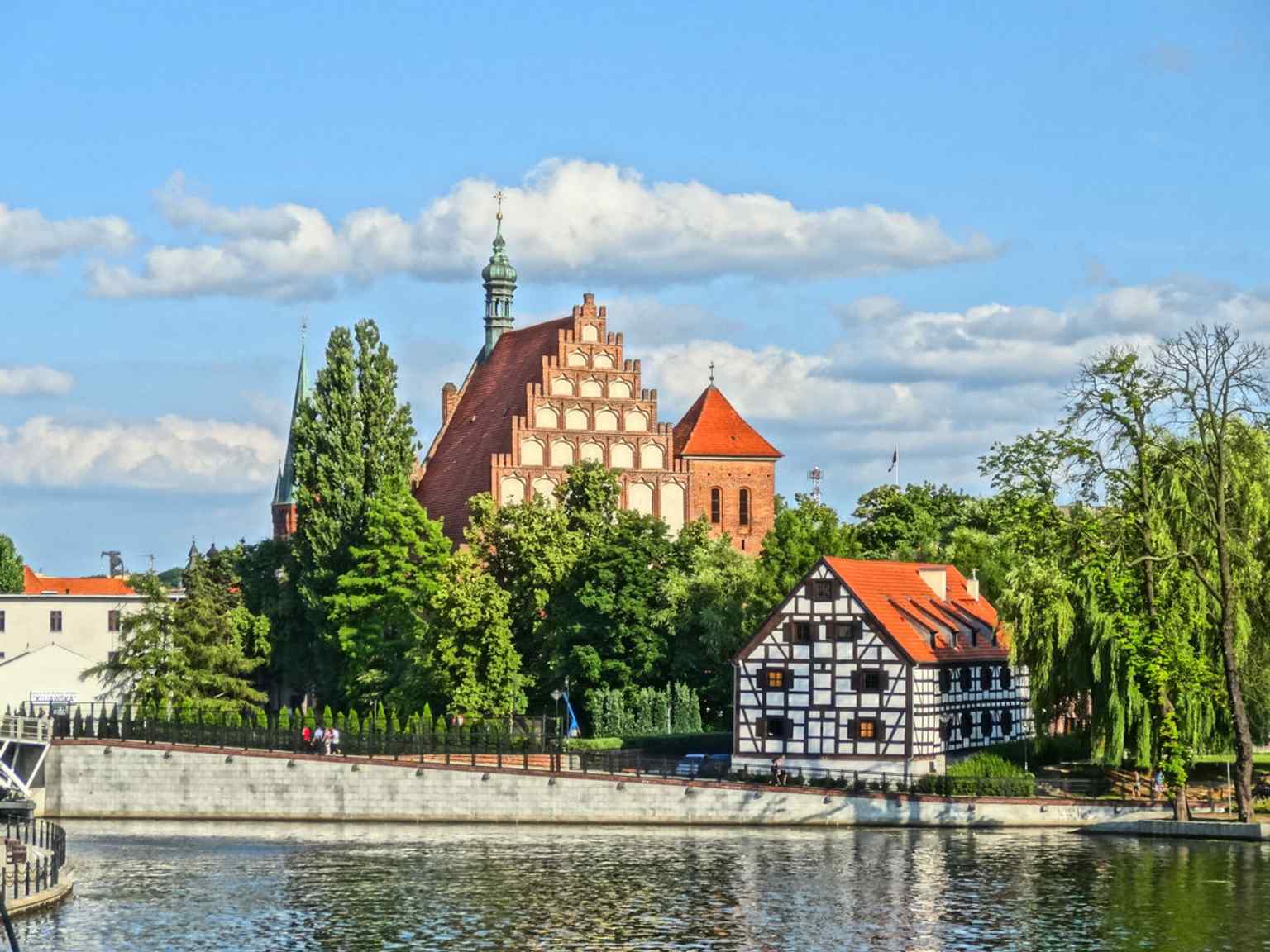
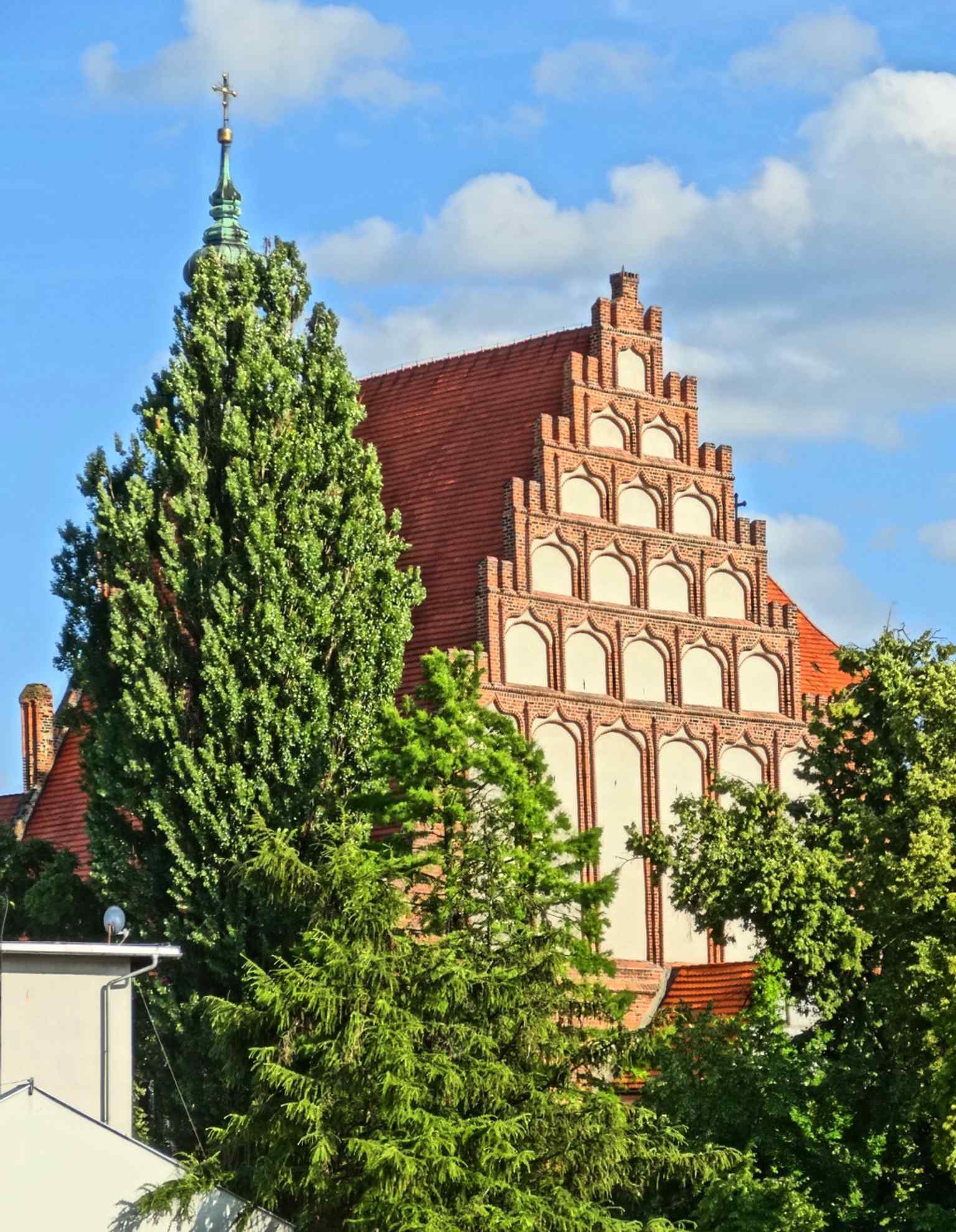
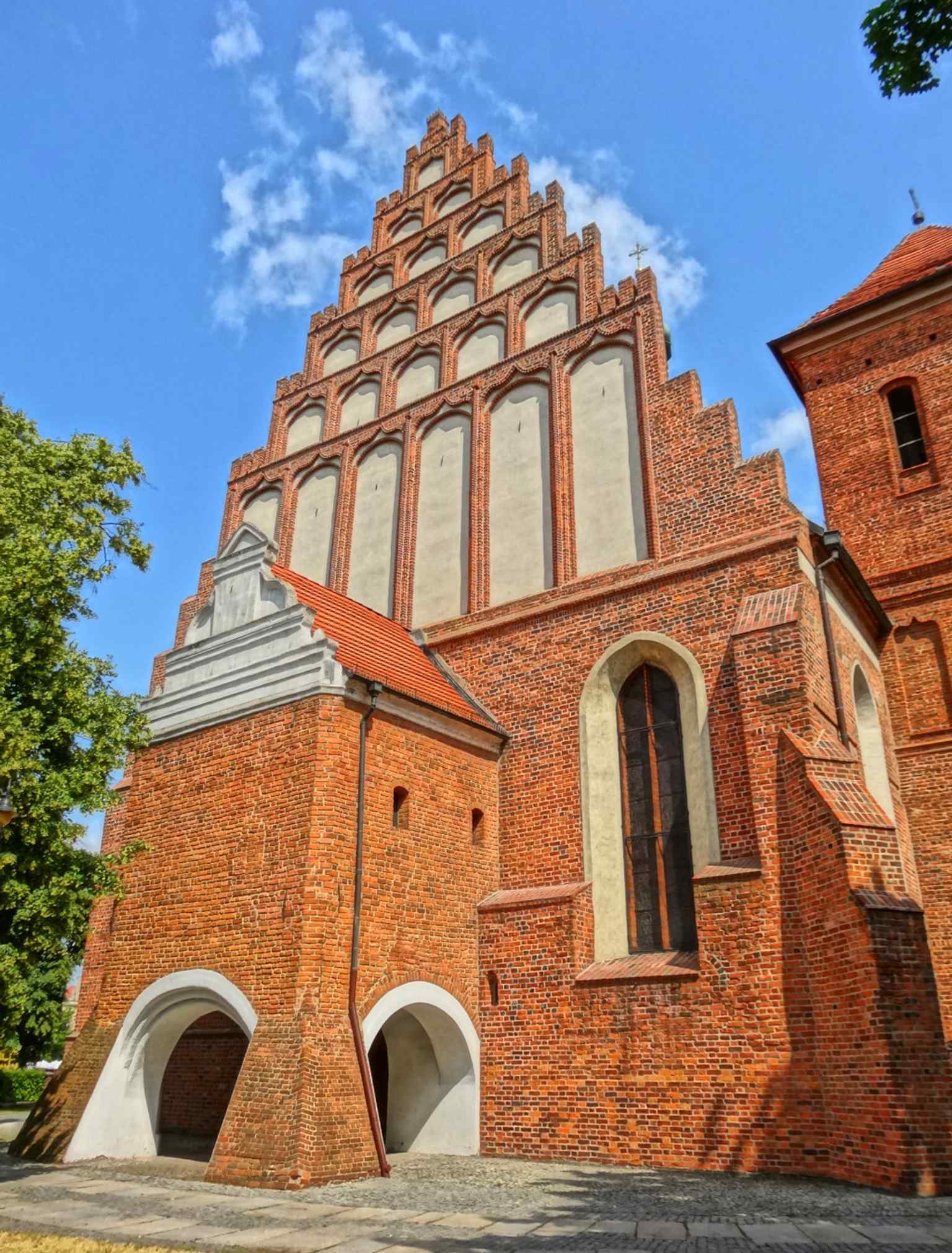
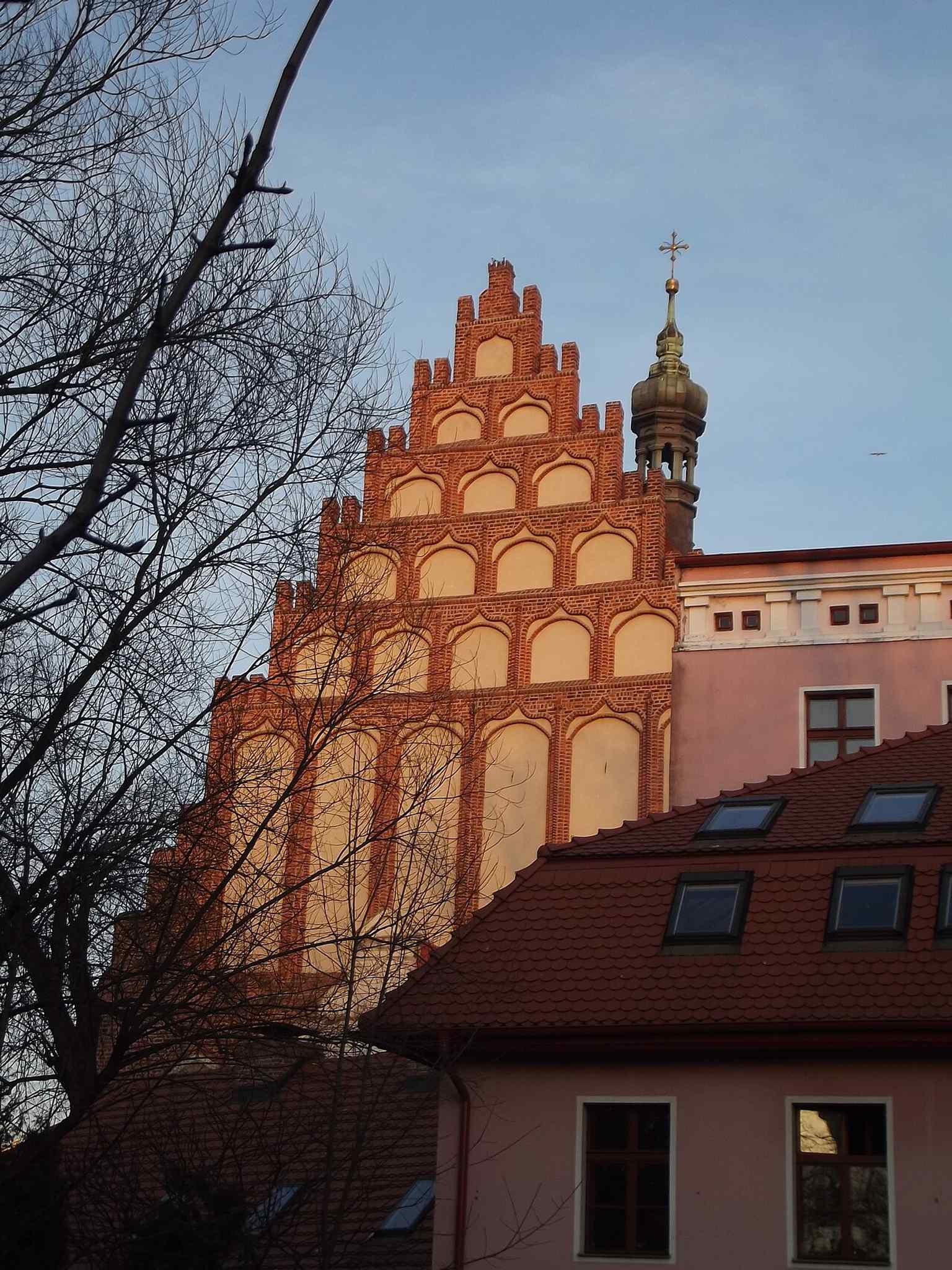
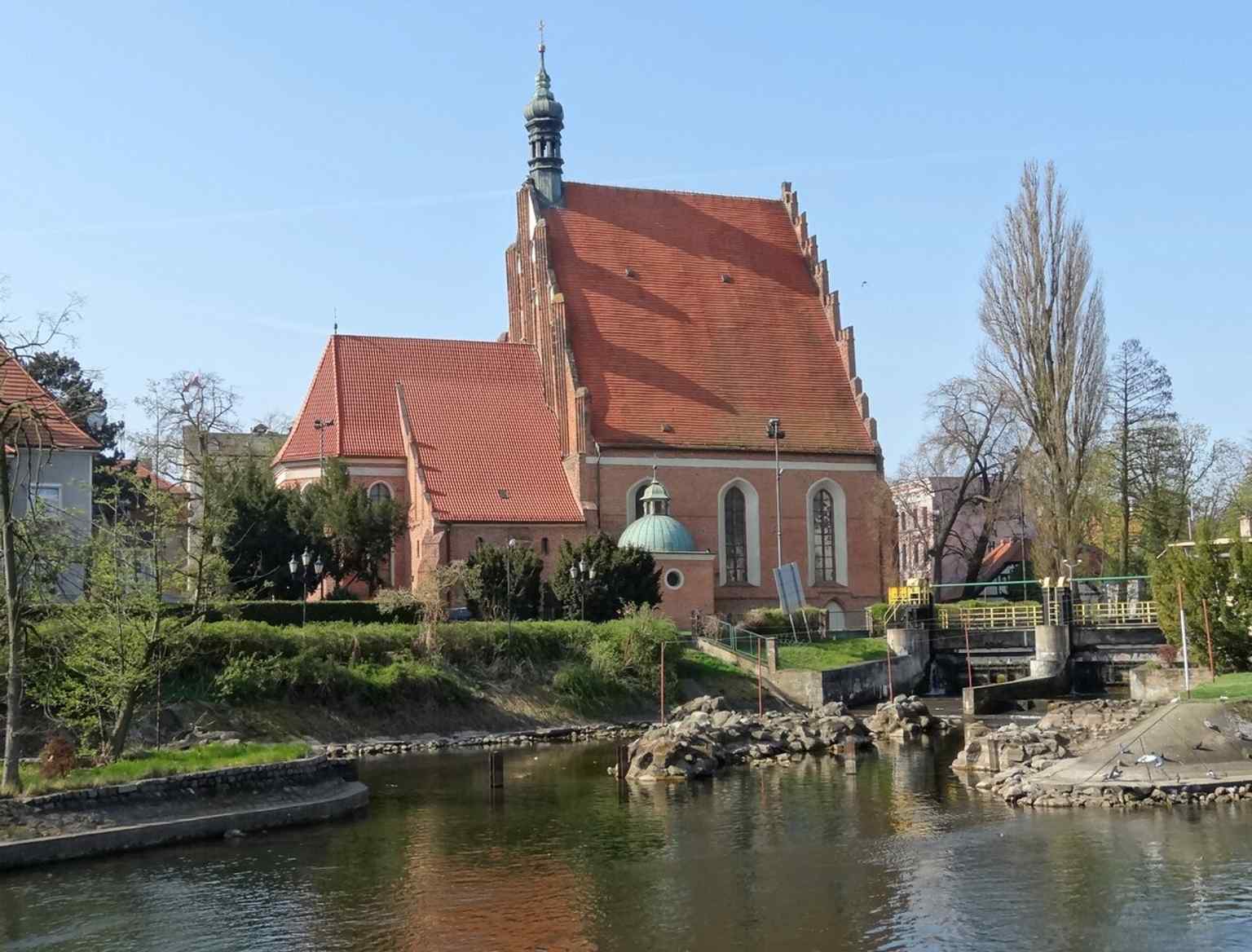
Cathedral of St. Martin and Nicholas in BydgoszczPhoto: Mariusz Guć, Wikimedia Commons, CC BY-SA 4.0. Cropped & resized. On your left, look for a tall red-brick Gothic church with pointed-arch windows, a broad stepped gable, and a small octagonal turret sitting right on the roof ridge.
This is the Cathedral of Saint Martin and Nicholas, and it has that rare thing some buildings carry without trying: gravity. For centuries people here simply called it the fara, meaning the main parish church. Bydgoszcz set this plot aside when the city received its charter in thirteen forty-six, right at the edge of the old town near the Brda and the mill channel, so the church has always belonged to the riverside rhythm of the city.
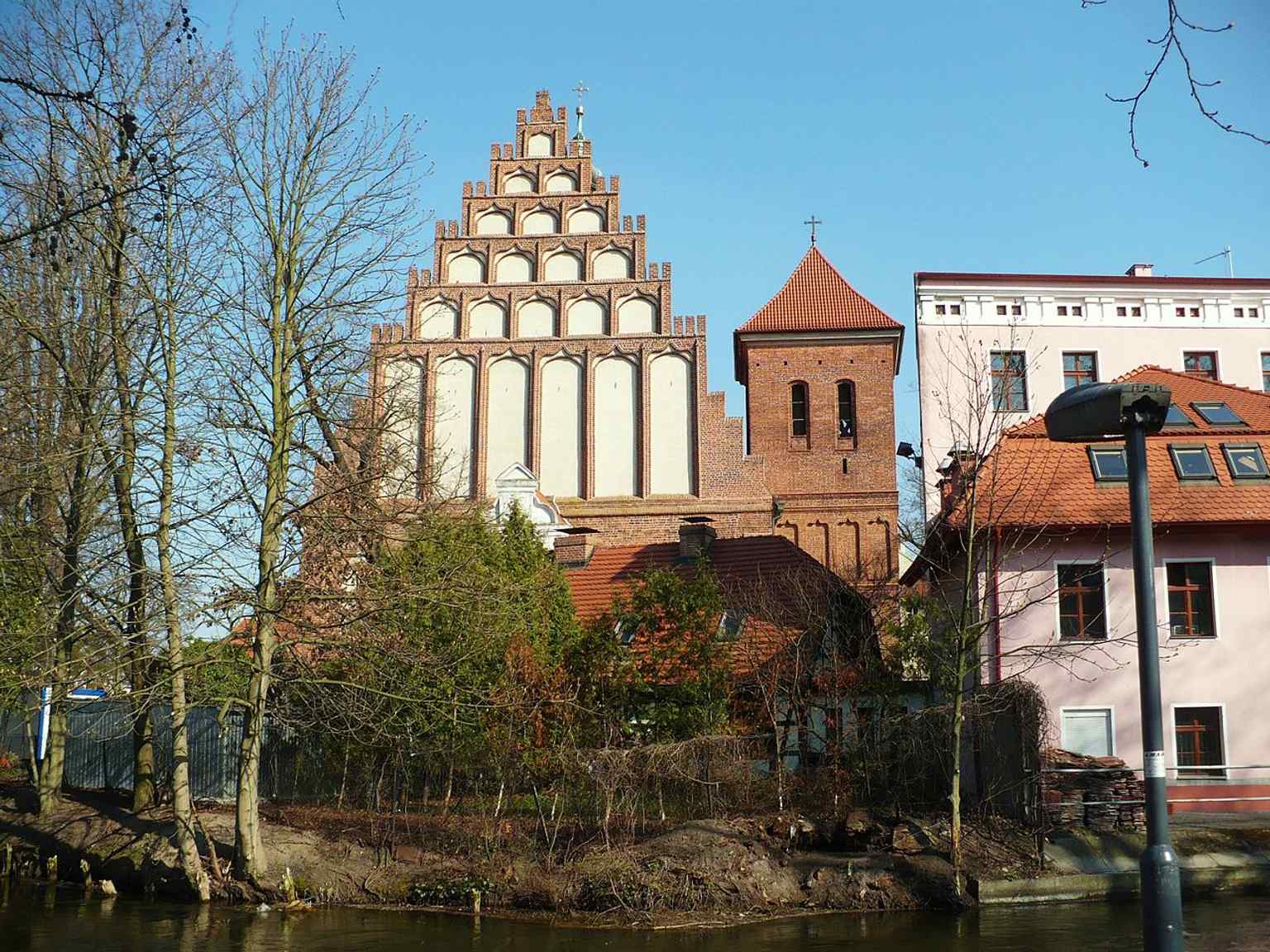
If you glance at your phone, that wider river view shows how naturally the cathedral locks into the waterfront scene.

The cathedral seen from the Mill Island embankment, showing how closely this medieval church is tied to Bydgoszcz’s riverside landscape.Photo: Pit1233, Wikimedia Commons, CC0. Cropped & resized. The first church here may have started in wood, but by the early fifteenth century it had already grown into a serious brick sanctuary. Then came disaster. In fourteen twenty-five, a huge city fire tore through Bydgoszcz, burned the church, and destroyed the municipal records stored inside. Imagine that... one blaze taking both prayer and paperwork in the same breath. The rebuilding began almost right away and stretched for decades, from fourteen twenty-five to fourteen sixty-six.
Here is the fun architectural twist: the builders kept one older northern wall instead of starting from scratch. That choice nudged the new plan slightly off line, so the chancel, the part around the main altar, ended up wider than the main body of the church by almost two meters. In other words, this cathedral is gloriously, historically a little crooked.
During the Thirteen Years’ War, King Casimir the Fourth Jagiellon visited Bydgoszcz again and again, along with nobles, clergy, and courtiers. That traffic brought money, prestige, and momentum, and the church rose into one of the largest parish churches in the whole Włocławek diocese.
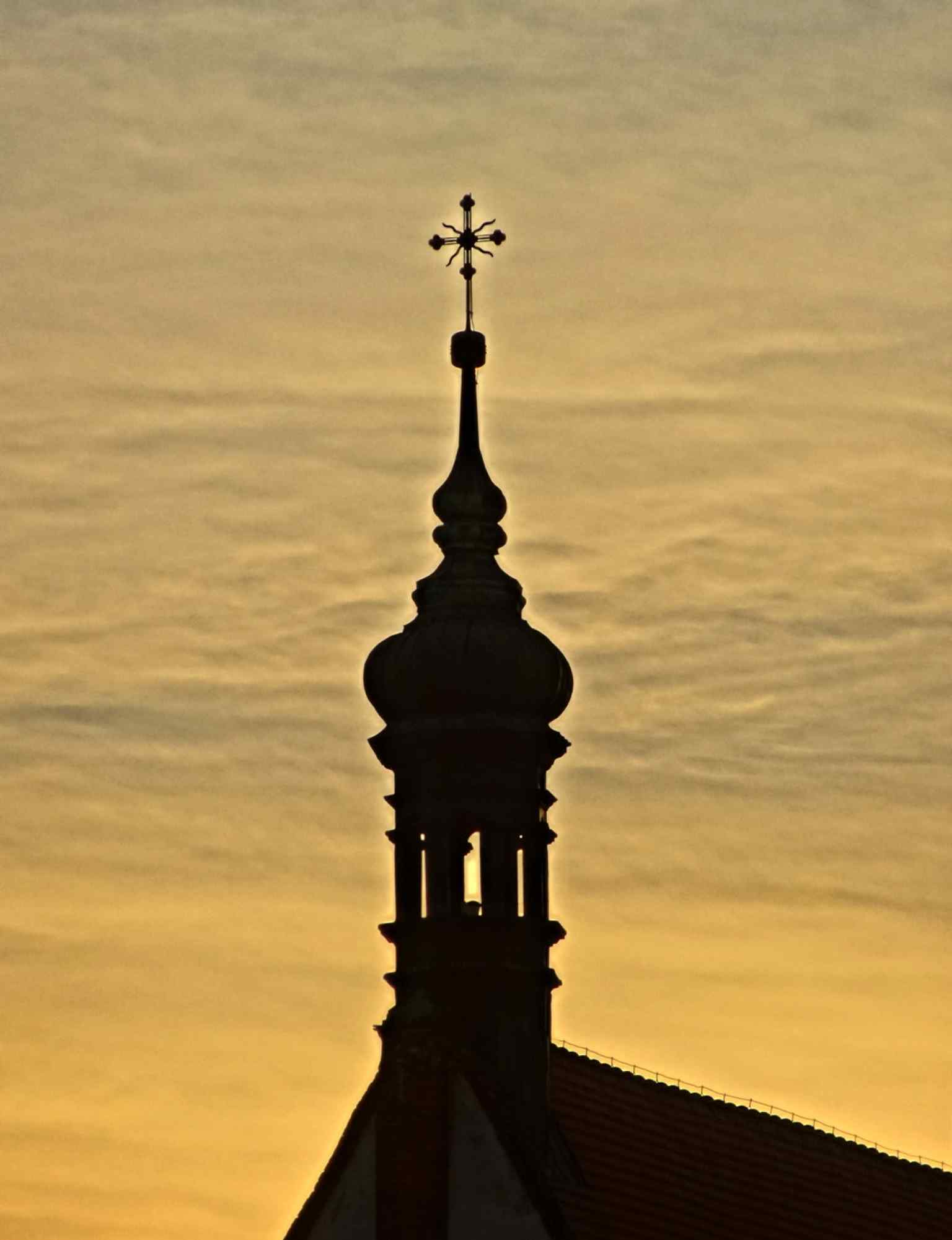
The outside kept evolving. The south tower came later, the western porch took on a Mannerist look in the seventeenth century, and the little roof turret you can spot above the church gained its Baroque form in the early eighteenth century. On another image, you can see that ridge turret more clearly, like a tiny crown balancing on the roofline.

A tighter look at the roof and small ridge turret, recalling the church’s historic signaturka and its long bell tradition.Photo: Pit1233, Wikimedia Commons, CC0. Cropped & resized. Inside lives the building’s emotional center: the Madonna with a Rose, a late fifteenth-century image later honored as Our Lady of Beautiful Love. People hung silver votive gifts beside it in thanks for favors received. In nineteen sixty-six, Cardinal Stefan Wyszyński crowned the image, and in nineteen ninety-nine Pope John Paul the Second crowned it again. A second treasured Marian painting, Our Lady of the Scapular, arrived here from the old Carmelite church after the Prussian authorities suppressed monasteries.
This church went through hard miles too. Soldiers used it during the Napoleonic era, war damaged it in nineteen forty-five, and yet it kept coming back. Then in two thousand and four, it became the cathedral of the newly created Diocese of Bydgoszcz. Not bad for a church that survived fire, partitions, occupation, and the usual human chaos.
And one last wild detail: in twenty eighteen, archaeologists found a hidden cache under the floor, including seventeenth-century jewelry and four hundred eighty-six gold coins, probably concealed during the Swedish wars.
This place feels less like a monument and more like a long, stubborn heartbeat.
Take one more look at the brickwork, and when you’re ready, we can wander on toward Jezuicka Street.

A classic riverfront view of the cathedral over the Brda, matching the source’s emphasis on its place in the city’s waterfront scenery.Photo: Pit1233, Wikimedia Commons, CC0. Cropped & resized. 
The tower and roofline from the Brda side, a good view of the fortress-like Gothic massing described in the history of the church.Photo: Pit1233, Wikimedia Commons, CC0. Cropped & resized. 
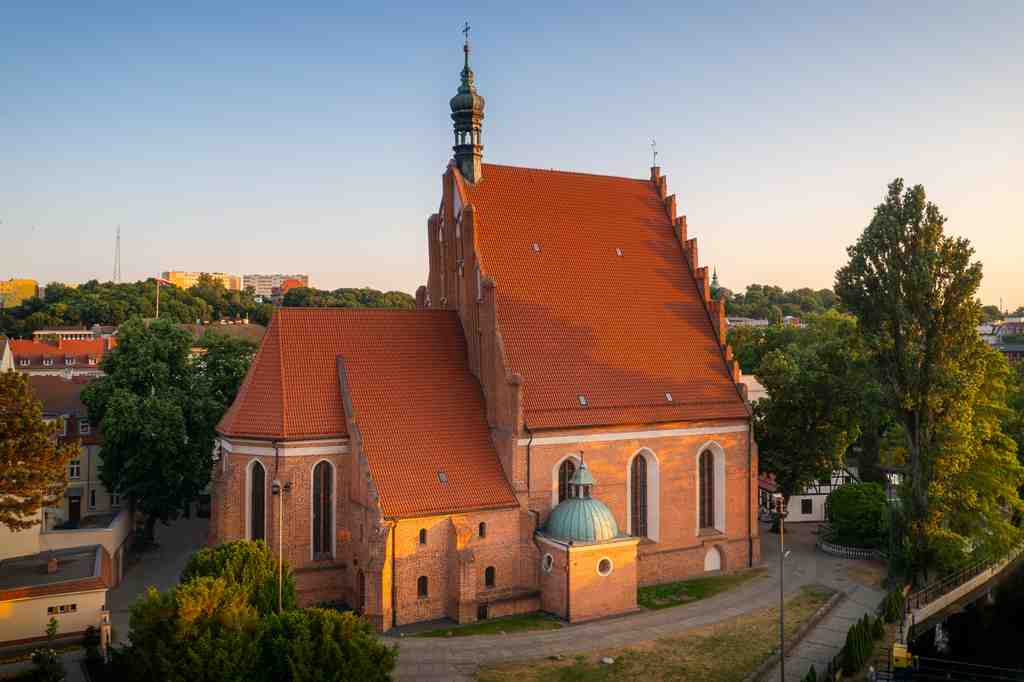
A full daylight view of Saint Martin and Nicholas Cathedral, the main exterior portrait of the landmark.Photo: Pit1233, Wikimedia Commons, CC0. Cropped & resized. 
The western Gothic gables and stepped brick silhouette, key features of the cathedral’s late-medieval architecture.Photo: Pit1233, Wikimedia Commons, CC0. Cropped & resized. 
Another broad exterior view that helps show the cathedral’s overall shape and scale in the old town.Photo: Darpaw, Wikimedia Commons, CC BY-SA 4.0. Cropped & resized. 
The stepped west gable in close view, highlighting the brick Gothic ornament that defines the building’s medieval character.Photo: Taktoperz77, Wikimedia Commons, CC BY-SA 4.0. Cropped & resized. 
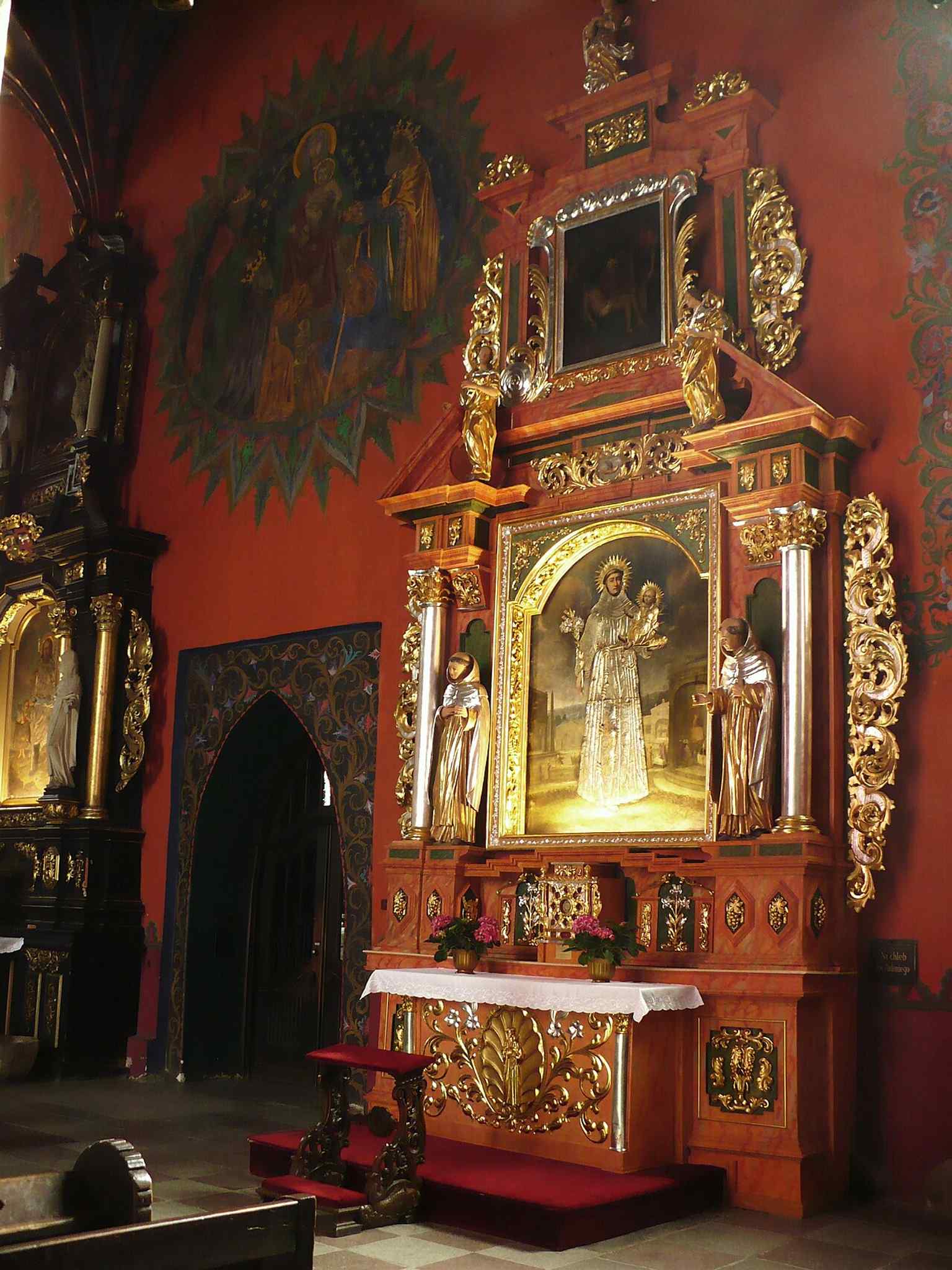
The Baroque Saint Anthony altar, one of the furnishings moved here from demolished Bydgoszcz churches after the Prussian-era losses.Photo: Taktoperz77, Wikimedia Commons, CC BY-SA 4.0. Cropped & resized. 
The cathedral from the Brda side with the sanctuary name in view, fitting the story of its riverside setting and Marian cult.Photo: Pit1233, Wikimedia Commons, CC0. Cropped & resized. 
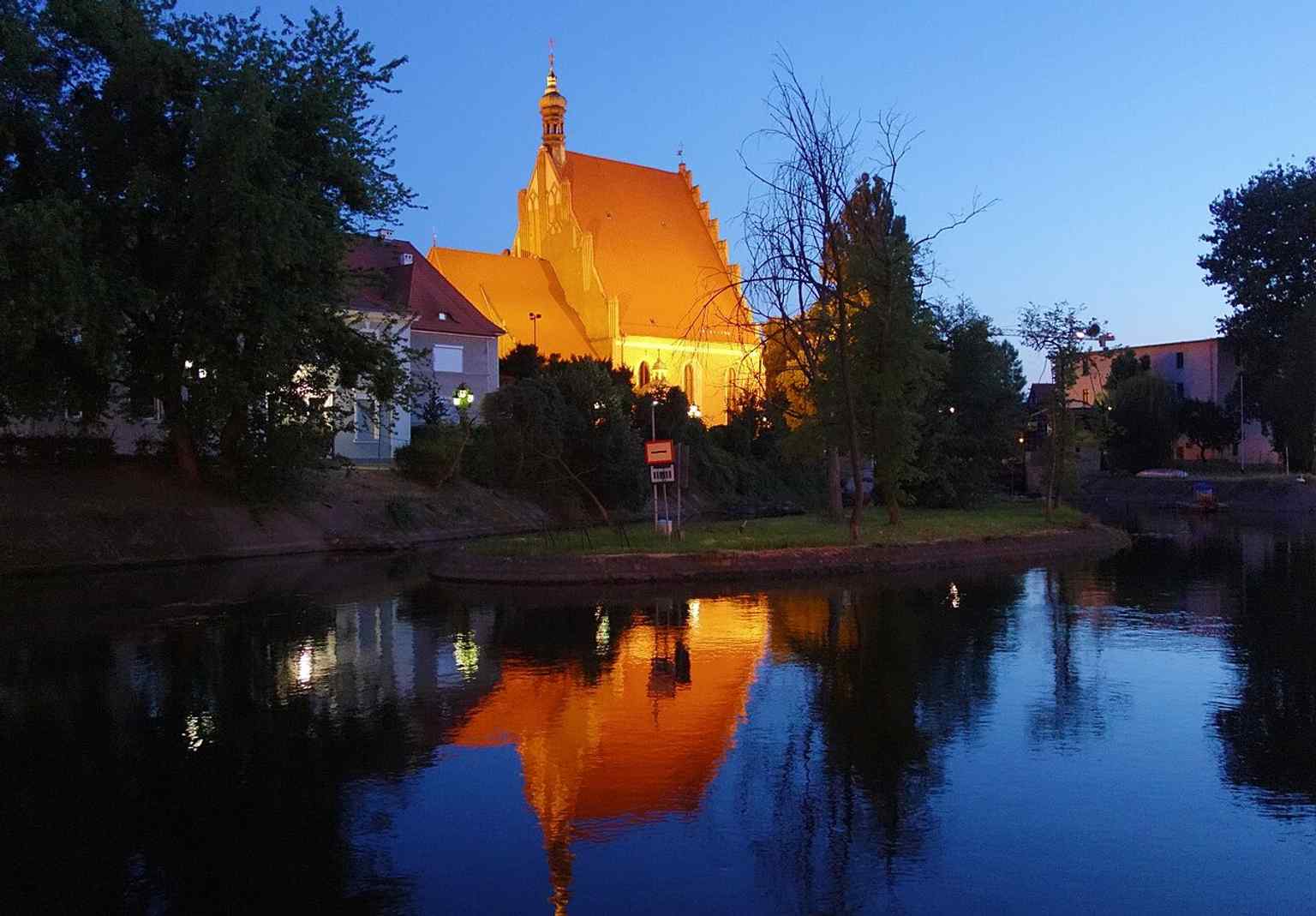
The cathedral at night, showing how the building still dominates the waterfront after dark.Photo: Pit1233, Wikimedia Commons, CC0. Cropped & resized. Look for a narrow stone-paved lane framed by plaster townhouses, with the long, formal brick-and-plaster bulk of the former Jesuit college standing like the street’s quiet anchor.…Mehr lesenWeniger anzeigen
Eigene Seite öffnen →
Jezuicka Street in BydgoszczPhoto: Mariusz Guć, Wikimedia Commons, CC BY-SA 4.0. Cropped & resized. Look for a narrow stone-paved lane framed by plaster townhouses, with the long, formal brick-and-plaster bulk of the former Jesuit college standing like the street’s quiet anchor.
Jezuicka is short, only about a hundred and fifty meters, but it carries a wild amount of history for such a slim little corridor. The city marked it out in the mid-fourteenth century, when medieval Bydgoszcz took shape, and its original job was beautifully practical: lead people from Długa Street straight to the parish church.
Then the Jesuits arrived, and this lane changed character. In the seventeenth and eighteenth centuries, they controlled much of the surrounding block. Around sixteen forty, they closed one side of the square with their Church of the Holy Cross and their college, turning this area into the intellectual engine room of old Bydgoszcz.
Here’s the twist I love: the big building you associate with the Town Hall originally faced this street, not the market. Jezuicka was the grand front door. The side toward the Old Market Square was just the back, a service elevation hidden by other buildings. Only after the Germans demolished those neighboring structures in nineteen forty did the old back suddenly become the new face. Cities do that sometimes... they spin around without moving an inch.
If you glance at the image in the app, you can catch that restored frontage and imagine how this street once carried much more status than its size suggests.

Jezuicka Street in Bydgoszcz today, showing the restored Old Town frontage that once faced the Jesuit college and later became the street’s main historic axis.Photo: Mariusz Guć, Wikimedia Commons, CC BY-SA 4.0. Cropped & resized. The seventeenth century hit hard. During the Swedish Deluge, from sixteen fifty-five to sixteen sixty, fire tore through much of this area, plague sent people fleeing, and many dying residents left their property to churches, monasteries, and hospitals. That is one reason so many houses here were known simply as “Jesuit houses.”
And then, in autumn of sixteen fifty-seven, this narrow street played host to serious European diplomacy. King Jan Kazimierz and Queen Maria Ludwika stayed in Bydgoszcz, along with the Brandenburg elector Frederick William and his wife Luise. Their courtiers lodged in the Jesuit college and nearby houses right here, while negotiations connected to the Treaties of Wehlau and Bydgoszcz moved forward. Those deals helped end Poland’s control over Prussia as a fief... not a small consequence for one little street.
Later centuries filled the gaps. A plan from seventeen seventy-four still showed empty plots, but by eighteen hundred the street had solid rows of houses on both sides. In the nineteen twenties, poorer Polish and Jewish families lived here, including bakers and shoemakers. In September nineteen thirty-nine, Jezuicka became one of the first scenes of Nazi terror in the Old Town. A famous photograph shows an arrested Polish civilian being marched along these walls at gunpoint.
Today the street feels gentler again, with restored facades, city offices, galleries, and a local bookstore called Gratka, known for years not just for books, but for caring for stray cats in the courtyard. That feels right somehow... scholarship, survival, and cats.
Jezuicka is one of those streets that looks modest and thinks in centuries.
Take your time here, and when you’re ready, we can wander on to the next stop.
Look for the low island edged by stone quays and long brick mill buildings, with the chunky red-brown mass of Rother’s Mills as the unmistakable marker. Mill Island is where…Mehr lesenWeniger anzeigen
Eigene Seite öffnen →
Mill Island, BydgoszczPhoto: Aneta Pawska, Wikimedia Commons, CC BY-SA 4.0. Cropped & resized. Look for the low island edged by stone quays and long brick mill buildings, with the chunky red-brown mass of Rother’s Mills as the unmistakable marker.
Mill Island is where Bydgoszcz lets you read its heartbeat in brick, water, and old engineering. It sits between the Brda and a leat, which is just a controlled branch of the river, shaped so water could power machines. For centuries, this was not some decorative patch of green. It was the city’s working engine, once called Royal Island, where mills were already grinding away by the fourteenth century while quieter corners held gardens.
Then money entered the picture... literally. Along Mennica Street - mennica means mint - a royal mint operated here from the late sixteenth century into the late seventeenth. Coins struck on this island traveled far beyond Bydgoszcz, so this little patch of land helped feed people and finance kingdoms at the same time.
The water made that possible. Medieval builders carved channels, raised the Parish Weir - a weir is a low dam that controls water level - and kept tuning the flow until the island became a tight knot of mills, granaries, workshops, and locks. In the eighteenth and nineteenth centuries, Prussian planners pushed the place into a bigger industrial age. The boldest move came with Rother’s Mills in the mid-nineteenth century: a huge brick complex that moved from water power to steam and then electricity, turning Bydgoszcz into a serious grain-processing center with exports reaching Britain and even Brazil.
If you look at your screen for a second, the White Granary’s cellar reveals one of the island’s hidden survivors: Gothic cross-vaults resting on thick brick pillars under an eighteenth-century granary.
What makes this place sing is its second life. The White Granary now holds archaeological collections. The Red Granary, once the Camphausen mill, became a gallery for modern art. An old mills administration building turned into an education center. A former officials’ villa became the Leon Wyczółkowski museum. Even the Kujawska hydropower plant, created in the early twentieth century to supply electricity to the mills, now also tells the story of energy itself. That’s the Mill Island trick: every hard-working building gets another chapter.
The island kept changing shape, too. In the late nineteen sixties, parts of its historic waterways were filled in. Then, after two thousand and four, the city launched a big revival. Quays were repaired, footbridges stitched the island back into the city, the Międzywodzie channel returned as a cascade, and museums and waterfronts opened up the old industrial core to everyone. By two thousand and twelve, the Polish Tourist Organisation named Mill Island the best tourist attraction in the country.
If you want a quick time jump, check the before-and-after image of Wilhelm Kopp’s old dyehouse across the water; it really shows how this waterfront keeps reinventing its working past.
So what you’re seeing is not just a pretty island. It’s the place where Bydgoszcz learned to turn water into bread, money, power, and culture.
Mill Island is basically the city in miniature: practical, creative, and quietly dramatic. It’s open twenty-four hours a day, every day. Take a moment to soak it in, and when you’re ready, we can head on to the next stop.

A wide aerial view of Rother’s Mills from Mill Island, showing the central industrial heart of the island on the Brda river.Photo: Mariusz Guć, Wikimedia Commons, CC BY-SA 4.0. Cropped & resized. 
Mill Island’s marina seen from above — a good match for the island’s modern recreational waterfront and boating facilities.Photo: Mariusz Guć, Wikimedia Commons, CC BY-SA 4.0. Cropped & resized. 
The recreated Międzywodzie channel from above, recalling the island’s historic water network and its 2007 restoration.Photo: Mariusz Guć, Wikimedia Commons, CC BY-SA 4.0. Cropped & resized. 
The Kujawska hydropower plant by the river, built to power the island’s mills and later turned into an energy museum.Photo: Mariusz Guć, Wikimedia Commons, CC BY-SA 4.0. Cropped & resized. 
The pedestrian bridge by Opera Nova, linking the island to the city and framing one of Bydgoszcz’s most iconic waterfront views.Photo: Mariusz Guć, Wikimedia Commons, CC BY-SA 4.0. Cropped & resized. 
The former bathhouse area on Mill Island, part of the heritage buildings now used for cultural and museum purposes.Photo: Aneta p, Wikimedia Commons, CC BY 4.0. Cropped & resized. 
Mill Island in autumn, with the Brda-side greenery that helped earn it the nickname ‘Venice of Bydgoszcz’.Photo: Aneta p, Wikimedia Commons, CC BY 4.0. Cropped & resized. On your left, Wool Market Square opens as a triangular paved space framed by stucco-and-brick tenements, with a bronze statue standing at its center. This little square has…Mehr lesenWeniger anzeigen
Eigene Seite öffnen →
Wool Market Square, BydgoszczPhoto: Pit1233, Wikimedia Commons, CC0. Cropped & resized. On your left, Wool Market Square opens as a triangular paved space framed by stucco-and-brick tenements, with a bronze statue standing at its center.
This little square has lived a lot of lives. Long before it turned into a neat historic pocket, this ground sat just outside the old Poznań Gate, one of the western entrances to medieval Bydgoszcz. That gate stood here from the fourteen hundreds into the early nineteenth century, rebuilt in wood and brick over the years, until the city finally knocked it down in eighteen twenty-eight because it squeezed Długa Street into a frustrating bottleneck. If you want a bird’s-eye clue, take a peek at the old map in the app... it helps you feel how this spot once hovered just beyond the walls.
By the late eighteen thirties, the square found its calling. Farmers from the surrounding countryside brought in firewood and wool, and the wool trade stuck so firmly that the name became official in eighteen fifty-four. There’s something kind of perfect about that. A place can change its face, but a good name keeps the memory warm.
Then came trams. The city’s first tram line ran through here in the late nineteenth century along Poznańska Street. And before electricity took over, the system used horse trams. Right here on the square stood a horse station, with spare harnessed horses waiting in huts while a boy managed the handoff. You can almost hear the rhythm of hooves, wheels, and people bargaining over bundles and bales. The line went electric in eighteen ninety-six, and the route through the square lasted until nineteen seventy.
Look around the edges and you’ll see why this place matters. Several of these houses are protected heritage buildings. Number four is the oldest, dating back to seventeen seventy-four, and it carries a strange little survivor: a cannonball set into the second floor facade, possibly a memory of the Kościuszko Uprising of seventeen ninety-four. Number two and number seven show off the work of Józef Święcicki, one of Bydgoszcz’s star architects, who loved facades with swagger... balconies, heavy ornament, and all that urban confidence.
The statue in the middle honors Leon Barciszewski, mayor of Bydgoszcz from nineteen thirty-two to nineteen thirty-nine. The Nazis murdered him and his son on the eleventh of November, nineteen thirty-nine. For decades, communist authorities blocked efforts to honor him, but local people kept pushing. Solidarność launched the monument campaign in nineteen eighty-one, and the statue finally appeared in nineteen eighty-nine, before the city moved it here in two thousand and seven. That matters, because from nineteen sixty until two thousand and eight, this square had been reduced to a parking lot. Imagine that... centuries of memory under parked cars.
Wool Market Square feels small, but it holds the whole city in miniature.
Take a moment here, and when you’re ready, we can wander on to Długa Street.
Look to your right for a long, straight street framed by stucco-and-brick townhouses, topped with varied gables and dormers, and marked by bronze autograph plaques set into the…Mehr lesenWeniger anzeigen
Eigene Seite öffnen →
Długa Street in BydgoszczPhoto: Mariusz Guć, Wikimedia Commons, CC BY-SA 4.0. Cropped & resized. Look to your right for a long, straight street framed by stucco-and-brick townhouses, topped with varied gables and dormers, and marked by bronze autograph plaques set into the pavement.
This is Długa Street, the longest street in old chartered Bydgoszcz, stretching a little over six hundred and fifty meters, and for centuries it worked like the city’s spine. In the Middle Ages, it linked two gates in the town walls: the Kuyavian Gate to the east and the Poznań Gate to the west. So if you had goods, gossip, grain, tools, or trouble... sooner or later, it all passed through here.
Back in the fourteenth century, the first houses along Długa were wooden or half-timbered, meaning timber frames packed with lighter material. Brick townhouses arrived later, around the fifteenth century, and the street gradually traded rough edges for a more ambitious face. Behind the main fronts ran little service lanes, Pod Blankami on one side and Zaułek on the other, where deliveries came in and horses waited in stables. The polished storefront world out front had a practical backstage.
And here’s a detail I love: in the sixteenth century, people laid a wooden water system along this street. Archaeologists found tree-trunk pipes running almost the whole length of Długa, buried not far below the surface. Imagine the confidence of that move... a proper urban artery, carrying water under a road already important enough to keep clean and passable.
The street also held a whole human mosaic. Alfred Cohn, a doctor and writer who grew up at the corner of Długa and Jana Kazimierza, remembered this place as the landscape of his “unfading happiness.” His father ran an iron goods shop, and around him lived a confectioner named Kraeger, the tobacco seller Janowski, and the jeweler Schroeter. In the nineteenth century, the middle stretch of Długa became a center of Jewish business life, while Polish shops clustered on other sections. It wasn’t some tidy little postcard of harmony... it was a real commercial street, layered, proud, competitive, alive.
If you want a visual for one of Długa’s later inventions, glance at your screen and you’ll see the Autographs Alley, a project started in two thousand and seven that set the signatures of notable people into the pavement itself. It’s such a cool idea: the street literally asks memory to walk with you.

The Bydgoszcz Autographs Alley embedded in Długa Street — a 2007 project that turns the pavement into a roll call of notable city visitors and residents.Photo: Mariusz Guć, Wikimedia Commons, CC BY-SA 4.0. Cropped & resized. Długa knew politics too. At number fifty-two, the Polish paper Dziennik Bydgoski fought Prussian pressure under editor Jan Teska. When the authorities forced him into the German army during the First World War, his wife Wincentyna kept the paper going and even printed his letters from the front. That’s grit, plain and simple.
And then there were the trams, threading through this narrow spine for decades before the line finally disappeared. If you check the photo in the app, you can spot the preserved vintage tram that still nods to that chapter.

The preserved vintage tram on Długa Street — a nod to the street’s long tramway history, including the 1896 electrification era and today’s tourist information point.Photo: Mariusz Guć, Wikimedia Commons, CC BY-SA 4.0. Cropped & resized. Długa Street is basically Bydgoszcz in one long sentence... merchant road, civic stage, tram line, memory lane.
Take your time with it, and when you’re ready, we can drift on toward Podwale Street.

A bird’s-eye view over Długa Street near Jana Kazimierza, showing the pedestrianized historic core where the old commercial route meets the city’s restored street pattern.Photo: Mariusz Guć, Wikimedia Commons, CC BY-SA 4.0. Cropped & resized. 
Looking west along Długa from Jezuicka Street — this is the heart of Bydgoszcz’s old merchant street, lined with historic townhouses and busy with walkers.Photo: Mariusz Guć, Wikimedia Commons, CC BY-SA 4.0. Cropped & resized. 
Długa 41, home to the Municipal and Regional Public Library, standing at the corner that once held important civic and police functions on the street.Photo: Mariusz Guć, Wikimedia Commons, CC BY-SA 4.0. Cropped & resized. 
Długa 52 / Jana Kazimierza 5, the corner building that housed the Polish Dziennik Bydgoski and later became the seat of the Voivodeship Administrative Court.Photo: Mariusz Guć, Wikimedia Commons, CC BY-SA 4.0. Cropped & resized. Look for a narrow street lined with plaster-and-brick townhouses, marked by a long straight run and the red-brick market hall with its steep roof and neo-Gothic shape. Podwale…Mehr lesenWeniger anzeigen
Eigene Seite öffnen →
Podwale Street in BydgoszczPhoto: Mariusz Guć, Wikimedia Commons, CC BY-SA 4.0. Cropped & resized. Look for a narrow street lined with plaster-and-brick townhouses, marked by a long straight run and the red-brick market hall with its steep roof and neo-Gothic shape.
Podwale is one of those places that seems quiet until history starts talking... and then it really does not shut up. You’re standing on the old eastern edge of Bydgoszcz’s Old Town, along a strip that medieval town planners never originally laid out. This street appeared later, in the early modern period, right beside the castle moat - that defensive water ditch that separated the chartered town from the older stronghold area where King Casimir the Great ordered a castle in the fourteenth century.
So this was a borderland. Not the poetic kind... the muddy kind. For a long time, the ground on the eastern side was barely stable land at all, more like the slowly filled remains of an old river channel turned into a moat. Archaeologists found that in the fourteenth and fifteenth centuries the water reached deep into what are now the plots along this side of the street. That explains why people did not build here earlier. There simply wasn’t much solid ground to trust.
If you want a good overview, take a quick glance at the image in the app. It helps you see Podwale the way historians do: not just as a street, but as the seam where town, castle, and water once rubbed against each other.

A clear northbound view along Podwale Street, the historic edge of Bydgoszcz’s Old Town where the city once met the castle moat.Photo: Mariusz Guć, Wikimedia Commons, CC BY-SA 4.0. Cropped & resized. And then came the discoveries. During works in two thousand eighteen and two thousand nineteen near the corner with Grodzka Street, archaeologists led by Robert Grochowski uncovered the remains of a sixteenth-century wooden city gate and fragments of the bridge that once led toward the castle. Construction had to stop on the spot. Out of that old moat mud they also pulled something extraordinary: a broken medieval sword from the turn of the fourteenth and fifteenth centuries. Researchers believe it may have seen combat during the war with the Teutonic Knights, possibly in fourteen oh nine, when King Władysław Jagiełło retook the Bydgoszcz castle. Imagine that for a second... one violent moment, one dropped weapon, then six hundred years of silence in the silt.
Podwale also carried traffic, noise, and commerce. A major trade route passed through here from Gdańsk through Świecie toward Inowrocław and farther south, crossing the city between the Gdańsk Gate and the Kuyavian Gate. If you peek at the second image, you can picture that old transit line more clearly.

Looking from Długa Street toward Podwale, a route that once formed a key transit corridor linking the old city with the Gdańsk–Kujawy trade road.Photo: Mariusz Guć, Wikimedia Commons, CC BY-SA 4.0. Cropped & resized. The street even had an older name: Żabia, or Frog Street. Not as an insult - just honest branding. The castle moat bred so many frogs that their croaking became the neighborhood’s defining soundtrack. Later, the name shifted to Podwale, tied to the filled-in area beside the former moat and the visible earthworks linked with the castle landscape.
Architecturally, most of what you see dates from the late eighteenth to early twentieth century. The big showpiece is the municipal market hall, designed by the Berlin firm Boswau and Knauer and opened in the early nineteen hundreds. It was modern for its day: ninety-six stalls, stone counters, meat and fish upstairs, poultry and dairy in the cellars, and a bell to announce trading hours. More recently, the city restored it and tried turning it into a modern food hall, but high prices and a mismatched concept sank the project, and another attempt failed too, leaving the old hall waiting for a better chapter.
Podwale is really a street about edges - between land and water, castle and town, everyday trade and buried memory.
Take a second to let that settle in, and when you’re ready, we can continue on to Grodzka Street.
Look for a broad stone-paved riverside street lined with brick and timber-fronted facades, with old granaries at one end and a striking glass granary-shaped bank marking its…Mehr lesenWeniger anzeigen
Eigene Seite öffnen →
Grodzka Street, BydgoszczPhoto: Pit1233, Wikimedia Commons, CC0. Cropped & resized. Look for a broad stone-paved riverside street lined with brick and timber-fronted facades, with old granaries at one end and a striking glass granary-shaped bank marking its modern edge.
Grodzka is not just a street... it’s a long stitched seam where Bydgoszcz kept repairing and reinventing itself. Town planners laid it out in the mid-fourteenth century, right when Bydgoszcz became a charter city, and ever since then this stretch along the Brda has carried trade, prayer, schooling, theater, and a whole lot of reinvention in about four hundred thirty meters.
The wild part is how deep its story goes. The eastern end of Grodzka cuts through the oldest settled part of Bydgoszcz. Archaeologists spent decades digging here and found traces of an early medieval stronghold on an island shaped by the river’s bends: log-cabin homes, work buildings, and even wooden harbor structures. Tree-ring dating pinned some of those fortifications to one thousand and thirty-seven and one thousand and thirty-eight. That is early... seriously early. Later digs near the corner with Bernardyńska added more wooden remains, and many of those finds ended up in the archaeological displays at the White Granary on Mill Island.
For centuries, this was the city’s northern edge and its main axis. One end pointed toward the cathedral, the other toward the old castle. Somewhere near the Podwale crossing stood the Grodzka Gate, the one passage between town and castle, with a bridge over the moat just beyond it. Archaeologists never found the gate itself, but old written records proved it stood here. Then the Swedish invasions tore down both gate and castle, and the city never raised them again.
This street even had a bathing district. The western part once took its name from public baths. In fifteen forty-nine, Andrzej Kościelecki reached an agreement with the city council to place public baths on the waterfront here. In fifteen seventy-three, Jan Kościelecki pushed for repairs so people could use them again for basic hygiene. Records still mention bathing activity in seventeen seventeen, which gives Grodzka this funny, practical side among all the grander stories.
Trade shaped the look of the place. The river side filled with granaries and harbor business, while the opposite side grew houses and institutions. That’s why Grodzka feels like a conversation between storage and ceremony: late eighteenth-century granaries, the Dutch Granary turned museum, the shipping-company elegance of Lloyd’s Palace, the neo-Gothic seminary on the old moat line, and then the bold glass forms of the mBank “new granaries,” which became an icon of modern Polish architecture.
And then there’s performance. At numbers fourteen and sixteen, a restaurant and entertainment complex grew into a major social venue after Jacob Wichert expanded it, and in eighteen ninety-seven Karl Bergner added a banquet hall for six hundred people. After the Second World War, when the municipal theatre was gone, artists adapted this building for stage work. Later it became the Chamber Theatre, a home for experimental productions until fire rules shut it down in nineteen eighty-eight. If you want, check the before-and-after image in the app; it’s a neat little proof that Grodzka keeps reviving its cultural heart.
If you glance at the historic Fish Market photo on your screen, you’ll catch the trading life that once pressed right up against this river edge.
Grodzka feels less like one street and more like the whole city told in one long breath.
Take your time here, and when you’re ready, we can drift on toward the old castle site.

A street-level view of Grodzka Street captures the historic riverside promenade in the Old Town.Photo: Mariusz Guć, Wikimedia Commons, CC BY-SA 4.0. Cropped & resized. 
The Chamber Theatre adds cultural life to Grodzka Street, in a building long used for performances and gatherings.Photo: Mariusz Guć, Wikimedia Commons, CC BY-SA 4.0. Cropped & resized. On your right, imagine a red-brick rectangular fortress with steep gabled roofs, corner towers, and a chunky gate tower guarding the entrance. That missing castle shaped…Mehr lesenWeniger anzeigen
Eigene Seite öffnen →
Castle in BydgoszczPhoto: Pit1233, Wikimedia Commons, Public domain. Cropped & resized. On your right, imagine a red-brick rectangular fortress with steep gabled roofs, corner towers, and a chunky gate tower guarding the entrance.
That missing castle shaped Bydgoszcz for more than three centuries. King Casimir the Great ordered it in the mid-fourteenth century, right on the hill where an older stronghold had burned after a Teutonic attack in thirteen thirty. The location was pure strategy: the Brda River protected one side, and moats wrapped around the others, turning this hill into a hard little knot of power.
If you glance at the image in the app, you can see how serious the place once looked. The castle followed a rectangle plan, big by northern Polish standards, and builders copied the tough red-brick style of Teutonic castles. Inside stood three heavy residential wings, three stories tall, around an inner courtyard. A brick gate tower controlled the way in, three corner towers watched the edges, and a long outer wall carried a crenellated top - that tooth-like parapet soldiers used for cover. There was a chapel, living quarters, offices, and stores of weapons all packed inside.

A rare 1600 engraving of Bydgoszcz Castle, showing the stronghold as it looked before the Swedish destruction in 1656.Photo: Pit1233, Wikimedia Commons, Public domain. Cropped & resized. And this wasn’t some sleepy outpost. Nearly every major Polish king passed through. Władysław Jagiełło fought to retake the castle from the Teutonic Knights in fourteen oh nine, storming it over eight days, from late September into early October. After that, he signed a truce here with Grand Master Ulrich von Jungingen - a pause before the war rolled on toward Grunwald. Later, Casimir Jagiellon came here again and again during the Thirteen Years’ War, and King Stefan Batory even lived here for three months in fifteen seventy-seven.
Then the border shifted, and the castle slowly lost its sharp military edge. In the seventeenth century, Jerzy Ossoliński tried to toughen it up with bastions - earthen-and-brick gun platforms protecting the road and bridge. You can check the layout on your screen if you want a map of how the castle, moat, and town fit together.

This reconstructed plan maps the castle, moat, and city layout together — a useful clue to how the fortress sat east of the medieval town.Photo: Gustav Reichert Emil Schulz, Wikimedia Commons, Public domain. Cropped & resized. But the real breaking point came in the Swedish Deluge. Swedish troops took the fortress in sixteen fifty-five, lost it, took it again, and during the fighting in October sixteen fifty-six, the stronghold blew apart. The explosion wrecked the living wings and smashed the surrounding bastions. After that, nobody truly brought it back.
What happened next feels almost brutal in its practicality. Prussian authorities pulled down more of the ruins, reused the brick for hussar barracks, and later the castle’s material ended up in city buildings, especially houses on Długa Street. By eighteen ninety-five, the last visible remains were gone. Even so, archaeologists kept finding traces - cannonballs, Gothic bricks, tower foundations, even a liturgical vessel of gold sheet - little hard facts refusing to disappear.
The castle is gone, but this patch of ground still feels like Bydgoszcz’s old command center.
You can visit this site anytime, since it’s open around the clock.
Take that in for a second. When you’re ready, we can wander on to Kościeleckich Square.

The scale model shows the castle complex in three dimensions, helping visualize the rectangular brick stronghold and its defensive towers.Photo: Ulrich Jahr, Wikimedia Commons, Public domain. Cropped & resized. 
A relief of medieval Bydgoszcz with the castle highlighted, echoing the source’s description of the castle beside the old town and its fortifications.Photo: Pit1233, Wikimedia Commons, CC0. Cropped & resized. 
A published historical illustration of the castle from 1902, preserving the memory of the ruin before the site was fully cleared in 1895.Photo: Erich Schmidt, Wikimedia Commons, Public domain. Cropped & resized. Look for a broad rectangular square paved in pale stone, crossed by straight paths and geometric beds, with rows of chestnut trees as its signature marker. Plac Kościeleckich…Mehr lesenWeniger anzeigen
Eigene Seite öffnen →
Kościeleckich SquarePhoto: Mariusz Guć, Wikimedia Commons, CC BY-SA 4.0. Cropped & resized. Look for a broad rectangular square paved in pale stone, crossed by straight paths and geometric beds, with rows of chestnut trees as its signature marker.
Plac Kościeleckich feels calm now, but this patch of ground has lived a bunch of different lives. For centuries, it sat beside a swampy arm of the Brda. Just north of here stood the early Bydgoszcz stronghold, and after its destruction in the fourteen hundreds, King Casimir the Great pushed up a brick castle ringed by a moat. That fortress mattered in the Polish-Teutonic wars, then the Swedish Deluge blew it apart with mines. After that... the place drifted into neglect, part wasteland, part garden plots.
And here is the wild part: for decades, children at the little Alf kindergarten nearby played above those buried royal walls without knowing it. Only after the building came down in two thousand and twenty-four did archaeologists uncover remarkably well-preserved castle remains. So this square is not just near history... it is sitting on top of it.
The square itself arrived much later. In eighteen ninety-nine, Prussian officials reshaped the old castle hill and laid out this urban space. The big northern anchor became the new neo-Gothic Evangelical church, finished in nineteen oh five and designed by Heinrich Seeling. Along the south side, Carl Meyer gave the square two more important neighbors: a former folk school and, in nineteen oh eight to nineteen oh nine, the Auguste-Victoria-Heim, an infant shelter that answered a grim problem of the era, high infant mortality. Today that building serves culture instead of medicine, which is a pretty graceful second act.
If you want the bird's-eye version, take a peek at the app image showing the renewed layout and the chestnut rows from above. Those trees matter. Gardeners planted chestnuts here in ordered rows in nineteen oh eight, and they became the square's signature. When the city tried to remove more of them in two thousand and seventeen, locals fought back hard. Conservation officials stepped in, the surviving trees stayed, and the recent renewal let them remain the stars.

Drone view after the 2024–2025 renewal, showing the square’s geometric layout and the restored chestnut trees that became its signature feature.Photo: Mariusz Guć, Wikimedia Commons, CC BY-SA 4.0. Cropped & resized. This place also had a loud, practical chapter. From nineteen thirty-five into the nineteen seventies, Plac Kościeleckich served as Bydgoszcz's bus station. That happened after the old station at Stary Port proved almost absurdly dangerous: in nineteen thirty and again in nineteen thirty-one, buses rolled straight into the Brda. In one case, a gas station worker's mistake sent a vehicle backing into the river. So the city moved the hub here, to dry ground. Later, the terminal vanished, and a modern glass-and-granite office block rose on part of that site; you can spot it in the app if you like.

The modern Immobile K3 office block now occupies the former bus station site on Kościeleckich Square, beside St. Andrew Bobola Church.Photo: Krystian Dobosz, Wikimedia Commons, CC BY 4.0. Cropped & resized. The name Kościeleckich honors the Kościelecki family, royal governors who helped Bydgoszcz thrive in its golden age. Somehow that fits. This square keeps turning old ground into new purpose... and never quite gives up its secrets.

A bird’s-eye view of building no. 8 on the square, one of the historic neighbors linked to the old school and children’s shelter described in the tour.Photo: Mariusz Guć, Wikimedia Commons, CC BY-SA 4.0. Cropped & resized. 
Street-level view of the building at 8 Kościeleckich Square, part of the south-side frontage that frames the square.Photo: Mariusz Guć, Wikimedia Commons, CC BY-SA 4.0. Cropped & resized.
Häufig gestellte Fragen
Wie starte ich die Tour?
Laden Sie nach dem Kauf die AudaTours-App herunter und geben Sie Ihren Einlösecode ein. Die Tour ist sofort startbereit – tippen Sie einfach auf „Play“ und folgen Sie der GPS-geführten Route.
Benötige ich während der Tour Internet?
Nein! Laden Sie die Tour vor dem Start herunter und genießen Sie sie vollständig offline. Nur die Chat-Funktion benötigt Internet. Wir empfehlen den Download über WLAN, um mobiles Datenvolumen zu sparen.
Handelt es sich um eine geführte Gruppentour?
Nein – dies ist ein selbstgeführter Audioguide. Sie erkunden unabhängig in Ihrem eigenen Tempo, wobei die Audioerzählung über Ihr Telefon abgespielt wird. Kein Reiseleiter, keine Gruppe, kein Zeitplan.
Wie lange dauert die Tour?
Die meisten Touren dauern 60–90 Minuten, aber Sie kontrollieren das Tempo vollständig. Pausieren Sie, überspringen Sie Stopps oder machen Sie Pausen, wann immer Sie wollen.
Was, wenn ich die Tour heute nicht beenden kann?
Kein Problem! Touren haben lebenslangen Zugriff. Pausieren Sie und setzen Sie sie fort, wann immer Sie möchten – morgen, nächste Woche oder nächstes Jahr. Ihr Fortschritt wird gespeichert.
Welche Sprachen sind verfügbar?
Alle Touren sind in über 50 Sprachen verfügbar. Wählen Sie Ihre bevorzugte Sprache beim Einlösen Ihres Codes. Hinweis: Die Sprache kann nach der Tour-Generierung nicht mehr geändert werden.
Wo greife ich nach dem Kauf auf die Tour zu?
Laden Sie die kostenlose AudaTours-App aus dem App Store oder von Google Play herunter. Geben Sie Ihren Einlösecode (per E-Mail gesendet) ein, und die Tour erscheint in Ihrer Bibliothek, bereit zum Download und Start.
Wenn Ihnen die Tour nicht gefällt, erstatten wir Ihnen den Kaufpreis. Kontaktieren Sie uns unter [email protected]
Sicher bezahlen mit