
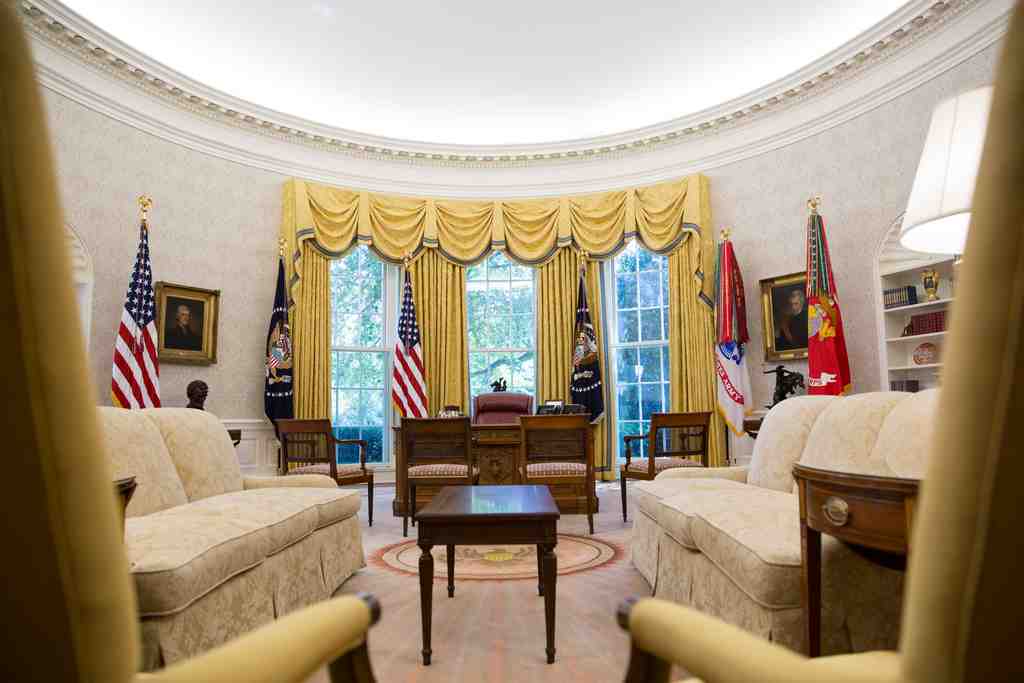
Look for the curved white wall projecting from the southeast corner of the West Wing, marked by three tall windows and a distinct bow shape that breaks the building's flat lines.
It is strange to think that for the first century of the presidency, this room did not exist. The Oval Office feels inevitable now, like a temple of democracy, but it is actually a relatively modern stage set designed for a specific actor. The current office was the idea of Franklin D. Roosevelt in nineteen thirty-four. FDR, who used a wheelchair, found the previous workspace in the center of the building too cramped and difficult to navigate. He hired architect Eric Gugler to shift the whole operation to this corner, expanding the footprint and giving himself direct access to the Residence. He designed a room where he could hold court from behind a desk, minimizing the need to stand.
That architectural dominance became a tool for his successors. The room is designed to intimidate. Lyndon B. Johnson, a towering man at six-foot-four, mastered this. He unleashed the famous Johnson Treatment here, leaning over visitors to invade their personal space, bullying and flattering them into submission. He even kept the bathroom door open while using the facilities, continuing conversations with aides just to show he had absolutely nothing to hide.
But the room has ears. In nineteen seventy-one, Richard Nixon ordered the Secret Service to install a voice-activated taping system. Seven microphones were hidden in the room, including two in the wall sconces by the fireplace. Nixon wanted an accurate historical record of his brilliance. Instead, the system captured the President discussing the Watergate cover-up. The invisible machinery he installed to preserve his legacy became the very thing that destroyed it.
The layout itself invites trouble. There is a private study and a windowless hallway just off the main room. That secluded corridor, hidden from the sightlines of the open doors, became the primary setting for the clandestine encounters between Bill Clinton and Monica Lewinsky. The architecture of privacy, meant for sensitive state matters, ended up fueling a constitutional crisis.
Even the furniture keeps secrets. The massive Resolute Desk, which you have likely seen in photographs, has a panel on the front bearing the presidential seal. That was not part of the original Victorian design. FDR requested it to conceal his heavy leg braces from visitors sitting across from him. He passed away before it was installed, but the panel remained, eventually serving as a hiding spot for John F. Kennedy Junior in those iconic photos of him peeking out from under his father's desk.
For all its security, the illusion of safety here is fragile. In nineteen seventy-four, a stolen Army helicopter actually landed on the South Lawn, just one hundred and fifty feet from these windows. The pilot was a mechanic named Robert Preston who had failed flight training and just wanted to prove his skills. He hovered near the Washington Monument before setting down right in the President's backyard.
The President may be the face of the nation, but the sheer volume of work requires an army of staff. Let’s head toward the massive, fortress-like building just to the west, which houses the thousands of people who make the executive branch run.




