
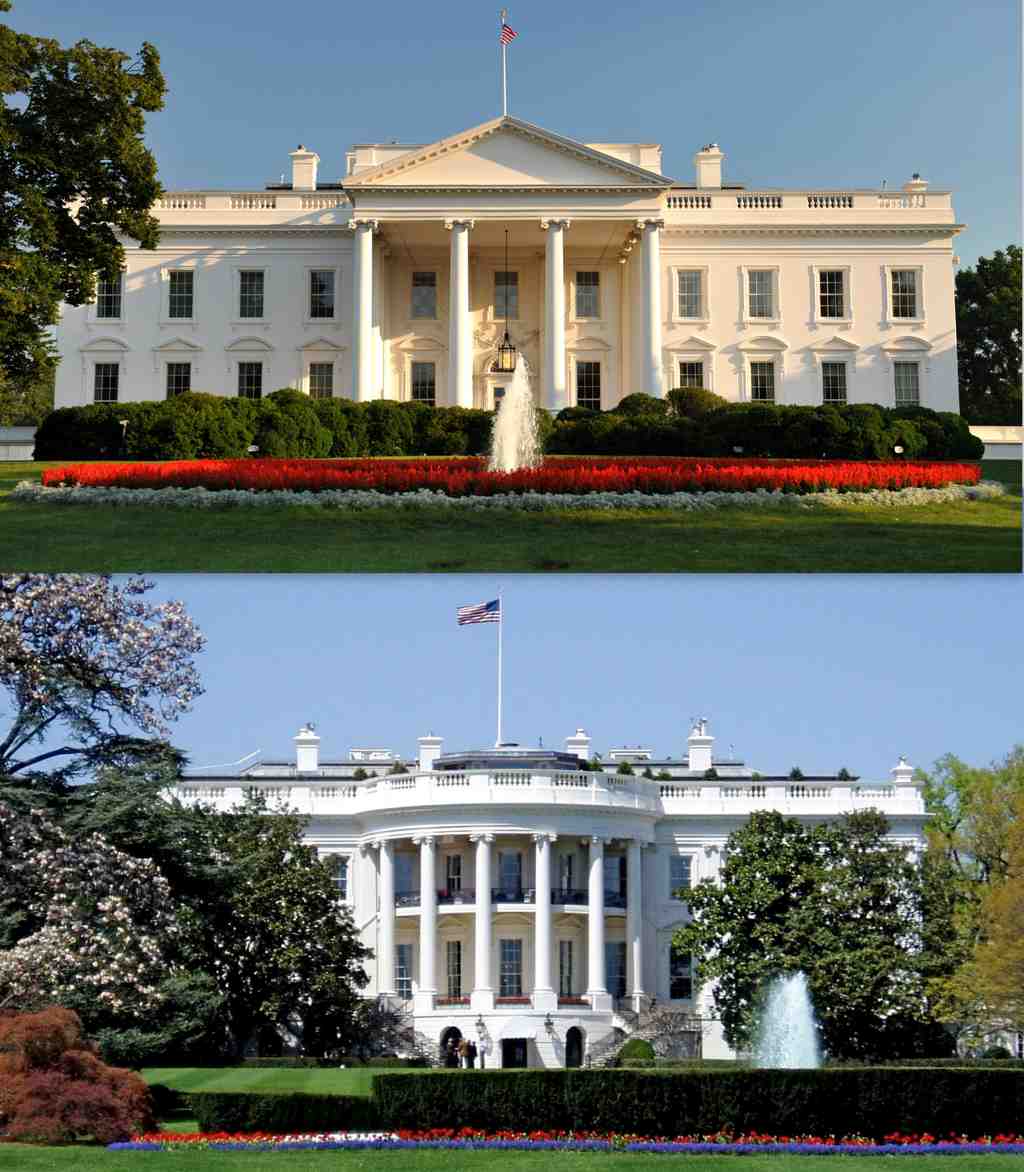
To spot this landmark, look for the massive building of painted white sandstone, anchored by a central triangular portico with tall columns and a flat, balustraded roofline that hides the top floor.
From where you are standing, this building projects absolute permanence. Look at the rhythm of those windows and the heavy, pale Aquia Creek sandstone. That is the Neoclassical style at work. The architects, starting with James Hoban, didn't just want a pretty house; they wanted to project ancient stability. They borrowed the visual language of Greek and Roman democracy-the symmetry, the heavy stone, the grand columns-to convince the world that this new, experimental government was here to stay. It is a brilliant piece of theater. A pristine stage set designed to make you believe the authority inside is as solid as the rock outside.
But if you were to peer behind that stone curtain, you would find that the inside has been burned, gutted, and rearranged more times than a Broadway set.
The first time the curtain fell was in 1814. During the War of 1812, British troops marched right into the dining room. They found a feast set for President Madison, ate the food, drank the wine, and then set the place on fire. Which I suppose is one way to critique the menu. Only these exterior walls survived, and even they were charred black.
They rebuilt it, but the drama inside didn't stop. By the late nineteenth century, the "Executive Mansion," as it was called then, was bursting at the seams. Imagine trying to run a country while living in a crowded boarding house. You had the President's family upstairs and the entire executive staff working downstairs. The public could just wander in. In 1837, Andrew Jackson invited the public to eat a fourteen-hundred-pound wheel of cheddar cheese in the entrance hall. The crowd devoured it in two hours, but the smell... well, the smell soaked into the curtains and stayed for months.
It became clear that the President didn't just need a home; he needed an office. This brings us to the West Wing. We tend to think of it as the historic seat of power, but it was actually a desperate solution to overcrowding. In 1902, Theodore Roosevelt simply couldn't work with his six noisy children running around, so he built a temporary office structure to the side. That "temporary" fix evolved into the global command center we recognize today.
But the biggest illusion of this building is its structure. By 1948, the house was literally falling down. The wooden beams, weakened by the 1814 fire and decades of cutting holes for pipes and wires, were snapping. President Truman had to move out. They didn't just renovate; they hollowed it out. They drove a bulldozer through the front door, dismantled every room, and built a modern steel skyscraper inside the empty shell of these stone walls. The interior cost nearly six million dollars at the time-which is over seventy million today. So, when you look at the White House, you are looking at an eighteenth-century skin wrapped around a twentieth-century steel skeleton.
It is a perfect metaphor for the presidency itself: a traditional face on the outside, masking a complex, modern machine on the inside. Now, let’s walk toward that "temporary" office I mentioned. It is just a short walk to the most famous room in the world.




