
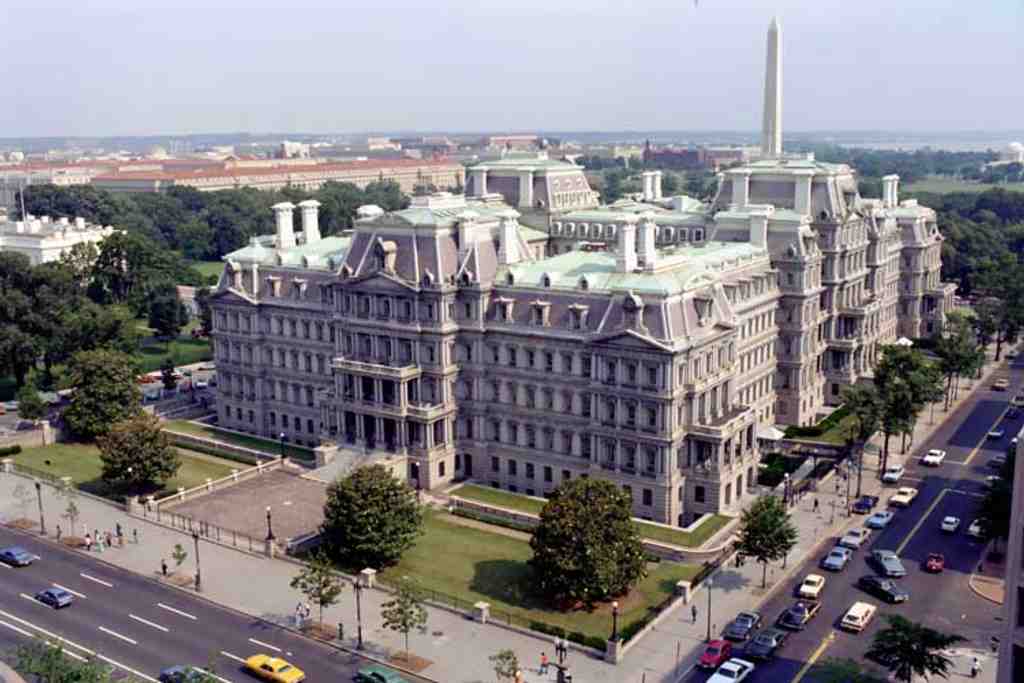
Look to your right at that colossal fortress of gray granite, instantly recognizable by its hundreds of tiered columns and the steep, green-tiled mansard roof capping the top.
If the White House is the polished face of the presidency, this... this is the engine room. It represents the Machine-the sheer, overwhelming scale of the bureaucracy required to actually run a country. Originally called the State, War, and Navy Building, it was completed in 1888 to house three entire cabinet departments. Today, those agencies would fill half the city, but back then, the entire executive machinery of the United States fit right here, behind these four-and-a-half-foot thick walls.
The style is French Second Empire, a lavish, tiered look borrowed from Paris that clashes aggressively with the polite white marble of the rest of D.C. At the time, critics absolutely loathed it. Mark Twain called it the ugliest building in America. President Harry Truman later called it a monstrosity, though he eventually saved it from demolition, arguing that its history was worth more than its aesthetics. It cost just over ten million dollars to build in the 1880s-which is roughly three hundred million dollars today.
The interior is just as intense. It was designed with fireproof cast-iron elements, including doorknobs cast with specific patterns to tell you which department you were entering-an anchor for the Navy, or a shield for War. But the real stories happen behind those doors.
This building is where the massive gears of influence turn. Richard Nixon actually preferred working here over the Oval Office. He had a hideaway in Room 180, where he felt more at ease. He even drilled a hole through the top of Theodore Roosevelt’s old desk to hide his phone cables. But that sanctuary became a trap; it was actually here, in this private hideaway, that the system captured the 'Smoking Gun' tape that ended his presidency.
Decades earlier, on December 7, 1941, this building witnessed a different kind of tension. Secretary of State Cordell Hull was in his office here when Japanese diplomats arrived for a meeting. Hull already knew about the attack on Pearl Harbor thanks to intercepted messages. He refused to let them sit, screamed that their diplomatic note was crowded with infamous falsehoods, and kicked them out without a handshake.
It also hides simpler secrets. Deep in the basement, there is a two-lane bowling alley originally installed for Harry Truman. Staffers still use it to blow off steam, wearing mismatched rental shoes beneath the seat of global power.
But the machine often consumes its creators. The architect, Alfred B. Mullett, dedicated years to this granite giant. He sued the government for a standard architect’s fee of five percent, expecting to be a wealthy man. The courts ruled against him, saying his government salary was enough. Destitute and feeling betrayed by the country he built monuments for, Mullett took his own life in 1890. Security guards still report seeing his spirit roaming the corridors, perhaps checking for cracks in the stone.
Let’s leave the heavy machinery of state behind us. We are going to head toward the cultural institutions that sit just outside these iron gates. Walk with me.




