
On your left, look for a hillside spread of brick and stone houses with steep rooflines and towers, anchored by the cathedral’s tall bell tower.
This district is less a single sight than a social map. Industrial power rarely went home quietly. In Fountain Hill, it went uphill. This was Bethlehem’s executive landscape: a neighborhood where railroad-era wealth turned into architecture, where status showed up in lot size, ornament, and whose carriage would have stopped at which door. The district holds forty-four contributing buildings and one contributing structure, and the National Register of Historic Places recognized it in nineteen eighty-eight.
The name is a little slippery. Most of the district actually sits outside the modern borough of Fountain Hill. But local history ties it to Tinsley Jeter’s nineteenth-century town plot, when this whole area was known as Fountain Hill, so the old name stuck... municipal boundaries, as usual, arrived later and complicated everything.
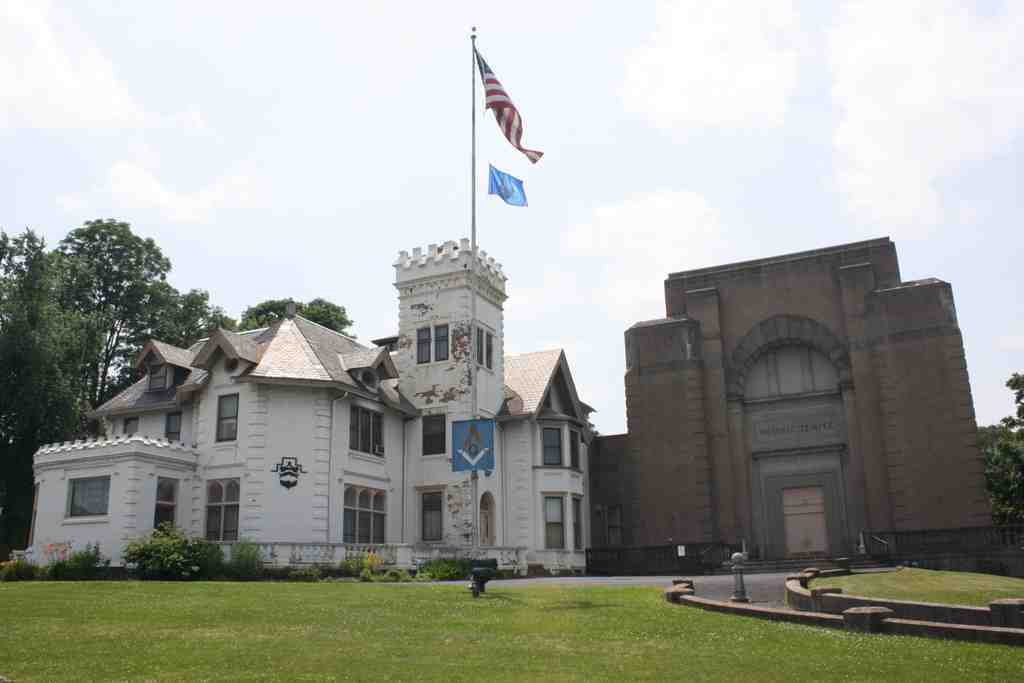
Many of these grand houses belonged to relatives and close associates of Asa Packer, the railroad magnate. Robert Heysham Sayre is a good guide to the place. Packer made him chief engineer of the Lehigh Valley Railroad, and Sayre chose this hillside carefully. Beginning in eighteen fifty-eight, he raised a Gothic Revival mansion here, a style that borrowed pointed shapes and a bit of medieval drama to signal seriousness and taste. In eighteen ninety-nine, he even added a two-story wing for his library, turning the house into both family home and working retreat. If you want a look, open the app image of Sayre’s house. After Sayre died in nineteen oh seven, the house kept changing roles: auctioned, reused, a Lehigh fraternity house by nineteen fourteen, and later the Sayre Mansion Inn. Survival here often meant adaptation, not preservation under glass.
Take a moment and scan the houses around this district... the shifts in scale, the ornament, the siting on the hill. You can almost read the hierarchy in the architecture.
Other families left their own marks. Elisha Packer Wilbur built a mansion in eighteen sixty-five for his wife and their ten children. The Linderman mansion later hosted Wilbur’s wedding reception, and under Charles M. Schwab it gained a more boisterous chapter, when he stayed here and played late-night poker with Bethlehem Steel managers. Business strategy, social climbing, and domestic life all shared the same neighborhood.
And then there’s Tinsley Jeter again. One of Fountain Hill’s most important institutions began not in a grand public building, but in his home on Mohican Street. A small gathering there grew into what would become the cathedral downtown. If you glance at the cathedral image in the app, you’re seeing the public face of something that started in a private parlor. Next, we’ll walk about three minutes to that church, where family memory, grief, and neighborhood ambition all took stone form.




