
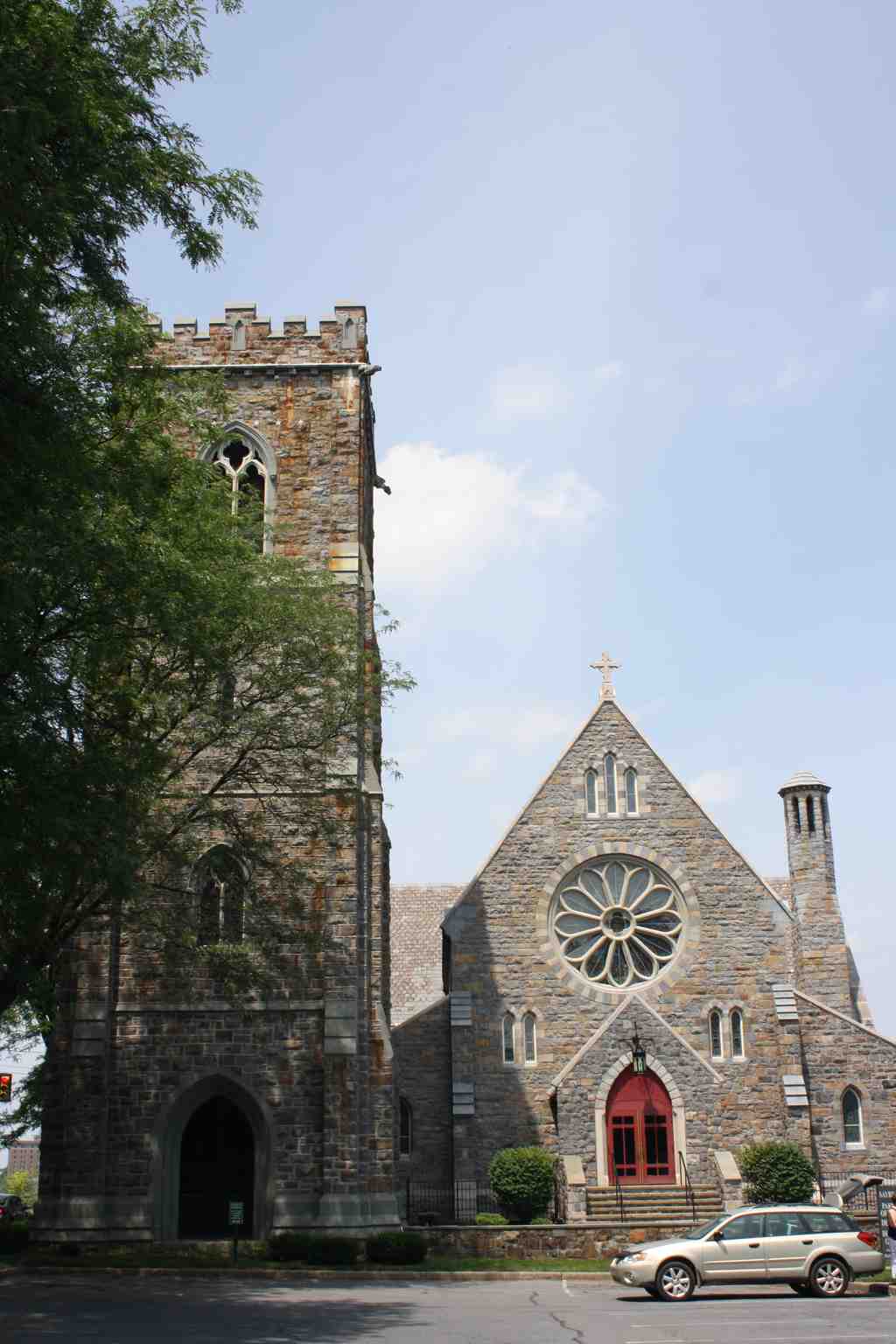
On your left, look for a gray stone church with a tall square tower, steep rooflines, and a rounded rear end that gives the whole building a solid, old-world silhouette.
From the sidewalk, this place looks permanent... almost inevitable. Locals know better. Before there was a grand stone church, Episcopal worship in South Bethlehem got stitched together in parlors, hotel rooms, halls, and even a railroad station. Robert H. Sayre and Tinsley Jeter hosted gatherings in their homes, and the first Episcopal service led by a clergyman here took place in Sayre’s parlor in eighteen sixty-one.
That matters, because it shows how faith and industry grew together here. The same families shaping rail lines, iron, and land deals also helped organize this parish. In eighteen sixty-two, a church school with fifty-two pupils met in the North Pennsylvania Railroad station, and that same year the young priest Eliphalet Nott Potter arrived as missionary. By November, a temporary church committee formed in Sayre’s home. Worship first, paperwork second... which is honestly how many institutions begin.
If you glance at the old photo on your screen, you can see the first church they built after all that improvising: Edward Tuckerman Potter’s eighteen sixties Gothic design, smaller and plainer than what stands here now. They laid the cornerstone in eighteen sixty-three, and by eighteen sixty-five the parish had its own stone church.
But Nativity was never just a spiritual shelter. It reflected the social order of an industrial town. Asa Packer and the Sayres joined the vestry; money, influence, and worship sat in the same pews. The congregation also included Black servants and coachmen from those elite households, and by nineteen oh one Black worshippers had built St. John A.M.E. Zion Church on Pawnee Street, creating space under their own leadership. That’s Bethlehem in one frame: devotion, hierarchy, generosity, and limits.
The building around you mostly dates to eighteen eighty-seven, when E. M. Burns enlarged it into the church you see now. A few years later, grief and gratitude got built right into the interior. If you check the sanctuary image, that carved screen behind the altar, the font, and the baptistery came as memorial gifts from the Linderman, Sayre, and Wilbur families. Even the tower bells, first rung in nineteen hundred, honored a lost wife. Private mourning became public sound.
Nativity also helped launch schools, chapels, and hospitals, which tells you something important: in Bethlehem, a parlor meeting could grow into a cathedral, and a household network could shape a whole city.
Today the cathedral describes itself as bilingual, multicultural, and fully affirming, with worship in English and Spanish and a strong neighborhood service mission. Next, head to Packer Memorial Chapel, about a fifteen-minute walk, where memory, philanthropy, and ceremony become even more deliberate. If you want to return, the cathedral is generally open weekdays from nine to five, closed Saturdays, and open Sundays from eight to four.




