
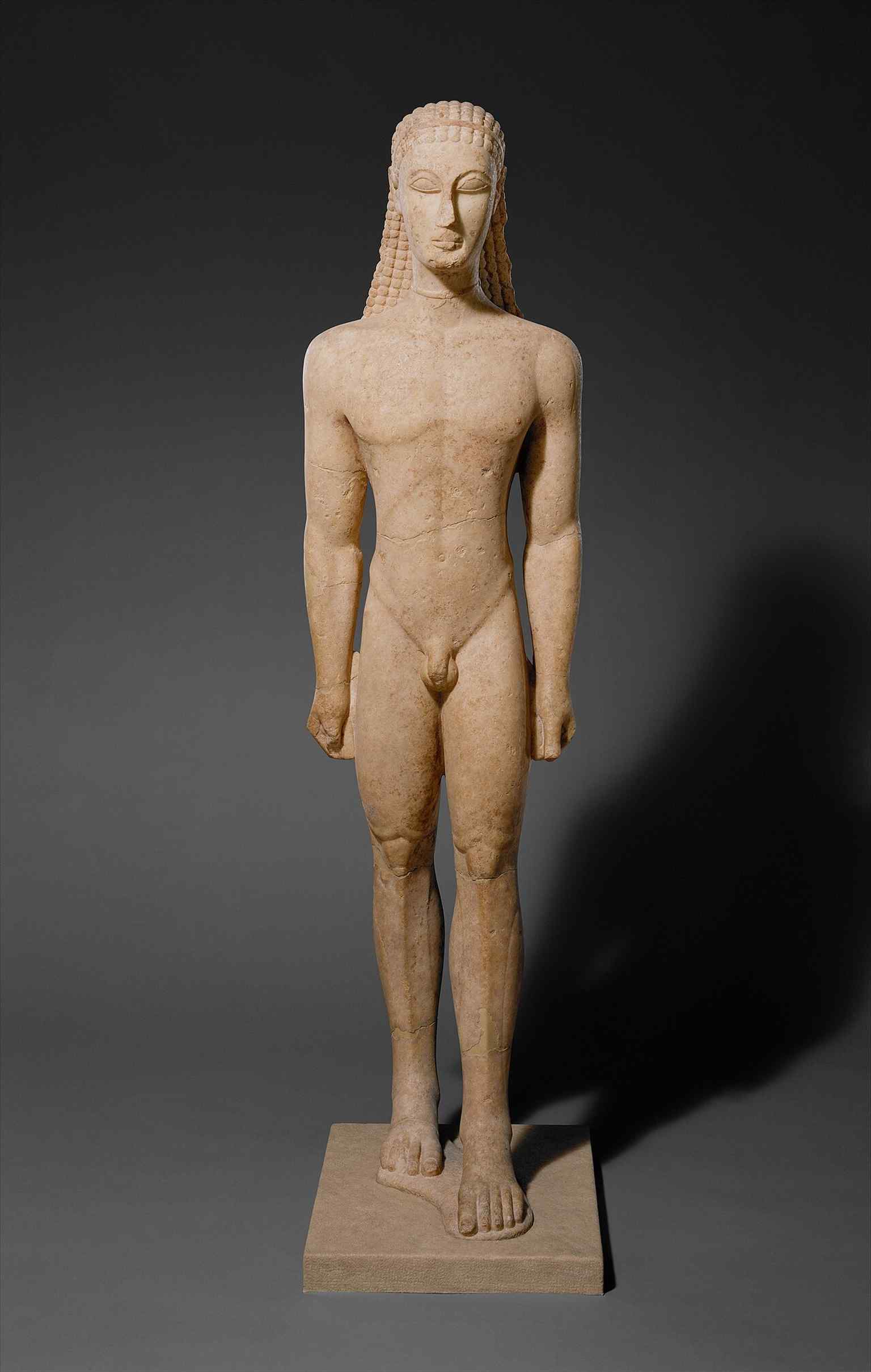
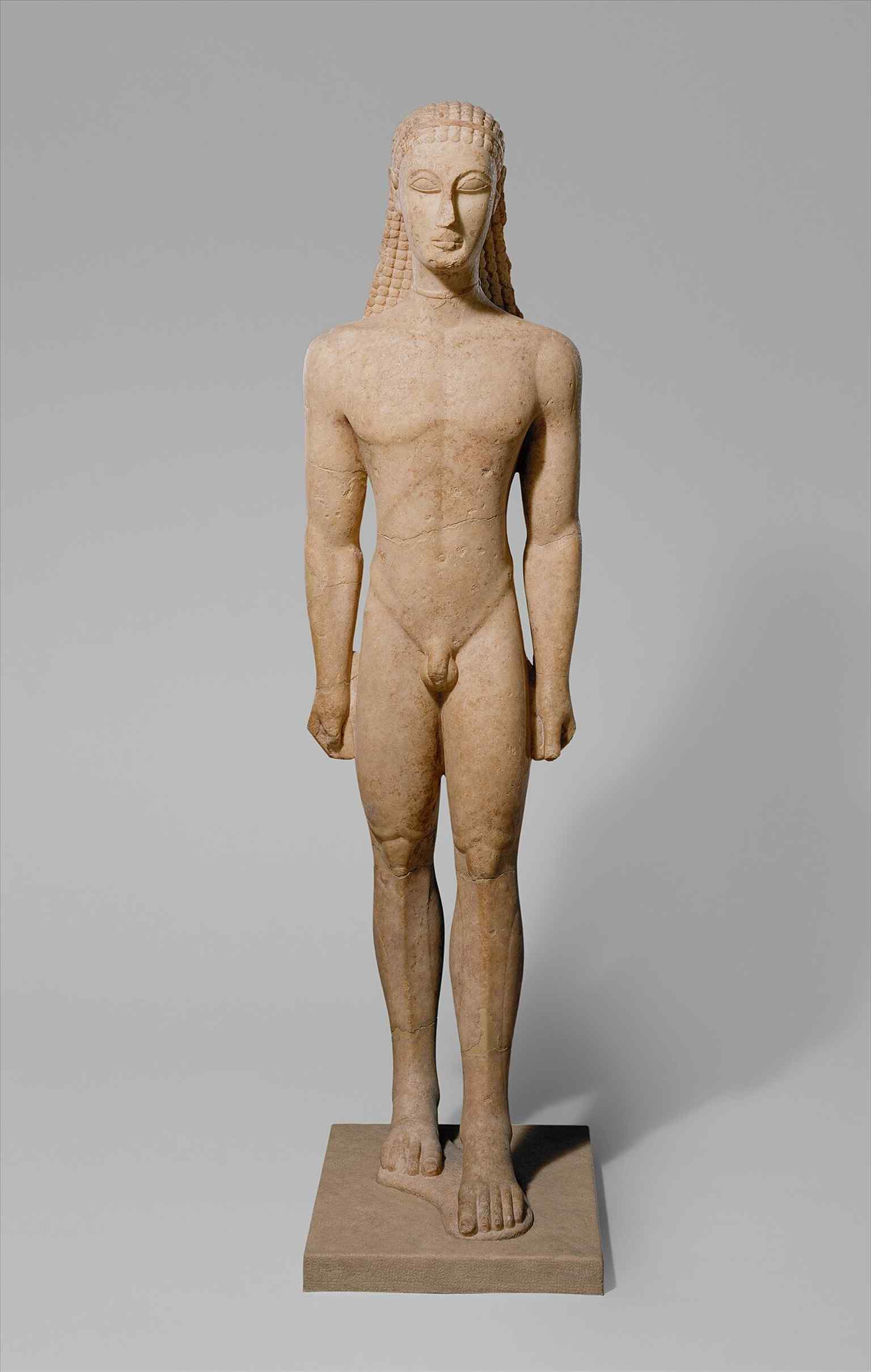
On your right is the New York Kouros... a young man in marble, carved around five hundred ninety to five hundred eighty B-C, and already doing something quietly radical. This is one of the earliest life-sized statues from Greece. It looks simple at first glance: a nude youth, front-facing, arms straight at his sides, left foot stepping forward. But this figure is really a record of ideas in transit. Art here works like cultural translation: the pose comes straight out of Egypt, while the marble itself came from Naxos, an island far from Attica, where the statue was carved for an Athenian grave.
If you want a quick look, open the full figure in the app. The stance is rigid enough to make a parade soldier seem relaxed. And that stiffness matters.
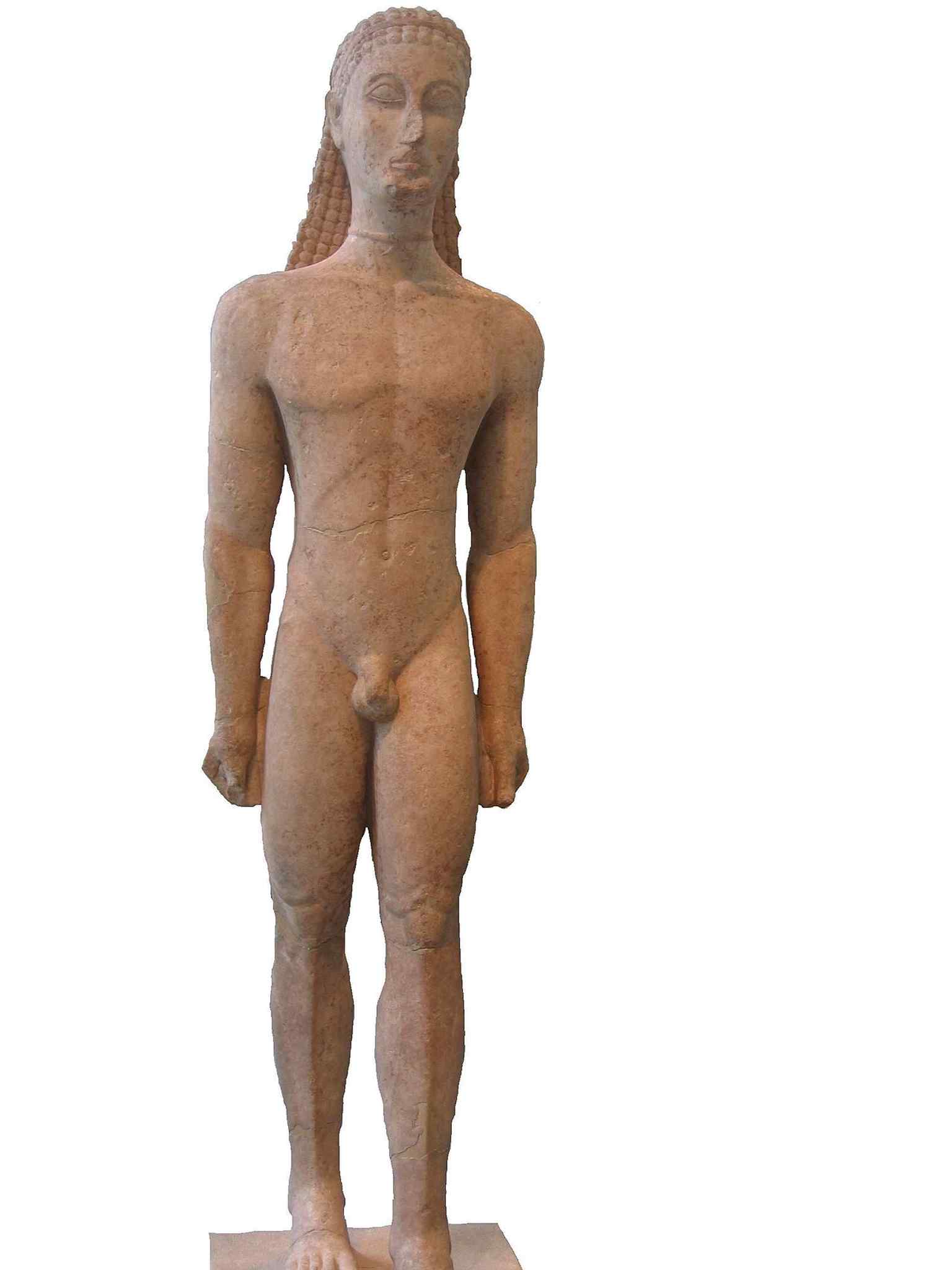
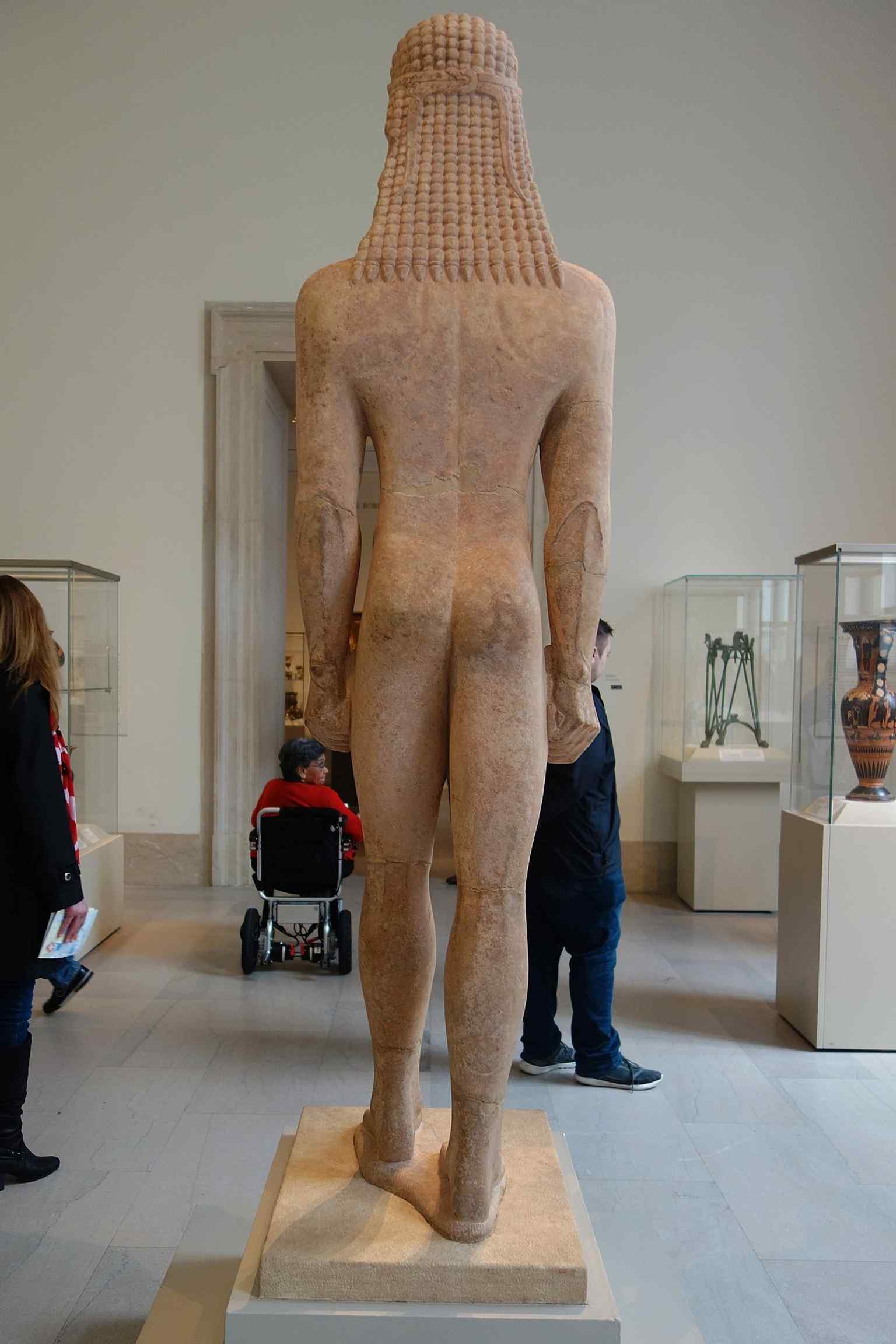
Greek artists in the archaic period were studying older, powerful models from abroad, especially Egyptian stone figures. They borrowed the left leg forward, the upright posture, even the grid system that helped map out the body. But they did not copy everything. Egyptian statues usually kept stone supports between the limbs and a slab at the back. Greek sculptors stripped those away, freed the body from the block, and made the figure nude. Same basic formula... different ambition.
Take a beat with the body here. Notice how geometric it is: the chest, knees, and muscles feel organized more like a design than a living person. The face and eyes are stylized too, not observed from life. Yet the left foot nudges forward, as if motion is trying to enter the stone. That little step is fascinating. It is not walking, exactly. It is the idea of walking, just beginning.
A second image in the app shows that carving more clearly. You can see how the limbs are detached from the block and how idealized the whole body is. This was not a portrait. The Met identifies it as a grave marker for a young Athenian aristocrat. In other words, a wealthy family paid for an expensive public statement above a grave: youth, strength, honor, permanence. Subtle was not really the point.
There is a small mystery attached to it too. Some scholars think this kouros and the later Anavysos Kouros may once have stood in the same grave plot at Phoinikia in Attica. Looters tore up that site in the early nineteen hundreds, so the evidence went with them. Annoying, but very human.
Even the marble had a long detective story. Scholars suspected for years that it came from Naxos, and scientific tests in two thousand fourteen confirmed it. That matters because it ties this statue to a wider trade network across the Cyclades and raises the possibility that Naxian sculptors themselves traveled to mainland Greece to carve monuments for local elites.
So this young man is not just an ancient body. He is proof that Greek art grew by looking outward, borrowing boldly, and then changing what it borrowed into something new. And that is part of what this museum does so well: it gathers objects that began in one world and took on new meaning in another. In about one minute, we’ll arrive at the Metropolitan Museum of Art itself... the great container for journeys exactly like this one.






%20MET%20DT263.jpg)
%20MET%20DT247656.jpg)
