
New York City Audio Tour: Midtown East Gems
Beneath the steel canyons of Midtown East, the concrete pulses with the echoes of forgotten rebellions and high society scandals that shaped the skyline. This self guided audio tour pulls back the velvet curtain on the city. Move beyond the tourist map to uncover the illicit dealings and hidden histories woven into the very marble of these landmarks. Why did a notorious political power broker choose 10 West 56th Street to orchestrate his most dangerous deception? What dark ritual or secret influence hides behind the soaring Gothic arches of Saint Thomas Church? And why did a single masterpiece at the MoMA nearly spark a riot among the elite? Traverse these blocks to witness the city morph from a cold grid into a living stage of human ambition. Feel the friction of history under your feet and finally see what remains invisible to everyone else. Begin the discovery now.
Tour preview
About this tour
- scheduleDuration 60–80 minsGo at your own pace
- straighten1.8 km walking routeFollow the guided path
- location_onLocationNew York, United States
- wifi_offWorks offlineDownload once, use anywhere
- all_inclusiveLifetime accessReplay anytime, forever
- location_onStarts at Paley Park
Stops on this tour
lock_open 3 free previews · 8 unlock with purchase
Look for the short flight of stone steps leading into a courtyard paved with rough-hewn granite, flanked by ivy-covered brick walls, and anchored at the far end by a massive…Read moreShow less
Open dedicated page →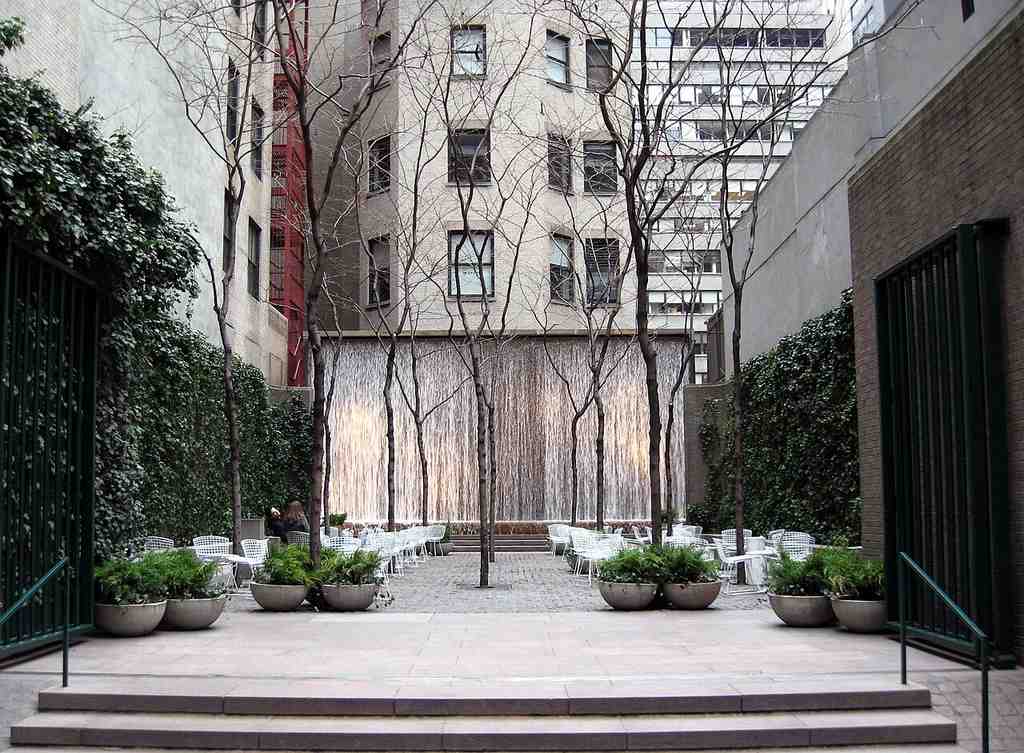
Paley ParkPhoto: Jim.henderson, Wikimedia Commons, Public domain. Cropped & resized. Look for the short flight of stone steps leading into a courtyard paved with rough-hewn granite, flanked by ivy-covered brick walls, and anchored at the far end by a massive twenty-foot wall of falling water.
Before nineteen sixty-seven, this exact spot was home to the world-famous Stork Club, a highly exclusive celebrity haunt. But after a bitter ten-year labor dispute, the club went into a steep decline. Broadcasting executive William S. Paley bought the building, tore it down in nineteen sixty-six, and built something completely different, a space dedicated entirely to the general public, named in memory of his father, Samuel Paley.
Landscape architect Robert Zion had pitched the pocket park concept back in nineteen sixty-three. He argued that New York needed small, high-quality retreats squeezed onto single fifty by one hundred foot lots, a radical shift from the city focus on massive regional parks.
Let us talk about that water. The waterfall dumps eighteen hundred gallons of water every minute, specifically engineered to hit approximately eighty-seven decibels. It acts as an auditory lure. The roar of the water catches the attention of pedestrians on the street, drawing them toward the back of the lot. Urbanists call this the discovery effect, that moment of surprise when a passerby stumbles upon a tiny, lush oasis wedged right between giant glass and steel office towers.
William S. Paley was fiercely protective of this plaza. He visited constantly, sometimes picking up litter himself. Check out your screen for a great shot of a C-B-S secretary helping plant flowers back in nineteen seventy-three, showing just how hands-on the whole team was. Paley even personally taste-tested the hot dogs sold at the refreshment stand, insisting ordinary New Yorkers deserved high quality for an affordable price.
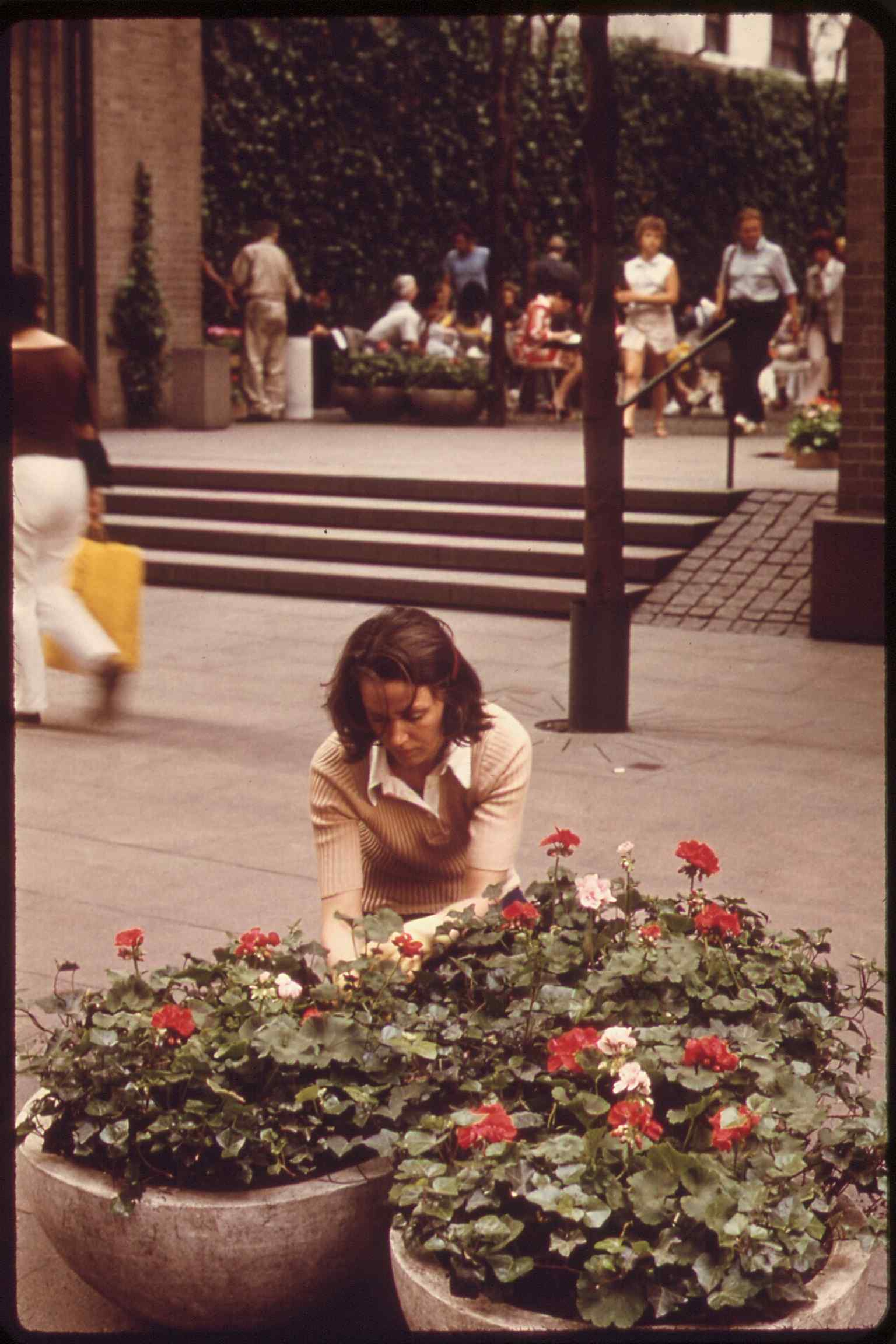
A CBS secretary helps plant flowers at Paley Park in 1973, reflecting William Paley's personal and hands-on commitment to the park's care and upkeep.Photo: Suzanne Szasz, Wikimedia Commons, Public domain. Cropped & resized. Take a look at the before and after image in your app to see how this space has maintained its tranquil charm over nearly fifty years.
Now, notice the side walls. Zion branded those ivy coverings vertical lawns to emphasize that nature could thrive even in the narrowest concrete canyons. And see those white wire-framed chairs designed by Harry Bertoia? They are not bolted down. Urban sociologist William H. Whyte observed that movable seating gave people a sense of personal sovereignty. Visitors could chase a patch of sunlight or slide into the shade whenever they pleased.
Whyte also discovered the waterfall created what he called triangulation. The sheer drama and volume of the water gave strangers a common experience, sparking conversations and breaking right through the traditional social anonymity of New York City. He found the park to be self-leveling, meaning people naturally spread out or clustered together to keep the space comfortable, even during the busy lunch rush.
Its massive success changed city policy, inspiring a nineteen seventy-five zoning resolution that gave developers extra floors if they built P-O-P-S, or privately owned public spaces, just like this one.
You can generally pop into the park every day of the week from eight A-M to eight P-M.
Paley Park proves that you do not need acres of space to create something magical, just some rushing water, movable chairs, and a vision. Whenever you are ready to keep exploring, we can head toward the next stop.
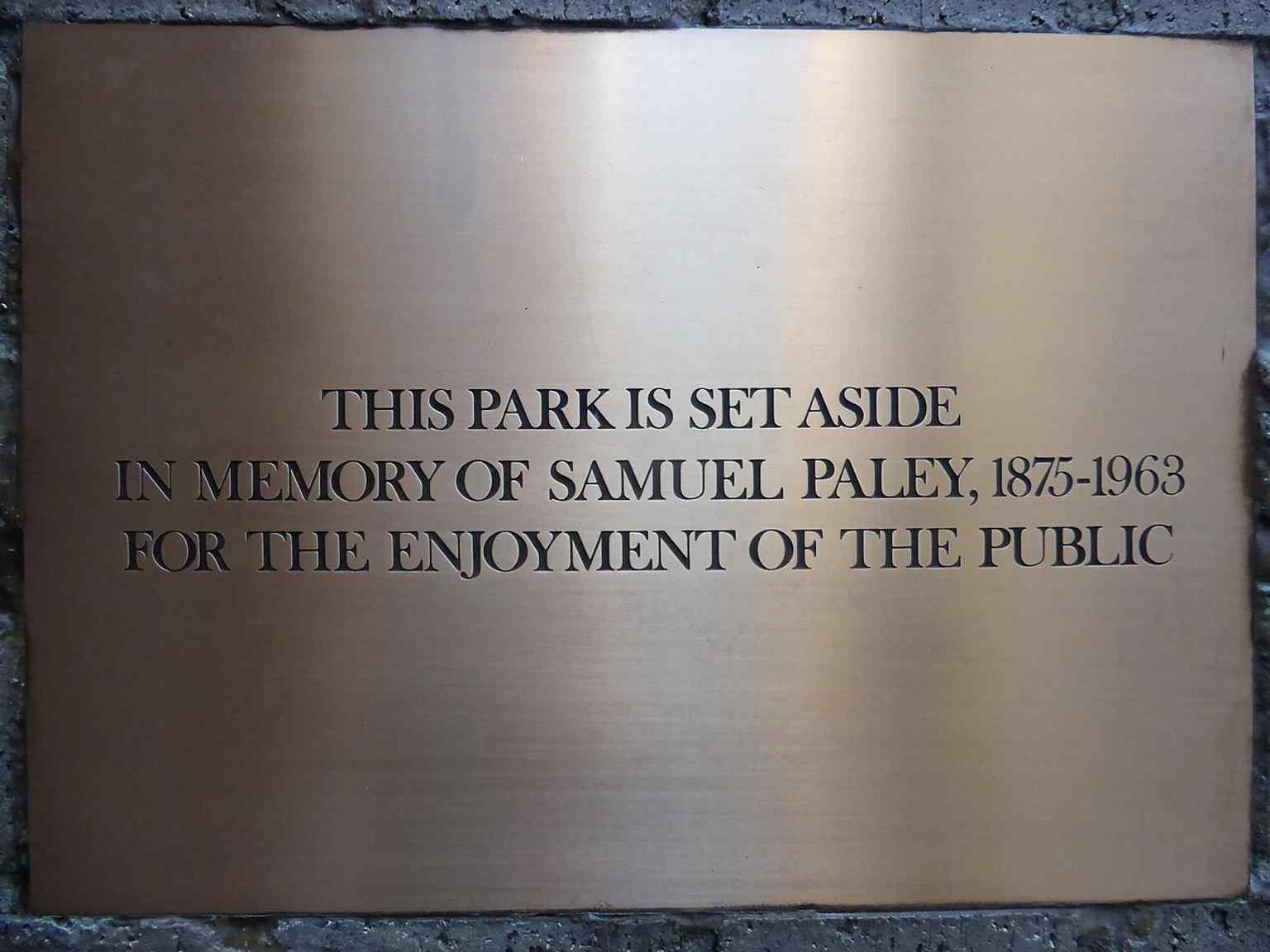
The dedication plaque honors Samuel Paley, father of William S. Paley, who financed and named the park in his memory.Photo: Michael Bednarek, Wikimedia Commons, CC BY-SA 4.0. Cropped & resized. 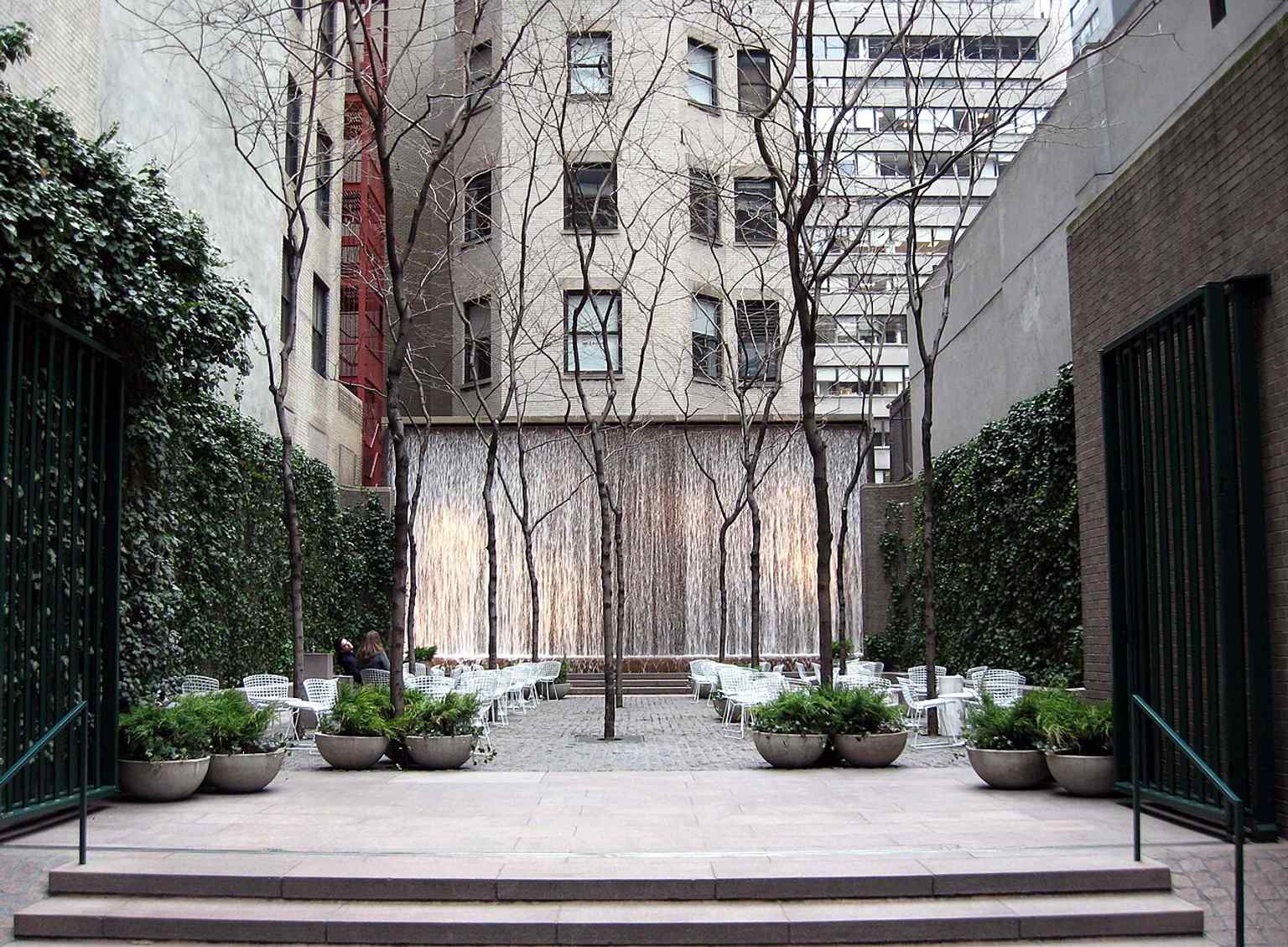
The park's open front on 53rd Street, nestled between massive glass-and-steel office towers, creates a "discovery effect" for passersby who stumble upon this urban oasis.Photo: Epicgenius, Wikimedia Commons, CC BY-SA 4.0. Cropped & resized. 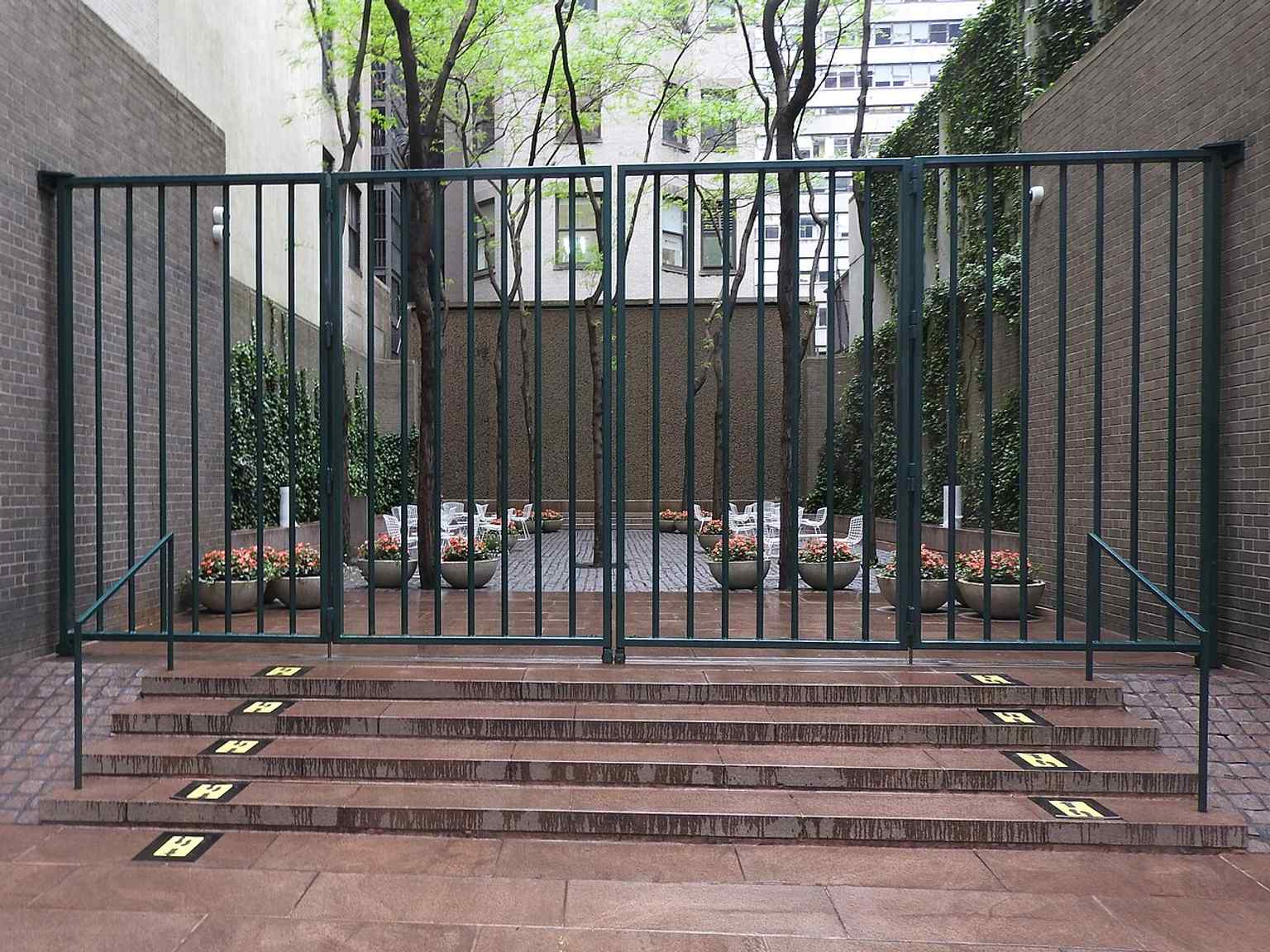
The entrance, elevated from the sidewalk level, features four steps and a wheelchair ramp, with rough-hewn granite pavers extending across the sidewalk to the street curb.Photo: Epicgenius, Wikimedia Commons, CC BY-SA 4.0. Cropped & resized. 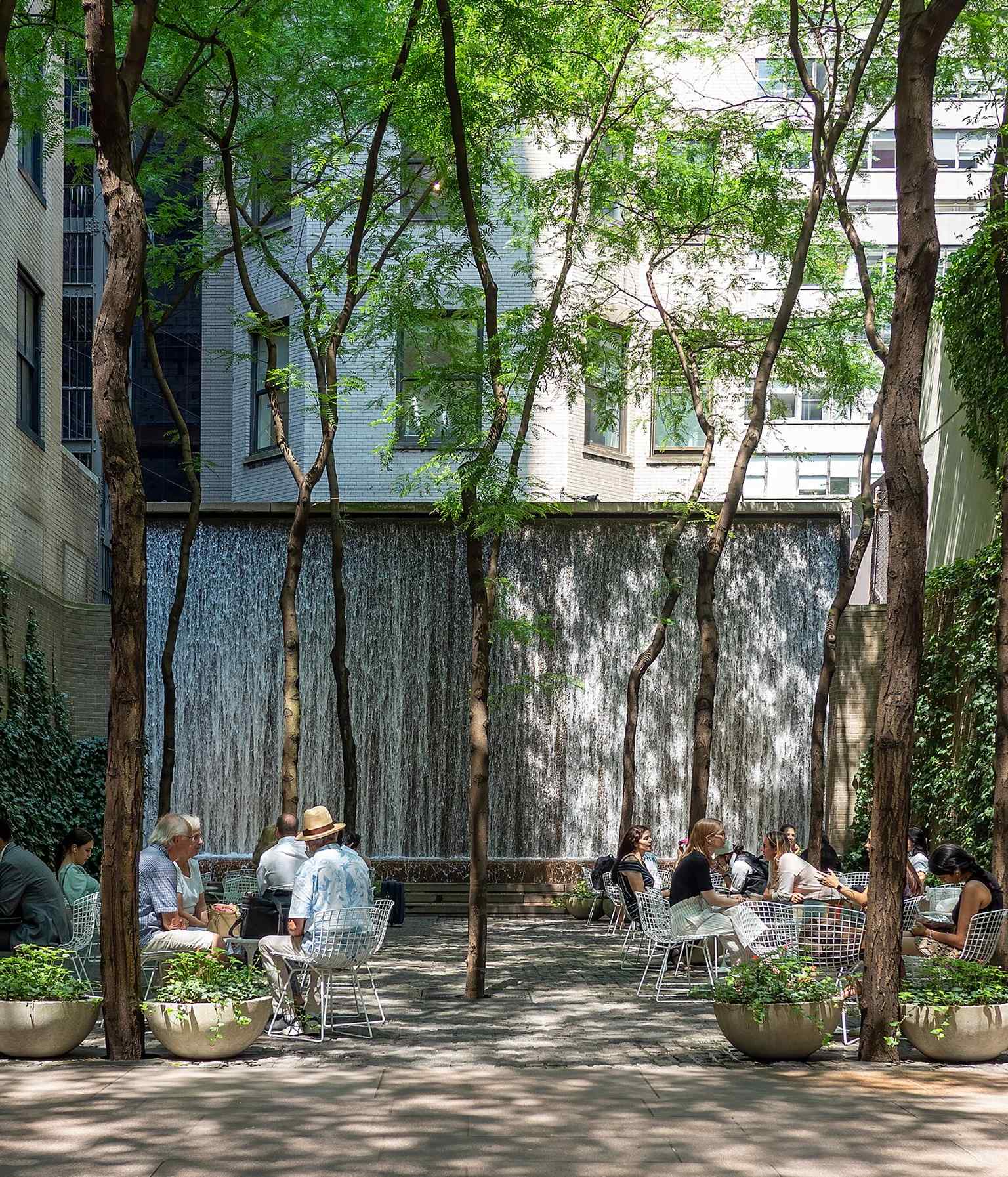
An overall view of the "pocket park," showcasing its airy honey locust trees and simple spatial organization that makes it one of the finest urban spaces in the United States.Photo: Epicgenius, Wikimedia Commons, CC BY-SA 4.0. Cropped & resized. 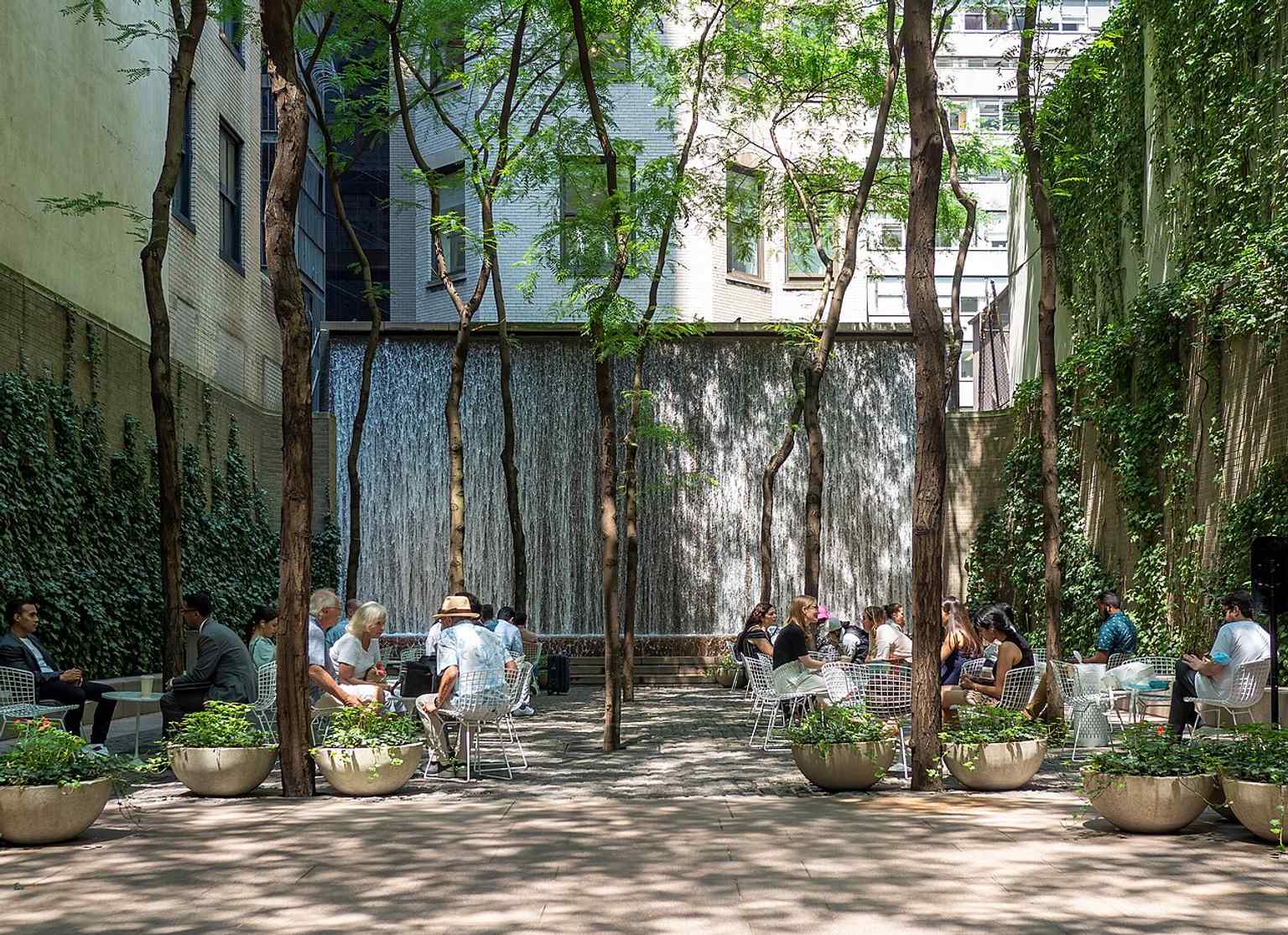
Inside the park, visitors enjoy the lush greenery and sense of enclosure provided by the ivy-covered side walls, which landscape architect Robert Zion called "vertical lawns."Photo: Epicgenius, Wikimedia Commons, CC BY-SA 4.0. Cropped & resized. 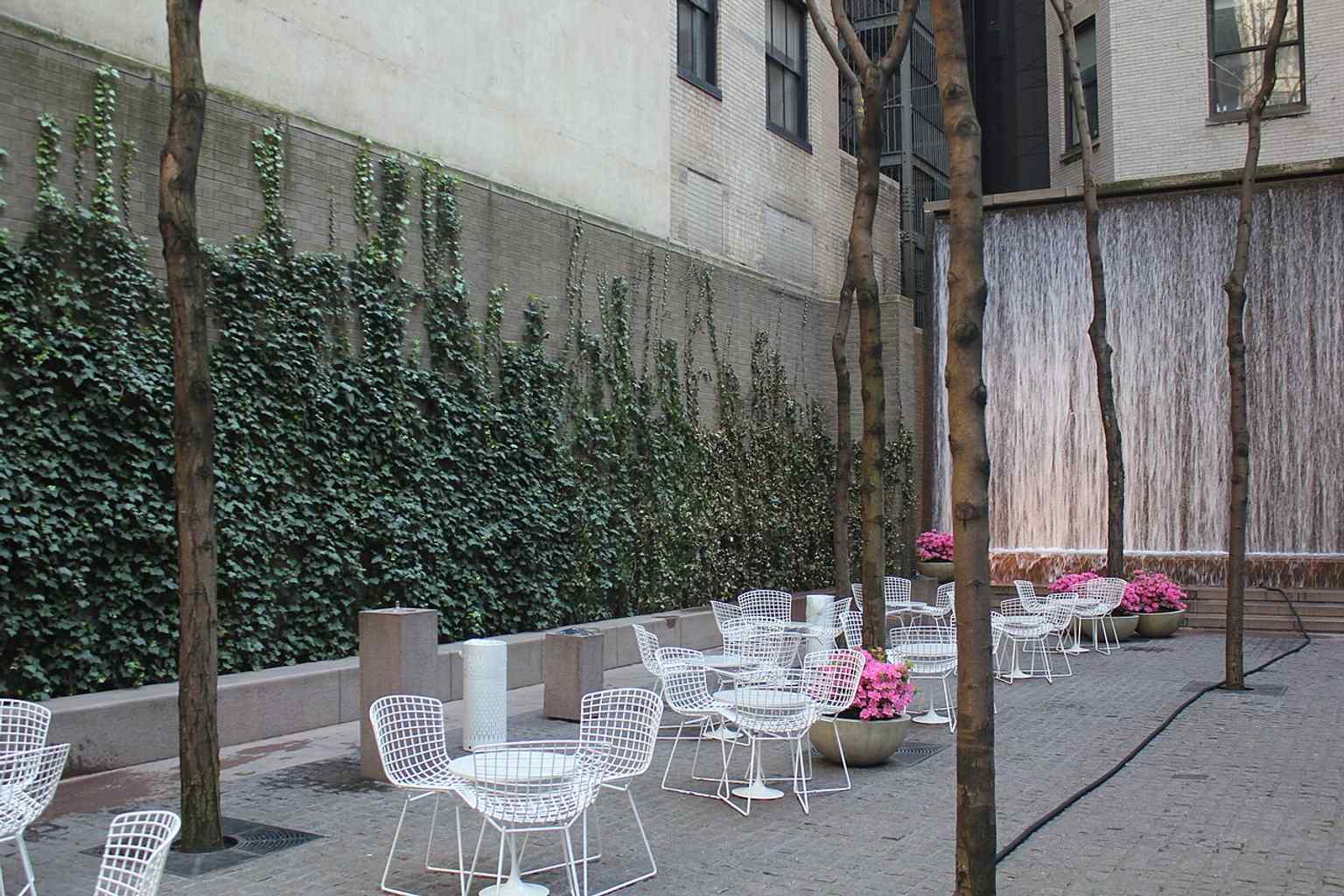
The 20-foot high waterfall spans the rear boundary, with a capacity of 1800 us gallons per minute, creating a backdrop of 87-decibel grey noise that masks city sounds.Photo: Epicgenius, Wikimedia Commons, CC BY-SA 4.0. Cropped & resized. 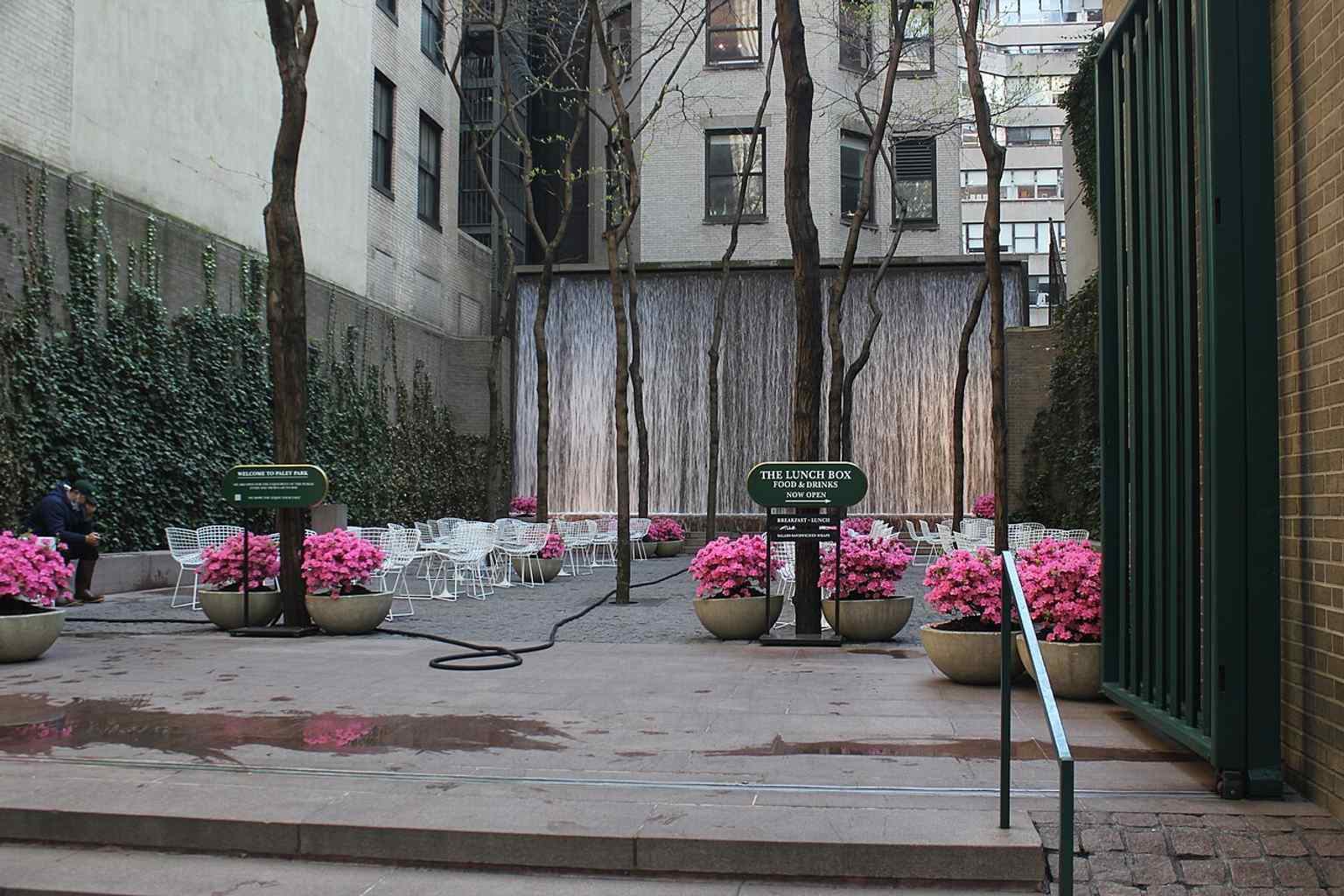
A closer look at the English ivy covering the side walls, referred to as "vertical lawns" by Robert Zion, emphasizes that nature can flourish even in the narrowest of urban canyons.Photo: Epicgenius, Wikimedia Commons, CC BY-SA 4.0. Cropped & resized. 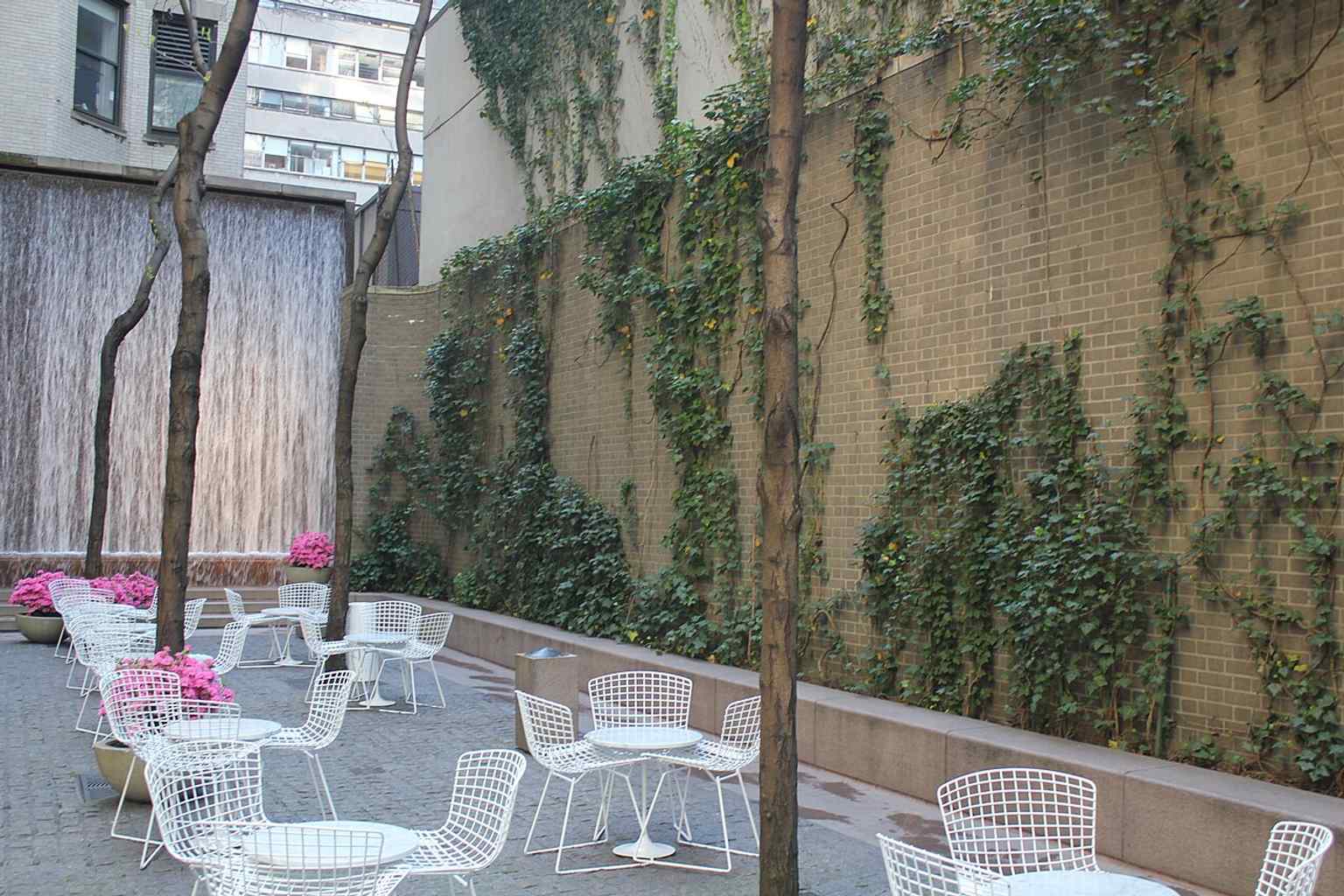
The park features Harry Bertoia-designed wire-framed chairs, which are movable to give visitors a sense of "personal sovereignty" to arrange their seating as they please.Photo: Epicgenius, Wikimedia Commons, CC BY-SA 4.0. Cropped & resized. 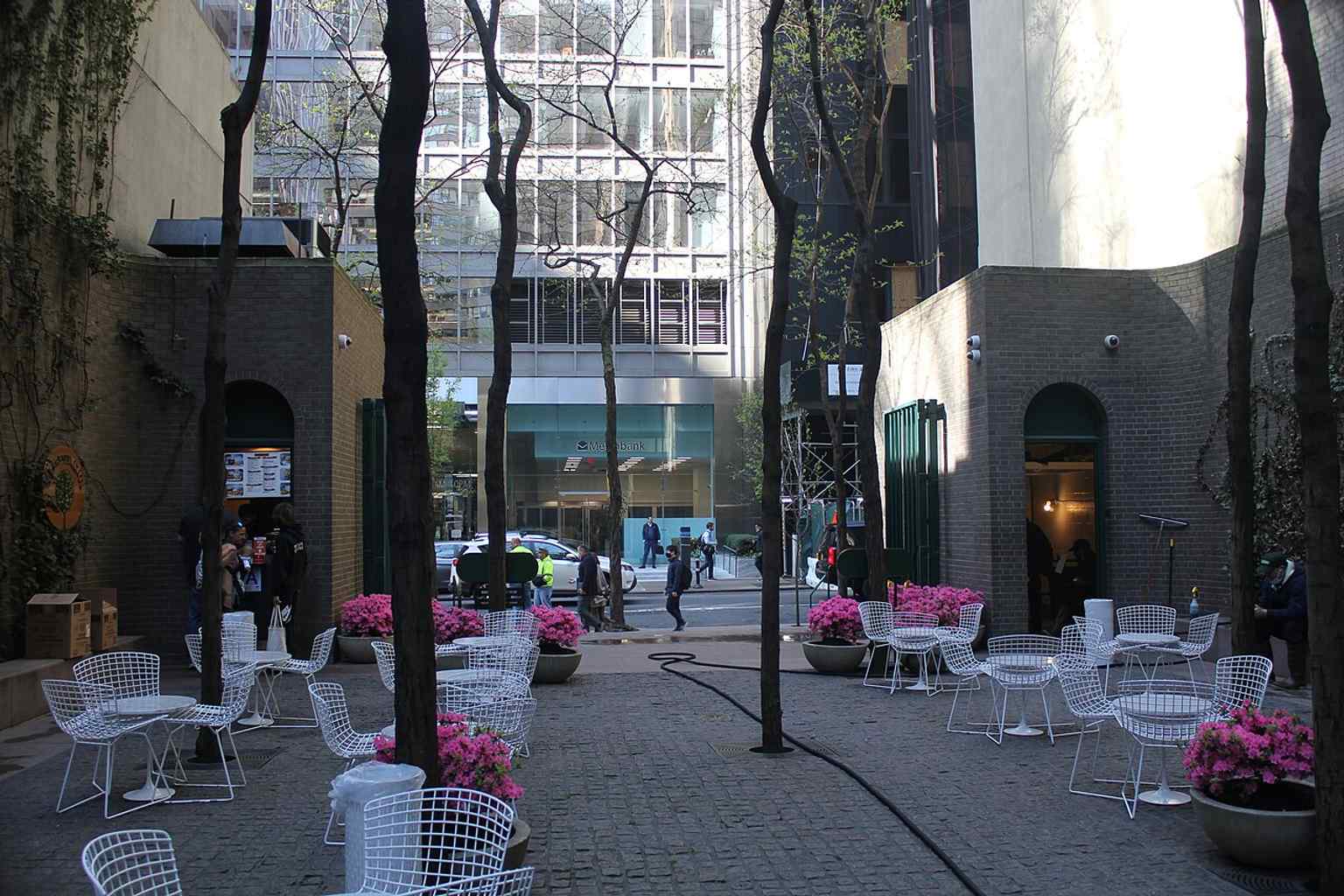
People enjoying the flexible seating, a key social design element that allows visitors to adjust their proximity to others, seek out sunlight, or move into the shade.Photo: Epicgenius, Wikimedia Commons, CC BY-SA 4.0. Cropped & resized. 
Visitors naturally group and thin out within the park, demonstrating William H. Whyte's observation that the space is "self-leveling" even during busy lunch hours.Photo: Epicgenius, Wikimedia Commons, CC BY-SA 4.0. Cropped & resized. Look right and you will spot a sleek multi-story glass grid framed by a massive white rectangular overhang, blending sharp modern geometry with smooth gray stone. This is the…Read moreShow less
Open dedicated page →Look right and you will spot a sleek multi-story glass grid framed by a massive white rectangular overhang, blending sharp modern geometry with smooth gray stone. This is the Museum of Modern Art, or MoMA. Its story begins at a nineteen twenty-eight lunch where three determined patrons, Abby Aldrich Rockefeller, Lillie P. Bliss, and Mary Quinn Sullivan, decided New York needed a place entirely dedicated to modern art. People called them the adamantine ladies, meaning unshakeable, because they challenged the traditional Metropolitan Museum of Art, which ignored contemporary artists. Despite disapproval from Abby's husband, John D. Rockefeller Junior, the trio opened the doors in November nineteen twenty-nine, just nine days after the Wall Street Crash.
Lillie P. Bliss saved the museum during its fragile early years by leaving them her massive collection when she died in nineteen thirty-one, but on one condition. The museum had to raise a dedicated financial fund, known as an endowment, to care for it. This allowed MoMA to sell certain pieces to fund the purchase of Vincent van Gogh's The Starry Night. You can see this vibrant masterpiece on your screen. You might also want to check the before and after pictures in your app to see how MoMA evolved from a modest nineteen thirties facade into this sprawling complex over eight decades.
The internal drama often rivaled the art. Founding director Alfred H. Barr Junior clashed with the board chairman, who fired Barr in nineteen forty-three. Barr simply refused to leave. He moved his desk into the library and kept working as a ghost director until they eventually hired him back.
A worker's dropped cigarette sparked a massive fire in nineteen fifty-eight. Tragically, an electrician named Ruby Geller died, and an eighteen-foot-long Claude Monet painting was destroyed. Braving the smoke, staff and volunteers formed a human bucket brigade, passing nearly two thousand artworks hand-to-hand to safety.
MoMA's history also includes wild legal hurdles. When art collector Ileana Sonnabend died in two thousand and seven, she left behind Robert Rauschenberg's Canyon, an artwork featuring a stuffed bald eagle. Because federal law prohibits selling bald eagles, the artwork's market value was zero. Yet the I-R-S insisted the art was worth sixty-five million dollars, handing the family a twenty-nine point two million dollar tax bill. To escape this, the family donated the eagle to MoMA in twenty twelve. The I-R-S dropped the bill, and the museum added Sonnabend to their founders wall.
They are equally ruthless about real estate. In twenty fourteen, MoMA demolished the award-winning American Folk Art Museum building next door, which was only thirteen years old. MoMA director Glenn D. Lowry called the bronze-clad building a bespoke suit, meaning it was custom-tailored to the point of being inflexible, preventing it from connecting to MoMA's new expansion.
If you want to explore inside, the museum opens daily from ten thirty in the morning to five thirty in the evening, extending to eight thirty at night on Fridays. Take a moment to soak this in. When you are ready, we can head to the next stop.
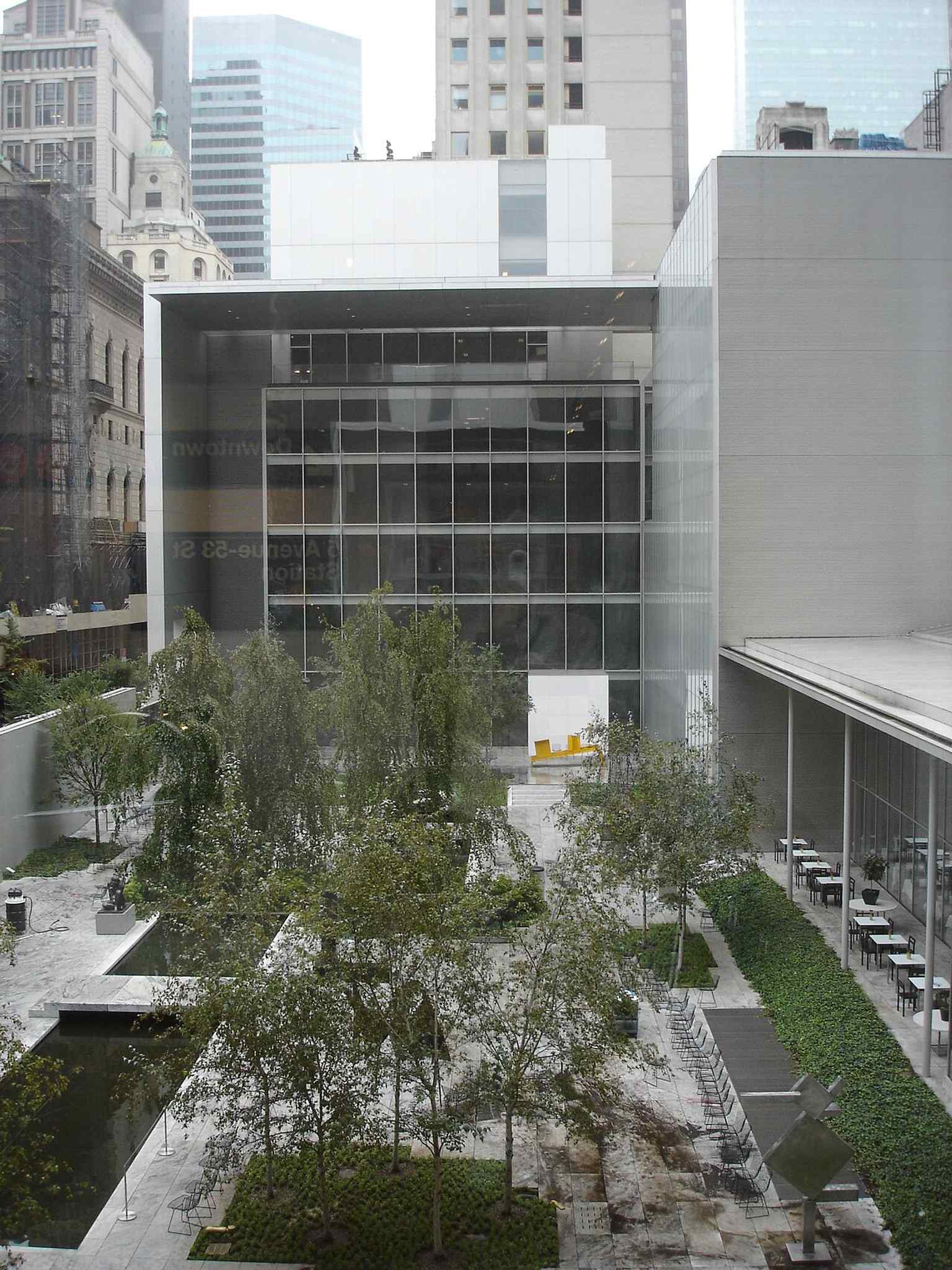
The Abby Aldrich Rockefeller Sculpture Garden, an integral part of MoMA's design, offers an outdoor gallery space for modern and contemporary sculptures.Photo: Velvet, Wikimedia Commons, CC BY-SA 3.0. Cropped & resized. 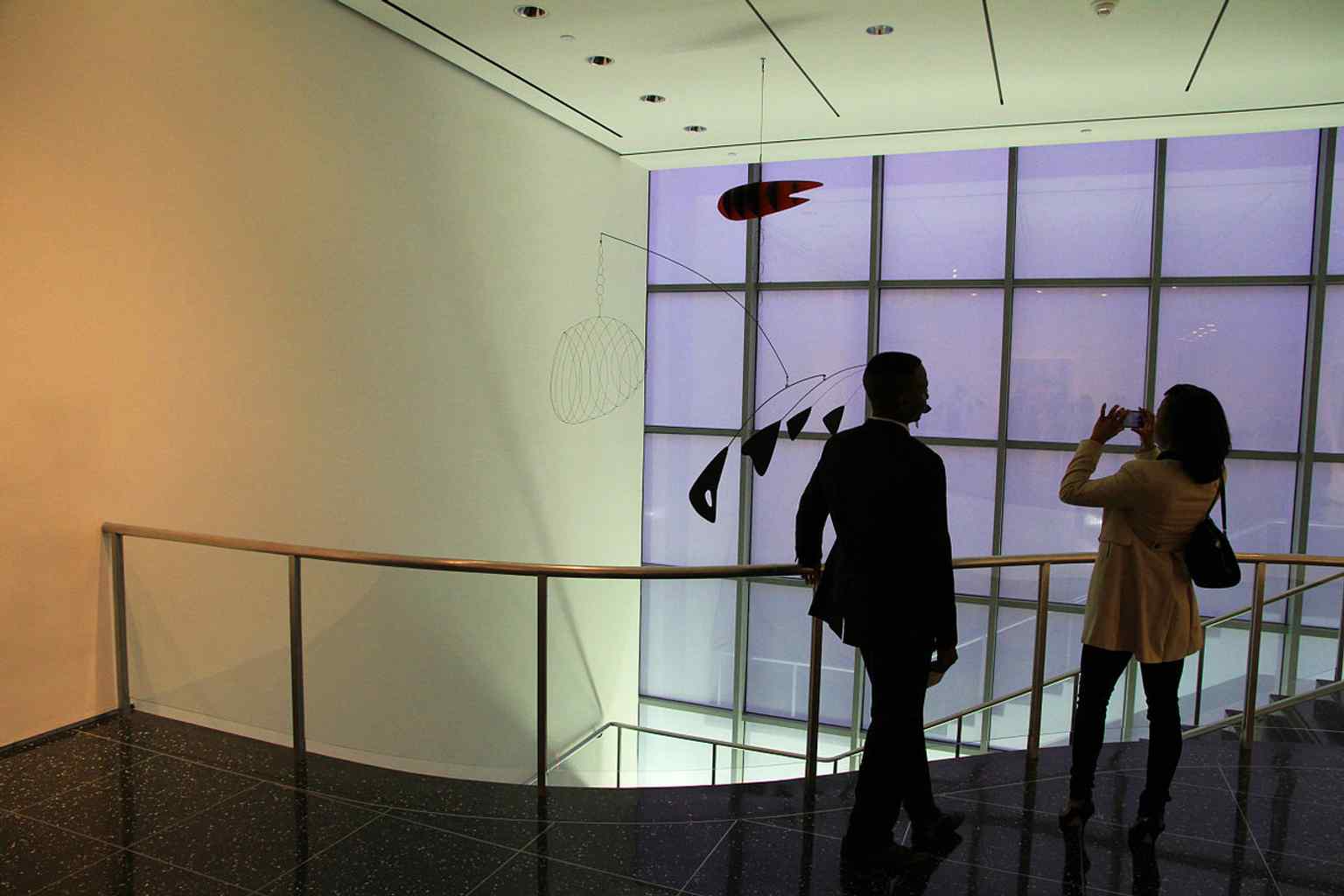
MoMA staff in 1937, during the early years when founding director Alfred H. Barr Jr. navigated dramatic power struggles with the board.Photo: Creator:Soichi Sunami, Wikimedia Commons, Public domain. Cropped & resized. 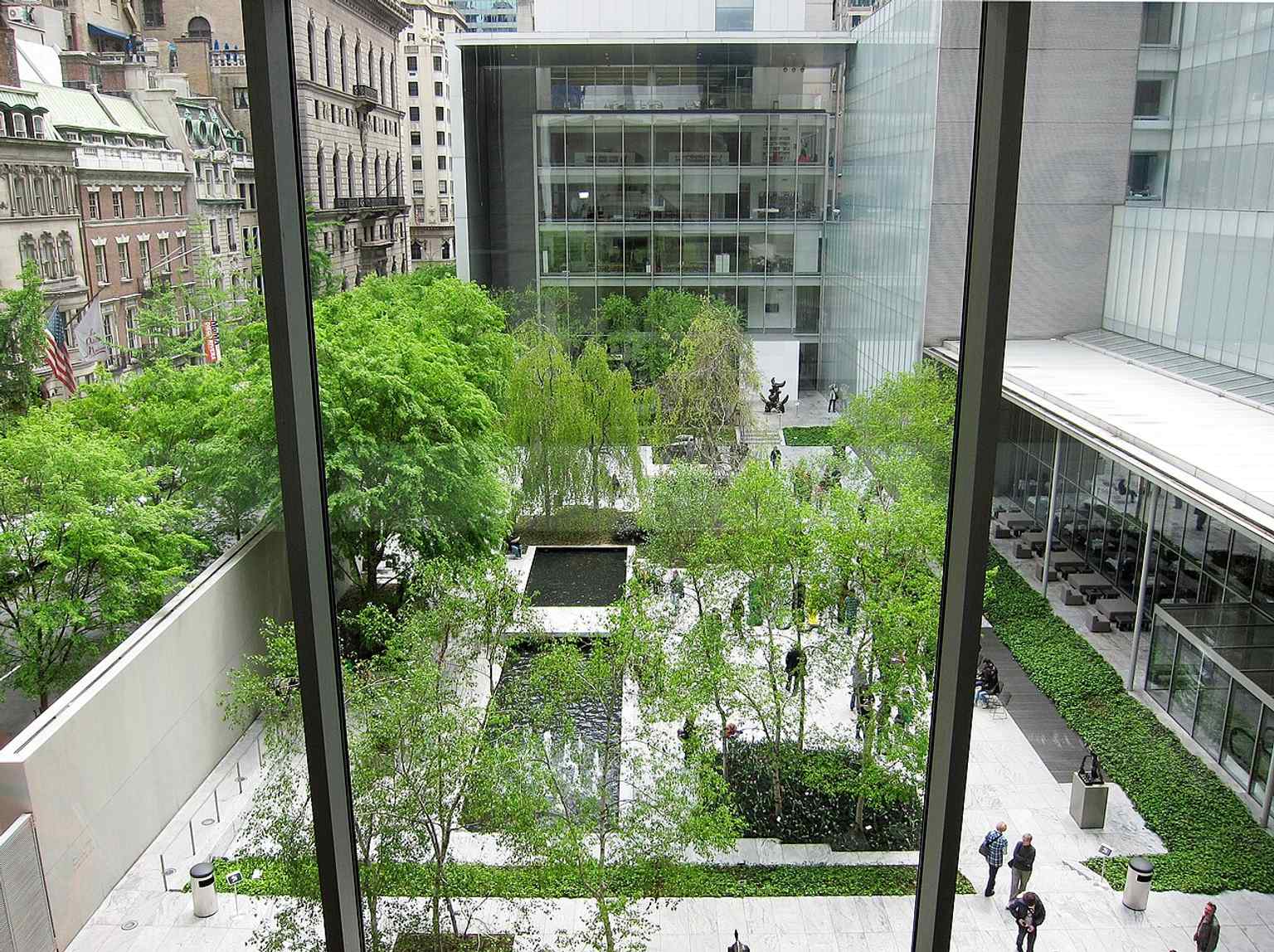
Inside the Titus Theater 2, a dedicated space within MoMA for film screenings, showcasing the museum's commitment to cinema as an art form.Photo: Shane Fleming, Wikimedia Commons, CC BY-SA 4.0. Cropped & resized. 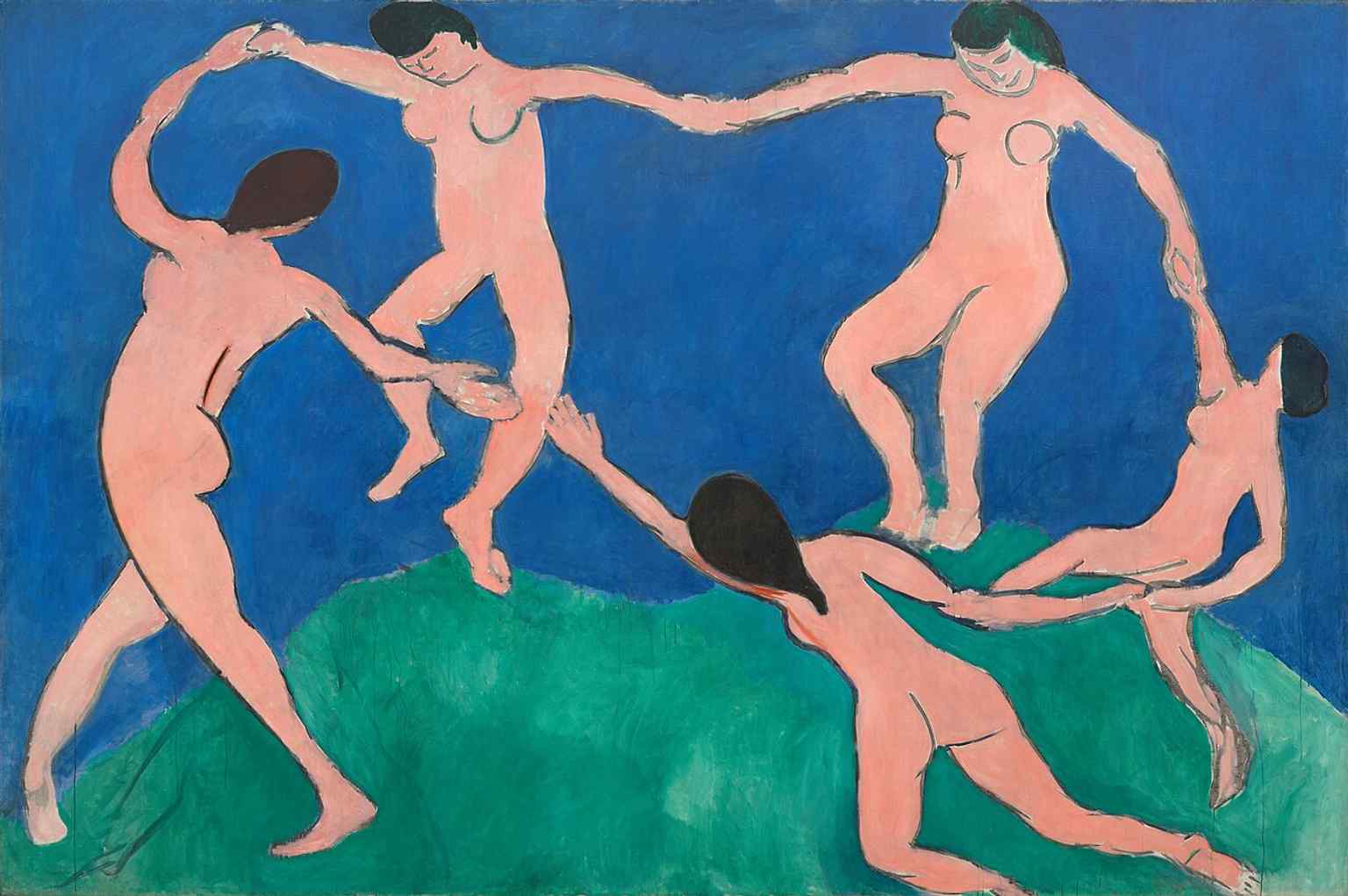
Joseph Glasco's 'Big Sitting Cat,' an ink drawing from 1949, represents the diverse mediums and styles within MoMA's extensive collection.Photo: Joseph Glasco Charitable Foundation, Wikimedia Commons, CC BY-SA 4.0. Cropped & resized. Look to your left and you will spot Saint Thomas Church, an asymmetrical limestone structure featuring a tall, square tower on its southern corner and a grand arched entrance…Read moreShow less
Open dedicated page →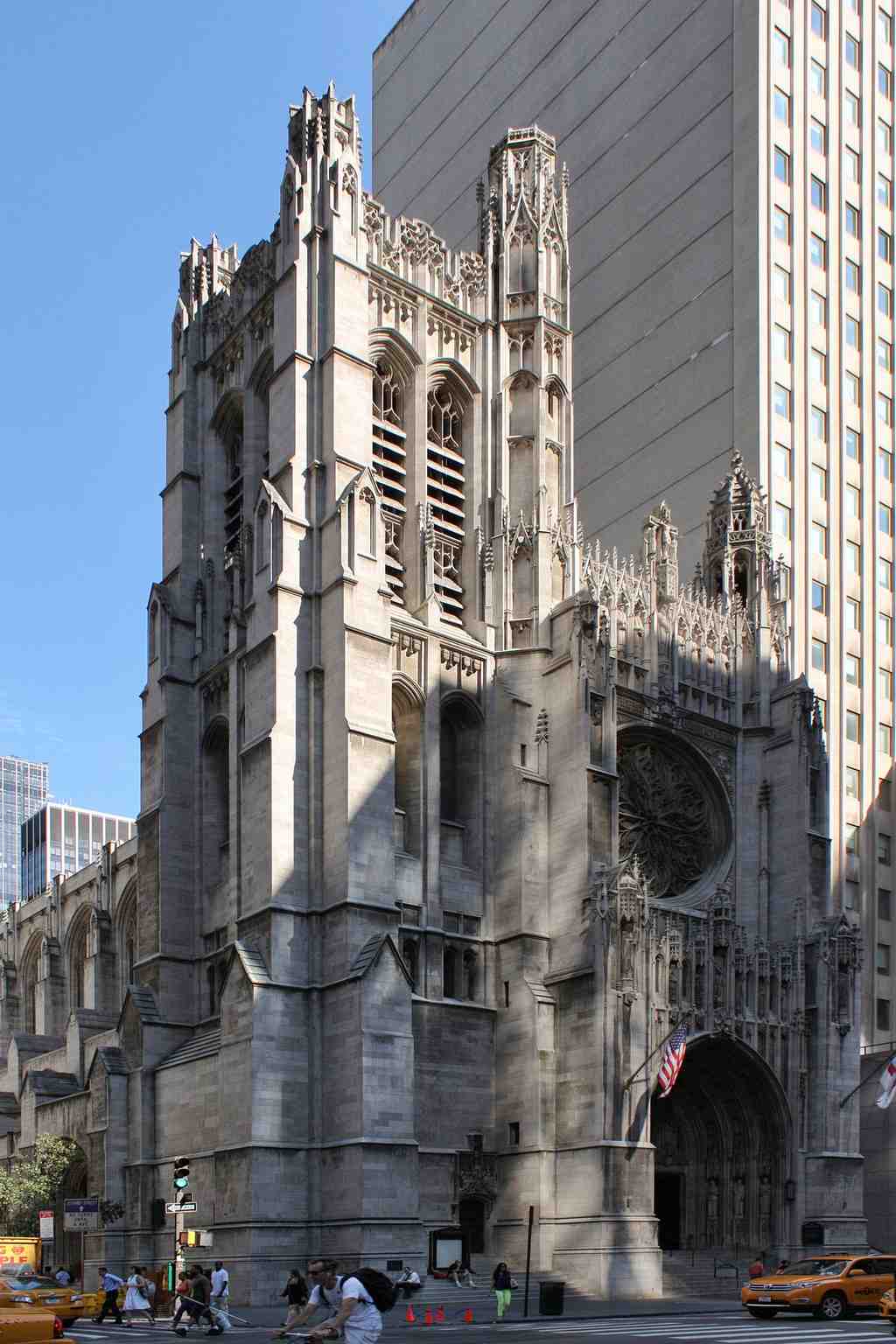
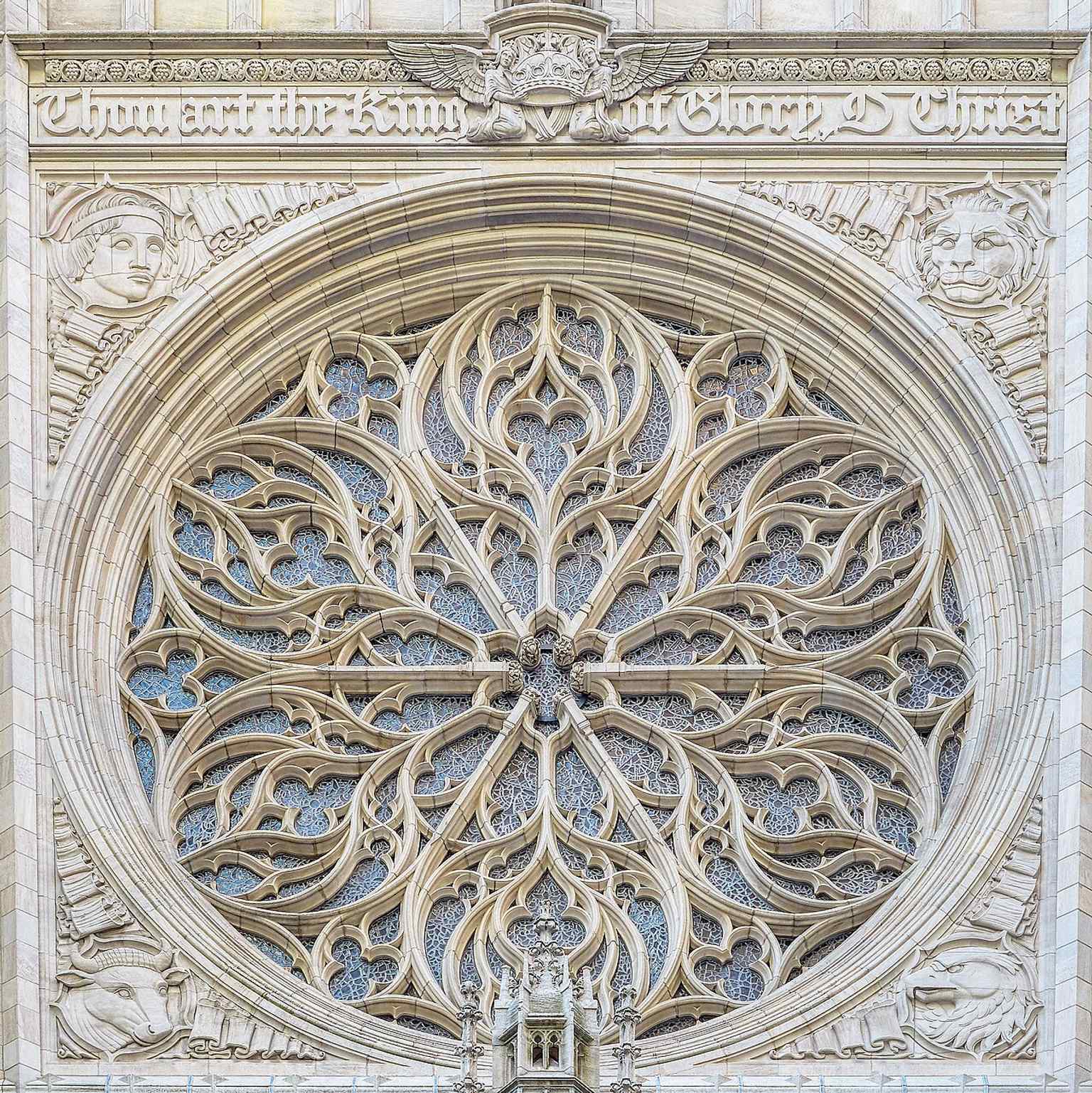
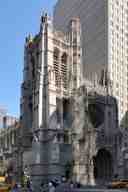
Saint Thomas ChurchPhoto: Yarl, Wikimedia Commons, CC BY-SA 3.0. Cropped & resized. Look to your left and you will spot Saint Thomas Church, an asymmetrical limestone structure featuring a tall, square tower on its southern corner and a grand arched entrance beneath a massive circular rose window. Take a glance at your screen to see a close-up of that magnificent rose window with its intricate stone carvings. This is actually the fourth church the congregation has built on this site. A massive fire consumed the third building in August nineteen zero five. The rectory housekeeper, Mrs. Sandsbach, discovered the blaze at six in the morning and ran screaming into Fifth Avenue. The heat grew so intense that the heavy stone walls shattered. Stones as big as paving blocks rained down on the surrounding mansions. A caretaker next door, Kate Scully, panicked and ran into the street, absolutely convinced someone had bombed the building.
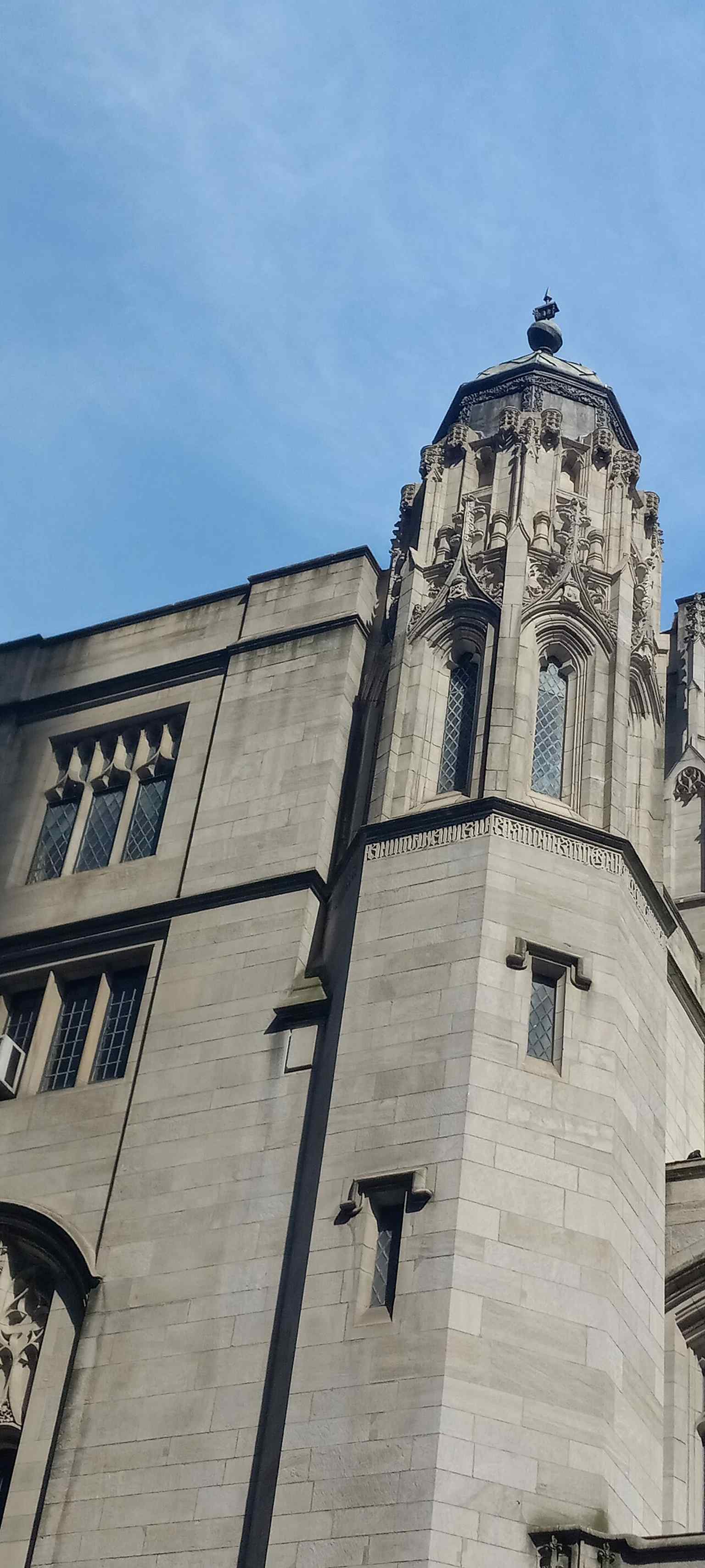
Above the main portal, this large rose window includes a tetramorph in low relief, part of the extensive sculptural program of the church.Photo: Axel Tschentscher, Wikimedia Commons, CC BY-SA 4.0. Cropped & resized. The congregation refused to move to another neighborhood. Instead, they hired architects Ralph Adams Cram and Bertram Grosvenor Goodhue to design the current French High Gothic Revival structure, which they completed in nineteen fourteen. These two architects shared brilliant minds and a deeply eccentric, bohemian lifestyle. They belonged to secret societies devoted to mystical rituals and long dinners. Their business partner actually wrote them a letter in eighteen ninety-five begging them to abandon their bizarre habits, warning them that their reputations were at risk following the infamous Oscar Wilde trial. The architects also shared a bitter jealousy. They dissolved their firm entirely right before they finished this project because Cram accepted a cathedral commission that Goodhue desperately wanted. Check your app for a great view of the full exterior they managed to complete before parting ways. Over the years, the church hosted some of high society's most dramatic moments. The sculptor who worked on the southern entrance, known as the Bride's Door, cheekily chiseled a subtle dollar sign right next to a true lover knot. He wanted to mock the fabulously wealthy, and sometimes cynical, marriages that took place inside. For instance, in eighteen ninety-five, Alva Vanderbilt forced her daughter Consuelo into a loveless marriage with the Duke of Marlborough just to secure a royal title. The bride wept openly behind her veil as she stood at the altar.
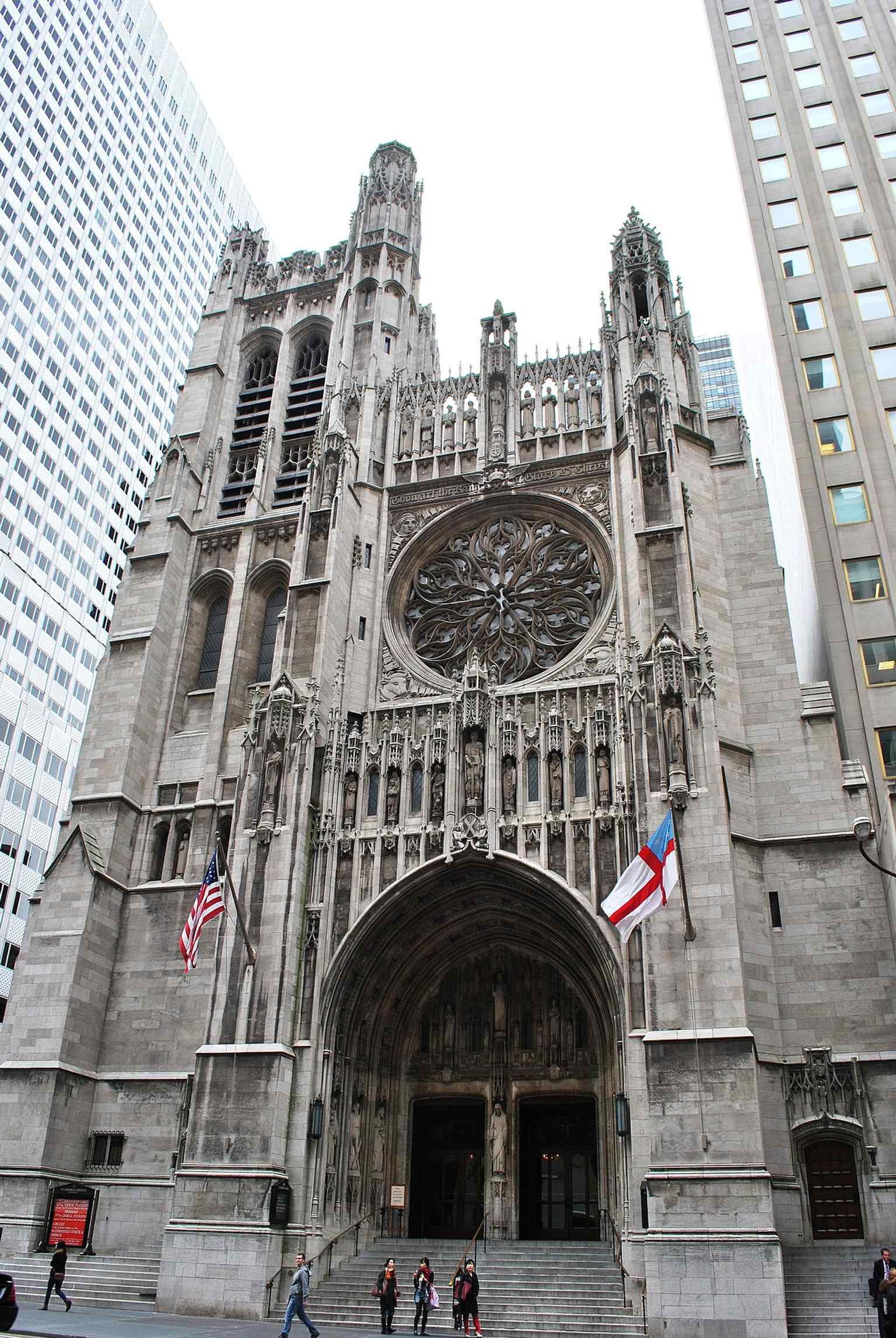
The current Saint Thomas Church, consecrated in 1916, showcases the French High Gothic Revival style of architects Ralph Adams Cram and Bertram Grosvenor Goodhue.Photo: Elisa Rolle, Wikimedia Commons, CC BY-SA 3.0. Cropped & resized. Decades later, the drama shifted from the pews to the pulpit. In two thousand and six, eleven parishioners filed a formal complaint against the rector, Andrew Mead. They accused him of entirely bizarre behavior, including flying first class to Paris solely to fire a staff member on vacation, and using parish funds to buy massive quantities of cat litter for his personal pets.
If you want to look for that hidden dollar sign or admire the interior acoustics, you can visit the church during its operating hours, which run from eight thirty A-M to six P-M Monday through Friday, opening at ten A-M on Saturdays and eight A-M on Sundays.
The outrageous scandals and the striking architecture both leave quite a lasting impression on this corner of the city. Whenever you feel ready to move on, casually make your way toward our next destination.
The church's asymmetrical main elevation on Fifth Avenue features the main entrance, where sculptures of the apostles were installed in 1963.Photo: Carmelo Bayarcal, Wikimedia Commons, CC BY-SA 3.0. Cropped & resized.
Show 8 more stopsShow fewer stopsexpand_moreexpand_less
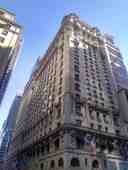
Look to your right at this towering eighteen-story limestone building, easily spotted by its elegantly curved corner, deep horizontal grooves across its lower base, and the ornate…Read moreShow less
Open dedicated page →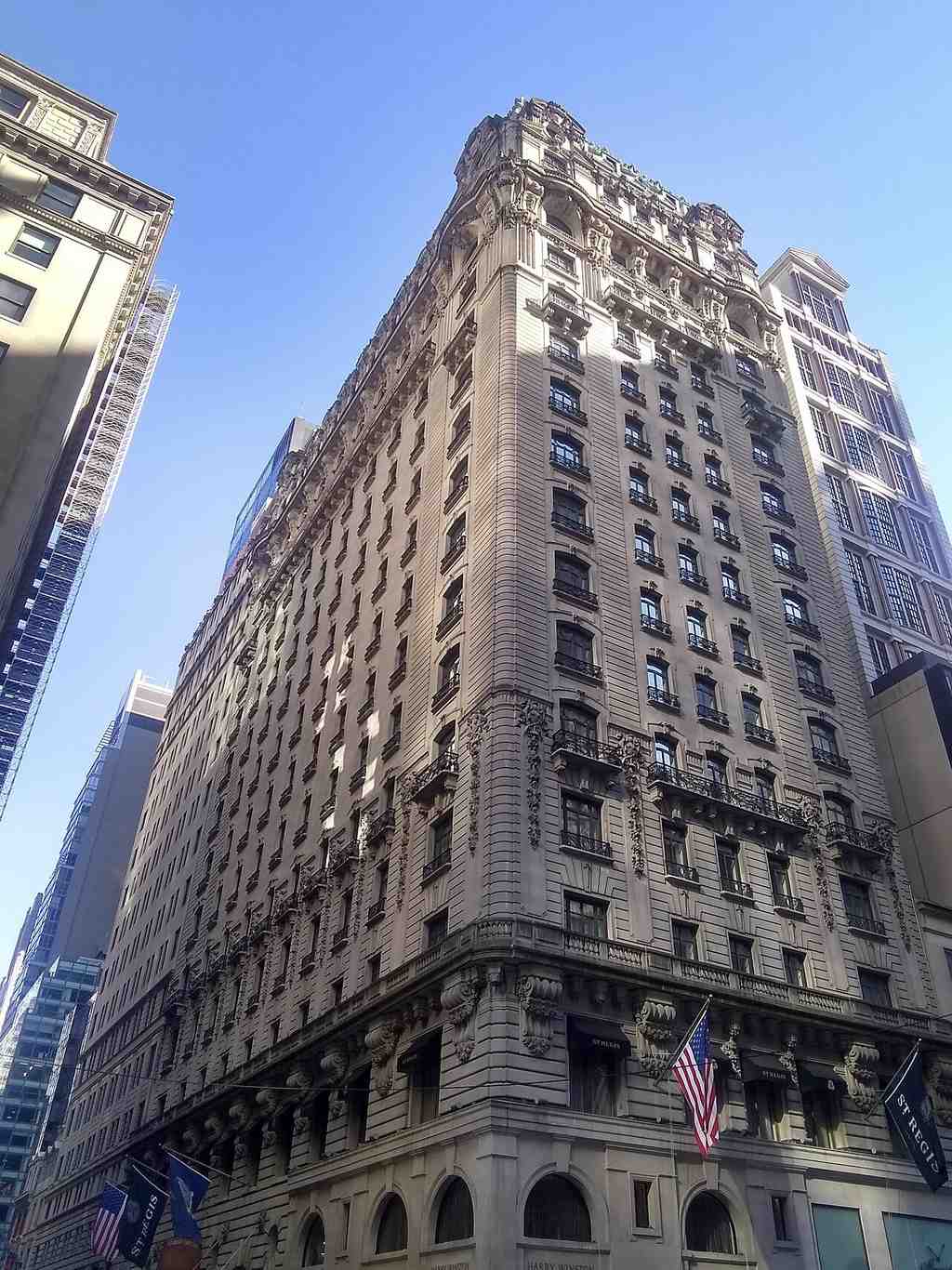
St. Regis New YorkPhoto: Epicgenius, Wikimedia Commons, CC BY-SA 4.0. Cropped & resized. Look to your right at this towering eighteen-story limestone building, easily spotted by its elegantly curved corner, deep horizontal grooves across its lower base, and the ornate carved stone garlands draping down its sides. This is the St. Regis New York, an absolute masterpiece of the Beaux-Arts style, which is a grand, heavily ornamented French architectural tradition. Over a century separates the views of this enduring elegance standing tall as the surrounding cityscape transformed from horse-drawn carriages to modern traffic, so tap the before and after image in your app to take a look. John Jacob Astor the Fourth opened this place in nineteen oh four. Now, Astor had two huge motivations here. First, he desperately wanted to outshine his cousin, who had just built the rival Waldorf-Astoria. Second, Astor needed a sanctuary. He had just outraged New York high society by divorcing his first wife and marrying a nineteen-year-old, so he figured he would just build his own private clubhouse to escape the glaring eyes of the elite.
His wealthy neighbors were absolutely furious. Oil tycoon William Rockefeller led the charge, branding the towering hotel a social crime that would bring unpredictable strangers into their exclusive enclave. Rockefeller and his millionaire buddies even planted bizarre rumors in the newspapers to scare away potential guests. They claimed the hotel charged visitors by the foot for filtered air, and that a simple chocolate eclair would cost five hundred dollars, which is about seventeen thousand dollars today. The smear campaign got so bad that the hotel manager had to issue public denials.
But Astor had the last laugh, filling the hotel with mind-blowing technology for the era. He installed an incredible central vacuum system where maids simply plugged flexible hoses into wall sockets that whisked dust directly down to the basement.
He also commissioned artist Maxfield Parrish to paint the famous Old King Cole mural for the bar, paying him five thousand dollars, roughly one hundred and seventy thousand dollars today. Parrish actually hated Astor's demanding attitude, so he took a subtle, hilarious revenge. If you ask the bartenders today, they will tell you that the smirking courtiers in the painting are reacting because Parrish secretly painted the King in a state of flatulence.
Tragically, Astor died on the Titanic in nineteen twelve, though survivors remembered him calmly smoking a cigar and heading down to free his dog, Kitty, before the ship sank.
His beloved hotel lived on to host a wildly colorful cast of characters. In the nineteen sixties and seventies, the surrealist painter Salvador Dalí lived here every winter. Dalí would casually walk his pet ocelot down the marble corridors on a leash. He even found a genius way to avoid paying his massive room service tabs. He would pay with personal checks that he had embellished with original sketches, knowing full well the management would rather frame his artwork than cash the checks.
Meanwhile, director Alfred Hitchcock maintained a favorite suite where he once devoured three full steaks and three portions of ice cream in a single sitting. And in nineteen seventy-one, John Lennon hunkered down on the seventeenth floor, happily sitting on the carpet to sort a massive delivery of Elvis Presley records, and practicing on a typewriter by repeatedly typing the phrase, I am a pimp.
From feuding millionaires to surrealists with wild cats, the walls of the St. Regis hold some of the best gossip in the city. Enjoy the lavish details of the facade before we move on to our next destination.
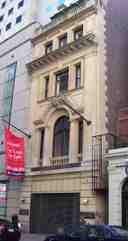
Look for the narrow limestone building featuring a striking, arched window separated by columns on the second level and decorative carved ledges stretching across the upper…Read moreShow less
Open dedicated page →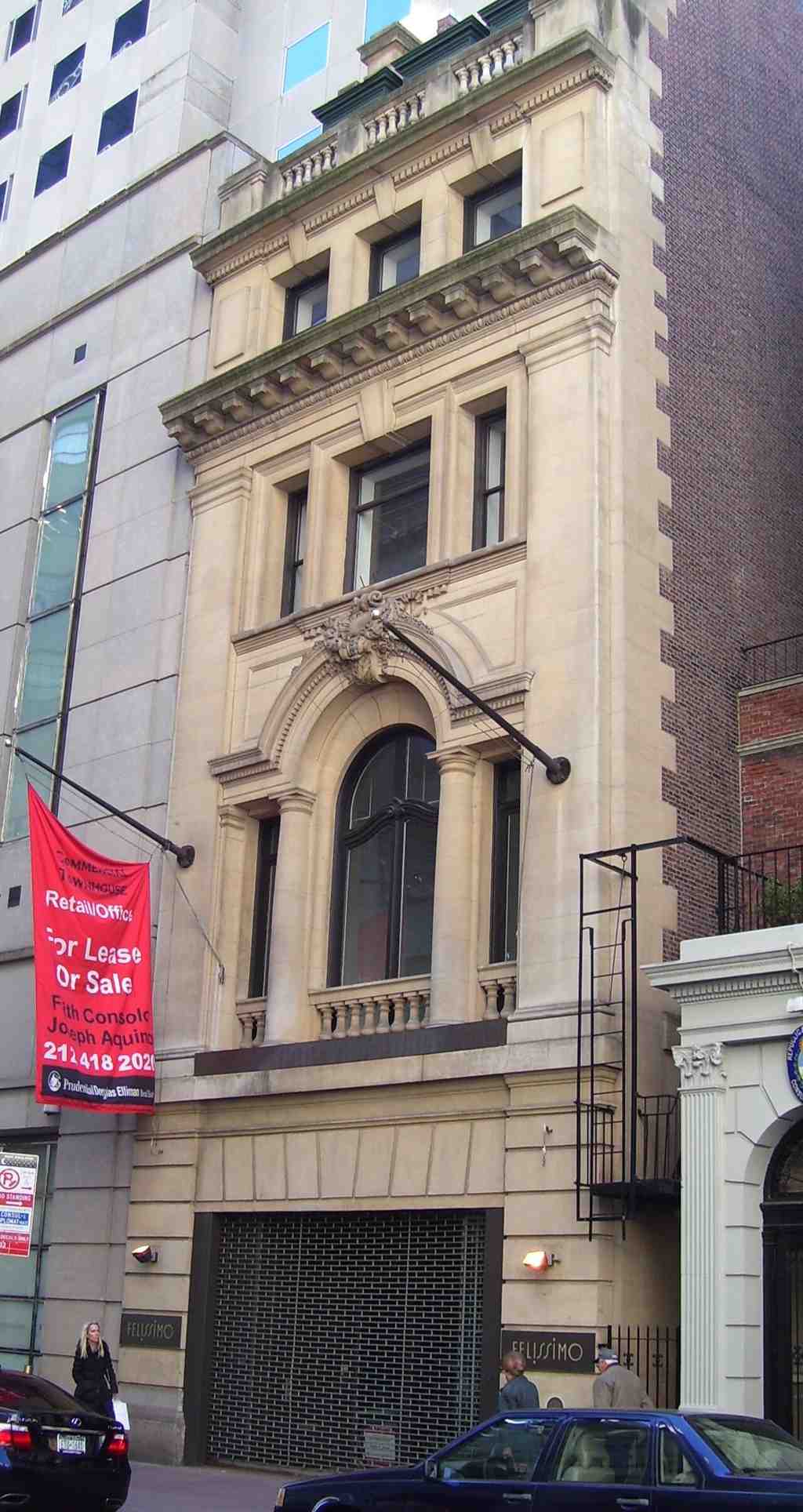
10 West 56th StreetPhoto: Beyond My Ken, Wikimedia Commons, CC BY-SA 4.0. Cropped & resized. Look for the narrow limestone building featuring a striking, arched window separated by columns on the second level and decorative carved ledges stretching across the upper floors.
This is number ten West Fifty-Sixth Street. Back in eighteen ninety-nine, a stockbroker named Frederick Edey and his socialite wife, Birdsall, bought this lot. Frederick and his business partner, H-B Hollins, bought adjacent lots, planning to build twin mansions side by side.
Hollins started building immediately next door at number twelve. But Frederick hit a snag. An old property covenant, a legal restriction tied to the deed, prevented him from building all the way to the sidewalk for two whole years. Hollins just kept building, leaving Frederick staring at an empty dirt patch.
By the time the Edeys could finally build in nineteen zero one, they ditched Hollins's architect and hired the firm Warren and Wetmore instead. The original construction cost was fifty thousand dollars, which is roughly one million eight hundred thousand dollars in today's money. They built this six-story French Renaissance Revival townhouse, a style inspired by grand European chateaus, giving it a much more rigid, formal look than the neighbor's house. You can check your screen to see a photo of these two completely mismatched buildings side by side. An architecture critic once described their contrasting styles as an uneasy dance, with one house doing the lively cancan and this one doing a stiff minuet.
The Edeys finally moved into their grand home in nineteen zero three, complete with an elevator and ten servants. If you pull up the before and after pictures in the app, you can see how this pristine facade looked back then compared to the modern towers surrounding it today. The Edeys threw grand parties here, but the house is also famous for a truly bizarre burglary in nineteen twelve. A thief broke in, locked a servant in a closet, and then fled the scene stealing absolutely nothing except the key to that very closet door. I guess he just really hated open doors.
By nineteen nineteen, Midtown was becoming a busy commercial zone, and the Edeys sold the house. Over the next century, it transformed into a high-end dressmaker shop, a cosmetics headquarters, and eventually a retail space arranged entirely by feng shui principles, the ancient Chinese practice of harmonizing individuals with their surrounding environment. It even hosted Hollywood royalty, as the actress Elizabeth Taylor lived right here for a few years in the mid-nineteen fifties.
More recently, in twenty eleven, Mexican billionaire Carlos Slim bought the townhouse for fifteen million five hundred thousand dollars. He leased it to a luxury hair salon for over a million dollars a year, but the salon stopped paying rent. Slim had to drag them to court twice just to get them out and recover his money.
Even billionaires have landlord troubles, but at least they own a magnificent piece of architectural history. Take your time admiring this surviving mansion, and when you feel ready, continue along the route.
Look up to your right and you will spot a soaring, ultra-thin rectangular skyscraper defined by a stark, repeating grid of square windows cut into poured white concrete. This is…Read moreShow less
Open dedicated page →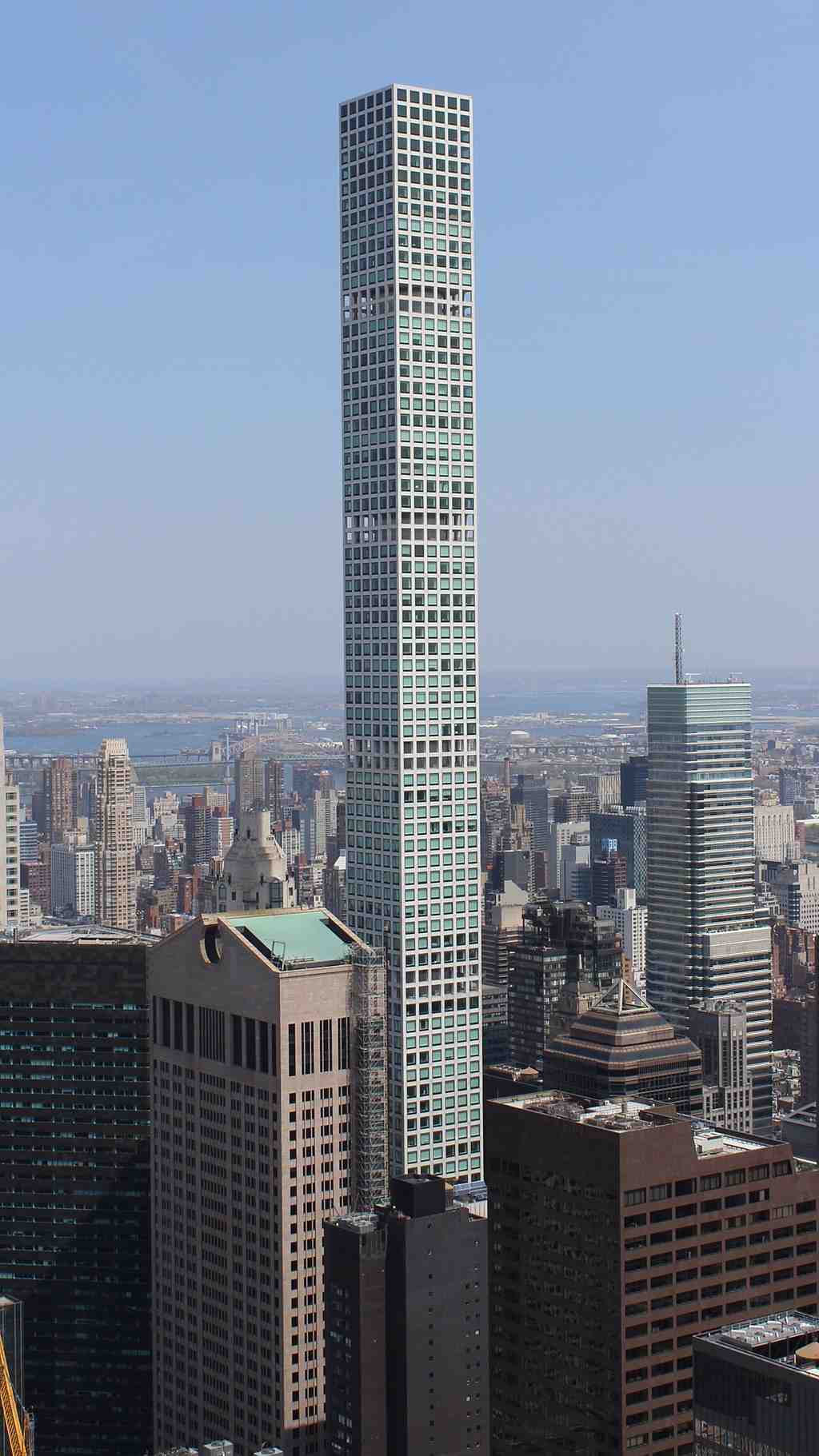
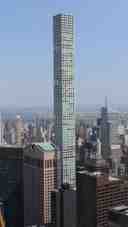
432 Park AvenuePhoto: Percival Kestreltail, Wikimedia Commons, CC BY-SA 4.0. Cropped & resized. Look up to your right and you will spot a soaring, ultra-thin rectangular skyscraper defined by a stark, repeating grid of square windows cut into poured white concrete. This is Four Hundred Thirty-Two Park Avenue, a defining pillar of Billionaires Row reaching an astonishing one thousand three hundred ninety-six feet into the sky. If you check your screen, you can see how this supertall marvel transformed from an exposed concrete framework surrounded by construction scaffolding into a gleaming, completed residential tower with its signature grid-like facade.
Developer Harry Macklowe and architect Rafael Viñoly designed this pinnacle of extreme wealth. Viñoly famously admitted that the rigid, regular lattice design was actually inspired by a nineteen oh five Austrian trash can. The public has been less kind, giving it nicknames like The Awful Waffle and The Middle Finger. You can pull up your app to see its stark, slender profile towering defiantly over the neighborhood, which many consider an architectural emblem of rising inequality.
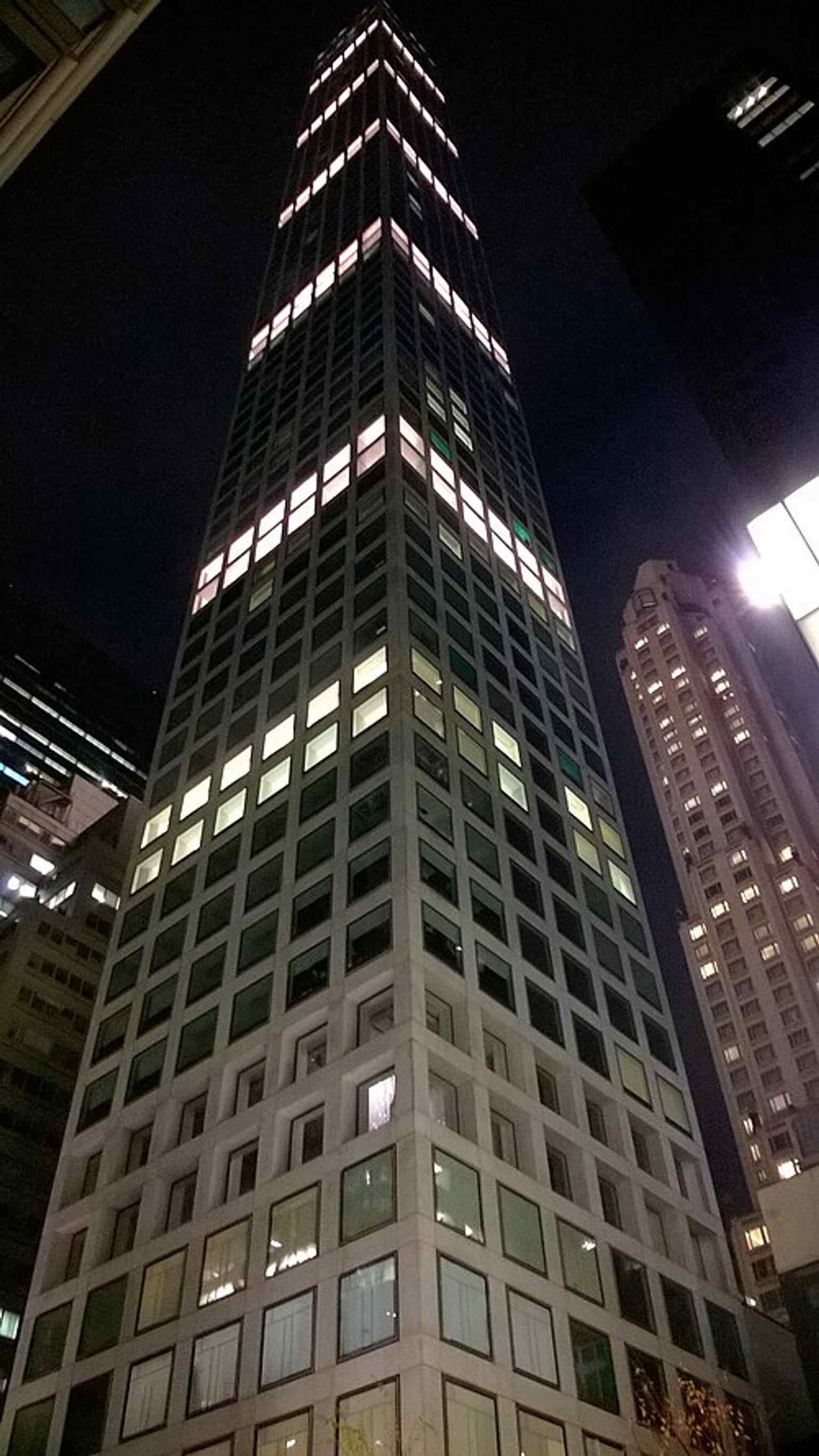
Its stark, slender profile, sometimes nicknamed "Awful Waffle" by New Yorkers, has become an "architectural emblem of rising inequality."Photo: Jdforrester, Wikimedia Commons, CC BY 4.0. Cropped & resized. When completed in two thousand fifteen, it was the tallest residential building in the world. Units sold for anywhere from ten point five million to over ninety million dollars. But living in a pencil tower comes with a unique set of terrifying perks. Its height-to-width ratio is fifteen to one, making it incredibly slender. Those empty, double-story floors you see every twelve levels are windbreaks meant to stop the building from swaying. They did not entirely work.
Residents describe the experience of living up there as downright eerie. When the wind picks up, the metal partitions inside the walls groan and vibrate so violently that water sloshes right out of the bathtubs. Elevators frequently break down during high winds. On Halloween night in twenty nineteen, the system glitched, trapping a resident inside a stalled car for an hour and twenty-five minutes. And then there is the garbage chute. Because the drop is so massive, bags of trash plummeting from the top floors sound like a bomb detonating when they finally hit the bottom. Talk about a rude awakening.
The ultra-wealthy occupants were furious. In twenty twenty-one, the condo board sued the developers, citing one thousand five hundred structural flaws. There were reports of giant cracks in the facade, some up to ten inches deep. Harry Macklowe reportedly offered a creative fix for the cracking concrete. He suggested applying a clear silicone finish, exactly like the one he used to coat his twenty-five million dollar personal sailing yacht. The board, quite sensibly, flatly rejected the idea.
While the building and its private staff operate twenty-four hours a day, the drama over this colossal luxury experiment never seems to sleep. Gaze up at this modern monolith as long as you like before we continue our walk.
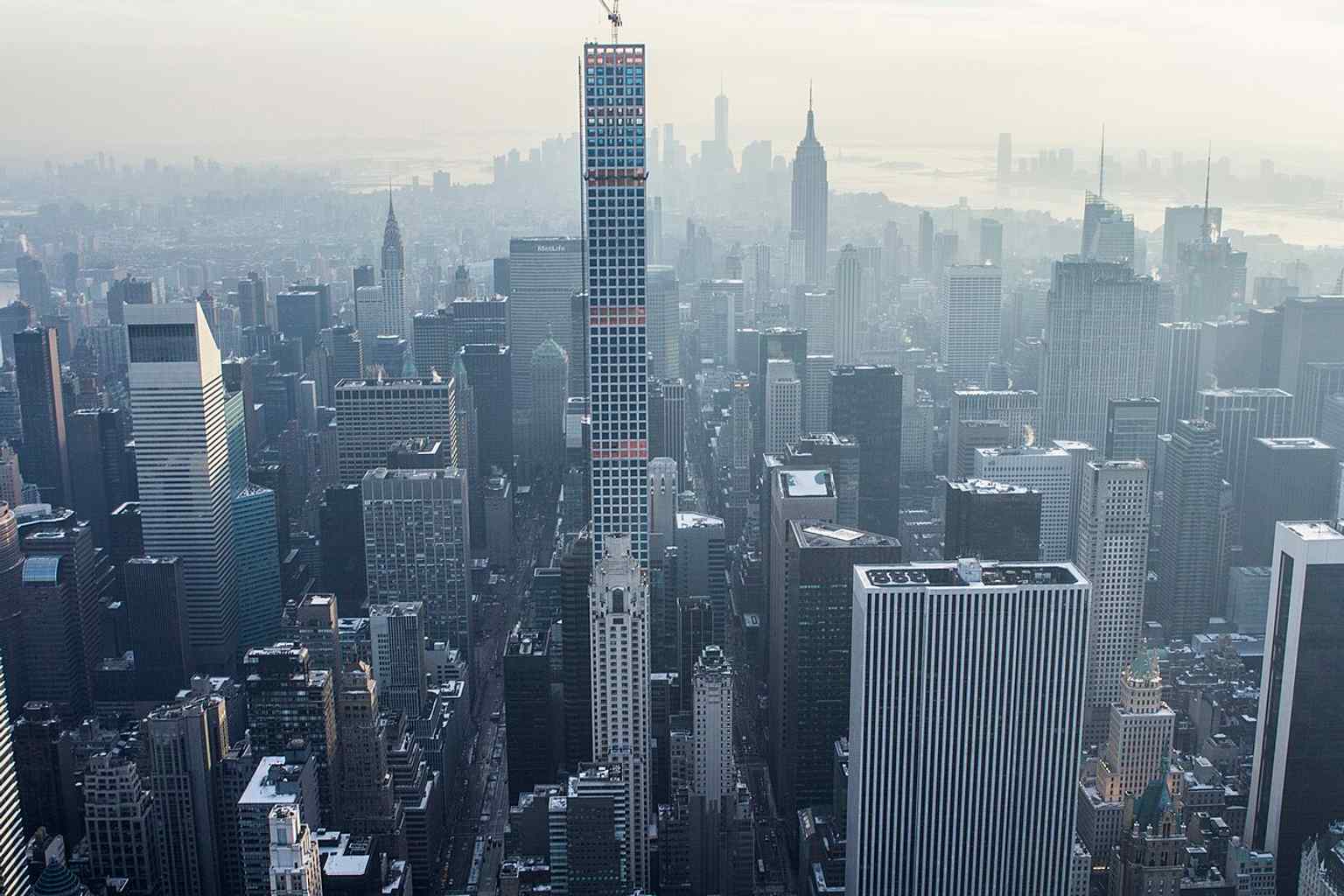
This panoramic view captures 432 Park Avenue towering among other "Billionaires' Row" skyscrapers, reflecting its status as one of the city's most expensive residences.Photo: G. Scott Segler, Wikimedia Commons, CC BY-SA 4.0. Cropped & resized. 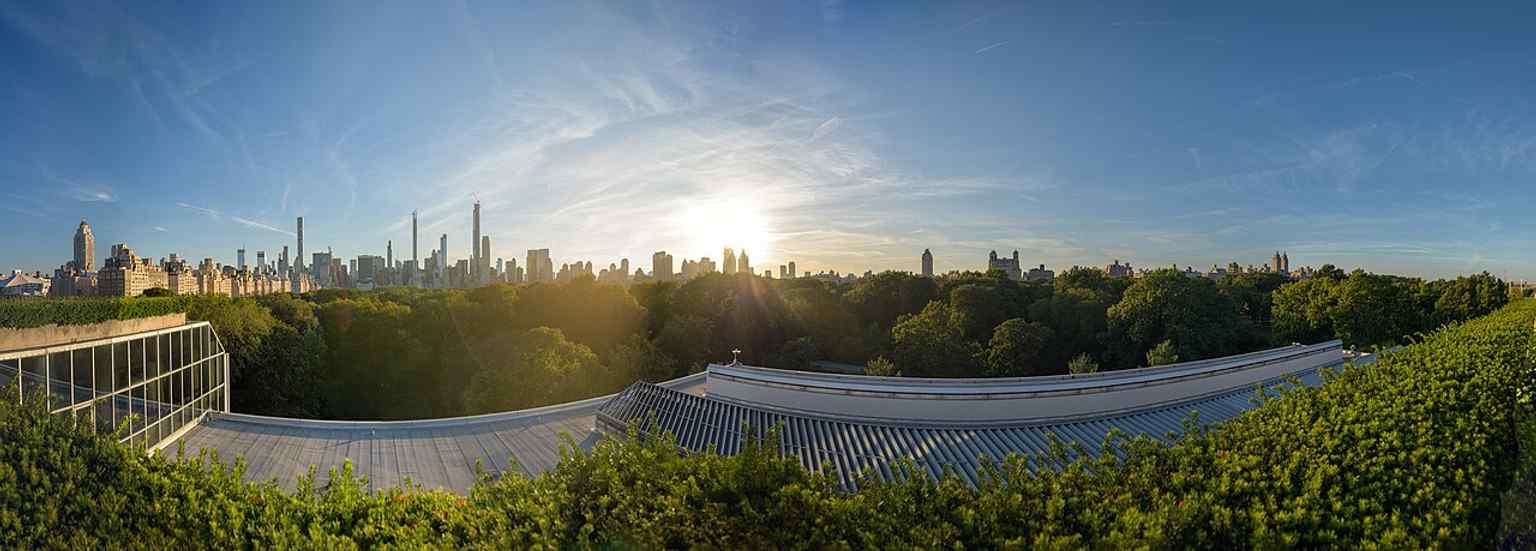
The skyscraper stands prominently in this vast Manhattan skyline, a "pencil tower" with a 15:1 height-to-width ratio, one of the most slender in the world.Photo: DavFace, Wikimedia Commons, CC BY-SA 4.0. Cropped & resized. 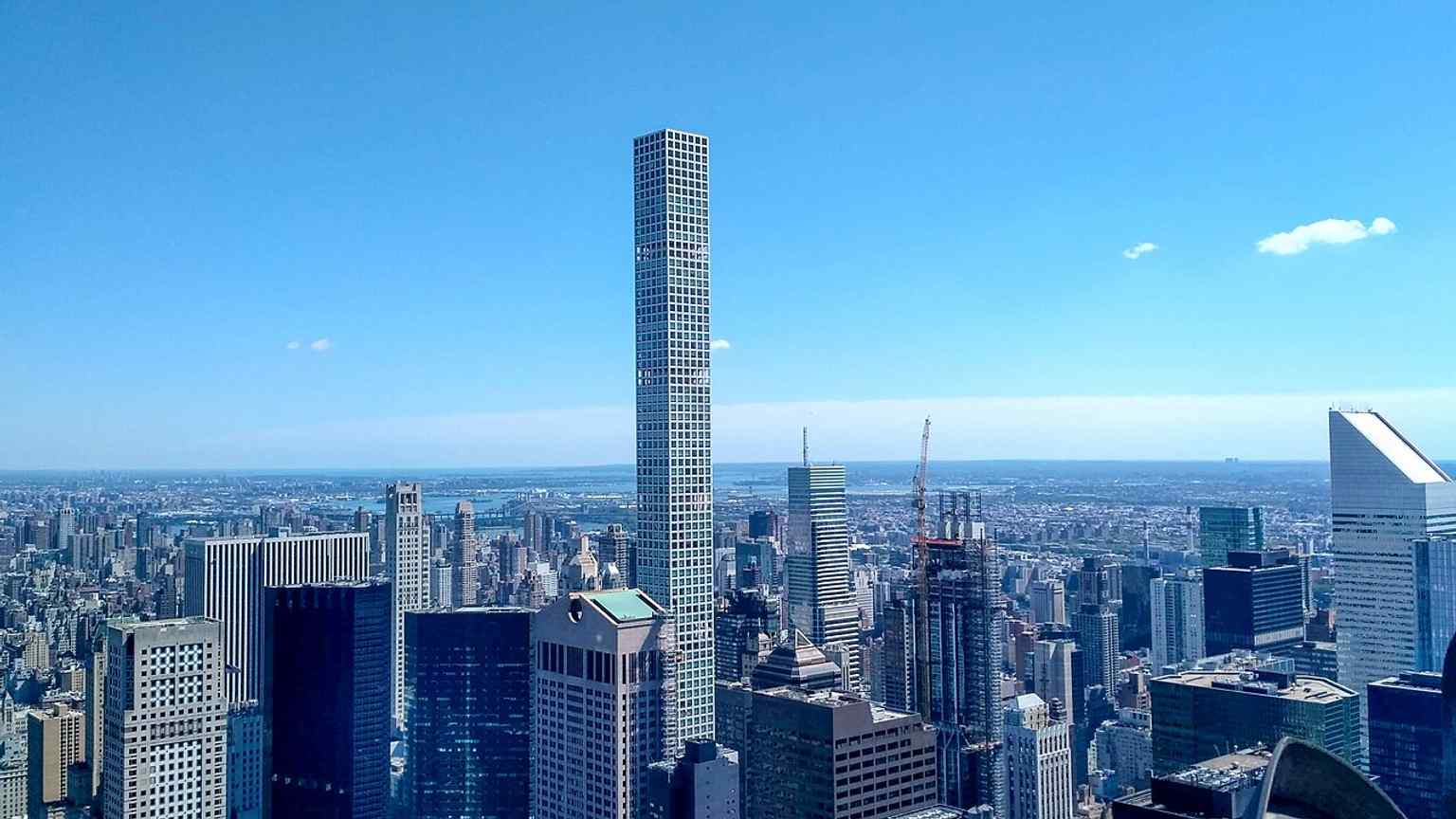
The building's exterior is a lattice of poured-in-place concrete made from white Portland cement, forming its distinctive gridded facade.Photo: Kidfly182, Wikimedia Commons, CC BY 4.0. Cropped & resized. 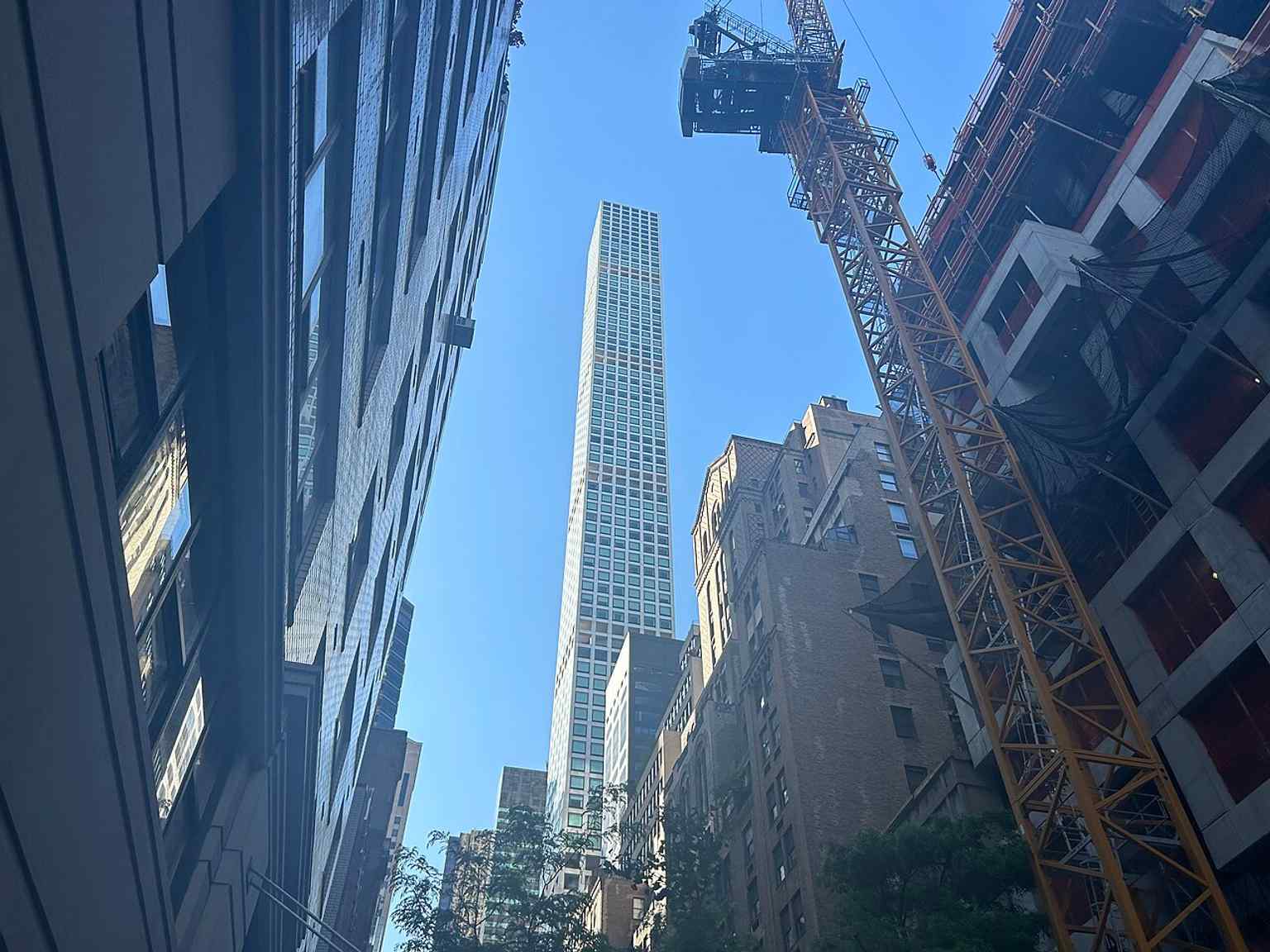
The building's base, clad with limestone, features its main entrance on 56th Street, an integral part of its L-shaped lot.Photo: Sir MemeGod, Wikimedia Commons, CC0. Cropped & resized. 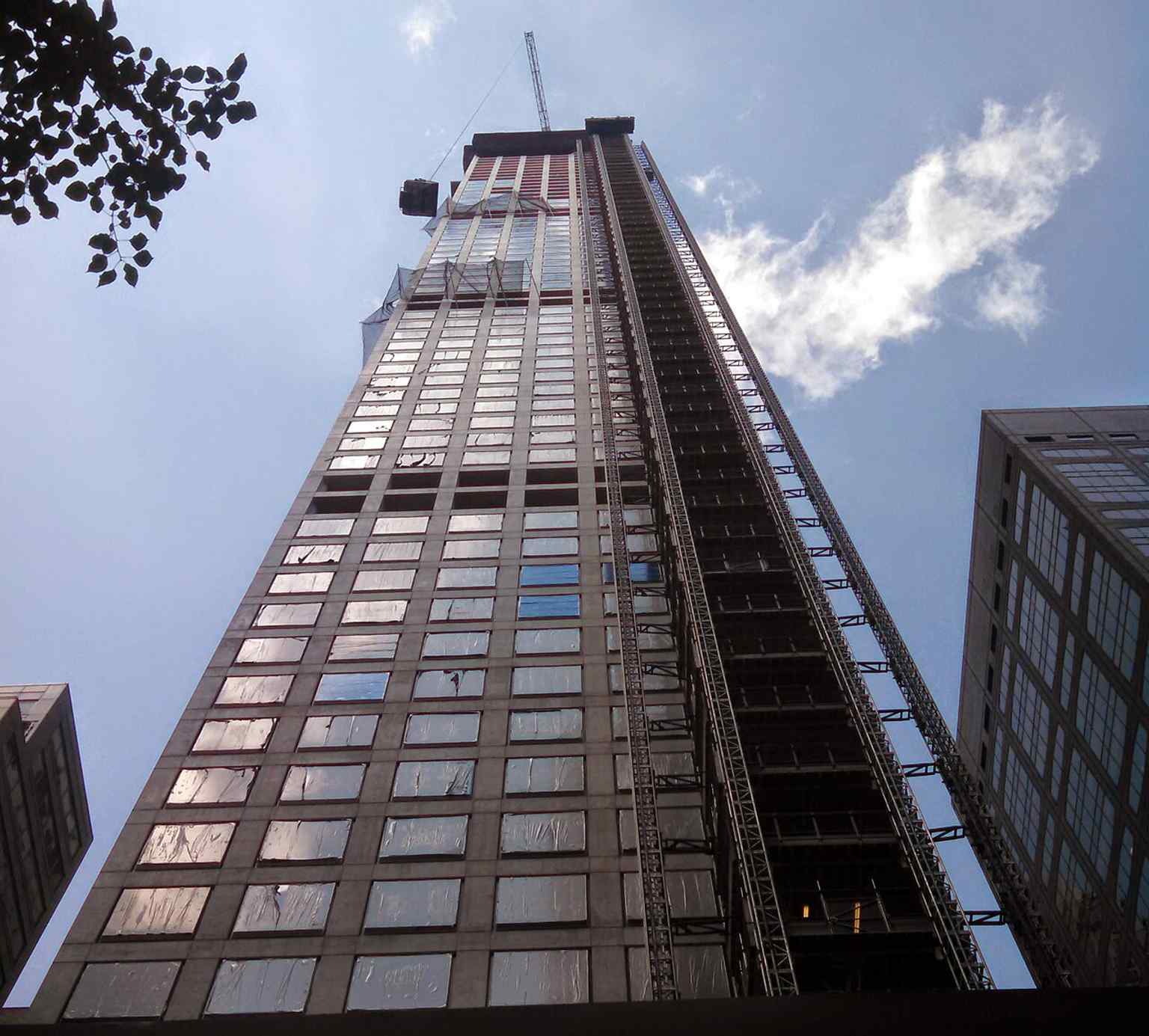
Seen from the Empire State Building, 432 Park Avenue once stood as the third-tallest building in the U.S. and the tallest residential building in the world at its completion in 2015.Photo: הגמל התימני, Wikimedia Commons, CC BY-SA 4.0. Cropped & resized. 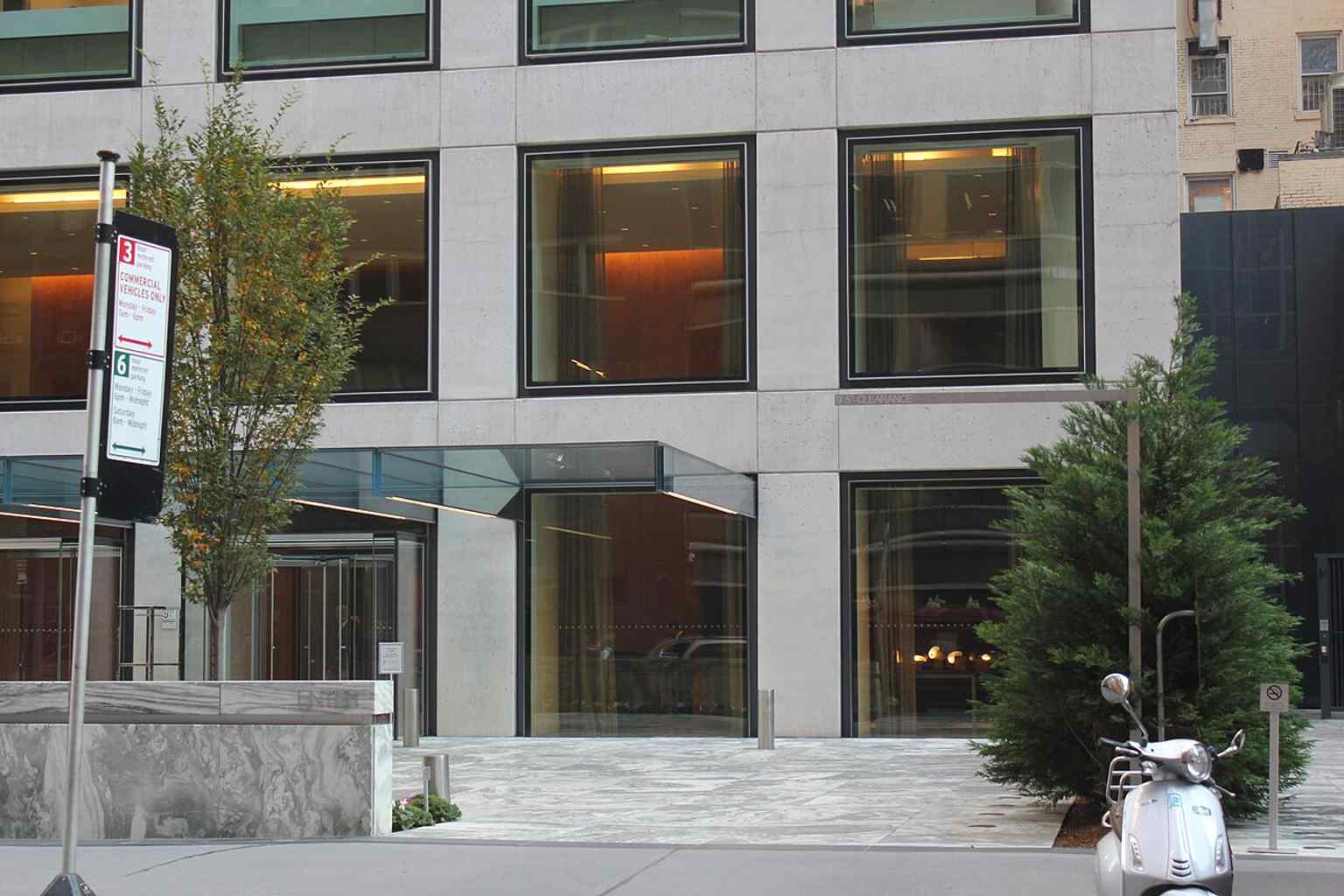
This image depicts 432 Park Avenue under construction in 2015, the year of its official completion, after facing numerous delays and financing challenges.Photo: Sikander Iqbal, Wikimedia Commons, CC BY-SA 4.0. Cropped & resized. Look to your right and you will spot a tiered granite fountain featuring a wide circular basin, crowned by a dark bronze statue of a woman holding a basket. This is the Pulitzer…Read moreShow less
Open dedicated page →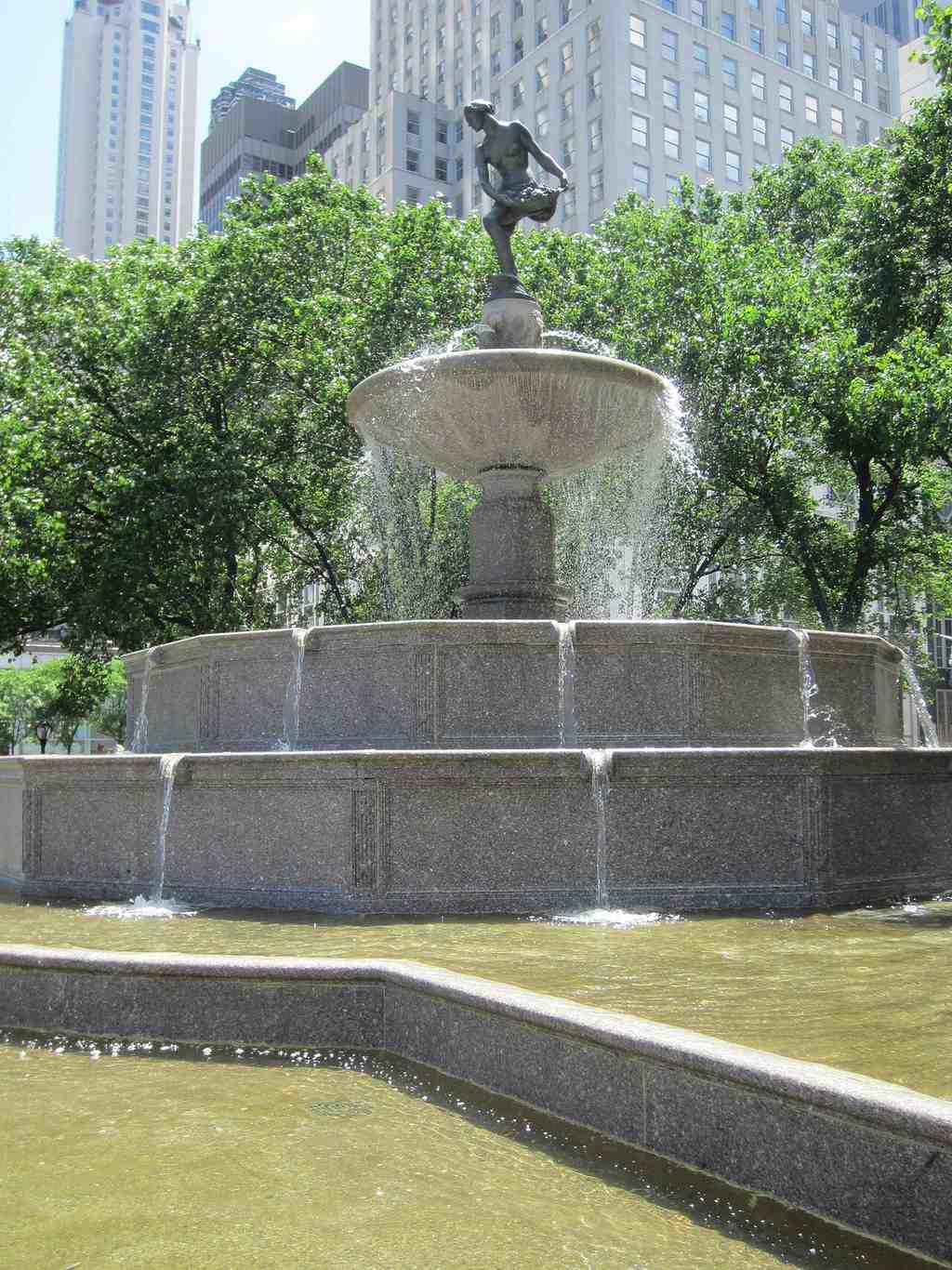
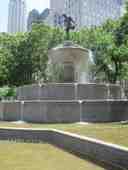
Pulitzer FountainPhoto: Another Believer, Wikimedia Commons, CC BY-SA 3.0. Cropped & resized. Look to your right and you will spot a tiered granite fountain featuring a wide circular basin, crowned by a dark bronze statue of a woman holding a basket. This is the Pulitzer Fountain, named for the legendary newspaper publisher Joseph Pulitzer, who died in nineteen eleven and left fifty thousand dollars, which is roughly one point six million dollars today, to build it. Pulitzer specifically wanted his fountain to look like the grand ones in the Place de la Concorde in Paris, France.
The executors of his estate held a massive design competition, and architect Thomas Hastings won the job. Hastings designed the magnificent structure you see before you, but the crowning glory, the statue of Pomona, the Roman goddess of fruit and abundance, came with a bit of a tragic backstory. Sculptor Karl Bitter designed the allegorical bronze figure, which is a piece of art meant to represent a broader concept like abundance, using a woman named Doris Doscher as his model. Bitter finished the plaster cast in April nineteen fifteen, but he died unexpectedly before he could cast it in bronze. If you look at your app, you can see a historical photo of that exact unfinished plaster cast. After Bitter passed away, his widow and the architect brought in another sculptor named Isidore Konti to complete the actual bronze statue. They finally dedicated the fountain in May nineteen sixteen, and local newspapers proudly declared it was bubbling with the purest water in the city.
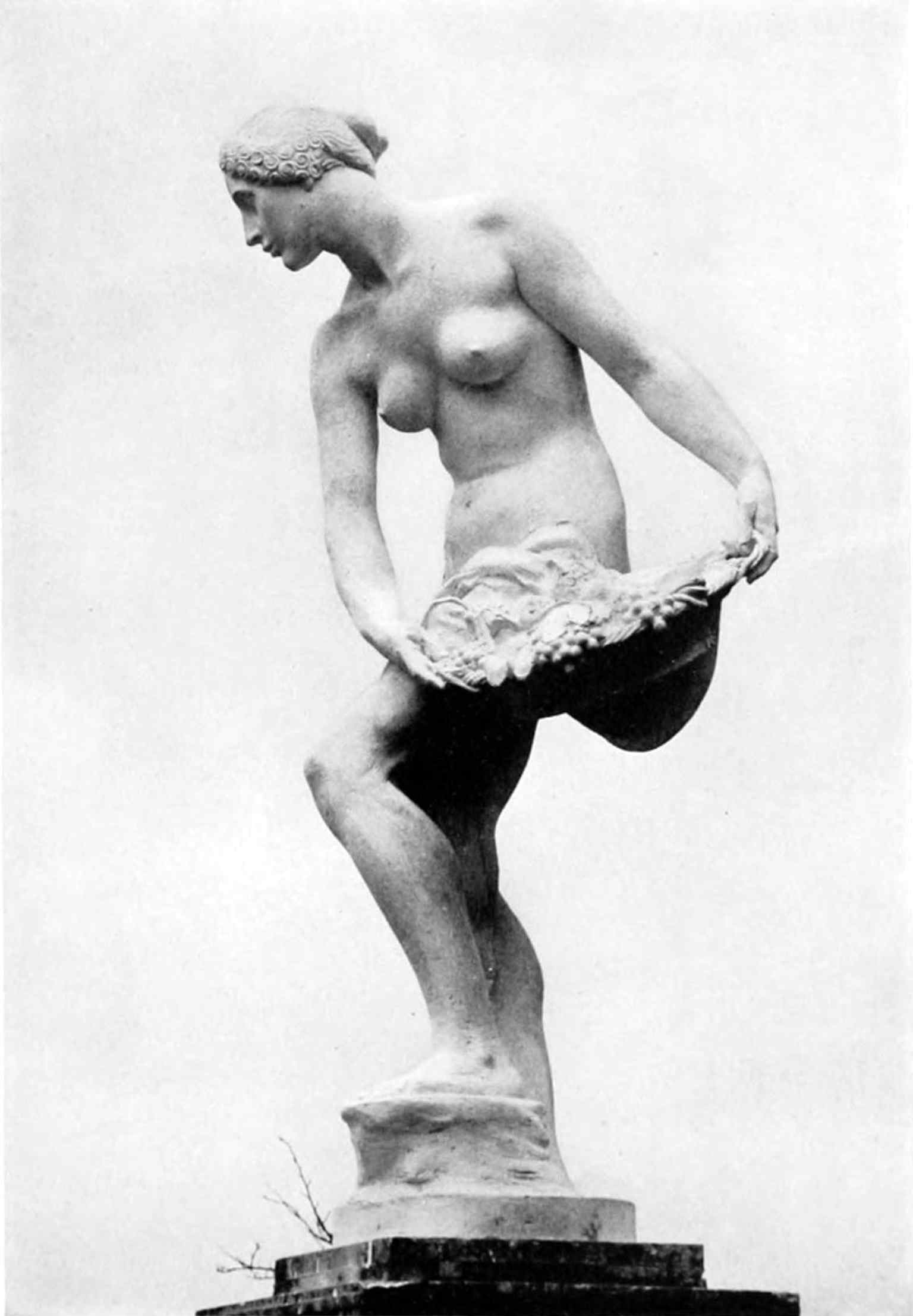
This image shows the unfinished plaster cast for the Pomona statue by Karl Bitter, who completed this work just before his death in April 1915.Photo: Karl Bitter, Wikimedia Commons, Public domain. Cropped & resized. Over the decades, the fountain required a few expensive facelifts. The original limestone basin was swapped for Italian marble in nineteen thirty-five, and finally rebuilt in sturdy granite during a massive restoration project that wrapped up in nineteen ninety. Before that nineteen ninety overhaul, the fountain had lost its magic and merely dripped and dribbled a sad stream of water. The restoration completely updated the mechanical systems, allowing the water to cascade exactly as intended, giving the plaza a brilliant rushing sound. Take a peek at your screen for a great shot of the water flowing perfectly.
Interestingly, that nineteen ninety renovation was mostly funded by neighboring businesses who formed a non-profit group to save the landmark. A huge chunk of that money, two hundred and sixty-four thousand dollars to be exact, came from the charitable foundation of Donald Trump. The incredibly generous donation raised a few eyebrows around town, primarily because a beautifully restored fountain indirectly benefited his own Plaza Hotel, which stands just across the street.
This rushing water and striking bronze goddess create a truly iconic New York vignette. Enjoy the refreshing sound of the cascading water, and whenever you are ready, let us cross over to our next location.
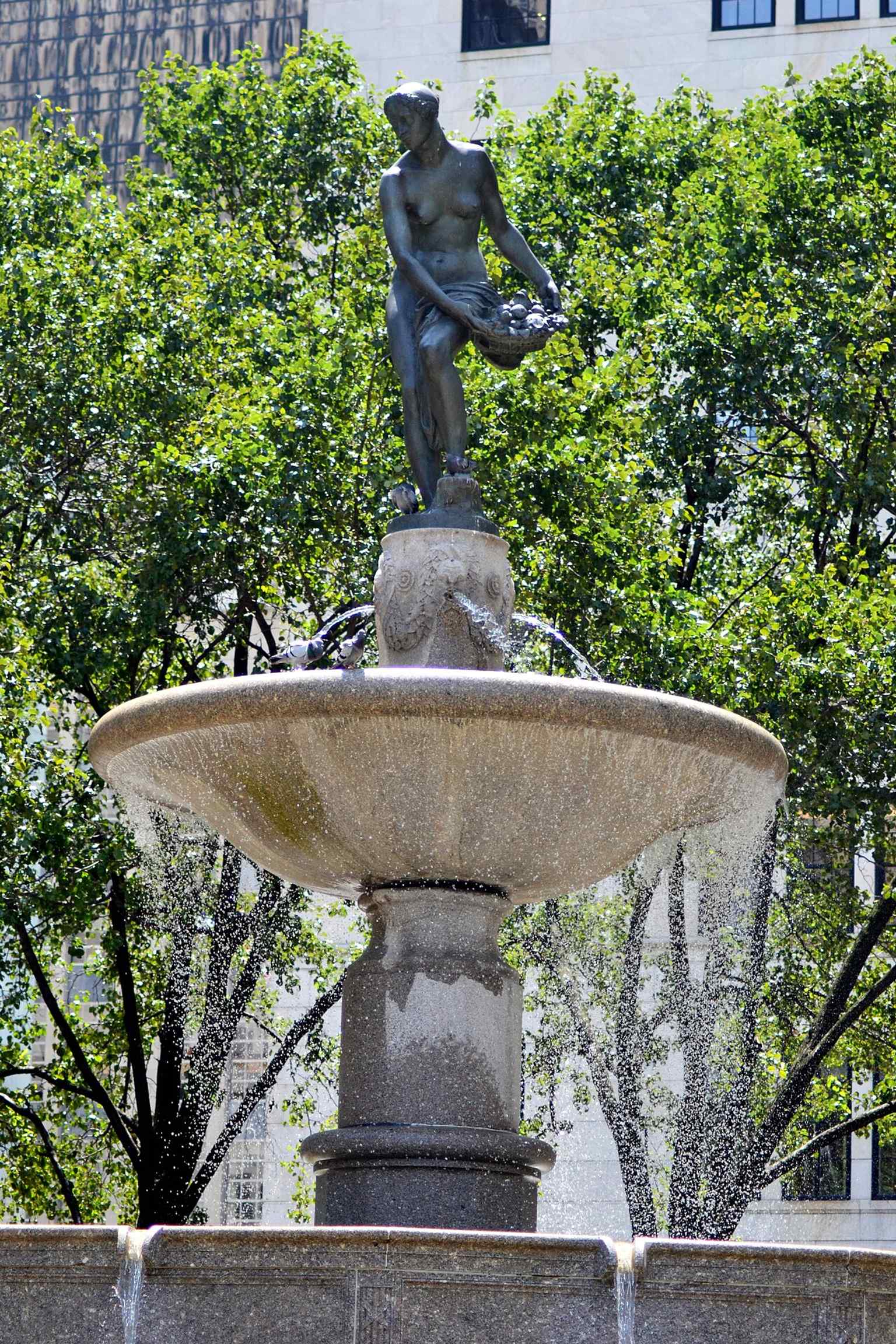
The Pulitzer Fountain, designed by architect Thomas Hastings, was intended by Joseph Pulitzer to be "like those in the Place de la Concorde, Paris, France."Photo: Photographer: Rangilo Gujarati. Sculptor: Karl Bitter (1867-1915)., Wikimedia Commons, CC BY-SA 3.0. Cropped & resized. 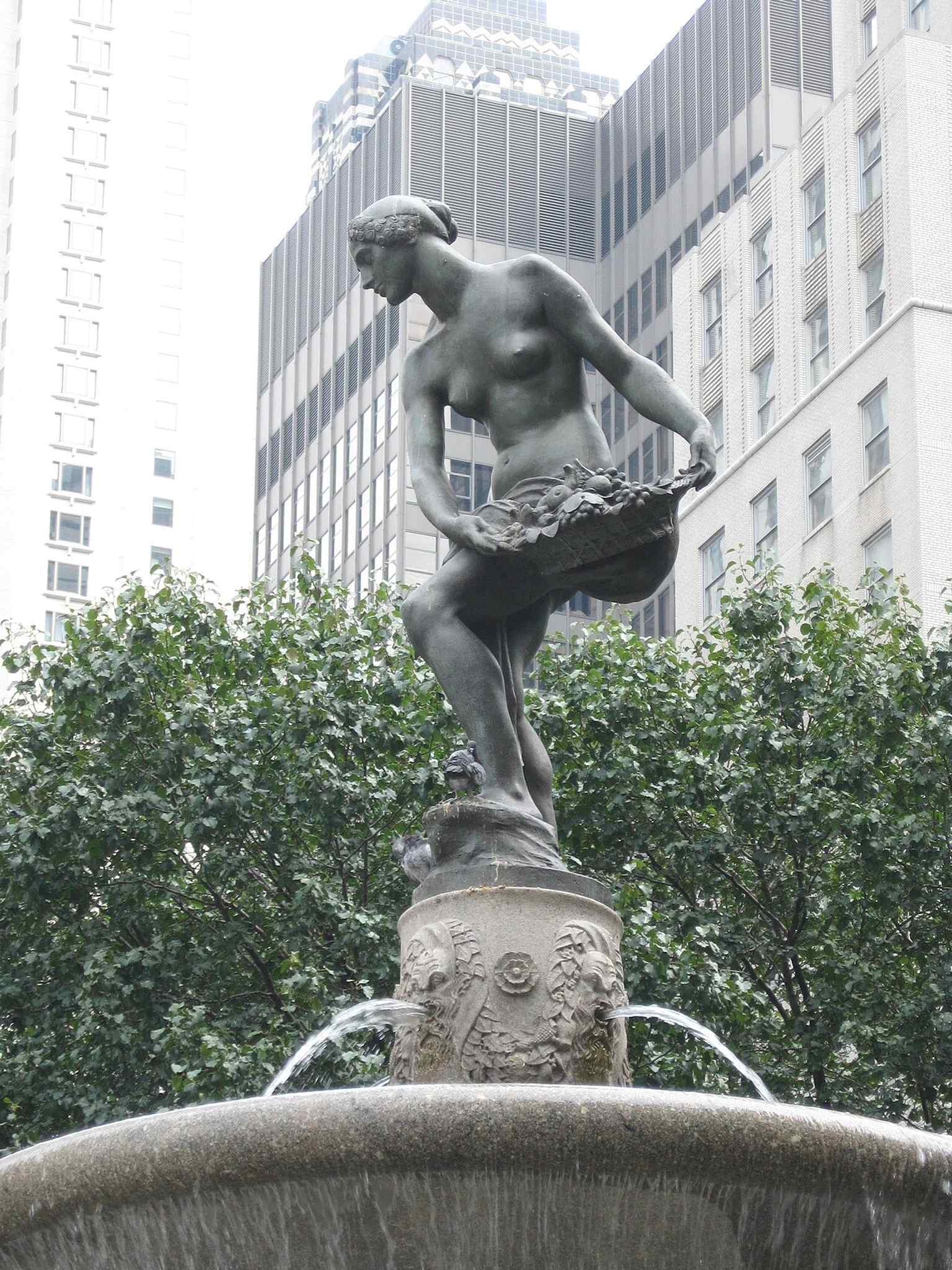
A view of the Pulitzer Fountain, crowned by the allegorical bronze statue of Pomona, goddess of abundance, holding a basket of fruit.Photo: Jim.henderson, Wikimedia Commons, Public domain. Cropped & resized. 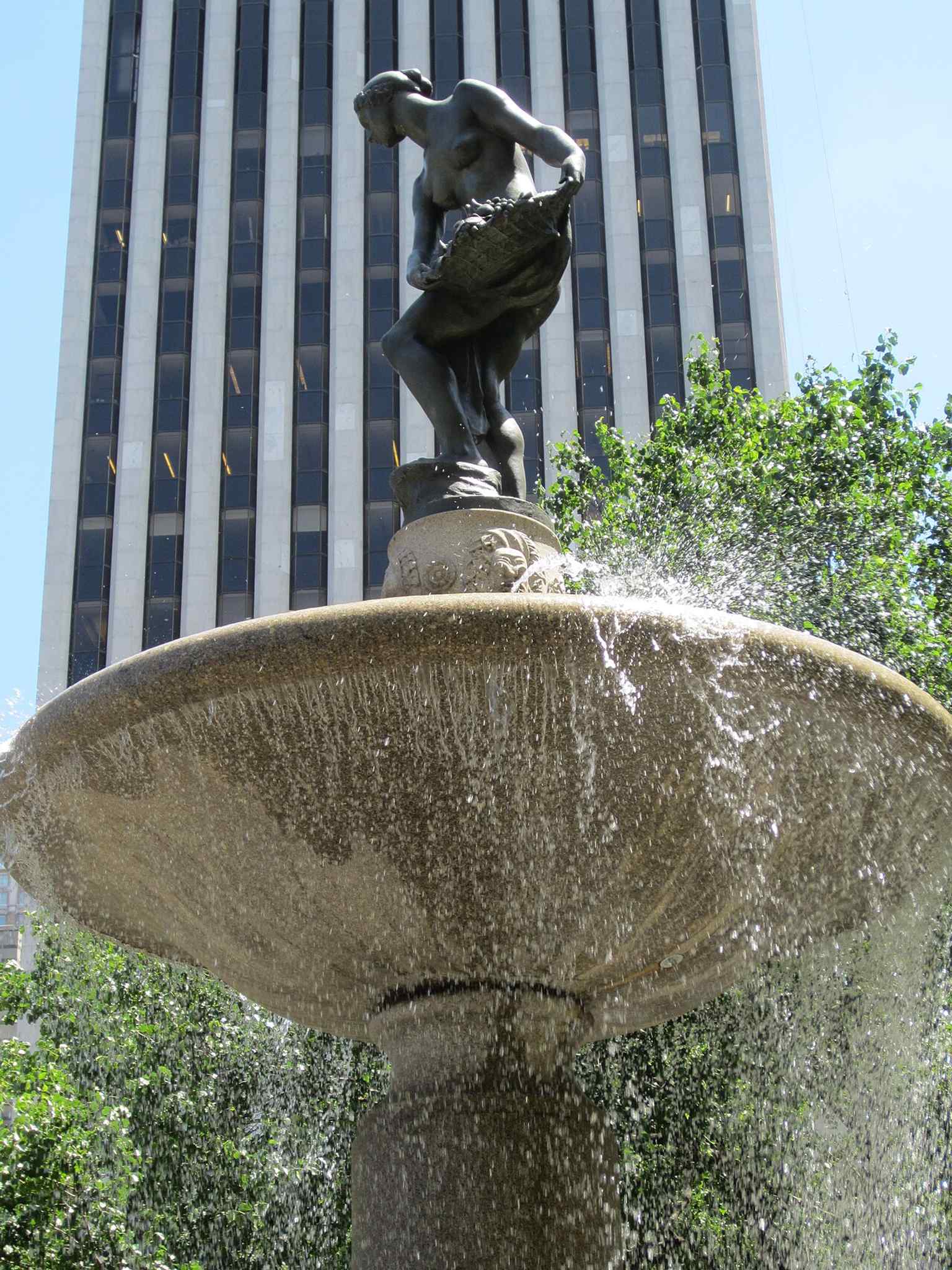
A wide view of Grand Army Plaza, where the Pulitzer Fountain was placed in the southern half, with the Sherman Monument in the northern half.Photo: Another Believer, Wikimedia Commons, CC BY-SA 3.0. Cropped & resized. 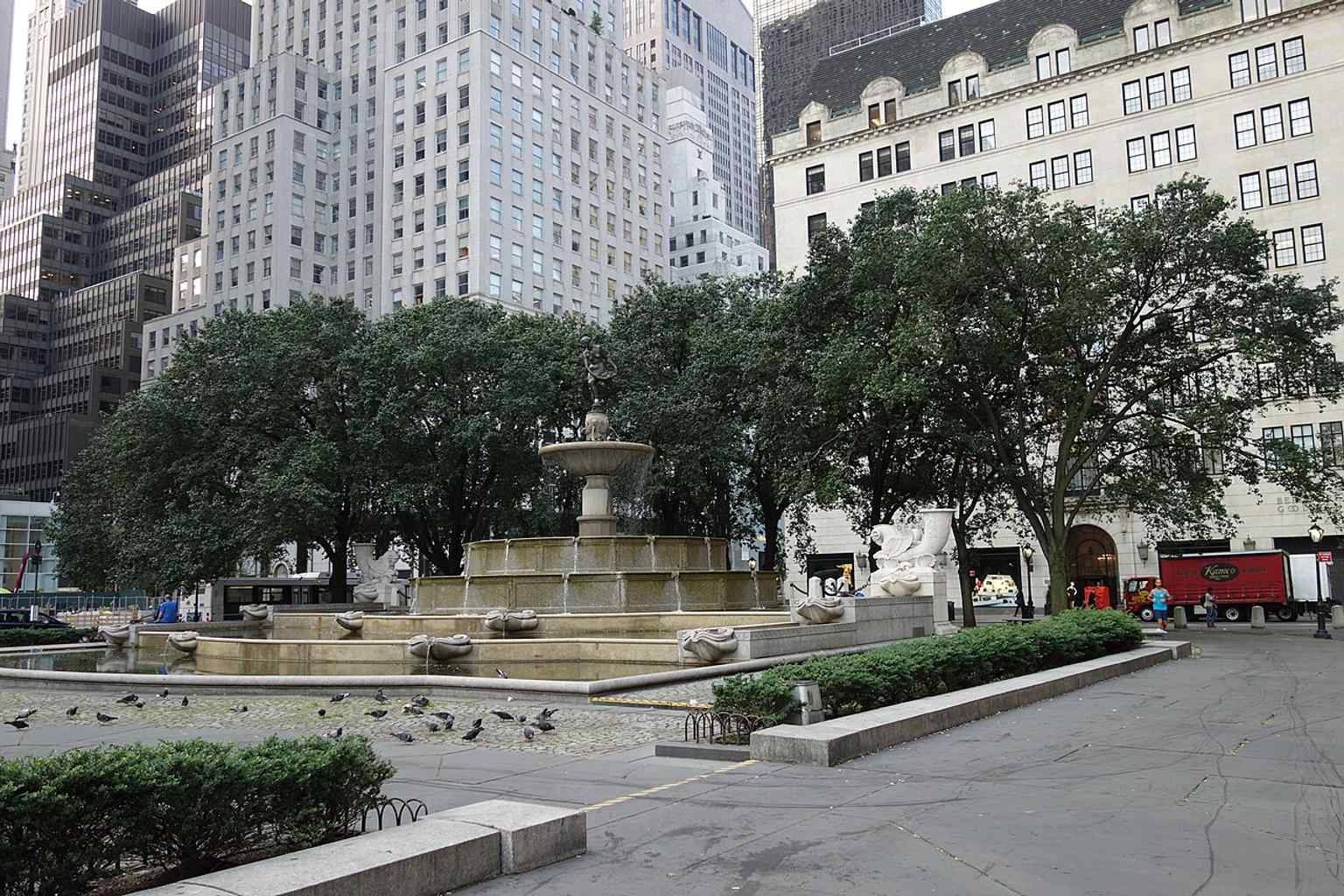
A street-level view of the Pulitzer Fountain in Grand Army Plaza, dedicated in May 1916.Photo: Tdorante10, Wikimedia Commons, CC BY-SA 4.0. Cropped & resized. 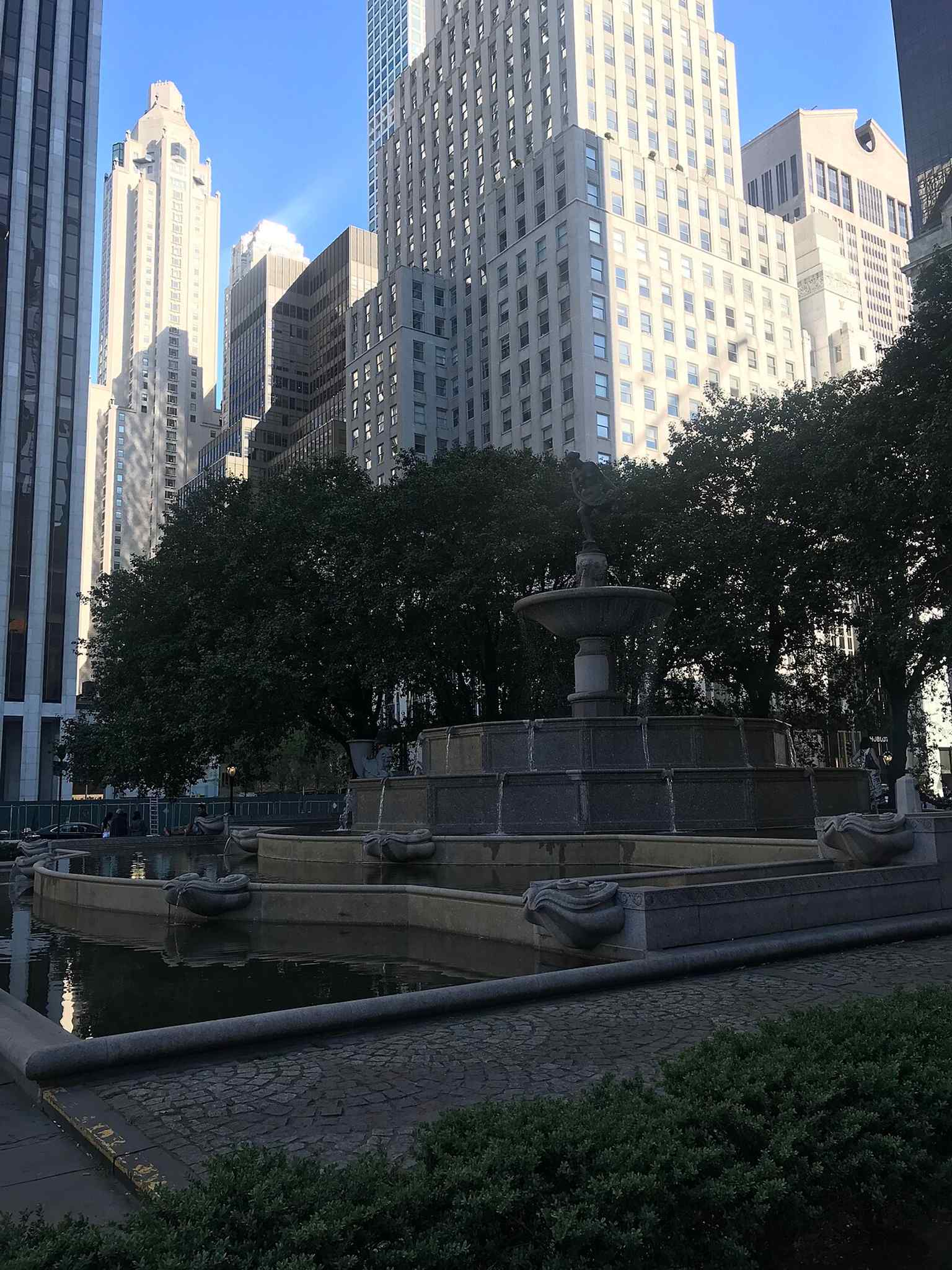
A side view of the Pulitzer Fountain's structure, which was reconstructed in granite during the 1985-1990 restoration to improve its cascading water effect.Photo: CarolPena8, Wikimedia Commons, CC BY-SA 4.0. Cropped & resized. 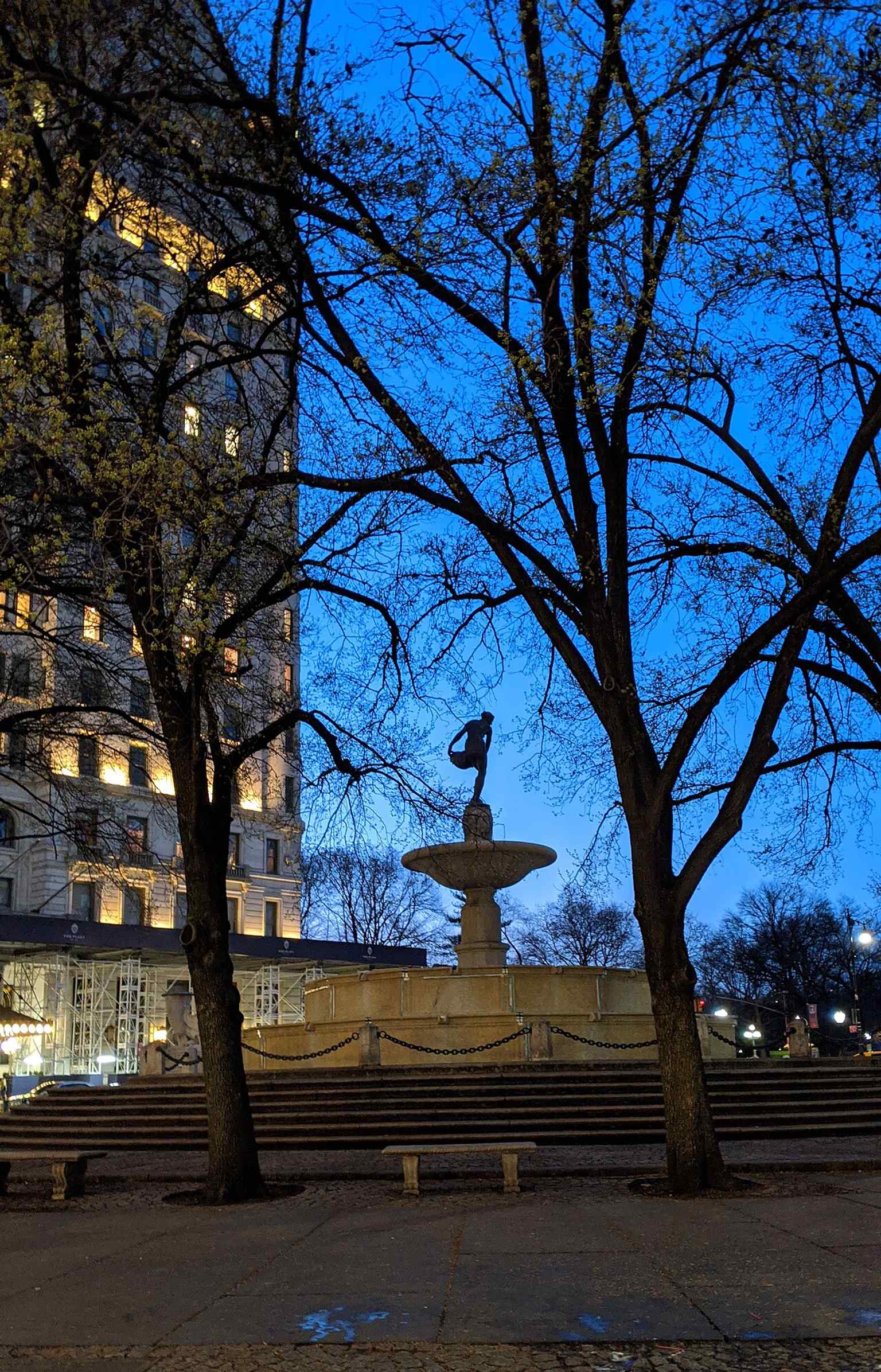
A close-up of the allegorical bronze statue of Pomona, modeled by Doris Doscher and completed by Isidore Konti after the death of sculptor Karl Bitter.Photo: PortableNYCTours, Wikimedia Commons, CC BY-SA 4.0. Cropped & resized. Here we are at Grand Army Plaza, specifically the northern half. Right in front of you is a dazzling, twenty-three point five karat gold monument. That is Union Army General…Read moreShow less
Open dedicated page →Here we are at Grand Army Plaza, specifically the northern half. Right in front of you is a dazzling, twenty-three point five karat gold monument. That is Union Army General William Tecumseh Sherman atop his horse, accompanied by the winged Greek goddess Nike, a striking symbol of victory.
The sculptor, Augustus Saint-Gaudens, unveiled this glittering masterpiece in nineteen oh three. Over the years, the statue has attracted plenty of commentary, including a bit of dark humor. During World War Two, a story went around about a Southern soldier who looked up at the gilded general and his female guide, shook his head, and muttered that he was a typical Yankee, since he rides the horse and makes the woman walk.
But that woman walking ahead of the general holds a fascinating story of her own. If you check your screen, you can see a close-up of her face. Her name was Hettie Anderson, an African-American model from South Carolina. Saint-Gaudens considered her the most striking model he had ever worked with. Tragically, Saint-Gaudens' son Homer later scrubbed Hettie's name and bust from his father's official catalog. Historians point to racial prejudice as the reason for this attempt to erase her from history, though today, her contribution is rightfully celebrated.
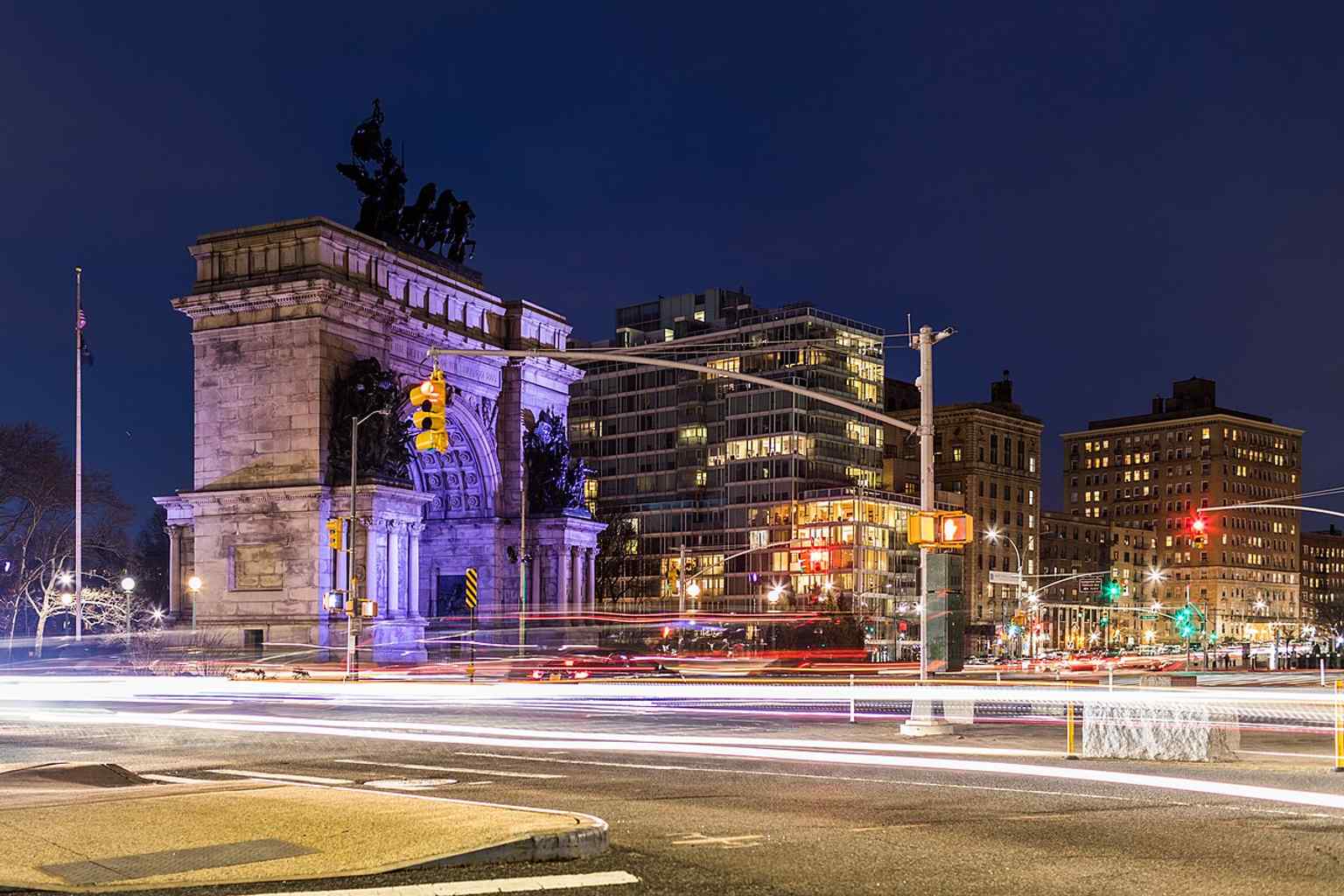
The allegorical figure of Victory leading General Sherman, a key part of the monument, was modeled by Hettie Anderson, an African-American woman whose significant contributions were largely erased from the historical record for decades.Photo: Axel Tschentscher, Wikimedia Commons, Public domain. Cropped & resized. The statue has had quite an eventful life. In nineteen fourteen, crews excavating the new subway lines underneath the plaza had to temporarily relocate the fifteen-ton bronze monument into Central Park. The local press had a field day with the sight. The Brooklyn Standard Union gleefully noted that it was the very first time General Sherman ever retreated. In nineteen ninety, a private foundation paid over one hundred and sixteen thousand dollars, or roughly two hundred and eighty thousand dollars today, just to refresh the statue's gold leaf.
Speaking of Brooklyn, this plaza is locked in a delightfully surreal rivalry with a completely different Grand Army Plaza located over in the borough of Brooklyn. The conflict is known as the Menorah War. Every Hanukkah, workers bring in a cherry picker to light a massive, four-thousand-pound steel menorah right here. A menorah is a multi-branched candelabra used in Jewish rituals. For years, both Manhattan and Brooklyn claimed to host the World's Largest Menorah. Even though the Brooklyn candelabra is technically six inches taller, a rabbinical court officially ruled in twenty sixteen that Manhattan holds the true title because they used the branding first. They legally ordered the Brooklyn organizers to call theirs the Central Menorah of Brooklyn instead.
This plaza really captures the heart of the city, blending high-society glamour with a bit of local drama. Whenever you are ready to keep exploring, we can stroll over to our final destination just across the way.
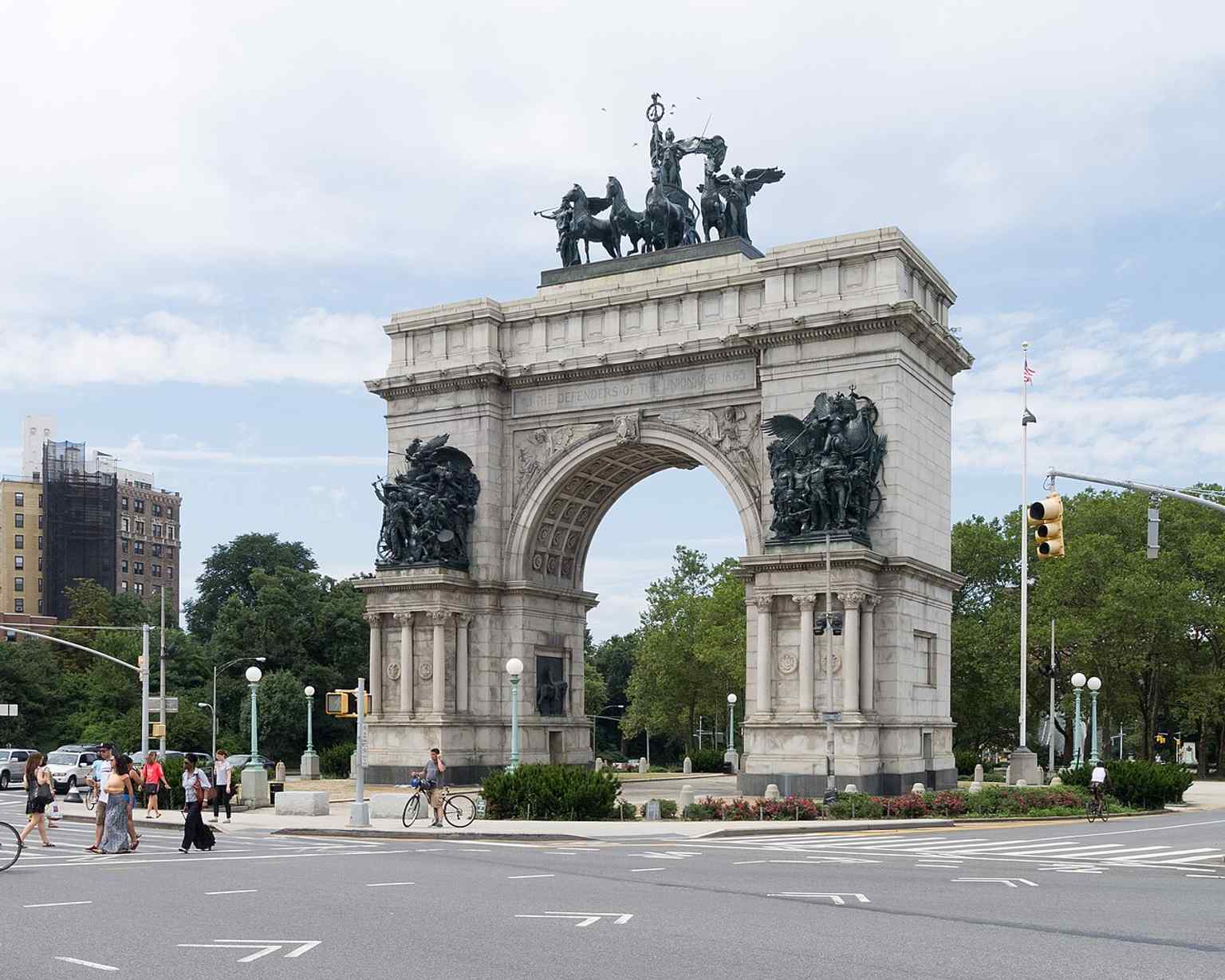
The Pulitzer Fountain undergoing renovation with the statue of Pomona absent, a recurring event in its history due to the original porous limestone basins, which famously deteriorated and were rebuilt multiple times.Photo: Jim.henderson, Wikimedia Commons, CC BY-SA 4.0. Cropped & resized. Well folks, we have reached the grand finale. Standing right here, looking at those elegant white brick walls and that green tiled mansard roof, which is the French-style sloping…Read moreShow less
Open dedicated page →Well folks, we have reached the grand finale. Standing right here, looking at those elegant white brick walls and that green tiled mansard roof, which is the French-style sloping roof up top, you are facing the undisputed king of New York hospitality, The Plaza Hotel.
Take a peek at your app to see how more than a century of development has risen around the timeless French Renaissance-style facade of the Plaza Hotel, transforming the quiet carriage-filled streets of nineteen oh eight into the bustling modern metropolis of today. The Plaza opened its doors in nineteen oh seven with a staggering price tag of twelve and a half million dollars, which is roughly four hundred million dollars today. And from day one, it was a magnet for scandal and spectacle. Just weeks after it opened, the British actress Missus Patrick Campbell caused an absolute uproar by doing the unthinkable. She lit a perfumed Egyptian cigarette in the dining room. When the headwaiter demanded she put it out, because women smoking in public was a severe etiquette breach at the time, she shot back, my good man, I understand this is a free country. I shall do nothing to change it. Management eventually compromised by putting privacy screens around her table.
The Plaza was also home to some incredibly eccentric full-time residents. Take Princess Vilma Lwoff-Parlaghy, a Hungarian painter who moved into a fourteen-room suite in nineteen oh nine. She brought along a massive entourage and a pet lion cub named Goldfleck, who mostly lived in her oversized bathtub.
Over the years, ownership changed hands multiple times. When Donald Trump bought the property in nineteen eighty-eight, his wife Ivana ran it with a famous iron fist, insisting every lemon wedge be cut to precise specifications. But Trump met his match in Fannie Lowenstein, an elderly widow living in a rent-controlled suite for just five hundred dollars a month. Known to the staff as the Eloise from Hell, Fannie constantly called city inspectors complaining that indoor air pollution was shrinking her curtains. Trump finally negotiated peace by giving her a massive suite, new furniture, and a free personal maid for life.
The hotel has also seen its share of history-making protests. Check out your screen for a look at the heavy wood doors of the Oak Room. In nineteen sixty-nine, feminist icon Betty Friedan and other members of the National Organization for Women staged a sit-in there to protest the hotel's men-only lunch policy. Waiters actually physically lifted the table away, leaving the women sitting in an empty circle on the floor until the stock exchange closed at three PM. The terrible publicity forced the hotel to drop the policy four months later.
As we wrap up our tour right here, just steps from where author F. Scott Fitzgerald and his wife Zelda once supposedly took a midnight swim in the Pulitzer Fountain, take a long look at this beautiful chateau. Thank you for walking the streets of Midtown East with me. It has been a true pleasure sharing these spectacular New York stories with you.
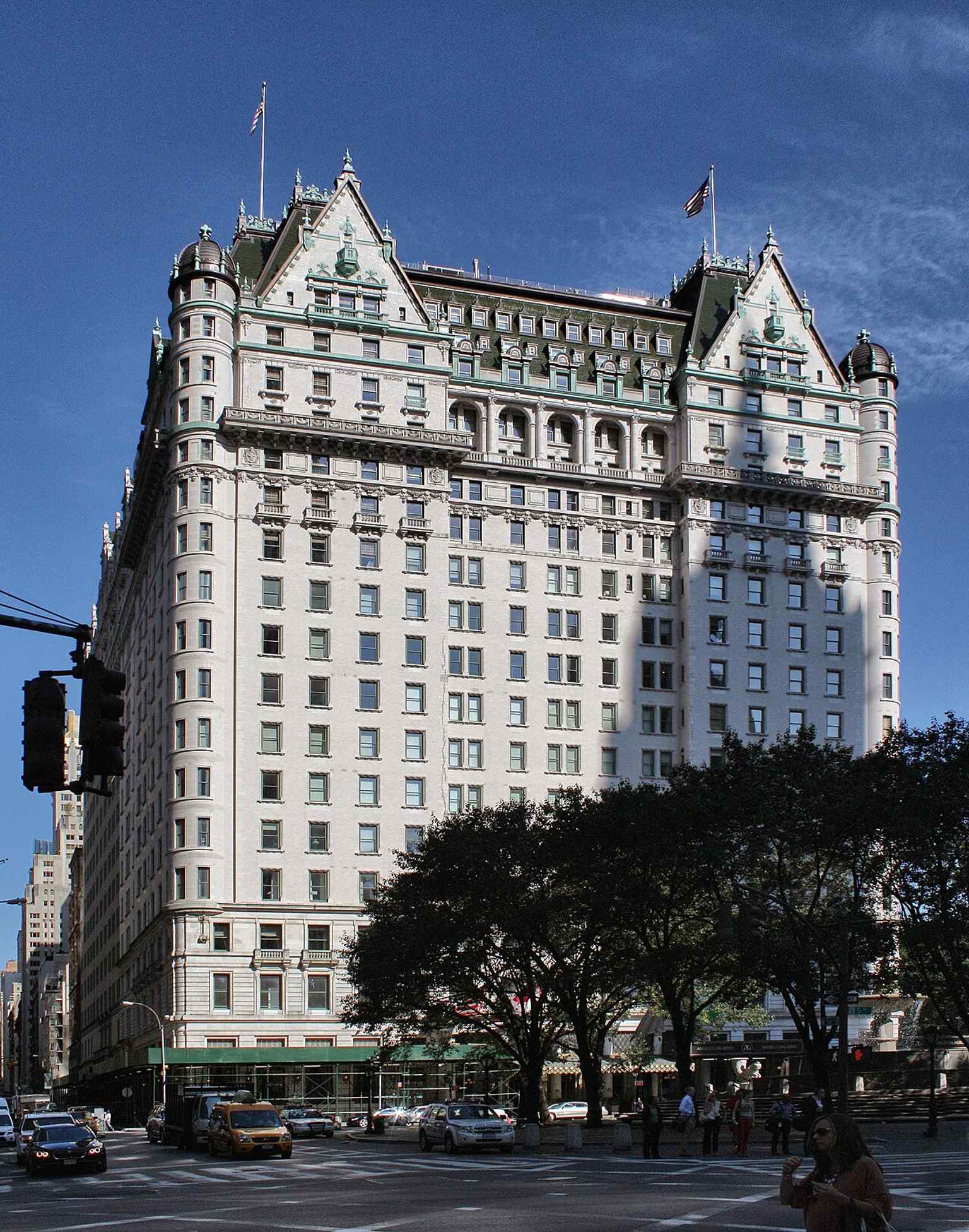
The Plaza Hotel's distinctive mansard roof, clad in green Ludowici tiles with copper trim, is a key feature of its French Renaissance architectural style.Photo: Carmelo Bayarcal, Wikimedia Commons, CC BY-SA 3.0. Cropped & resized. 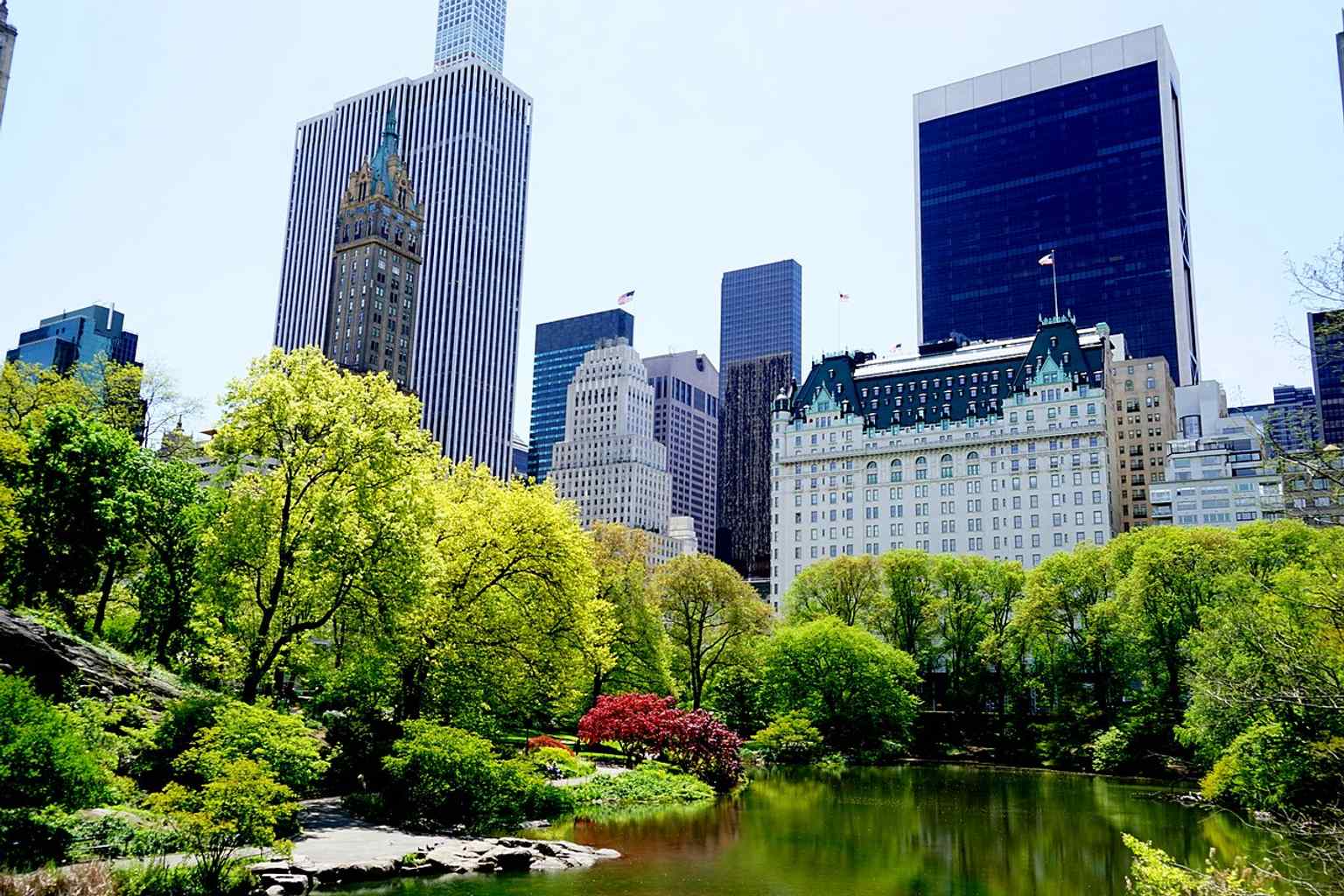
Situated on the western side of Grand Army Plaza, the hotel's prominent location at the southeastern corner of Central Park is a major part of its allure.Photo: Elisa Rolle, Wikimedia Commons, CC BY-SA 3.0. Cropped & resized. 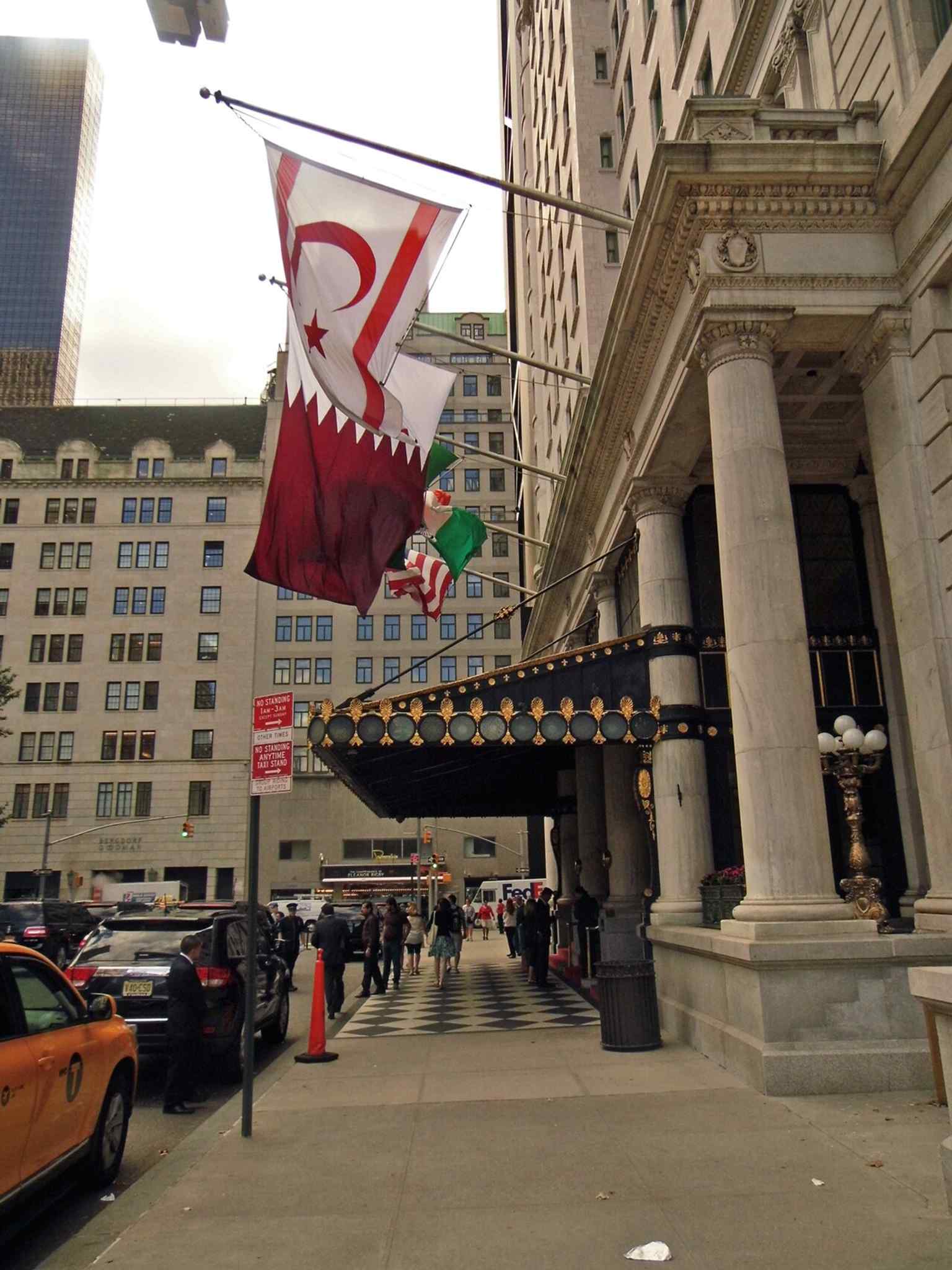
The northeastern and southeastern corners of the hotel feature rounded turrets, painted green to match the trees of Central Park, adding to its château-style charm.Photo: Yarl, Wikimedia Commons, CC BY-SA 3.0. Cropped & resized. 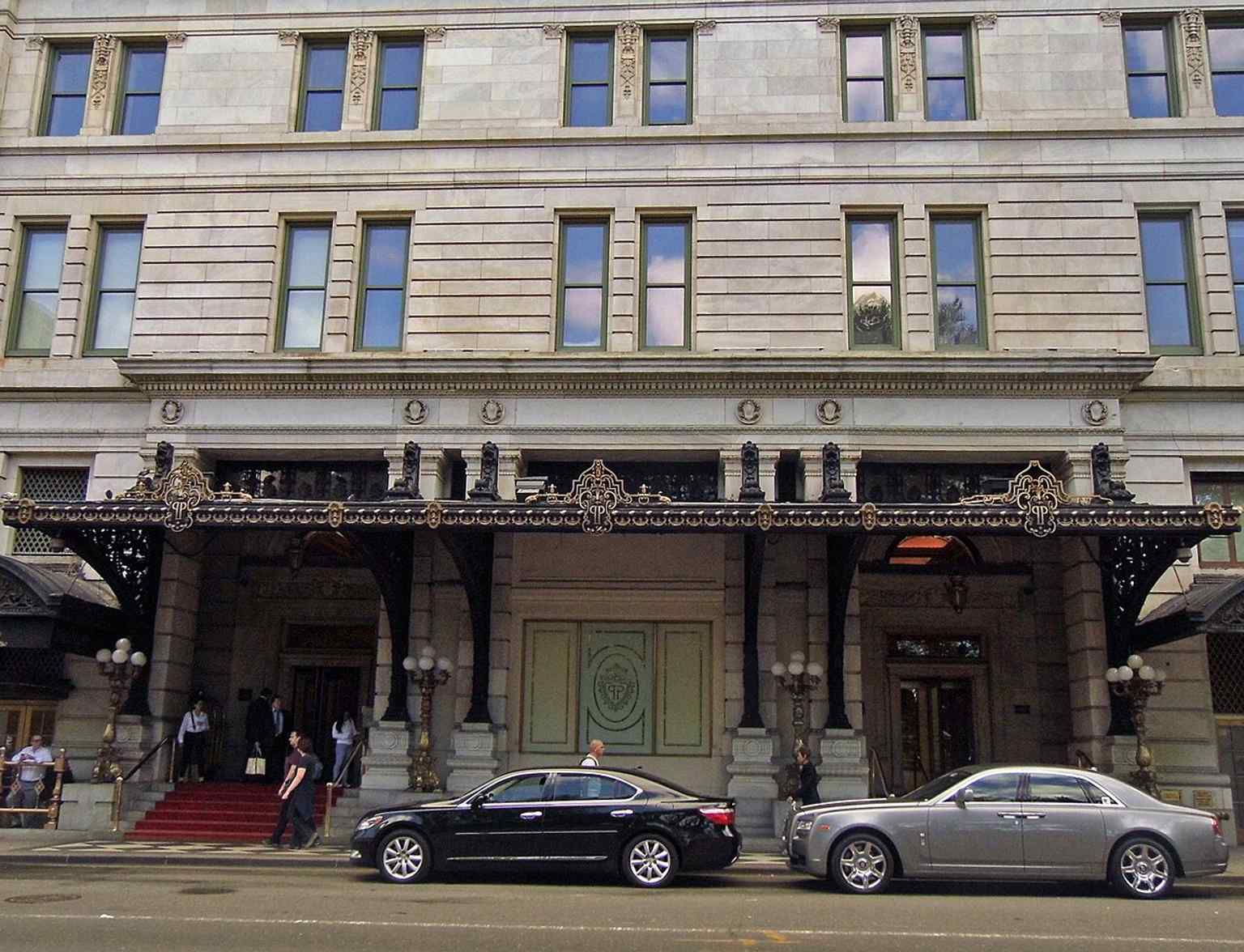
This view from Central Park emphasizes the Plaza Hotel's acclaimed location, facing the Pond and Hallett Nature Sanctuary, which greatly contributed to its appeal for wealthy residents.Photo: Cheburashka007, Wikimedia Commons, CC BY-SA 4.0. Cropped & resized. 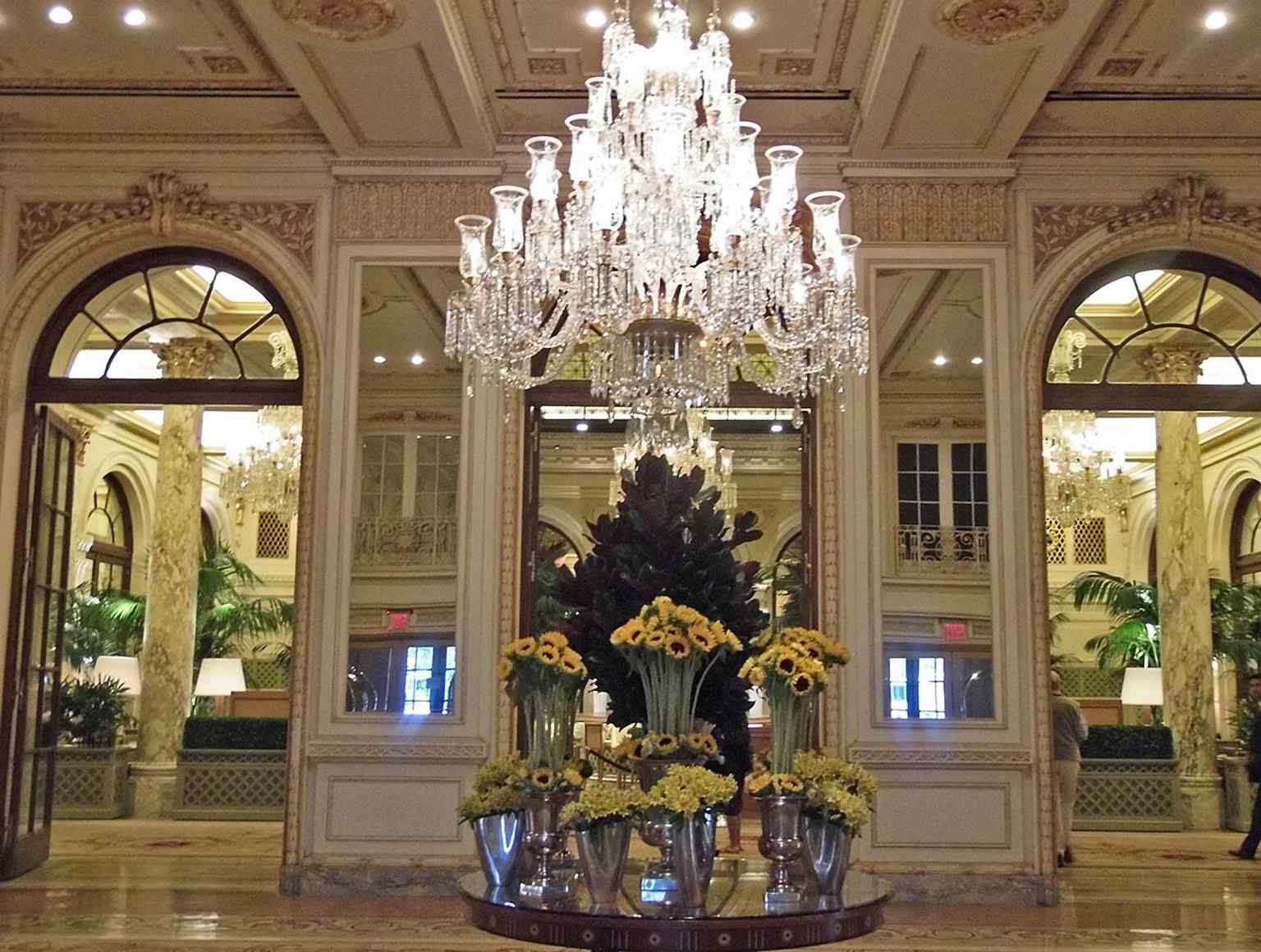
The opulent main entrance foyer, with its French marble walls, gilded-bronze column capitals, and mosaic floor, was envisioned by architect Henry Janeway Hardenbergh as the hotel's most important space.Photo: Zinetv1, Wikimedia Commons, CC BY-SA 3.0. Cropped & resized. 
This detail shows the canopy of the Central Park South entrance, which since the 2008 renovation has served as the entrance to the building's condominiums.Photo: Zinetv1, Wikimedia Commons, CC BY-SA 3.0. Cropped & resized. 
This panoramic view highlights the Plaza Hotel's prominent location at the southeastern corner of Central Park, an acclaimed site that offers unobstructed views.Photo: G. Scott Segler, Wikimedia Commons, CC BY-SA 4.0. Cropped & resized.
Frequently asked questions
How do I start the tour?
After purchase, download the AudaTours app and enter your redemption code. The tour will be ready to start immediately - just tap play and follow the GPS-guided route.
Do I need internet during the tour?
No! Download the tour before you start and enjoy it fully offline. Only the chat feature requires internet. We recommend downloading on WiFi to save mobile data.
Is this a guided group tour?
No - this is a self-guided audio tour. You explore independently at your own pace, with audio narration playing through your phone. No tour guide, no group, no schedule.
How long does the tour take?
Most tours take 60–90 minutes to complete, but you control the pace entirely. Pause, skip stops, or take breaks whenever you want.
What if I can't finish the tour today?
No problem! Tours have lifetime access. Pause and resume whenever you like - tomorrow, next week, or next year. Your progress is saved.
What languages are available?
All tours are available in 50+ languages. Select your preferred language when redeeming your code. Note: language cannot be changed after tour generation.
Where do I access the tour after purchase?
Download the free AudaTours app from the App Store or Google Play. Enter your redemption code (sent via email) and the tour will appear in your library, ready to download and start.
If you don't enjoy the tour, we'll refund your purchase. Contact us at [email protected]
Checkout securely with 






%20-%201.JPG)
%2014%20-%20Pulitzer%20Fountain%2C%20Grand%20Army%20Plaza.jpg)


