
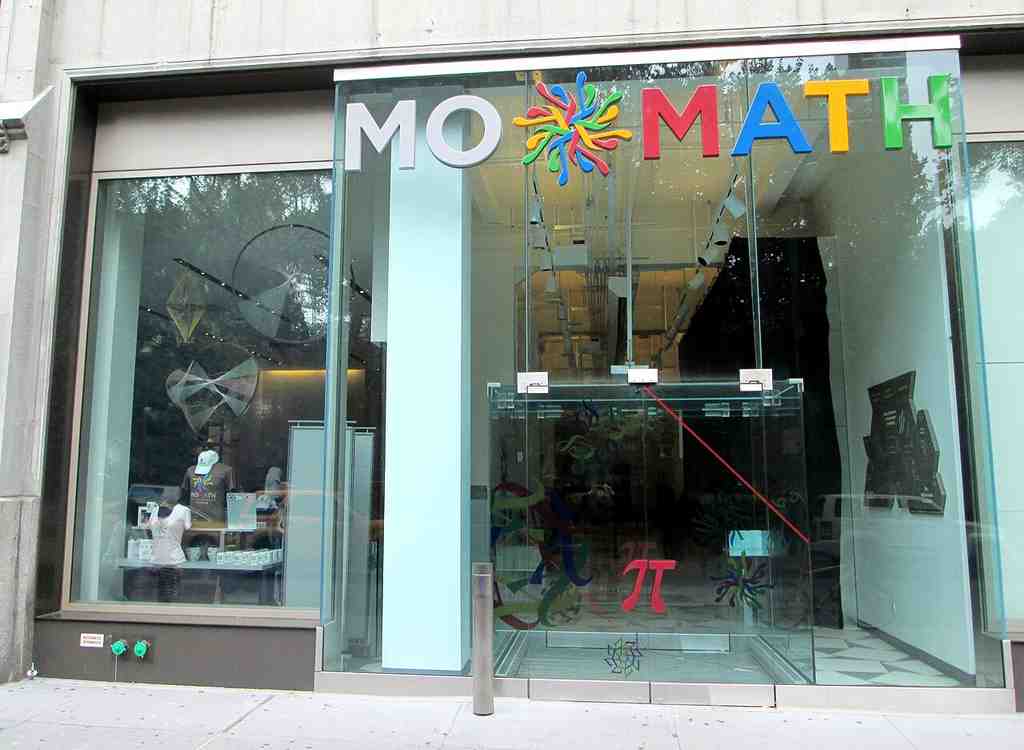
Look for a modern glass entrance set into a broad street-level facade, with tall rectangular panes and the MoMath name marking the doorway.
This is the National Museum of Mathematics, or MoMath, and it treats numbers less like homework and more like choreography. Right here in Chelsea, the museum carries a mission that sounds simple and radical at the same time: to enhance public understanding and perception of mathematics.
The story begins with a real loss. In two thousand and six, the Goudreau Museum on Long Island closed, and the United States lost its only museum devoted entirely to math. Glen Whitney and a group of supporters decided that could not be the end of the story. They secured a charter from the New York State Education Department in two thousand and nine, then raised more than twenty-two million dollars in under four years... which is pretty remarkable for a place built around equations, patterns, and ideas people often claim to fear. Their first home opened on the twelfth of December, two thousand and twelve, on East Twenty-Sixth Street, with more than thirty interactive exhibits. If you want to see that first chapter, take a peek at the image on your screen. At that point, MoMath stood alone as North America’s only museum dedicated to mathematics.
One of the key dreamers behind it was George W. Hart, a co-founder who served as chief of content. He spent five years designing exhibits and workshop activities, and you can feel that hands-on philosophy in everything MoMath does. This place does not ask you to admire math from a distance. It wants you to grab it, test it, and laugh with it.
Its most famous example is a tricycle with square wheels. Seriously. Have a look at that beauty on your phone. It rides smoothly because the track uses a catenary curve, which is the shape a hanging chain naturally makes before you flip it upside down. That single exhibit turns a visual joke into a lesson about geometry, motion, and the weird elegance of the physical world.
MoMath pushed that spirit far beyond its building through Math Midway, a traveling exhibition that debuted at the World Science Festival in two thousand and nine and reached more than half a million visitors across the country. Another program, Math Encounters, brought in speakers to make math feel alive through topics like origami, juggling, and even mathematical ideas in The Simpsons and Futurama. That is such a New York mix: scholarship, pop culture, and performance all in one room.
After the pandemic forced the closure of the old physical site, the museum regrouped, opened temporarily on Fifth Avenue in March of twenty twenty-four, and then announced this larger Chelsea home at six hundred thirty-five Avenue of the Americas that November. This location opened in February of twenty twenty-six. It already has over sixty interactive exhibits, and the museum plans to grow to seventy-two, including thirty-one brand-new ones. There is also an upper gallery for rotating shows inspired by mathematical art, and that same month the museum named Manjul Bhargava, a mathematician honored with one of the field’s highest prizes, as its first president.
If you want to go inside later, the museum is open every day from ten A-M to five P-M. Standing here, you can feel MoMath making a joyful case that math belongs to everyone. Take a moment here, and when you’re ready, we can continue on to the Rubin Museum of Himalayan Art.




