
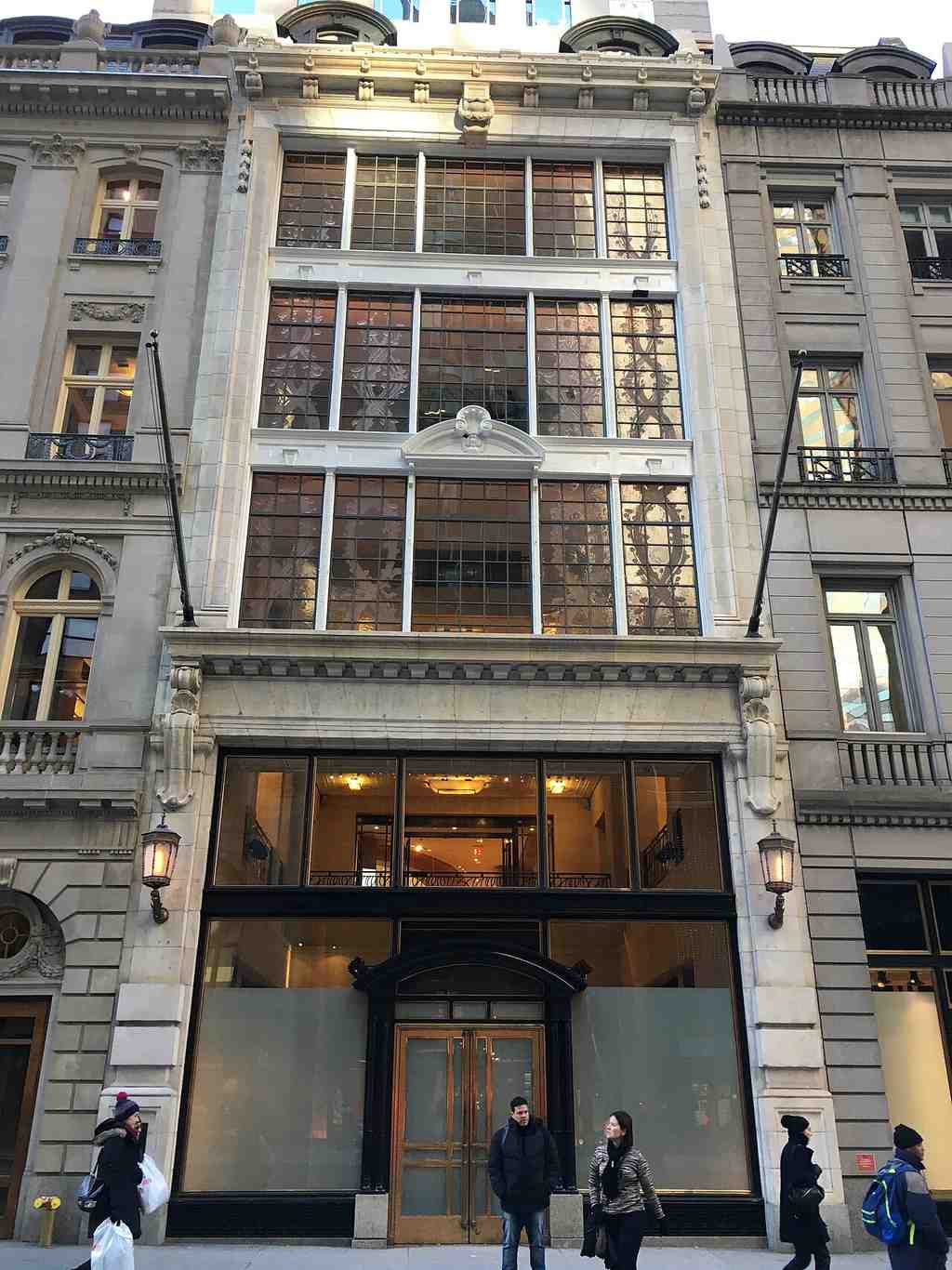
Look for the slim limestone-framed facade with a broad wall of pale glass across the middle floors and a dark mansard roof punctured by small arched dormers.
This little survivor at seven fourteen Fifth Avenue started life in eighteen seventy-one as a brownstone rowhouse. Then Charles A. Gould, a manufacturer from Buffalo who had actually lived here, noticed what was happening on Fifth Avenue: parlors were losing ground to showrooms, and private addresses were turning into public seductions. Call it transparent commercialism. In nineteen oh seven, Gould hired architect Woodruff Leeming to strip away the old brownstone face and replace it with something far more candid... a glass wall that let commerce announce itself right on the avenue.
That was a bold move. Fifth Avenue had long preferred the manners of a drawing room. Gould chose display instead. He kept a French flavor, with limestone framing and a mansard roof, but the center became a vertical advertisement for modern luxury. If you check the wider image in the app, you can see the strange result today: the historic facade survives like a refined mask, while the later tower rises behind it.
In nineteen ten, perfumer François Coty leased the building for his American headquarters, and that changed everything. Coty understood that scent is invisible, so the storefront had to do some of the flirting. He commissioned René Lalique, the great French jeweler and glass artist, to create the windows on the third through fifth floors. There are two hundred seventy-six panes in all, with curling vines and flowers, probably tulips, pressed into the glass. They are the only documented architectural work by Lalique anywhere in the United States. Not bad for a perfume shop front.
Coty had a gift for spectacle. Industry legend says he first broke through in Paris after accidentally smashing a bottle of perfume in a department store; the fragrance spread, shoppers crowded in, and he sold out. Here, he turned that instinct into architecture: a visual fragrance, really, rising above the sidewalk in pale glass. On your screen, the closer exterior image helps those Lalique panels read more clearly, especially the way the floral patterns thicken toward the edges.
The building kept evolving. It hosted a tuberculosis awareness exhibition, then a wartime charity benefit, then shops and offices for women with so-called “smart feet,” portrait photographers for the social set, and bespoke tailors for businessmen who liked their vanity professionally managed. Fifth Avenue had completed its conversion from residential row to commercial theater.
Then came the near-death moment. In the early nineteen eighties, developers wanted to demolish this building for a new skyscraper. Architectural historian Andrew Dolkart noticed the grimy glass, realized it might be Lalique, and tracked down a former Coty executive from France to confirm it. Once landmark status arrived in nineteen eighty-five, the city even stationed police here around the clock because people feared a midnight demolition. New York, ever the picture of calm restraint.
The compromise was classic Manhattan: save the facade, remove the interior, and build the tower behind it. That practice is called facadism, meaning the face remains while the body changes. Imperfect? Sure. But without it, this glass-fronted experiment in luxury selling would be gone.
Next, head about a minute north to Tiffany and Company, where the art of making desire visible reached a whole new level. Practical note: this address generally keeps weekday hours from nine in the morning to four in the afternoon, and it is closed on weekends.




