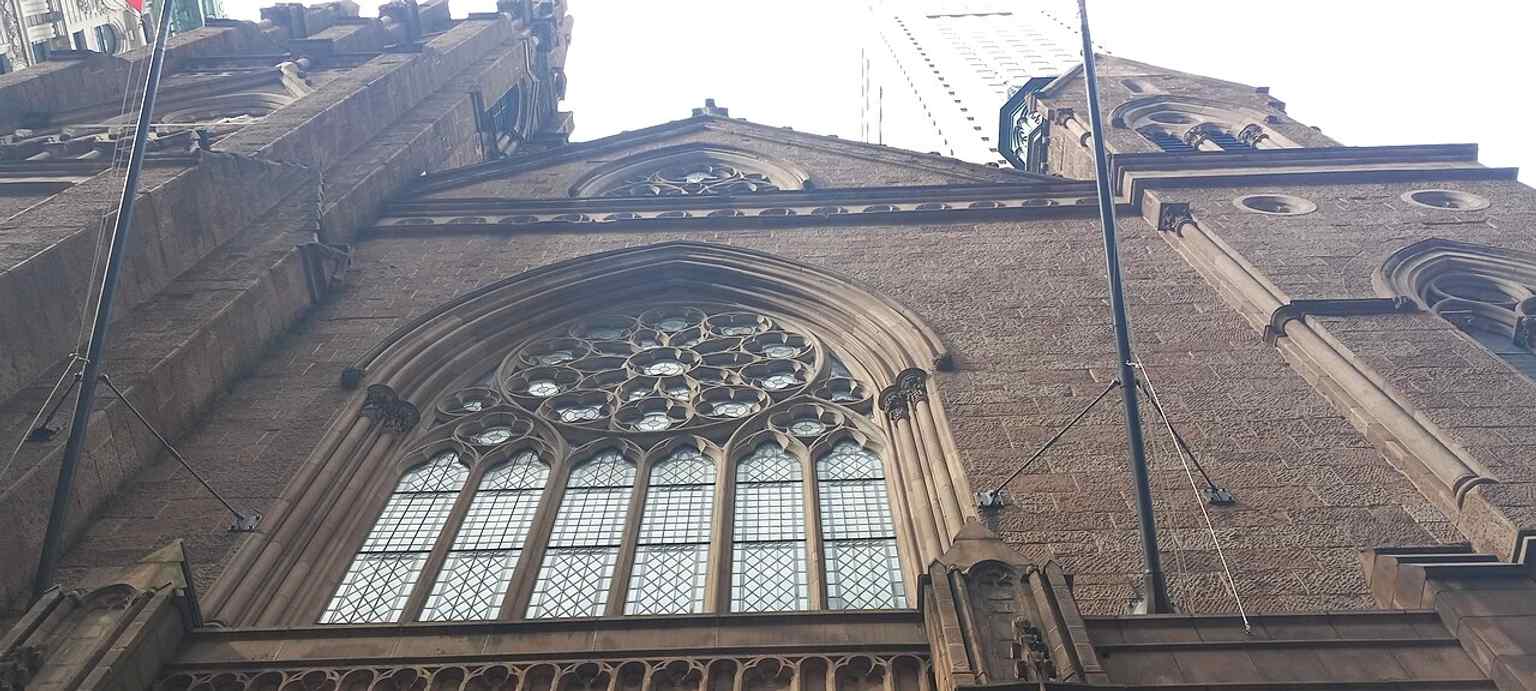
On your left, look for the red sandstone Gothic church with its pointed-arch entrance, tall clock tower, and steep spire rising above the avenue.
This is Fifth Avenue Presbyterian Church, and it has stood on this corner since eighteen seventy-five, after following Manhattan’s wealth northward in stages from Cedar Street to Duane Street to Nineteenth Street, and finally here. The congregation paid three hundred fifty thousand dollars for the site, roughly nine million in today’s money, then spent about one million dollars more to build the church... something like thirty million today. They chose this stretch because they thought Central Park would keep commerce from ever marching farther uptown. New York, as usual, had other ideas.
From the street, you see a stern rectangle of stone. Inside, Carl Pfeiffer designed something much stranger and smarter: a sanctuary tucked within the outer shell, separated by air so city noise stayed outside. The result is an oval, ship-like room with a sloping floor and pews that fan outward, all built to favor the spoken word. If you glance at the interior image on your screen, you can see how the whole room pulls attention toward the pulpit rather than toward ornament.
That priority shaped the church’s public life too. In eighteen eighty-four, this sanctuary held the joint funerals of Theodore Roosevelt’s mother and his first wife, Alice, who died on the same day. In nineteen ten, Theodore Roosevelt Junior married here, with the former president in attendance and about five hundred Rough Riders filling the scene with a distinctly American blend of piety, politics, and spectacle.
But the story that gives this place its sharpest edge came much later, out here on the steps. In late two thousand one, New York police began waking homeless people sleeping here and threatening arrests. The church sued, arguing that sheltering people on its steps was part of its religious mission, protected by the First Amendment and by the Religious Land Use and Institutionalized Persons Act, a federal law meant to shield religious practice from government interference.
If you had been the judge, where would you draw that line... between a city’s duty to control public space and a church’s duty to offer refuge?
In two thousand two, the court split the difference. The city could keep the public sidewalks clear, but it could not interfere with people sleeping on the elevated church steps and landings, because those counted as the church’s own space for ministry. In other words, sanctuary here was not just a sermon topic. It became a federal case.
That tension fits the building. Fifth Avenue prestige on one hand, radical hospitality on the other. The same church that hosted Roosevelts also defended the right of homeless New Yorkers to rest at its door. That is a serious claim in this neighborhood, where the instinct to exclude usually dresses better.
And look up at the tower: the clock still runs on its original eighteen seventy-five mechanism and staff still wind it by hand each week. No bells, though. The builders skipped them so patients across the street at St. Luke’s Hospital would not be disturbed. Even this lofty tower learned restraint.
If you want a quick sense of how wildly the surroundings changed, tap the before-and-after image in the app. The church went from mansion district to Midtown canyon and simply stayed put.
If you want to return, it is generally open from nine to six on weekdays, a bit later on Wednesday, and for shorter hours on weekends. As you head on, let your eyes shift from this red sandstone mass to the polished commercial facades beside it... the Coty Building is right next door.