
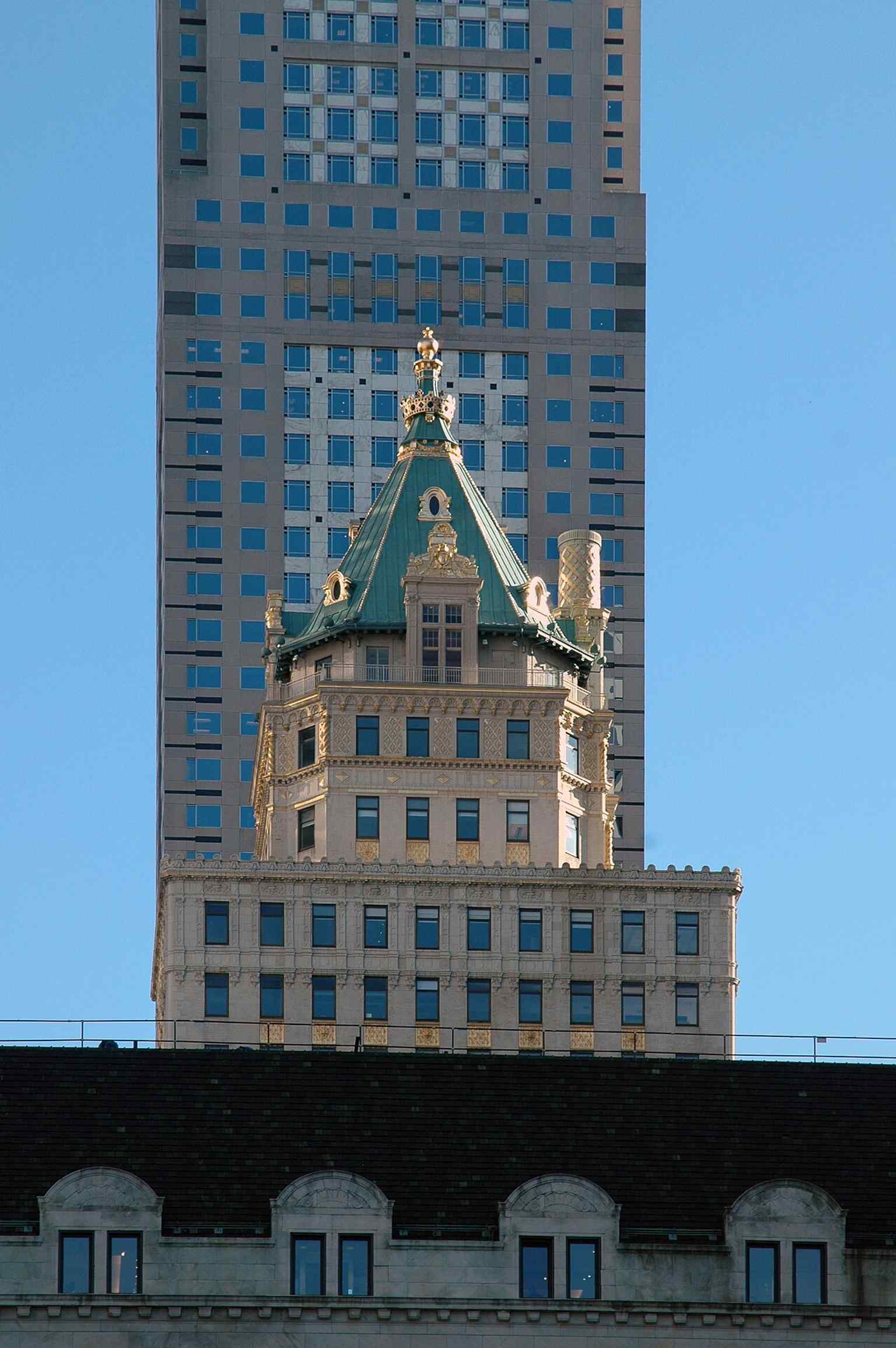
On your left stands a pale limestone tower that rises in stacked setbacks to a green octagonal roof, with gilded panels and a crown-like top that make it easy to pick out.
This building is one of New York’s best lessons in how a dry city law can accidentally produce poetry. In nineteen sixteen, the city passed the Zoning Resolution, a rule meant to protect light and air on the street. In plain English: if a building got too tall, it had to step back as it rose, instead of climbing straight up like a cliff. Charles Wetmore, the architect here, turned that rule into what I’d call zoning gymnastics. Because Fifth Avenue, Fifty-seventh Street, and Fifty-sixth Street all had different widths, he had to give the Crown Building four different faces, each stepping back at different points. So the tower never reads as one simple block... it shifts as you look at it.
August Heckscher, a mining magnate and philanthropist, pushed this project forward between nineteen twenty and nineteen twenty-two, right as this stretch of Fifth Avenue was changing from mansion country into a polished machine for luxury commerce. Heckscher called it the ultimate place for exclusive shopping. Subtle man. Others called it a “tower of trade” and even a “cathedral of commerce,” which tells you just how openly New York had started worshiping money in stone.
Look at how the building announces that ambition. The first nine stories wear Indiana limestone like formal dress. Above that, the shaft shifts to buff brick and cream terracotta. Then the whole thing climbs into that remarkable pyramidal roof. The details are French Renaissance in spirit, with carved ornament, salamander motifs, and gilded spandrels between the windows. In the nineteen eighties, later owners added one thousand three hundred sixty-three ounces of twenty-three karat gold leaf to the facade, partly to compete with Trump Tower across the street. Fifth Avenue occasionally settles arguments the way peacocks do.
If you want a closer look at the roofline, check the image on your screen. The crown really does earn the building’s later name.
There’s another delicious irony here. Before the Museum of Modern Art moved into its own home, it opened on the twelfth floor of this building in nineteen twenty-nine. One of its most influential exhibitions introduced the “International Style” - clean, stripped-down modern architecture. So inside this ornate, setback-heavy Beaux-Arts tower, curators helped popularize the very aesthetic that would soon make buildings like this seem old-fashioned. That’s New York for you: one era quietly financing the next.
Today, the lower floors still trade in luxury, while the upper stories have turned into the Aman hotel and residences - commerce below, seclusion above. Transparent selling evolved into carefully guarded privilege.
Before you leave, tilt your gaze upward and around this intersection. You can see the city’s skyline argument in one glance: layered, gilded, expressive towers giving way to cooler, more severe heights. In a few minutes, we’ll head to perhaps the purest version of that later idea... Four hundred thirty-two Park Avenue.





