
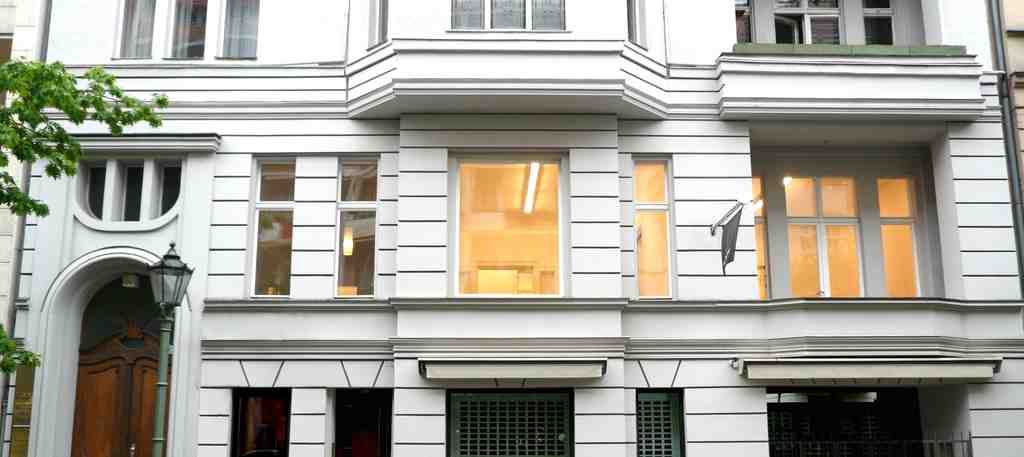
Look for the stark white facade featuring deep horizontal grooves, large rectangular upper windows, and a prominent arched entryway with heavy wooden doors. You are standing outside Galerie Buchholz, one of the most respected contemporary art galleries in the world. But to understand the weight of this space, we have to rewind to nineteen eighty-six and a sixteen-year-old kid in Cologne, Germany. Daniel Buchholz did not start with a trust fund or a shiny Manhattan lease. He started by sweeping floors and organizing shelves as an apprentice in a renowned bookstore.
That early exposure to paper and print shaped everything that followed. Today, this gallery occupies what used to be a private doctor's office, transforming a space of quiet East Side privilege into a stage for the global avant-garde. It is a perfect example of how the elite corners of this city constantly morph, shedding old skins to build completely new cultural dynasties. When they opened this New York branch in two thousand and fifteen, they completely ignored standard commercial art trends. Instead, their inaugural show was a meticulously researched tribute to the French writer Raymond Roussel, featuring, among other things, a single cookie the author had saved from a nineteen twelve lunch, enshrined like a holy relic.
Now, here is a detail most visitors completely miss when they admire the gallery's pristine international presence. The entire Buchholz empire is rooted in a literal back room. When Daniel Buchholz needed a primary exhibition space in nineteen ninety-three, he took over the storage closet behind his father's antiquarian bookstore. We are talking about a room of maybe nine square meters. In fact, Buchholz jokes that the original space is so tiny it is exactly where the gallery's computer servers sit today.
That cramped, intimate setting forced a completely different way of showing art, far away from massive, impersonal white rooms. In nineteen ninety-three, a young artist named Wolfgang Tillmans showed up from London carrying his photos in a suitcase. He bypassed traditional frames entirely, simply taping and pinning his raw prints directly to the walls of that tiny storage room. That do-it-yourself defiance challenged the established artistic hierarchy and helped launch Tillmans to global fame.
The gallery also has a history of embracing genuine architectural danger. In nineteen ninety, Buchholz hosted an installation by Chris Burden called Samson. Burden connected a hundred-ton mechanical jack to a turnstile at the gallery entrance. Every single time a visitor walked through, the jack expanded by a fraction of a millimeter, applying immense pressure to the primary load-bearing walls of the building. It moved like a glacier. Slow, silent, and with the very real threat that if a few too many art lovers showed up, the entire building would collapse into a pile of rubble. It was a massive gamble, but the building ultimately held together.
If you want to step inside, they are open Tuesday through Saturday from ten AM to six PM, but closed Sunday and Monday.
Let us keep moving toward the final monumental mansions of our route, heading next to the Benjamin N. Duke House, which is just a two-minute walk away.




