
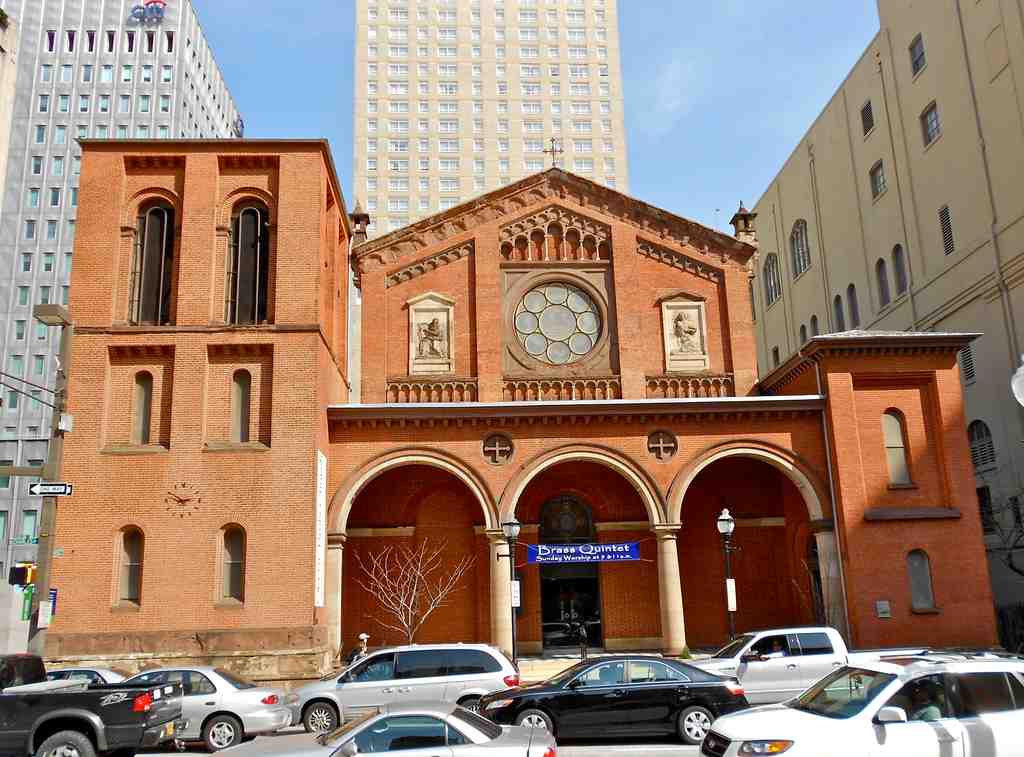
To spot St. Paul’s Episcopal Church, just look ahead for a striking brick building with big rounded arches, a rose window, and two sculpted figures above the entrance-nestled right between taller city towers on North Charles Street.
Alright, you’ve made it to Old St. Paul’s Church! Imagine you’re standing where Baltimore’s history pulses beneath your feet, right on the edge of Cathedral Hill and the humming downtown. If these walls could talk, they’d have plenty of stories-and maybe even a few jokes about how they’ve outlasted most of Baltimore’s fads and fashions.
Let’s rewind all the way to 1692, when this story began, back when Maryland was still just a British colony and the area around here was more wilderness than city. This site became the parish church for the original “Patapsco Parish,” one of Maryland’s first Anglican outposts. The first building wasn’t even here-it started way out where the Patapsco River meets the Chesapeake Bay, in what’s now Highlandtown and Dundalk. Can you picture old colonial folks trekking across rough land, church bells ringing to call in scattered settlers?
As Baltimore Town took shape in the 1730s, St. Paul’s made its move-right up to the highest legal lot on the north side of the new town. Back then, this spot overlooked the Jones Falls stream, with a brick church facing south so the congregation could soak up both sunlight and city energy. Over time, generations of residents built, rebuilt, and reshaped this landmark-with each version grander (and, luckily, less prone to catching on fire).
Speaking of fire, here’s a twist fit for a mystery novel! By the early 1800s, Baltimore was booming and so was St. Paul’s, but disaster struck in 1854-an inferno devoured the grand neoclassical building designed by Robert Cary Long Jr., 1,600 seats, Greek columns, and all. The church's cross tumbled from the burning tower, but like a phoenix, St. Paul’s rose again-this time with a bold, Italian-inspired design by Richard Upjohn. If you look closely, see those two stone bas-reliefs of Christ and Moses flanking the big round window? They were rescued from the previous church and placed here as a reminder that you can knock St. Paul’s down, but you can’t keep it down.
St. Paul’s became an architectural patchwork: 12th-century Italian flair outside, Romanesque touches inside, and bits of history tugged from every era. The stained glass of the risen Christ, the baptismal font by Maximilian Godefroy, and the Bishop’s chair? All relics connecting you to two centuries’ worth of Baltimore’s most powerful and colorful characters. This church has watched Revolutionaries, War of 1812 heroes, civic leaders, and yes-even a mayor named William Donald Schaefer-pass through its doors.
Let your imagination wander: think of the somber toll of gravestones once circling the church, later moved to make room for city growth, where today, you’ll find echoes of soldiers and statesmen. Don’t miss the Tiffany glass over the altar and windows by New York’s famous studios-a rainbow of light that changed as the church moved from somber Victorian orange to sunlit white, to its current brilliant blend.
For nearly 150 years, the church’s professional choirs-first boys, then girls, then a mixed ensemble-filled the nave with soaring music, mixing tradition and innovation like every other part of Old St. Paul’s.
In the end, you’re standing at the heart of a story stretching from colonial days to the hustle of modern Baltimore, with every brick and column holding secrets of the past. Listed on the National Register of Historic Places, and part of the Cathedral Hill Historic District, St. Paul’s isn’t just a church-it’s a survivor, a time capsule, and the spiritual godparent to nearly every Episcopal congregation around here. If you’re quiet for a moment, you might just feel the centuries swirl around you… or maybe it’s just the city traffic. Either way, take it all in, and get ready-Baltimore’s story is only just unfolding!




