
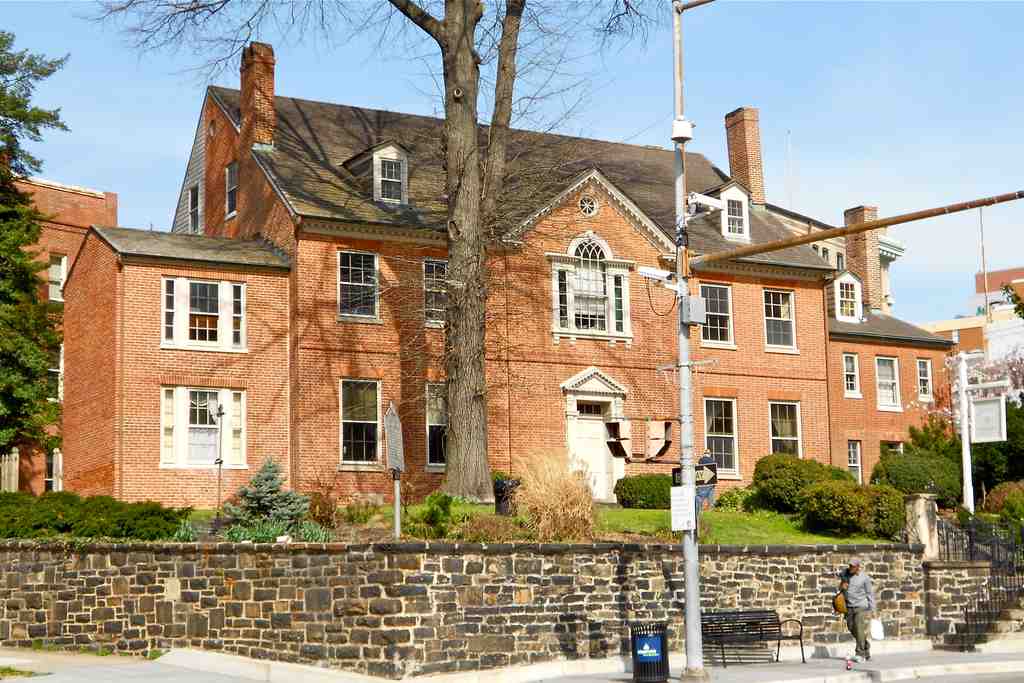
Look ahead for a stately, three-story brick house set atop a little rise, framed by a tall stone wall and crowned by a decorative window in its pointed roof-it's the proud, historic St. Paul's Church Rectory, right at the corner of Cathedral and Saratoga Streets!
Picture yourself here in the late 1700s, standing on this wild, steep patch of “Cathedral Hill,” with nothing but open land behind you and just a handful of churchgoers making their way up the lane. This grand old house, built between 1789 and 1791, was one of Baltimore’s very first brick mansions, paid for in part by a town lottery-can you imagine eager citizens hoping for a jackpot, never realizing their ticket might help raise a parsonage instead of a fortune? Established on land donated by Colonel John Eager Howard, a Revolutionary War hero and local legend, the rectory sits on top of ground that witnessed everything from colonial farm fields to the grand march of Baltimore’s social heights.
As you study the Classical lines and the bull’s-eye window above the front door, realize this house was once called “the Parsonage on the Hill," a fitting title for its stately, almost presidential air. It was meant for the Rev. Dr. William West-friend of George Washington, no less! Sadly, West died just before its completion, so he never slept under this roof. Instead, his grateful parishioners, with help from Howard and other Baltimore notables, saw to it that the house would serve generations of clergy. And let’s not forget the lottery that funded the build-at $2 a ticket, you didn’t just buy hope, you bought bricks!
Through the centuries, this home became the nerve center of Old St. Paul’s, a bustling place where church leaders plotted parish dramas and parishioners gathered for solace and company. Think of the tall trees once shading picnics, or the laughter echoing down Saratoga Street. In the 1830s, a two-story extension popped up to the west, making room for a growing city and an even busier parish. Over time, the Rectory’s Georgian and Federalist details witnessed everything from quiet family breakfasts to church meetings buzzing with city gossip-just imagine those candlelit halls during a blizzard or a sweltering Baltimore summer, clergy robes hung by the fire to dry.
But times change! By the 1990s, after more than a century as the clergy’s domain, the house was rented to outside groups, its halls echoing with the new voices of preservationists. Then, after being leased out for thirty years, the church reclaimed the building and, in a spirit of revival, launched a big renovation in 2019 under Reverend Mary Luck Stanley. Picture architects mulling over blueprints and construction crews bringing 18th-century splendor back to life. When the work was finally done, they held a “House Blessing”-a moment of cheers and hope as clergy, planners, and parishioners crossed the threshold once again, now with a fresh purpose as the Urban Retreat House and parish offices.
This old mansion has also watched the neighborhood transform: it looked on as the houses of local tycoons rose nearby, as grand old hotels like the Rennert came and went, and as concrete parking garages tried their best (but not quite) to outshine the area’s vintage flair. Even Edgar Allan Poe’s literary career traces its roots to a nearby parlor-perhaps he even glanced up at this elegant roof while strolling Baltimore’s streets.
Designated a vital piece of the Cathedral Hill Historic District, St. Paul’s Church Rectory proudly stands among the city’s oldest homes, a testament to stewardship, history, and just a little bit of Baltimore’s good-hearted stubbornness. Every brick tells a story-sometimes solemn, sometimes surprising, and always ready to welcome in a new era.




