
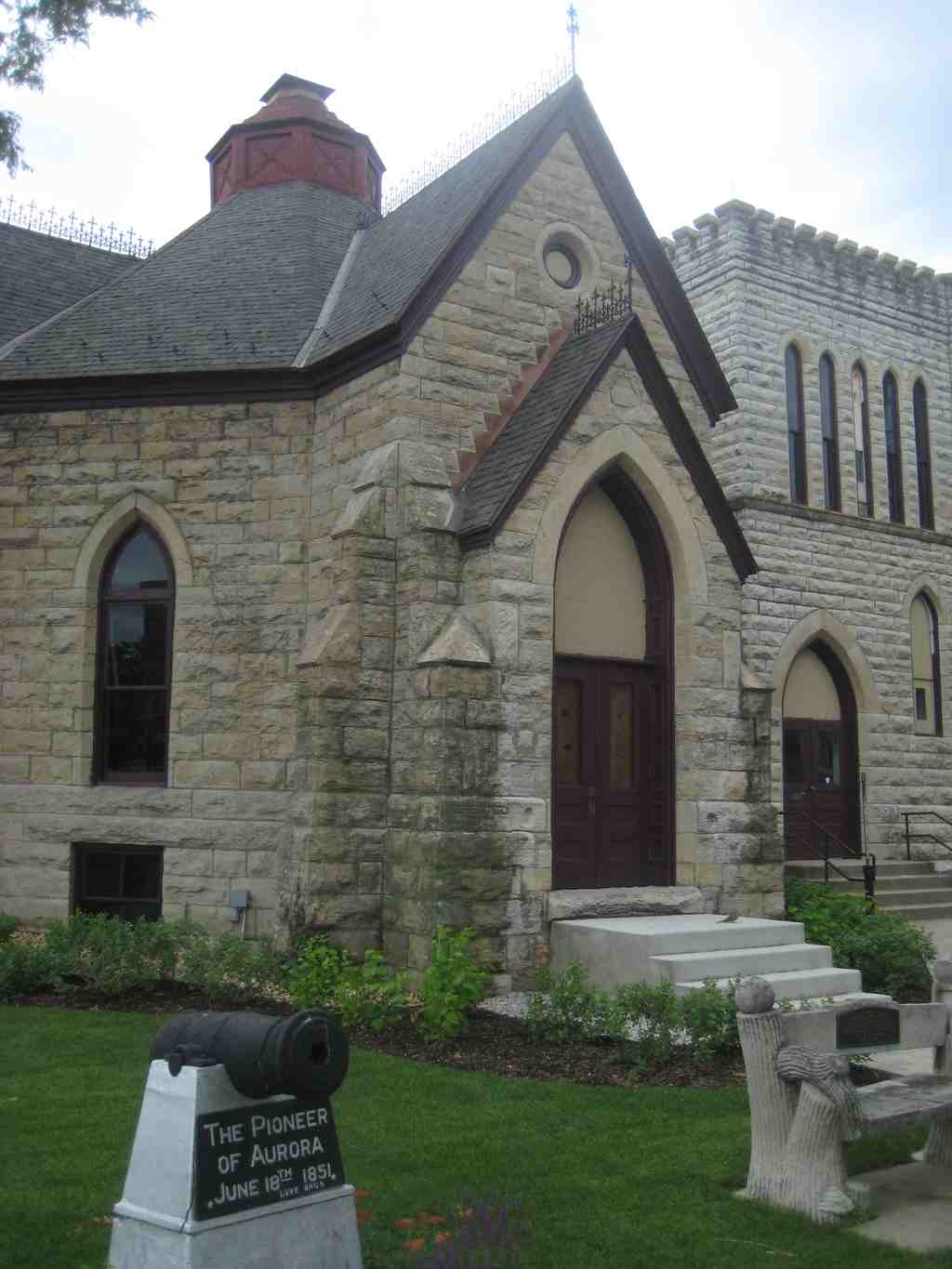
On your right is a compact octagonal hall of pale limestone, capped by a steep roof and marked by an old cannon out front beside the small entry lot.
This place looks modest... but Aurora loaded it with some of its biggest civic hopes. The Grand Army of the Republic Hall opened on the fourth of July, eighteen seventy-eight, and that date was no accident. Local residents raised the money, Joseph Stolp donated the land, and together they created a building that honored Union veterans while serving the whole city.
That choice of site mattered. Stolp Island sat between Aurora’s east and west sides, and people treated it as neutral ground when those two halves of town got touchy with each other. So planting a memorial here meant more than convenience; it said public memory belonged in a shared center, not on one side’s turf. Along this Fox River corridor, geography kept shaping identity, and this hall turned that awkward middle ground into common ground.
The story started in eighteen sixty-nine, when the Soldier’s Monument Association began raising funds for a Civil War monument. Then Fred O. White, the group’s secretary, came back from Foxborough, Massachusetts, with a sharper idea. He had seen Memorial Hall there and thought Aurora needed not just a tribute, but a useful building... a place for meetings, books, and civic life. Architect Joseph Mulvey designed it in a Gothic Revival style, which means pointed, medieval-inspired forms meant to feel solemn and uplifting. Builders kept the basic Foxborough model, though they skipped the granite roof and stained glass.
Here’s the part most people walking by never guess: this veterans’ hall also became Aurora’s first public library, holding more than five thousand five hundred volumes. That is a serious shelf count for a building many folks assume did only one job. Until the Carnegie library opened across the street in nineteen oh-three, this was Aurora’s only public library.
Aurora’s Grand Army of the Republic Post Number Twenty met here for decades. Its last surviving member, Daniel Augustus Wedge, died in nineteen forty-seven on his one hundred and sixth birthday, and with him, Aurora’s living link to the Civil War finally slipped away. Then even the building nearly vanished. In the early nineteen sixties, city leaders wanted parking. Public protest, and especially pressure from Korean War veterans, kept the wrecking ball away. That saved not just stone and wood, but the idea behind them.
Restoration came in fits and starts, then surged after twenty eleven. Crews stabilized the structure, repaired the masonry, restored floors, stairs, and woodwork, and added modern utilities so it could reopen in twenty sixteen as a museum again.
If you want to come back inside, the museum is generally open Wednesday through Friday from noon to four, and Saturday from ten to three. When you’re ready, head toward the Stolp Woolen Mill Store... just about a minute away, where Aurora’s working life put on its public face.




