
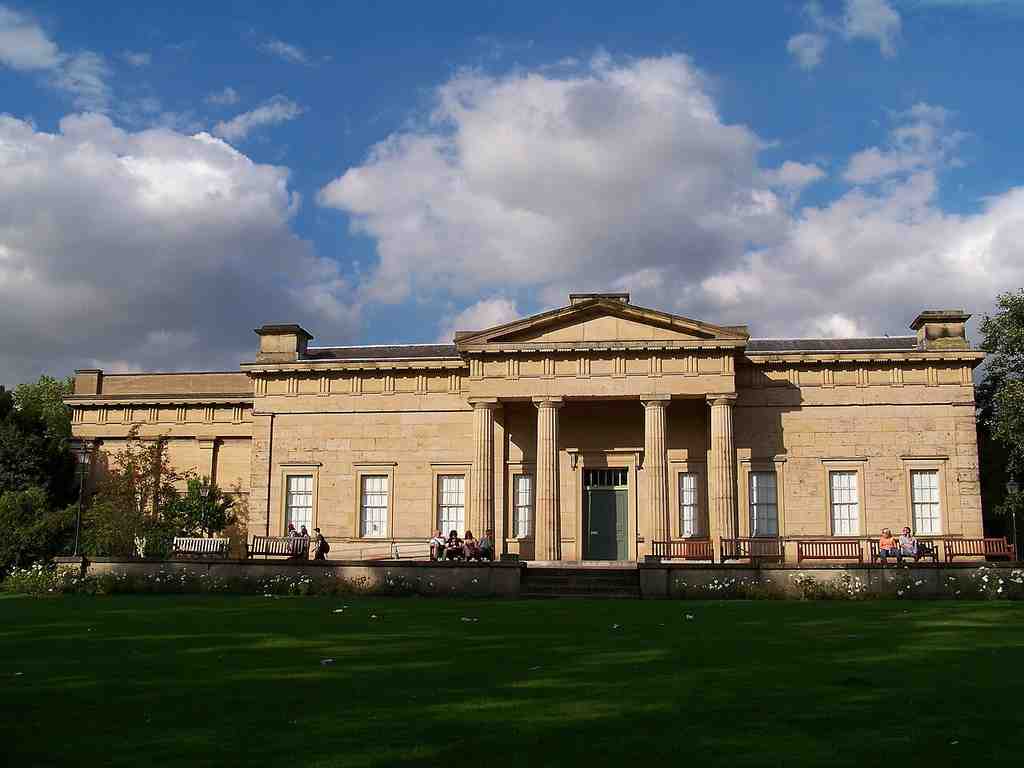
On your left is a pale stone, temple-like building with a long symmetrical front, a triangular pediment, and a row of classical columns announcing Victorian confidence with zero shyness.
This museum is one of York’s boldest acts of reinvention. In the late eighteen twenties, the Yorkshire Philosophical Society outgrew its rooms in Ousegate and secured a royal grant of ten acres here, land that had belonged to St Mary’s Abbey. So a place once shaped by monks and prayer became a home for fossils, coins, Roman sculpture, and scientific debate. York does love a new use for old ground.
William Wilkins designed the building in the Greek Revival style, which means he gave it the look of an ancient classical temple: strict symmetry, columns, and that stern triangular top called a pediment. It opened in February eighteen thirty, making it one of the oldest museums in England. The surrounding land had to remain botanical gardens under the terms of the grant, which is why the Museum Gardens are not just pretty grounds but part of the original plan. If you want, take a glance at the before-and-after image in the app; the building stays wonderfully self-possessed even as the visitors and gardens around it change with the decades.
And here is the part most tourists miss: the museum does not merely sit near the abbey ruins... it sits directly over them. Some of St Mary’s Abbey survives in the basement, which makes this whole place feel like an argument in stone. First a powerful religious house, born from that turbulent monastic world we touched on earlier, then a nineteenth-century institution for science and archaeology, confidently planted on the same footprint.
The human face of that confidence was John Phillips, the museum’s first keeper. He was not just a caretaker with keys; he was a serious geologist, nephew of William Smith, the man behind the first full geological map of a country. Phillips helped turn the museum into a place for real research, not just dusty curiosities. In eighteen thirty-one, the museum even hosted the inaugural meeting of the British Association for the Advancement of Science, which is a grand way of saying some of the sharpest minds in Britain came here to compare notes and probably disagree politely.
But scholarship here has never been entirely tidy. Phillips’s escaped-bear encounter still lingers in the museum’s lore, a reminder that York rarely keeps learning and mischief in separate rooms.
Inside, the collections range from Roman York to Viking treasure, from dinosaur fossils to the oldest Mesolithic art in Britain. If you glance at the image of the carved abbey boss on your screen, you’ll see one small reminder that the medieval house below never quite disappeared.
The place has taken its knocks too. In nineteen forty-two, a bomb narrowly missed the museum, smashing roof and windows; curator Reginald Wagstaffe helped clear away so much broken glass and damaged specimens that seven large bath-tubs were filled with debris. Even then, the building carried on.
That feels right for York. Knowledge here is serious, ambitious, even a little grand... but never fully free of surprise, accident, or personality. When you’re ready, continue to York Theatre Royal, about four minutes away, where another York institution proves that performance is just another way this city keeps old spaces alive. The museum is generally open from ten in the morning to five in the afternoon, Tuesday through Sunday, and closed on Mondays.




