
York Audio Tour: Bishophill Echoes—Minsters, Markets & Mysteries
Stone towers in York have watched fires, feasts, and fury for nearly a thousand years, and Bishophill still keeps the city’s sharpest secrets close. This is a self guided audio tour through York, from the soaring height of York Minster to the tight lanes by York Castle and the medieval parish churches. Hear the stories pinned to doors, stained glass, and river fog, and spot the details most visitors hurry past. When rebellion flared, who paid the price inside York Castle, and how close did the city come to breaking? What mystery lingers in the shadowed corners of York Minster after the last candle is out? Why does one parish church hide a scar, a symbol, or a name that feels too oddly specific to be accidental? Walk, listen, and let scandals, political fights, forgotten moments, and quiet miracles rise up at every turn. Press play and let those stone towers speak.
Tour preview
About this tour
- scheduleDuration 90–110 minsGo at your own pace
- straighten2.6 km walking routeFollow the guided path
- location_onLocationYork, United Kingdom
- wifi_offWorks offlineDownload once, use anywhere
- all_inclusiveLifetime accessReplay anytime, forever
- location_onStarts at Museum Street
Stops on this tour
lock_open 3 free previews · 17 unlock with purchase
Just a short walk from Museum Street, we arrive at this beautiful Grade One listed townhouse. In the United Kingdom, Grade One means a building is of exceptional national…Read moreShow less
Open dedicated page →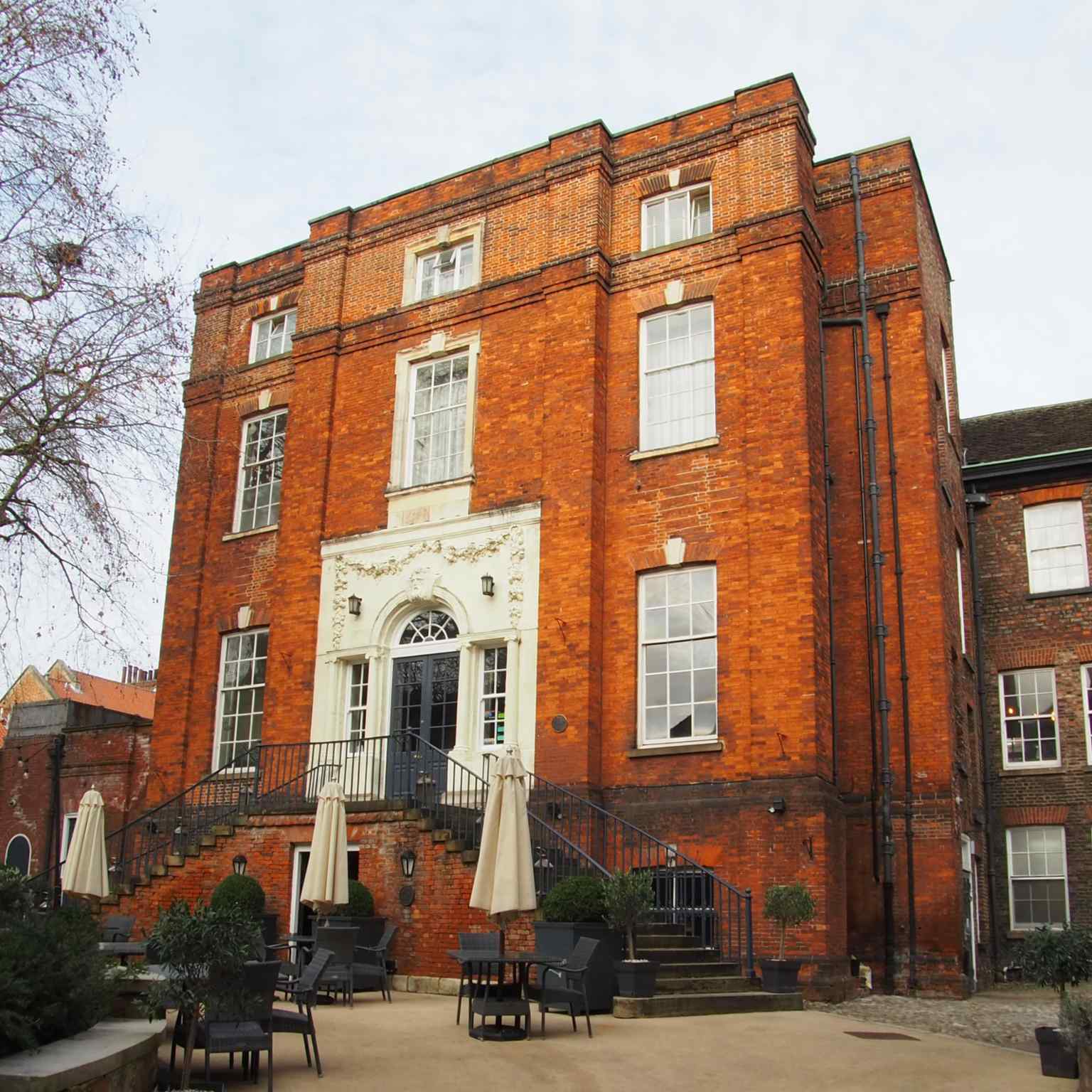
The beautiful Grade One listed Judges' Lodgings, featuring the iconic front steps added in the nineteenth century (2023).Photo: Malcolmxl5, Wikimedia Commons, CC BY-SA 4.0. Cropped & resized. Just a short walk from Museum Street, we arrive at this beautiful Grade One listed townhouse. In the United Kingdom, Grade One means a building is of exceptional national historical interest, and looking at it, you can easily see why. Standing here at the front-left of the Judges' Lodgings, you get a wonderful view of its early eighteenth-century classical design. Notice the outside front stairs leading up to the main door... they were actually added in the nineteenth century. Originally, there was just a single flight.
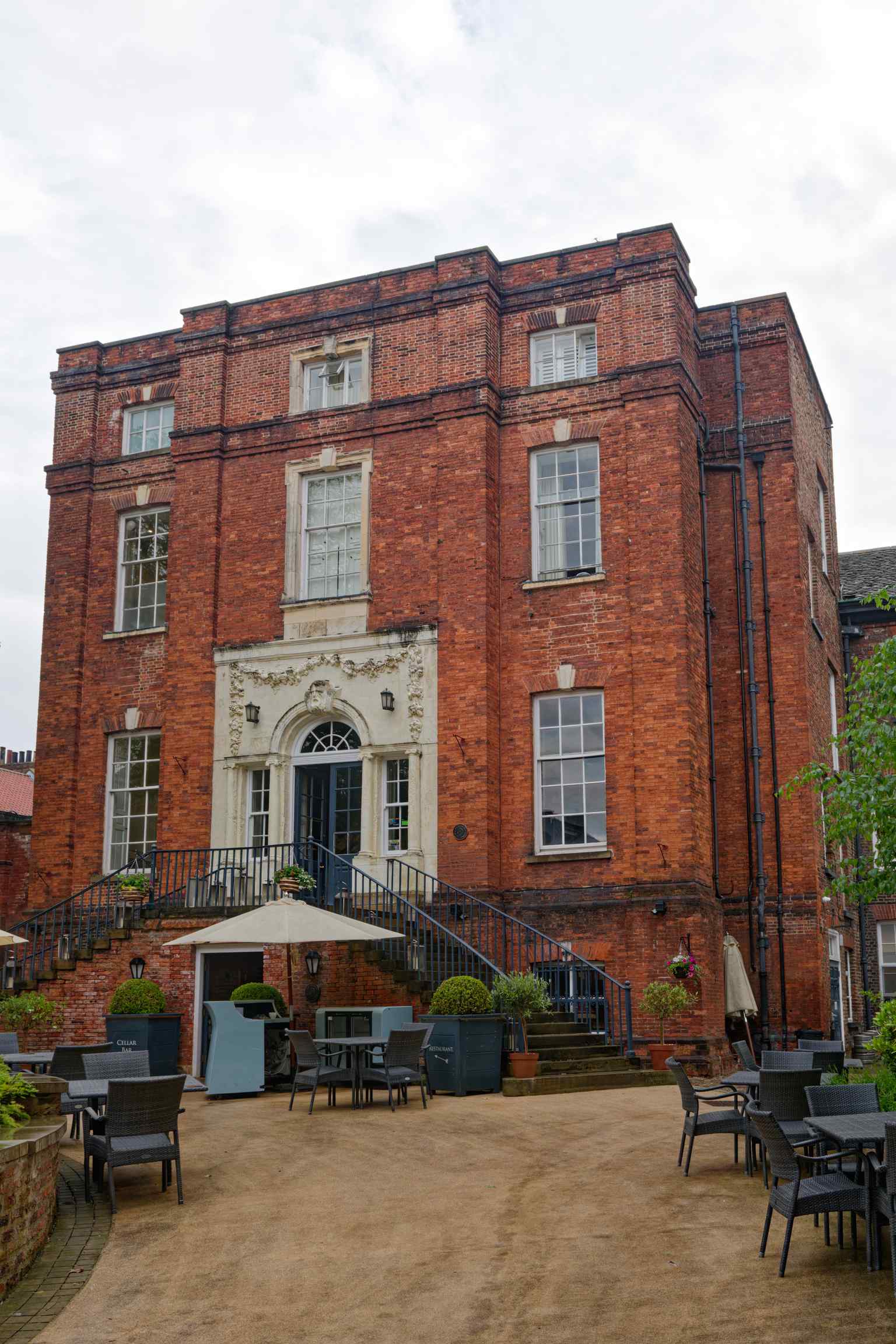
The classical Georgian facade at 9 Lendal, hiding ancient Roman and medieval foundations beneath its cellars (2024).Photo: Tilman2007, Wikimedia Commons, CC BY-SA 4.0. Cropped & resized. Look closely at the stone door surround. It is framed by a Venetian-style arch, decorated with carved festoons of fruit. Right in the center, on the keystone, there is a carved face. That bearded mask represents Aesculapius, the ancient god of medicine. He is there because this house was first built between 1711 and 1726 as a private residence for Dr. Clifton Wintringham, a prominent medical practitioner. Building his perfect home came with quite a surprise, though. The house sits on land that once belonged to St Wilfred's Church, which had been demolished much earlier. A local historian recorded that when workers dug the foundations, they threw up several cart loads of human bones. And in the 1980s, excavations in the cellar uncovered even older secrets... the cobblestone foundations of a late Roman interval tower.
In 1806, the building took on the role that gave it its name. It was purchased to house visiting judges. They came to York four times a year to preside over the Assize Courts, which were special criminal courts handling the most serious offenses in the country. A couple named Mr. and Mrs. Kilvington lived in the side wing as paid housekeepers, ensuring the high court judges had everything they needed. And they really prioritized convenience. Inside the dining room, hidden discreetly behind a secret panel concealed by a window shutter, is a built-in chamber pot just for the dining gentlemen. Today, this historic townhouse is a hotel run by the Daniel Thwaites group, and it is open for visitors every day from early morning until ten at night.
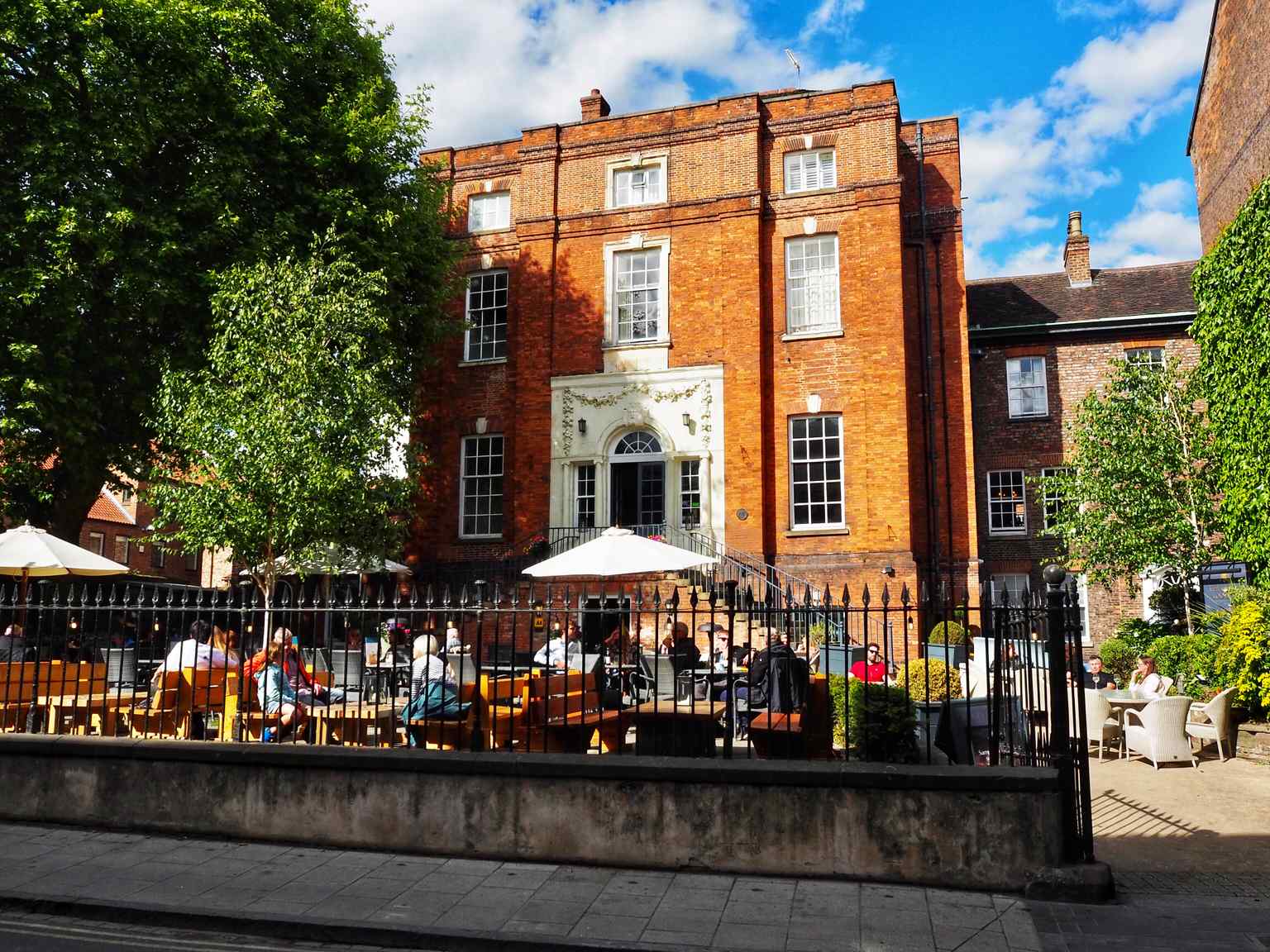
Admire the intricate details of the masonry before continuing your journey through historic York (2025).Photo: Malcolmxl5, Wikimedia Commons, CC BY-SA 4.0. Cropped & resized. Take a moment to admire the intricate stone carvings on the archway. Whenever you are ready to continue, we can head out to our next stop.
Show 17 more stopsShow fewer stopsexpand_moreexpand_less
Look for the open paved plaza anchored by a striking building with bold red walls, tall white pillars, and a golden crest resting near the roof. That prominent building is the…Read moreShow less
Open dedicated page →Look for the open paved plaza anchored by a striking building with bold red walls, tall white pillars, and a golden crest resting near the roof. That prominent building is the Mansion House, and through the gateway right beside it is the York Guildhall we just left.
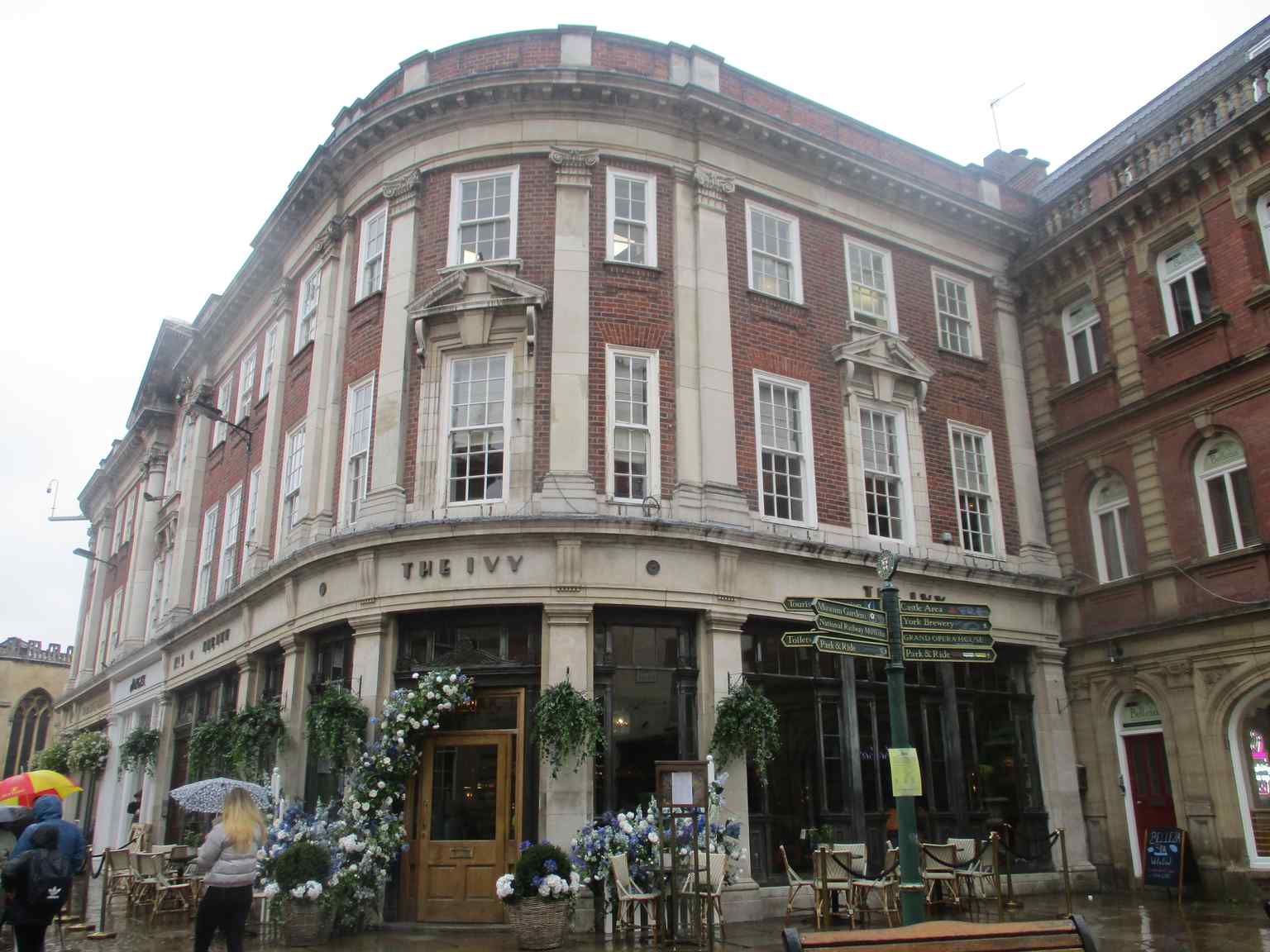
The bustling modern life of St Helen's Square, seen here in 2020, hides a layered history of Roman fortresses and old church graveyards.Photo: Mtaylor848, Wikimedia Commons, CC BY-SA 4.0. Cropped & resized. This wide open space is St Helen's Square, but it has not always been so grand and orderly. Long ago, during the Roman era, the massive south-western gate of their fortress... the porta praetoria... stood right where you are standing. Centuries later, this spot completely transformed. Until the mid-eighteenth century, this very ground was entirely swallowed up by the sprawling graveyard of St Helen's Church. People used to trudge along a narrow dirt footpath directly across the graves to get between Davygate and Blake Street.
The nearby street junction even had the rather cheeky name of Cuckold's Corner. Eventually, the city needed more room. In 1745, they gave the church a new plot of land on Davygate, moved the graveyard, and paved right over this space to create the square.
It quickly became a vital hub. By 1770, stagecoaches rumbled out from the new York Tavern here, embarking on long, bumpy journeys to London. A few decades later, the famous Terry's opened their chocolate shop on the square, delighting locals for over a century, and today the elegant Bettys tea rooms sit proudly on the southeastern corner. From a quiet resting place to a gathering spot for rallies and massive holiday celebrations, this intersection truly holds the heartbeat of the city. Soak in the bustling atmosphere of the square, and once you are ready, our route continues just ahead on Blake Street.
Look for the striking black and white timber framed building with its upper floors stepping outward, and spot the unique wooden sign above the door shaped like an open book that…Read moreShow less
Open dedicated page →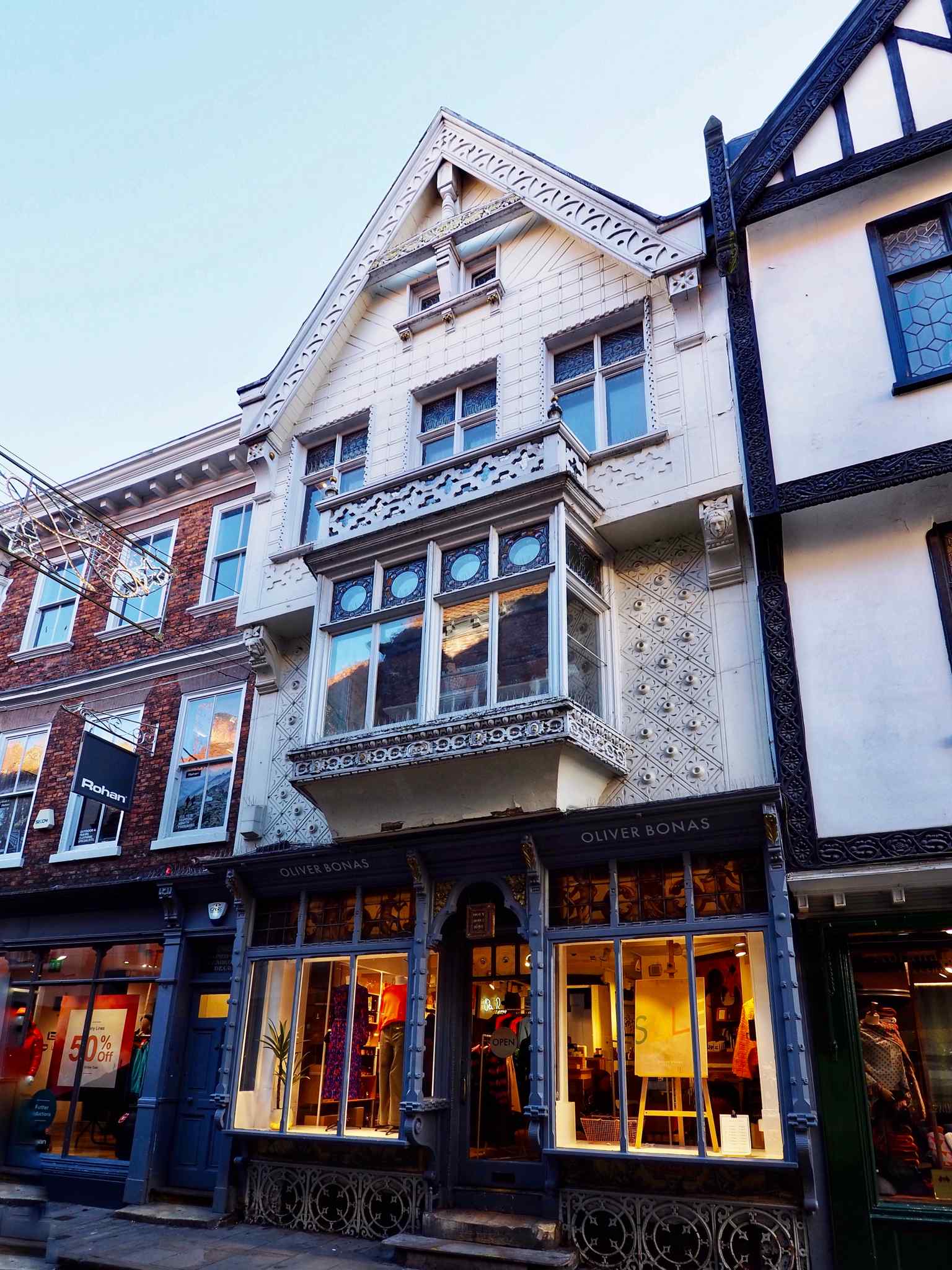
35 Stonegate York Jan24Photo: Malcolmxl5, Wikimedia Commons, CC BY-SA 4.0. Cropped & resized. Look for the striking black and white timber framed building with its upper floors stepping outward, and spot the unique wooden sign above the door shaped like an open book that reads Holy Bible 1682. This beautiful structure at 35 Stonegate holds centuries of eclectic stories.
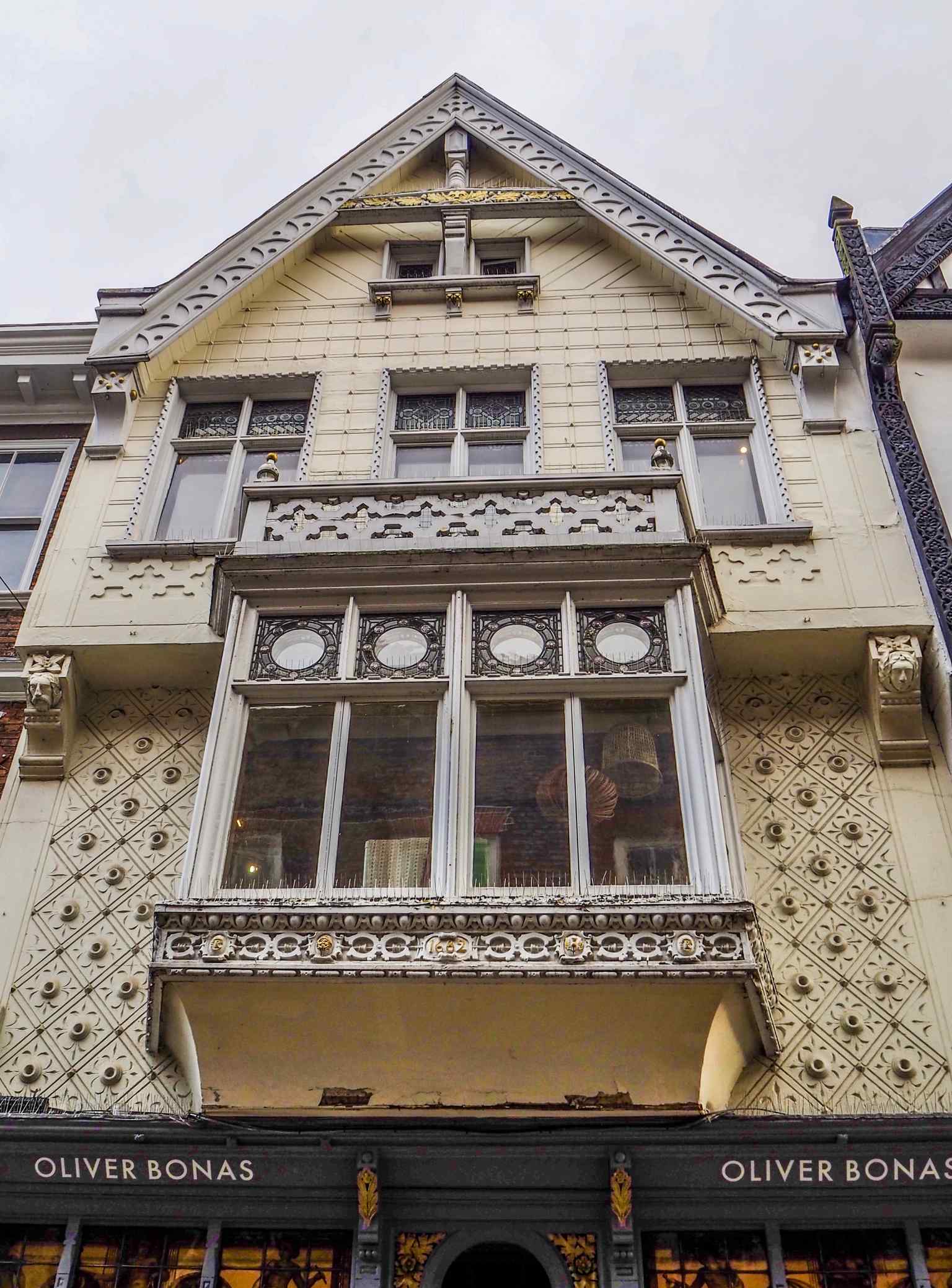
Upper floors of 35 Stonegate YorkPhoto: Malcolmxl5, Wikimedia Commons, CC BY-SA 4.0. Cropped & resized. Just a minute ago we were at the York Medical Society, but here we step back even further. The front section of this building was constructed in the 15th century, though the land was owned back in the 1300s by the Prebend of Bramham, a senior administrative official of the church. See how the first and second floors jut out over the street? That overhanging architectural style is called jettied. It was a clever medieval trick to gain more floor space upstairs without having to pay for a wider ground level plot.
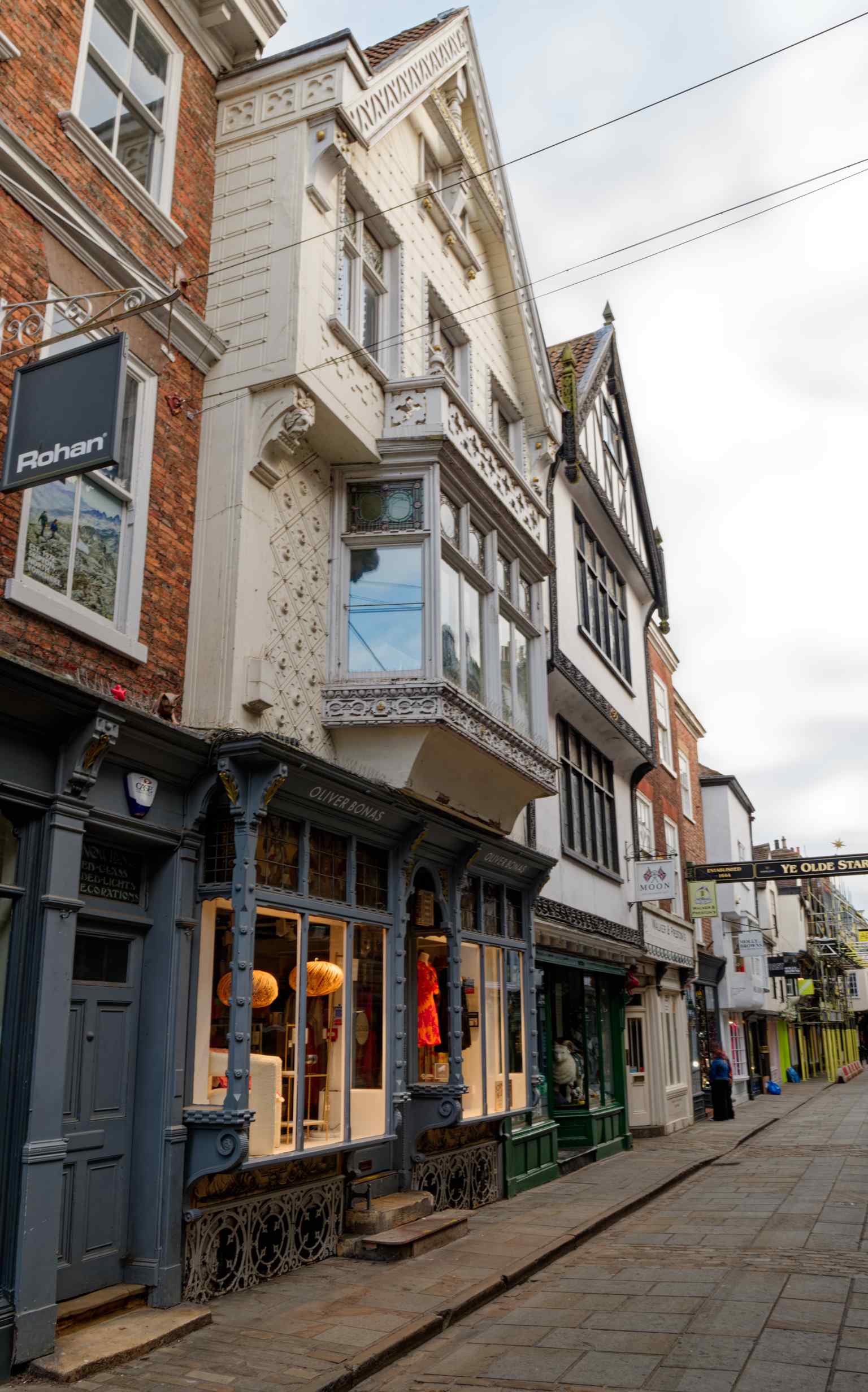
1256524 At the Sign Of The Bible, 35 Stonegate York 20240520 0001 DxOPhoto: Tilman2007, Wikimedia Commons, CC BY-SA 4.0. Cropped & resized. By 1682, a man named Francis Hildyard opened a bookshop right where you are standing, famously known as At the Sign of the Bible. In 1759, a later owner sold the very first two hundred copies of Laurence Sterne's famous novel, The Life and Opinions of Tristram Shandy, Gentleman.
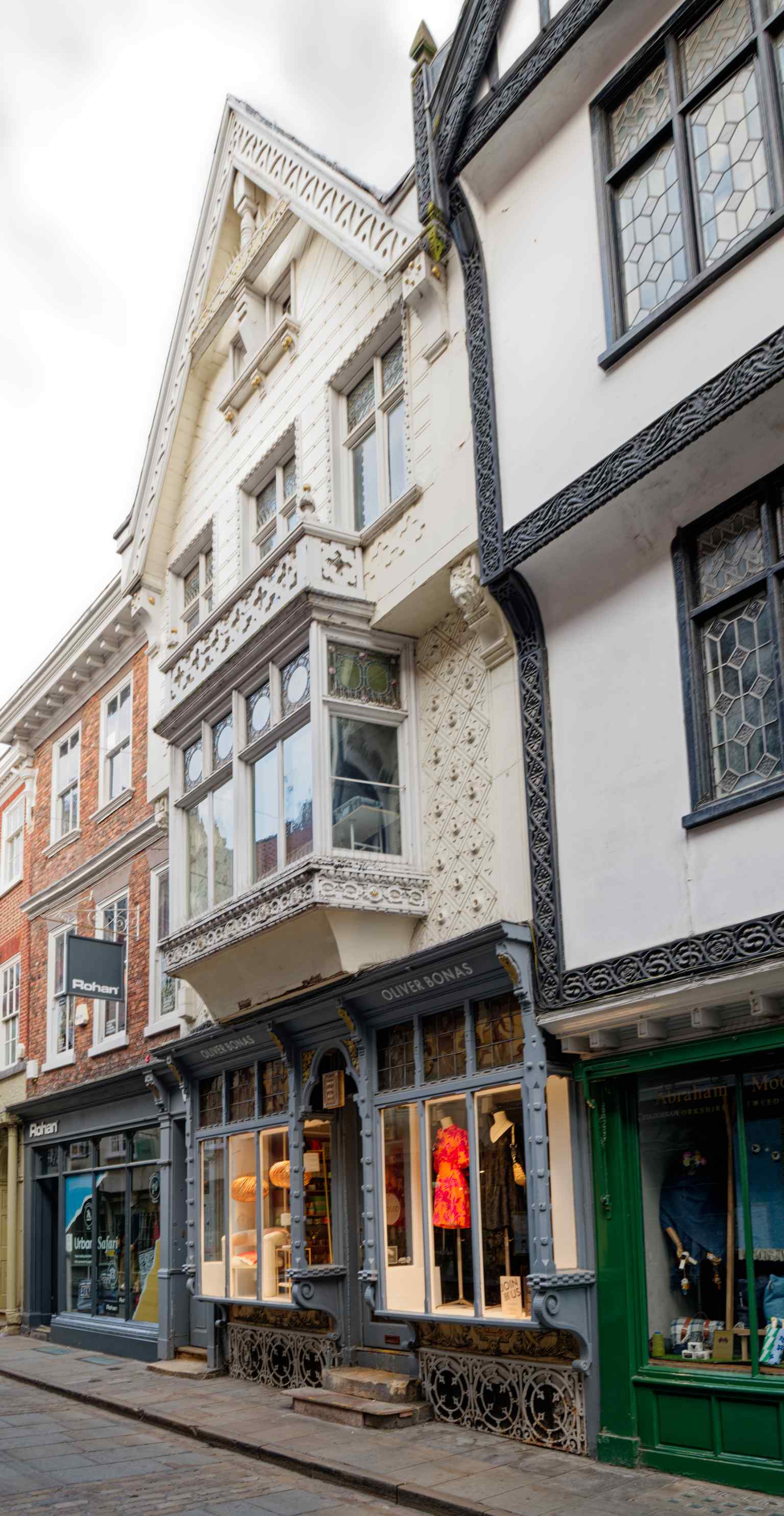
1256524 At the Sign Of The Bible, 35 Stonegate York 20240520 0002 DxOPhoto: Tilman2007, Wikimedia Commons, CC BY-SA 4.0. Cropped & resized. The building eventually fell into the hands of John Ward Knowles in 1872. He was a stained glass maker who gave the facade its ornate, Tudor inspired decorative makeover. Later on, things took a rather curious turn. In 1999, an astrologer bought the shop, eventually teaming up with Uri Geller to open the Museum of Psychic Experience, and even running a haunted house attraction. Today it is a peaceful shop, quietly hiding all those ghosts and stories inside its medieval timber. Take a moment to soak this in, and our next destination awaits just ahead at York Minster.
You'll easily spot York Minster on your left by its massive, creamy-white limestone exterior, towering Gothic spires, and the striking, intricate circular rose window set high in…Read moreShow less
Open dedicated page →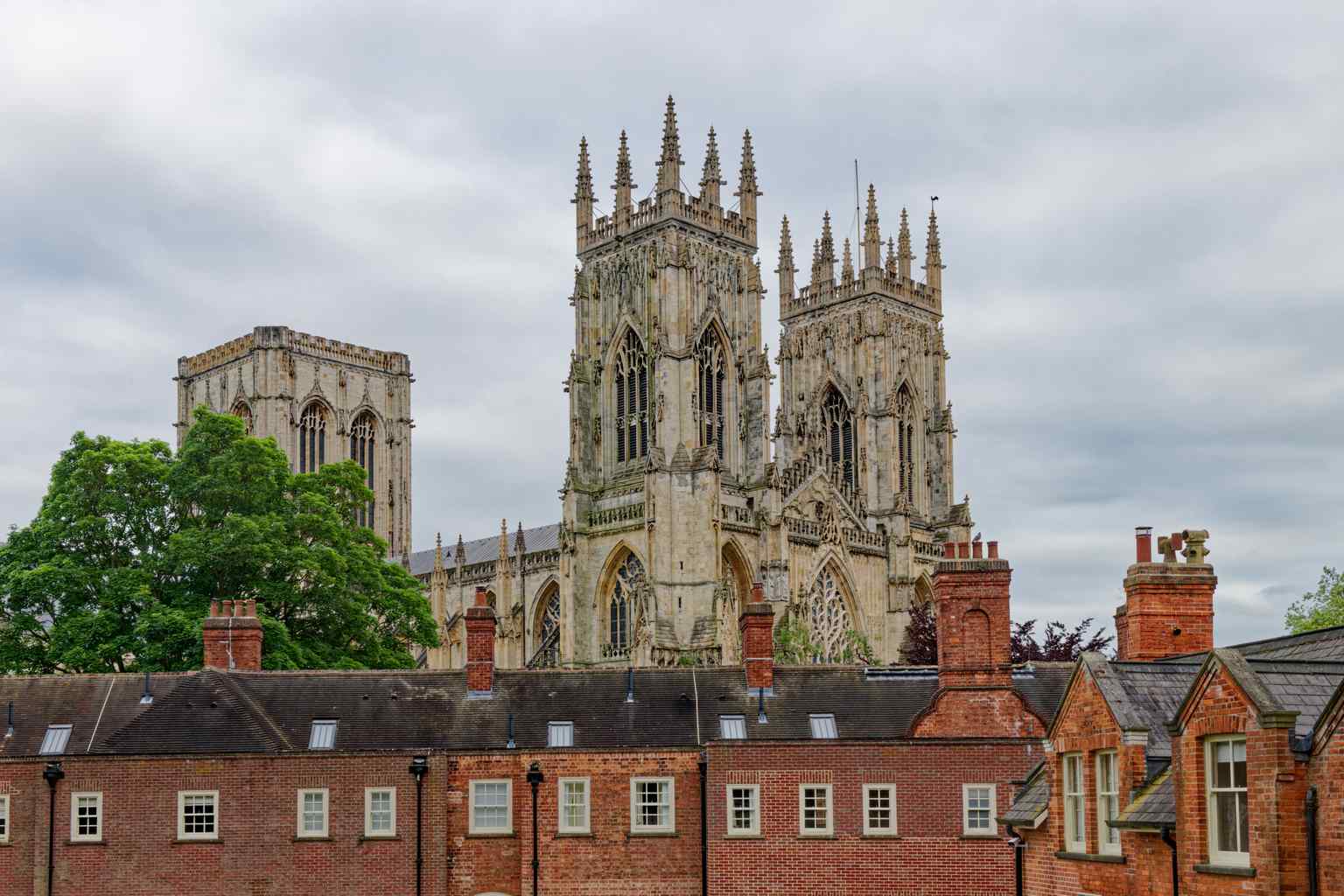
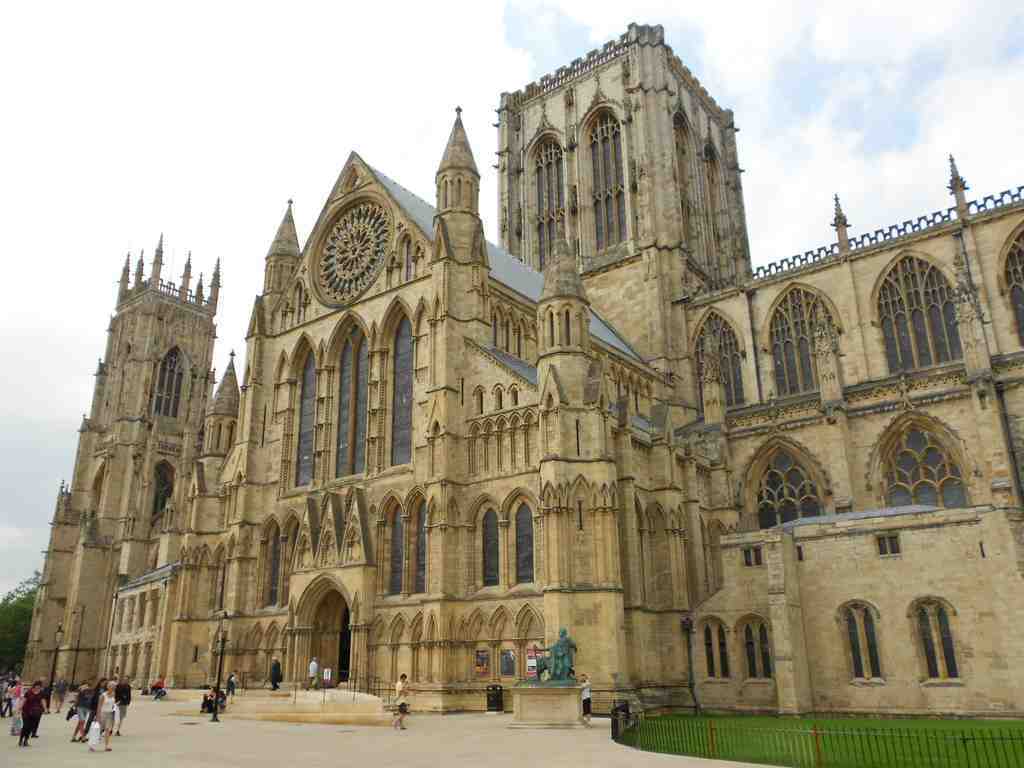
A stunning overview of York Minster's creamy-white limestone exterior and towering Gothic spires, seen from the northwest (2024).Photo: Tilman2007, Wikimedia Commons, CC BY-SA 4.0. Cropped & resized. You'll easily spot York Minster on your left by its massive, creamy-white limestone exterior, towering Gothic spires, and the striking, intricate circular rose window set high in the central facade. Just a short stroll from 35 Stonegate, which we saw earlier, we now find ourselves standing before a true giant of human devotion and history. This is the largest Gothic cathedral completed during the medieval period in Northern Europe, and taking it in all at once is almost impossible. The stone you see is magnesian limestone, quarried nearby, which gives the building its luminous, pale glow. Generations of stonemasons dedicated their entire lives to this structure, as the bulk of what you see was built over two and a half centuries, between 1220 and 1472.
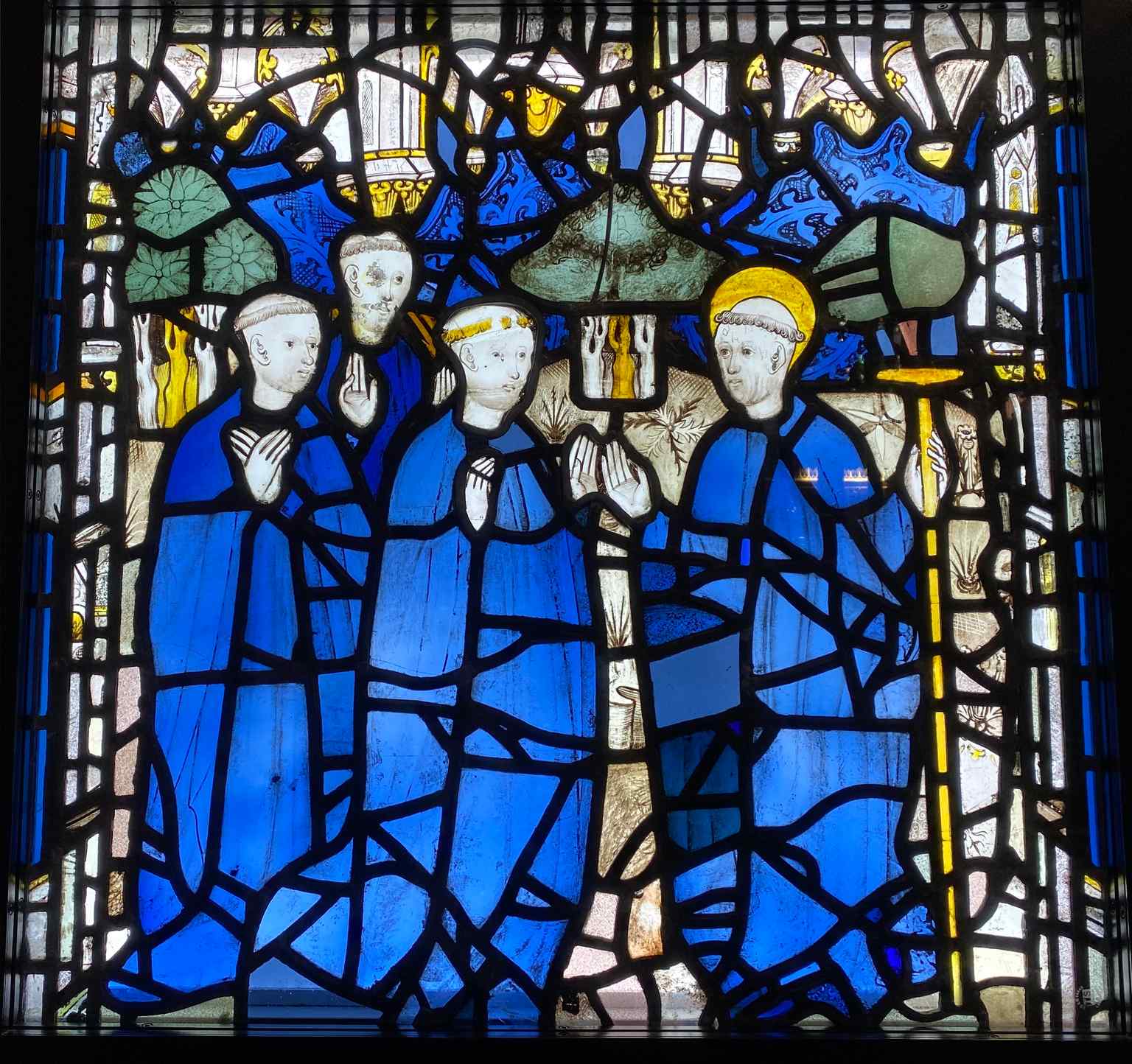
Detailed medieval stained glass in the St. Cuthbert Window, showcasing the incredible artistry of glaziers from centuries past (2022).Photo: Charc2018, Wikimedia Commons, CC BY-SA 4.0. Cropped & resized. Inside, this building holds one of the greatest surviving collections of medieval stained glass in the world. The Great East Window alone is the largest single expanse of medieval glass in the country. It was designed in 1405 by a master glazier named John Thornton. He was paid sixty-six pounds for his work, which would be roughly sixty thousand dollars today. It depicts scenes from the Book of Revelation across over three hundred individual panels. Then there is the Five Sisters window in the north transept... the transept being the arm of the church that crosses the main hall to form a cross shape. This window features five tall, narrow, pointed openings known as lancet windows. Instead of colorful Bible stories, they are filled with grisaille glass, which is a beautifully subtle, grayish-green glass painted with delicate geometric patterns.
The crossing of the Minster, capturing the awe-inspiring heights and resilient architecture that survived the 1984 fire in the south transept (2024).Photo: Tilman2007, Wikimedia Commons, CC BY-SA 4.0. Cropped & resized. But the story of York Minster is not just about ancient triumphs... it is also about survival. In the early morning hours of July ninth, 1984, a devastating fire broke out in the south transept. A subsequent investigation found an eighty percent chance that the fire was sparked by a lightning strike to a metal electrical box on the roof. The heat was so intense that the glass of the beloved rose window shattered, though its lead framing miraculously held the pieces together. To save the rest of the great cathedral, firefighters had to make a heartbreaking choice. They deliberately collapsed the burning wooden roof of the south transept by pouring tens of thousands of gallons of water onto it. It was a drastic measure, but it worked, saving the heart of the Minster.
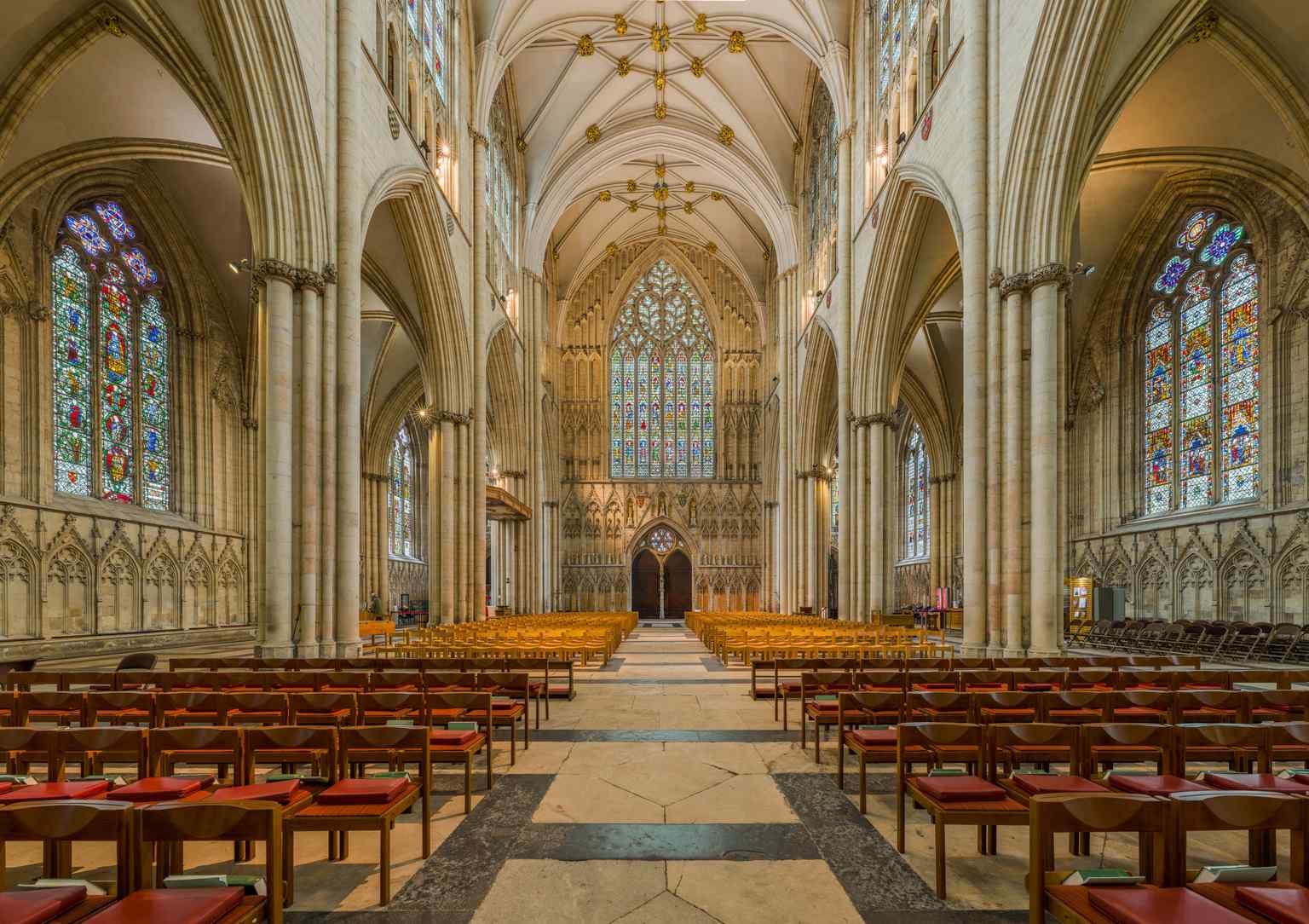
A breathtaking view of York Minster and its magnificent spires as seen from Bootham Bar, standing tall over the historic city (2024).Photo: Tilman2007, Wikimedia Commons, CC BY-SA 4.0. Cropped & resized. The restoration that followed brought out the best in the community. When it came time to replace the roof bosses... the decorative carved wooden blocks where the ceiling beams intersect... the cathedral used new designs. Five of these were actually designed by children who won a competition on a popular British television program. It is a beautiful reminder that this ancient building is still a living, breathing part of the community today, and if you would like to explore the vast interior, the Minster is generally open to visitors from nine thirty to four Monday through Saturday, with a shorter window on Sundays. Look up at the magnificent spires one last time before we follow the path to our next destination.
On your right, you will spot a wide, arched metal sign spelling out Shambles Market, suspended high between the brick buildings and guiding the way toward a corridor of…Read moreShow less
Open dedicated page →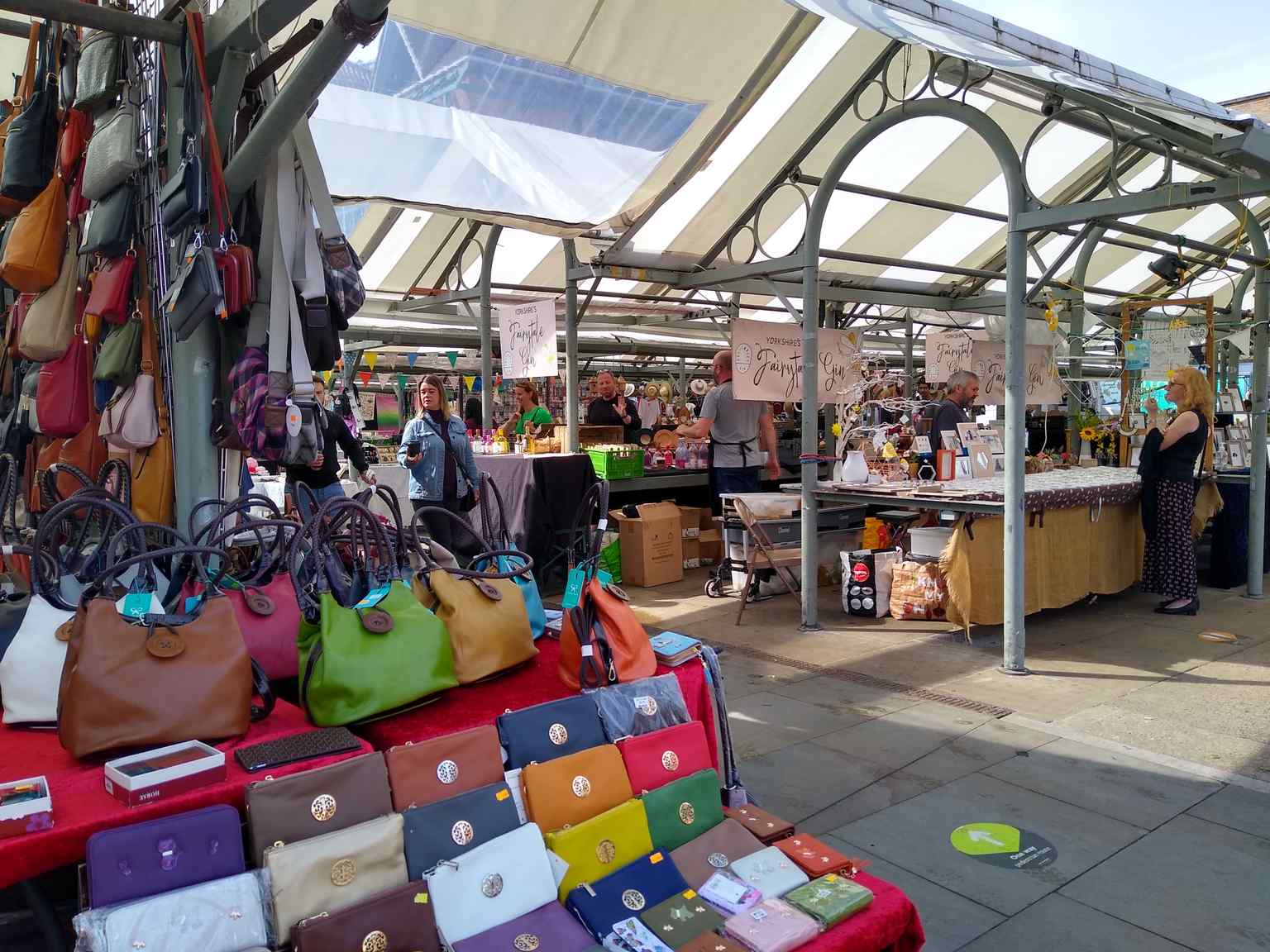
The bustling stalls and lively atmosphere of Shambles Market in 2021.Photo: Mx. Granger, Wikimedia Commons, CC0. Cropped & resized. On your right, you will spot a wide, arched metal sign spelling out Shambles Market, suspended high between the brick buildings and guiding the way toward a corridor of canvas-roofed stalls. After treating ourselves at York's Chocolate Story, wandering through a local market feels just right. The story of this space is actually quite bittersweet. Back in the 1950s, the city needed a new home for vendors after closing the market at St Sampson's Square and scaling back the one on Parliament Street. To create this open space, the city made a choice that still frustrates historians today. They demolished an entire street of medieval buildings known as Little Shambles. So much centuries-old architecture was lost forever to the wrecking ball. Initially, planners almost named the new space Gell Garth, an old medieval term for the area, but they settled on Newgate Market instead. It wasn't until a one point six million pound refurbishment in 2014 that it finally became Shambles Market. Today, eighty-six stalls and several food kiosks fill the area, and the heart of this market is its people. Families here have been setting up shop for generations. At the permanent stalls built for meat and fish, you will find Cross of York, a fishmonger that opened in 1957 and took home the national Fishmonger of the Year title in 2020. Nearby, Swain Family Butchers celebrated their fiftieth anniversary in 2022. It is wonderful to see that deep dedication to a craft. The market is open every day from nine to five if you want to browse. It is a wonderful community that keeps the city nourished. Take your time exploring the stalls, and let's continue on to The Blue Bell whenever you finish browsing.
You will spot it by its slender red-brick facade, the elegantly arched windows on the ground floor, and the lovely hanging sign shaped like a blue bell. Just a short stroll from…Read moreShow less
Open dedicated page →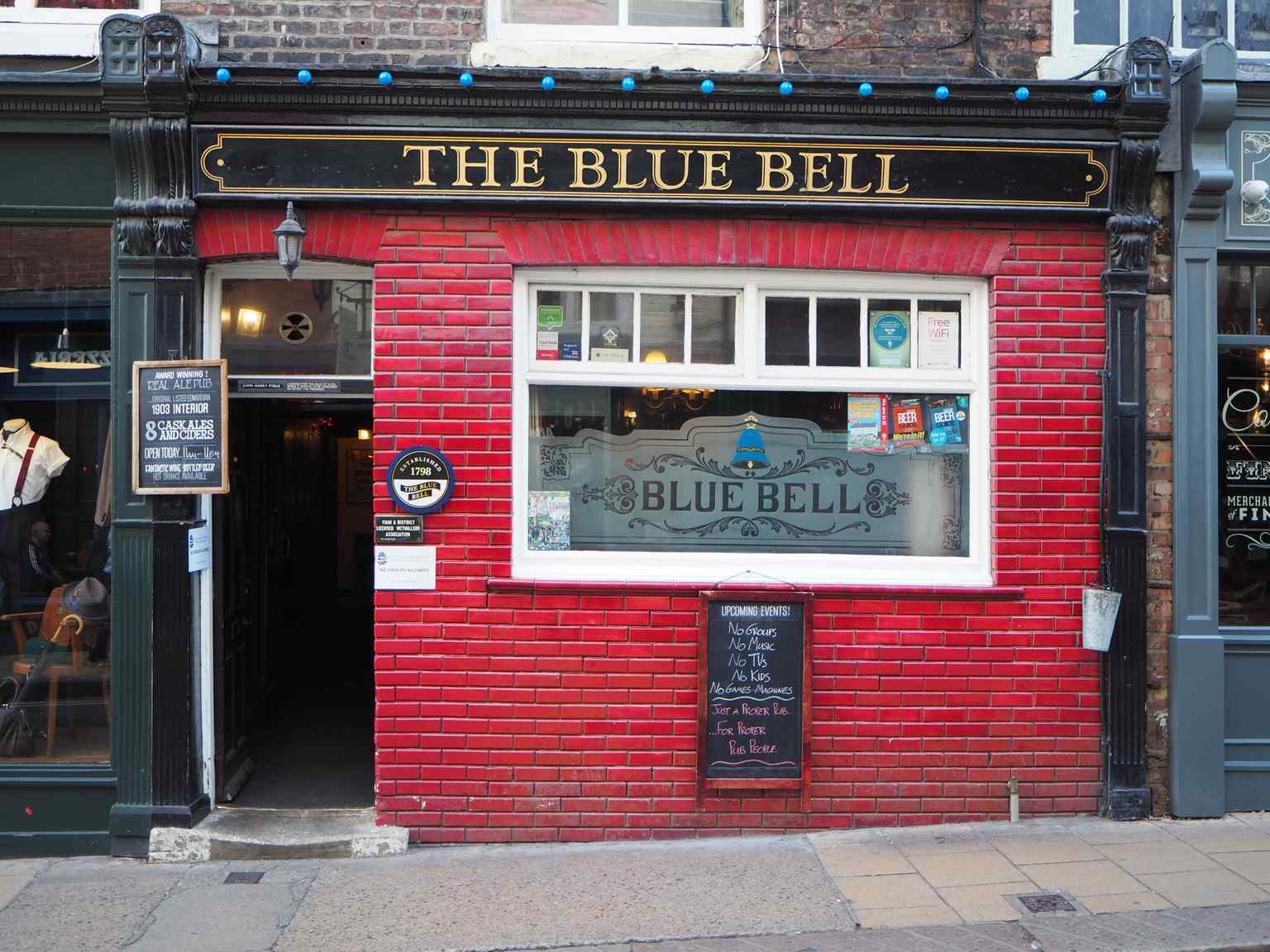
The slender red-brick facade and hanging sign of The Blue Bell on Fossgate (2018).Photo: Malcolmxl5, Wikimedia Commons, CC BY-SA 4.0. Cropped & resized. You will spot it by its slender red-brick facade, the elegantly arched windows on the ground floor, and the lovely hanging sign shaped like a blue bell. Just a short stroll from the Shambles Market we explored earlier, we find one of the city's most stubborn little treasures.
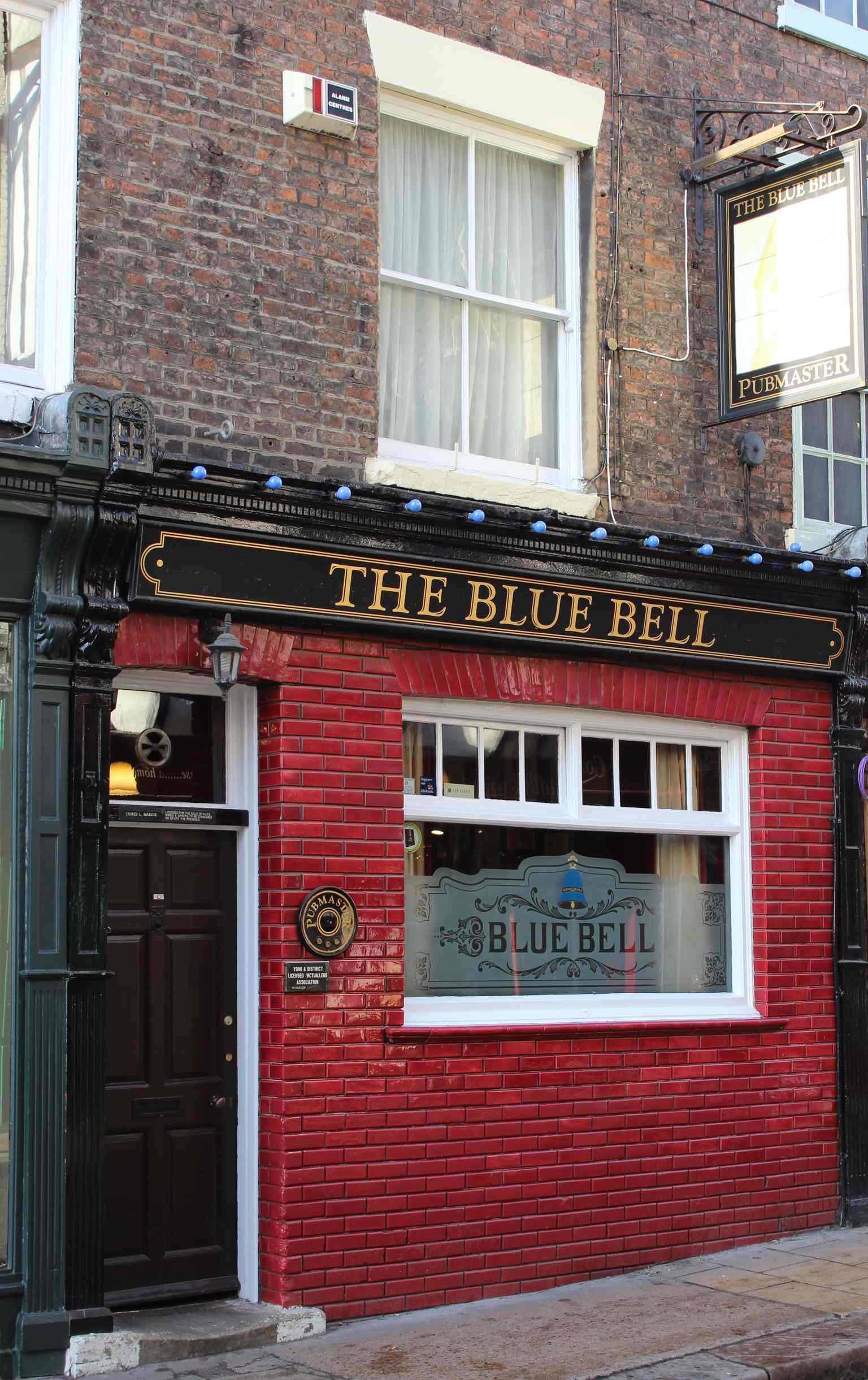
The remarkably preserved historic pub interior, unchanged since its remodel in 1903 (2015).Photo: BZ4brbr, Wikimedia Commons, CC BY-SA 3.0. Cropped & resized. The building began in the late seventeenth century as a timber-framed house with a jettied front. It was eventually refronted in brick and opened as The Blue Bell in 1798. But the real charm lies in a 1903 remodel by a local pub chain. Amazingly, the inside has not changed since. It is one of the very few pubs awarded a Grade II star listing entirely for its interior, which is a high British designation protecting exceptionally rare historic buildings. If you look inside, it still has the original varnished wood panels, glazed screens, and a tiny entrance lobby. For nearly ninety years, it was fiercely protected by one family. George Robinson, who actually helped found the York City Football Club, passed it down to his wife, and then to their daughter Edith, who finally retired in 1992. The pub is wonderfully tiny, holding just sixty-five people. To this day, it bans large groups, swearing, and music. They used to hang a fake private party sign on the door to scare off loud crowds, though loyal regulars knew they could just ignore it and walk right in. It remains an inexpensive spot, open every day from noon to eleven at night. Admire this wonderful survivor, and let's take a quick walk over to the Golden Fleece.
Look to your left for the pink-grey brick building with wide, three-part windows and a hanging sign showing a golden sheep. This is the Golden Fleece, an inn whose history…Read moreShow less
Open dedicated page →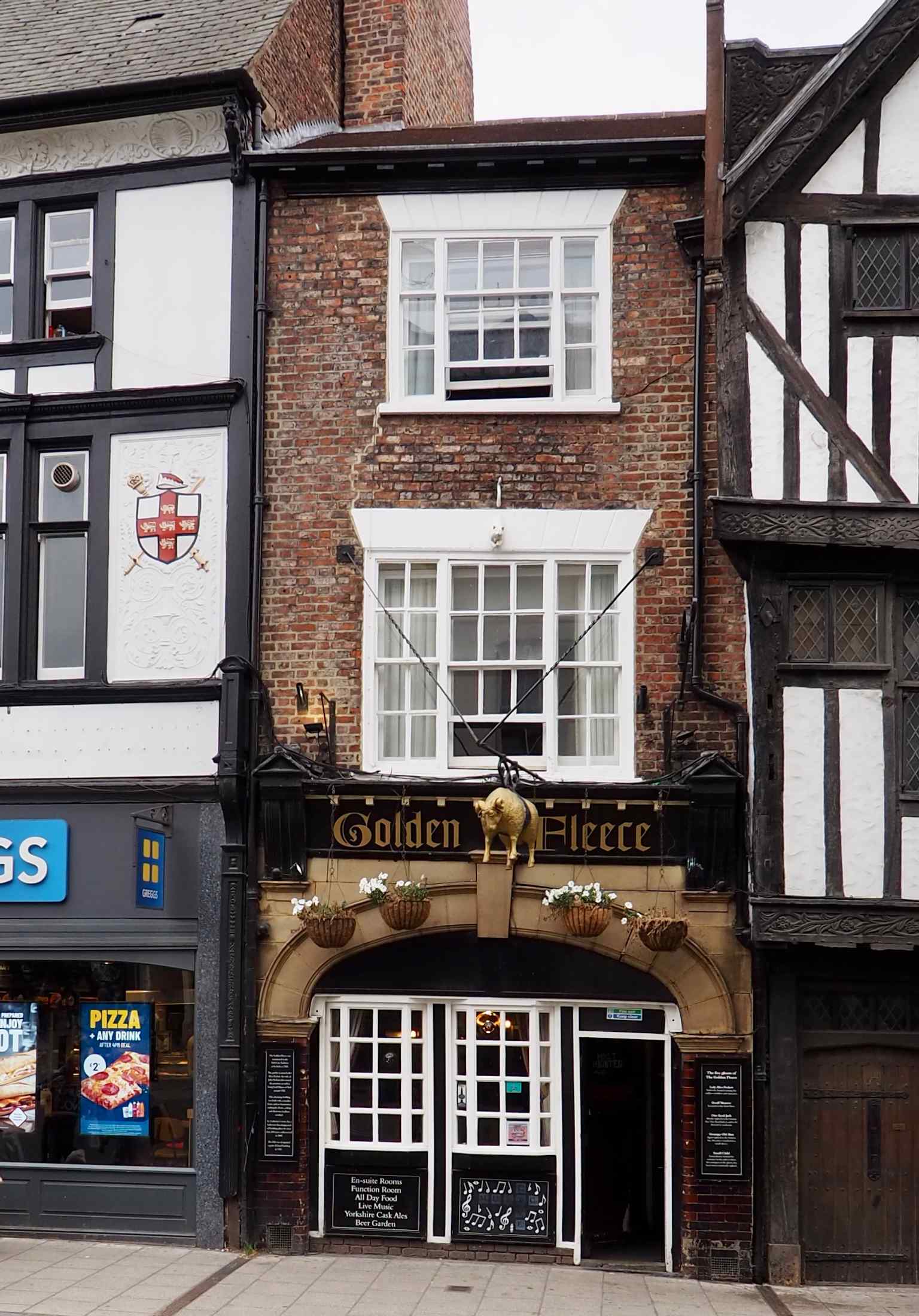
The historic exterior of the Golden Fleece Inn, noted for its pink-grey brick and hanging golden sheep sign (2021).Photo: Malcolmxl5, Wikimedia Commons, CC BY-SA 4.0. Cropped & resized. Look to your left for the pink-grey brick building with wide, three-part windows and a hanging sign showing a golden sheep. This is the Golden Fleece, an inn whose history stretches all the way back to 1503. Back then, it was originally built as a coaching house and got its name from the local wool traders who gathered here.
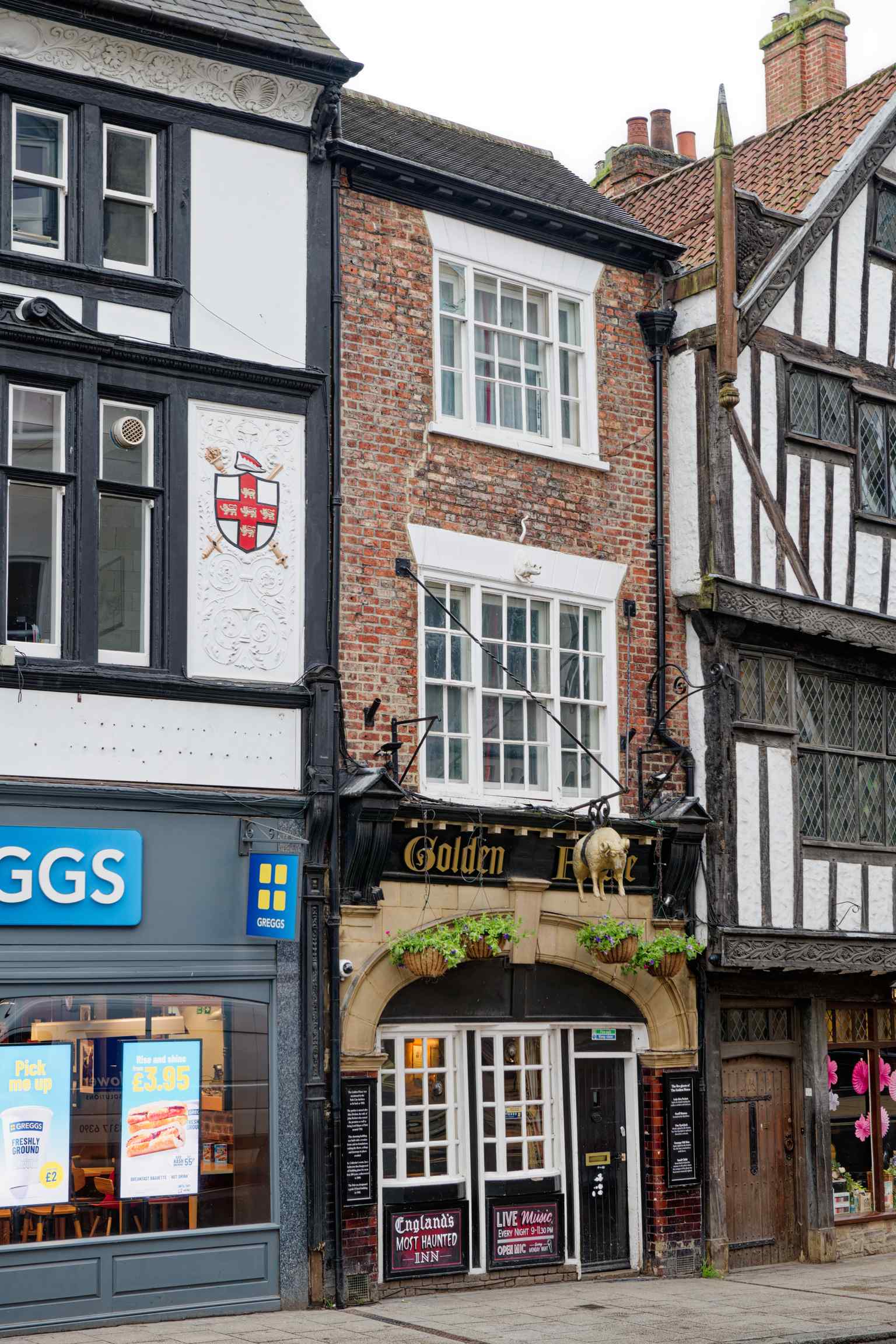
A closer look at the 16 Pavement facade, adorned with glazed tiles and ashlar stone (2024).Photo: Tilman2007, Wikimedia Commons, CC BY-SA 4.0. Cropped & resized. If you look closely at the front, you will see it is decorated with glazed tiles and ashlar, which is simply a term for large, smoothly cut blocks of stone. But the real stories are hidden inside. The Golden Fleece claims to be the most haunted pub in York. One famous resident spirit is Alice Peckett, the wife of a former Lord Mayor, who is said to wander the halls. You might even feel her presence in the back alley, appropriately named Lady Peckett's Yard.
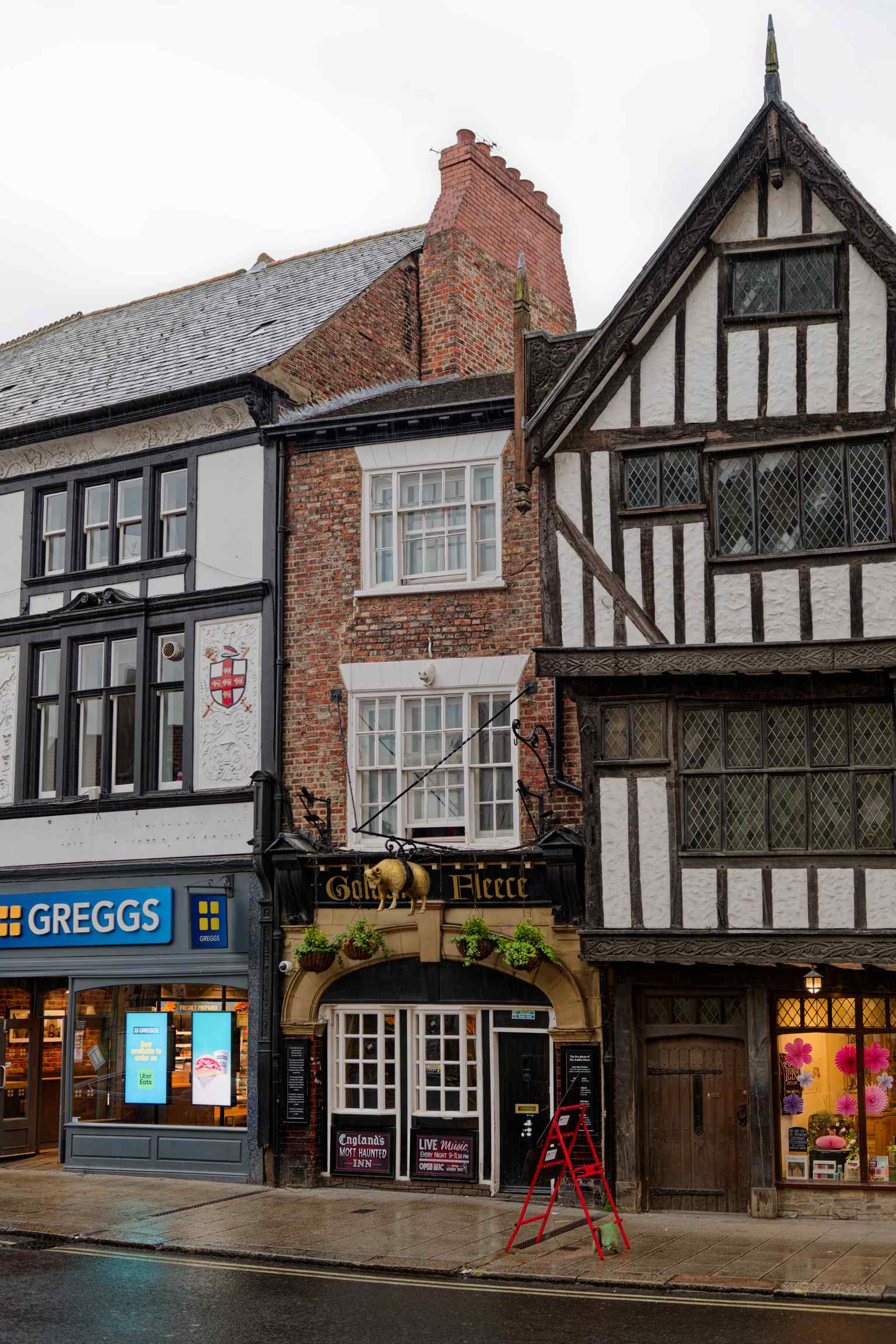
The Golden Fleece is famously known as the most haunted pub in York, hiding dark tales behind its traditional exterior (2024).Photo: Tilman2007, Wikimedia Commons, CC BY-SA 4.0. Cropped & resized. There is an even darker tale, too. In 1800, a woman named Elizabeth Johnson forged a one pound bank note, which was roughly the equivalent of one hundred pounds today. For this crime, she became the last woman hanged at York's Tyburn, the city's execution gallows. A replica of her skull is actually displayed inside the pub. Oddly enough, someone stole the skull in January of 2022, but thankfully returned it later that same month.
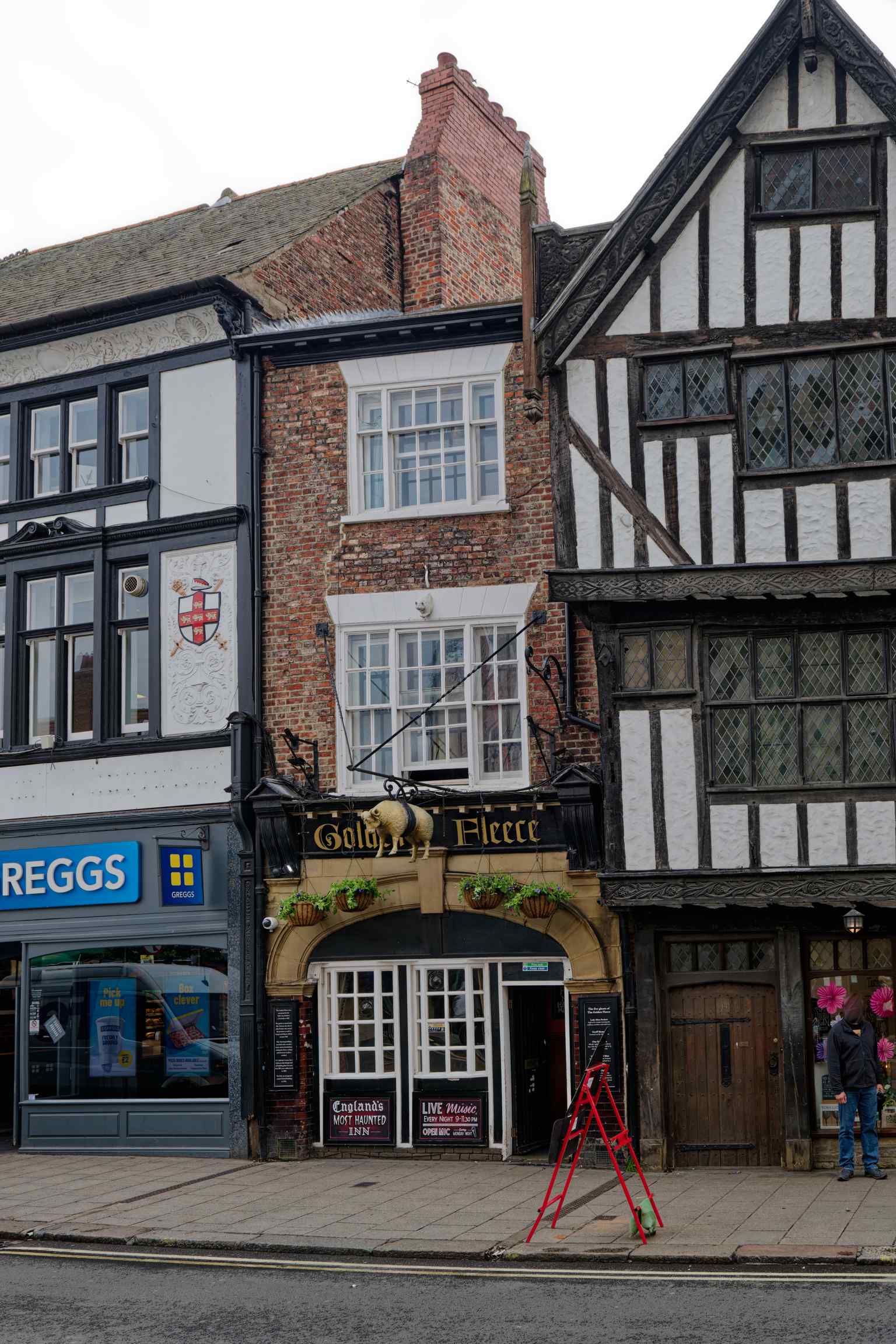
A charming spot to grab a bite and soak up centuries of local folklore before continuing the journey (2024).Photo: Tilman2007, Wikimedia Commons, CC BY-SA 4.0. Cropped & resized. If you are feeling brave, they serve moderately priced food and drinks from ten in the morning until midnight every day. It is a wonderful place to soak up centuries of local folklore. Soak up the centuries of local folklore, and let's stroll on to our next stop, the Merchant Adventurers' Hall.
Just a few minutes ago we were stepping away from the cozy corners of The Blue Bell, and now, we find ourselves at the back of something truly magnificent. Peeking through the…Read moreShow less
Open dedicated page →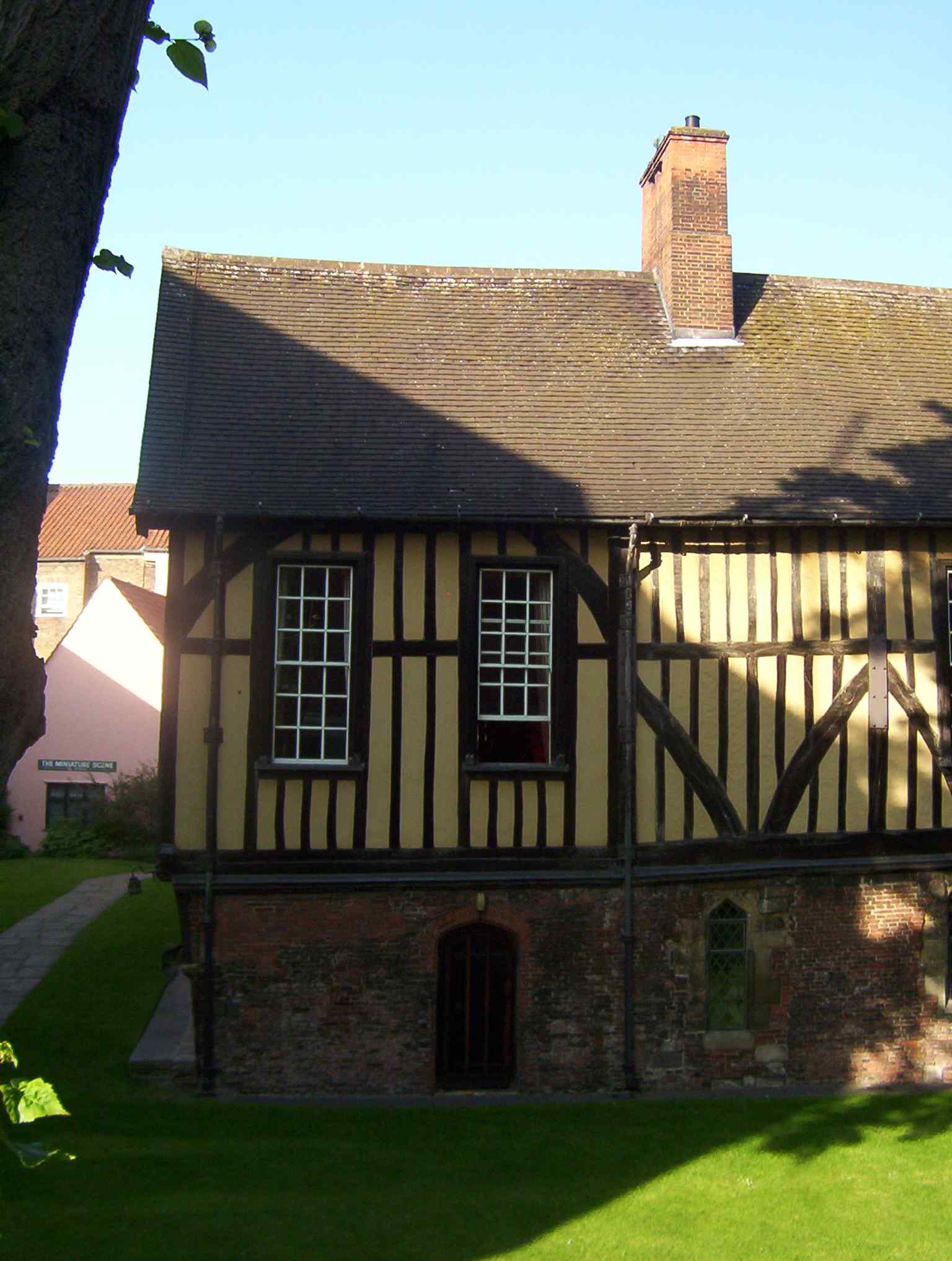
Merchant Adventurers Hall YorkPhoto: User:Kaly99, Wikimedia Commons, CC BY-SA 3.0. Cropped & resized. Just a few minutes ago we were stepping away from the cozy corners of The Blue Bell, and now, we find ourselves at the back of something truly magnificent. Peeking through the surroundings here on your left, you can catch sight of the Merchant Adventurers' Hall.
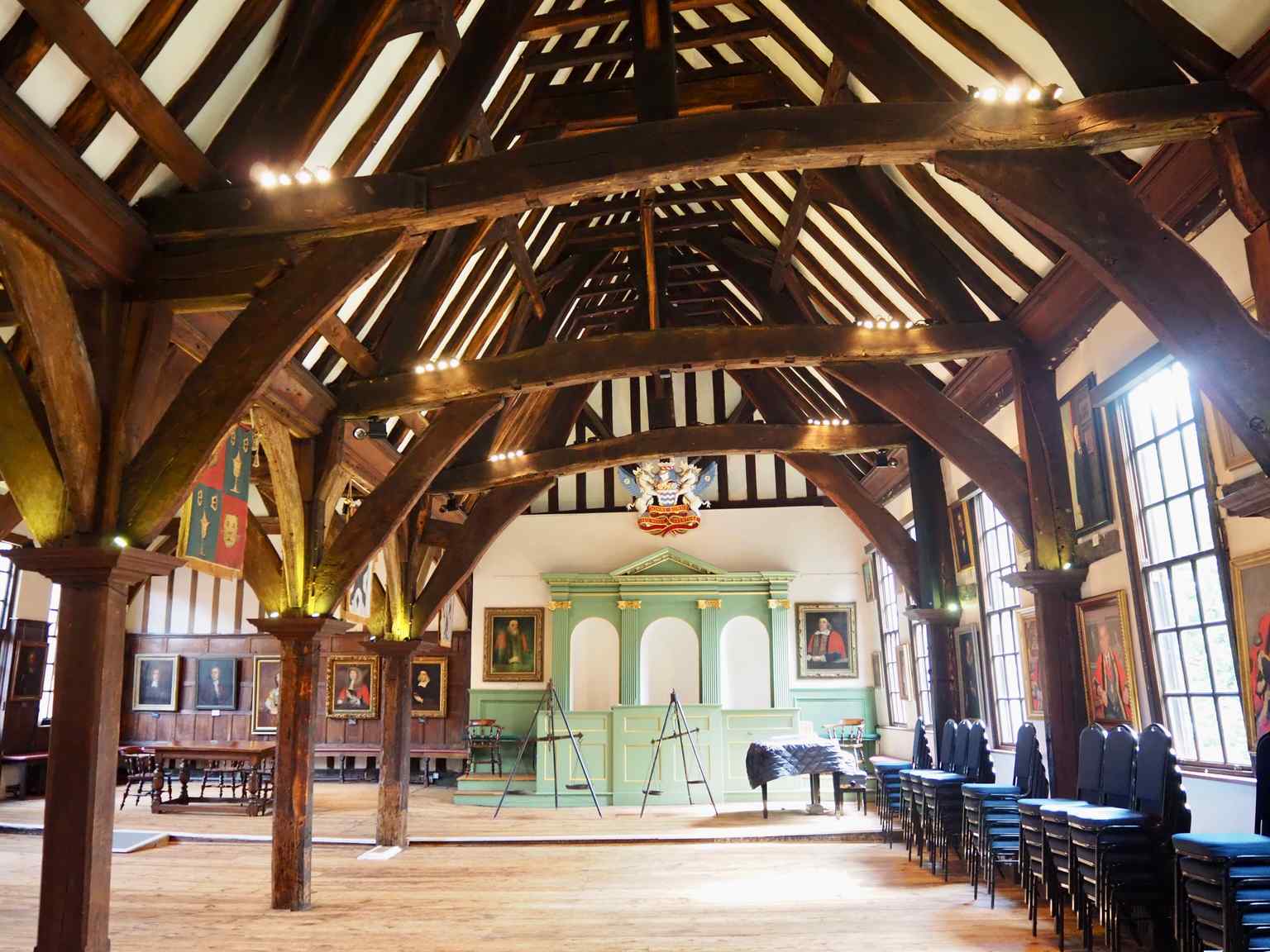
Great Hall Merchant Adventurers Hall York 03Photo: Malcolmxl5, Wikimedia Commons, CC BY-SA 4.0. Cropped & resized. Even from this partially hidden vantage point, you can sense the sheer weight of history. Built in 1357, this is the largest timber-framed building in the entire United Kingdom still standing and used for its original purpose. Imagine the labor it took to construct the Great Hall over five long years. Its massive roof is held up by a grand row of central timber posts and complex crown posts, all locked together with wooden pegs instead of iron nails.
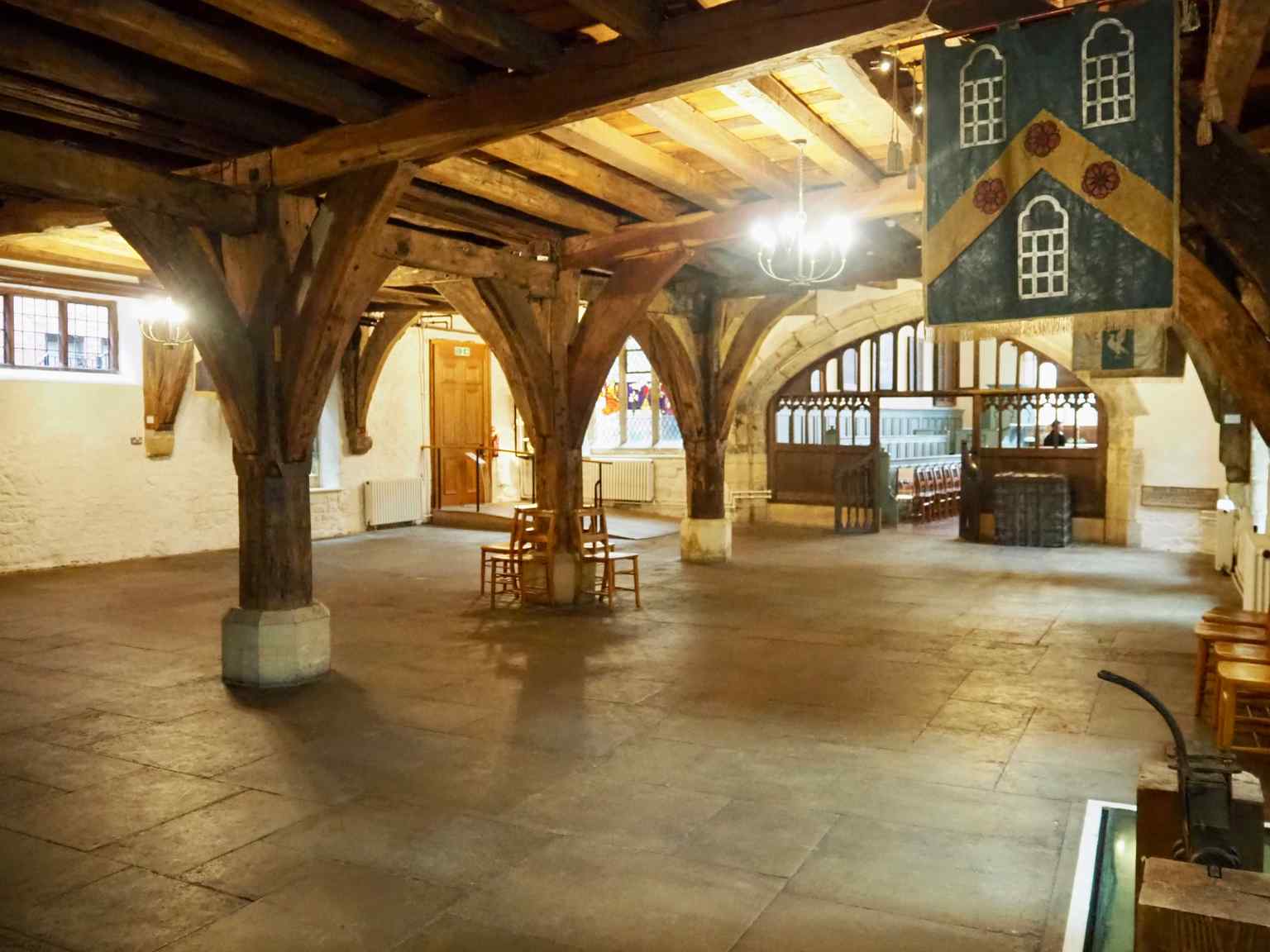
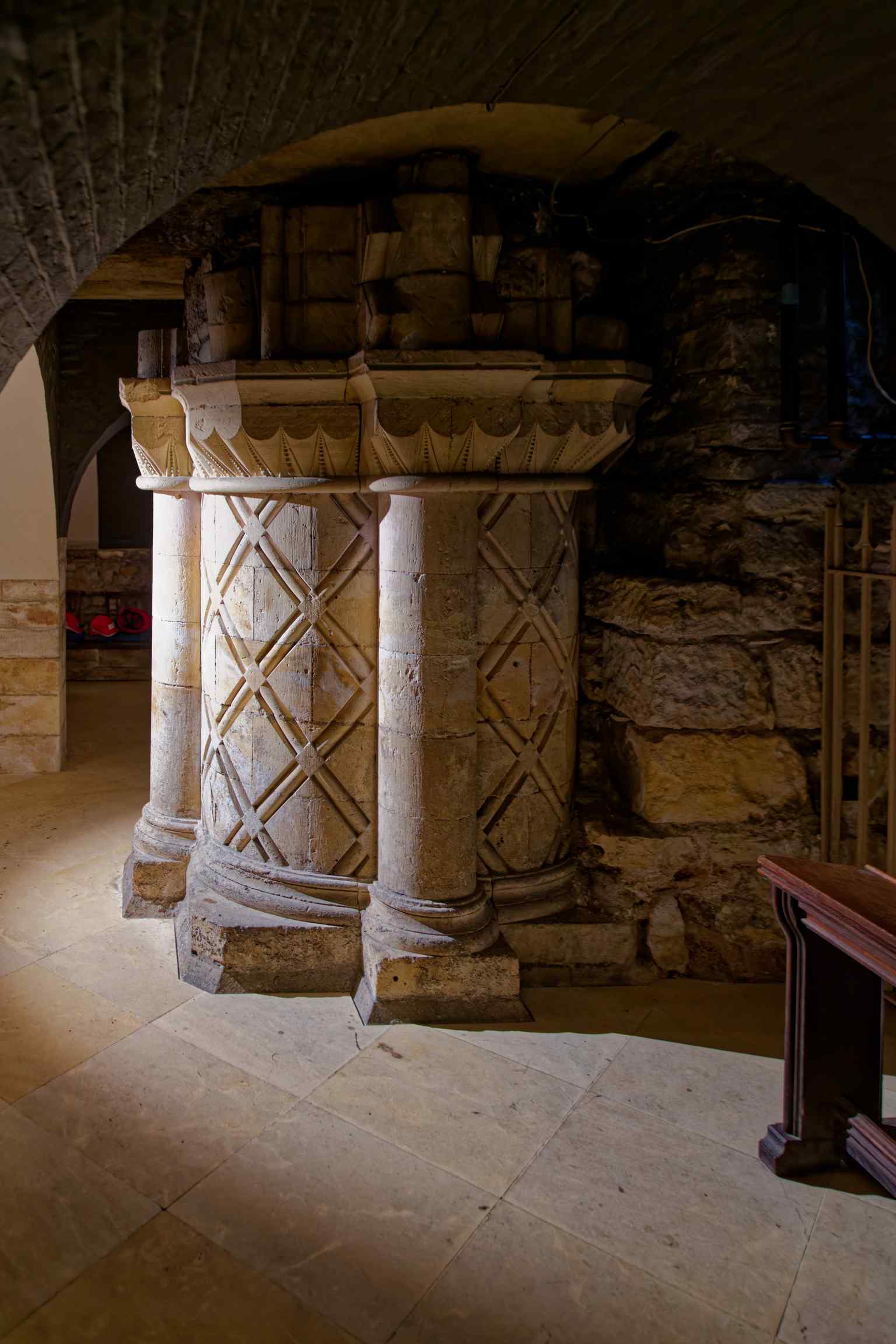
Undercroft Merchant Adventurers Hall York 01Photo: Malcolmxl5, Wikimedia Commons, CC BY-SA 4.0. Cropped & resized. What touches my heart most is why it was built. A group of influential men and women created this space not just for business, but for care. Down in the undercroft... the lower supporting floor... they established a hospital in 1371 to care for the poor and ill of York. There is even a beautiful attached chapel there that is still used for worship today.
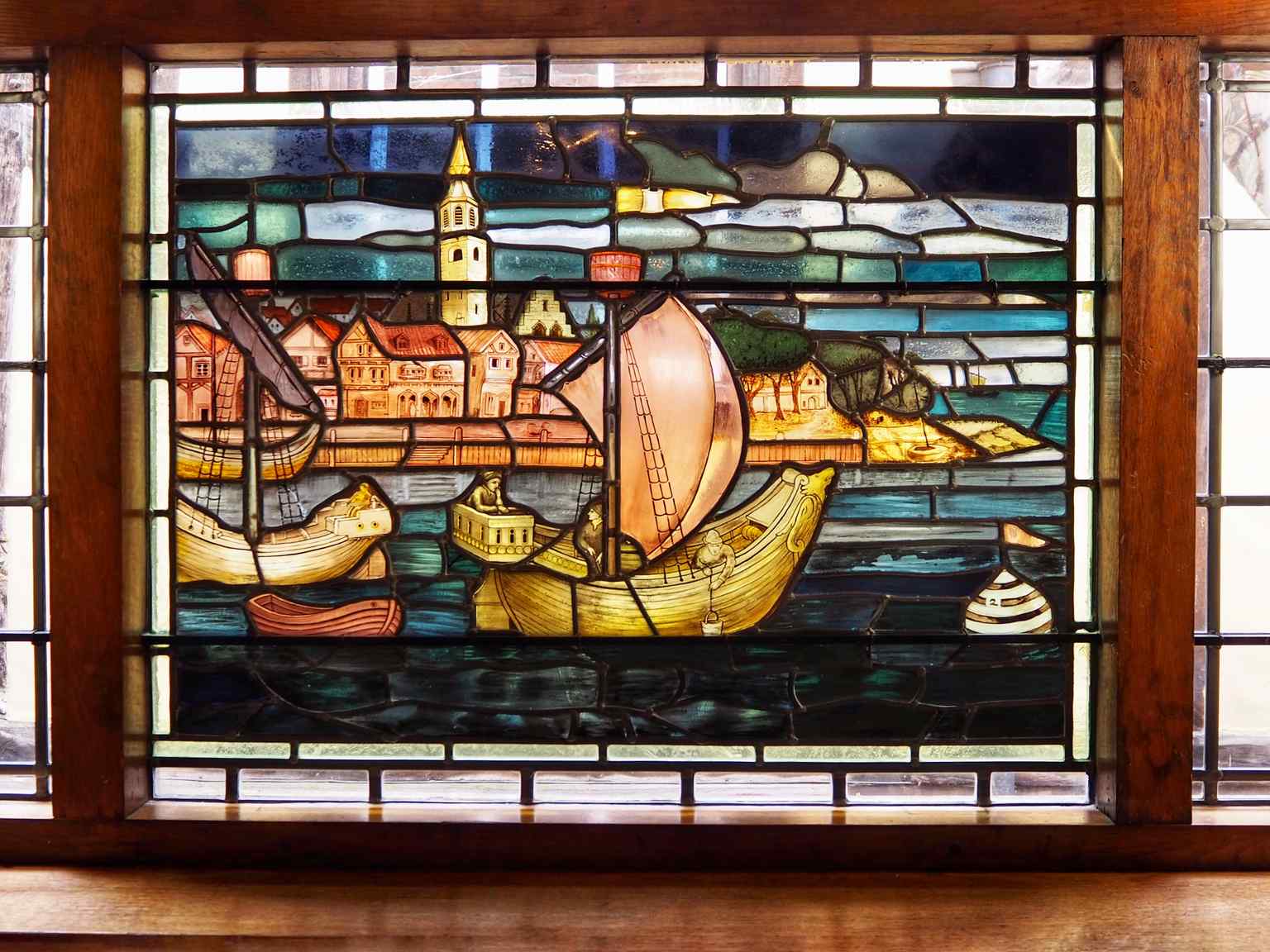
Stained glass (2) Governor’s Parlour Merchant Adventurers HallPhoto: Malcolmxl5, Wikimedia Commons, CC BY-SA 4.0. Cropped & resized. Over the centuries, this group gained royal charters from King Henry VI and Queen Elizabeth the First, eventually becoming the Company of Merchant Adventurers in 1581. Remarkably, that company still exists today as a charitable membership group, keeping their ancient records safe inside.
If you want to look inside, the hall is open from 10 AM to 4 PM every day except Saturday. Take a moment to admire these ancient timbers before we take a short stroll to explore some of York's medieval parish churches.
Look across the street for that striking red brick building with an asymmetrical front and a lovely row of linked, round-headed windows on the upper floor. It is hard to imagine…Read moreShow less
Open dedicated page →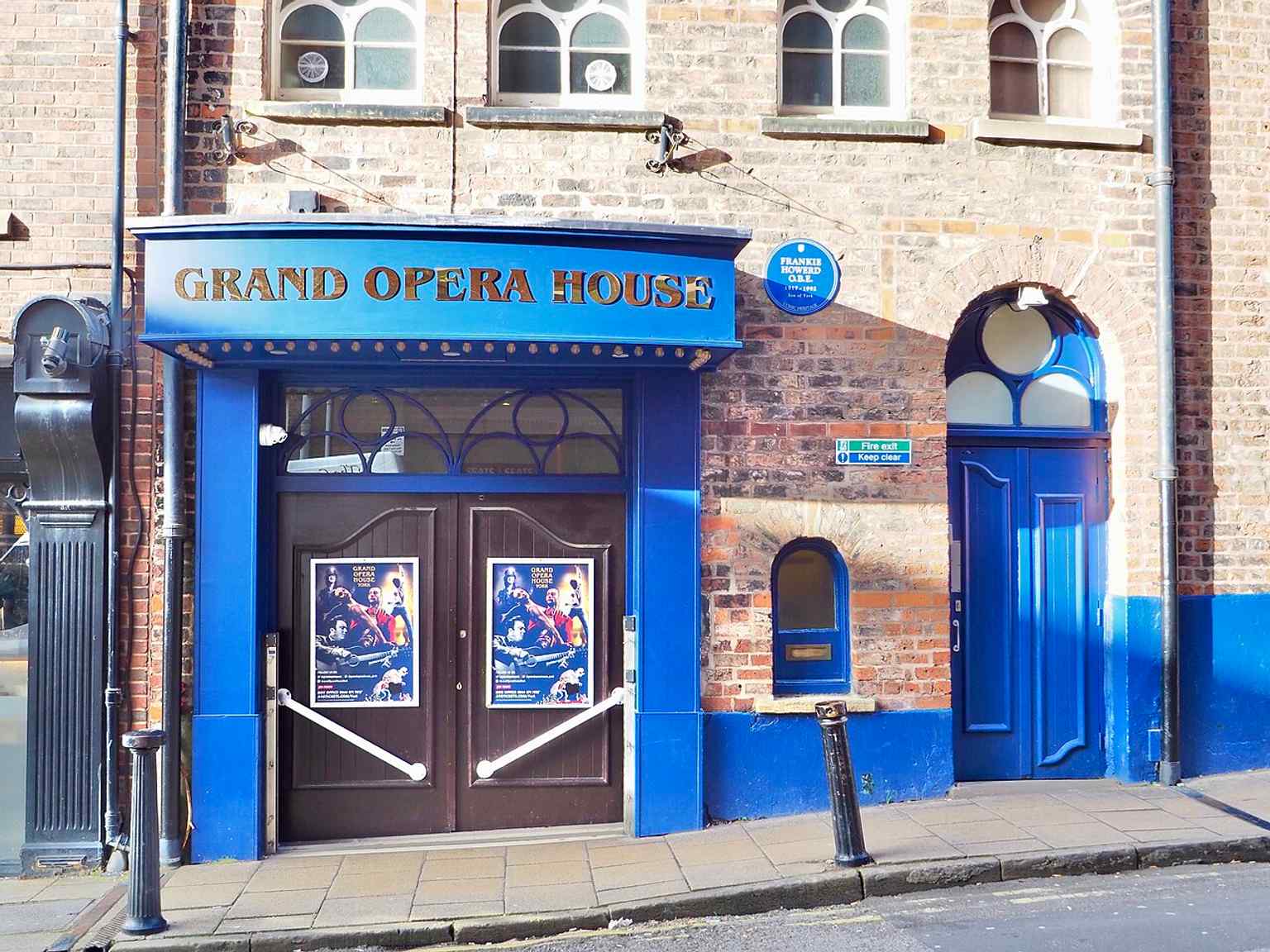
The striking red brick facade of the Grand Opera House along Clifford Street, photographed in 2022.Photo: Malcolmxl5, Wikimedia Commons, CC BY-SA 4.0. Cropped & resized. Look across the street for that striking red brick building with an asymmetrical front and a lovely row of linked, round-headed windows on the upper floor. It is hard to imagine now, but when this Italianate structure, a design inspired by classic Italian architecture, officially opened on October 28, 1868, it was not a theater at all, but a corn exchange with a massive main hall measuring 74 feet long and 63 feet wide.
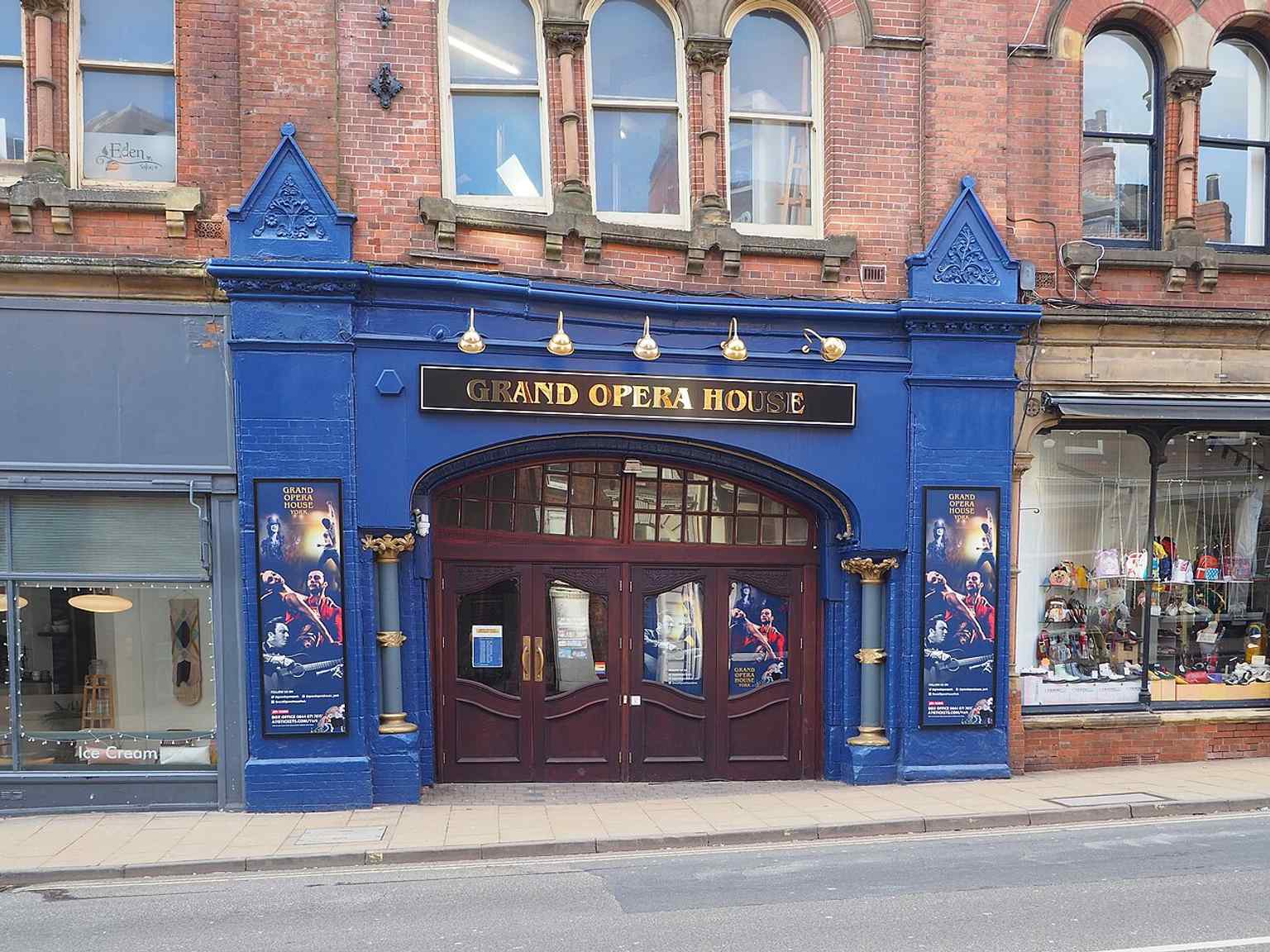
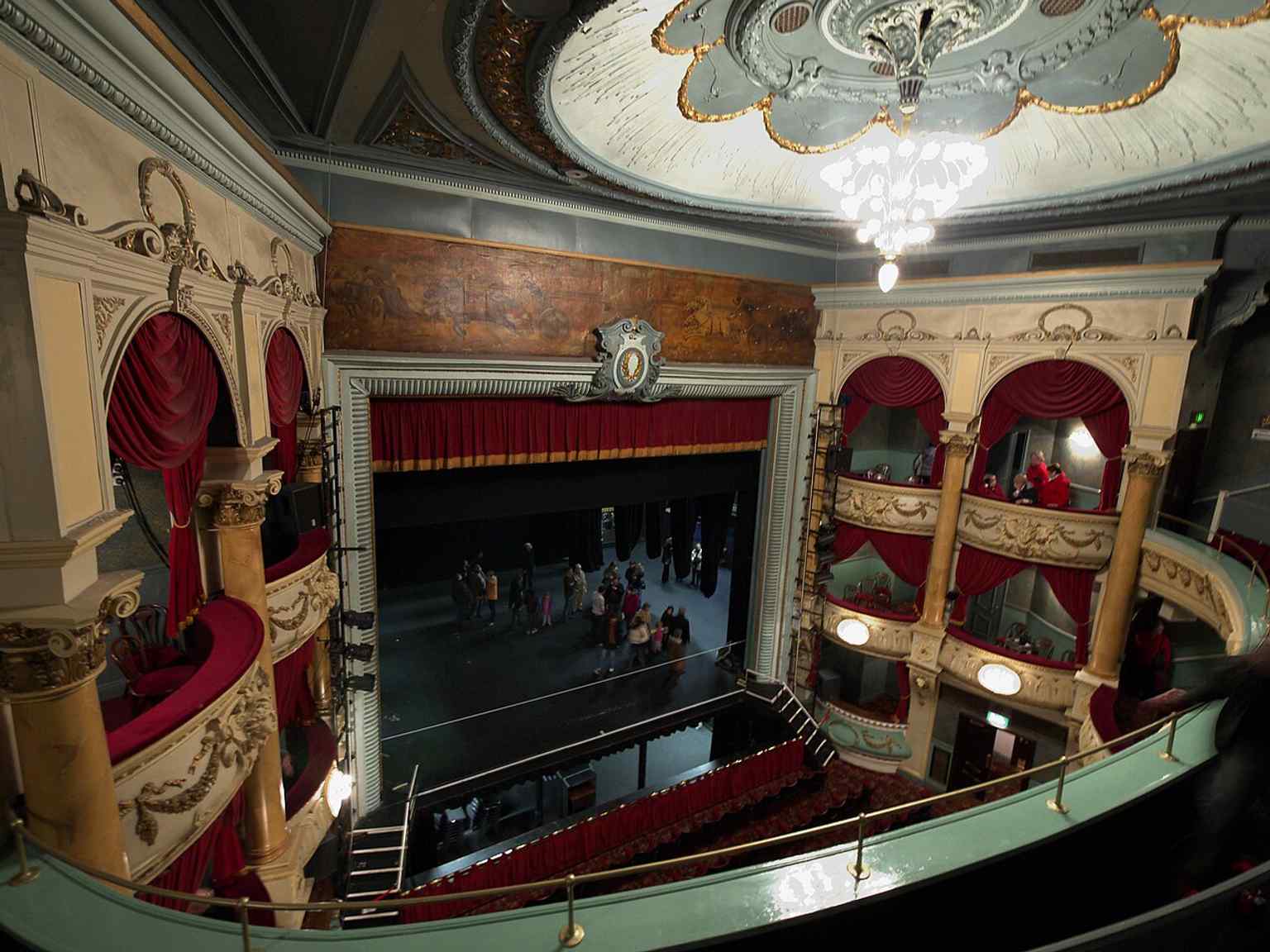
A closer look at the historic Italianate architecture of the building, which was originally built as a corn exchange, seen here in 2024.Photo: Tilman2007, Wikimedia Commons, CC BY-SA 4.0. Cropped & resized. When British agriculture declined, so did the corn exchange. But in the early 20th century, a man named William Peacock bought it along with a warehouse out back. He spent 24,000 pounds, which is over three million today, to merge them into a grand music hall. The architect, John Priestley Briggs, added raked seating, which means the rows are angled gently upwards so everyone gets a perfect view, and a proscenium arch, the beautiful architectural frame around traditional stages. It opened on January 20, 1902, with a pantomime of Little Red Riding Hood starring Florrie Forde.
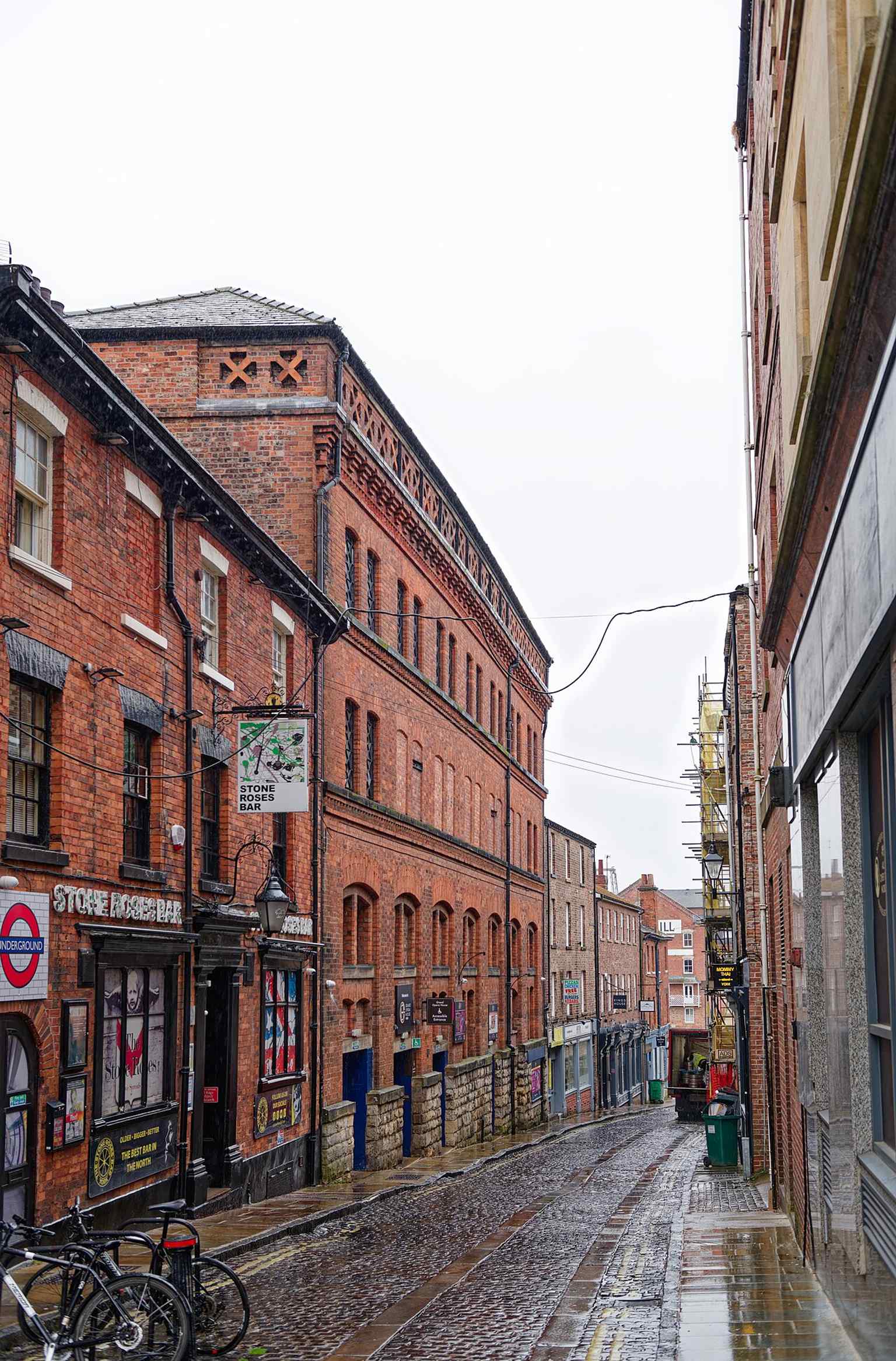
The imposing side profile of the Grand Opera House, viewed from King Street in 2024.Photo: Tilman2007, Wikimedia Commons, CC BY-SA 4.0. Cropped & resized. Taxes forced the theater to close in 1956. Then, a local named Ernest Shepherd ripped out that beautiful seating to turn it into a bingo hall and roller skating rink. You can almost hear the rumble of skates echoing through the old auditorium. Thankfully, in 1987, the India Pru Company spent four million pounds to restore the theater, reopening on September 26, 1989, with a majestic performance of Macbeth.
The Cumberland Street entrance of the Grand Opera House, featuring a memorial plaque for Frankie Howerd, photographed in 2022.Photo: Malcolmxl5, Wikimedia Commons, CC BY-SA 4.0. Cropped & resized. If you want to look inside, the venue is usually open Monday through Saturday from 6 to 8 PM. It is wonderful to see such a storied place still alive with drama today. Whenever you are ready to continue, our next stop is just steps away at The Water Lanes.
On your right, look for a grand brick building featuring a large rounded Romanesque archway and a distinctive central tower soaring upward. This is the York Institute of Art,…Read moreShow less
Open dedicated page →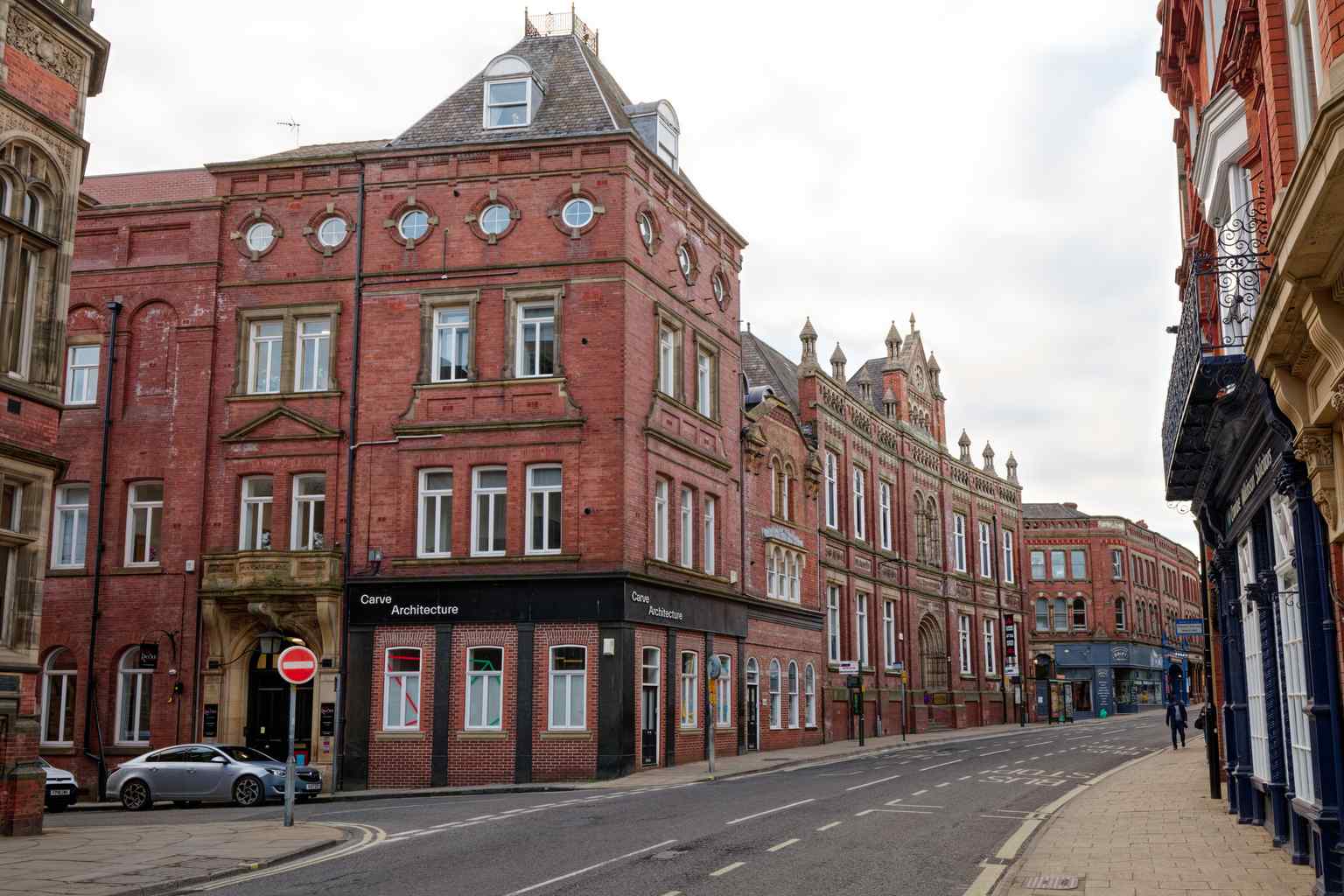
1259238 12 Clifford Street York 20240520 0176 DxOPhoto: Tilman2007, Wikimedia Commons, CC BY-SA 4.0. Cropped & resized. On your right, look for a grand brick building featuring a large rounded Romanesque archway and a distinctive central tower soaring upward. This is the York Institute of Art, Science and Literature.
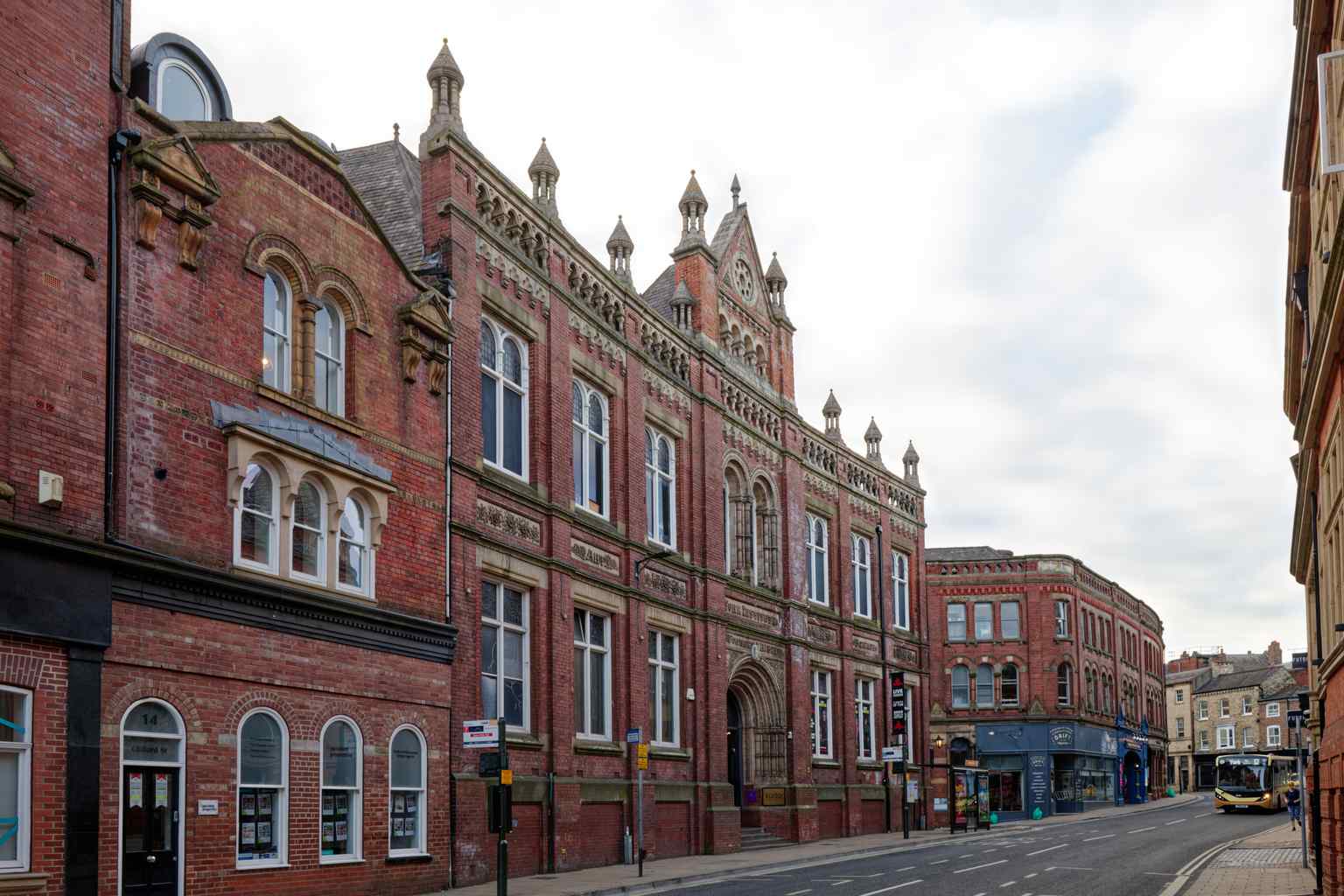
1259238 12 Clifford Street York 20240520 0177 DxOPhoto: Tilman2007, Wikimedia Commons, CC BY-SA 4.0. Cropped & resized. Back on July 18, 1883, the Prince of Wales laid the foundation stone right here using a secret Masonic ritual. Architect Walter Green Penty designed this beautiful Clifford Street frontage, complete with an eighty five foot tower and carved capitals, the decorative stone tops resting on the entrance columns. When the Marquis of Lorne opened the building in 1885, it was a true palace of learning. The basement held a gymnasium, and the main floor featured a magnificent hall fitting five hundred people.
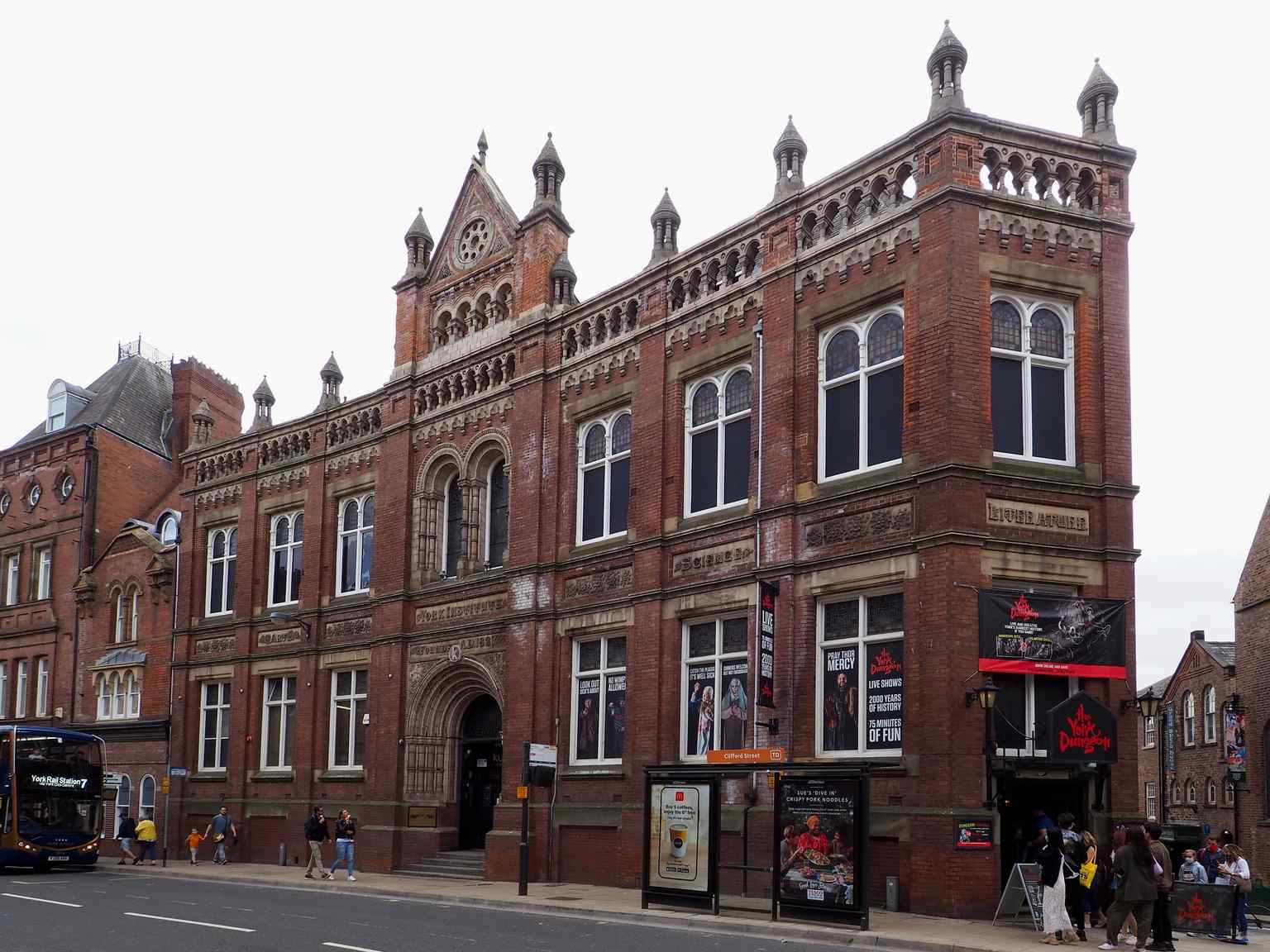
12 Clifford Street YorkPhoto: Malcolmxl5, Wikimedia Commons, CC BY-SA 4.0. Cropped & resized. After later serving as the York Technical College, the space completely transformed. Today, it houses Kuda nightclub and the York Dungeon, which is our next destination. You can brave the Dungeon Thursday afternoons or from 10 AM to 5 PM most other days, though it is closed Tuesdays and Wednesdays. It is wonderful how a strict Victorian educational space evolved into a venue for modern thrills. Whenever you feel brave enough, we will head over to the Dungeon just steps away.
Right across from where we just admired the Institute of Art, Science and Literature, you will spot a tall, red brick corner building with large rectangular windows and a dark,…Read moreShow less
Open dedicated page →Right across from where we just admired the Institute of Art, Science and Literature, you will spot a tall, red brick corner building with large rectangular windows and a dark, dramatic banner hanging just above the main wooden entrance doors. This is the York Dungeon, sitting right here at 12 Clifford Street.
It opened back in 1986, making it only the second attraction of its kind, right after the original London location. Over the years, it transformed from a traditional museum into a live action, interactive horror experience loosely based on actual history. In 1997, a massive three and a million pound investment brought the lost Roman legion to life, and soon after, exhibits detailing brutal Viking attacks and historic witch trials were added to the lineup.
Today, actors lead visitors through different chilling eras. You might find yourself in a 1551 plague doctor surgery, listening to a rather unfortunate medical assistant, or sitting in the Dick Turpin area where sudden drop benches jolt downward to simulate a crashing stagecoach. It certainly keeps visitors alert.
But the dungeon has faced very real terrors of its own. Because it sits so close to the River Ouse, it has flooded severely several times, including twice in 2012. Those deep waters forced a massive redesign and a triumphant reopening in 2013, making the shows even more interactive and replacing damaged sets with clever character comedy.
The attraction also loves stirring up a bit of local trouble. In 2007, management made headlines by offering free weekend admission to anyone with an ASBO. An ASBO was an Anti Social Behavior Order, a strict legal restriction given by British courts to individuals causing public trouble or nuisance. The manager claimed he wanted to shock the offenders by showing them what medieval punishment looked like. Local politicians and crime victims were absolutely outraged by the stunt, but in the end, not a single person actually showed up to claim a free ticket.
They also ruffled feathers in 2004 with a Christmas show named Satan's Grotto. Local church leaders worried it might do real pastoral harm, though the Dungeon insisted the whole production was completely tongue in cheek.
If you ever want to brave the dark, they are generally open daily from eleven to four, and a bit longer on weekends. It is certainly a uniquely theatrical way to experience local lore. Whenever you are ready to continue, we can easily make our way over to Castlegate.
Just a short walk from Castlegate, we arrive at our final destination. On your left, you will spot York Castle, a pale stone tower with an unusual clover-like shape perched high…Read moreShow less
Open dedicated page →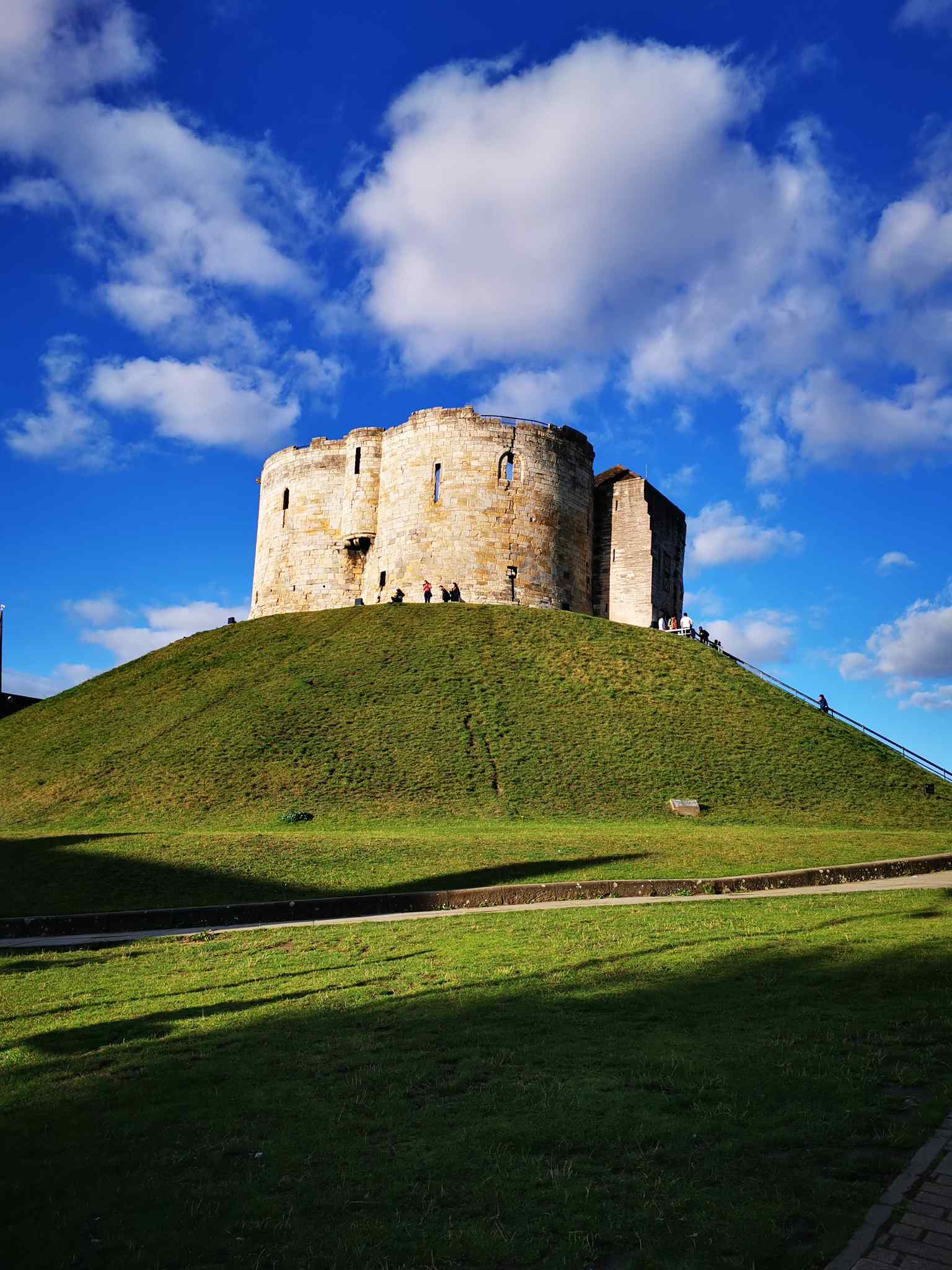
Clifford's Tower stands atop its steep grassy motte, an iconic remnant of York Castle. (2020)Photo: Sandra Atkinson, Wikimedia Commons, CC BY-SA 4.0. Cropped & resized. Just a short walk from Castlegate, we arrive at our final destination. On your left, you will spot York Castle, a pale stone tower with an unusual clover-like shape perched high atop a steep grassy mound, with a long, straight flight of stairs leading directly up to its entrance.
This iconic ruin is commonly known as Clifford's Tower, and it represents nine centuries of royal power, political maneuvering, and profound tragedy. The story begins way back in 1068. William the Conqueror ordered a wooden motte and bailey castle built right here. A motte is a large, artificially raised earthwork mound, like the grassy hill before you. Because York was a densely packed Viking city, hundreds of homes were abruptly torn down to make room for this hasty construction.
The original wooden tower on this mound was the site of the darkest day in York's past. In 1190, the city erupted into a pogrom, which is an organized, violent attack against a specific ethnic or religious group. Fueled by religious prejudice and local merchants wanting to erase their financial debts, an angry mob targeted the local Jewish community. Around one hundred fifty Jewish men, women, and children fled to the wooden keep for safety, but the mob quickly laid siege. Realizing their position was hopeless and refusing to face capture and mutilation, their religious leader proposed collective suicide. The wooden keep was set ablaze, and the vast majority took their own lives rather than surrender to the mob's brutality.
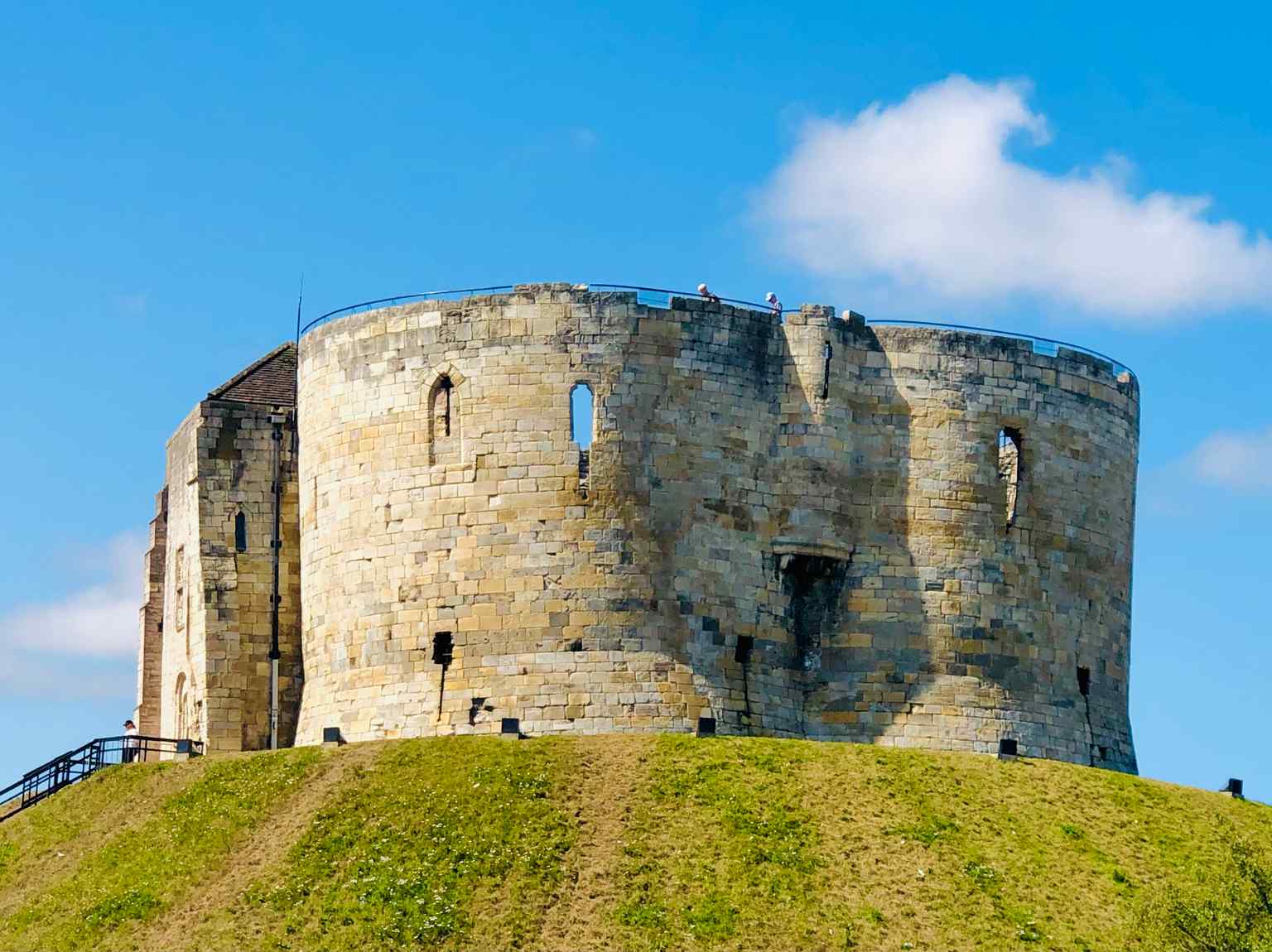
The reconstructed stone keep, ordered by King Henry III, showcases its unique quatrefoil or "four-leaf clover" shape. (2020)Photo: Amourgirl1, Wikimedia Commons, CC BY-SA 4.0. Cropped & resized. The castle was rebuilt, and in the middle of the thirteenth century, King Henry the Third ordered a new stone keep constructed. He chose a unique quatrefoil design, meaning the building has a four-lobed footprint, much like a four-leaf clover.
By the seventeenth century, locals had grown to deeply resent the military garrison stationed here, mockingly calling the castle the Minced Pie. Then, on a spring evening in 1684, a massive explosion tore through the tower's ammunition magazine, completely gutting the interior. The military claimed a celebratory cannon salute accidentally set the roof on fire, which then ignited the gunpowder. Locals, however, had their doubts. Suspiciously, several soldiers had moved their personal belongings to safety just before the blast, and not a single garrison member was injured. The sheer heat of that massive fire actually baked the limestone, giving the tower the faint pinkish hue you can still notice today.
In 1825, the county bought the ruined tower and the surrounding land for eight thousand eight hundred pounds, which is roughly seven hundred ninety thousand pounds today, to build a massive, forbidding prison. That prison was eventually demolished, leaving behind the striking, solitary tower we see now.
If you would like to explore the interior and look out over the city, the site is open to the public every day of the week from 10 AM to 5 PM, except on Mondays when it opens at 11 AM.

Frequently asked questions
How do I start the tour?
After purchase, download the AudaTours app and enter your redemption code. The tour will be ready to start immediately - just tap play and follow the GPS-guided route.
Do I need internet during the tour?
No! Download the tour before you start and enjoy it fully offline. Only the chat feature requires internet. We recommend downloading on WiFi to save mobile data.
Is this a guided group tour?
No - this is a self-guided audio tour. You explore independently at your own pace, with audio narration playing through your phone. No tour guide, no group, no schedule.
How long does the tour take?
Most tours take 60–90 minutes to complete, but you control the pace entirely. Pause, skip stops, or take breaks whenever you want.
What if I can't finish the tour today?
No problem! Tours have lifetime access. Pause and resume whenever you like - tomorrow, next week, or next year. Your progress is saved.
What languages are available?
All tours are available in 50+ languages. Select your preferred language when redeeming your code. Note: language cannot be changed after tour generation.
Where do I access the tour after purchase?
Download the free AudaTours app from the App Store or Google Play. Enter your redemption code (sent via email) and the tour will appear in your library, ready to download and start.
If you don't enjoy the tour, we'll refund your purchase. Contact us at [email protected]
Checkout securely with 






.jpg)


_Governor%E2%80%99s_Parlour_Merchant_Adventurers_Hall.jpg)


