
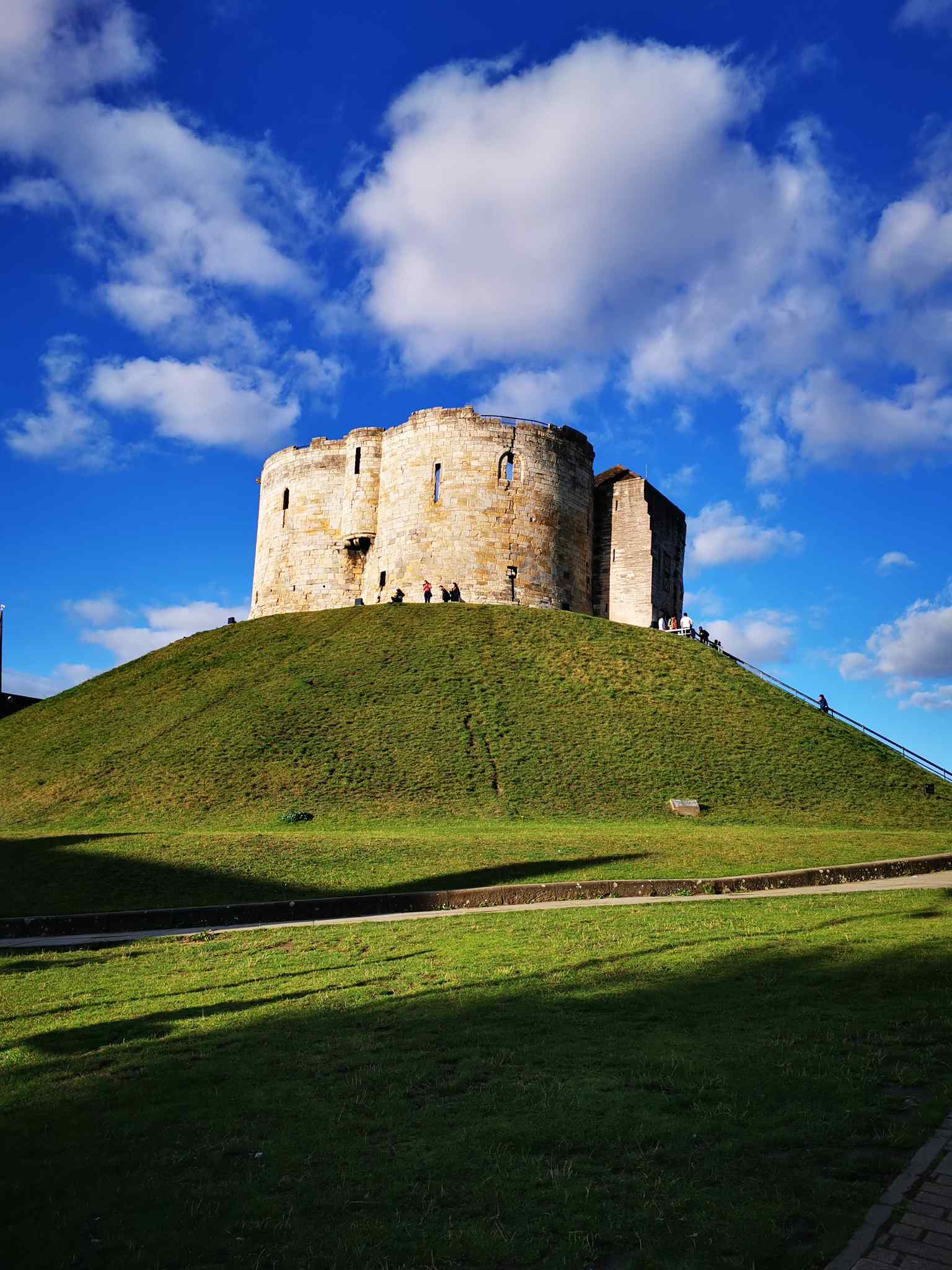
Just a short walk from Castlegate, we arrive at our final destination. On your left, you will spot York Castle, a pale stone tower with an unusual clover-like shape perched high atop a steep grassy mound, with a long, straight flight of stairs leading directly up to its entrance.
This iconic ruin is commonly known as Clifford's Tower, and it represents nine centuries of royal power, political maneuvering, and profound tragedy. The story begins way back in 1068. William the Conqueror ordered a wooden motte and bailey castle built right here. A motte is a large, artificially raised earthwork mound, like the grassy hill before you. Because York was a densely packed Viking city, hundreds of homes were abruptly torn down to make room for this hasty construction.
The original wooden tower on this mound was the site of the darkest day in York's past. In 1190, the city erupted into a pogrom, which is an organized, violent attack against a specific ethnic or religious group. Fueled by religious prejudice and local merchants wanting to erase their financial debts, an angry mob targeted the local Jewish community. Around one hundred fifty Jewish men, women, and children fled to the wooden keep for safety, but the mob quickly laid siege. Realizing their position was hopeless and refusing to face capture and mutilation, their religious leader proposed collective suicide. The wooden keep was set ablaze, and the vast majority took their own lives rather than surrender to the mob's brutality.
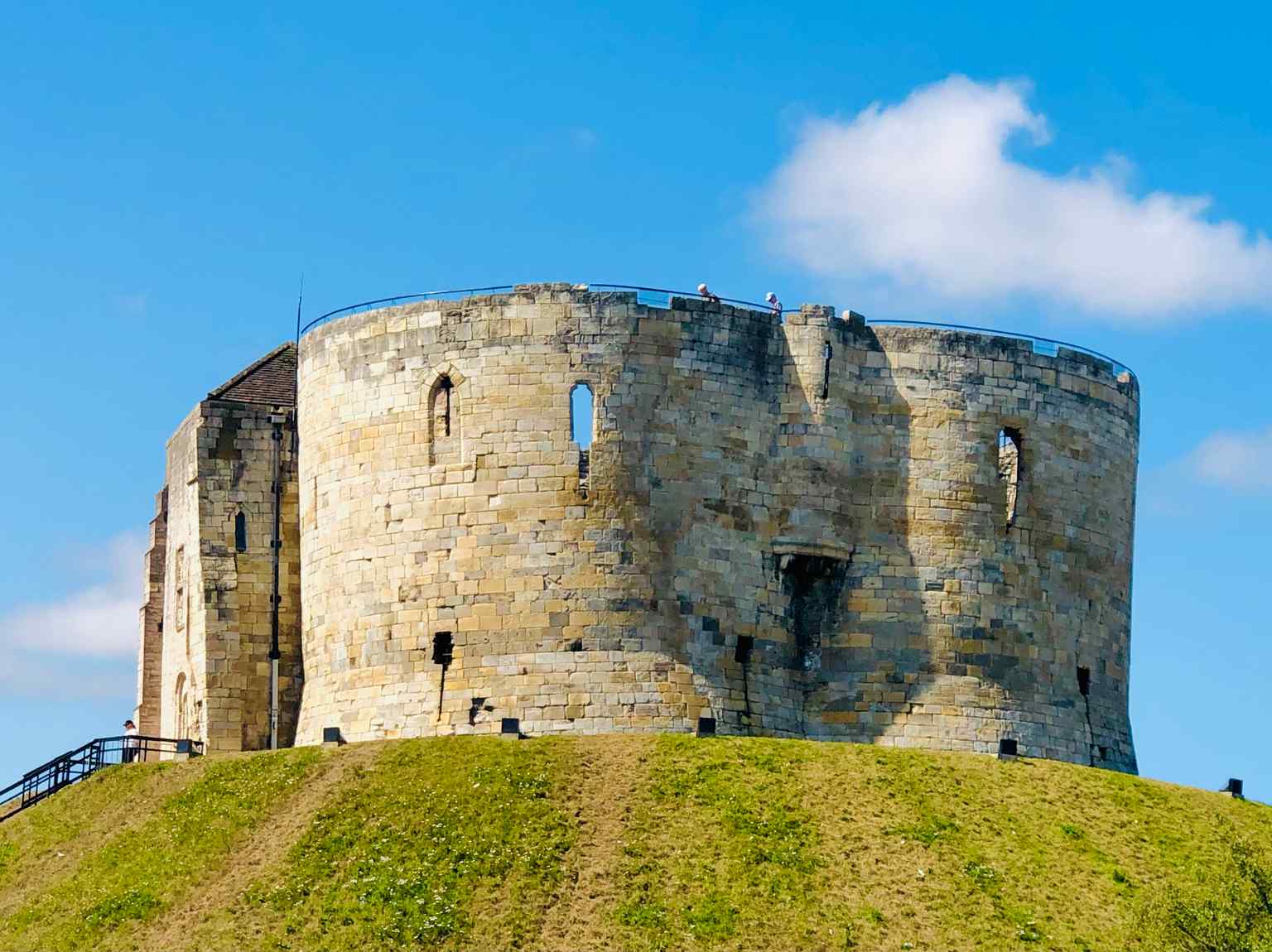
The castle was rebuilt, and in the middle of the thirteenth century, King Henry the Third ordered a new stone keep constructed. He chose a unique quatrefoil design, meaning the building has a four-lobed footprint, much like a four-leaf clover.
By the seventeenth century, locals had grown to deeply resent the military garrison stationed here, mockingly calling the castle the Minced Pie. Then, on a spring evening in 1684, a massive explosion tore through the tower's ammunition magazine, completely gutting the interior. The military claimed a celebratory cannon salute accidentally set the roof on fire, which then ignited the gunpowder. Locals, however, had their doubts. Suspiciously, several soldiers had moved their personal belongings to safety just before the blast, and not a single garrison member was injured. The sheer heat of that massive fire actually baked the limestone, giving the tower the faint pinkish hue you can still notice today.
In 1825, the county bought the ruined tower and the surrounding land for eight thousand eight hundred pounds, which is roughly seven hundred ninety thousand pounds today, to build a massive, forbidding prison. That prison was eventually demolished, leaving behind the striking, solitary tower we see now.
If you would like to explore the interior and look out over the city, the site is open to the public every day of the week from 10 AM to 5 PM, except on Mondays when it opens at 11 AM.






