
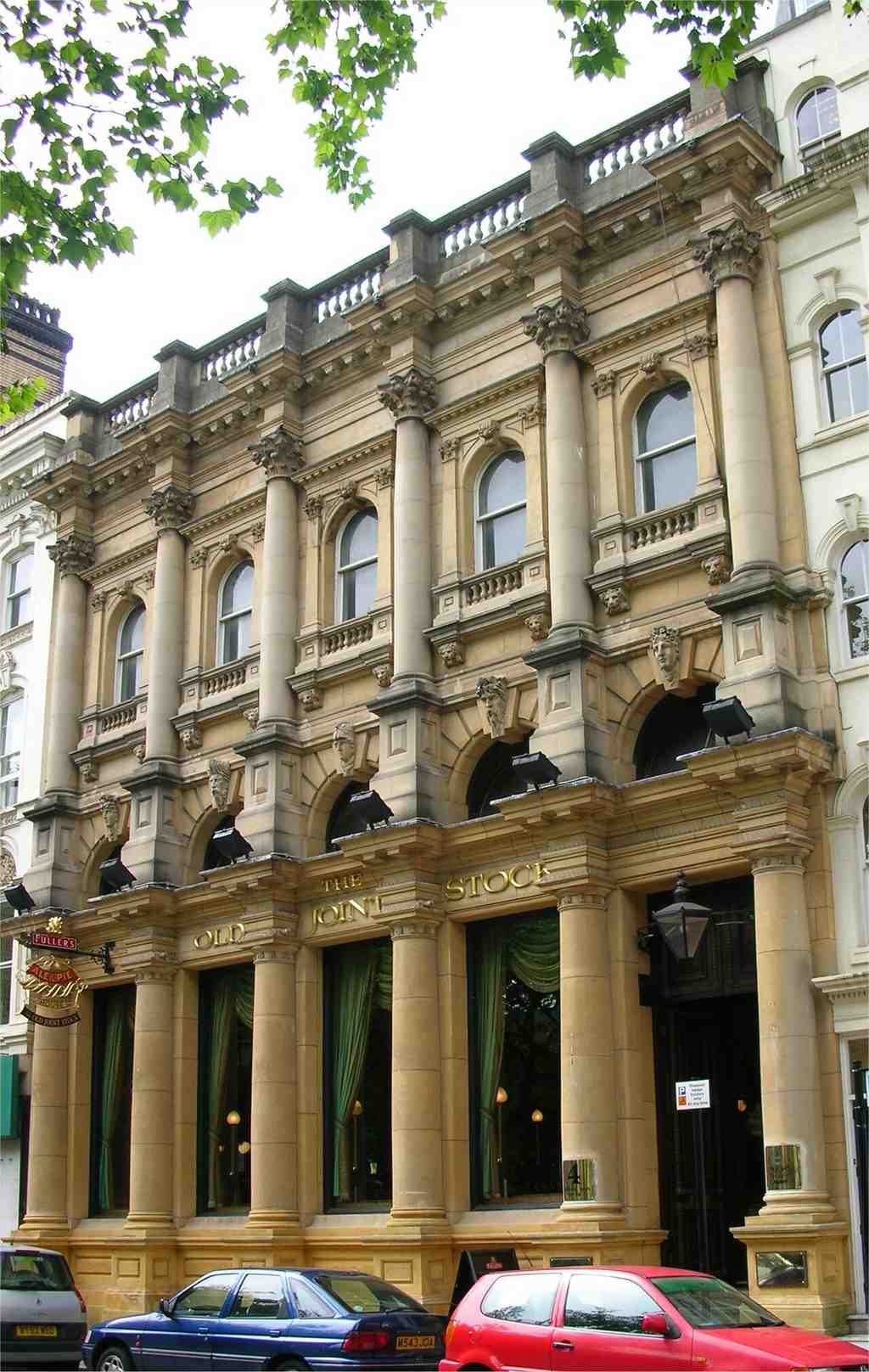
On your right is a compact pale-stone Victorian building with a rounded corner turret, tall arched windows, and carved classical detailing that still gives it the stern face of an old bank.
This place has had more career changes than most people. Architect J. A. Chatwin designed it in eighteen sixty-two as a parson’s library for St Philip’s Church - a clergy library, in other words, meant to serve the church community across the road. Chatwin also worked on St Philip’s itself, so there is a neat local family resemblance here: sacred reading on one side, worship on the other.
That calm scholarly beginning did not last long. The Birmingham Joint Stock Bank, founded in eighteen sixty-one, took over the building, and its Temple Row branch opened here in eighteen sixty-two. Then, in eighteen eighty-nine, Lloyds absorbed the bank and carried on from this address. That date matters a bit more than it first seems: eighteen eighty-nine is also when Birmingham officially became a city. So while the paperwork changed hands inside, the city outside was stepping up in status too.
If you want a closer look at the façade, glance at the image in the app - it shows how much of that Victorian confidence still clings to the exterior.
Now take a moment and study the details in front of you... the stonework, the formal windows, the slightly grand entrance. Which earlier life feels strongest here: library, bank, pub, or theatre? The building seems happy to answer, “yes.”
In nineteen ninety-seven, the old bank became a pub, but not a wipe-clean conversion. Fuller’s kept many of the original fixtures and fittings in the main bar and function rooms, so the place held on to some of its old character instead of pretending history had never happened. Then, in two thousand and six, the owners spent three hundred and fifty thousand pounds turning derelict second-floor rooms into a studio theatre. They even brought in an experienced former theatre manager as a consultant, which is reassuring - nobody wants a theatre designed by guesswork and optimism alone.
Upstairs, reached by stairs at the back, is a small flexible theatre seating about ninety-five. That tucked-away approach gives it an intimate feel, perfect for comedy, cabaret, and small-cast drama. Touring comics have used it as a testing ground before heading to the Edinburgh Fringe, and it has welcomed names like Stewart Lee, Reginald D Hunter, Jim Jefferies, and Tom Allen. It also backs local work, including Untamed Productions’ Birmingham premiere of Blackout in twenty twenty-two.
That is the charm here: not every reinvention needs a skyline. Sometimes one doorway holds a whole civic biography. When you’re ready, head on to one hundred and thirty Colmore Row, about a three-minute walk away. If you fancy coming back later, the pub keeps fairly generous hours - mostly eleven to eleven, with shorter Sunday opening - and prices are moderate.




