
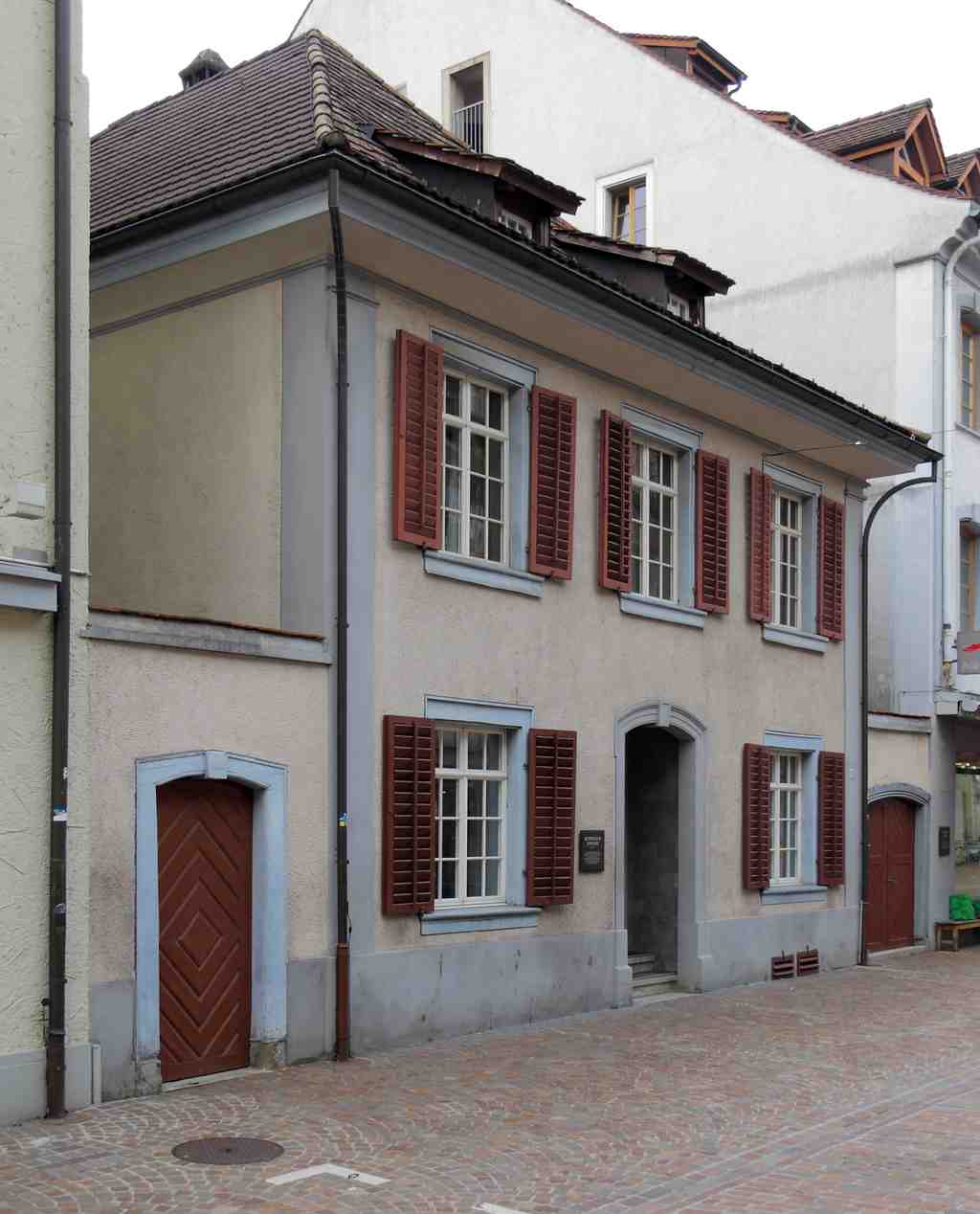
On your left, look for a modest plastered house with a steep roof and simple rectangular windows, marked out by the rare little open side courtyard that still survives beside it.
This is the Rüpplin chaplaincy, and its story begins with intention rather than grandeur. In fifteen eighty, Joachim Joner, called Rüplin, a citizen of Frauenfeld and an administrator for the Abbey of Reichenau, endowed this house as a chaplaincy, meaning a funded post for a priest. He did not do it as a passing act of devotion. He and his wife, Barbara Locher, shaped it as a family project, one meant to outlive them and quietly guide the city’s spiritual life.
Joachim had already gathered power with care. He bought lands from the former Helfenberg castle, acquired the local courts of Kefikon and Islikon, and added the Strasshof. This foundation belonged to that same strategy: wealth, land, law, and prayer woven together. The oldest Rüpplin son held the right to choose the priest. If the family line ever failed, that right would pass to the Locher family. Even the chaplain stood in an intriguing position: he supported the clergy of the parish, but he did not answer to the parish itself.
So this house was more than a residence. It was a piece of social machinery, almost invisible, yet enduring. In fifteen eighty-eight, Joachim extended his influence into Saint Nicholas Church by leaving it a late medieval statue, a gift that joined family memory to public worship.
The building itself has survived what much of Frauenfeld did not. After the devastating fires of seventeen seventy-one and seventeen eighty-eight, much of the old town had to be rebuilt, and this one kept the little in-between courtyards, the Höfli, that once separated homes for safety. They are the only survivors of that pattern here.
Since nineteen fifty-five, no priest has lived here. The upper floor is rented, the ground floor serves parish life, and since the nineteen eighties locals have even known it as the Rüpplin Treff, a meeting place after mass. In a moment, we will walk to Saint Nicholas, where this family’s private design meets the public face of faith.




