
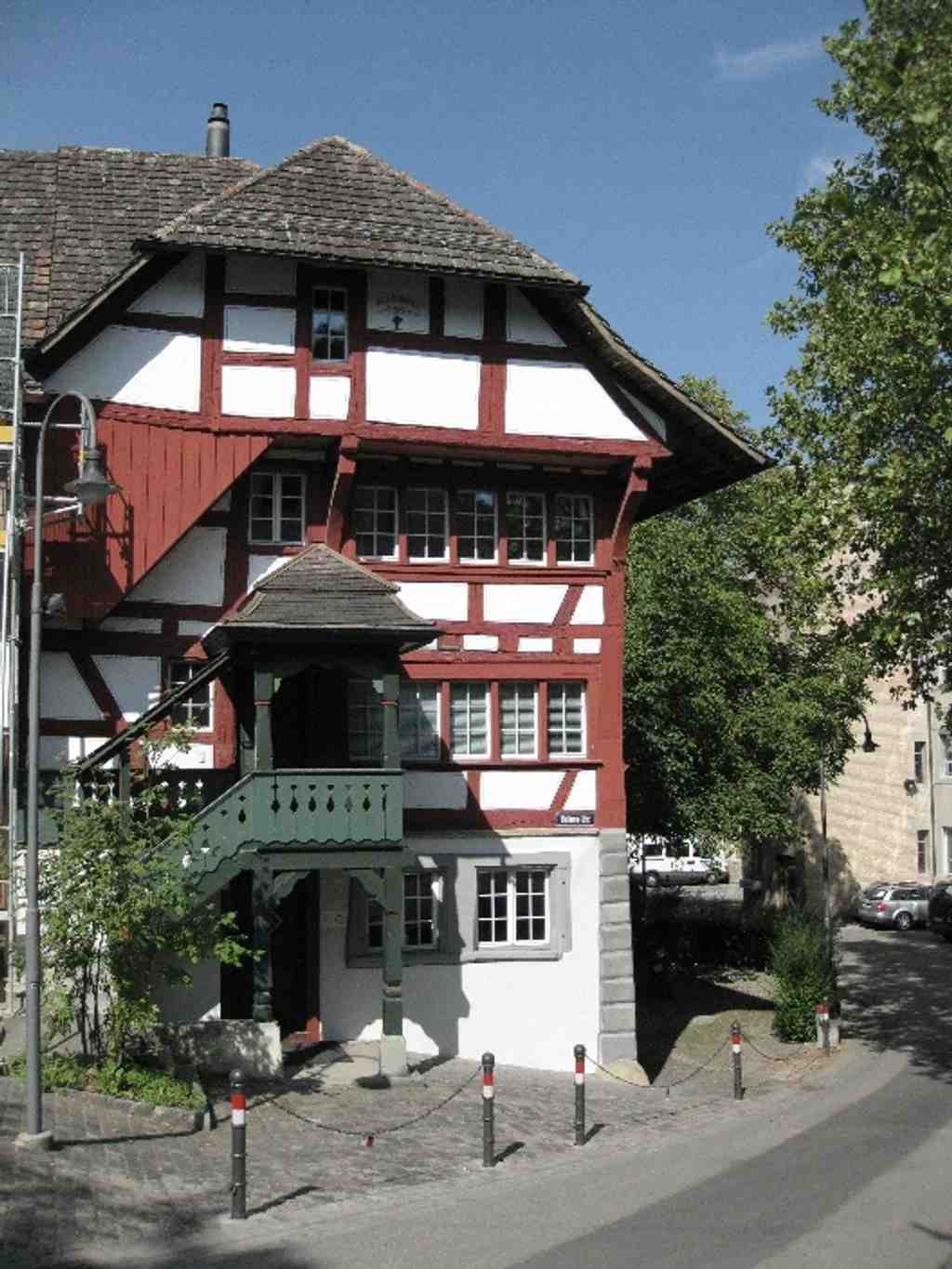
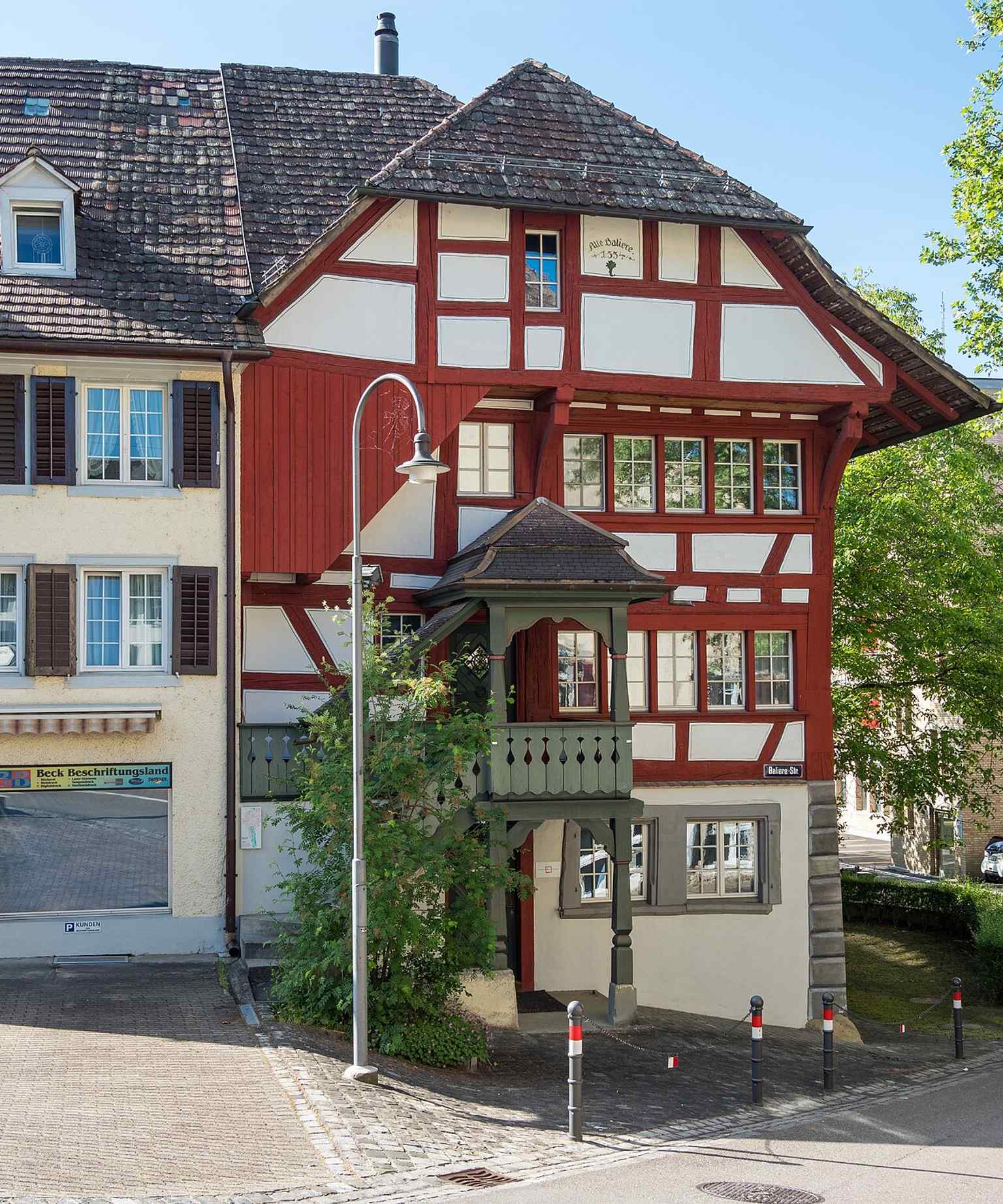
On your left, look for a three-storey timber-framed house with a broad hipped roof, a slightly overhanging top floor, and an old date carved into the stone cellar portal.
Baliere looks modest enough, but it tells you something essential about Frauenfeld: not every force that shaped this town wore a crown or stood on a battlement. Some of it arrived through skill, paperwork, and moving water. Visible prosperity often depended on invisible infrastructure, and here that meant permissions granted by authorities, a canal directing power where it was needed, and water wheels turning out of sight while work above ground earned a reputation far beyond the street.
This house took its name from Hans Hoffmann the Balierer. That word means, roughly, a grinder and polisher, the man who gave steel its final precision and shine. Hoffmann came from Lindau, with roots in Nuremberg, and in fifteen fifty-two the authorities of the Swiss Confederation formally granted him the right to settle here and practise as a weaponsmith. He did not slip into town quietly; Frauenfeld welcomed him as a specialist.
The house you are facing rose between fifteen fifty-five and fifteen fifty-seven as his home and business address. If you glance at the image on your screen, you can see how firmly the old timber structure still holds its sixteenth-century outline. Most people assume the workshop sat somewhere inside. It did not. The real working heart stood over on the site of today’s Kappeler Gerberei, and two water wheels, fed by the Fabrikkanal, powered Hoffmann’s machinery. That small local detail changes everything. Baliere was part of an early industrial network, not just a handsome residence.
And Hoffmann’s work mattered. He made armour and swords so admired that examples survive in the Swiss National Museum in Zurich and in the Historical Museum at Frauenfeld Castle: half-armours, richly worked swords, pieces with a finish fine enough to outlast the men who carried them. His son Lorenz Hoffmann, born in fifteen forty-one, continued the family trade and became the better-known armourer, making breastplates, helmets, and ceremonial swords. Then history shifted. By around sixteen twenty-five, plate armour no longer held the same military value, and the family left the craft.
Even then, the place did not fall silent. From the late seventeenth century until seventeen sixty-seven, the Dumelin family kept working here as grinders and polishers. So the skill changed shape rather than disappearing. That feels very Frauenfeld.
The building itself nearly gave way in the late twentieth century. A central post in the cellar had rotted, beams near the chimney weakened, and the eastern side sank so badly that rooms meant to align no longer did. During restoration in the early nineteen nineties, the city hydraulically lifted the floors back into position and anchored the east façade with tie rods. In other words, they rescued the house by engineering it upward, not by flattening it and starting again.
Now Baliere serves as the city gallery, with exhibitions and small readings where trade once rang in iron and grit. If rulers in the castle defended territory, craftsmen here equipped the world below.
In about five minutes, the Main Post Office will reveal another hidden system that kept this town alive: not blades and water power, but routes, messages, and the discipline of connection.





%20in%20Frauenfeld.jpg)
