
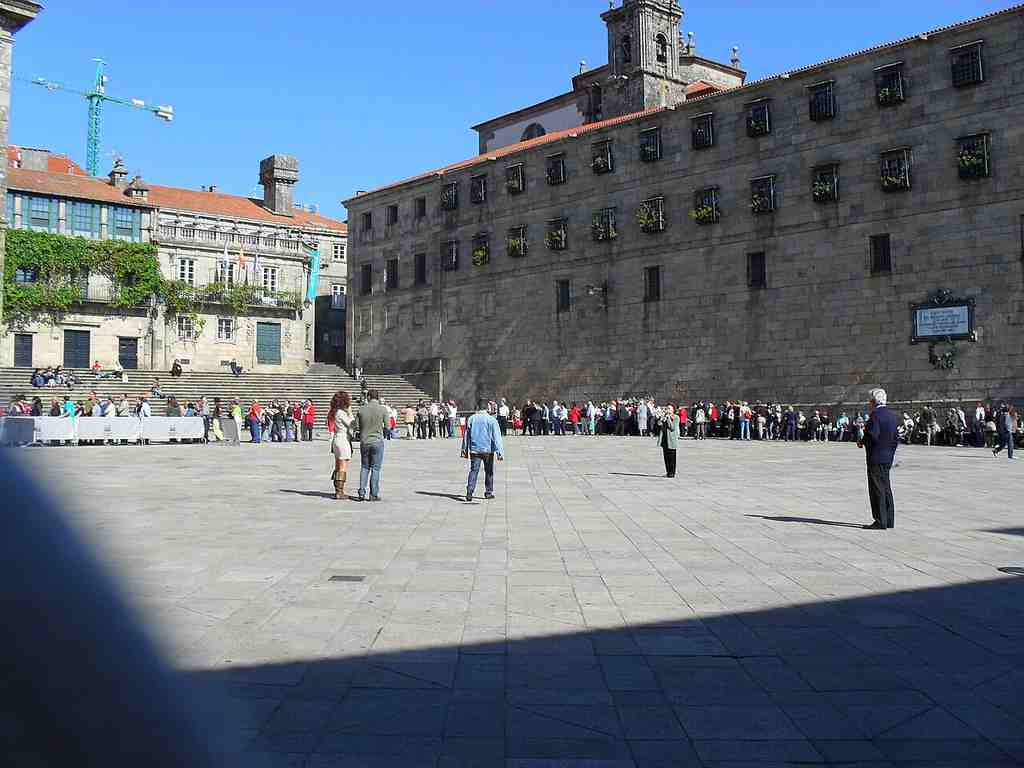
Welcome to Quintana Square, a vast expanse of grey granite paving divided by a wide, monumental staircase and bordered by an immense, windowless stone wall.
Today, it feels like a grand public stage. But step back a few centuries, and this lower level was the Quintana de Mortos, the cemetery of the dead. By seventeen eighty, city officials realized that having a crowded graveyard right next to the most important church in Spain was less than ideal. Fear of disease spreading from foul air caused them to dig up the remains and move them far away.
Standing here in this sweeping open space, imagine what it feels like knowing you are walking over an ancient cemetery.
Even the architecture surrounding you hides a few secrets. Look at the long, uniform stone curtain forming the eastern facade of the cathedral. That was the grand vision of Canon José Vega y Verdugo in the seventeenth century. Much like the cathedral exterior we discussed earlier, he looked at a chaotic medieval jumble of mismatched chapels and decided to simply build a massive wall to hide it all. It was a brilliant piece of architectural theater, designed to project the absolute, unshakeable power of the church hierarchy. To get it done smoothly, builders even buried discarded fragments of a priceless medieval stone choir right under the newly paved floor.
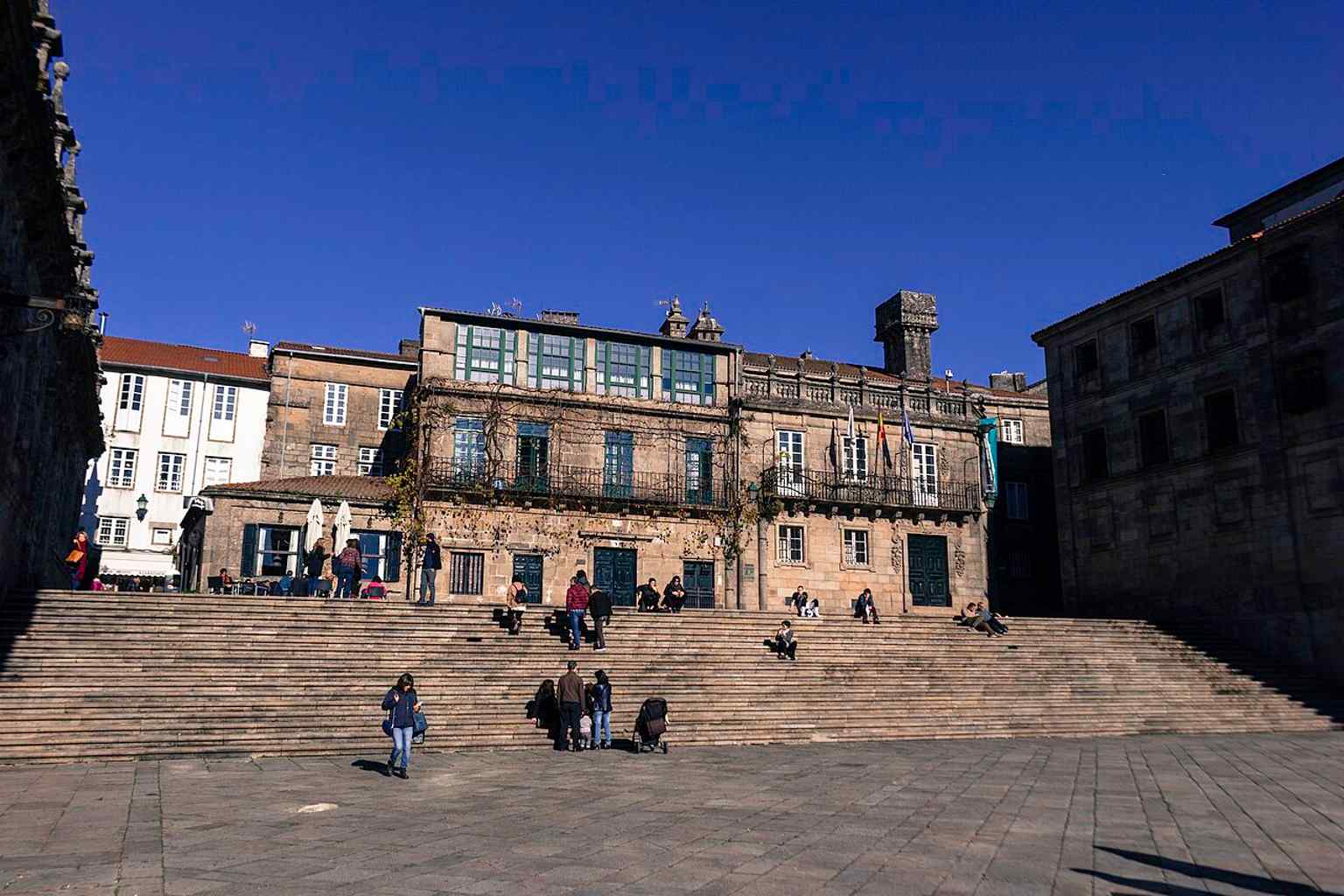
If you glance at your screen, you can see a shot of how the staircase distinctly splits the upper tier, the square of the living, from the lower tier, the square of the dead.
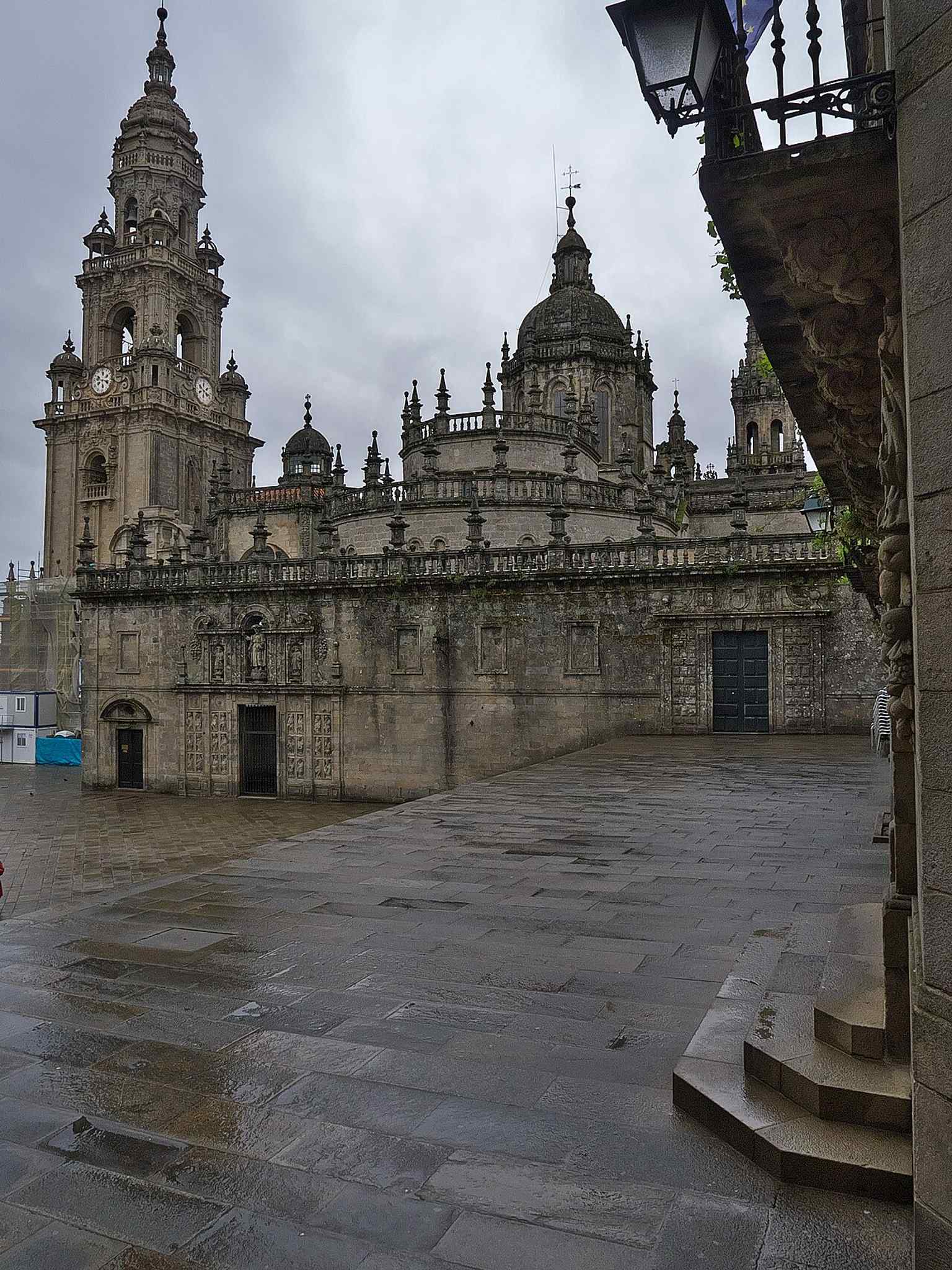
And speaking of the dead... if you look toward the deep corner beneath the clock tower, you might find something mysterious at nightfall. Take a look at your app to see the Berenguela Tower where this happens. Due to the lighting of a granite pillar, a silhouette appears on the stone. Locals call it the Shadow of the Pilgrim. Science calls it an optical illusion, but the folklore is far better. The most famous legend claims a cathedral priest fell in love with a cloistered nun from the neighboring convent. They planned to elope, and he dressed in a pilgrim's wide-brimmed hat and staff to hide his identity. He waited for her in the square, but she never appeared. Now, his spirit returns to that exact spot every night, forever waiting for his lost love.
This plaza has witnessed more than just ghostly romance. In eighteen oh eight, local university students gathered here to form the Literary Battalion to fight invading foreign troops. Despite having zero military training, they fought with such fierce distinction that the few survivors were promoted to officers in the regular army.
Now, let us turn our attention back to that massive, austere granite wall bordering the eastern edge of the square. It belongs to the very convent where that legendary nun was supposedly cloistered. We are going to head there now. It is a short three minute walk to our next stop, the Monastery of San Pelayo de Antealtares.






