
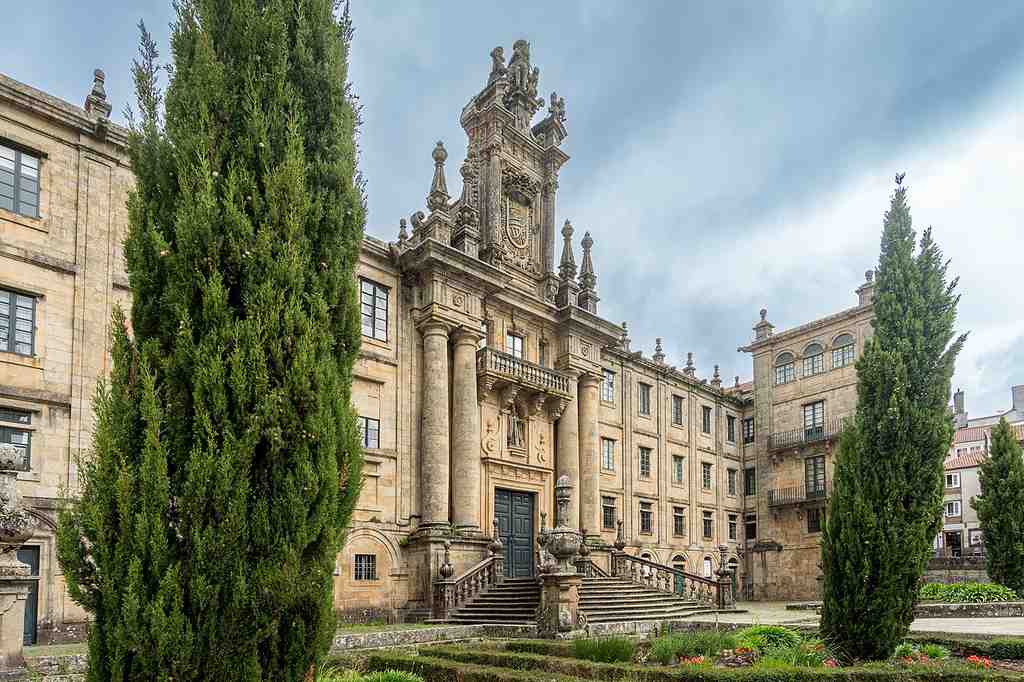
Look for the massive stone facade on your left, anchored by four towering columns and topped with a highly ornate, towering stone crest. This is the Monastery of San Martiño Pinario. Long ago, this area underwent a dramatic transformation, shifting from a wild, dense pine forest into a sprawling religious empire. The very name Pinario is a nod to those lost pines.
By the sixteenth century, this Benedictine monastery had grown into a powerhouse. It was the second largest monastery in Spain, home to nearly a thousand monks at its peak. The community amassed so much wealth and political influence that the neighboring Cathedral clergy grew deeply paranoid. The Cathedral leaders actually forced the monastery's architects to cap their towers at the roofline, ensuring the monks could never literally or metaphorically look down upon the Cathedral.
It is fascinating how a place dedicated to heavenly pursuits can become so deeply entangled in earthly rivalries.
But all that hoarded wealth and power could not protect the monastery from the harsh realities of war. In the early nineteenth century, Napoleonic Soldiers marched into Santiago de Compostela. The occupying French troops seized this immense, sacred complex and turned it into their military barracks. The centuries of quiet, prayerful devotion were instantly erased, replaced by the chaotic clamor of a foreign army. The soldiers did not care about the spiritual or historical wealth surrounding them. They raided the monastery's renowned library, tearing priceless, centuries old manuscripts from the shelves and throwing them into roaring fires just to stay warm.
The indignities did not end there. Decades later, during a local rebellion in eighteen forty-six, rebel troops decided to turn the upper floors into a fortified battery. They dragged massive, heavy iron cannons right up the monastery's grand stone staircases. The sheer, crushing weight of the artillery cracked the ancient steps and caused the stone landings to sag so severely that modern restoration teams had to use hydraulic jacks just to push the building back into place.
Today, the monks are gone, their nine hundred year run ended by government eviction decrees in eighteen thirty-five. But the stones remain, bearing the invisible scars of both holy men and soldiers.
If you want to look inside, the museum and church are open Monday through Saturday from ten AM to two PM, and again from four to six PM, though it is closed on Sundays.
Now, let us leave behind the grand monuments of powerful archbishops and armies. We are going to visit a space built by the common folk of the city, so we will head to the Chapel of Souls, which is just a three minute walk away.




